
Under the conventional retail method, which of the following are not included in the
denominator of the current period cost-to-retail conversion percentage? A. Purchase
returns.
B. Net markups.
C. Purchases.
D. Net markdowns.
Answer:
An exclusive 20-year right to manufacture a product or use a process is a: A. Patent.
B. Copyright.
C. Trademark.
D. Franchise.
Answer:
Revenue associated with gift card sales should be recognized: A. When the gift card is
sold.

B. No later than the last day of the operating period in which the gift card is delivered to
the customer.
C. When the probability of gift card redemption is viewed as remote.
D. Under no circumstances, as gift cards are not themselves a delivered product, but
rather a selling technique.
Answer:
Priscilla’s Exotic Pets discounted a note receivable without recourse and the sales
criteria were met. The discounting is recorded as: A. A secured borrowing.
B. Only note disclosure of the arrangement is required.
C. A sale.
D. None of the above.
Answer:
Lake Power Sports sells jet skis and other powered recreational equipment. Customers
pay one-third of the sales price of a jet ski when they initially purchase the ski, and then
pay another one-third each year for the next two years. Because Lake has little
information about the ability to collect these receivables, it uses the installment method

for revenue recognition. In 2012, Lake began operations and sold jet skis with a total
price of $900,000 that cost Lake $450,000. Lake collected $300,000 in 2012, $300,000
in 2013, and $300,000 in 2014 associated with those sales. In 2013, Lake sold jet skis
with a total price of $1,500,000 that cost Lake $900,000. Lake collected $500,000 in
2013, $400,000 in 2014, and $400,000 in 2015 associated with those sales. In 2015,
Lake also repossessed $200,000 of jet skis that were sold in 2013. Those jet skis had a
fair value of $75,000 at the time they were repossessed.
In its December 31, 2013, balance sheet, Lake would report:A. Deferred gross profit of
$700,000.
B. Deferred gross profit of $1,050,000.
C. Installment receivables (net) of $750,000.
D. Installment receivables (net) of $900,000.
Answer:
Fellingham Corporation purchased equipment on January 1, 2011, for $200,000. The
company estimated the equipment would have a useful life of 10 years with a $20,000
residual value. Fellingham uses the straight-line depreciation method. Early in 2013,
Fellingham reassessed the equipment’s condition and determined that its total useful life
would be only six years in total and that it would have no salvage value. How much
would Fellingham report as depreciation on this equipment for 2013? A. $24,000.
B. $27,333.
C. $36,000.
D. $41,000.
Answer:
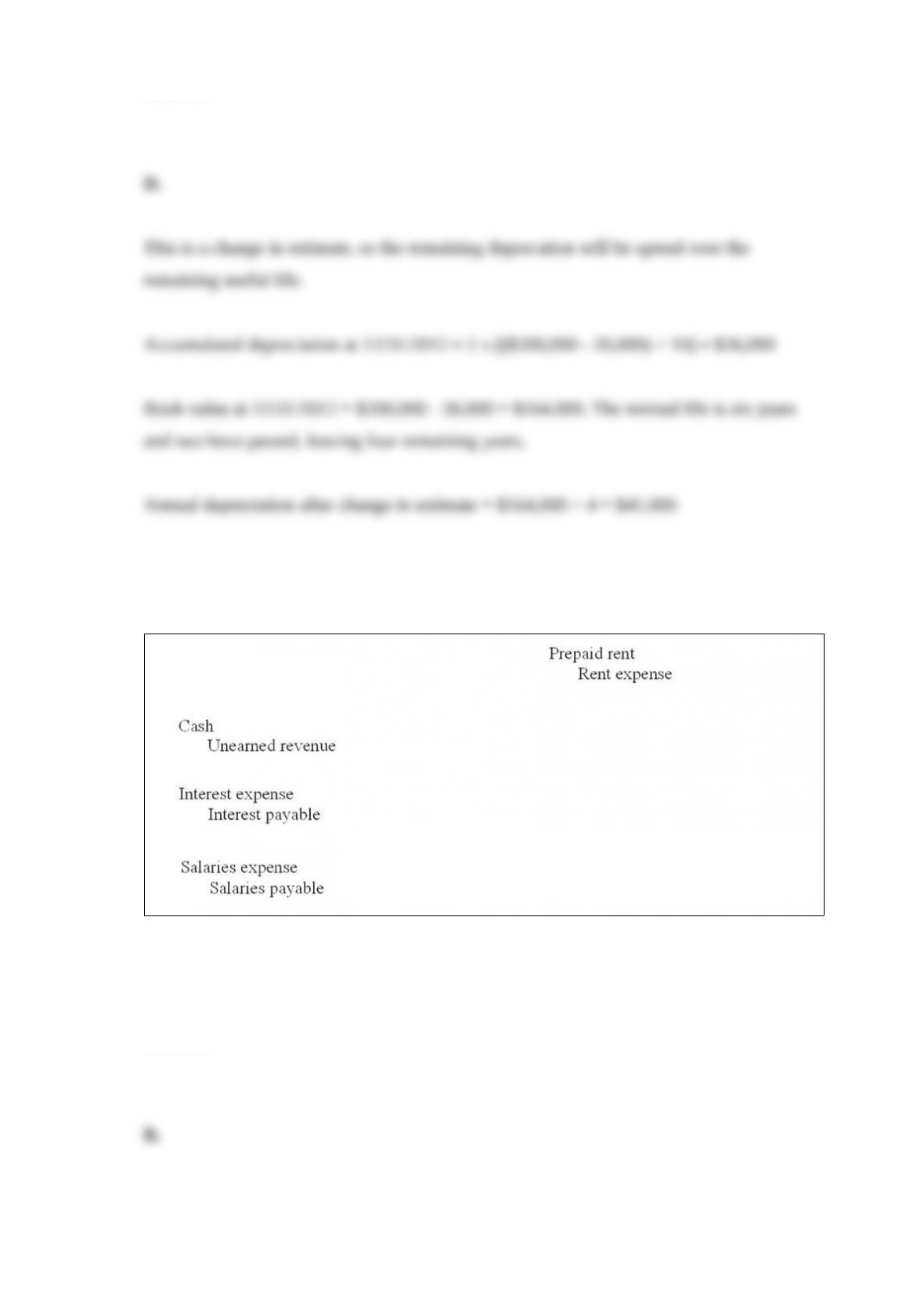
Which of the following is not an adjusting entry? A.
B.
C.
D.
Answer:

Todd Sweeney is an artist who sells his work under consignment (he displays his work
in local barbershops, and customers purchase his work there). Sweeney recently
transferred a painting to a local barbershop.
Sweeney most likely should recognize revenue when: A. He paints the painting,
because the painting is produced while he works.
B. When he transfers a painting to a barbershop.
C. When the barbershop sells the painting.
D. When the barbershop’s right of return expires.
Answer:
The investment category for which the investor’s “positive intent and ability to hold” is
important is: A. Securities reported under the equity method.
B. Trading securities.
C. Securities classified as held to maturity.
D. Securities available for sale.
Answer:
An item that should be reported as a prior period adjustment is the: A. Correction of an
error in depreciation from last year.
B. Payment of taxes due to a tax audit of last year’s tax return.
C. Payment of a previously recorded warranty expense.
D. Receipt of the proceeds of a note receivable that was due last year.
Answer:
Scallion Company received the following reports of its defined benefit pension plan for
the current calendar year:
The long-term expected rate of return on plan assets is 10%. Assuming no other data are
relevant, what is the pension expense for the year? A. $197,000.
B. $227,000.
C. $172,000.
D. $202,000.
Answer:

Basic earnings per share is computed using: A. The actual number of common shares
outstanding at the end of the year.
B. A weighted-average of preferred and common shares.
C. The number of common shares outstanding plus common stock equivalents.
D. Weighted-average common shares outstanding for the year.
Answer:
COSO defines internal control as a process, affected by an entity’s board of directors,
management, and other personnel, designed to provide reasonable assurance regarding
the achievement of objectives in: A. Effectiveness and efficiency of operations.
B. Reliability of financial advice.
C. Compliance with local ordinances.
D. All of the above are correct.
Answer:

Seybert Systems accounts for its investment in Wang Engineering as available for sale.
Seybert’s balance in accumulated other comprehensive income with respect to the Wang
investment is a credit balance of $20,000, and Seybert reports the investment at
$100,000 on its balance sheet. Seybert purchased the Wang investment for (ignore
taxes): A. $100,000.
B. $120,000.
C. $80,000.
D. Cannot be determined from this information.
Answer:
Inventory does not include: A. Materials used in the production of goods to be sold.
B. Assets intended to be sold in the normal course of business.
C. The cost of office equipment.
D. Assets currently in production for normal sales.
Answer:

Which of the following is added to net income as an adjustment under the indirect
method of preparing the statement of cash flows? A. Salaries payable decrease.
B. Gain on the sale of land.
C. Loss on the sale of equipment.
D. Accounts receivable increase.
Answer:
For 2013, Rahal’s Auto Parts estimates bad debt expense at 1% of credit sales. The
company reported accounts receivable and an allowance for uncollectible accounts of
$86,500 and $2,100, respectively, at December 31, 2012. During 2013, Rahal’s credit
sales and collections were $404,000 and $408,000, respectively, and $2,340 in accounts
receivable were written off
Rahal’s 2013 bad debt expense is: A. $2,100.
B. $2,340.
C. $4,080.
D. None of the above is correct.
Answer:
Holiday Laboratories purchased a high-speed industrial centrifuge at a cost of
$420,000. Shipping costs totaled $15,000. Foundation work to house the centrifuge cost
$8,000. An additional water line had to be run to the equipment at a cost of $3,000.
Labor and testing costs totaled $6,000. Materials used up in testing cost $3,000. The
capitalized cost is: A. $455,000.
B. $446,000.
C. $437,000.
D. $435,000.
Answer:
When cash is received from customers in the form of a refundable deposit, the cash
account is increased with a corresponding increase in: A. A current liability.
B. Revenue.

C. Shareholders’ equity.
D. Paid-in capital.
Answer:
The board of directors of Capstone Inc. declared a $0.60 per share cash dividend on its
$1 par common stock. On the date of declaration, there were 50,000 shares authorized,
20,000 shares issued, and 5,000 shares held as treasury stock. What is the entry for the
dividend declaration? A.
B.
C.
D.
Answer:

Lake Power Sports sells jet skis and other powered recreational equipment. Customers
pay one-third of the sales price of a jet ski when they initially purchase the ski, and then
pay another one-third each year for the next two years. Because Lake has little
information about the ability to collect these receivables, it uses the installment method
for revenue recognition. In 2012, Lake began operations and sold jet skis with a total
price of $900,000 that cost Lake $450,000. Lake collected $300,000 in 2012, $300,000
in 2013, and $300,000 in 2014 associated with those sales. In 2013, Lake sold jet skis
with a total price of $1,500,000 that cost Lake $900,000. Lake collected $500,000 in
2013, $400,000 in 2014, and $400,000 in 2015 associated with those sales. In 2015,
Lake also repossessed $200,000 of jet skis that were sold in 2013. Those jet skis had a
fair value of $75,000 at the time they were repossessed.
Total cash collections on installment sales during 2013 would be: A. $700,000.
B. $300,000.
C. $800,000.
D. $0
Answer:
On September 30, 2013, Bricker Enterprises purchased a machine for $200,000. The
estimated service life is 10 years with a $20,000 residual value. Bricker records
partial-year depreciation based on the number of months in service. Depreciation (to the
nearest dollar) for 2014, using sum-of-the-years’ digits, would be: A. $31,909.
B. $29,455.
C. $35,456.
D. $54,000.

Answer:
The adjusting entry required when amounts previously recorded as unearned revenues
are earned includes: A. A debit to a liability.
B. A debit to an asset.
C. A credit to a liability.
D. A credit to an asset.
Answer:
Listed below are 5 terms followed by a list of phrases that describe or characterize the
terms. Match each phrase with the correct term. 1)Accrued liabilities
2)Times interest earned ratio
3)Unqualified opinion
4)Notes receivable
5)Current liabilities

A. Presented fairly in conformity with GAAP.
B. The larger the better from a debt holder’s perspective.
C. Expenses incurred but not yet paid.
D. Supported by a negotiable instrument.
E. Will be satisfied in the next year or the operating cycle, whichever is longer.
Answer:
Smith buys and sells securities, which it typically classifies as available for sale. On
December 15, 2013, Smith purchased $500,000 of Jones shares and elected the fair
value option to account for the Jones investment. As of December 31, 2013, the Jones
shares had a fair value of $525,000. In the 2013 financial statements, Smith will show
(ignore taxes): A. Investment income of $25,000 in its income statement.
B. Other comprehensive income of $25,000.
C. Accumulated other comprehensive income of $525,000.
D. An investment in Jones of $500,000.
Answer:
Listed below are five terms followed by a list of phrases that describe or characterize

each of the terms. Match each phrase with the correct term. 1) Realization principle
2) Materiality
3) Matching principle
4) Full disclosure
5) Historical cost
A. Basis of measurement for fixed assets.
B. Application of GAAP sometimes avoided under this constraint.
C. Recognition of expense in the period in which it is incurred to earn revenue.
D. Reporting of all information that could affect decisions.
E. Recognition of revenue only after certain criteria are satisfied.
Answer:
Assets acquired under multi-year deferred payment contracts are: A. Valued at their fair
value on the date of the final payment.
B. Valued at the present value of the payments required by the contract.
C. Valued at the sum of the payments required by the contract.
D. None of the above.
Answer:

Sloan Company has owned an investment during 2013 that has increased in fair value.
After all closing entries for 2013 are completed, the effect of the increase in fair value
on total shareholders’ equity would be: A. Higher under the available-for-sale approach
than under the trading-securities approach.
B. Lower under the available-for-sale approach than under the trading-securities
approach.
C. The same amount under the available-for-sale and trading-securities approaches.
D. Not possible to identify whether the available-for-sale or trading-securities
approaches yield higher shareholders’ equity given this information.
Answer:
Listed below are 10 organizations followed by a list of phrases that describe or
characterize the organizations. Match each phrase with the correct organization by
placing the number designating the best term in the space provided by the phrase. 1)
FAF
2) FASB
3) SEC
4) IMA
5) PCAOB
6) AICPA

7) IASC
8) IASB
9) EITF
10) APB
A. Regulates the financial reporting for public companies
B. Sets accounting standards in the United States.
C. Sets global accounting standards.
D. National organization of certified public accountants.
E. Provides timely responses to financial reporting issues.
F. Establishes auditing standards in the U.S for public companies
G. Primary national organization of accountants working in industry.
H. Parent organization of the IASB.
I. FASB’s predecessor.
J. The FASB’s parent organization.
Answer:
Simpson and Homer Corporation acquired an office building on three acres of land for a
lump-sum price of $2,400,000. The building was completely furnished. According to
independent appraisals, the fair values were $1,300,000, $780,000, and $520,000 for
the building, land, and furniture and fixtures, respectively. The initial values of the
building, land, and furniture and fixtures would be:
A. Option a

B. Option b
C. Option c
D. None of the above.
Answer:
Hawkeye Auto Parts uses the retail method to estimate inventories. Data for the first six
months of 2013 include: beginning inventory at cost and retail were $55,000 and
$100,000, net purchases at cost and retail were $785,000 and $1,300,000, and sales
during the first six months totaled $800,000. The estimated inventory at June 30, 2013,
would be: A. $330,000.
B. $360,000.
C. $362,300.
D. None of the above is correct.
Answer:

Below is a list of accounts in no particular order. Assume that all accounts have normal
balances.
Required:
In column A, indicate whether a debit will:
1. Increase the account balance, or
2. Decrease the account balance.
In column B, classify each account according to the following scheme. For contra
accounts, indicate the classification of the account to which it relates.
1. A current asset in the balance sheet.
2. A noncurrent asset in the balance sheet.
3. A current liability in the balance sheet.
4. A long-term liability in the balance sheet.
5. A permanent equity account in the balance sheet.
6. A revenue account in the income statement.
7. An expense account shown in the income statement.
8. Account does not appear in either the balance sheet or the income statement.
Cost of goods sold
Answer:
In the following question, inventory errors are noted for 2013. Assume that the errors
are not discovered until 2012, and that the company uses a periodic inventory system.
Indicate the effect of the error, if any, on the accounts noted in the columns, using the
following code:
U = Understated; O = Overstated; NE = No effect
Answer:
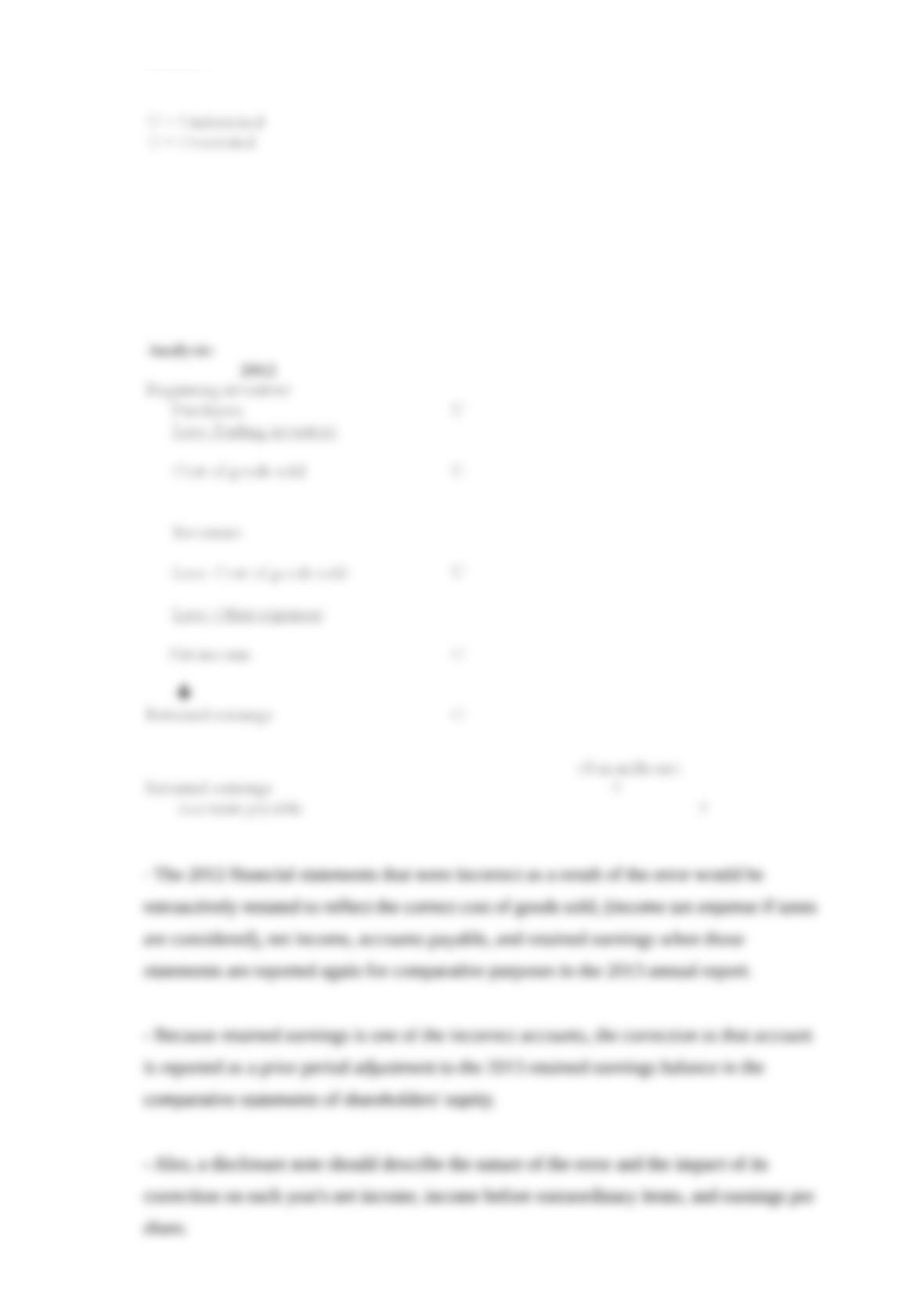
In the year 2013, the internal auditors of Goofy Co. discovered that goods costing $25
million that were purchased in December of 2012 were recorded for $20 million. The
goods were properly measured in the December 31, 2012, ending physical inventory.
Required:
Prepare the journal entry needed in 2013 to correct the error. Also, briefly describe any
other measures Goofy would take in connection with correcting the error. (Ignore
income taxes.)
Answer:
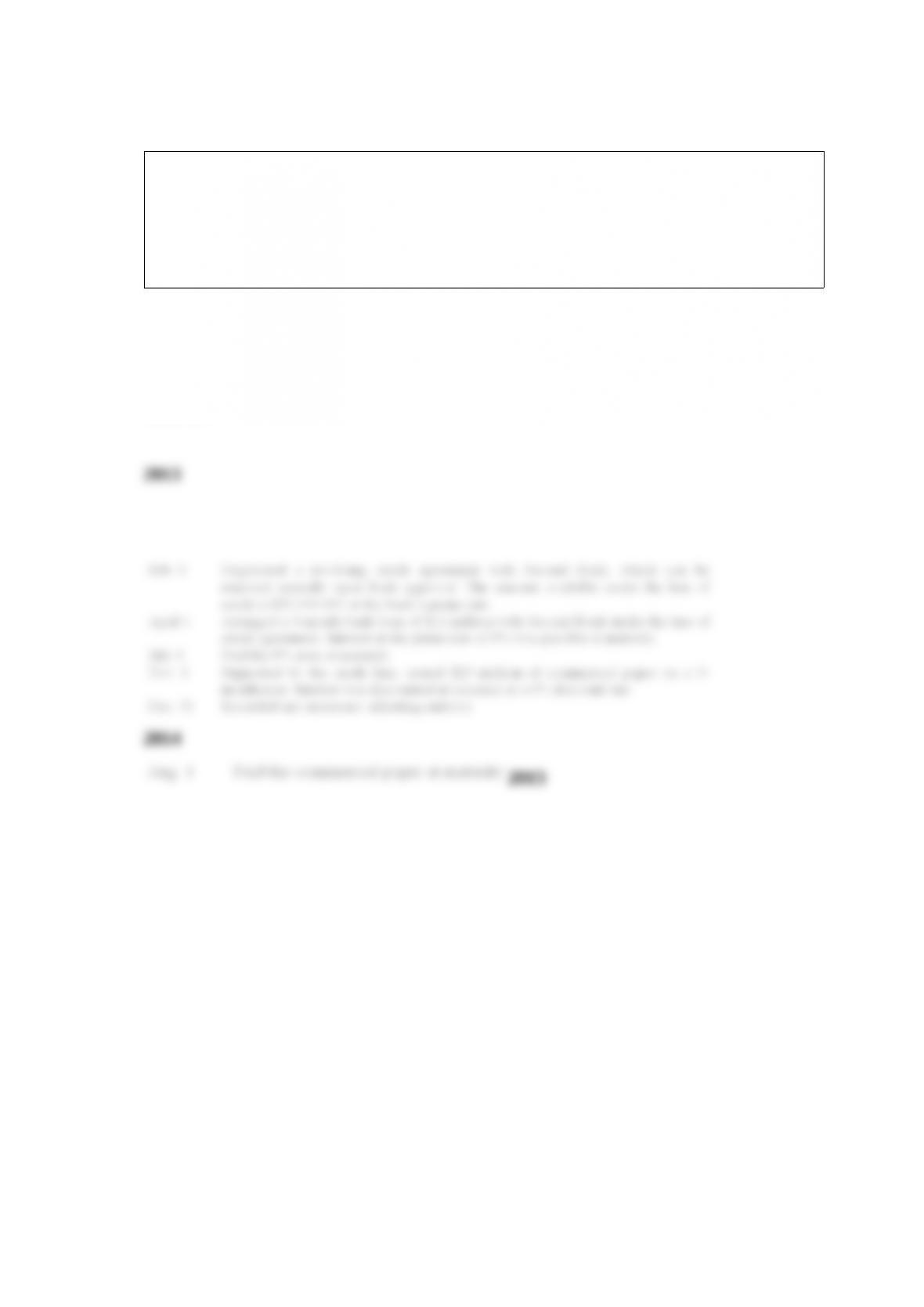
The following selected transactions relate to liabilities of Rose Dish Corporation. Rose’s
fiscal year ends on December
Required:
Prepare the appropriate journal entries through the maturity of each liability.
Answer:
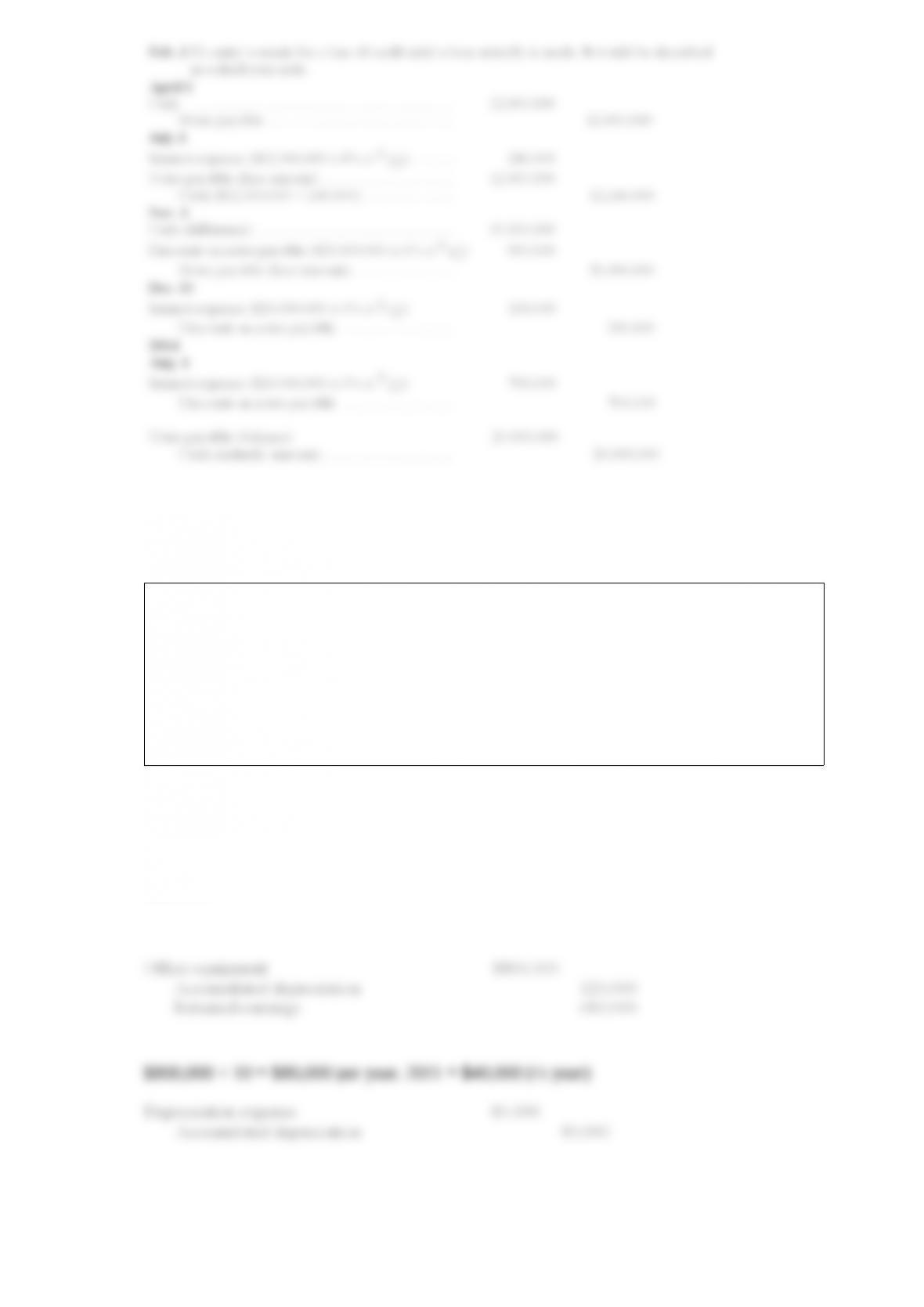
In December of 2013, XL Computer’s internal auditors discovered that office equipment
costing $800,000 was charged to expense in 2011. The asset had an expected life of 10
years with no residual value. XL would have recorded a half year of depreciation in
Required:
Prepare the necessary correcting entry that would be made in 2013 (ignore income
taxes), and the entry to record depreciation for 2013.
Answer:
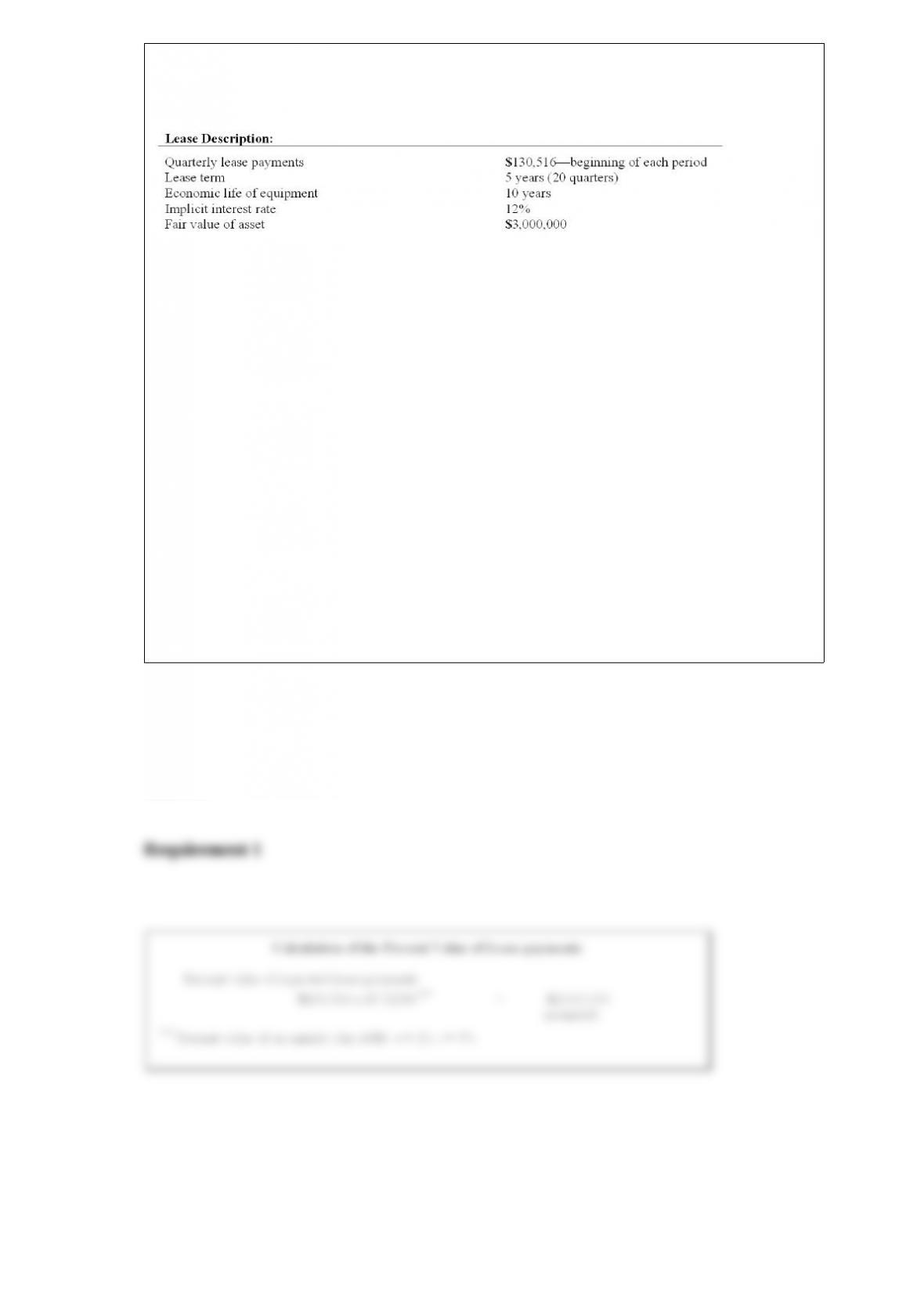
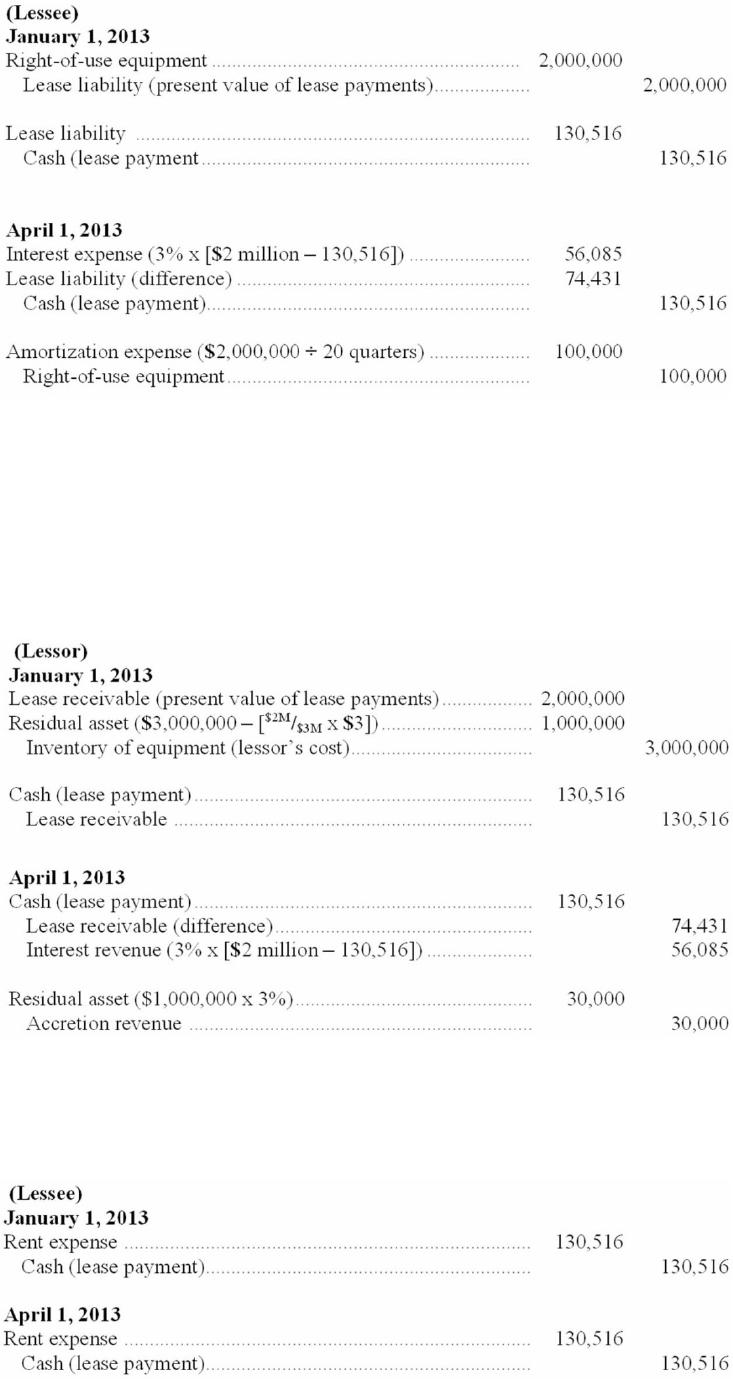
Tolmeka Leasing purchased equipment for $3,000,000 and leased it to Munchow
Industries on January 1, 2013. Both companies record appropriate adjusting entries
quarterly.
Required:
1) Following the guidance of the new ASU, prepare the journal entries to record the
lease by Munchow (lessee) at its commencement of the lease through the second lease
payment on April 1, 2013. Round to nearest dollar. Show calculations.
2) Following the guidance of the new ASU, prepare the journal entries to record the
lease by Tolmeka (lessor) at its commencement of the lease through the second lease
payment on April 1, 2013. Round to nearest dollar. Show calculations.
3) Following current U.S. GAAP, prepare the journal entries to record the lease by
Munchow (lessee) at its commencement of the lease through the second lease payment
on April 1, 2013. Round to nearest dollar. Show calculations.
4) Suppose the cost and fair value of the asset is $2,000,000 and its economic life is 5
years. Following current U.S. GAAP, prepare the journal entries to record the lease by
Munchow (lessee) at its commencement of the lease through the second lease payment
on April 1, 2013. Round to nearest dollar. Show calculations.
Answer:

Alpaca Corporation had revenues of $200,000 in its first year of operations. The
company has not collected on $20,000 of its sales and still owes $25,000 on $70,000 of
merchandise it purchased. The company had no inventory on hand at the end of the
year. The company paid $15,000 in salaries. Owners invested $20,000 in the business
and $20,000 was borrowed on a five-year note. The company paid $2,000 in interest
that was the amount owed for the year, and paid $6,000 for a two-year insurance policy
on the first day of business. Alpaca has an effective income tax rate of 40%.
Compute the cash balance at the end of the first year for Alpaca Corporation.
Answer:

To raise operating funds, Combs Corporation sold a piece of equipment on January 1,
2013, to a finance company for $600,000. Combs immediately leased the equipment
back for a 10-year period. After that time ownership will transfer to Combs. The
equipment has a fair value of $624,000. Its cost and its carrying value were $480,000.
Its useful life is 12 years. The lease requires Combs to make payments of $80,000 to the
finance company each January 1 beginning at the inception date of the lease. Combs
depreciates similar assets on a straight-line basis. The appropriate interest rate is 7%.
The present value of an annuity due of $1 for 10 years at 7% is 5.
Required:
Prepare the journal entries for Combs on January 1, 2013, to record the sale-leaseback
and the December 31, 2013, adjusting entries.
Answer:
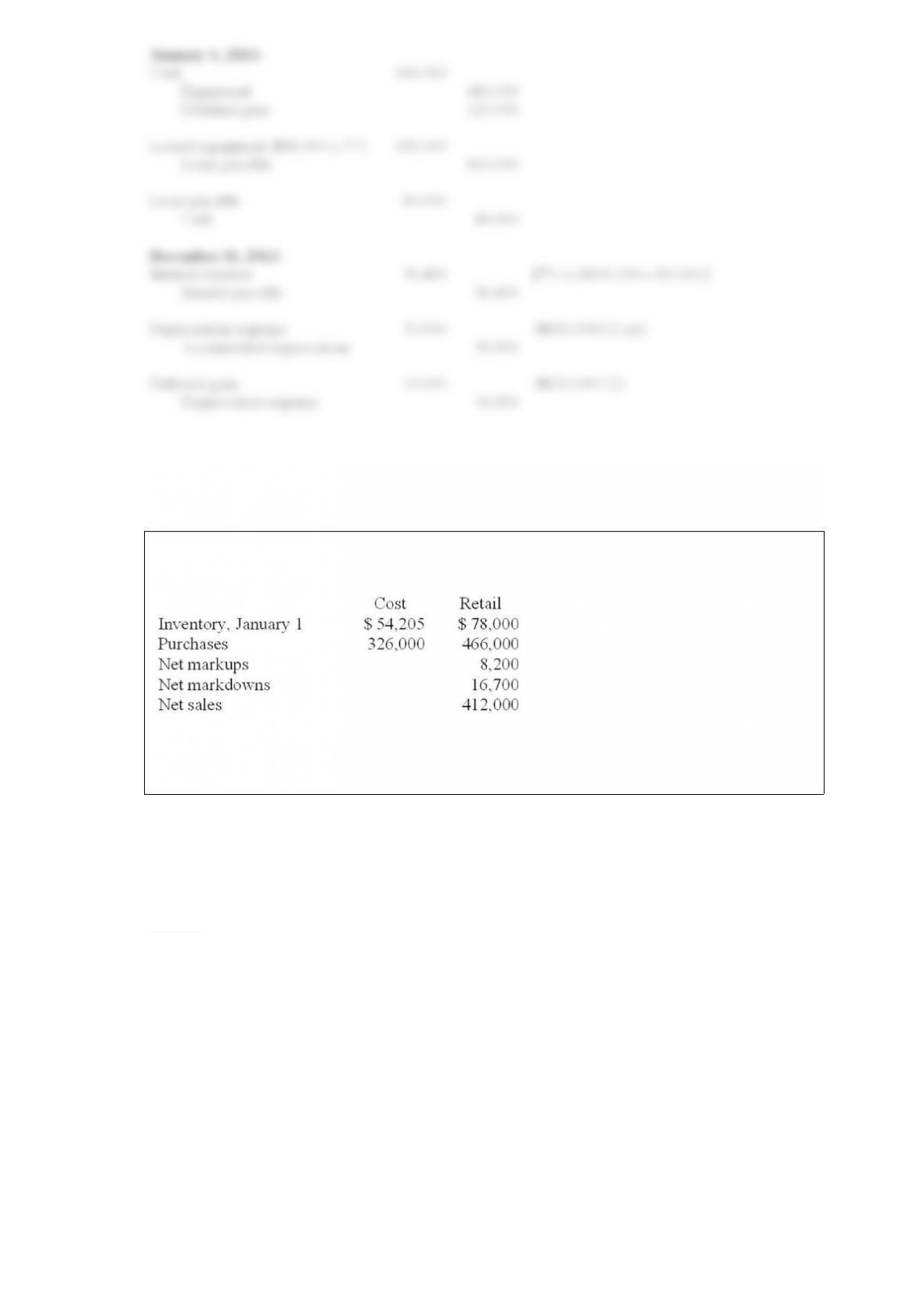
Manila Bread Company uses the average cost retail method to estimate its ending
inventories. The following data has been summarized for the year 2013:
Required:
Estimate the ending inventory as of December 31, 2013.
Answer:
Beacon Inc. received a gift of land and building in Twin Pines Park as an inducement to
relocate. The land and buildings have fair values of $45,000 and $455,000.
Required:
Prepare journal entries to record the above transactions.
Answer:
The IASB and FASB are collaborating on a joint project intended to revise standards for
accounting for leases. Briefly describe the tentative decisions of the two boards
regarding the overall approach of the new standard.
Answer:
On October 15, 2013, a 5% stock dividend was declared and distributed. The market
value of the common stock on this date was $32 per share. Fractional share rights
represented 100,000 shares. Cash was paid in lieu of issuing fractional share rights. On
the date of declaration and payment, the company had 10 million shares of common
stock outstanding. The par value of the common shares was $5.
Required:
Prepare any necessary journal entries to record the above events.
Answer:
Indicate whether each of the actions listed below will immediately increase (I), decrease
(D), or have no effect (N) on the ratios shown. Assume each ratio is greater than 1.0
before the action is taken.
Answer:
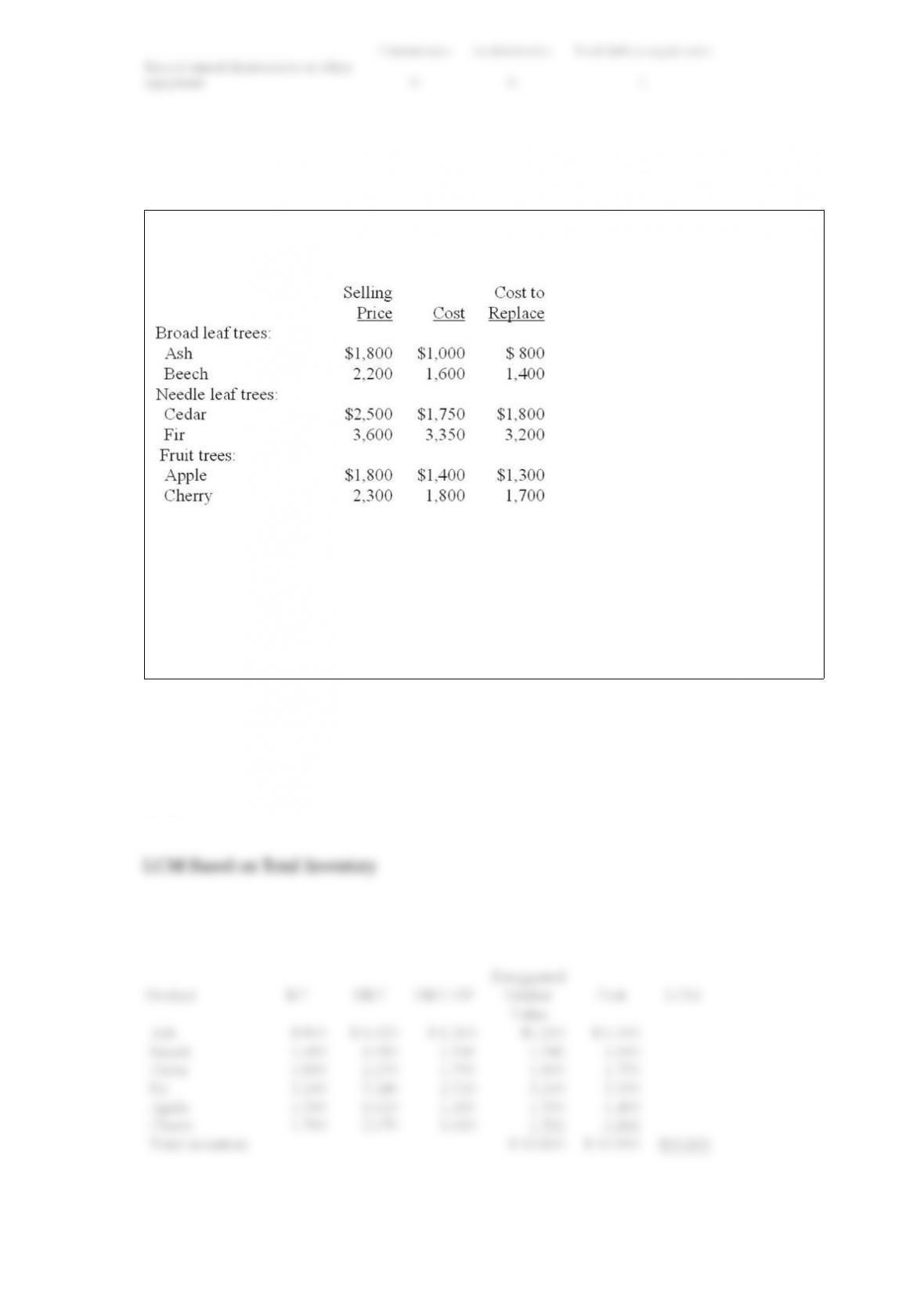
Novelli’s Nursery has developed the following data for lower-of-cost-or-market
valuation for its products:
The normal profit margin on all trees is 20% of selling price and disposal costs are 10%
of selling price.
Required:
Determine the balance sheet inventory carrying value assuming the LCM rule is applied
to the total inventory.
Answer:
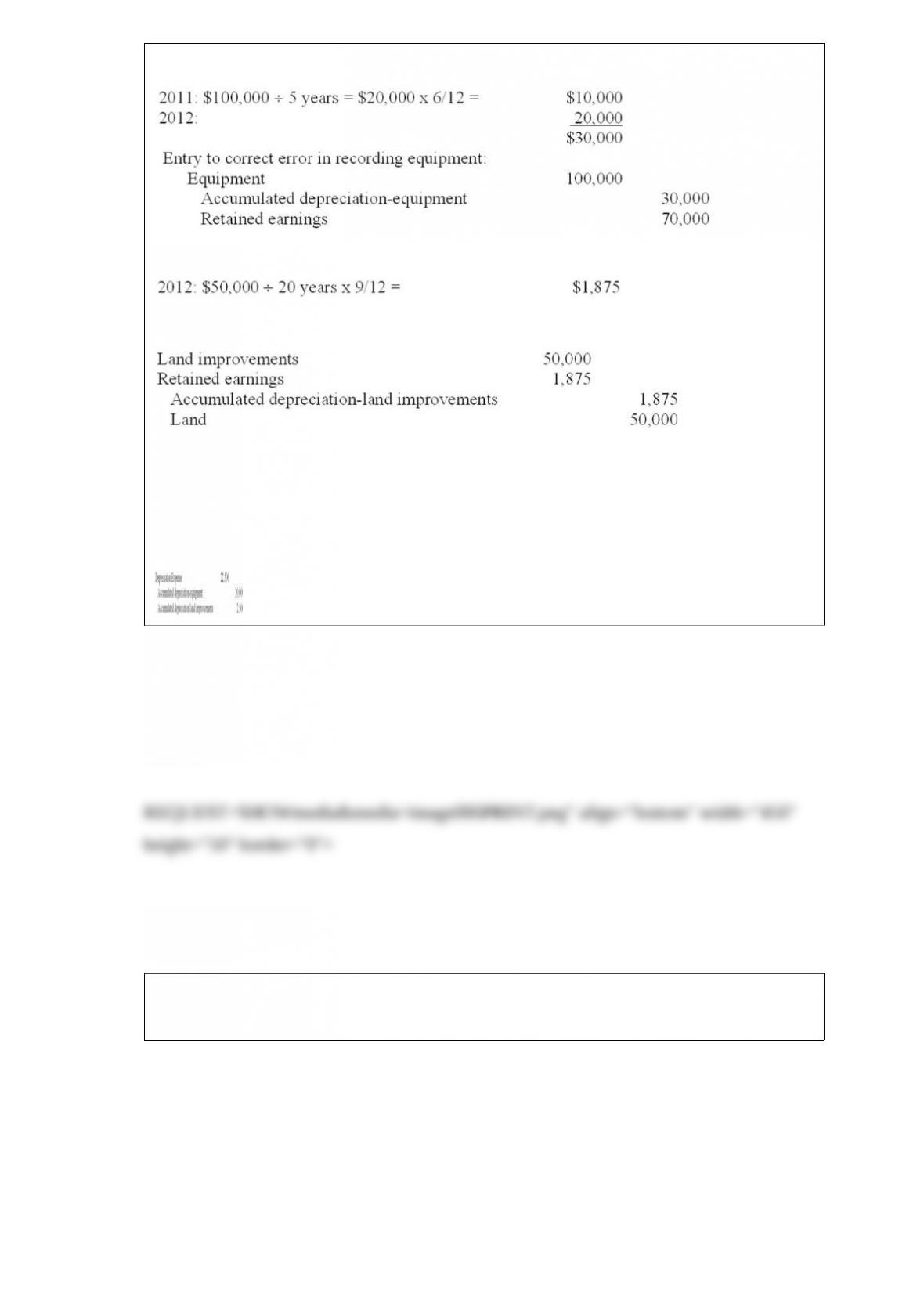
Depreciation that should have been recorded in prior years on the equipment:
Depreciation that should have been recorded in prior years on land improvements:
Entry to correct error in recording land improvements:
2. 2013 depreciation:
Equipment: $100,000 ÷ 5 years = $20,000
Land improvements: $50,000 ÷ 20 years = $2,500
Answer:
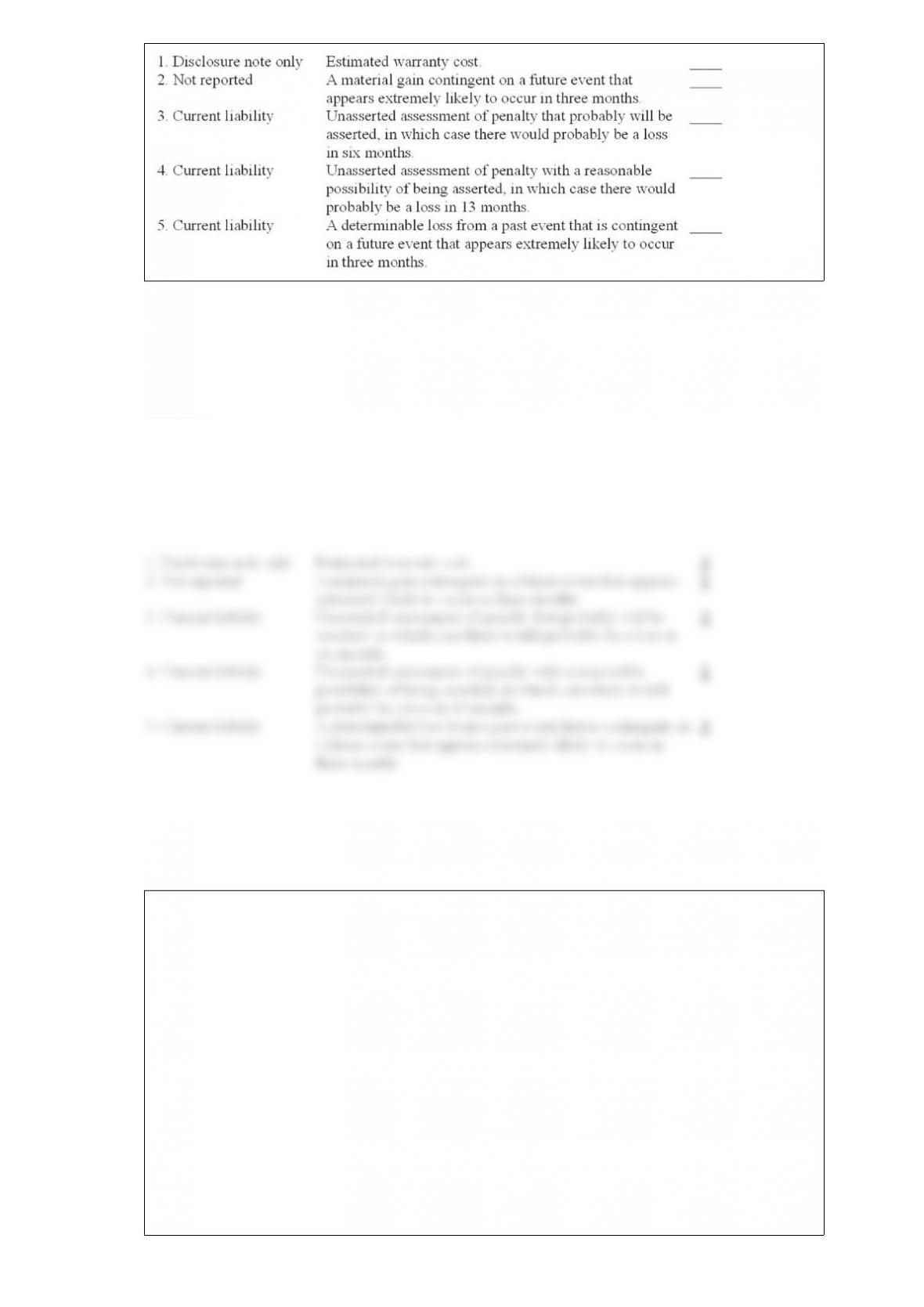
Indicate (by number) the way each of the items listed below should be reported in a
balance sheet at December 31, 2013.
Answer:
On February 1, 2013, Wolf Inc. issued 10% bonds dated February 1, 2013, with a face
amount of $200,000. The bonds sold for $239,588 and mature in 20 years. The effective
interest rate for these bonds was 8%. Interest is paid semiannually on July 31 and
January 31. Wolf’s fiscal year is the calendar year. Wolf uses the effective interest
method of amortization.
Required:
1) Prepare the journal entry to record the bond issuance on February 1,
2) Prepare the entry to record interest on July 31, 2013.
3) Prepare the necessary journal entry on December 31, 2013.
4)Prepare the necessary journal entry on January 31, 2014.
Answer:
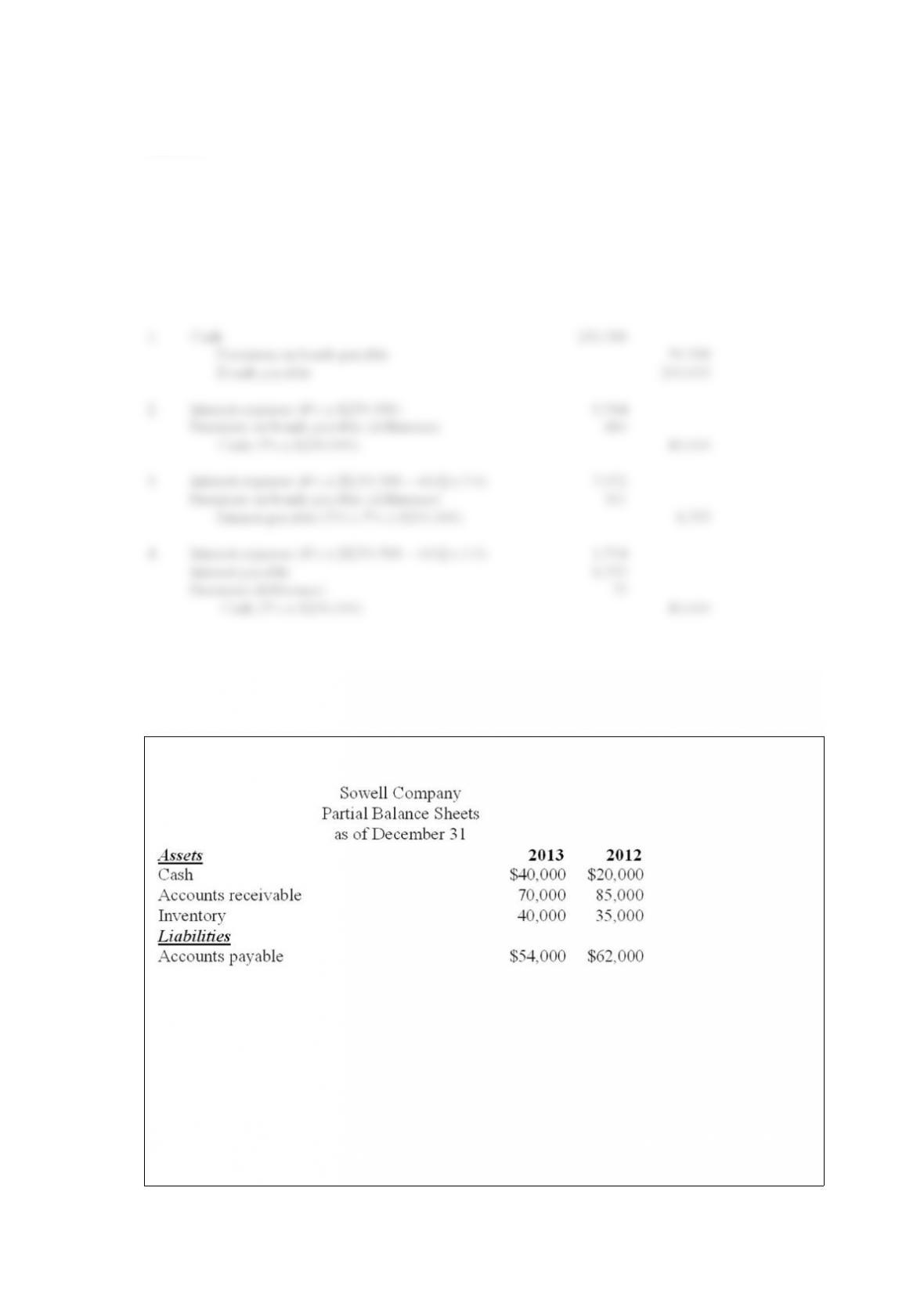
Partial balance sheets and additional information are listed below for Sowell Company.
Additional information for 2013:
Net income was $88,000.
Depreciation expense was $19,000.
Required:
Prepare the operating activities section of the statement of cash flows for 2013 using the
indirect method.

Answer: