
Which of the following is an objective of inventory management?
A.minimize the sum of ordering and carrying costs.
B.minimize ordering costs and maximize carrying costs.
C.maximize the sum of ordering and carrying costs.
D.maximize the ordering costs and minimize carrying costs.
Activity-based costing assigns more costs to items produced in __________ than
traditional methods do.
A.small runs
B.medium runs
C.large runs
D.extra large runs
The appropriate discount rate that analysts use in computing the present value of future
cash flows is composed of a risk factor reflecting the riskiness of the project. Thus,
A.the greater a projects risk, the higher the discount rate.
B.the Federal government has the lowest probability of default, so government bodies
usually have the lowest risk premiums.
C.a different discount rate would be used to invest a company’s funds in a high-risk
research and development project rather than low-risk bonds.
D.all of the above.
Which of the following characterizes a time period long enough to allow management
to change the level of production within the constraints of current total productive
capacity?
A.short run.
B.medium run.
C.long run.
D.relevant range.
What is the secondstep in the activity analysis process used to implement Activity
Based Management?
A.Chart, from start to finish, the activities used to complete the product or service.
B.Classify activities as value-added or non-value-added.
C.Eliminate non-value-added activities.
D.Continuously improve and reevaluate the efficiency of value-added activities or
replace them with more efficient activities.

Management tools which provide diagnostic signals and identify potential causes of a
problem(s) are called
A.control charts.
B.cause-and-effect charts.
C.Pareto charts.
D.All of the answers are correct.
Which of the following statements is true concerning the agency view of motivation?
A.The agency view of motivation provides desirable rewards.
B.The agency view of motivation provides a high probability that behaving as the
organization wishes will lead to the rewards.
C.The agency view of motivation looks for ways to encourage agents to act in the
interests of principals.
D.None of the answers is correct.

Which of the following is(are) the transfer price that would leave the selling division no
worse off if the good is sold to an internal division?
A.The negotiated transfer price.
B.The minimum transfer price.
C.The maximum transfer price.
D.Both a. and c.
Which of the following is an advantage for companies to award managerial
performance based on a formula-based approach?
A.Managers know precisely what is expected of them.
B.Managers know what reward they will get if they achieve expectations.
C.Managers who do not fully trust their superiors tend to prefer this approach.
D.All of the answers are correct.
What is an opportunity cost?
A.The difference in total costs which results from selecting one choice instead of
another.
B.The profit forgone by selecting one choice instead of another.
C.A cost that may be saved by not adopting an alternative.
D.A cost that may be shifted to the future with little or no effect on current operations.
Which of the following costing system has characteristics of both job and process
costing?
A.normal costing.
B.actual costing
C.operation costing.
D.standard costing.
Which of the following costing system is appropriate for a company that mass-produces
homogeneous products (continuous flow processing)?
A.job costing.
B.process costing.
C.operation costing.
D.dynamic costing.

When sales dollars are used as the measure of volume in the cost-volume-profit
equation, the focus is on solving for which of the following?
A.total revenue required to break even rather than total units.
B.a target profit rather than total units.
C.total revenue required to break even rather than total units and a target profit rather
than total units.
D.One cannot utilize cost-volume-profit relationships to solve for sales dollars.
Which of the following are not controls that can be instituted to prevent financial
fraud?
A.Separate duties where a single person carrying out a series of tasks could not commit
fraud and hide it.
B.Hire internal auditors.
C.Have independent auditors review a company’s internal controls.
D.Have the bank independently reconcile cash balances with company records.
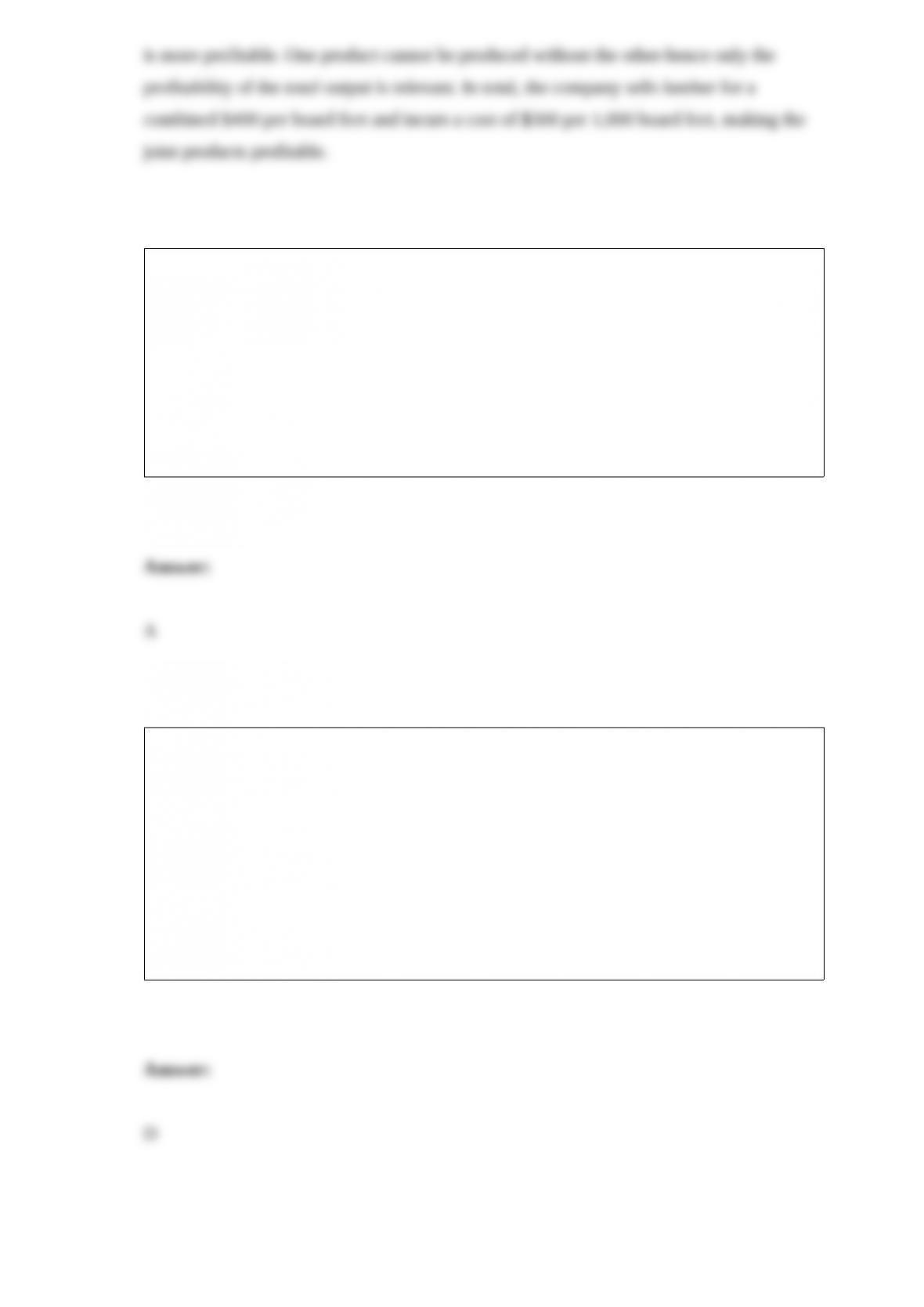
Northstar Timber processes timber into Grade A and Grade B lumber. Timber costs
$200 per unit, where one unit equals 1,000 board feet. The process involves cutting
timber into the two grades of lumber. Each unit of timber produces .25 unit (250 board
feet) of Grade A lumber with a market value of $240 and .75 unit (750 board feet) of
Grade B with a market value of $160. The joint cost of the production process is $100
per unit.
Required:
a. Assume that the joint costs of the two grades of lumber are to be allocated on the
basis of units of output. What cost is assigned to each product (for .25 unit of Grade A
and .75 unit of Grade B)?
b. If the joint costs are allocated on the basis of the net realizable value, what cost is
assigned to each product? How much profit or loss does the Grade A lumber earn? Is it
really possible to determine which product is more profitable? Explain why or why not.
In principle, a cost is
A.a sacrifice of resources.
B.something used up to produce revenues in a particular accounting period.
C.only comprised of direct material and direct labor.
D.something measured in conformity with generally accepted accounting principles.
The calculation of the net present value of a proposed project does not require estimates
of which of the following?
A.the amount of future cash flows.
B.the timing of future cash flows.
C.the cost of capital rate.
D.the amount of sunk costs already incurred.
Why bother allocating joint-process costs?
A.It is a performance measurement.
B.It is used in resolving contractual disputes.
C.It is used for estimating casualty losses
D.All of the answers are correct.