When cash is paid before the related expense is incurred, an asset is reported on the
balance sheet.
Intangible assets with limited lives are usually amortized using the straight-line method
with no residual value.
A liability for dividends is recorded on the date of record.
Cash that is legally or contractually required to be set aside for a specific purpose
cannot be reported with Cash and Cash Equivalents on the balance sheet.
The straight-line method of amortization allocates the amount of bond premium or
discount over each period of a bond’s life in amounts corresponding to the bond’s
carrying value.
The price-earnings ratio reveals information about the stock market’s expectations for a

company’s future growth in earnings.
The higher the receivables turnover, the slower accounts receivable are being collected.
A company signed an agreement to rent store space from another company. This is an
example of a transaction that should be recorded.
An entertainment company received $6 million in cash for advance season ticket sales.
Prior to the beginning of the season, these sales should be recorded as a liability.
A company billed a client for services performed on January 10. The customer paid
one-half of the amount owed on January 20 and the other one-half on February 24.
When should the company record the related Service Revenue?
A) On January 10
B) On January 20
C) One-half on January 20 and the other half on February 24
D) At year-end in an adjusting entry
Which of the following statements about bond premiums or discounts is correct?
A) A discount on a bond reduces the amount that the issuer has to repay to the lenders.
B) A premium on a bond increases the interest expense of the loan to the issuer.
C) A premium on a bond increases the amount that the issuer has to repay to the
lenders.
D) A discount on a bond increases the interest expense of the loan to the issuer.
A company’s revenue recognition policy:
A) affects the income statement but not the balance sheet.
B) defines when its revenue should be collected.
C) is usually described in the notes to a company’s financial statements.
D) states that revenues should not be recorded until payments are received from
customers.
On October 1, Angelica Inc. signs a note for $200,000 to provide the funds needed to
build a new facility. The note is due in 10 years, includes an annual interest rate at 7%,
and requires semiannual interest payments each April and October. The journal entry to
record the issuance of the promissory note should debit:
A) Notes Payable for $200,000, debit Interest Expense for $14,000, credit Cash for
$200,000, and credit Interest Payable for $14,000.
B) Accrued Interest and credit Cash for $14,000.
C) Cash and credit Notes Payable for $200,000.
D) Cash for $200,000, debit Interest Expense for $14,000, credit Notes Payable for
$200,000, and credit Interest Payable $14,000.
When the direct write-off method is used, the entry to write-off a specific account
would:
A) increase net income.
B) have no effect on net income.
C) increase Accounts Receivable and increase net income.
D) decrease Accounts Receivable and decrease net income.
Which of the following statements about adjustments is correct?
A) An accrual adjustment that increases an asset will include an increase in an expense.
B) A deferral adjustment that decreases an asset will include an increase in an expense.
C) An accrual adjustment that increases an expense will include an increase in assets.
D) A deferral adjustment that increases a contra account will include an increase in an
asset.
A company acquired property that included land, building and equipment for a total
cost of $163,000. The land was appraised at $87,500, the building at $35,000, and the
equipment at $52,500. What should be the allocation of the total cost in the accounting
records?
A) Land $75,000; Building $30,000; Equipment $45,000
B) Land $75,000; Building $30,800; Equipment $46,200
C) Land $87,500; Building $35,000; Equipment $52,500
D) Land $81,500; Building $32,600; Equipment $48,900
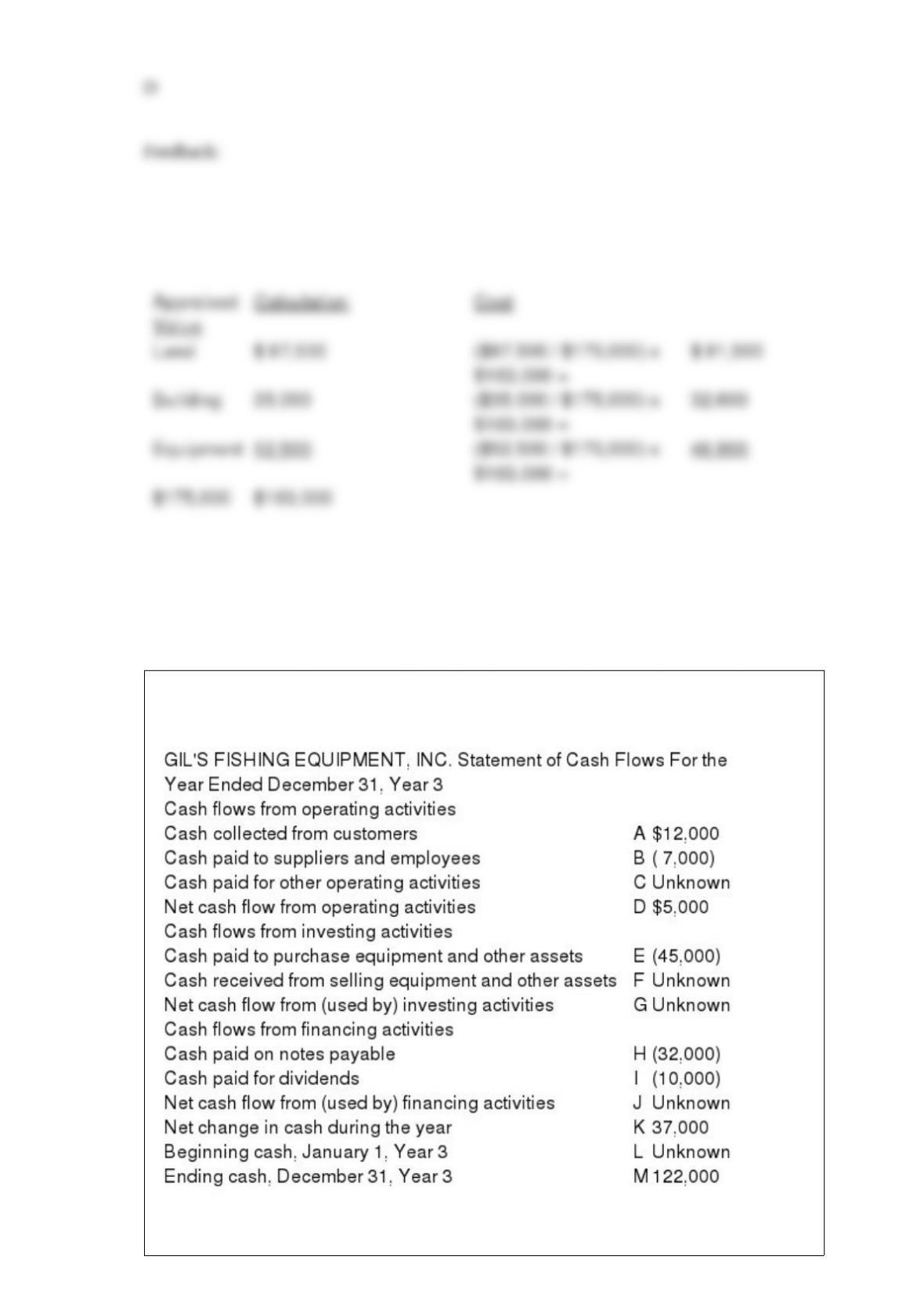
Use the information above to answer the following question. What amount is
represented by letter C in the statement of cash flows?
A) $14,000
B) $10,000
C) ($14,000)
D) $0
The entry to record a bond retirement at maturity usually involves:
A) no gain or loss.
B) a credit to Gain on Bond Retirement.
C) a debit to Loss on Bond Retirement.
D) a credit to Bonds Payable.
Par value of a stock refers to the:
A) issue price of the stock.
B) value assigned to a share of stock in the corporate charter.
C) market value of the stock.
D) maximum selling price of the stock.
Which of the following statements about the current ratio is not correct?
A) When making comparisons across companies, it ‘s far easier to express the
relationship as a ratio.
B) The current ratio is used to evaluate a company ‘s ability to pay current obligations.
C) Having more current assets than current liabilities will yield a current ratio less than
1.0.
D) A high current ratio suggests good liquidity.
Which of the following ratios is used to evaluate solvency?
A) Fixed asset turnover ratio
B) Days to sell ratio
C) Current ratio
D) Times interest earned
A company has net sales of $612,850 and cost of goods sold of $441,252. The
company’s gross profit percentage is:
A) 72%.
B) 0.28%.
C) 38.9%.
D) 28%.
Equipment, beginning of year $170,000
Equipment, end of year 210,000
Accumulated depreciation, beginning of year 95,000
Accumulated depreciation, end of year 92,000
Equipment with a cost of $10,000 and a book value of $3,000 was sold during the year
for cash of $9,000. Additional equipment was purchased during the year for cash.
Using the T-account approach:
A) Net income appears on the debit side of the Cash account under operating activities.
B) Payment of long-term debt appears on the debit side of the Cash account under
financing activities.
C) Purchase of equipment appears on the credit side of the Cash account under
operating activities.
D) An increase in Accounts Receivable appears on the debit side of the Cash account
under operating activities.
Wiggly Pet Store had $6,000 of supplies at the end of October. During November, the
company bought $2,000 of supplies. At the end of November, the company had $1,000
of supplies remaining. Which of the following statements is not correct?
A) During November, the company used $7,000 of supplies.
B) Supplies should be reported at $1,000 on the balance sheet.
C) An expense should be debited for $7,000 in November.
D) An asset should be debited for $1,000 in November.
Three months of rent were prepaid on May 1 for $7,200, but two months have now
expired, leaving only one month prepaid at June 30. What is the amount of rent expense
that will be recorded in the related adjusting entry dated June 30?
A) $0
B) $2,400
C) $4,800
D) $7,200
Dunedin Inc. began the month with inventory of $10,000 and then purchased inventory
at a cost of $105,000. The perpetual inventory system indicates that inventory costing
$94,000 was sold during the month for $141,000. An inventory count shows that
inventory costing $20,100 is actually on hand at month-end.
Required:
What amount of shrinkage occurred during the month?
Maple Industries Inc. deposits all cash receipts on the day when they are received and it
makes all cash payments by check. At the close of business on December 31, its Cash
account shows a debit balance of $18,303. The company ‘s bank statement as of June 30
shows an ending cash balance of $15,921. The following information was also
available.
Outstanding checks as of December 31 total $2,261.
Included with the bank statement was a debit memo in the amount of $35 for service
charges.
Check No. 2519, listed with the canceled checks, was correctly drawn for $805 in
payment of a utility bill on December 16. The company mistakenly recorded it with a
debit to Utilities Expense and a credit to Cash in the amount of $850.
The December 31 cash receipts of $3,425 were placed in the bank ‘s night depository
after banking hours and were not recorded on the December 31 bank statement.
The bank deducted $1,228 for an NSF check from a customer deposited on December
10.
Required:
Prepare the journal entries for the items that would appear on the company ‘s bank
reconciliation as of December 31. (Do not prepare the bank reconciliation.)
Listed below are the account balances that appear on the company’s adjusted trial
balance as of December 31, 2015. All accounts have normal balances.
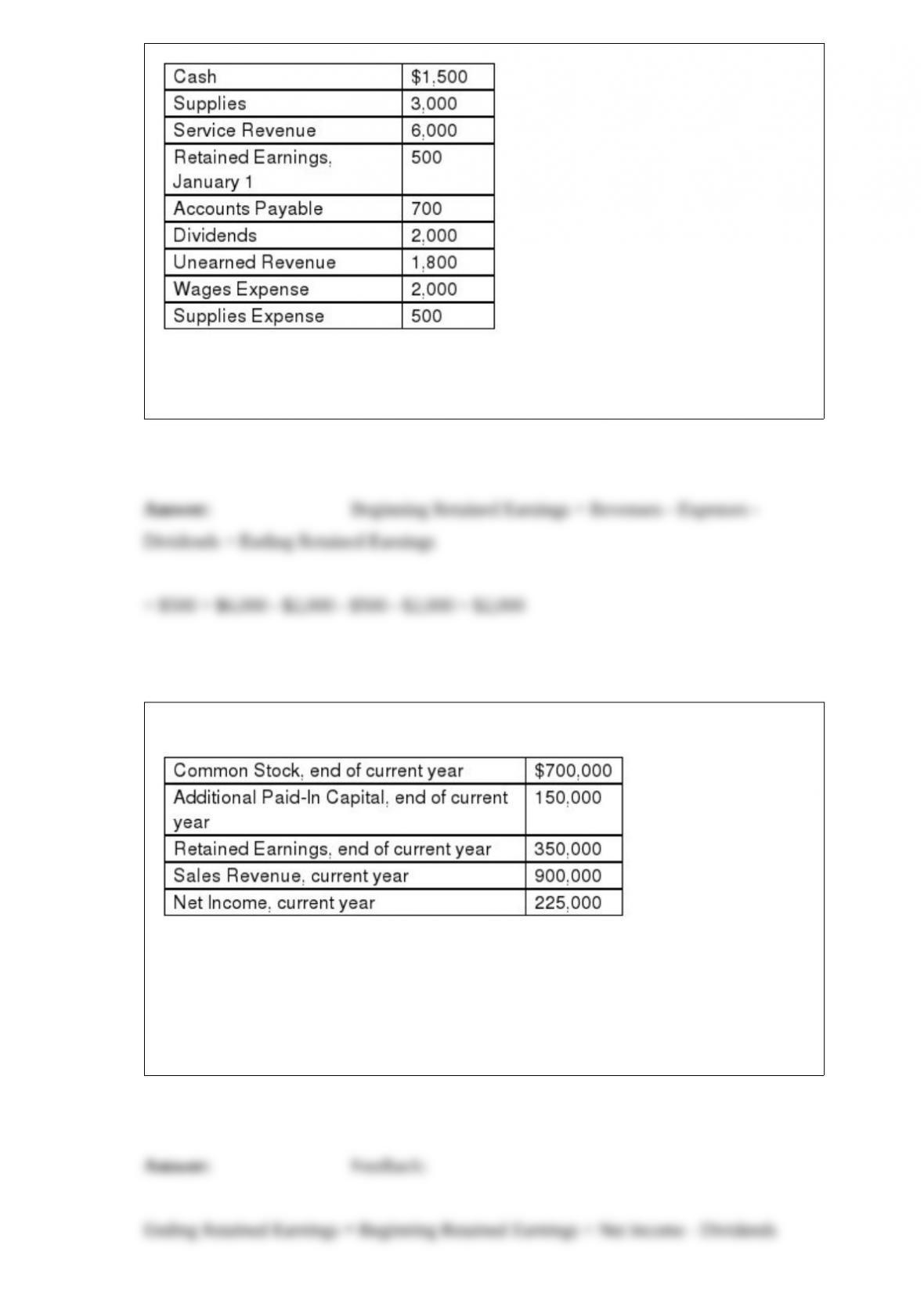
Required:
Determine the ending balance in the Retained Earnings account.
A company provided the following information:
There was no change in contributed capital and there were no dividends declared in the
current year.
Required:
Calculate the return on equity ratio.
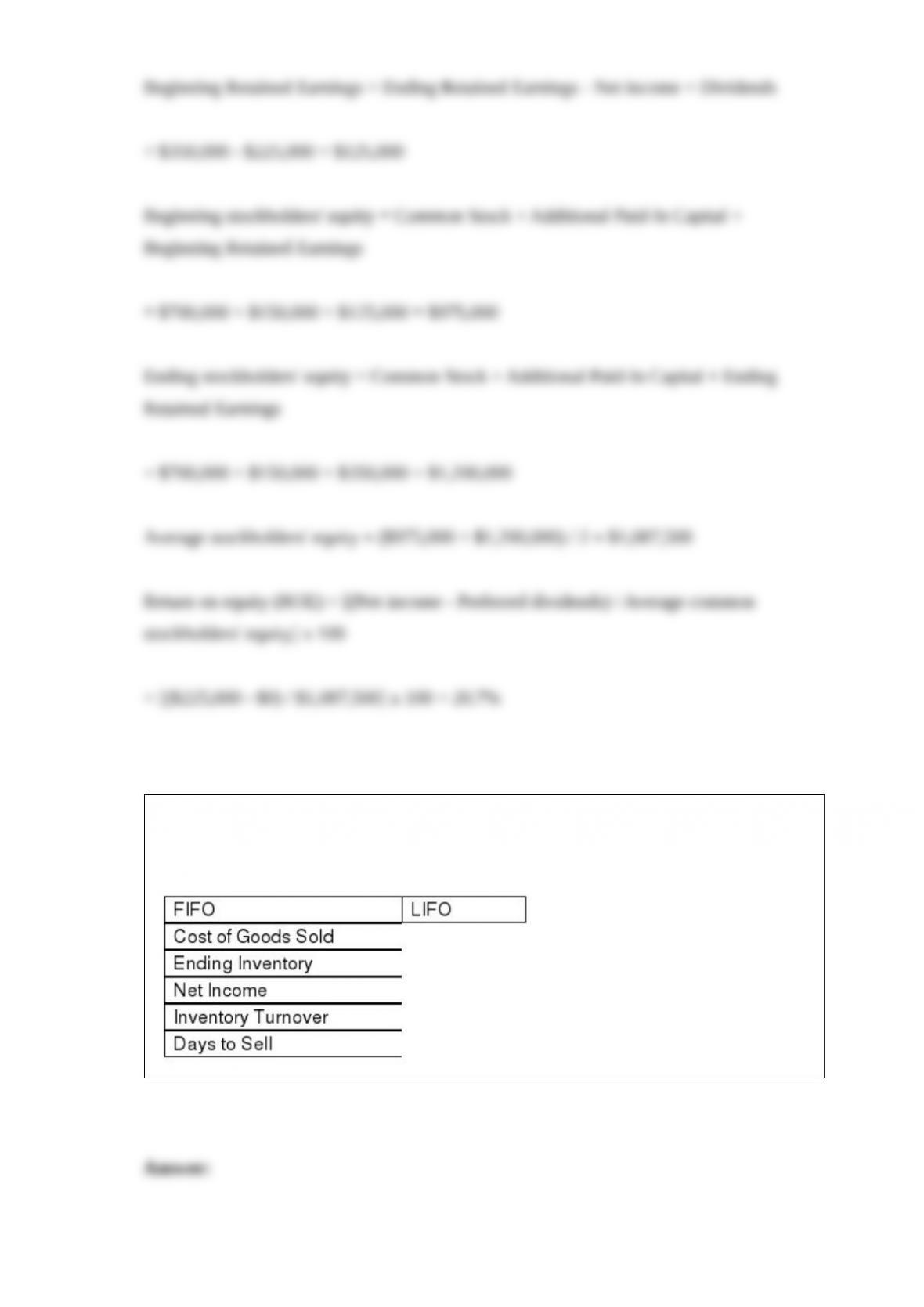
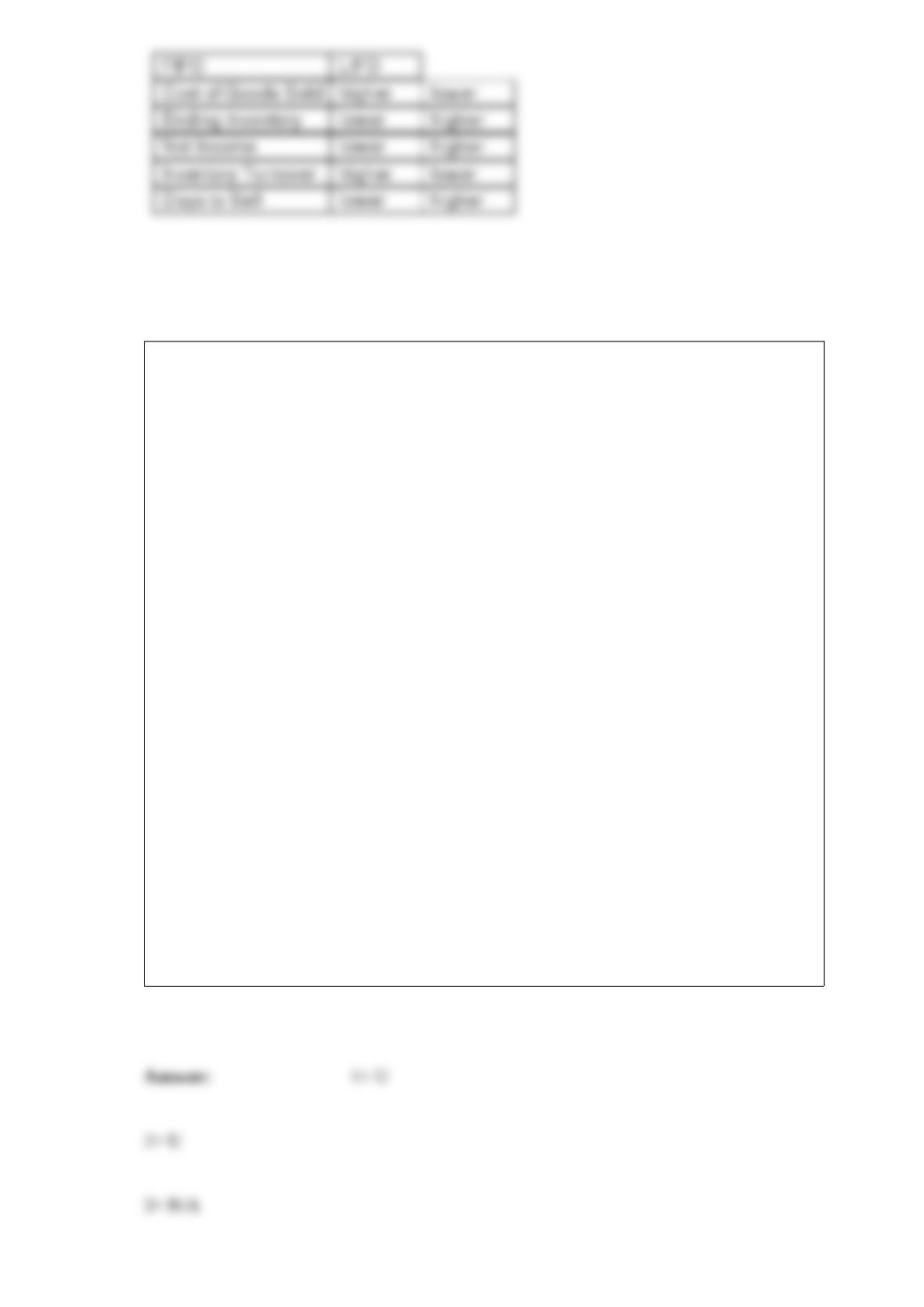
Fill in the blanks below with the words “higher” and “lower” to indicate which
inventory costing method causes the value to be higher and which causes it to be lower.
Assume that the cost of inventory is decreasing.
Assume that a company uses accrual basis accounting. For each of the following,
indicate the effect the situation would have on net income in the current period.
SITUATION
1>_____ Recording prepaid costs as current expenses
2>_____ Recording an expense at more than the actual cost
3> _____ Failing to record the receipt of a payment by a customer on account
4> _____ Failing to record some supplies received
5>_____ Recording unearned revenue as revenue
6>_____ Recording an expense as revenue
7> _____ Failing to record the company issuing additional shares of its own common
stock
IMPACT ON NET INCOME
O – Overstate net income
U – Understate net income
N/A – Not applicable; no effect on net income
Greenies Inc. updates its inventory periodically. The company ‘s cost of goods sold was
$24,700 and purchases were $12,000 during the year. The company ‘s ending inventory
count was $3,500.
Required:
Determine the amount of beginning inventory.