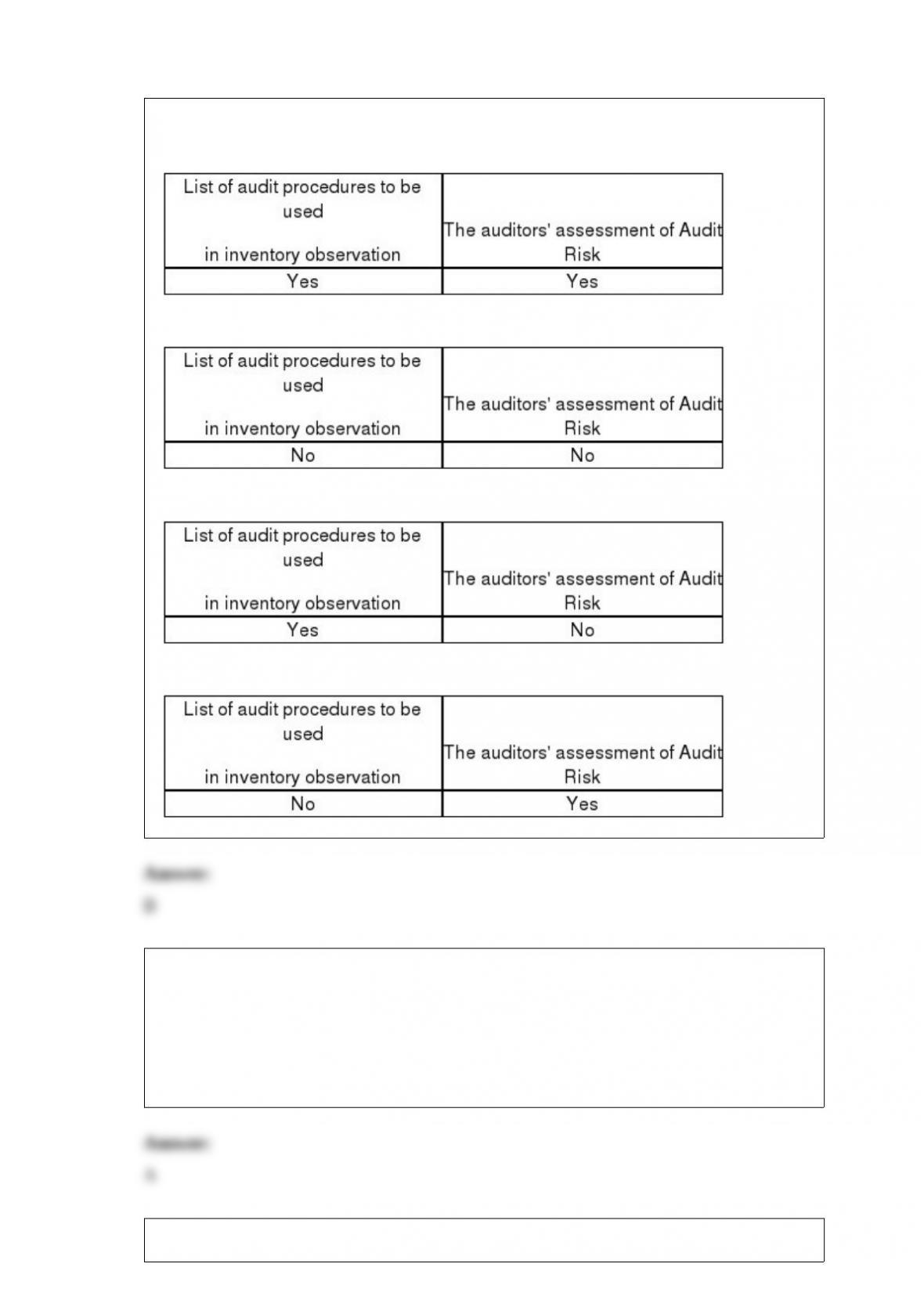
1) Which is usually included in the engagement letter?
A)
B)
C)
D)
2) Research indicates that the most effective way to prevent and deter fraud is to:
A) implement programs and controls that are based on core values embraced by the
company
B) hire highly ethical employees
C) communicate expectations to all employees on an annual basis
D) terminate employees who are suspected of committing fraud
3) Auditors seldom expect to find misstatements when testing payroll transactions.

A) True
B) False
4) Which of the following is a factor that relates to attitudes or rationalization to
commit fraudulent financial reporting?
A) Significant accounting estimates involving subjective judgments
B) Excessive pressure for management to meet debt repayment requirements
C) Management’s practice of making overly aggressive forecasts
D) High turnover of accounting, internal audit and information technology staff
5) When making decisions about evidence for a given audit, the auditor’s goal is to
obtain a sufficient amount of timely, reliable evidence that is relevant to the information
being verified. In addition, the goal of audit efficiency is to gather and evaluate the
information:
A) no matter the cost involved in obtaining such evidence
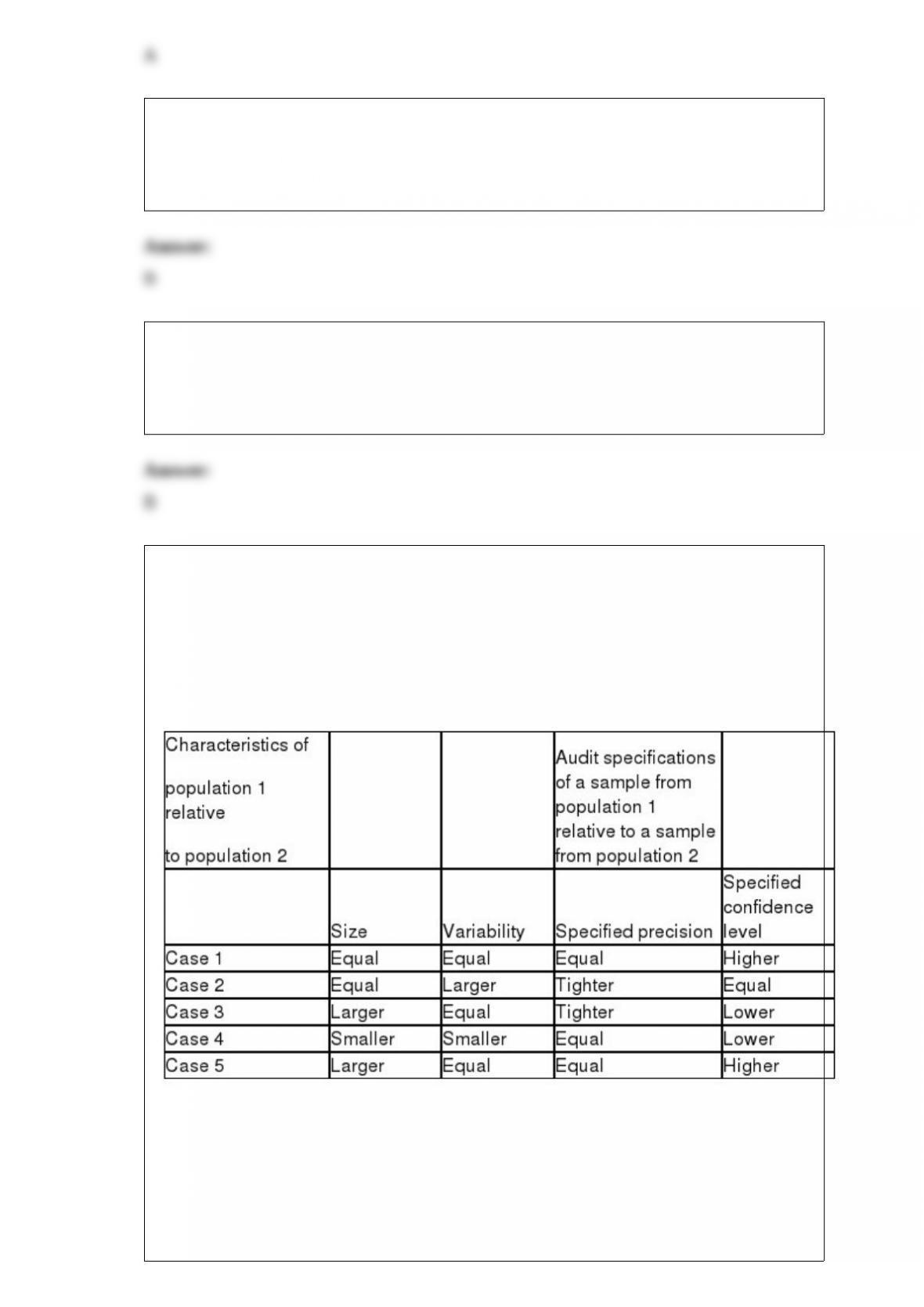
B) even if cost is irrelevant to the auditor, because they bill the client for costs incurred
C) at the lowest possible total cost
D) at the cost suggested in the engagement letter
6) Tests of the presentation and disclosure-related objectives are generally done as part
of the completion phase of the audit.
A) True
B) False
7) In a financial statement audit, inherent risk is evaluated to help an auditor asses
which of the following?
A) The internal audit department’s objectivity in reporting a material misstatement of a
financial statement assertion it detects to the audit committee
B) The risk the internal control system will not detect a material misstatement of a
financial statement assertion
C) The risk that the audit procedures implemented will not detect a material
misstatement of a financial statement assertion
D) The susceptibility of a financial statement assertion to a material misstatement

assuming there are no related controls
8) In which situation would the auditor be choosing between “except for” qualified
opinion and an adverse opinion?
A) The auditor lacks independence
B) A client-imposed scope limitation
C) A circumstance imposed scope limitation
D) Lack of full disclosure within the footnotes
9) Which of the following would indicate a deficiency in internal controls in the
acquisition and payment cycle?
A) Repairs and maintenance accounts are reviewed for unusual entries each quarter
B) Acquisitions are made and approved by the department that will use the equipment
C) Acquisitions of equipment greater than $1,000 are to be capitalized
D) Acquisitions of equipment less than $1,000 are to be expensed as incurred
10) Match eight of the terms (a-k) with the definitions provided below (1-8):
a.Haphazard selection
b.Attributes sampling
c.Block sample selection
d.Judgmental sampling
e.Non-probabilistic sample selection
f.Probabilistic sample selection
g.Random sample
h.Representative sample
i.Statistical sampling
j.Systematic sample selection
k.Sampling distribution
________ 1> The use of mathematical measurement techniques to calculate formal
statistical results and quantify sampling risk.
________ 2> A non-probabilistic method of sample selection in which items are
selected in measured sequences.
________ 3> A sample whose characteristics are the same as those of the population.
________ 4> A statistical, probabilistic method of sample evaluation that results in an
estimate of the proportion of items in a population containing a characteristic of
interest.
________ 5> A non-probabilistic method of sample selection in which items are chosen

without regard to their size, source, or other distinguishing characteristics.
________ 6> An auditor selects items such that each population item has a known
probability of being included in the sample.
________ 7> A frequency distribution of the results of all possible samples of a
specified size that could be obtained from a population containing some specific
parameters.
________ 8> A sample in which every possible combination of elements in the
population has an equal chance of constituting the sample.
11) For proper internal control, the person(s) responsible for signing the payroll checks
should not have access to timekeeping or be otherwise involved in the preparation of
payroll.
A) True
B) False
12) Difference estimation frequently results in smaller sample sizes than any other
variables sampling method.
A) True
B) False
13) SSARS are issued by the SEC.
A) True
B) False

14) In determining the reasonableness of the client’s amount for depreciation expense
the auditor is primarily concerned that the client has followed a consistent policy and
the calculations are correct. Which of the following audit objectives best addresses the
above concerns?
A) Existence
B) Accuracy
C) Valuation
D) Allocation
15) In auditing the current year acquisitions of property, plant, and equipment, all
balance-related audit objectives except realizable value and disclosure are used as a
framework for subsequent audit testing.
A) True
B) False
16) If tests of controls reveal that controls are sufficiently effective to justify reducing
control risk, the auditor is justified in reducing substantive audit tests.
A) True
B) False
17) The transfer of money from one bank account to another and improperly recording
the transfer so that the amount is recorded as an asset in both banks is referred to as
kiting.
A) True
B) False
18) The audit firm issues an audit report for its client. The auditor’s have NO obligation
to make further inquiries with respect to the client’s audited financial statements unless:
A) a development occurs that may affect the company’s long term viability as a
company
B) final resolution was made on disclosed contingency for which no liability needed to
be accrued
C) new information comes to the auditor’s attention concerning an event that occurred

prior to the date of the audit report that, if known, would have impacted the audit
opinion
D) a lawsuit, in which the risk of loss was considered remote, was resolved in the
company’s favor
19) Acceptable risk of incorrect rejection affects auditors’ action only when they
conclude that a population is:
A) fairly stated
B) acceptable
C) materially misstated
D) acceptable after certain adjustments
20) “An attitude, character, or set of ethical values exist that allow management or
employees to commit a dishonest act .” describes the opportunities condition included
in the fraud triangle.
A) True
B) False
21) When using statistical sampling, the auditor would most likely require a smaller
sample if the:
A) population increases
B) desired reliability decreases
C) desired precision interval narrows
D) expected exception rate increases
22) Which of the following is a significant audit concern related to the transfer of
inventory from one location to another?
A) recorded transfers occurred
B) transfers were properly transported
C) transfers were properly planned
D) transfers represent efficient movement of assets
23) Tests of controls and tests of details of balances are the auditor’s most important
means of verifying account balances in the payroll and personnel cycle.
A) True
B) False
24) Inherent risk for payroll-related liabilities is normally higher than for accounts
receivable.
A) True
B) False
25) An audit partner is developing an office-training program to familiarize his
professional staff with statistical decision models applicable to the audit of dollar-value
balances. He wishes to demonstrate the relationship of sample sizes to population size
and variability and the auditor’s specifications as to precision and confidence level. The
partner prepared the following table to show comparative population characteristics and
audit specifications of two populations.
Based on the information presented above, you are to indicate for the specified case
from the table the required sample size to be selected from population 1 relative to the
sample from population 2 . In case 5, the required sample from population 1 is:
A) larger than the required sample size from population 2
B) equal to the required sample size from population 2
C) smaller than the required sample size from population 2
D) indeterminate relative to the required sample size from population 2

26) The reason for testing the client’s bank reconciliation is to verify whether the
client’s recorded bank balance is the same amount as the actual cash in bank, except for
deposits in transit, checks outstanding, and other reconciling items. The information
needed to complete the tests of the reconciliation are provided by the:
A) client’s records and ledgers for the year under audit
B) cutoff bank statement
C) client’s records and ledgers for the subsequent year
D) canceled checks for the year under audit
27) Which of the following errors would be least likely to be discovered during the tests
of the bank reconciliation?
A) Payment was made to an employee for more hours than he worked
B) Cash received by the client subsequent to the balance sheet date was recorded as
cash receipts in the current year
C) Payments on notes payable were debited directly to the bank balance by the bank
were not entered in the client’s records
D) Deposits were recorded in the cash receipts records near the end of the year,
deposited in the bank, and were included in the bank reconciliation as a deposit in
transit
28) Failure to record the acquisition of goods is a violation of which audit objective?
A) Accuracy
B) Occurrence
C) Authorization
D) Completeness
29) Describe the differences between positive and negative confirmations. Which type
is generally viewed as more reliable?
30) There are three primary reasons for obtaining a thorough understanding of the
client’s industry and external environment. What are these reasons?
31) You are part of the audit team that is auditing Hillsburg Hardware Co. and you have
been assigned to the sales and collection business process. You are testing whether the
cash received has been recorded in the cash receipts journal. (completeness objective
/assertion). List two tests of controls and at least one test of transactions that you would
do to satisfy yourself regarding the completeness assertion.
32) Management’s identification and analysis of risk is an ongoing process and is a
critical component of effective internal control. An important first step is for
management to identify factors that may increase risk. Identify at least five factors,
observable by management, which may lead to increased risk in a typical business
organization.
33) How do auditors determine the extent of testing of internal controls in the
acquisition and payment cycle?
34) Discuss the audit procedures performed when testing the detail tie-in objective for
accounts receivable, and explain why this objective is ordinarily tested before any other
objectives for accounts receivable.
35) What two steps must an auditor do if they have reservations about the audit client
continuing as a going concern?
36) In developing an understanding of the client’s accounting information system the
auditor follows a sequential process. Describe the process below:
37) Discuss three major differences between operational and financial auditing.