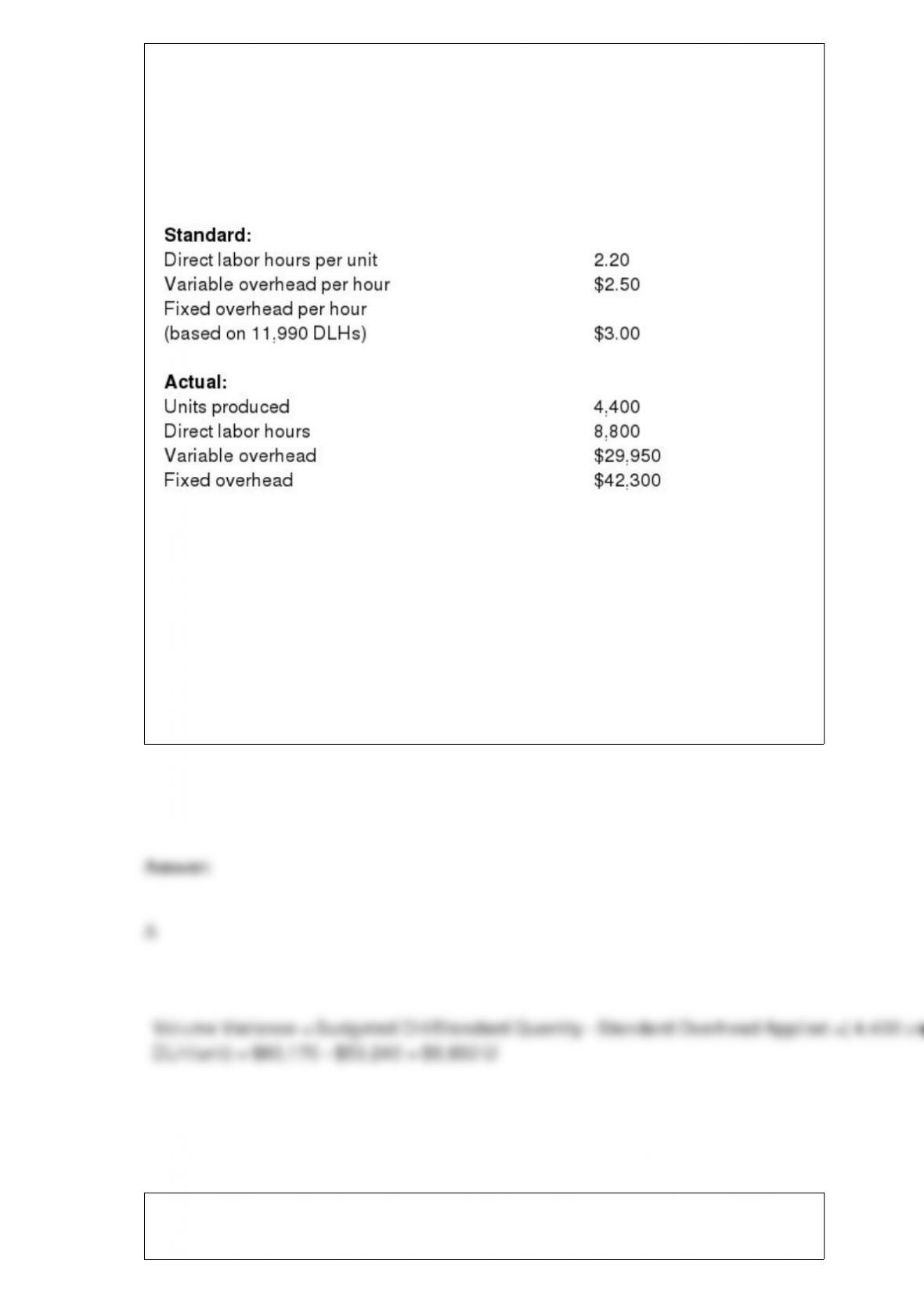
Pearce Company
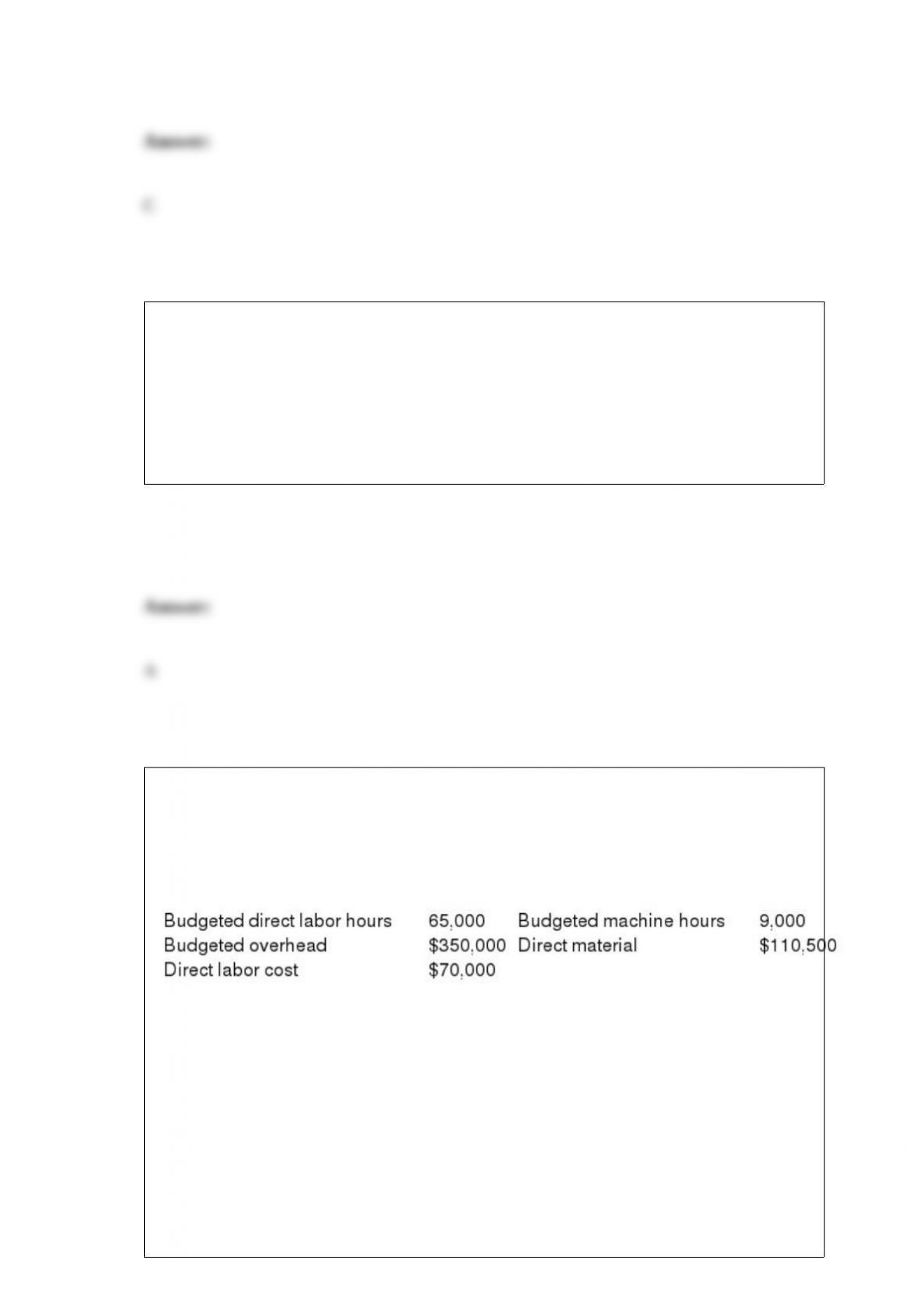
Pearce Company uses a standard cost system for its production process. Pearce
Company applies overhead based on direct labor hours. The following information is
available for July:
Refer to Pearce Company Using the four-variance approach, what is the volume
variance?
a. $6,930 U
b. $13,260 U
c. $0
d. $2,640 F
The Jordan Company makes three products. The cost data for these three products is as
follows:
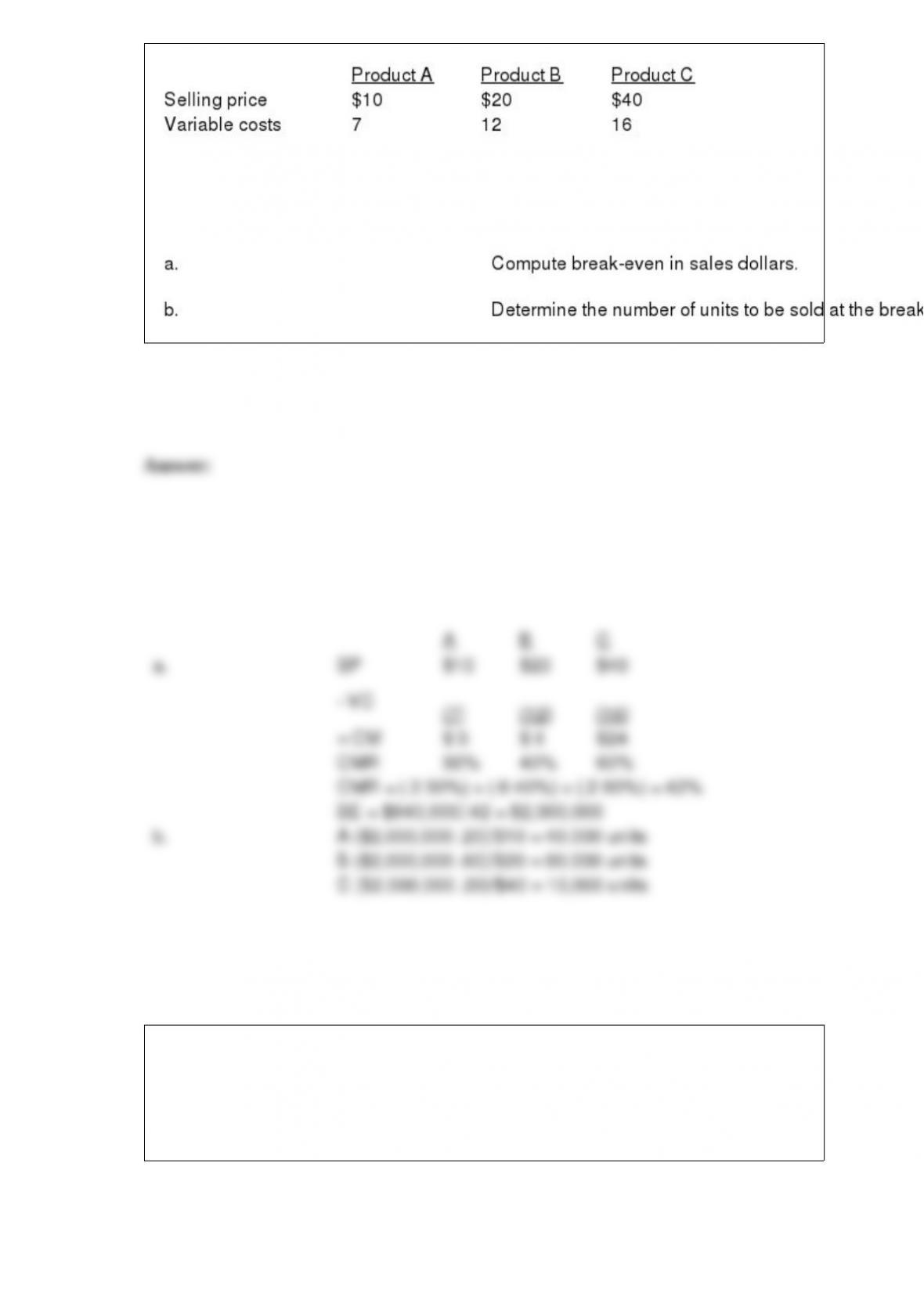
Total annual fixed costs are $840,000. The firm’s experience has been that about 20
percent of dollar sales come from product A, 60 percent from B, and 20 percent from C.
Required:
The Appliance Division
The Appliance Division of Electrotech Corporation reported the following results for a
recent year
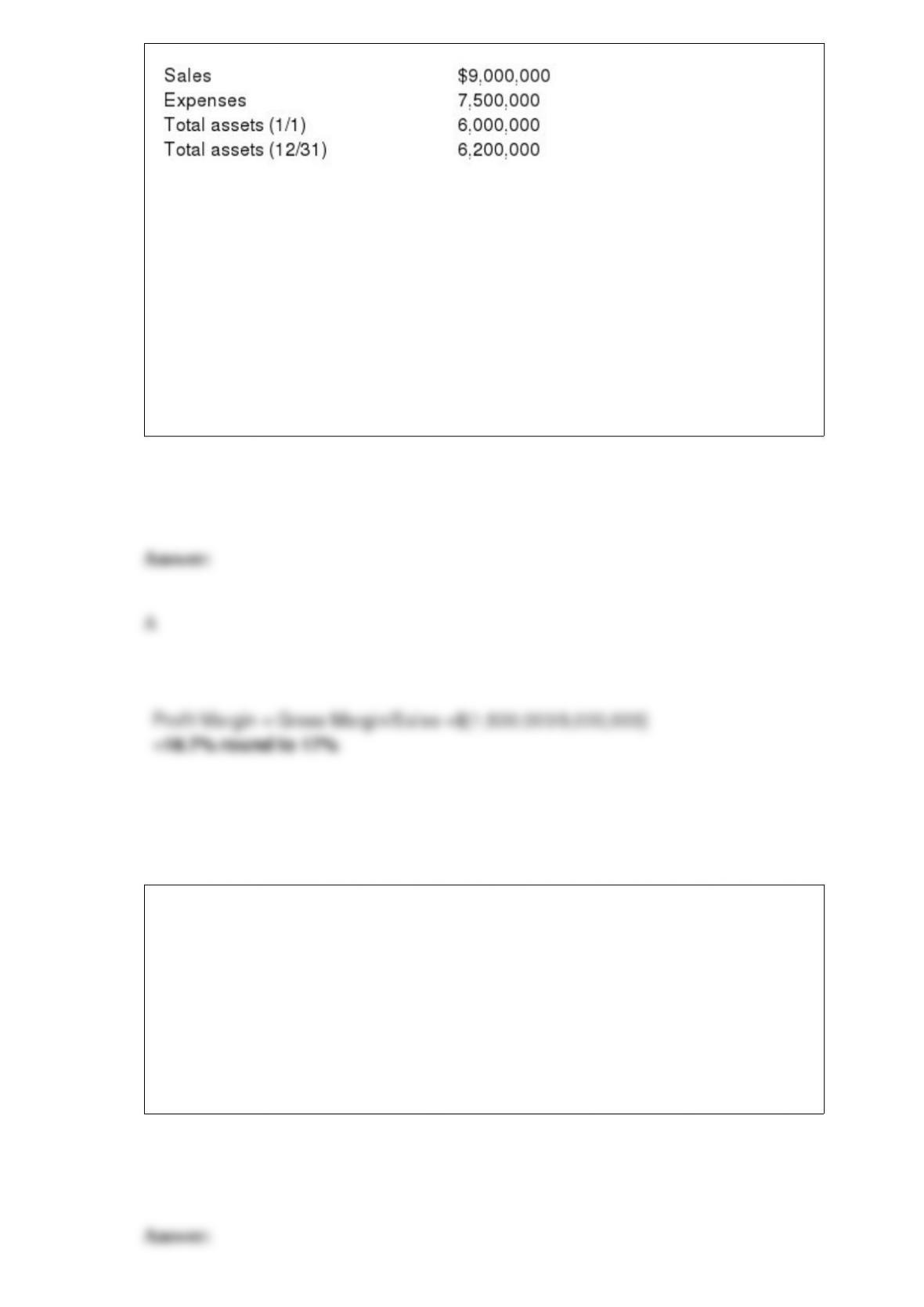
Refer to the Appliance Division
What was the profit margin for The Appliance Division?
a. 17%
b. 24%
c. 25%
d. 69%
If two or more products share a common process before they are separated, the joint
costs should be assigned in a manner that
a. assigns a proportionate amount of the total cost to each product on a quantitative
basis.
b. maximizes total earnings.
c. minimizes variations in unit production costs.
d. does not introduce an element of estimation into the process of accumulating costs
for each product.
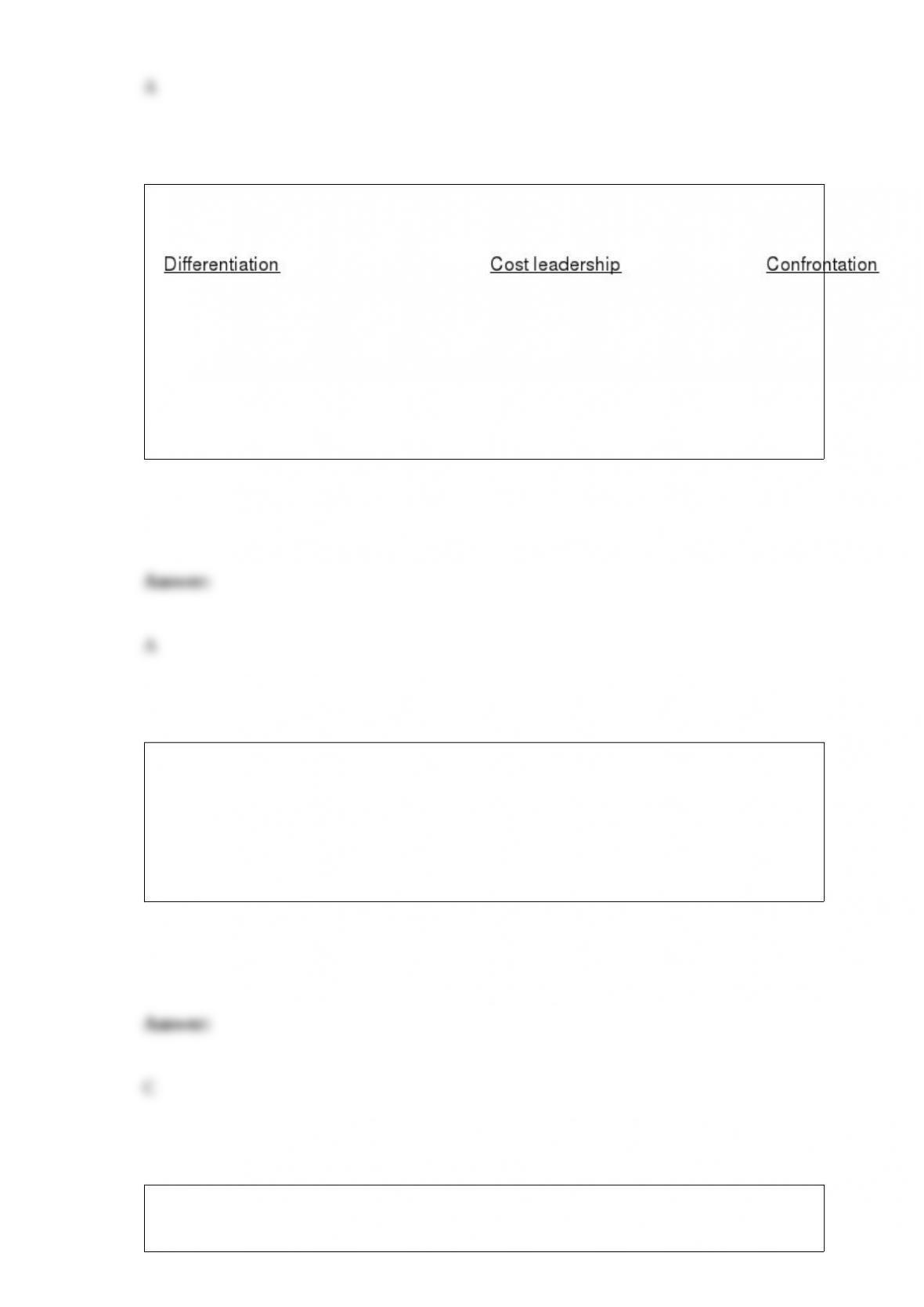
Distinguishing a product by adding additional features or value is part of which of the
following competitive strategies?
a. yes no yes
b. yes yes yes
c. yes no no
d. no yes yes
Overhead is applied to jobs in a job-order costing system
a. at the end of a period.
b. as jobs are completed.
c. at the end of a period or as jobs are completed, whichever is earlier.
d. at the end of a period or as jobs are completed, whichever is later.
If an investment has a positive net present value, the
a. internal rate of return is higher than the discount rate.
b. discount rate is higher than the hurdle rate of return.
c. internal rate of return is lower than the discount rate of return.
d. hurdle rate of return is higher than the discount rate.
The ISO 9000 series refers to
a. international guidelines for quality standards.
b. provisions regarding benchmarking activities in the European Union.
c. guidelines for appropriate expenditures on the various categories of quality costs.
d. all of the above.
The cost of abnormal losses (net of disposal costs) should be written off as
a. yes no
b. yes yes
c. no yes
d. no no

Value engineering seeks to obtain increased
a. product life-cycle and reduced direct labor inputs.
b. planning team membership and reduced time-to-market.
c. product performance ratio and reduced substitute goods.
d. product functionality and reduced costs.
The world has essentially become smaller because of
a. improved technology.
b. trade agreements.
c. better communications systems.
d. all of the above.

The variancemost useful in evaluating plant utilization is the
a. variable overhead spending variance.
b. fixed overhead spending variance.
c. variable overhead efficiency variance.
d. fixed overhead volume variance.
Strategic alliances take the form of
a. joint ventures.
b. technology swaps.
c. licensing.
d. all of the above.
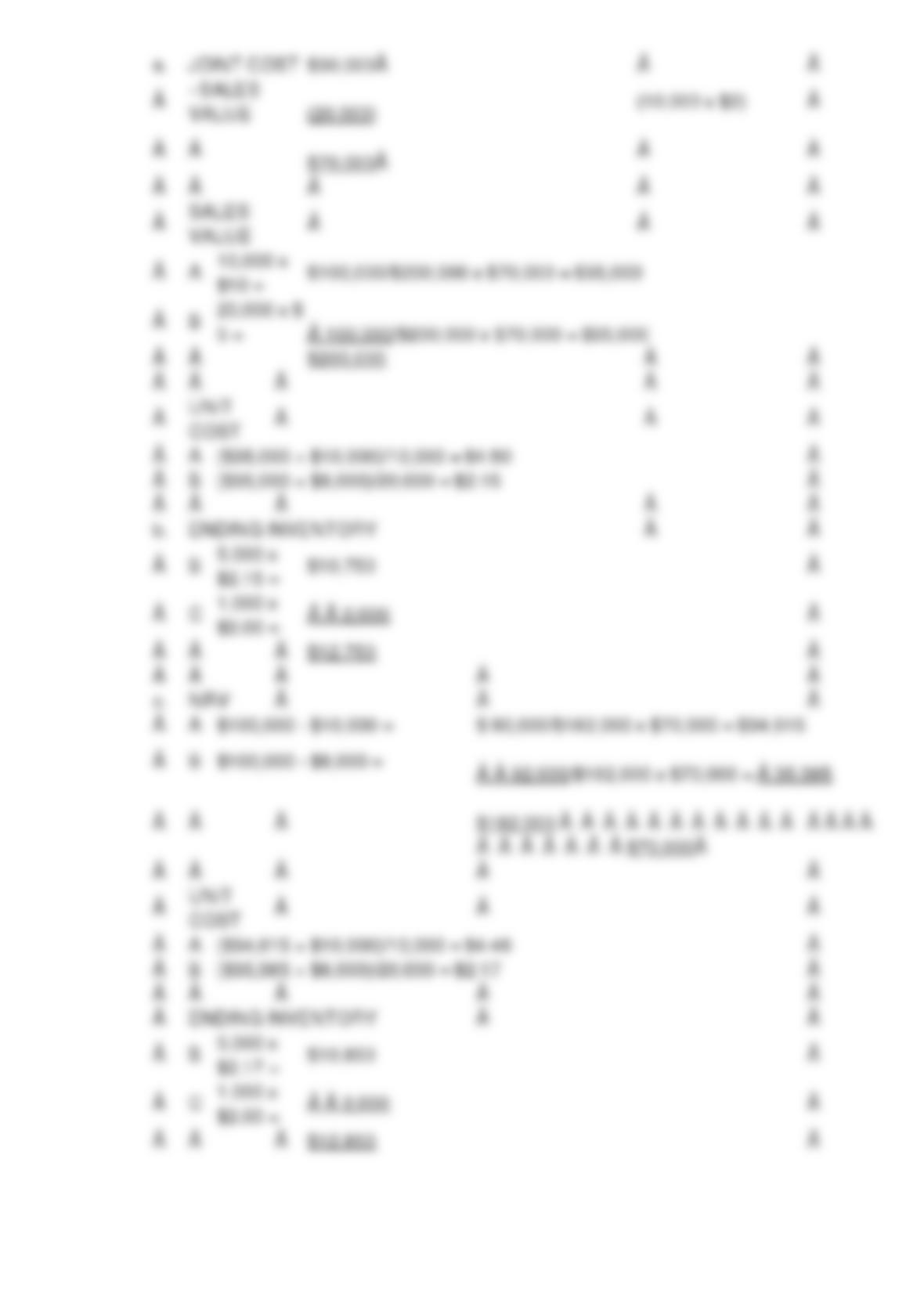
Arnold Company processes raw material in Department 1 from which come two main
products, A and B, and a by-product, C. A is further processed in Department 2, B in
Department 3, and C in Department 4. The value of the by-product reduces the cost of
the main products, and sales value is used to allocate joint costs.
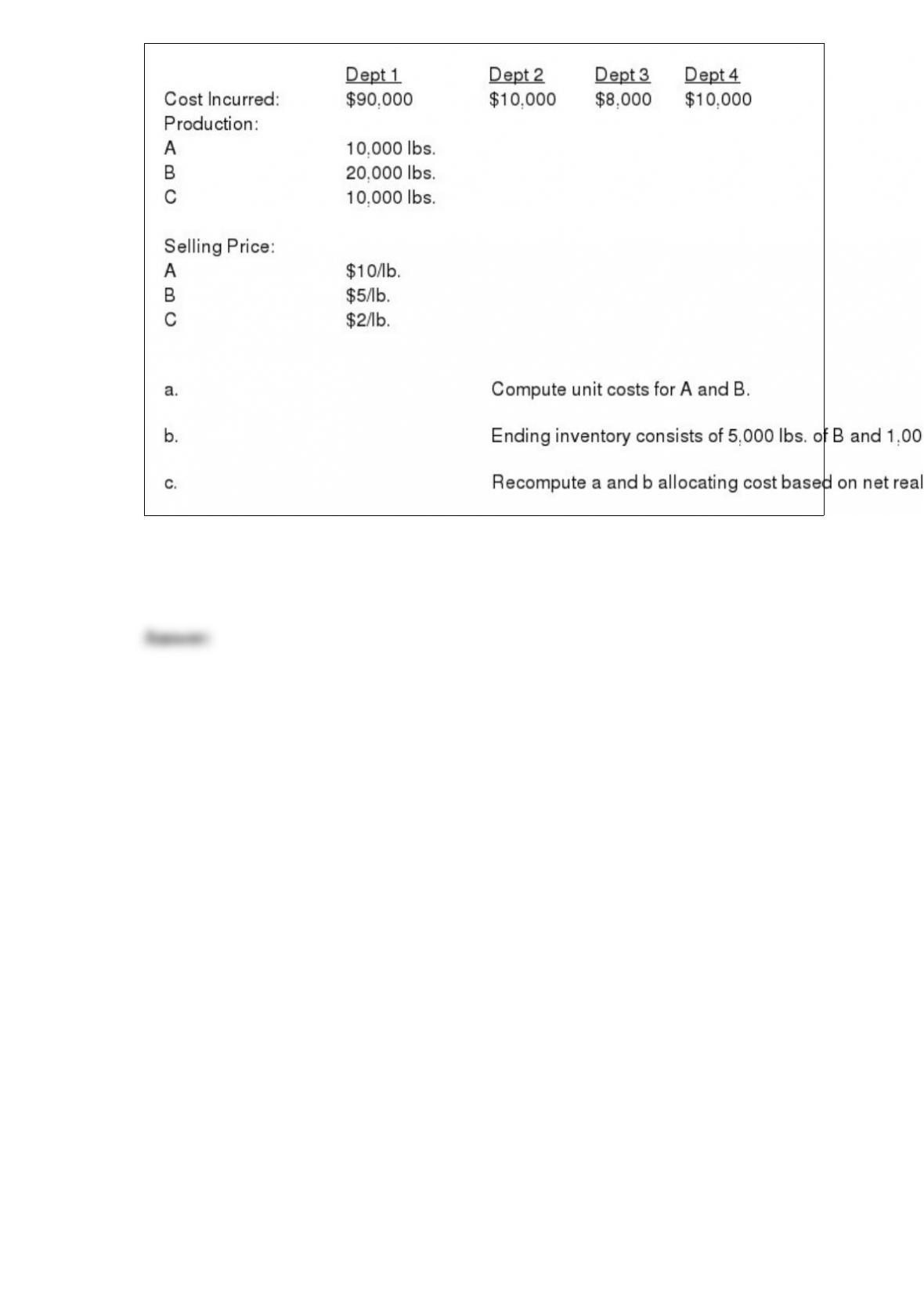
Required:
The FIFO method of process costing will produce the same cost of goods transferred
out amount as the weighted average method when
a. the goods produced are homogeneous.
b. there is no beginning Work in Process Inventory.
c. there is no ending Work in Process Inventory.
d. beginning and ending Work in Process Inventories are each 50 percent complete.
Benchmarking allows a company to
a. identify its strengths and weaknesses.
b. imitate those ideas that are readily transferable.
c. improve on methods in use by others.
d. all of the above.
A just-in-time manufacturing process should have substantially lessof which of the
following than a traditional manufacturing process?
a. yes yes yes yes
b. yes no no yes
c. yes yes no yes
d. no yes yes no
Joint costs are allocated to joint products to
a. obtain a cost per unit for financial statement purposes.
b. provide accurate management information on production costs of each type of
product.
c. compute variances from expected costs for each joint product.
d. allow the use of high-low analysis by the company.
Davis Company
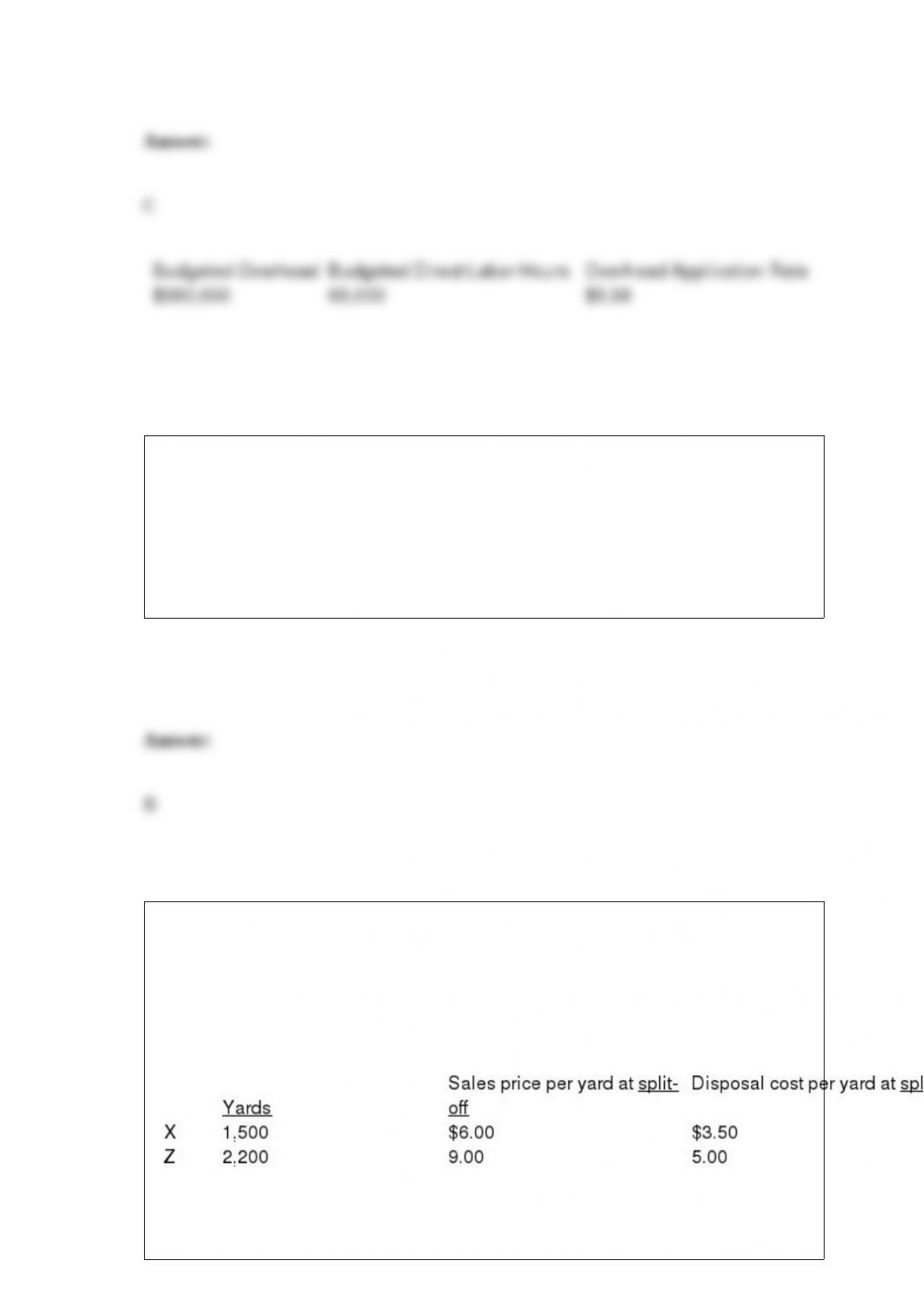
Davis Company uses a job-order costing system. Assume that Job #504 is the only one
in process. The following information is available:
Refer to Davis Company. What is the overhead application rate if Davis uses a
predetermined overhead application rate based on direct labor hours (rounded to the
nearest whole dollar)?
a. $ 0.20
b. $ 5.00
c. $ 5.38
d. $38.89
Which of the following replaces the retailing component “Purchases” in computing
Cost of Goods Sold for a manufacturing company?
a. direct material used
b. cost of goods manufactured
c. total prime cost
d. cost of goods available for sale
Chambers Company
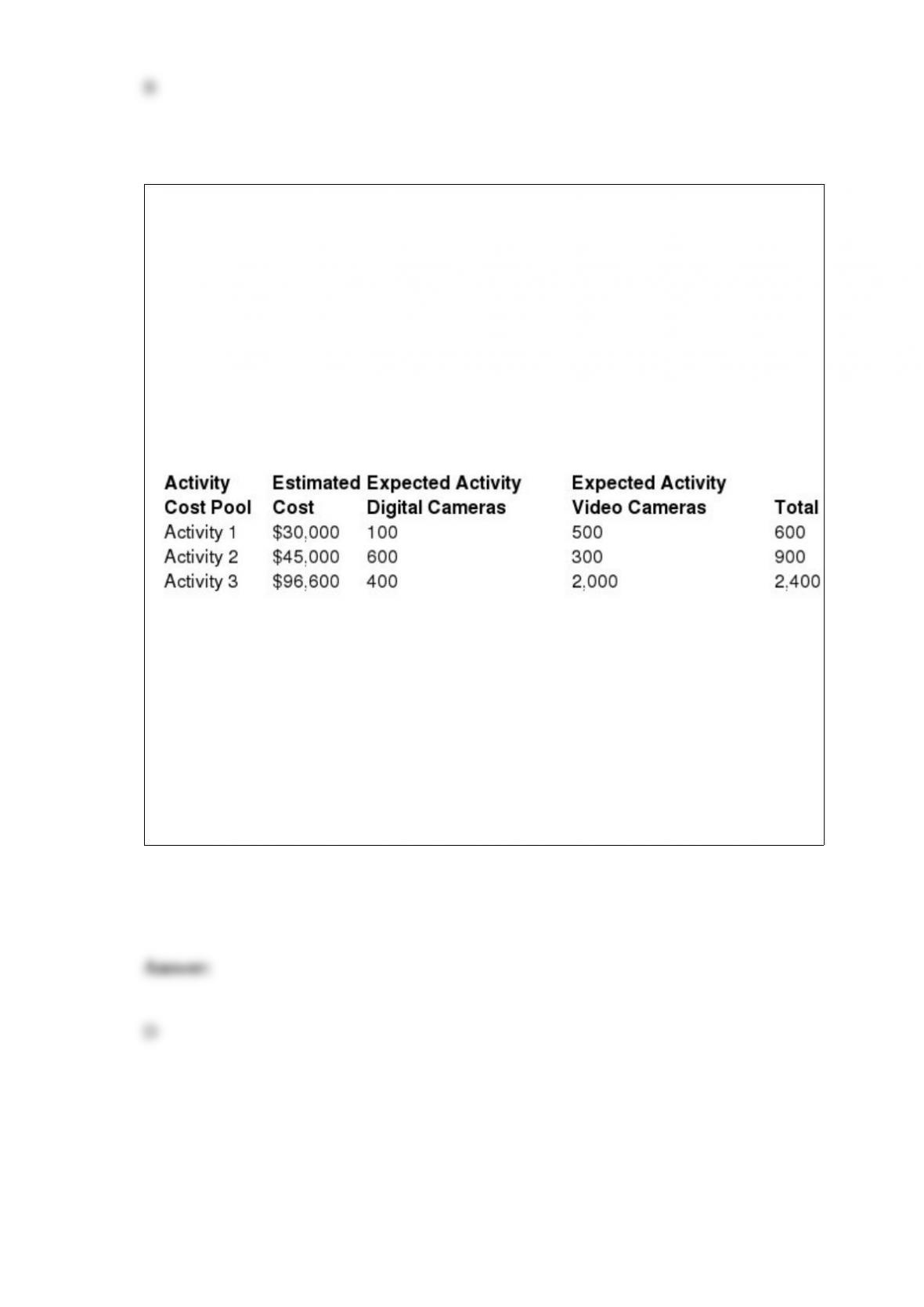
Chambers Company produces two products from a joint process: X and Z. Joint
processing costs for this production cycle are $8,000.
If X and Z are processed further, no disposal costs will be incurred or such costs will be
borne by the buyer.

Refer to Chambers Company. Using a physical measure, what amount of joint
processing cost is allocated to Product X (round to the nearest dollar)?
a. $4,000
b. $4,757
c. $5,500
d. $3,243
Sterling Vision Corporation
Sterling Vision Corporation manufactures various glass products including a car
window. The setup cost to produce the car window is $1,200. The cost to carry a
window in inventory is $3 per year. Annual demand for the car window is 12,000 units.
Refer to Sterling Vision Corporation. If the annual demand for the car window was to
increase to 15,000 units,
a. the number of setups would decrease.
b. the total carrying costs would increase.
c. the economic order quantity would decline.
d. all of the above would occur.
Morrison Company
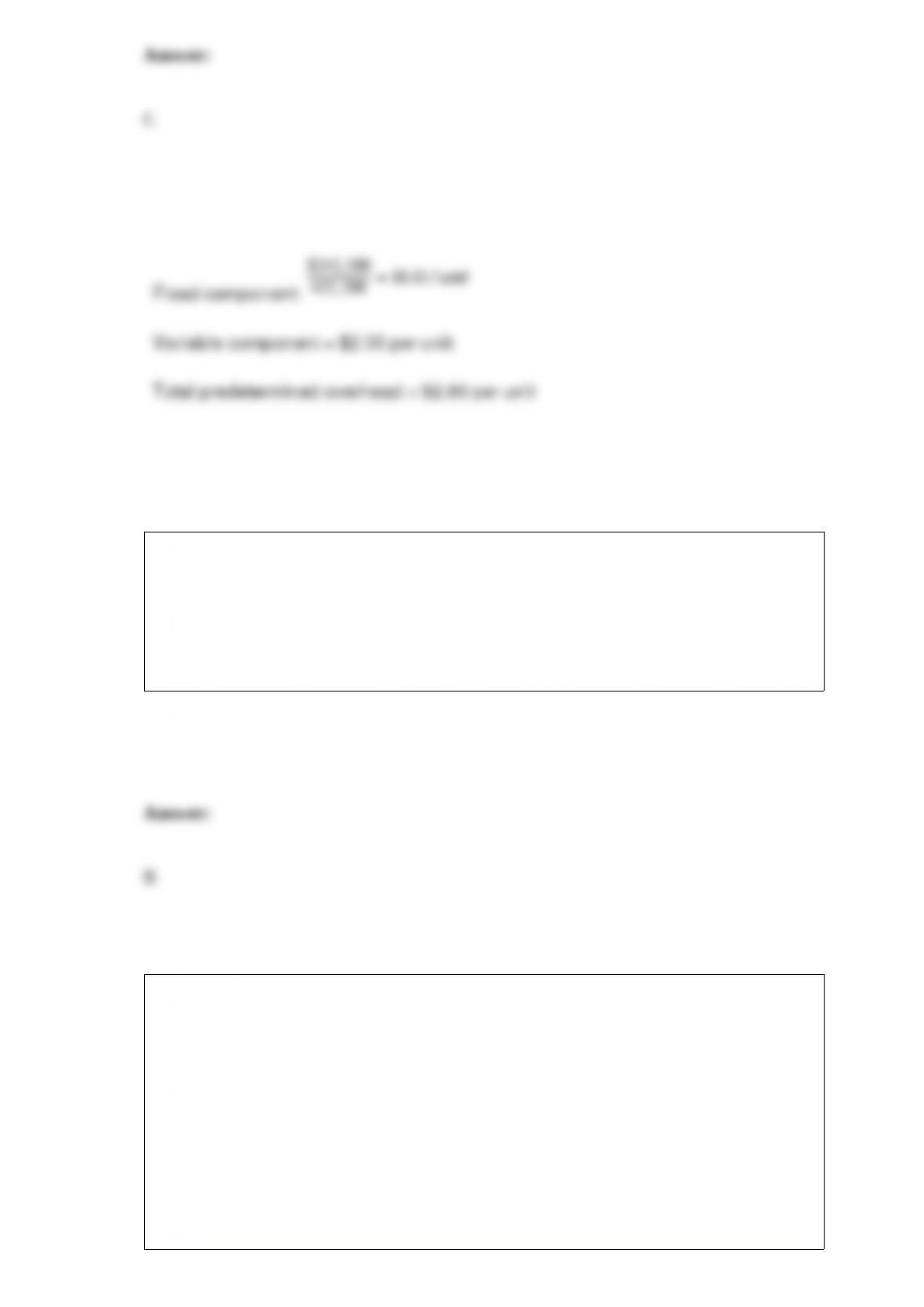
Morrison Company manufactures two products: digital cameras and video cameras. The
company uses an activity-based costing system. The annual production and sales
volume of digital cameras is 10,000 units and of video cameras is 8,000 units. Direct
costs for the digital cameras are $122; for the video cameras, direct costs are $153.
For overhead costs, there are three activity cost pools with the following expected
activities and estimated total costs:
Refer to Morrison Company. Using ABC, the total cost per video camera is
approximately:
a. $162.50
b. $163.69
c. $168.35
d. $168.07

All other factors equal, which of the following would affect a project’s internal rate of
return, net present value, and payback period?
a. an increase in the discount rate
b. a decrease in the life of the project
c. an increase in the initial cost of the project
d. all of the above
Landon Corporation wishes to develop a single predetermined overhead rate. The
company’s expected annual fixed overhead is $340,000 and its variable overhead cost
per machine hour is $2. The company’s relevant range is from 200,000 to 600,000
machine hours. Landon expects to operate at 425,000 machine hours for the coming
year. The plant’s theoretical capacity is 850,000. The predetermined overhead rate per
machine hour should be
a. $2.40.
b. $2.57.
c. $2.80.
d. $2.85.
For cost control purposes, fixed costs are classified as
a. product or period costs.
b. discretionary or committed.
c. direct or common.
d. sunk or avoidable.
On December 30, a fire destroyed most of the accounting records of the Stone Division,
a small one-product manufacturing division that uses standard costs and flexible
budgets. All variances are written off as additions to (or deductions from) income; none
are pro-rated to inventories. You have the task of reconstructing the records for the year.
The general manager informs you that the accountant has been experimenting with both
absorption costing and variable costing.
The following information is available for the current year:
a. Cash on hand, December 31 $10
b. Sales $128,000
c. Actual fixed indirect manufacturing costs 21,000
d. Accounts receivable, December 31 20,000
e. Standard variable manufacturing costs per unit 1
f. Variances from standard of all variable manufacturing costs $5,000 U
g. Operating income, absorption-costing basis $14,400
h. Accounts payable, December 31 18,000
i. Gross profit, absorption costing at standard (before deducting variances)
22,400
j. Total liabilities 100,000
k. Unfavorable budget variance, fixed manufacturing costs 1,000 U
l. Notes receivable from chief accountant 4,000
m. Contribution margin, at standard (before deducting variances) 48,000
n. Direct-material purchases, at standard prices 50,000
o. Actual selling and administrative costs (all fixed) 6,000
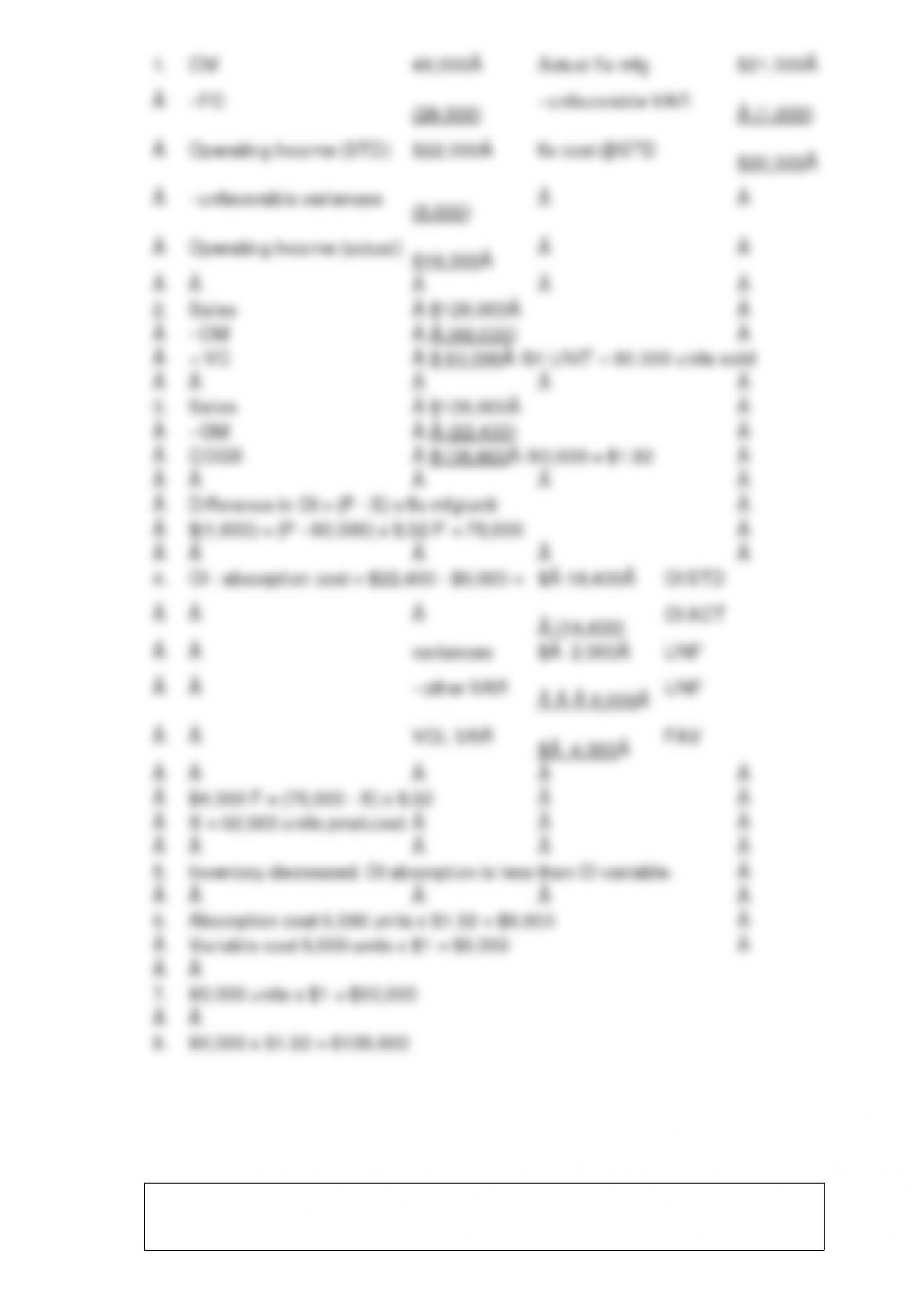
Required:
Compute the following items (ignore income tax effects).
When cost relationships are linear, total variable prime costs will vary in proportion to

changes in
a. direct labor hours.
b. total material cost.
c. total overhead cost.
d. production volume.
Answer the following questions regarding economic value added (EVA):
a. What is it intended to do?
b. How is it measured?
c. How is the measurement different than that of RI?
d. Why is EVA a better performance measure of RI?
e. What is the major problem with using EVA as a long-term performance measure?

Which of the following statements is false? The cost of rework on defective units, if
a. abnormal, should be assigned to a loss account.
b. normal and if actual costs are used, should be assigned to material, labor and
overhead costs of the good production.
c. normal and if standard costs are used, should be considered when developing the
overhead application rate.
d. abnormal, should be prorated among Work In Process, Finished Goods, and Cost of
Goods Sold.
Favorable variances are represented by debit balances in the overhead account.
Batch level costs occur once for each unit produced.

As production becomes more automated, direct labor may be viewed more as a
conversion cost than as a prime cost.
Financial accounting is most concerned with meeting the needs of internal users.
Profit margin Asset Turnover is often referred to as the _________________________.
What is a “job” as defined in a job-order costing system?
When multiple materials are used, the effect of substituting a non-standard mix of
materials during the production process is referred to as a ____________________
variance.
All manufacturing costs other than direct materials are referred to as
_________________________.
Total quality management requires that an organization analyze the costs and benefits of
each of its customer segments.

Standards can be used in a job-order costing system if the products manufactured are
similar in nature.
Costs incurred to correct defects in products prior to shipment are referred to as
________________________________________.
Abnormal spoilage is always accounted for on an equivalent unit basis.
Define segment margin and explain why it is a relevant measure of a segment’s
contribution to overall organizational profitability.
The amount of cost that differs across decision choices is referred to as
_________________________.
Kinney Corporation estimates that it will consume 400,000 units of Part 303 in the
coming year. The ordering cost for this unit is $3.20. Kinney Corporation wants to
maintain a safety stock of 1,000 units, and its factory operates 200 days per year. What
is the order point if the lead time is 2 days?
Discuss the assignment of costs to transferred-out inventories in both process costing
methods.
Break-even point may be expressed in terms of units or dollars.