A company started the current year with assets of $700,000, liabilities of $350,000 and
contributed capital of $200,000. During the current year, assets increased by $400,000,
liabilities decreased by $50,000 and contributed capital increased by $275,000. There
was no payment of dividends to owners during the year.
What was the amount of the change in total stockholders’ equity during the year?
A. $350,000 increase
B. $450,000 increase
C. $250,000 increase
D. $200,000 increase
Answer:
In March, BetterBuy purchases six plasma TVs from Toshiba for $1,500 each (serial
numbers 11534892 through 11534897). In April, the company purchases four more
identical TVs from Toshiba for $1,450 each (serial numbers 11542631 through
11542634). In May, the company purchases five more identical TVs for $1,600 each
(serial numbers 11550964 through 11550968). In June, BetterBuy sells two of these
TVs (serial numbers 11534894 and 11542631).
Use the information above to answer the following question. BetterBuy records $3,000
as the cost of goods sold. BetterBuy is using the:
A. Specific identification method.
B. LIFO method.
C. FIFO method.
D. Weighted average cost method.
Answer:
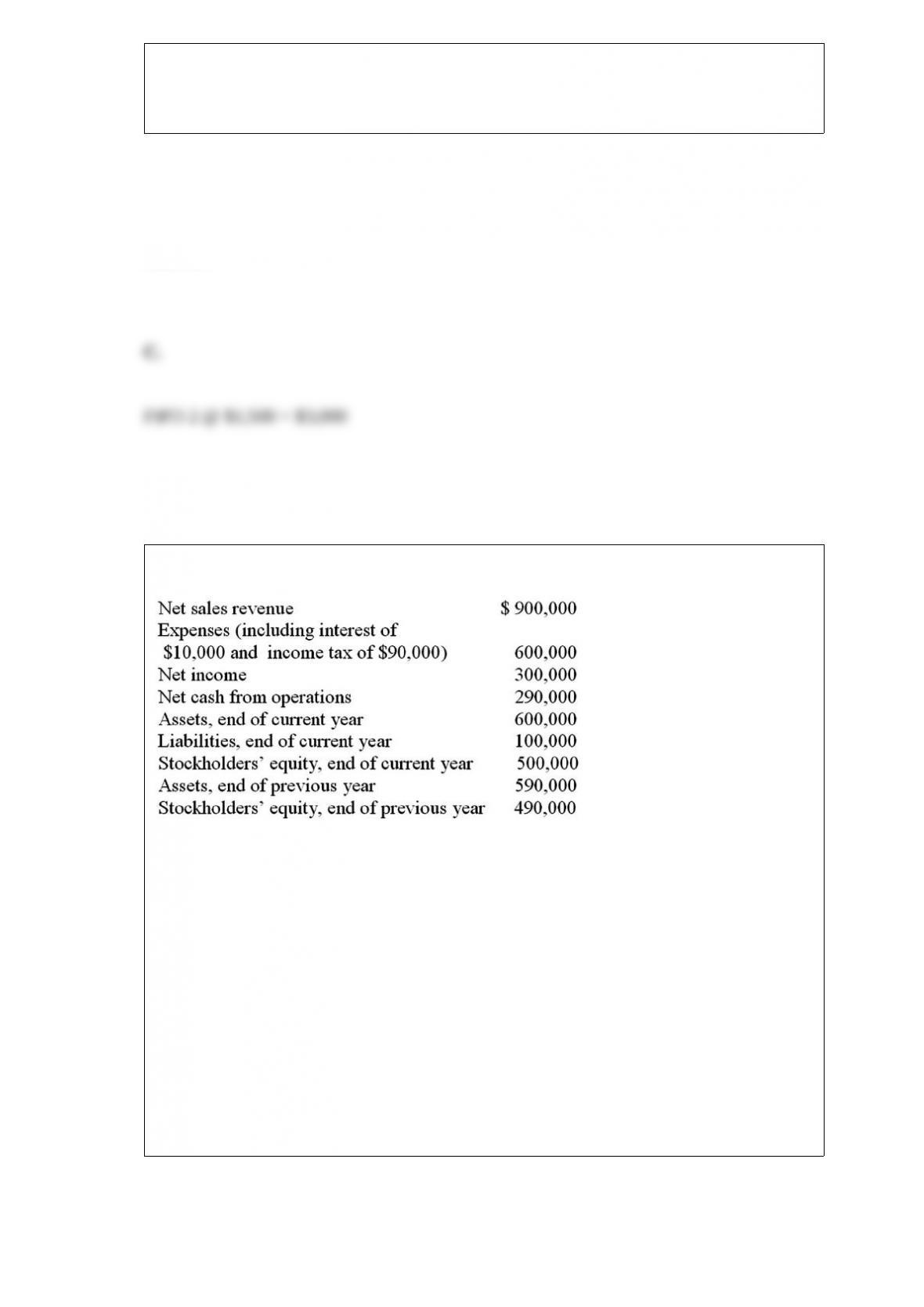
The following information is taken from the financial statements of B. Darin Company:
In addition, there was an average of 40,000 shares of common stock outstanding and
the current market price of the stock is $15 per share.
Use the information above to answer the following question. Which of the following is
closest to the company’s asset turnover ratio for the current year?
A. 0.50
B. 1.51
C. 1.80
D. 2.00
Answer:
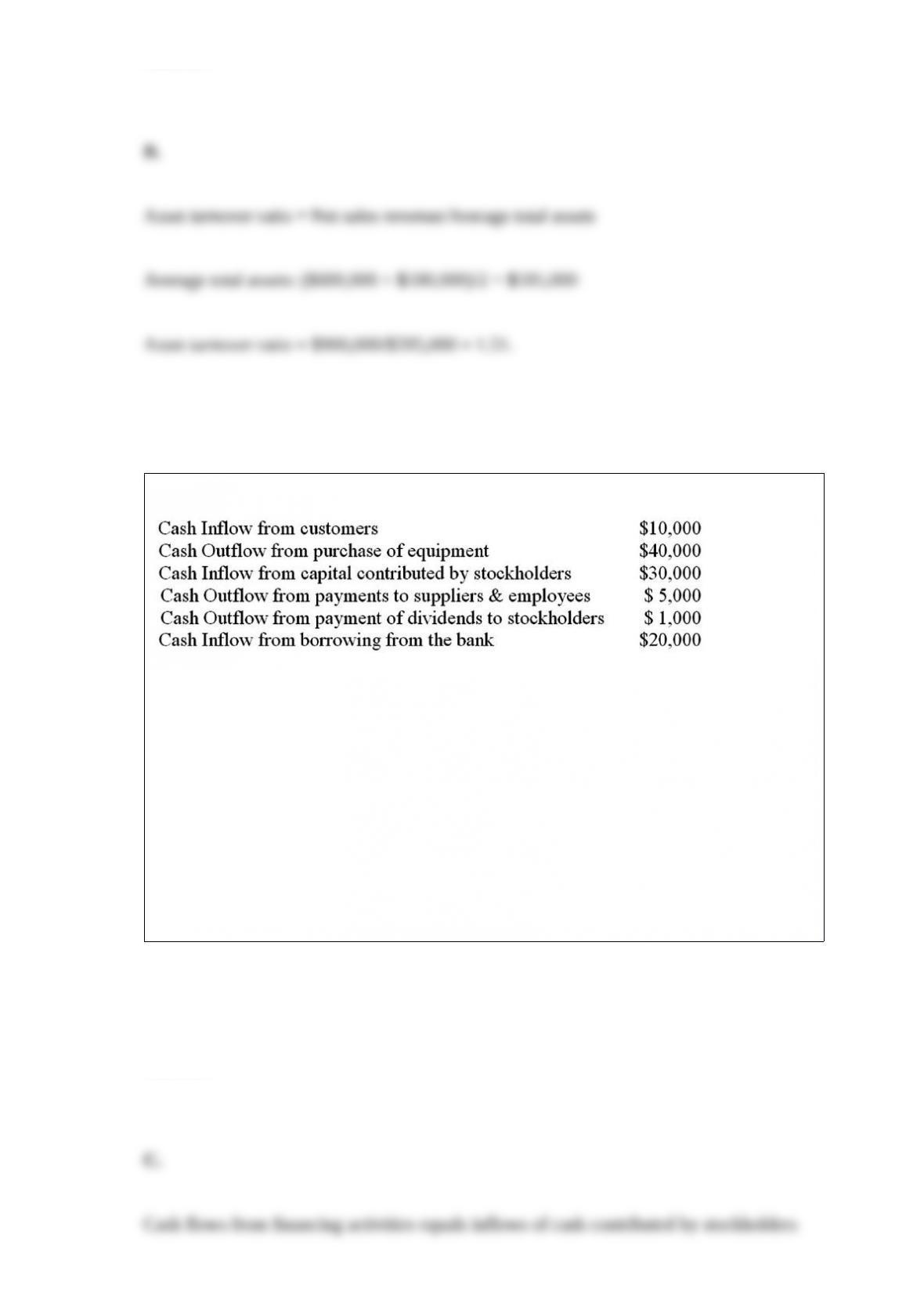
The Statement of Cash Flows for the current year contained the following:
The change in cash for the current year was an increase of $14,000.
What is the amount of Cash Flows from Financing Activities?
A. Cash outflow of $40,000
B. Cash inflow of $5,000
C. Cash inflow of $49,000
D. Cash inflow of $10,000
Answer:
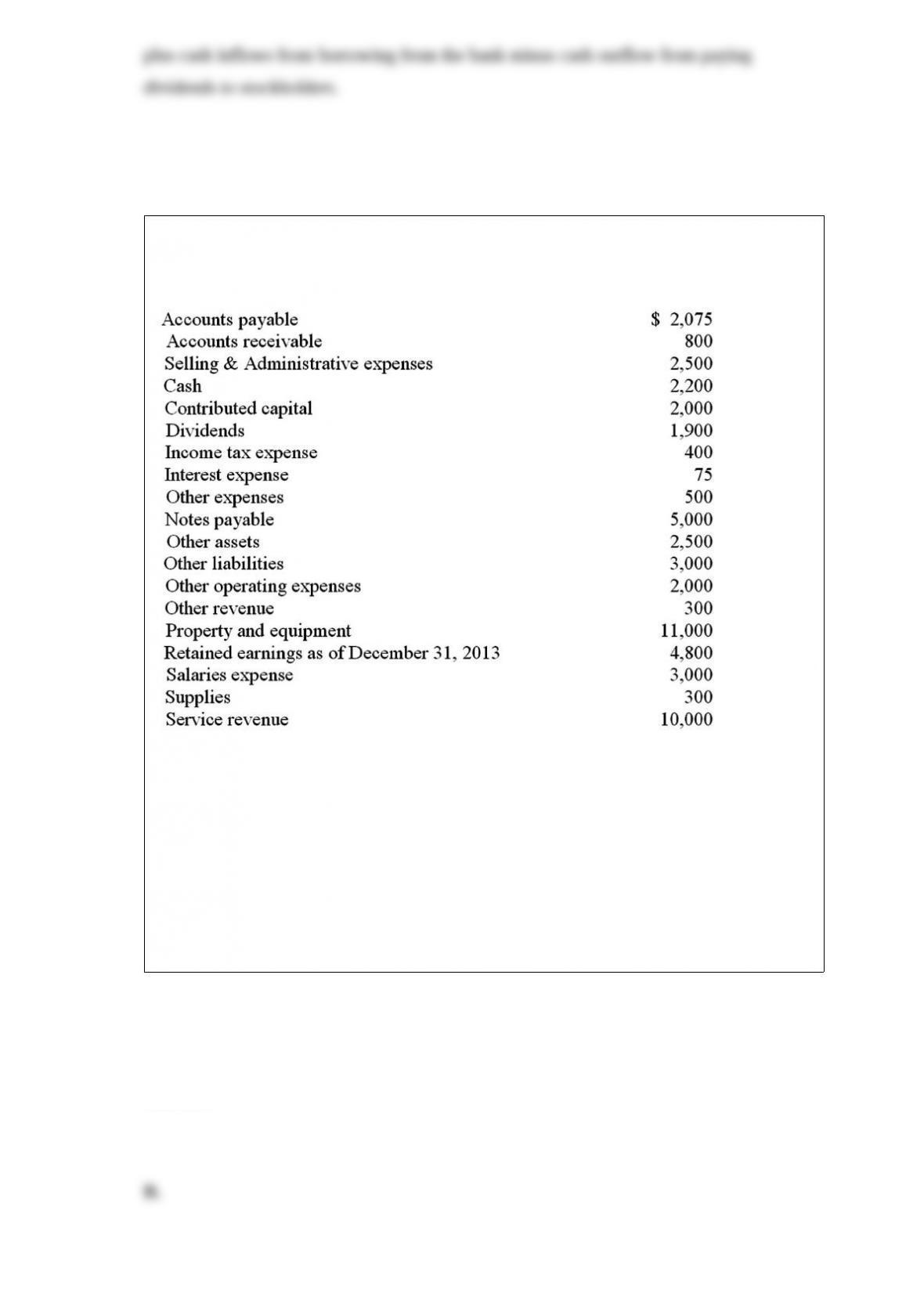
The following accounts are taken from the December 31, 2014 financial statements of a
company.
What is the amount of net income for the year 2014?
A. $3,825.
B. $1,825.
C. $10,300.
D. $5,625.
Answer:
Cash transactions relating to the purchase and sale of which types of assets affect a
company’s cash flows from investing activities?
A. All of a company’s assets.
B. All of a company’s assets except inventory.
C. All of a company’s non-current assets.
D. Only property, plant and equipment.
Answer:
On the payment date for a dividend, the company:
A. debits Dividends Declared and credits Dividends Payable for the amount of the
dividend.
B. debits Dividend Expense and credits Cash for the dividend amount.
C. debits Dividends Payable and credits Cash for the dividend amount.
D. establishes who will receive the dividend payment.
Answer:
When are adjusting entries made?
A. At the beginning of the accounting period.
B. At the end of the accounting period.
C. Daily.
D. Weekly.
Answer:
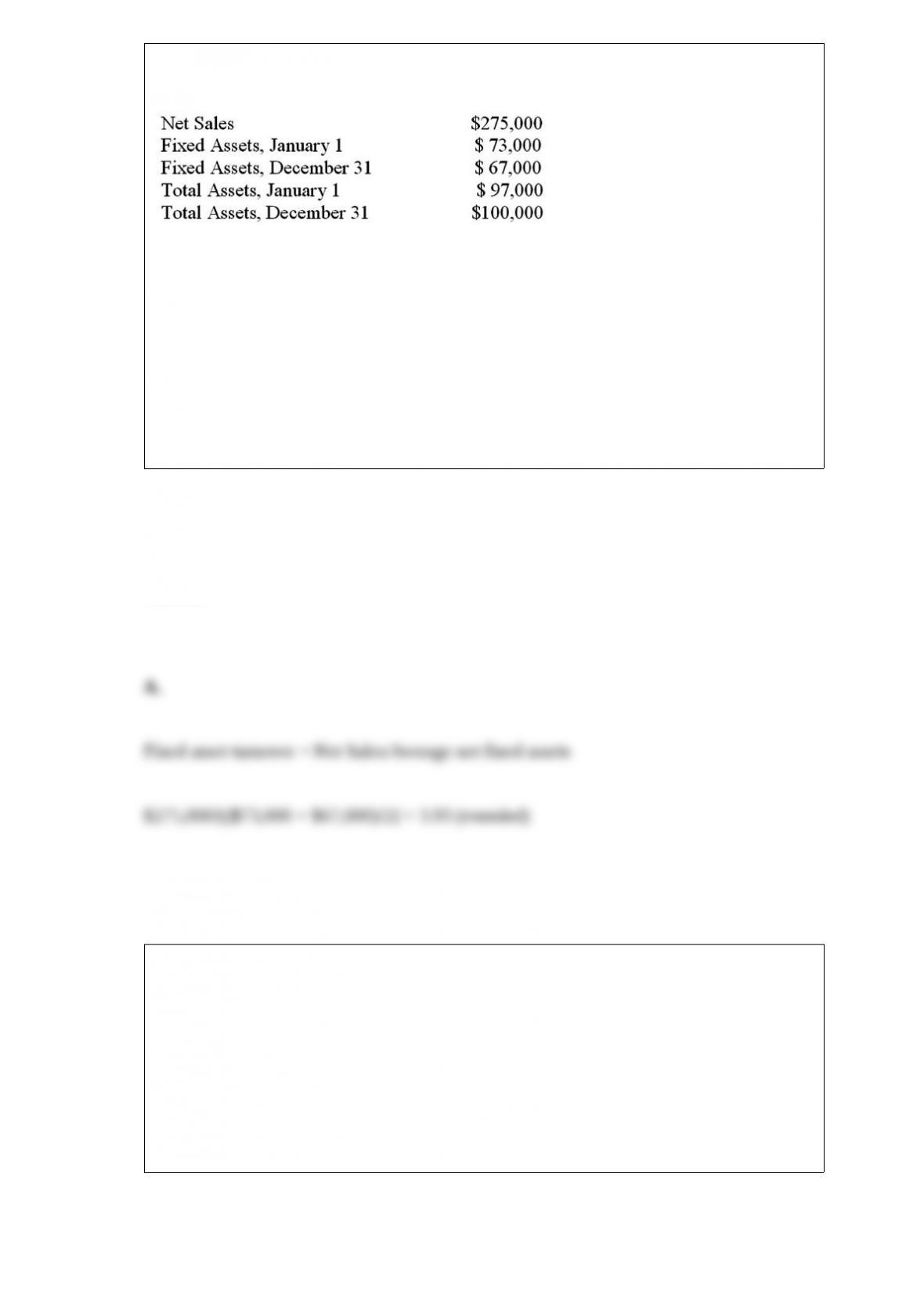
T. Powers Company’s financial statements on December 31, 2013, showed the
following:
What is the fixed asset turnover for 2013 (rounded to two decimal places)?
A. 3.93
B. 2.60
C. 4.10
D. 2.79
Answer:
Lower of cost or market is an application of which accounting principle?
A. Consistency
B. Conservatism
C. Matching
D. Accrual Basis

Answer:
Which of the following is an activity common to the operations of merchandising,
manufacturing, and service companies?
A. Producing the product.
B. Incurring operating expenses.
C. Buying goods or raw materials.
D. Selling a physical product.
Answer:
At the end of the month, the adjusting journal entry to record the use of supplies would
include:
A. A debit to supplies and a credit to supplies expense.
B. A debit to supplies expense and a credit to supplies.
C. A debit to supplies and a credit to revenue.
D. A debit to supplies and a credit to cash.
Answer:
If a company uses the indirect method to determine cash flows from operating
activities:
A. gains must be added to net income and losses subtracted from net income.
B. gains and losses must be added to net income.
C. gains must be subtracted from net income and losses added to net income.
D. gains and losses must be subtracted from net income.
Answer:
When the direct method is used to determine the cash flows from operating activities,
which of the following adjustments must be made to income tax expense to determine
total income tax payments?
A. Add all changes in income taxes and income taxes payable.
B. Add decreases in income taxes payable and subtract increases in income taxes
payable.
C. Add increases in income taxes payable and subtract decreases in income taxes
payable.
D. Subtract all changes in income taxes payable.
Answer:
If a company’s gross wages are $12,000, and it withholds $1,800 for income taxes and
$800 for FICA taxes and other deductions, the journal entry to record the employees’
pay should include a:
A. debit to Wages Expense for $9,400.
B. debit to Wages Payable for $9,400.
C. credit to Wages Payable for $12,000.
D. credit to Wages Payable for $9,400.
Answer:
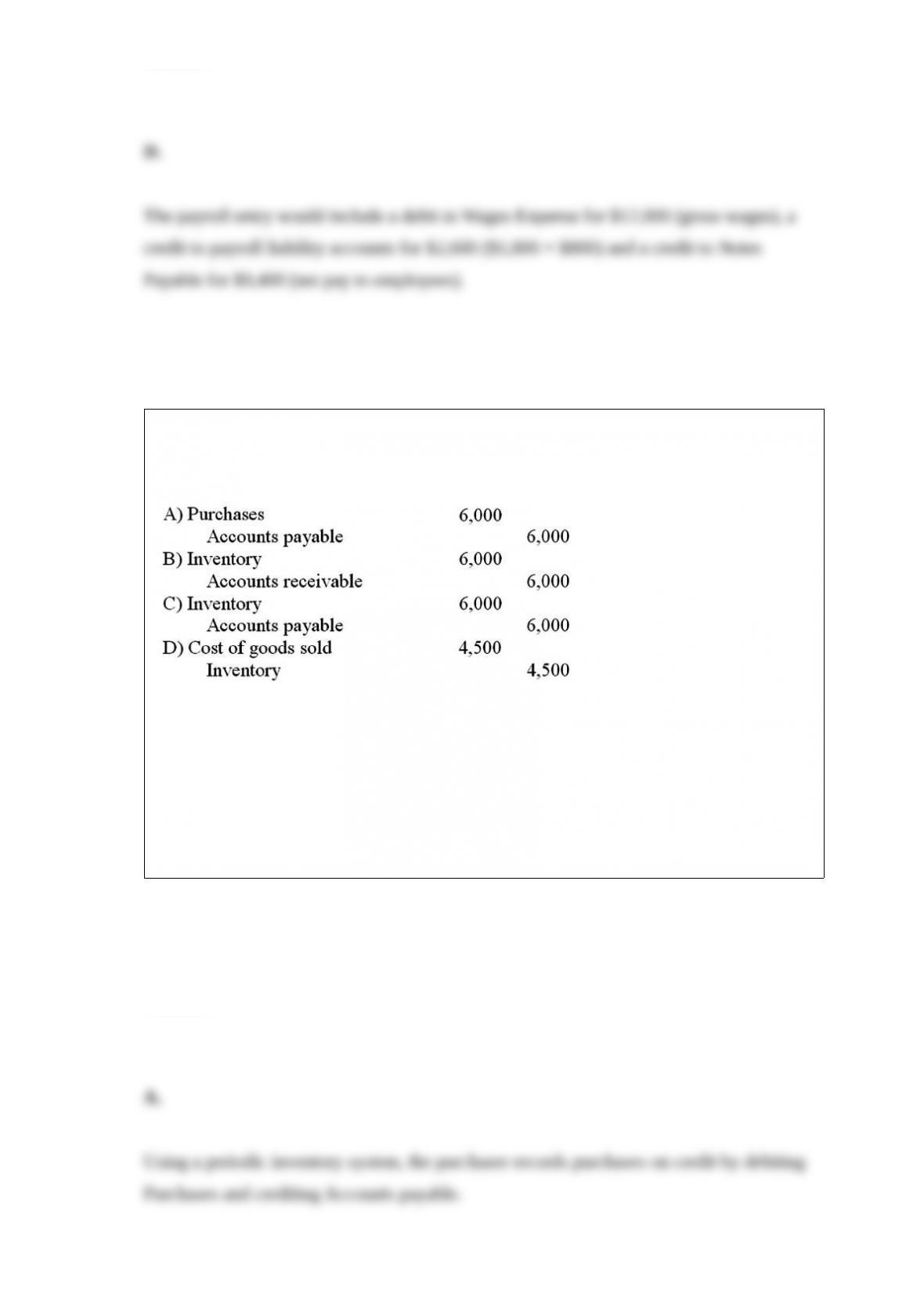
On July 1, B. Darin Company sold merchandise costing $4,500 to S. Dee Company for
$6,000, terms 2/10, n/30. Both companies use a periodic inventory system. What is the
journal entry that S. Dee Company will make on July 1?
A. Option A
B. Option B
C. Option C
D. Option D
Answer:
In the U.S., public companies have to be audited by independent auditors using rules
approved by the:
A. 1933 Securities Act.
B. Public Company Accounting Oversight Board (PCAOB).
C. Financial Accounting Standards Board (FASB).
D. American Institute of Certified Public Accountants (AICPA).
Answer:
A cumulative dividend preference means that:
A. preferred stockholders are paid dividends before common stockholders are paid
dividends for the current year only.
B. unpaid dividends to preferred stockholders accumulate and must be paid before
common stockholders receive dividends.
C. preferred stockholders are paid their full fixed dividend rate each period as long as
the company is in operation.
D. unpaid cash dividends to preferred stockholders must be replaced with stock
dividends during the current period.

Answer:
A company reported net income of $6 million. During the year the average number of
common shares outstanding was 3 million. The price of a share of common stock at the
end of the year was $5. There were 400,000 shares of preferred stock outstanding on
average and no dividends were declared and the preferred stock is noncumulative.
Use the information above to answer the following question. The EPS is approximately:
A. $0.40.
B. $1.76.
C. $1.86.
D. $2.00.
Answer:
The fixed asset turnover is the
A. number of sales dollars generated by each dollar of total assets.
B. rate at which inventories are being rotated.
C. number of dollars in notes payable generated by each dollar in fixed assets.
D. number of sales dollars generated by each dollar of fixed assets.
Answer:
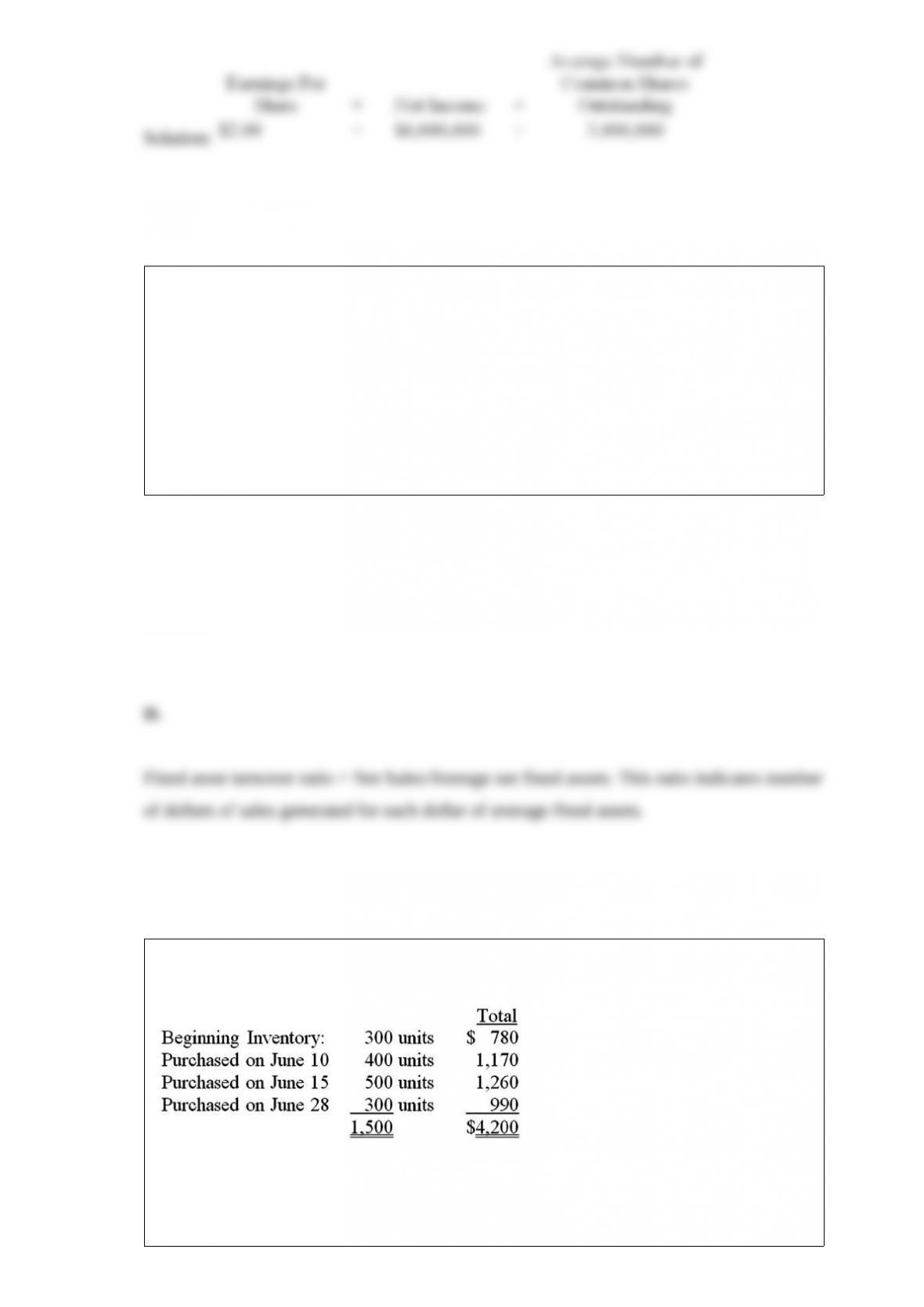
BAF Company uses a periodic inventory system and its inventory records for June
contain the following information:
The company sold 1,000 units during June and 500 units were in its ending inventory
on June 30.

Use the information above to answer the following question. If the company uses the
LIFO costing method, what is the cost of its ending inventory?
A. $1,365.
B. $1,494.
C. $1,620.
D. $2,835.
Answer:
The going-concern assumption states that the:
A. company will always maximize the profit for stockholders.
B. company is not expected to go out of business in the near future.
C. company is a separate concern from the stockholders.
D. company’s results will be reported in a consistent manner from period to period.
Answer:
A company has positive cash flow from investing and financing activities, but negative
cash flow from operating activities. The likely result is
A. investors may not buy the company’s stock because dividends are unlikely.
B. investors will continue to buy stock since the company’s growth prospects are good.
C. creditors will continue to lend money to the company.
D. creditors will demand immediate repayment of all outstanding debt.
Answer:
Use of a cash register or point of sale terminal addresses all of the following internal
control principles, except which one?
A. Restrict access.
B. Document transactions.
C. Independently verify.
D. Segregate duties.
Answer:
Which of the following statements about stock options is false?
A. Stock options are intended to give upper management the same goals as
stockholders.
B. When stock options are exercised by upper management, existing stockholders lose
voting power.
C. Stock options may create an incentive for upper management to overstate net
income.
D. An expense is reported by the company when stock options are exercised.
Answer:
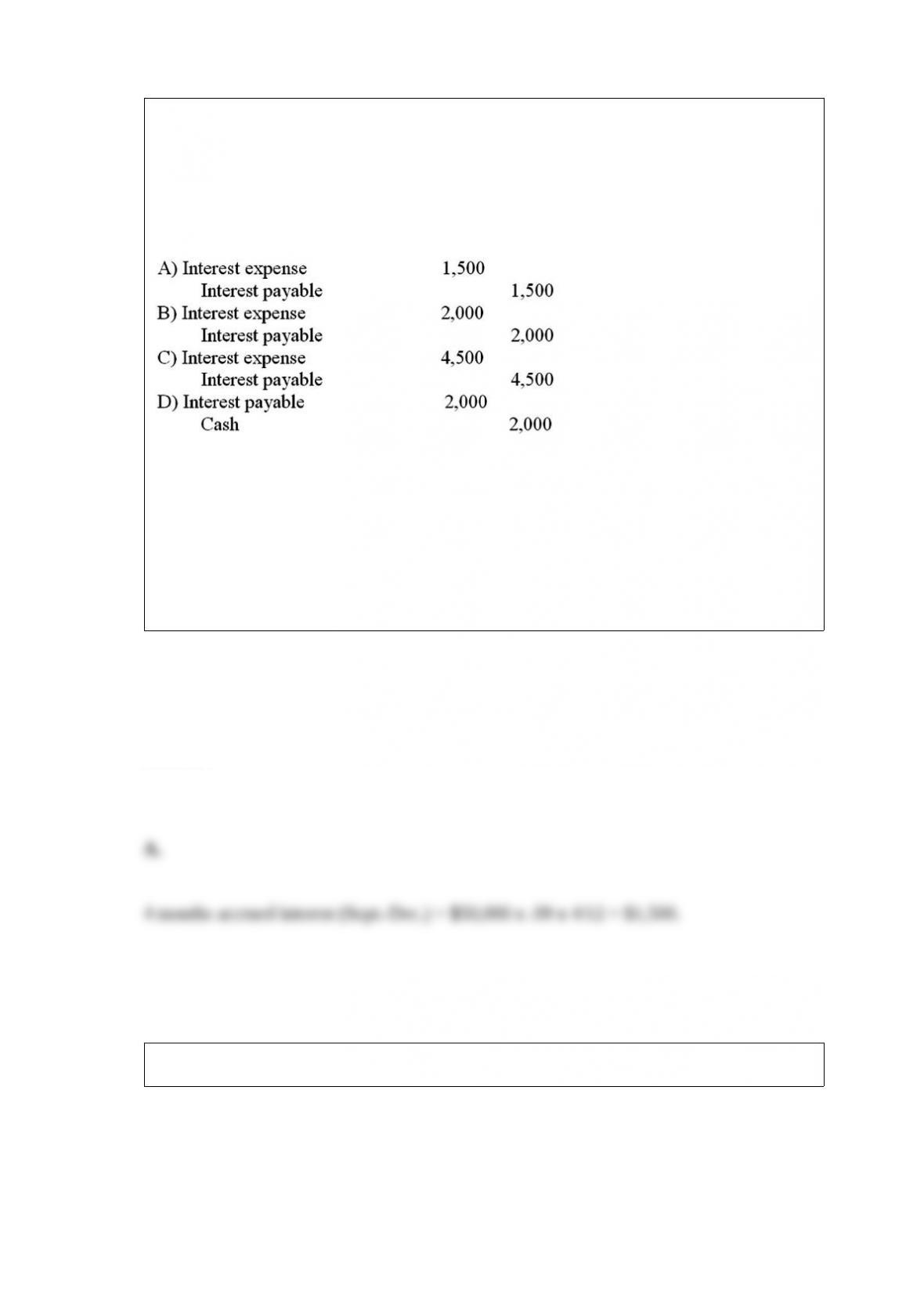
On September 1, 2014, a company issued a $50,000, 6-month, 9% note payable to
purchase a piece of equipment. The company pays the note with interest at the maturity
date.
Use the information above to answer the following question. What is the adjusting
journal entry at December 31 to record the accrued interest on the note payable?
A. Option A
B. Option B
C. Option C
D. Option D
Answer:
The comparative financial statements of B. Darin include the following data:
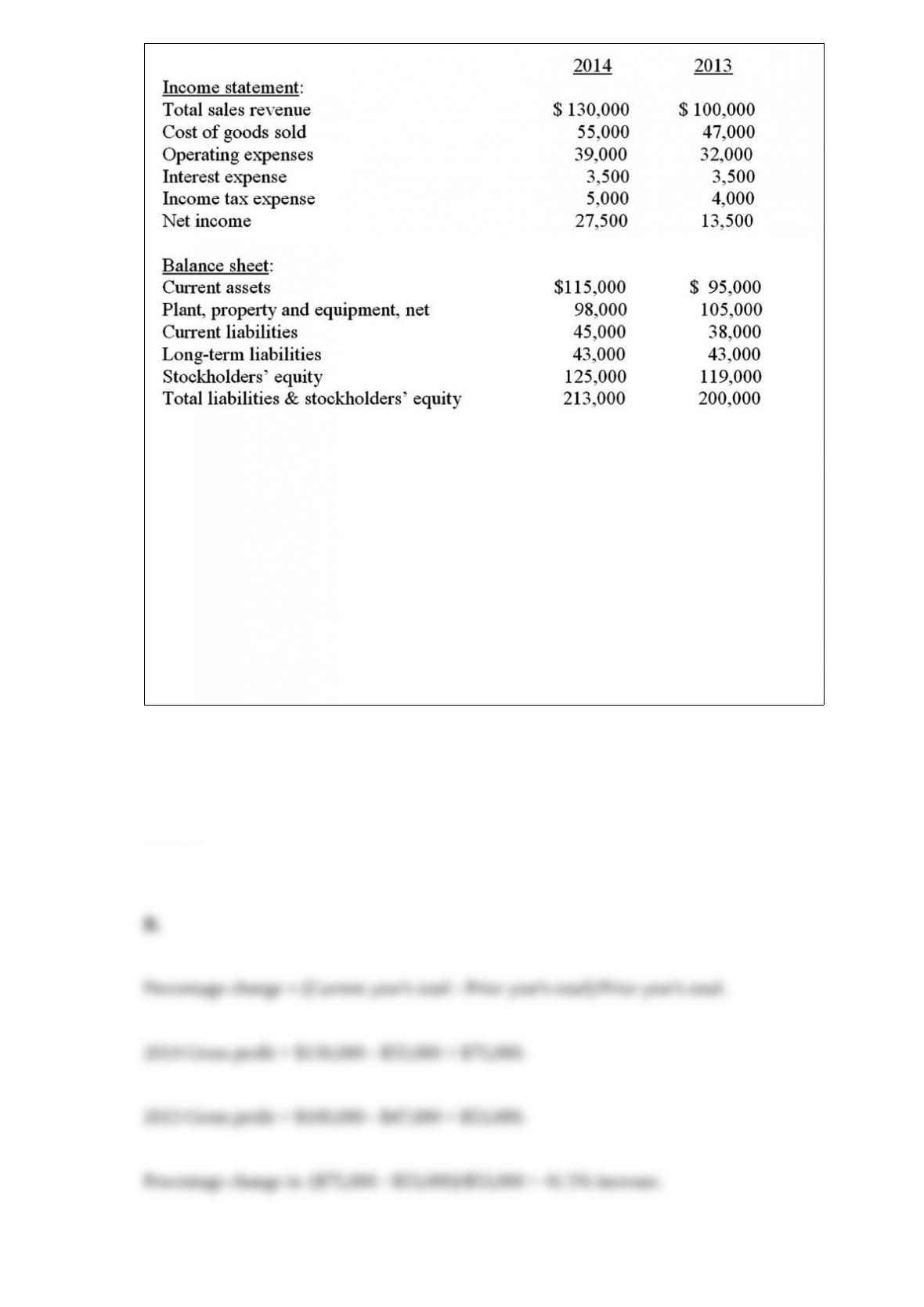
Use the information above to answer the following question. Which of the following
would be shown on B. Darin’s horizontal analysis when calculating percentage changes
from 2013 to 2014?
A. An increase in sales revenue of 23%.
B. An increase in gross profit of 41.5%.
C. An increase in interest expense of 100%.
D. An increase in net income of 57%.
Answer:
During 2013, Shockglass Company recorded inventory purchases of $45,000 and cost
of goods sold of $50,000. If inventory at the beginning of the year was $15,000, the
ending inventory balance must have been:
A. $10,000.
B. $25,000.
C. $26,000.
D. $27,000.
Answer:
A current ratio of less than one is not so much of a concern when the company has a:
A. low fixed asset turnover ratio.
B. high days to collect number.
C. high inventory turnover ratio.
D. high debt-to-equity ratio.
Answer:
Which of the following accounts does not have a normal credit balance?
A. Contributed capital
B. Accounts Payable
C. Service Revenue
D. Rent Expense
Answer: