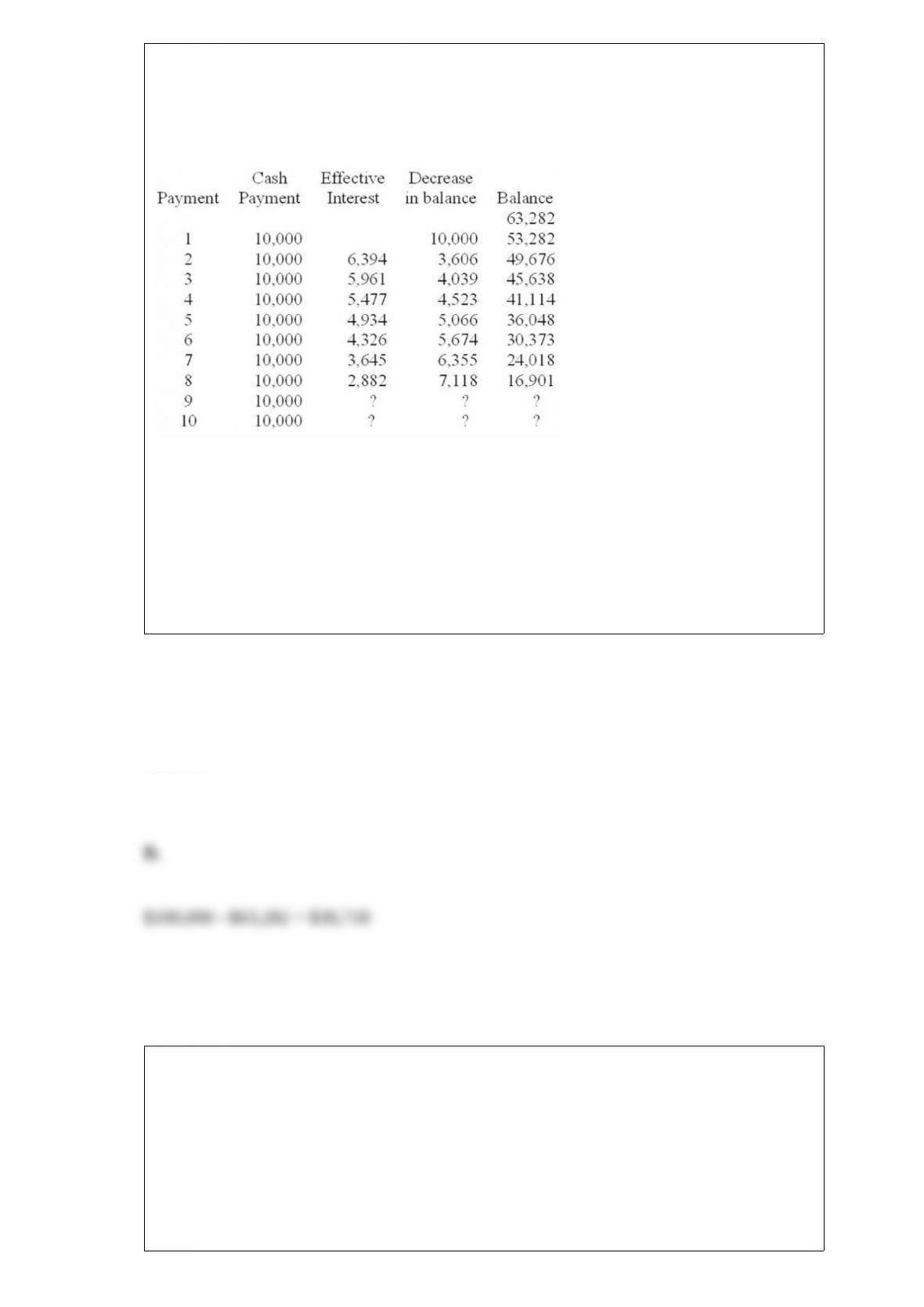
Refer to the following lease amortization schedule. The 10 payments are made annually
starting with the inception of the lease. Title does not transfer to the lessee and there is
no bargain purchase option or guaranteed residual value. The asset has an expected
economic life of 12 years. The lease is noncancelable.
What is the total effective interest paid over the term of the lease? A. $100,000.
B. $36,718.
C. $53,282.
D. $63,282.
Answer:
Oregon Co.’s employees are eligible for retirement with benefits at the end of the year
in which both age 60 is attained and they have completed 35 years of service. The
benefits provide 15 years reimbursement for health care services of $20,000 annually,
beginning one year from the date of retirement.
Ralph Young was hired at the beginning of 1977 by Oregon after turning age 22 and is
expected to retire at the end of 2015 (age 60). The discount rate is 4%. The plan is
unfunded.

The PV of an ordinary annuity of $1 where n = 15 and i = 4% is 11.11839.
The PV of $1 where n = 2 and i = 4% is 0.92456
The EPBO for a particular employee on January 1, 2013, was $30,000. The APBO at
the beginning of the year was $6,000. The appropriate discount rate for this
postretirement plan is 5%. The employee is expected to serve the company for a total of
25 years with 5 of those years already served as of January 1, 2013. What is the APBO
at December 31, 2013? A. $6,300.
B. $7,200.
C. $7,500.
D. $7,560.
Answer:
Listed below are account balances (in $ millions) taken from the records of Symphony
Stores. All of these are permanent accounts, except the last two that have yet to be
closed. The installment receivables are current. Symphony uses a perpetual inventory
system.
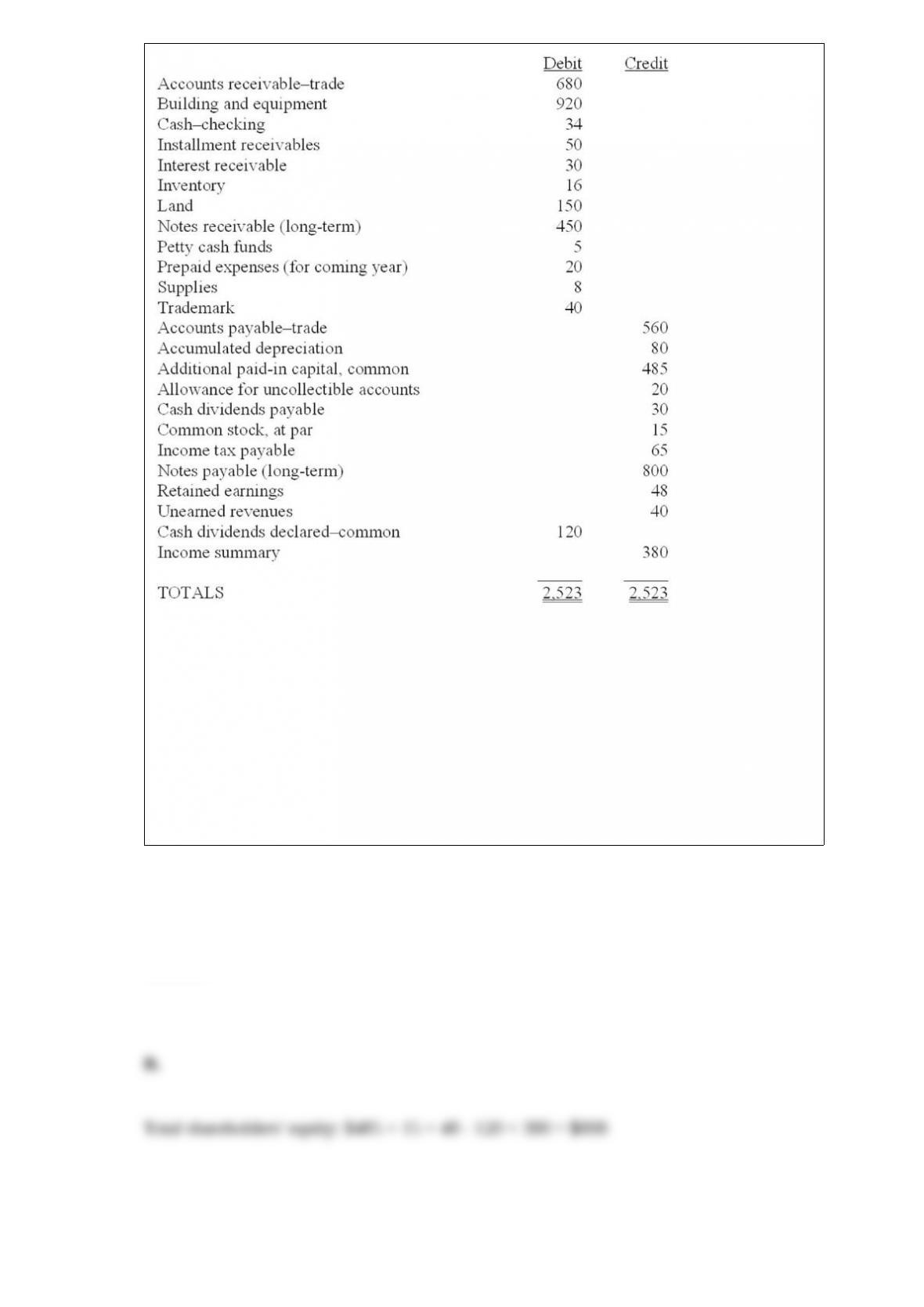
What would Symphony report as total shareholders’ equity?
A. $323.
B. $808.
C. $838.
D. $928.
Answer:
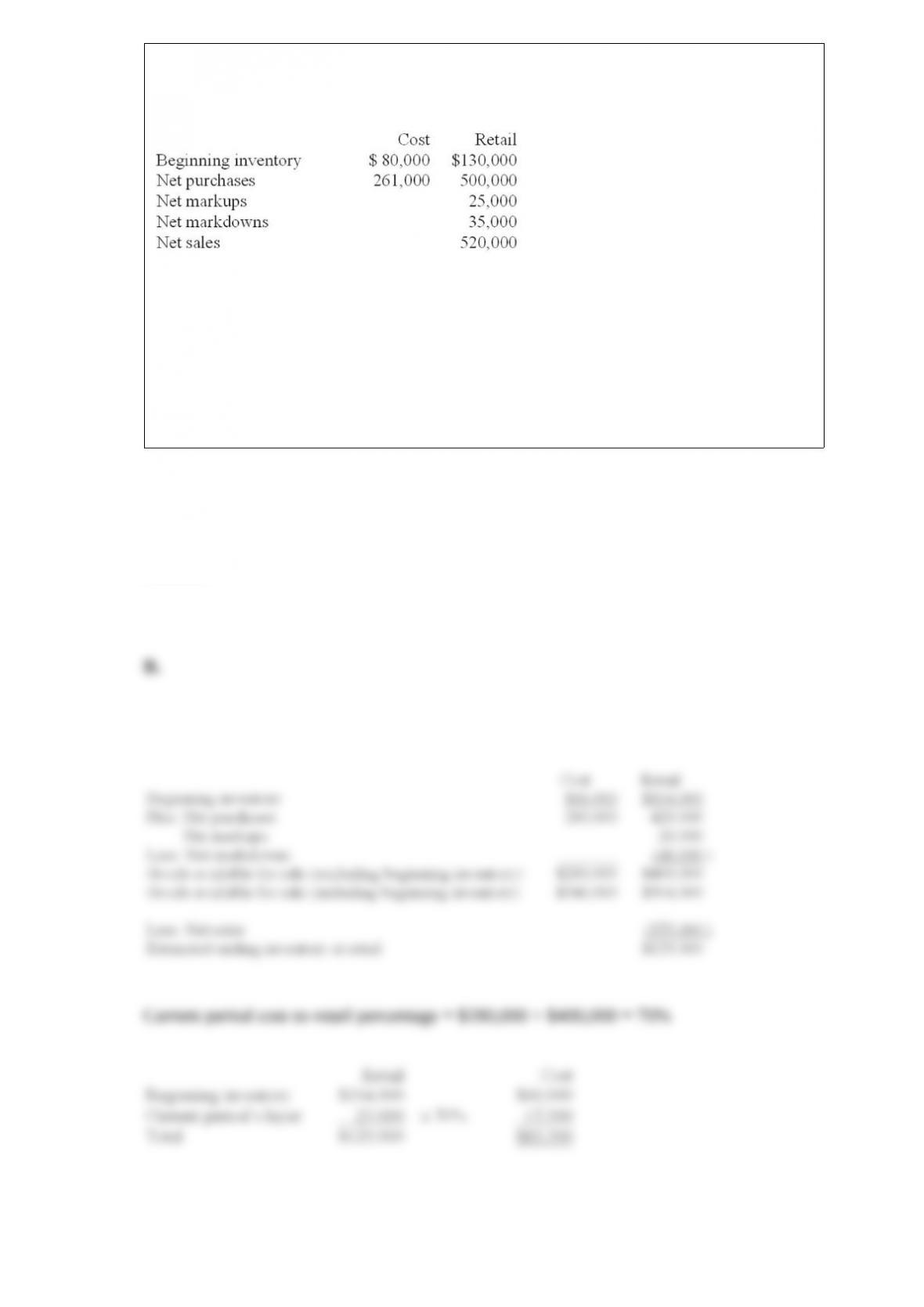
Marilee’s Electronics uses a periodic inventory system and the average cost retail
method to estimate ending inventory and cost of goods sold. The following data is
available from the company records for the month of June 2013:
Estimated ending inventory at cost is: A. $90,720.
B. $83,500.
C. $91,600.
D. None of the above is correct.
Answer:

The net postretirement benefit liability (APBO minus plan assets) is increased by: A.
Service cost.
B. Expected return on plan assets.
C. Amortization of net gain.
D. Cash contributions to plan assets.
Answer:
Of the following temporary differences, which one ordinarily creates a deferred tax
asset? A. Intangible drilling costs.
B. MACRS depreciation.
C. Rent received in advance.
D. Installment sales.
Answer:
Listed below are five terms followed by a list of phrases that describe or characterize
each of the terms. Match each phrase with the correct term. 1)Amortization

2)Natural resources
3)Technological feasibility
4)Research and development costs
5)Nonmonetary exchange
A. The allocation of cost for intangible assets
B. Expensed in the period incurred
C. Wasting assets
D. Point in time to begin capitalization of software development costs
E. The basic principle is to value assets acquired using fair value of consideration given
Answer:
On December 31, 2013, Perry Corporation leased equipment to Admiral Company for a
five-year period. The annual lease payment, excluding executory costs, is $40,000. The
interest rate for this lease is 10%. The payments are due on December 31 of each year.
The first payment was made on December 31, 2013. The normal cash price for this type
of equipment is $125,000 while the cost to Perry was $105,000. For the year ended
December 31, 2013, by what amount will Perry’s pretax earnings increase from this
lease? A. $20,000.
B. $24,000.
C. $28,500.
D. $40,000.
Answer:
In the balance sheet at the end of its first year of operations, Dinty Inc. reported an
allowance for uncollectible accounts of $82,000. During the year, Dinty wrote off
$32,000 of accounts receivable it had attempted to collect and failed. Credit sales for
the year were $2,200,000, and cash collections from credit customers totaled
$1,950,000.
What accounts receivable balance would Dinty report in its first year-end balance
sheet? A. $196,000.
B. $218,000.
C. $230,000.
D. None of the above is correct.
Answer:
When investments are treated as available-for-sale, other comprehensive income (OCI)
also includes the tax effects associated with unrealized holding gains and losses. As a
result: A. Accumulated other comprehensive income would be increased by the tax
benefits typically associated with unrealized holding gains.

B. Other comprehensive income typically would be reduced by the tax expense
associated with unrealized holding gains.
C. Accumulated other comprehensive income would not be affected by taxes.
D. None of the above is correct.
Answer:
Under IFRS, which of the following is not a condition for recognizing revenue? A. The
amount of revenue and costs associated with the transaction can be measured reliably.
B. It is reasonably possible that the economic benefits associated with the transaction
will flow to the seller.
C. For sales of goods, the seller has transferred to the buyer the risks and rewards of
ownership and doesn’t effectively manage or control the goods.
D. For sales of services, the stage of completion can be measured reliably.
Answer:
Which of the following is not an example of a derivative? A. Interest rate swap.
B. Cash.
C. Stock option.
D. Forward contract.
Answer:
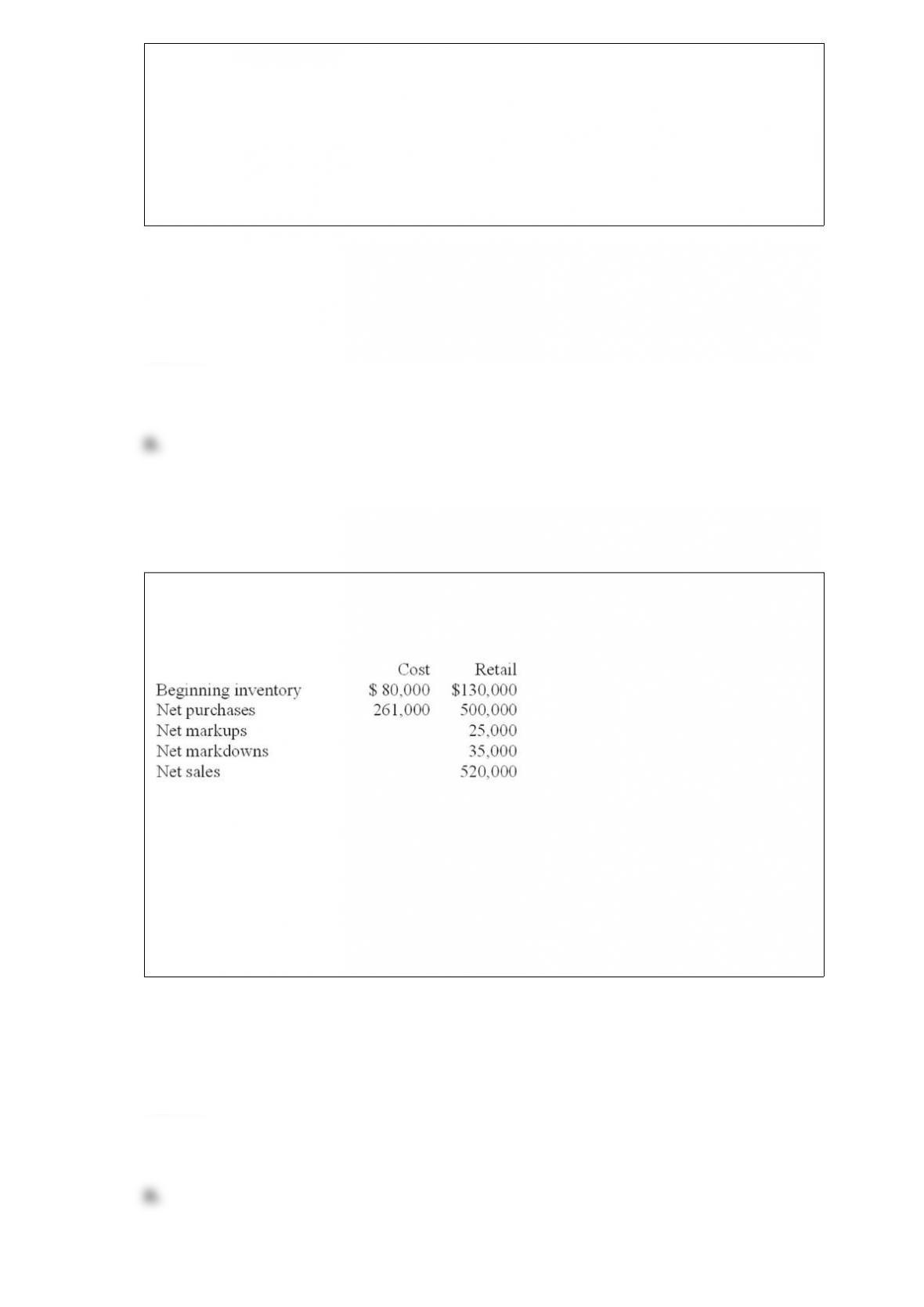
Marilee’s Electronics uses a periodic inventory system and the average cost retail
method to estimate ending inventory and cost of goods sold. The following data is
available from the company records for the month of June 2013:
The average cost-to-retail percentage is: A. 74.5%.
B. 55.6%.
C. 57.4%.
D. 58.7%.
Answer:

Northwest Fur Co. started 2013 with $94,000 of merchandise inventory on hand.
During 2013, $400,000 in merchandise was purchased on account with credit terms of
1/15, n/45. All discounts were taken. Purchases were all made f.o.b. shipping point.
Northwest paid freight charges of $7,500. Merchandise with an invoice amount of
$5,000 was returned for credit. Cost of goods sold for the year was $380,000.
Northwest uses a perpetual inventory system.
Assuming Northwest uses the gross method to record purchases, what is the cost of
goods available for sale? A. $492,500.
B. $496,500.
C. $490,500.
D. $492,550.
Answer:

GAAP is an abbreviation for: A.Generally authorized accounting procedures.
B.Generally applied accounting procedures.
C.Generally accepted auditing practices.
D.Generally accepted accounting principles.
Answer:
When reported in financial statements, a LIFO allowance account usually: A. Is shown
in the firm’s income statement.
B. Is added to LIFO cost to indicate what the inventory would cost on a FIFO basis.
C. Indicates the effect on income if LIFO were not used.
Answer:
Which of the following is not a potential component of pension expense? A. Return on

plan assets.
B. Prior service cost.
C. Retiree benefits paid.
Answer:
Gains are: A.Inflows from selling a product or service to a customer.
B.Increases in equity resulting from transfers of assets to the company from owners.
C.Increases in equity from peripheral transactions of an entity.
D.None of the above is correct.
Answer:
For a bond issue that sells for more than the bond face amount, the effective interest
rate is:A. The rate printed on the face of the bond.
B. The Wall Street Journal prime rate.
C. More than the rate stated on the face of the bond.
D. Less than the rate stated on the face of the bond.
Answer:
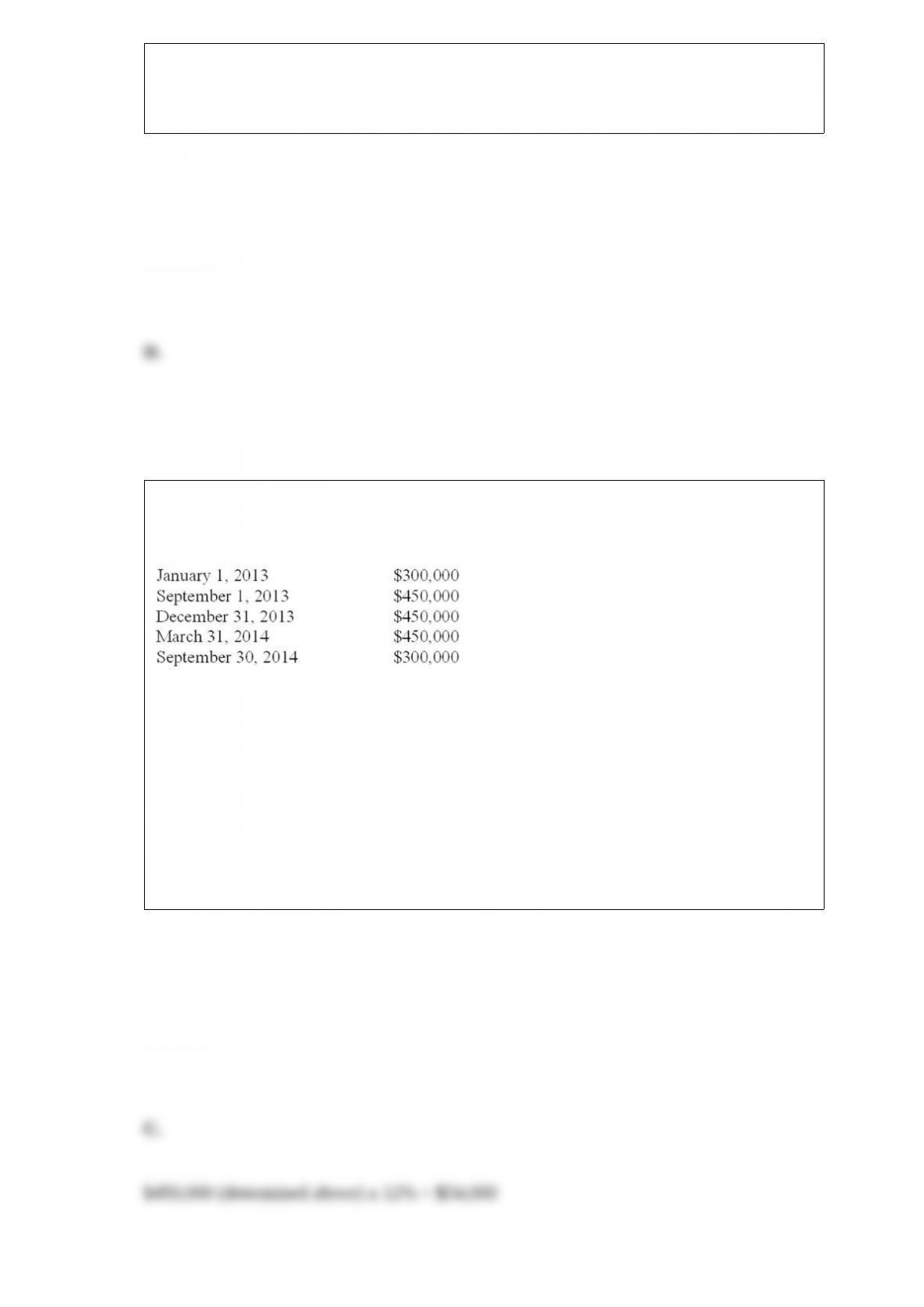
On January 1, 2013, Dreamworld Co. began construction of a new warehouse. The
building was finished and ready for use on September 30, 2014. Expenditures on the
project were as follows:
Dreamworld had $5,000,000 in 12% bonds outstanding through both years.
Dreamworld’s capitalized interest in 2013 was: A. $72,000.
B. $63,000.
C. $54,000.
D. $36,000.
Answer:

Excerpts from Hulkster Company’s December 31, 2013 and 2012, financial statements
are presented below:
Hulkster’s 2013 average collection period is: A. 73 days.
B. 104 days.
C. 109 days.
D. 128 days.
Answer:
The most political issue in the FASB’s most recent deliberations and amendments to
GAAP on business combinations was: A.The negative effects on subsequent earnings of
amortizing goodwill if firms were required to use the purchase method of accounting
for the combination.
B.The negative effects on subsequent earnings of amortizing goodwill if firms were
required to use the pooling method of accounting for the combination.
C.The unrealistic balance sheet assets that would be created if firms were required to
use the purchase method of accounting for the combination.
D.The unrealistic balance sheet assets that would be created if firms were required to
use the pooling method of accounting for the combination.
Answer:
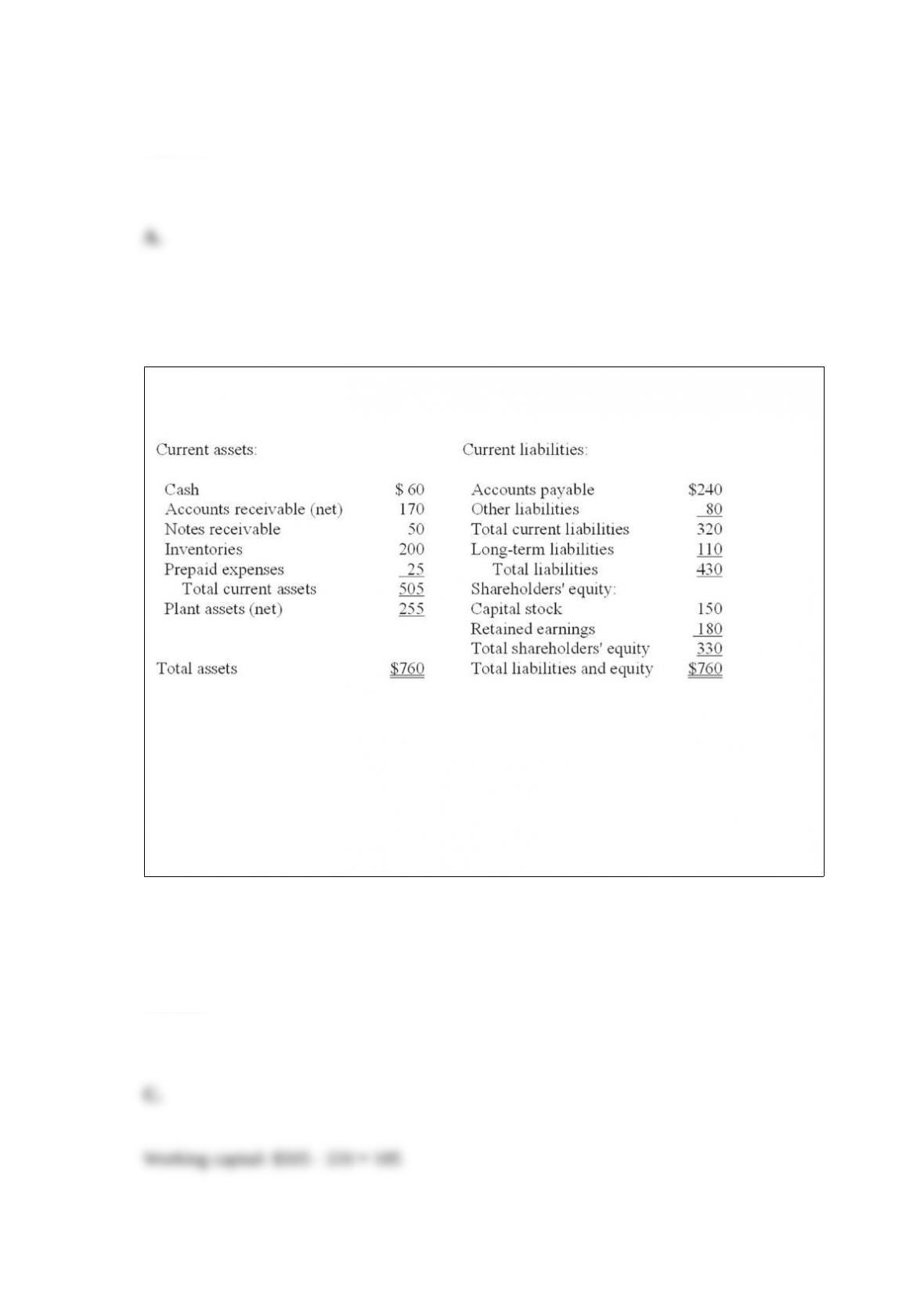
The following partial balance sheet ($ in thousands) for Paisano Seafood Inc. is shown
below.
Working capital is: A. $505.
B. $265.
C. $185.
D. $75.
Answer:

Fryer Inc. owns equipment for which it paid $90 million. At the end of 2013, it had
accumulated depreciation on the equipment of $27 million. Due to adverse economic
conditions, Fryer’s management determined that it should assess whether an impairment
loss should be recognized for the equipment. The estimated undiscounted future cash
flows to be provided by the equipment total $60 million, and the equipment’s fair value
at that point is $40 million. Under these circumstances, Fryer: A. Would record no
impairment loss on the equipment.
B. Would record a $3 million impairment loss on the equipment.
C. Would record a $23 million impairment loss on the equipment.
D. None of the above is correct.
Answer:
Excerpts from Dowling Company’s December 31, 2013 and 2012, financial statements
and key ratios are presented below (all numbers are in millions):
Dowling’s 2013 average collection period is (rounded): A. 50 days.
B. 63 days.
C. 57 days.
D. 51 days.
Answer:
State and Federal Unemployment Taxes (SUTA and FUTA) must be withheld from
employees’ wages.
Answer:
When a transfer is made between cash and cash equivalents with no gain or loss, how is
the transaction treated in the statement of cash flows? A. It is included as an operating
activity.
B. It is included as a noncash financing activity.
C. It is included as an investing activity.
D. It is not reported.
Answer:
FX Services granted 15 million of its $1 par common shares to executives, subject to
forfeiture if employment is terminated within three years. The common shares have a
market price of $8 per share on the grant date. Ignoring taxes, what is the effect on
earnings in the year after the shares are granted to executives? A. $0.
B. $15 million.
C. $40 million.
D. $120 million.
Answer:
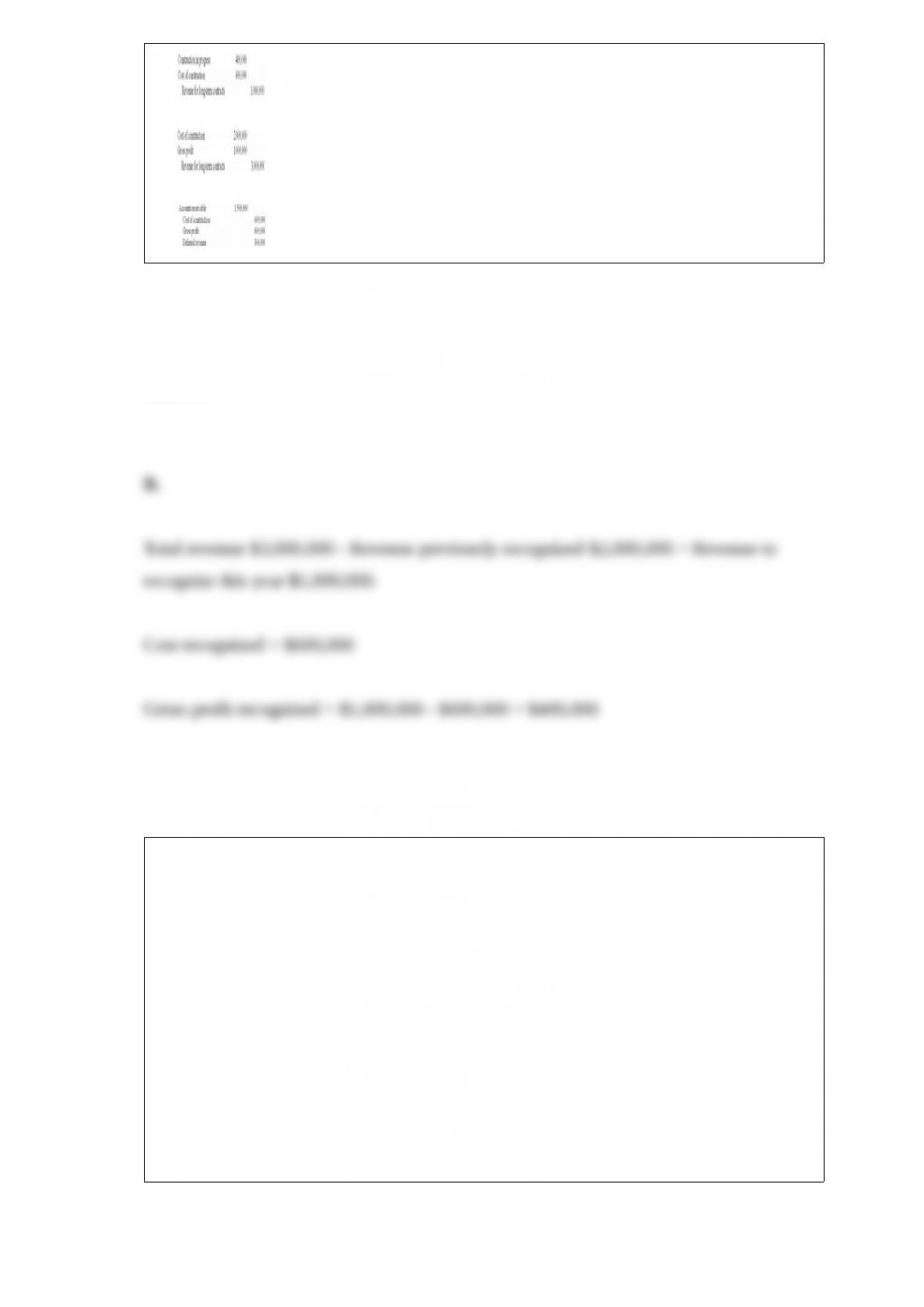
Arizona Desert Homes (ADH) constructed a new subdivision during 2012 and 2013
under contract with Cactus Development Co. Relevant data are summarized below:
ADH uses the percentage-of-completion method to recognize revenue.
For 2013, what is the journal entry to record revenue?A.
B.
C.
D.
Answer:
Calistoga Produce estimates bad debt expense at ½% of credit sales. The company
reported accounts receivable and allowance for uncollectible accounts of $471,000 and
$1,650, respectively, at December 31, 2012. During 2013, Calistoga’s credit sales and
collections were $315,000 and $319,000, respectively, and $1,720 in accounts
receivable were written off.
Calistoga’s adjusted allowance for uncollectible accounts at December 31, 2013, is: A.
$1,575.
B. $1,505.
C. $1,650.
D. $1,720.
Answer:
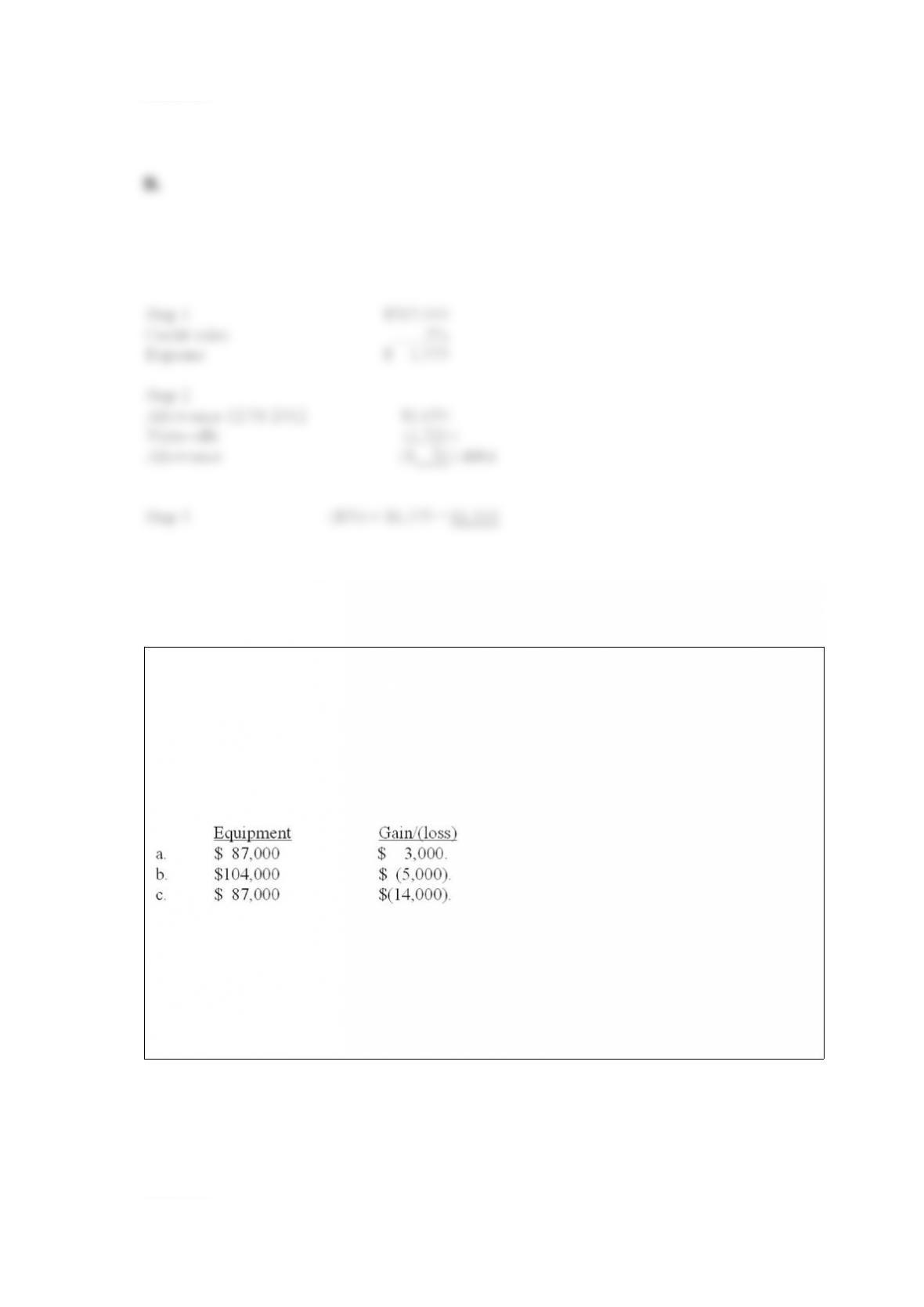
Horton Stores exchanged land and cash of $5,000 for similar land. The book value and
the fair value of the land were $90,000 and $100,000, respectively.
Bloomington Inc. exchanged land for equipment and $3,000 in cash. The book value
and the fair value of the land were $104,000 and $90,000, respectively.
Bloomington would record equipment and a gain/(loss) of:
A. Option a
B. Option b
C. Option c
D. None of the above is correct.
Answer:
When an accounting change is reported under the retrospective approach, account
balances in the general ledger: A. Are not adjusted.
B. Are closed out and then updated.
C. Are adjusted net of the tax effect.
D. Are adjusted to what they would have been had the new method been used in
previous years.
Answer:
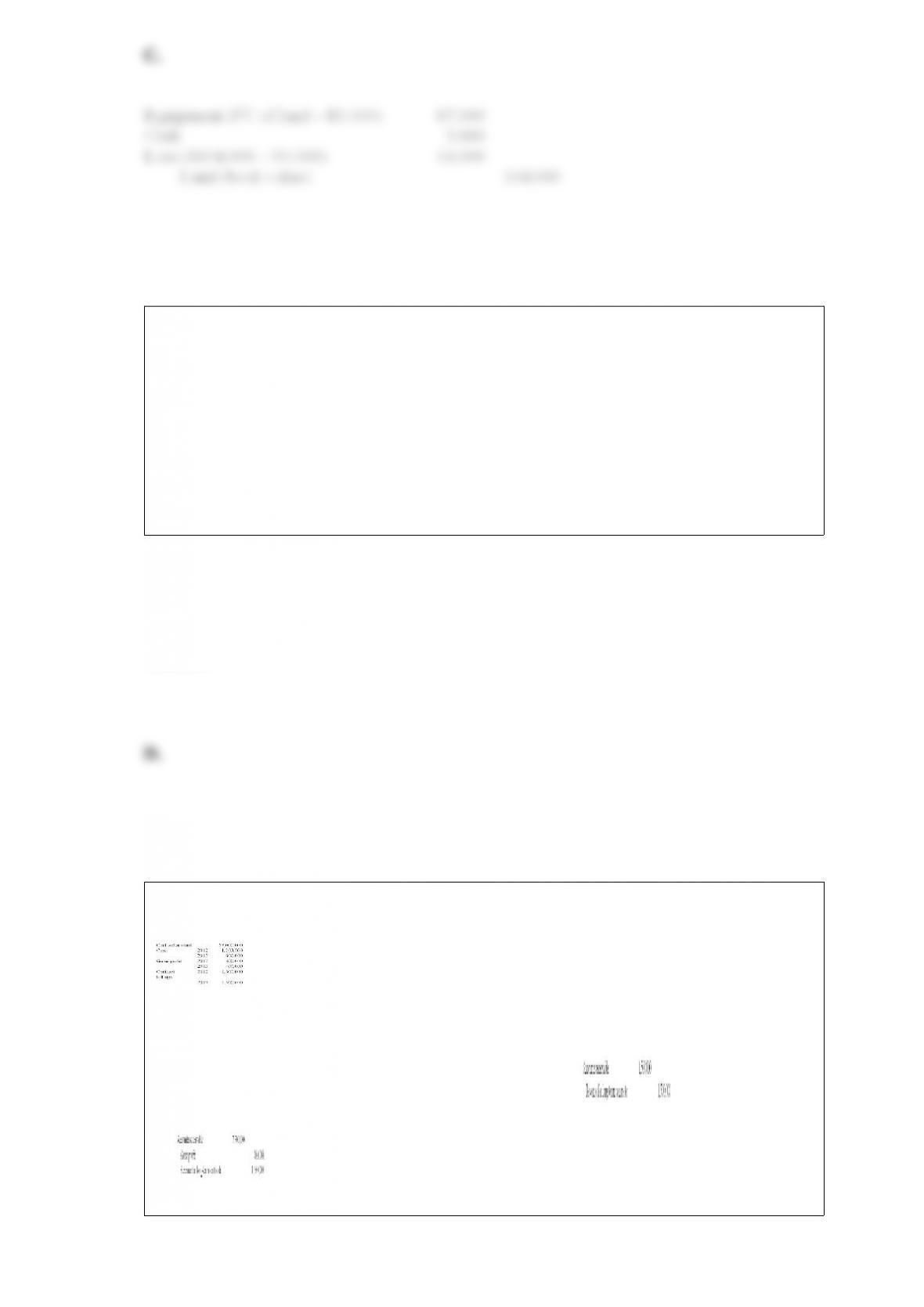
ADH constructed a new subdivision during 2012 and 2013 under contract with Cactus
Development Co. Relevant data are summarized below:
ADH uses the completed contract method to recognize revenue.
For 2012, what is the journal entry to record revenue? A.
B.
C.
D. No entry.
Answer:
Briefly explain the differences between the terms depreciation, depletion, and
amortization.
Answer:
Schefter Mining operates a copper mine in Wyoming. Acquisition, exploration, and
development costs totaled $8.2 million. Extraction activities began on July 1, 2013.
After the copper is extracted in approximately six years, Schefter is obligated to restore
the land to its original condition, including constructing a park. The company’s
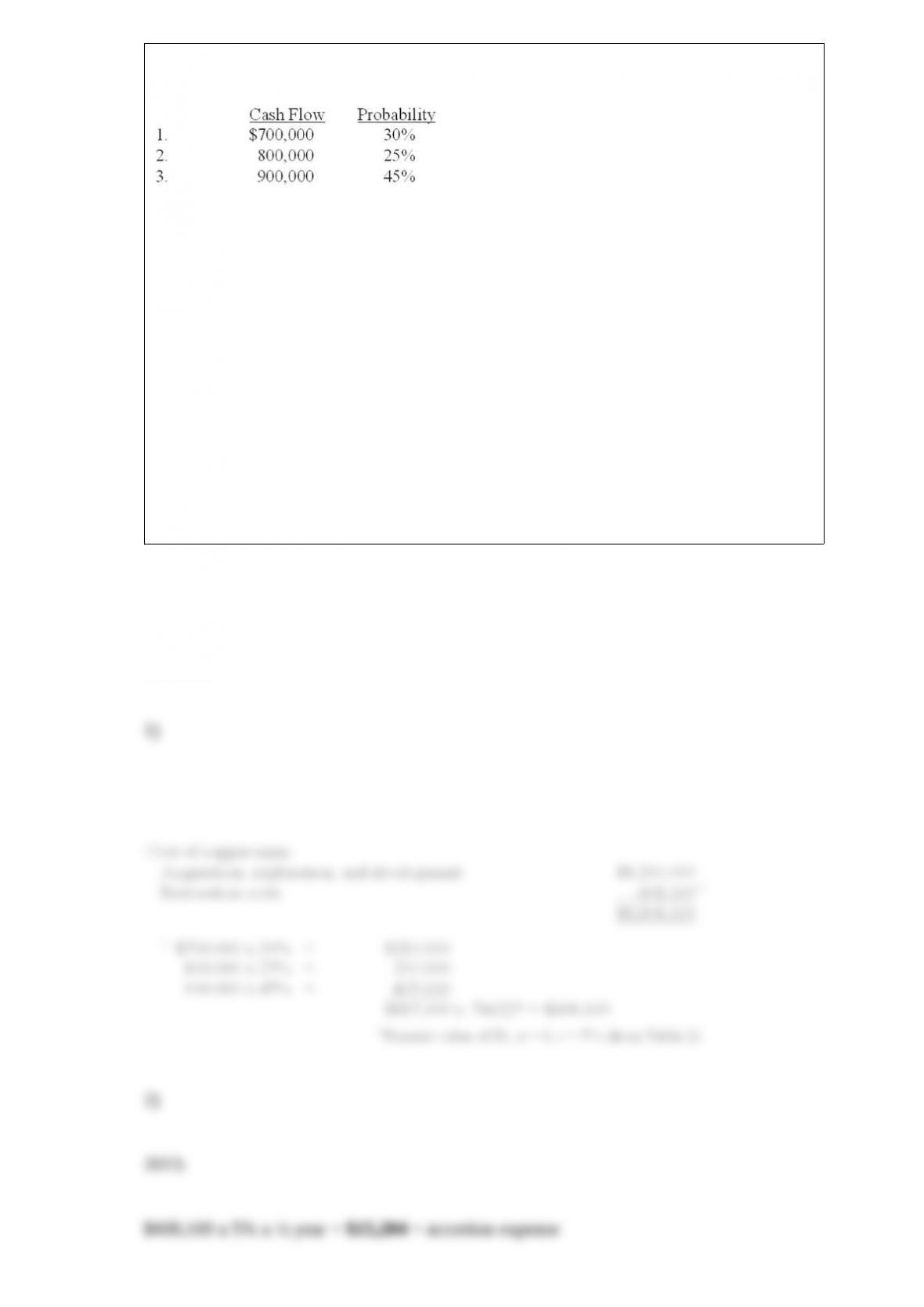
controller has provided the following three cash flow possibilities for the restoration
costs:
The company’s credit-adjusted, risk-free rate of interest is 5%, and its fiscal year ends
on December 31.
Required:
1) What is the initial cost of the copper mine? (Round computations to nearest whole
dollar.)
2) How much accretion expense will Schefter report in its 2013 income statement?
3) What is the carrying value (book value) of the asset retirement obligation that
Schefter will report in its 2013 balance sheet?
4) Assume that actual restoration costs incurred in 2019 totaled $860,000. What amount
of gain or loss will Schefter recognize on retirement of the liability?
Answer:
How do U.S. GAAP and International Financial Reporting Standards (IFRS) differ with
respect to leases of land and buildings?
Answer:

Using the chart of accounts provided, indicate by account number the account or
accounts that would be debited and credited in the following transactions and indicate
the type of transaction as: (1) an external transaction, (2) an internal transaction
recorded as an adjusting journal entry, or (3) a closing entry. The company uses a
perpetual inventory system. All prepayments are initially recorded in permanent
accounts.
Collected a note receivable at maturity, including the interest that had already been
accrued.
Answer:
It’s not unusual for one company to buy another company in order to obtain technology
that the acquired company has developed or is in the process of developing.
Required:
Explain the accounting treatment of purchased technology.
Answer:

Gallo Light began operations in 2013. The company sometimes sells used warehouses
on an installment basis. In those cases, Gallo Light reports income in its income
statement in the year of the sale. In its income tax return, though, Gallo Light reports
installment income by the installment method. Installment income in 2013 was
$90,000, which Gallo Light expects to collect equally over the next three years. The tax
rate is 30%, but based on an enacted law, is scheduled to become 35% in 2015.
Gallo Light’s pretax accounting income from the 2013 income statement was $830,000,
which includes $40,000 of interest revenue from an investment in municipal bonds.
There were no differences between accounting income and taxable income other than
those described above.
Required:
(1) Prepare the appropriate journal entry to record Gallo Light’s 2013 income taxes.
Show calculations.
(2) What is Gallo Light’s 2013 net income?
Answer:
Briefly explain how a company that recognized revenue under the
percentage-of-completion method (estimating percentage of completion using a
cost-to-cost ratio) could manage earnings upward to meet a profit projection. What sort
of ethical problems could result from that earnings management?
Answer:
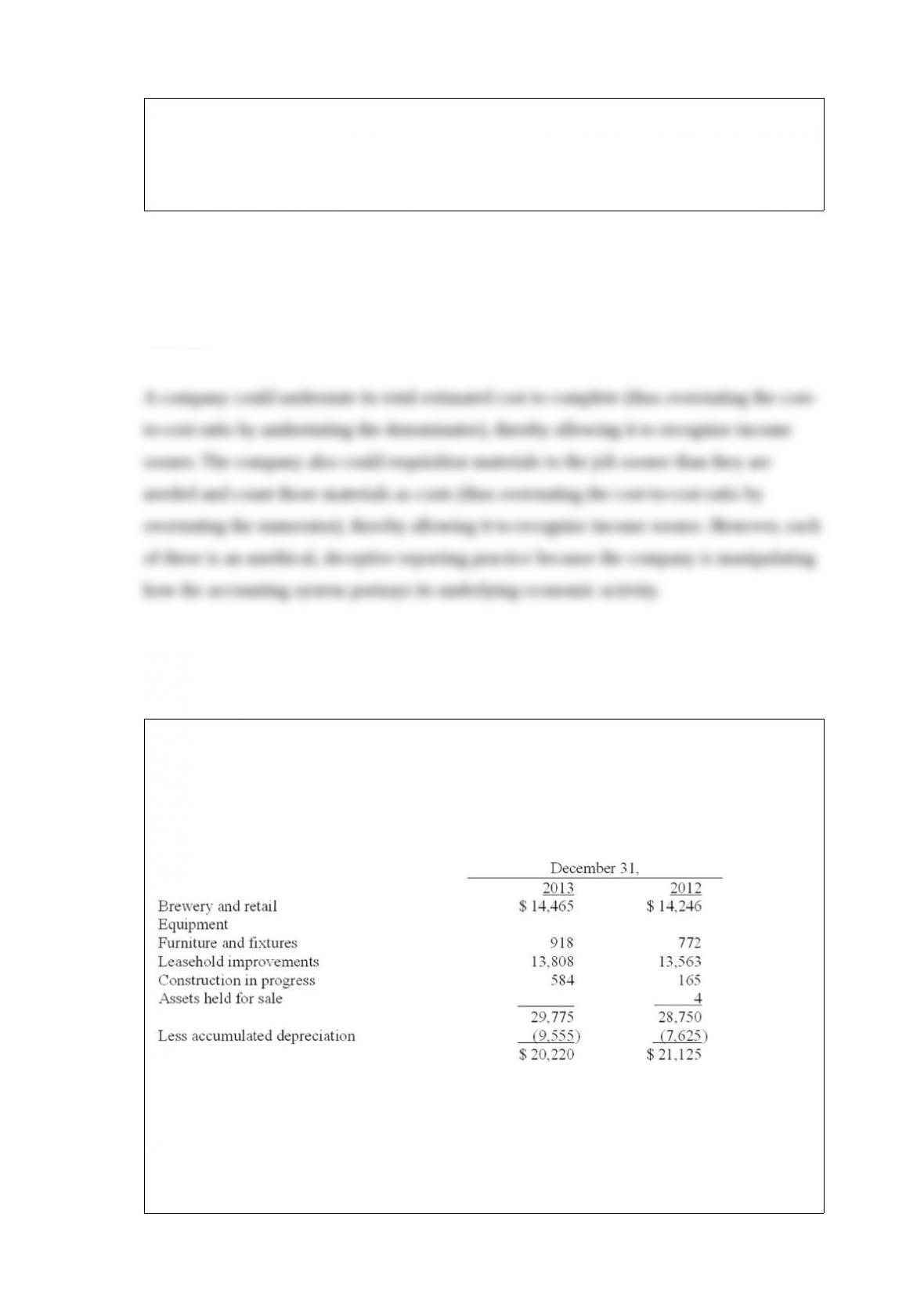
In its 2013 annual report to shareholders, Plank Breweries disclosed the following
footnote:
Fixed Assets
Fixed assets consist of the following (in $ thousands):
Total depreciation expense was approximately $2.121 million and $2.179 million for
the years ended December 31, 2013 and 2012, respectively.
Also, Plank Breweries reported the following information in its annual report (in $
thousands):
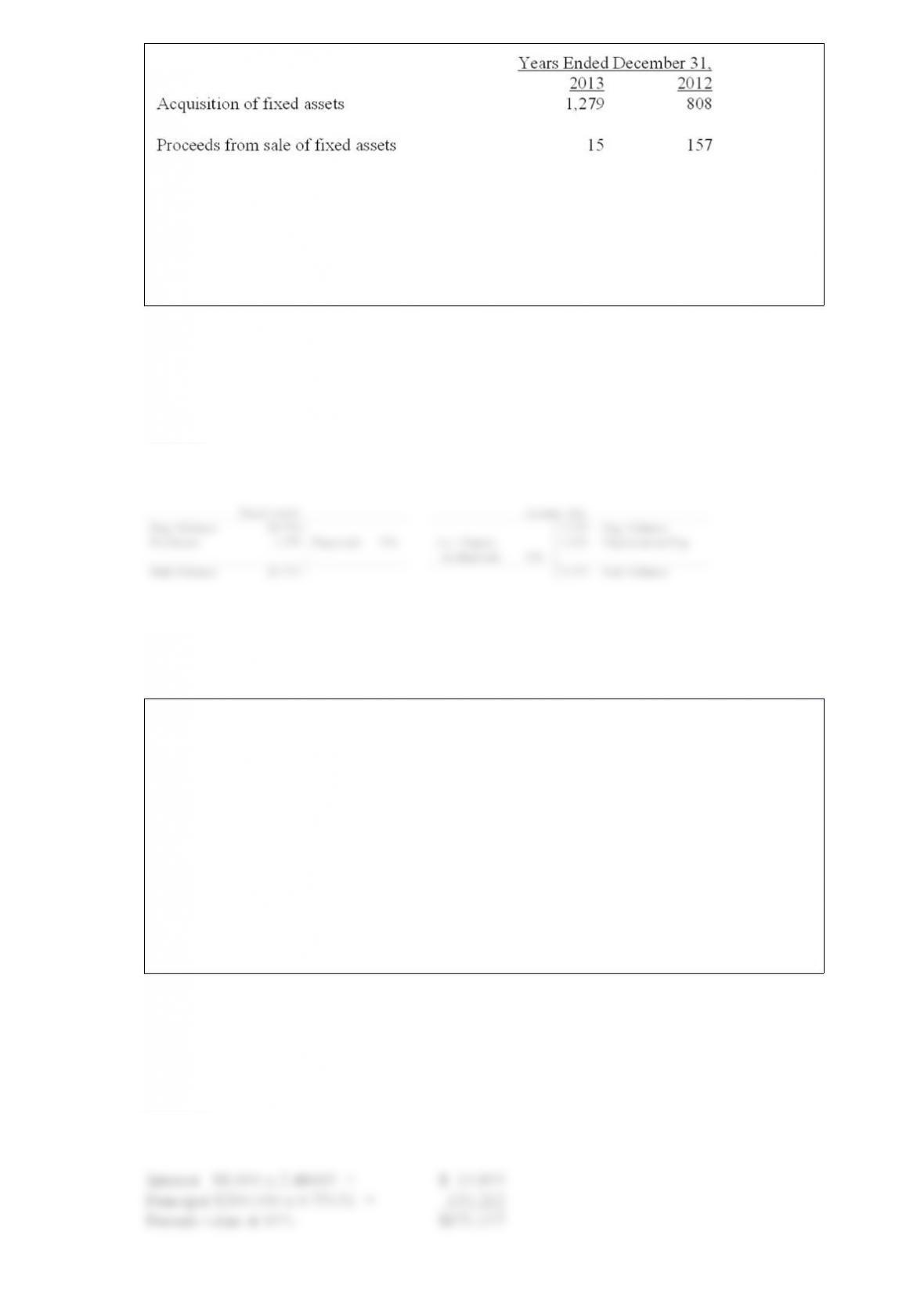
Required:
Use a T- account to show the balances and changes during 2013 in Plank Breweries:
Fixed assets account and Accumulated depreciationfixed assets account (in $
thousands).
Answer:
Miranda Company contracted with Stewart Corporation to construct custom-made
equipment. The equipment was completed and ready for use on January 1, 2013.
Miranda paid for the machine by issuing a $200,000, three-year note that bears interest
at the rate of 4%, payable annually on December 31 each year. Since the machine was
custom-built, the cash price was unknown. However, when compared to similar
contracts, 10% was deemed to be a reasonable rate of interest.
Required:
1) Prepare the journal entry by Miranda to record the purchase of equipment.
2) Prepare journal entries to record interest for each of the first two years.
Answer:
Why are software development costs treated differently than other types of R&D?
Answer:
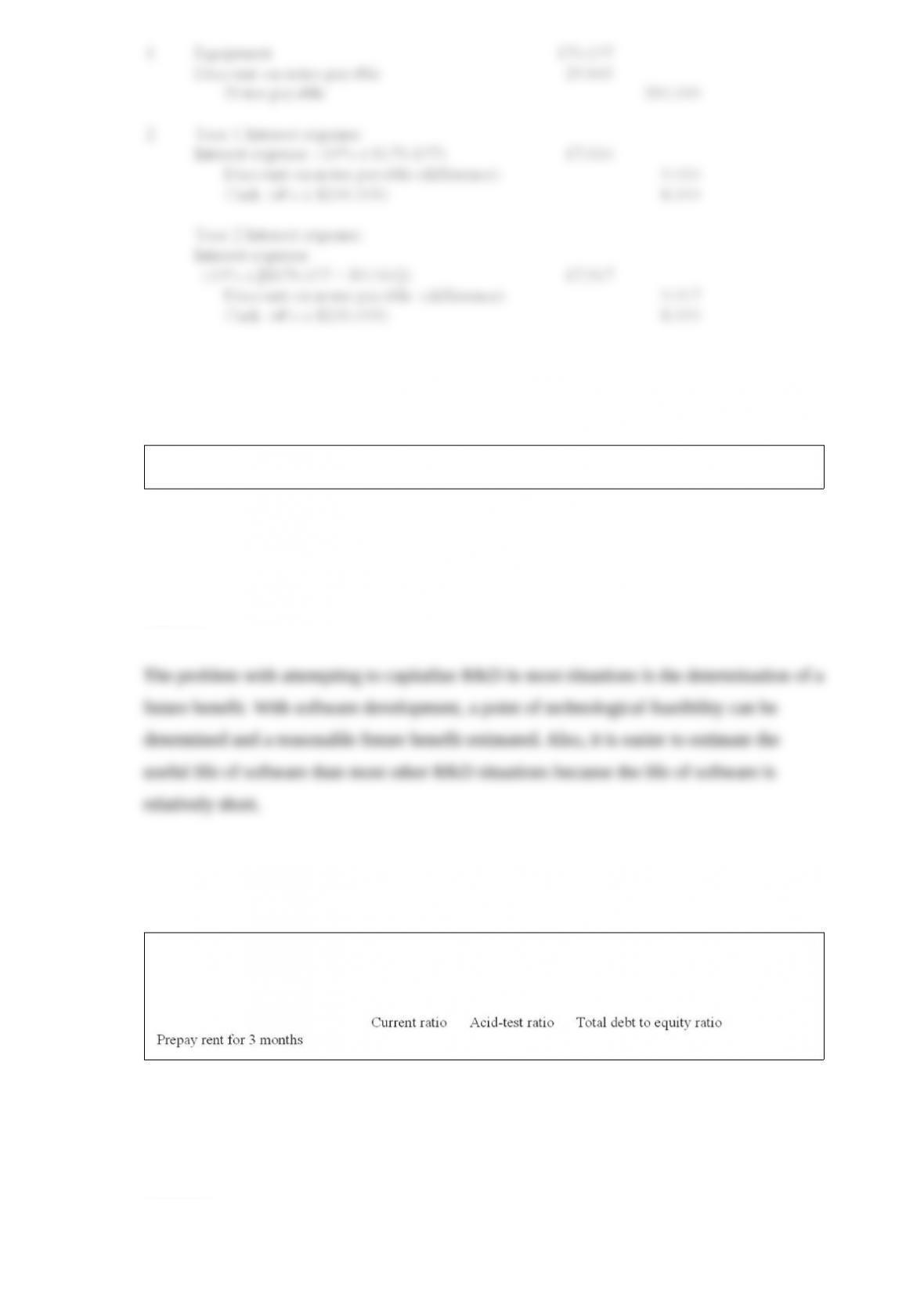
Indicate whether each of the actions listed below will immediately increase (I), decrease
(D), or have no effect (N) on the ratios shown. Assume each ratio is greater than 1.0
before the action is taken.
Answer:
How do retiree health benefits differ from pension benefits with respect to accounting,
funding, regulation, and employee benefits?
Answer:
Partial balance sheets and additional information are listed below for Monaco
Company.
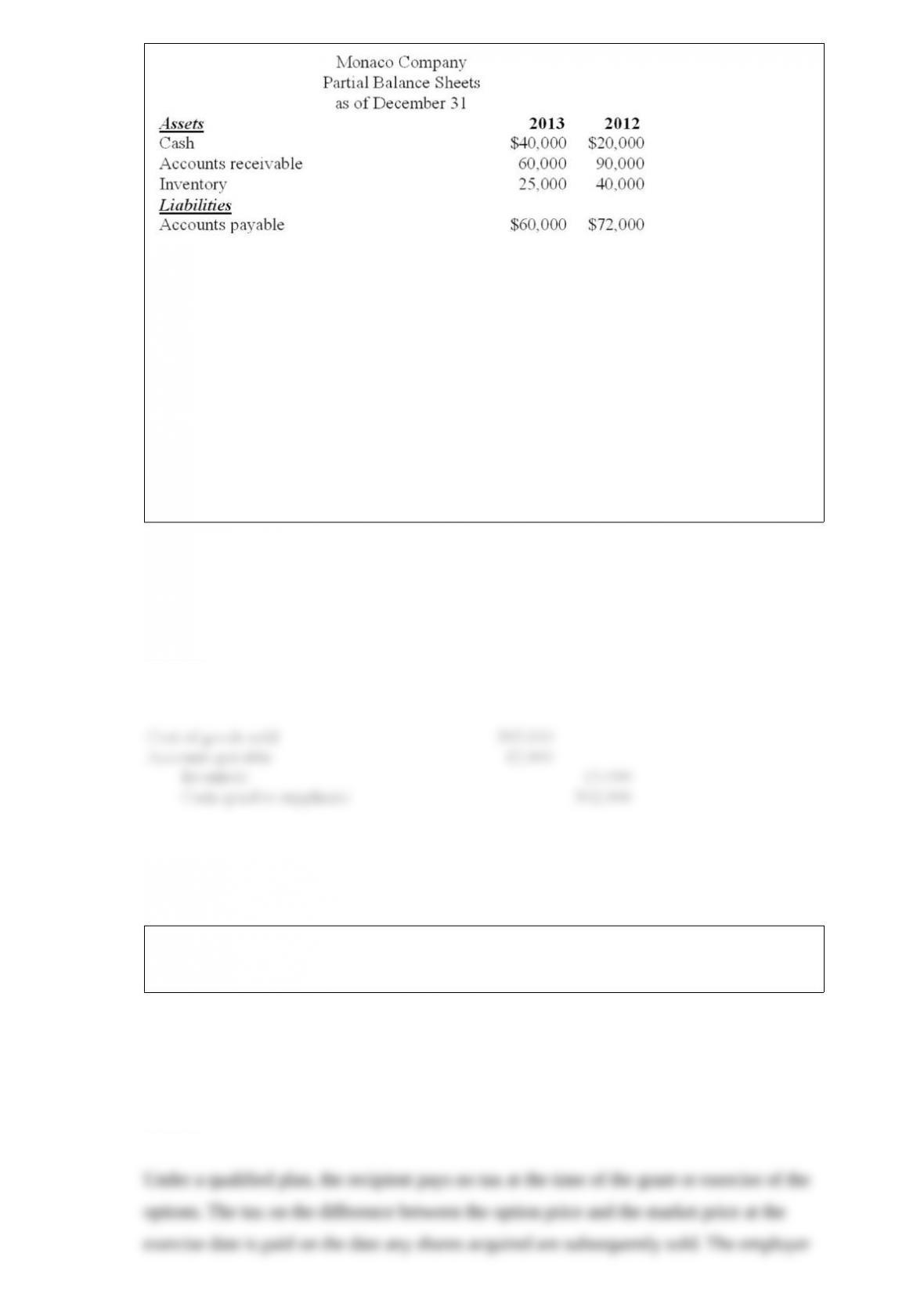
Additional information for 2013:
Net income was $270,000.
Depreciation expense was $30,000.
Sales totaled $800,000.
Cost of goods sold totaled $305,000.
Required:
Calculate the amount of cash paid to merchandise suppliers during 2013.
Answer:
The tax code differentiates between qualified and nonqualified incentive plans. What
are the major differences in tax treatment between the two?
Answer:
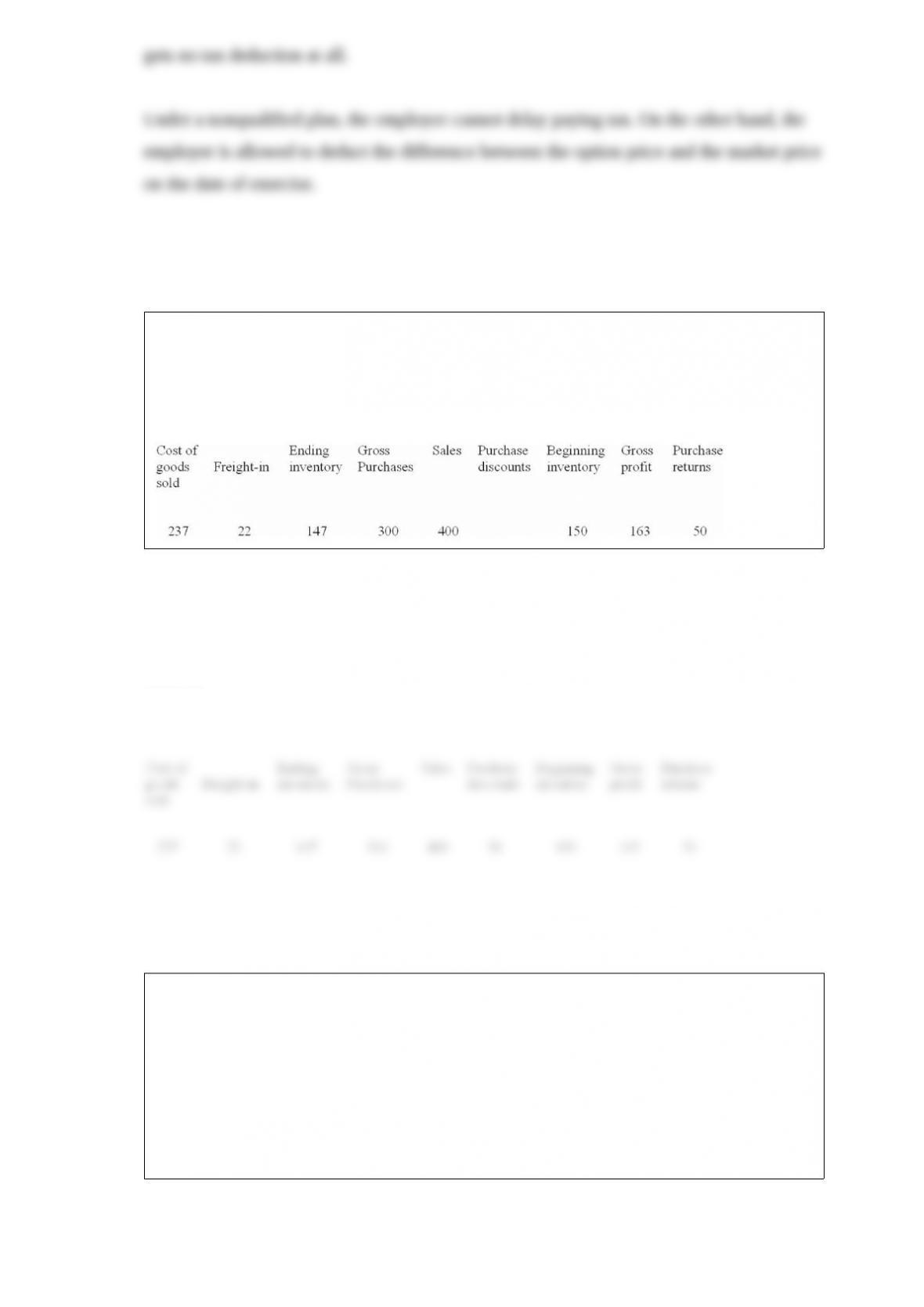
The following information is taken from the accounting records of Rapid Runner Inc.
for the year 2013. Missing information has been left blank.
Required:
Compute the missing amounts.
Answer:
Eckland Manufacturing Co. purchased equipment on January 1, 2011, at a cost of
$90,000. Straight-line depreciation for 2011 and 2012 was based on an estimated
eight-year life and $2,000 estimated residual value. In 2013, Eckland revised its
estimate and now believes the equipment will have a total service life of only six years,
while the residual value remains the same.
Required:
Compute depreciation for 2013 and 2014.
Answer:
List at least four operating activities that would be reported in the statement of cash
flows for Walmart. Assume the use of the direct method.
Answer:
Texon Oil is being sued for price fixing and environmental damage. The litigation
started this year and is expected to last five years. There is no doubt that Texon is guilty,
but the settlement cost will be between $3 billion and $22 billion. Briefly explain how
Texon would address this in its current year financial statements.
Answer:
Wainright Co. began the year with a net pension liability of $112 million (underfunded
pension plan). Pension expense for the year included the following ($ in millions):
service cost, $40; interest cost, $24; expected return on assets, $16; amortization of net
loss, $8; amortization of prior service cost, $12.
Required:
Prepare the appropriate general journal entry to record Wainright’s pension expense.
Answer: