1) Cash withdrawn by the owner of a proprietorship should be treated as an expense of
the business.
2) A leasehold refers to the rights the lessor grants to the lessee under the terms of the
lease.
3) The main difference between the income statement of a manufacturer and a
merchandiser is that the merchandiser includes cost of goods manufactured rather than
cost of goods purchased.
4) All necessary numbers to prepare the balance sheet can be found in the balance sheet
columns of the work sheet including ending owner’s capital.
5) On January 1, a company issued a $500,000, 10%, 8-year bond payable, and received
proceeds of $487,000. Interest is payable each June 30 and December 31. The company
uses the straight-line method to amortize the discount. The amount of discount
amortized each period is $812.50.
6) Sales variances may be computed in a manner similar to cost variances-that is,
computing both price and volume variances.
7) If budgeted beginning inventory is $8,300, budgeted ending inventory is $9,400, and
cost of goods sold is expected to be $10,260, then budgeted purchases should be
$9,160.
8) The three common forms of business ownership include sole proprietorship,
partnership, and non-profit.
9) The full disclosure principle requires that the notes to the financial statements report
a change in accounting method for inventory.
10) Stocks with a price-earnings ratio greater than 20 to 25 are likely to be underpriced.
11) Current liabilities include accounts receivable, unearned revenues, and salaries
payable.
12) A corporation is a legal entity separate from its owners.
13) If a check correctly written and paid by the bank for $794 is incorrectly recorded in
the company’s books for $749, how should this error be treated on the bank
reconciliation?
A.Subtract $45 from the bank’s balance
B.Add $45 to the bank’s balance
C.Subtract $45 from the book balance
D.Add $45 to the book balance
E.Subtract $45 from the bank’s balance and add $45 to the book’s balance
14) Refer to the following selected financial information from Fennie’s, LLC. Compute
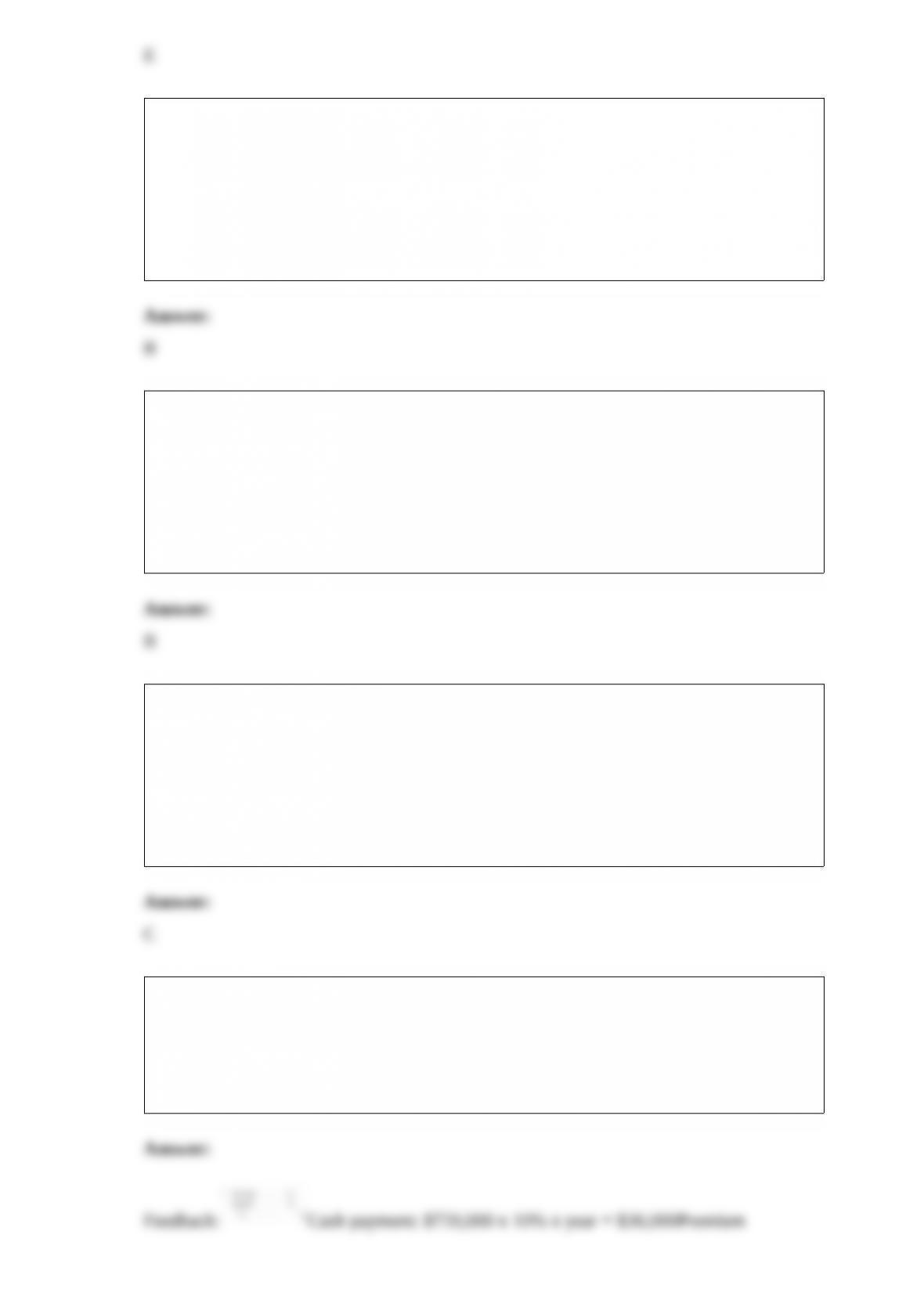
the company’s days’ sales in inventory for Year 2.
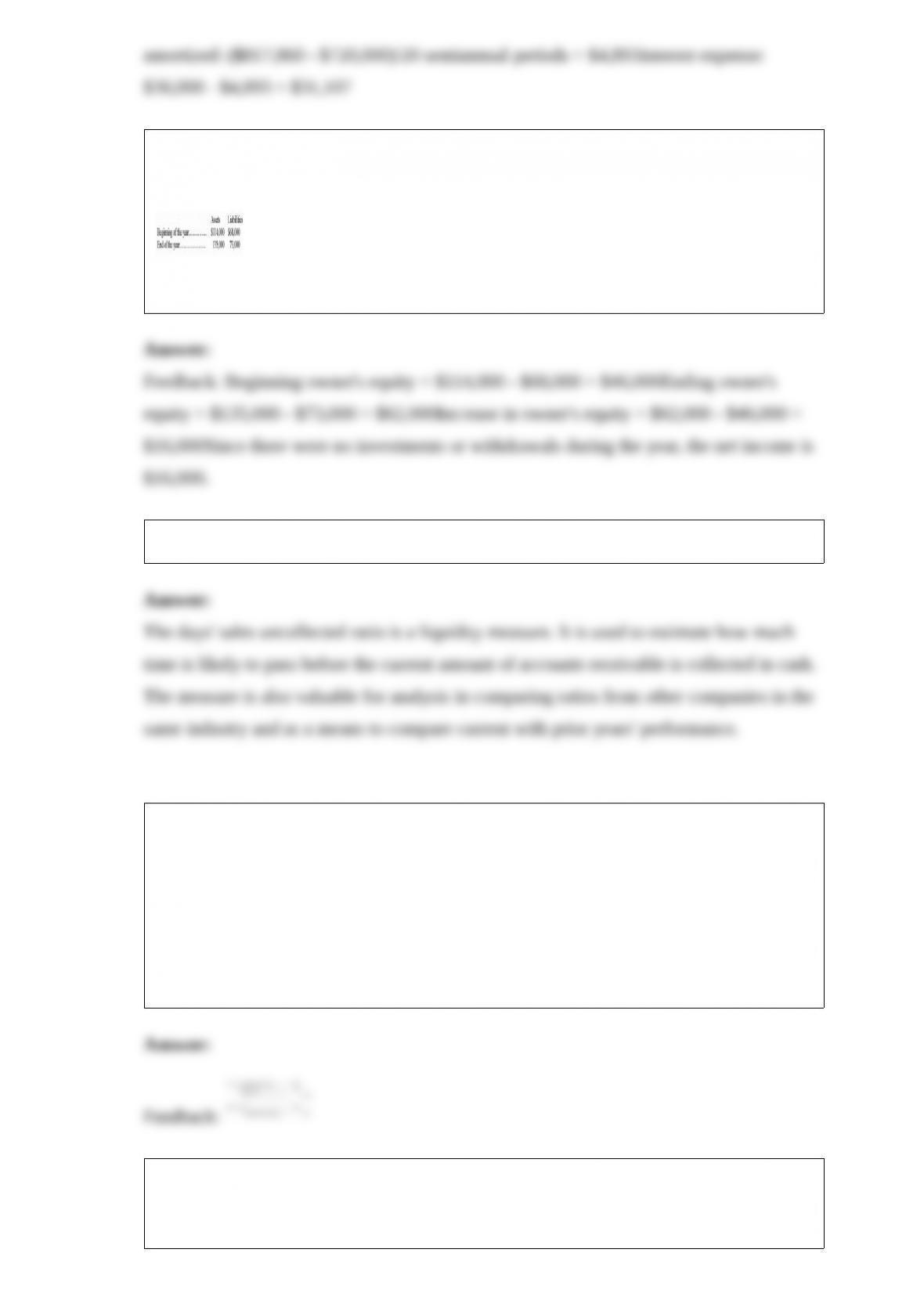
A.43.9
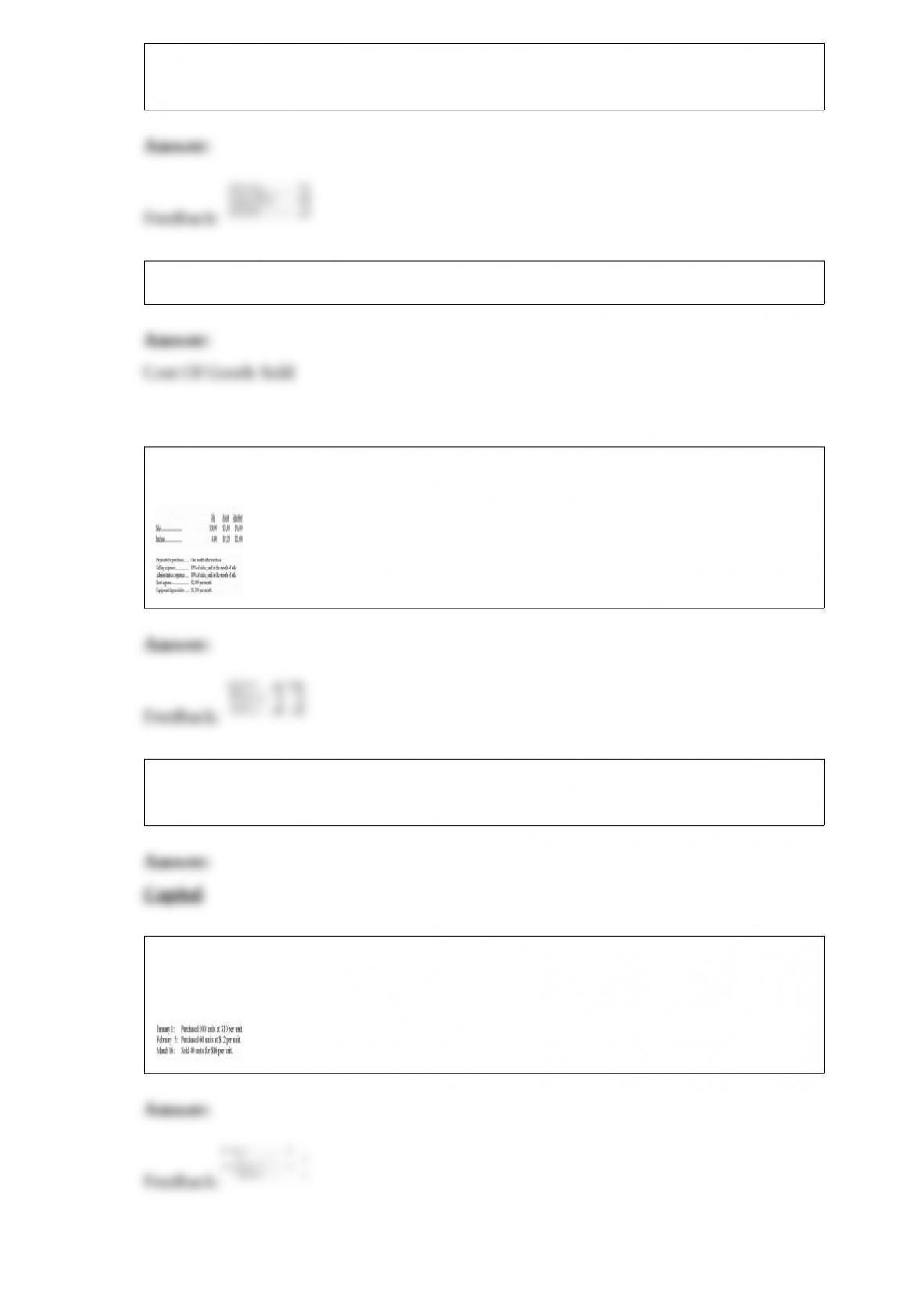
B.42.3
C.46.2
D.80.0
E.113.3
15) Aniston Enterprises manufactures stylish hats for sophisticated women. All
materials are introduced at the beginning of the manufacturing process in the Cutting
Department. Conversion costs are incurred uniformly throughout the manufacturing
process. As the cutting of material is completed, the pieces are immediately transferred
to the Sewing Department. Information for the Cutting Department for the month of
May follows.
Goods in Process, May 1 (50,000 units, 100% complete for direct materials, 40%
complete with respect to direct labor and overhead (conversion costs); includes $70,500
of direct material cost; $34,050 of conversion costs).
Goods in Process, May 31 (75,000 units, 100% complete for direct materials; 20%
complete for conversion costs).
If Aniston Enterprises uses the FIFO method of process costing, compute the cost per
equivalent unit for direct materials and conversion costs respectively for May.
A.$1.52; $1.81
B.$1.50; $1.76
C.$1.83; $1.72
D.$1.71; $1.81
E.$3.30; $3.30
16) Keisha has $3,500 now and plans on investing it in a fund that will pay her 12%
interest compounded quarterly. How much will Keisha have accumulated after 2 years?
A.$4,433.80
B.$4,340.00
C.$4,390.40
D.$3,920.00
E.$3,500.00
17) The appropriate section in the statement of cash flows for reporting the cash
payment of wages is:
A.Operating activities
B.Financing activities
C.Investing activities
D.Schedule of noncash investing or financing activity
E.None of these. This is not reported on the statement of cash flows
18) Regina Harrison is a partner in Pressed for Time. An analysis of Regina Harrison’s
capital account indicates that during the most recent year, she withdrew $20,000 from

the partnership.
Her share of the partnership’s net loss was $16,000 and she made an additional equity
contribution of $10,000. Her capital account ended the year at $150,000. What was her
capital balance at the beginning of the year?
A.$124,000
B.$144,000
C.$192,000
D.$176,000
E.$134,000
19) The ratio of the sales volume for the various products sold by a company is called
the:
A.Current product mix
B.Relevant mix
C.Sales mix
D.Inventory cost ratio
E.Production ratio
20) The main difference in the sales journal under the perpetual and periodic inventory
system is:
A.The column to record cost of goods sold and inventory amounts sold that is used
under the perpetual system but not the periodic
B.The sales tax receivable column that is used under the perpetual system but not the
periodic
C.The sales tax payable column that is used under the perpetual system but not the
periodic
D.The accounts receivable column that is used under the perpetual system but not the
periodic
E.The column for recording cash that is used under the perpetual system but not the
periodic
21) A company issued 60 shares of $100 par value stock for $7,000 cash. The total
amount of paid-in capital is:
A.$100
B.$600
C.$1,000
D.$6,000
E.$7,000
22) Match each of the following terms with the appropriate definitions.
1>Coupon bonds A. An obligation requiring a series of periodic payments to the lender.
2>Market rate B. Bonds that are made payable to whoever holds them; also called
unregistered bonds.
3>Unsecured bonds C. Bonds that are backed by the issuer’s credit standing.
4>Convertible bonds D. Bonds that are scheduled for payment on one specified date.
5>Effective interest rate method E. The contract between the bond issuer and the
bondholders; it identifies the rights and obligations of the parties.
6>Bond indenture F. An accounting method that allocates interest expense over the
bonds’ life in a way that yields a constant rate of interest.
7>Installment note G. Bonds with interest coupons attached to their certificates; the
bondholders detach the coupons when they mature and present them to a bank or broker
for collection.
8>Serial bonds H. The interest rate that borrowers are willing to pay and that lenders
are willing to accept for a particular bond at its risk level.
9>Bearer bonds I. Bonds that can be exchanged by the bondholders for a fixed number
shares of the issuing corporation’s common stock.
10>Term bonds J. Bonds that mature at more than one date and are usually paid over a
number of periods.
23) A flexible budget is prepared:
A.Before the operating period only
B.After the operating period only
C.During the operating period only
D.At any time in the planning period
E.A flexible budget should never be prepared
24) The basic components of an accounting information system include all of the
following except:
A.Source documents
B.Warehouses
C.Information processors
D.Information storage
E.Input devices
25) On October 1, Mutch Company sold merchandise in the amount of $5,800 to Carr
Company, with credit terms of 2/10, n/30. The cost of the items sold is $4,000. Mutch
uses the perpetual inventory system. On October 4, Carr returns some of the
merchandise. The selling price of the merchandise is $500 and the cost of the
merchandise returned is $350. The entry or entries that Mutch must make on October 4
is:
A.Choice A
B.Choice B
C.Choice C
D.Choice D
E.Choice E
26) The 12-month period that ends when a company’s sales activities are at their lowest
level is called the:
A.Fiscal year
B.Calendar year
C.Natural business year
D.Accounting period
E.Interim period
27) Berkley Co.’s sales are 10% cash and 90% on credit. Credit sales are collected as
follows: 30% in the month of sale, 50% in the next month, and 20% in the following
month. On December 31, the accounts receivable balance includes $12,000 from
November sales and $42,000 from December sales. Assume that total sales for January
are budgeted to be $50,000. What are the expected cash receipts for January from the
current and past sales?
A.$18,500
B.$51,500
C.$51,900
D.$55,500
E.$60,500
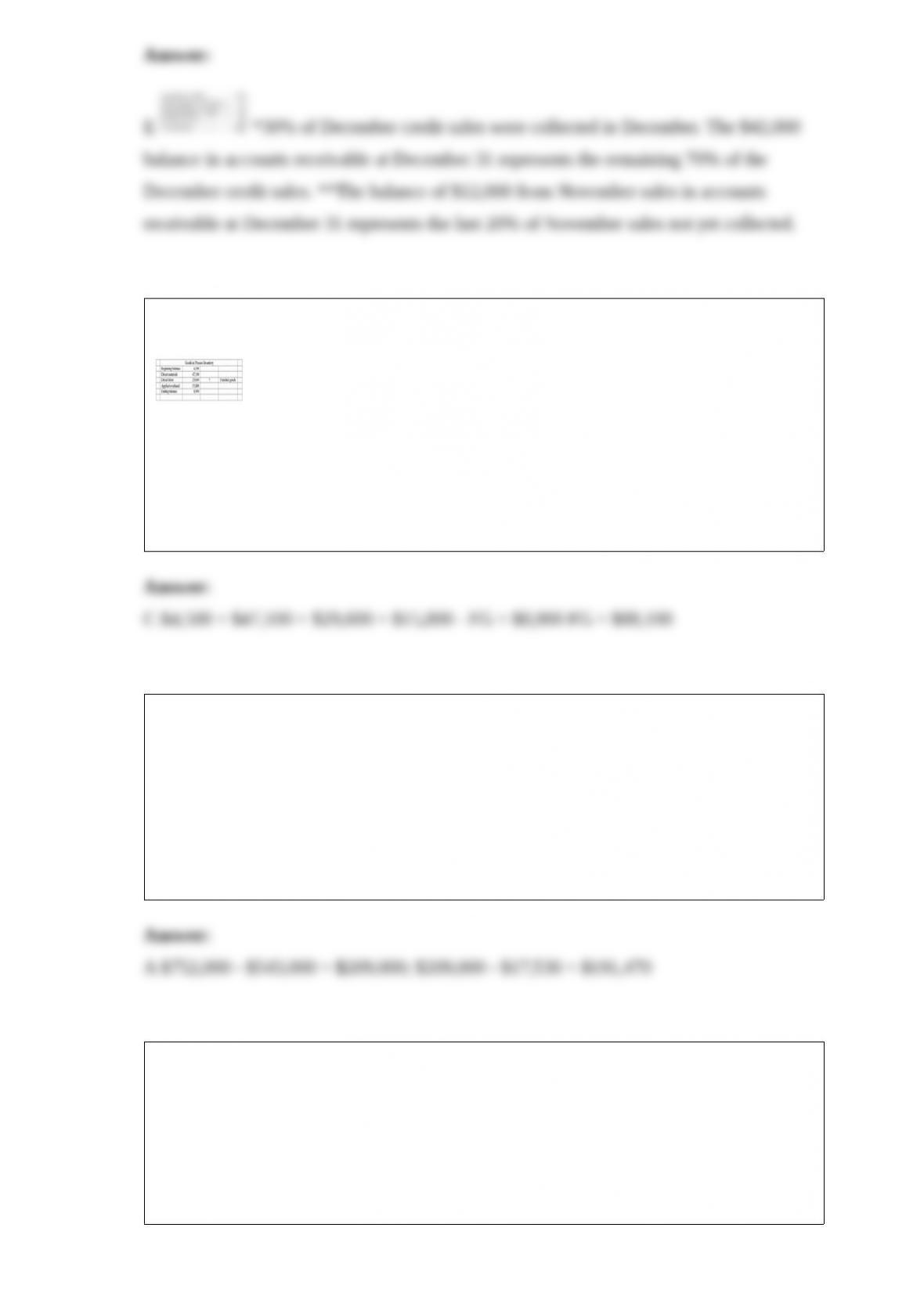
28) The Goods in Process Inventory account for AB Manufacturing follows. Compute
the cost of jobs completed and transferred to Finished Goods Inventory.
The cost of units transferred to finished goods is:
A.$97,000
B.$105,900
C.$88,100
D.$95,200
E.$92,500
29) A company has net sales and cost of goods sold of $752,000 and $543,000,
respectively. Its net income is $17,530. The company’s gross margin and operating
expenses are ________ and ___________, respectively.
A.$209,000; $191,470
B.$191,470; $209,000
C.$525,470; $227,000
D.$227,000; $525,470
E.$734,000; $191,470
30) A general journal is:
A.A ledger in which amounts are posted from a balance column account
B.Not required if T-accounts are used
C.A complete record of any transaction and the place from which transaction amounts
are posted to the ledger accounts
D.Not necessary in electronic accounting systems
E.A book of final entry because financial statements are prepared from it
31) Book value per common share is computed by:
A.Multiplying the number of common shares outstanding times the market price per
common share
B.Dividing total assets by the number of shares outstanding
C.Dividing stockholders’ equity applicable to common shares by the number of
common shares outstanding
D.Multiplying the number of common shares outstanding by par value per share
E.Dividing the number of common shares outstanding by stockholders’ equity
applicable to common shares
32) Cost of goods sold:
A.Is another term for merchandise sales.
B.Is the term used for the cost of buying and preparing merchandise for sale.
C.Is another term for revenue.
D.Is also called gross margin.
E.Is a term only used by service firms.
33) If the liabilities of a business increased $75,000 during a period of time and the
owner’s equity in the business decreased $30,000 during the same period, the assets of
the business must have:
A.Decreased $105,000
B.Decreased $45,000
C.Increased $30,000
D.Increased $45,000
E.Increased $105,000
34) Available-for-sale debt securities are:
A.Recorded at cost and remain at cost over the life of the investment
B.Reported at historical cost, adjusted for the amortized amount of any difference
between cost and maturity value
C.Reported at fair value on the balance sheet
D.Intended to be held to maturity
E.Always classified with Long-Term Liabilities
35) The following account balances are taken from Mesky Sports at December 31.
Calculate the number of days’ sales uncollected for both years. According to this
analysis, is the company’s collection of receivables improving? Explain.
36) Lester Company uses special journals to record transactions. All of the companies
listed below supply inventory to Lester except Harry Co. that supplies equipment. Use
the purchases journal given below to answer the following questions:
a. Foot and crossfoot the journal for accuracy.
b. Identify the error and indicate how to correct the error.
c. When Lester compares the general ledger Accounts Payable account to the Accounts
Payable ledger, it notices that the general ledger control account is $10,000 more that
the schedule of Accounts Payable. What is the most likely cause and how should it be
corrected?
37) Montaigne Corp. has the following information about its standards and production
activity for November. The controllable variance is:
A.$1,295U

B.$1,295F
C.$2,400U
D.$2,400F
E.$3,695U
38) Which of the following accounting principles prescribes that a company record its
expenses incurred to generate the revenue reported?
A.Going-concern assumption
B.Matching principle
C.Cost principle
D.Business entity assumption
E.Consideration assumption
39) Overhead cost variance is:
A.The difference between the overhead costs actually incurred and the overhead
budgeted at the actual operating level
B.The difference between the actual overhead incurred during a period and the standard
overhead applied
C.The difference between actual and budgeted cost caused by the difference between
the actual price per unit and the budgeted price per unit
D.The costs that should be incurred under normal conditions to produce a specific
product (or component) or to perform a specific service
E.The difference between the total overhead cost that would have been expected if the
actual operating volume had been accurately predicted and the amount of overhead cost
that was allocated to products using the standard overhead rate
40) A partner can withdraw from a partnership by:
A.Selling his/her interest to another person for cash
B.Selling his/her interest to another person in exchange for assets
C.Receiving cash from the partnership in the amount of his/her interest
D.Receiving assets from the partnership in the amount of his/her interest
E.All of these
41) Tepsi’s accounts receivable turnover was 9.9 for this year and 11.0 for last year.
Craig’s turnover was 9.3 for this year and 9.3 for last year. These results imply that:
A.Craig has the better turnover for both years
B.Tepsi has the better turnover for both years
C.Craig’s turnover is improving
D.Craig’s credit policies are too loose
E.Craig’s is collecting its receivables more quickly than Tepsi in both years
42) A company sold merchandise on credit for $5,000 (cost is $2,400). Identify the
journal the transaction would be recorded in.
A.Cash disbursements journal
B.Sales journal
C.Cash receipts journal
D.Purchases journal
E.General journal
43) A partnership designed to protect innocent partners from malpractice or negligence
claims resulting from acts of another partner is a:
A.Partnership
B.Limited partnership
C.Limited liability partnership
D.General partnership
E.Limited liability company
44) On January 1, a company issued 10%, 10-year bonds payable with a par value of
$720,000. The bonds pay interest on July 1 and January 1. The bonds were issued for
$817,860 cash, which provided the holders an annual yield of 8%. Prepare the journal
entry to record the first semiannual interest payment, assuming it uses the straight-line
method of amortization.
45) Josephine’s Bakery had the following assets and liabilities at the beginning and end
of the current year:
If Josephine made no investments in the business and withdrew no assets during the
year, what was the amount of net income earned by Josephine’s Bakery?
46) What is the purpose of the days’ sales uncollected ratio?
47) Outdoors Unlimited accepts the Explorer credit card from its customers. Explorer
charges a 3.5% service fee and pays Outdoors Unlimited the amount net of Explorer
charges once a month. During February, Outdoors Unlimited sold $27,000 worth of
merchandise to customers using the Explorer charge card. On February 28, Outdoor
Unlimited sent the $27,000 worth of credit card receipts to Explorer. On March 4,
Outdoors Unlimited received cash proceeds from Explorer for the February credit sales
less the service charge. Prepare the journal entries to record February sales and the
March 4 cash receipt.
48) Miles Company is preparing a cash budget for February. The company has $30,000
cash at the beginning of February and anticipates $75,000 in cash receipts and $96,250
in cash disbursements during February. Miles Company has an agreement with its bank
to maintain a cash balance of $10,000. What amount, if any, must the company borrow
during February to maintain a $10,000 cash balance?
49) The gross margin ratio equals net sales less ___________ divided by net sales.
50) Use the following data to determine the company’s cash disbursements for each
month of August and September:
51) ____________________ leases are long-term or noncancelable leases by which the
lessor transfers substantially all risks and rewards of ownership to the lessee.
52) Using the information given below, prepare the general journal entry to record the
March 16 sale assuming a cash sale and the weighted average method is used.