In 2014, Lawrence Company had gross sales of $750,000 on account and granted sales
discounts of $15,000. On January 1, 2014, the Allowance for Doubtful Accounts had a
credit balance of $18,000. During 2014, $30,000 of uncollectible accounts receivable
were written off. Past experiences indicate that 3% of net credit sales become
uncollectible. Using the percentage of credit sales method, what would be the adjusted
balance in the Allowance for Doubtful Accounts at December 31, 2014?
A. $10,050.
B. $10,500.
C. $22,050.
D. $34,500.
Answer:

Purrfect Pets has a facility that originally cost $375,000. The balance of the
accumulated depreciation account for the facility is $258,000. The company expects to
be able to sell the facility for $107,000 at the end of its useful life. The residual value of
the facility is:
A. $117,000.
B. $151,000.
C. $268,000.
D. $107,000.
Answer:
Using the T-account approach:
A. Net income appears on the debit side of the cash account under operating activities.
B. Payment of long-term debt appears on the debit side of the cash account under
financing activities.
C. Purchase of equipment appears on the credit side of the cash account under operating
activities.
D. An increase in accounts receivable appears on the debit side of the cash account.
Answer:
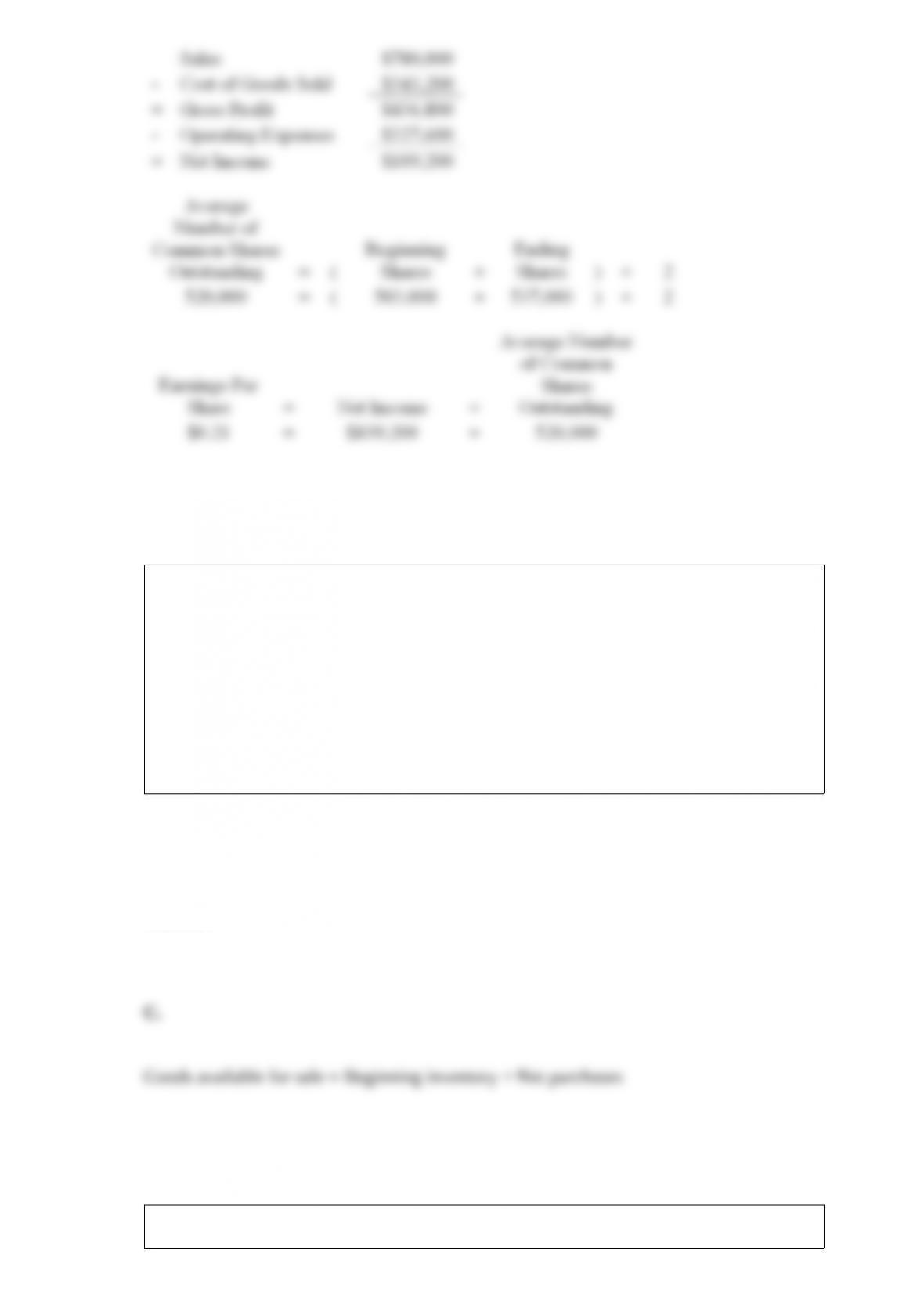
A retail clothing company began operations in 2014 with assets of $42,000. The
following additional data have been taken from the records as of December 31, 2014:
All accounts have normal balances.
What is the amount of total liabilities at December 31, 2014?
A. $11,700.
B. $14,100.

C. $51,618.
D. $35,450.
Answer:
Company X has net sales revenue of $780,000, cost of goods sold of $343,200 and all
other expenses of $327,600 for the current year. At the beginning of the year, 503,000
shares of common stock were outstanding, and, at the end of the year, 537,000 shares of
common stock were outstanding. The basic EPS for the company is:
A. $1.50.
B. $0.84.
C. $0.21.
D. $0.87.
Answer:
A merchandise company’s beginning inventory plus merchandise purchases equals:
A. ending inventory.
B. cost of goods sold.
C. goods available for sale.
D. net purchases.
Answer:
Which one of the following would be listed as a long-term asset?
A. Cash
B. Supplies
C. Buildings and equipment
D. Prepaid insurance
Answer:
Which of the following would be reported on the income statement for the current year?
A. In the current year, the company sold goods to customers who agreed to pay next
year.
B. In the current year, the company received payment in cash for goods that were sold
to customers last year.
C. In the current year, the company borrowed money from the bank which is to be used
in the business activities this year.
D. In the current year, the company issued stock to owners and received cash
immediately.
Answer:
A company has assets of $10 million and liabilities of $7 million. Liabilities include $4
million in accounts payable, $2 million in long-term notes payable and $1 million in
other non-current liabilities. If a financial web site uses long-term debt rather than total
liabilities to calculate the company’s debt-to-assets ratio, the web site will report a ratio
of:
A. 0.4, which would correctly state financing risk.
B. 0.4, which would suggest more financing risk than it actually has.
C. 0.3, which would suggest less financing risk than it actually has.
D. 0.3, which would suggest more financing risk than it actually has.
Answer:
The balance sheet category “intangible assets” includes:

A. Patents, trademarks, and franchises.
B. Equipment, land, and buildings.
C. Investments, receivables, and cash.
D. Goodwill, inventory, and vehicles.
Answer:
Flynn Company’s monthly bank statement showed the ending balance of cash of
$18,500. The bank reconciliation for the period showed an adjustment for a deposit in
transit of $1,500, outstanding checks of $2,000, a NSF check of $700, bank service
charges of $30 and the EFT from a customer in payment of the customer’s account of
$1,500.
Use the information above to answer the following question. What is the adjusted cash
balance at the end of the month?
A. $18,000
B. $17,230
C. $19,000
D. $19,270
Answer:
In January, the Huntington Beach Resort (HBR) accepts your reservation and receives
your $2,000 payment for a week of sun and fun in California during spring break. The
$2,000 would be recorded by HBR during January as a:
A. debit to Cash and a credit to Unearned Revenue.
B. debit to Accounts Payable and a credit to Service Revenue.
C. debit to Cash and a credit to Service Revenue.
D. debit to Service Revenue and a credit to Cash.
Answer:
A loss on disposal of an asset would be reported:
A. in the Operating Revenues section of the income statement.
B. in the Operating Expenses section of the income statement.
C. as a direct increase to the asset account on the balance sheet.
D. as a direct decrease to the asset account on the balance sheet.

Answer:
All other things being equal, in which of the following cases would an analyst rank the
company most favorably?
A. The company has the highest debt-to-assets ratio in the industry as well as the
highest profit margin ratio and asset turnover ratio.
B. The company has the highest debt-to-assets ratio in the industry as well as the
highest profit margin ratio while its asset turnover ratio is the lowest.
C. The company has the lowest debt-to-assets ratio in the industry as well as the lowest
asset turnover ratio while its profit margin ratio is the highest.
D. The company has the lowest debt-to-assets ratio in the industry as well as the highest
profit margin ratio and asset turnover ratio.
Answer:
The MegaHit Film Studio has a licensing right (or agreement) to distribute films
produced by the Artsy Film Company. How would the MegaHit Company classify this
licensing right on its balance sheet?
A. Tangible asset
B. Research and development
C. Intangible asset
D. Fixed asset
Answer:
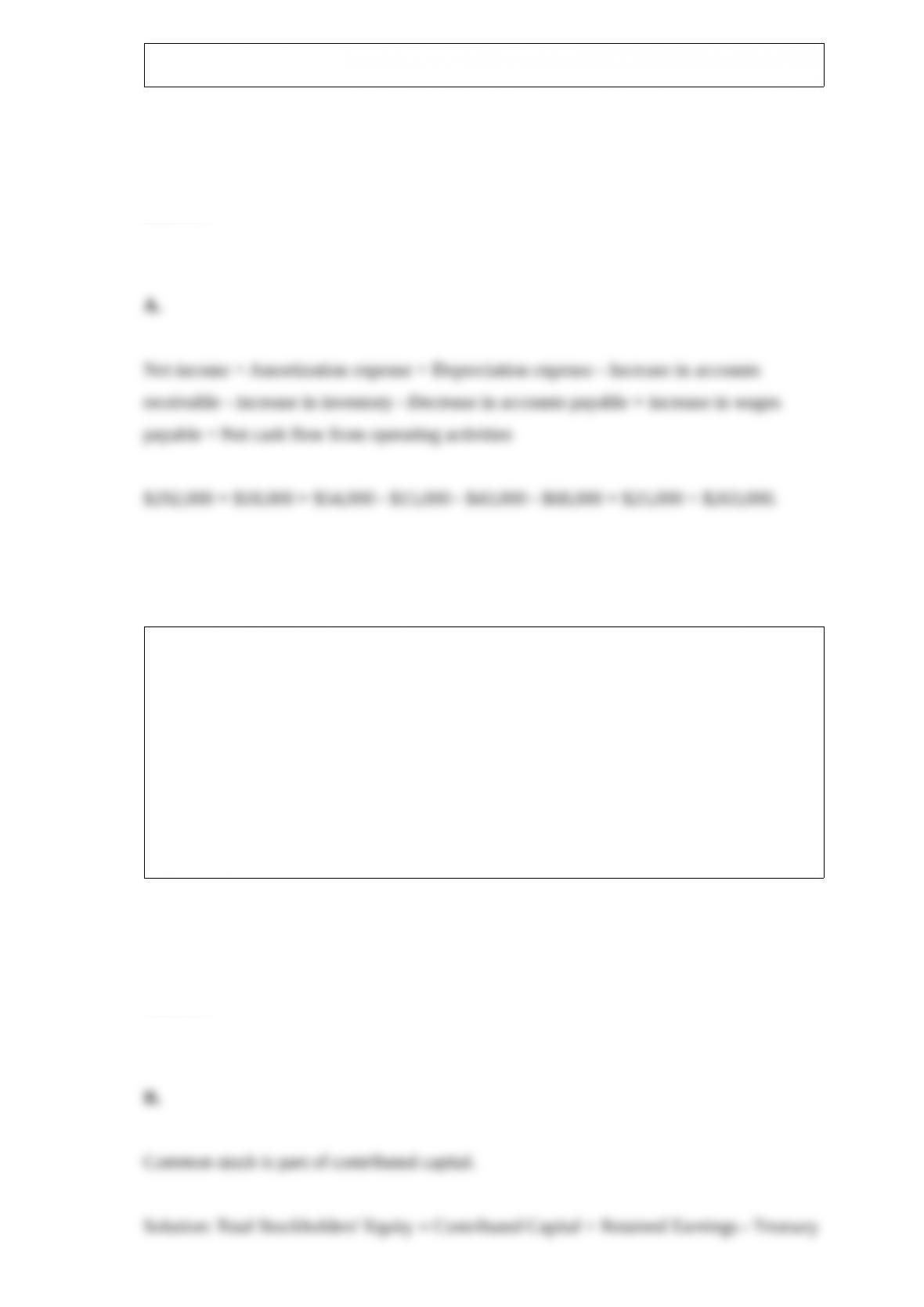
C. Hitchens Company’s income statement for the year ended December 31, 2014,
reported net income of $292,000. The following additional information is available
from the financial statements of C. Hitchens Company for the year ended December 31,
2014:
The amount of net cash flow from operating activities for 2014 is:
A. $263,000
B. $285,000
C. $396,000
D. $368,000
Answer:
Contributed capital is 30,000, retained earnings is 65,000, treasury stock is 18,000, and
common stock is 10,000. What is the total stockholders’ equity?
A. $113,000
B. $77,000
C. $123,000
D. $87,000
Answer:
The allowance for doubtful accounts will have a debit balance before adjustments,
when
A. the accountant has made a mistake.
B. bad debts were overestimated.
C. bad debts were underestimated.
D. the company recovered some accounts previously written off.
Answer:
Which inventory costing method generally results in the most recent costs being
assigned to ending inventory?
A. LIFO.
B. FIFO.
C. Weighted average cost.
D. Simple average cost.
Answer:
A discount on bonds payable is reported in the financial statements as:
A. a reduction from the bond liability on the balance sheet.
B. an expense on the income statement.
C. an asset on the balance sheet.
D. revenue on the income statement.
Answer:
An increasing balance in the inventory account and a faster inventory turnover ratio
would imply that the inventory build-up is occurring because:
A. goods are not selling as fast as anticipated.
B. the company is expecting to sell more in the future.
C. goods are selling but it is taking longer to collect payment.
D. the economy is slowing down.
Answer:
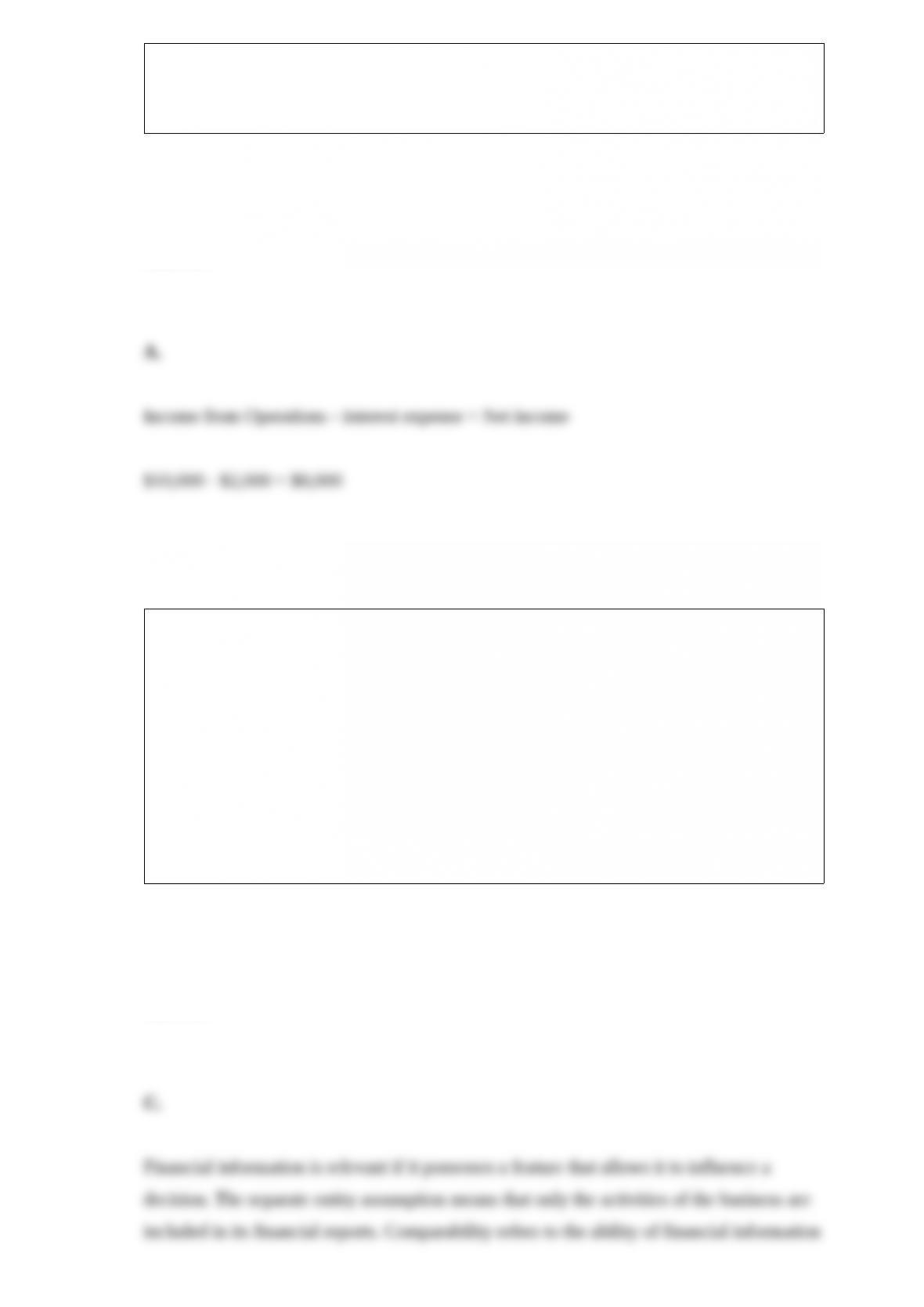
The following is a listing of some of the balance sheet accounts and all of the income
statement accounts for Mulberry Street Sportswear as they appear on the 12/31/14
adjusted trial balance.
Use the information above to answer the following question. Net Income for 2014
would be
A. $8,000.
B. $9,000.
C. $10,000.
D. $14,000.
Answer:
Relevance is an objective of external financial reporting that means
A. the financial reports of a business are assumed to include the results of only that
business’s activities.
B. financial information can be compared across businesses because similar accounting
methods have been applied.
C. the financial information possesses a feature that allows it to influence a decision.
D. the financial information depicts the economic substance of business activities.
Answer:
The book value of equipment is equal to which of the following?
A. Cost of equipment plus accumulated depreciation.
B. Accumulated depreciation less depreciation expense.
C. Cost of equipment less accumulated depreciation.
D. Accumulated depreciation plus depreciation expense.
Answer:
An increase in the gross profit percentage indicates that:
A. cost of goods sold as a percentage of sales has decreased.
B. cost of goods sold as a percentage of sales has increased.
C. operating expenses as a percentage of sales have increased.
D. operating expenses as a percentage of sales have decreased.
Answer:
When the allowance method is used, the entry to record the write-off of specific
uncollectible accounts would decrease
A. the allowance for doubtful accounts.
B. net income.
C. the net realizable value of accounts receivable.
D. bad debt expense.
Answer:
A company’s revenue recognition policy:
A. affects the income statement but not the balance sheet.
B. defines when its revenue should be collected.
C. is usually described in the notes to a company’s financial statements.
D. states that revenues should not be recorded until payments are received from
customers.
Answer:
Which of the following misstatements would cause the debt-to-assets ratio to be
overstated?
A. Recording costs as assets that should have been expensed.
B. Failing to adjust for depreciation in the current period.
C. Failing to accrue income taxes of the current period.
D. Failing to accrue interest earned of the current period.
Answer:

The receivables turnover ratio is calculated as:
A. the average number of days from the time a sale is made on account to the time cash
is collected.
B. the average number of days from the time a sale is made on account to the time
payment is due.
C. how many times a year receivables go uncollected.
D. how many times, on average, the process of selling and collecting is repeated during
the period.
Answer:
Which of the following measures is most useful in analyzing a company’s ability to
control expenses?
A. Debt-to-assets ratio.
B. Asset turnover ratio.
C. Net profit margin ratio.
D. Pro forma ratio.
Answer:
In a trial balance a contra-account appears:
A. just before the account it offsets but in the opposite column.
B. just after the account it offsets and in the same column.
C. just after the account it offsets but in the opposite column.
D. just before the account it offsets and in the same column.
Answer:
When you identify outstanding checks in performing a bank reconciliation, you must:
A. deduct the amount of the outstanding checks from the balance per books.
B. deduct the amount of the outstanding checks from the balance per bank.
C. add the amount of the outstanding checks to the balance per books.
D. add the amount of the outstanding checks to the balance per bank.
Answer: