
Select the correct statement regarding relevant revenues.
A. Relevant revenues must not differ between the alternatives being considered.
B. Past or future revenues may be relevant.
C. Relevant revenues must make a difference in the decision under consideration.
D. Revenues are not considered relevant in the same way as relevant costs.
Select the correct statement about budgeting and human behavior.
A. People are usually very comfortable with budgets.
B. The attitudes of upper managers significantly impact budget effectiveness.
C. Budgets increase individual freedom within an organization.
D. Participative budgeting contributes to fear and resentment.
In 2014, Wade Company reported wages expense of $32,000. The beginning balance in
wages payable was $1,200, and at the end of the year, the balance in wages payable was
$1,700. What was the amount of cash that Wade paid for employee wages during the
year?
A. $29,100
B. $31,500
C. $34,400
D. $32,500
Which of the following costs would be most fairly allocated using a volume based cost
driver?
A. Inventory holding costs
B. Property taxes
C. Set up costs for product batches
D. Indirect labor costs
The following balance sheet information is provided for Patton Company:
Assuming 2014 cost of goods sold is $730,000, what is the company’s average days to
sell inventory? (Use 365 days in a year. Do not round your intermediate calculations.)
A. 17.5 days
B. 18.25 days
C. 19 days
D. 20.86 days
Crown Company produces and sells two products. The following monthly data are
provided:
The break-even point for the current sales mix is 360 units (144 Slicer models and 216
Chopper models). What would be the impact on profit if 360 units are sold but 145
Slicer models are sold instead of 144?
A. $3 decrease
B. $5 increase
C. $2 decrease
D. $2 increase
Mark Company, Inc. sells electronics. The company generated sales of $45,000.
Contribution margin is $20,000 and net income is $4,000. Based on this information,
the magnitude of operating leverage is:
A. 2.25 times
B. 11.25 times
C. 5 times
D. 6.25 times
A manager refuses to replace an existing asset even though an extensive analysis
indicates that replacement is desirable. One possible explanation for the manager’s
action is that:
A. A financial loss may be reported in the current period if the asset is replaced.
B. The manager is concerned that his or her superior may think that the original asset
purchase was a mistake on the part of the manager.
C. The manager expects to be promoted or transferred in the near future and is
concerned primarily about short-term performance.
D. All of these.
Which of the following statements concerning product costs versus general, selling, and
administrative costs is false?
A. Product costs incurred during the period will initially appear as inventory on the
balance sheet.
B. General, selling, and administrative costs are always expensed when paid.
C. Product costs may be divided between the balance sheet and income statement.
D. General, selling, and administrative costs never appear as inventory on the balance
sheet.
Consider the following cost-volume-profit graph:
What is the approximate amount of fixed costs in this organization?
A. $0
B. $25,000
C. $60,000
D. $30,000

Assume that the company sells two products, X and Y, with contribution margins per
unit of $12 and $10, respectively. What happens to the break-even volume if sales mix
shifts to favor product X? (In other words, Y makes up a higher percentage of the sales
mix.)
A. Break-even volume increases.
B. Break-even volume decreases.
C. Break-even volume stays the same.
D. None of these answers is correct.
Which of the following reason(s) cause flexible budgets to be useful planning tools?
A. Flexible budgets allow managers to anticipate results under a variety of scenarios.
B. Flexible budgets can help determine if a company’s cash position is adequate.
C. Flexible budgets can help managers judge if materials and storage facilities are
appropriate for various production levels.
D. All of these answers are correct.
Standard cost systems facilitate the management practice known as:
A. Management by the numbers.
B. Management development.
C. Managing by exception.
D. Just-in-time management.
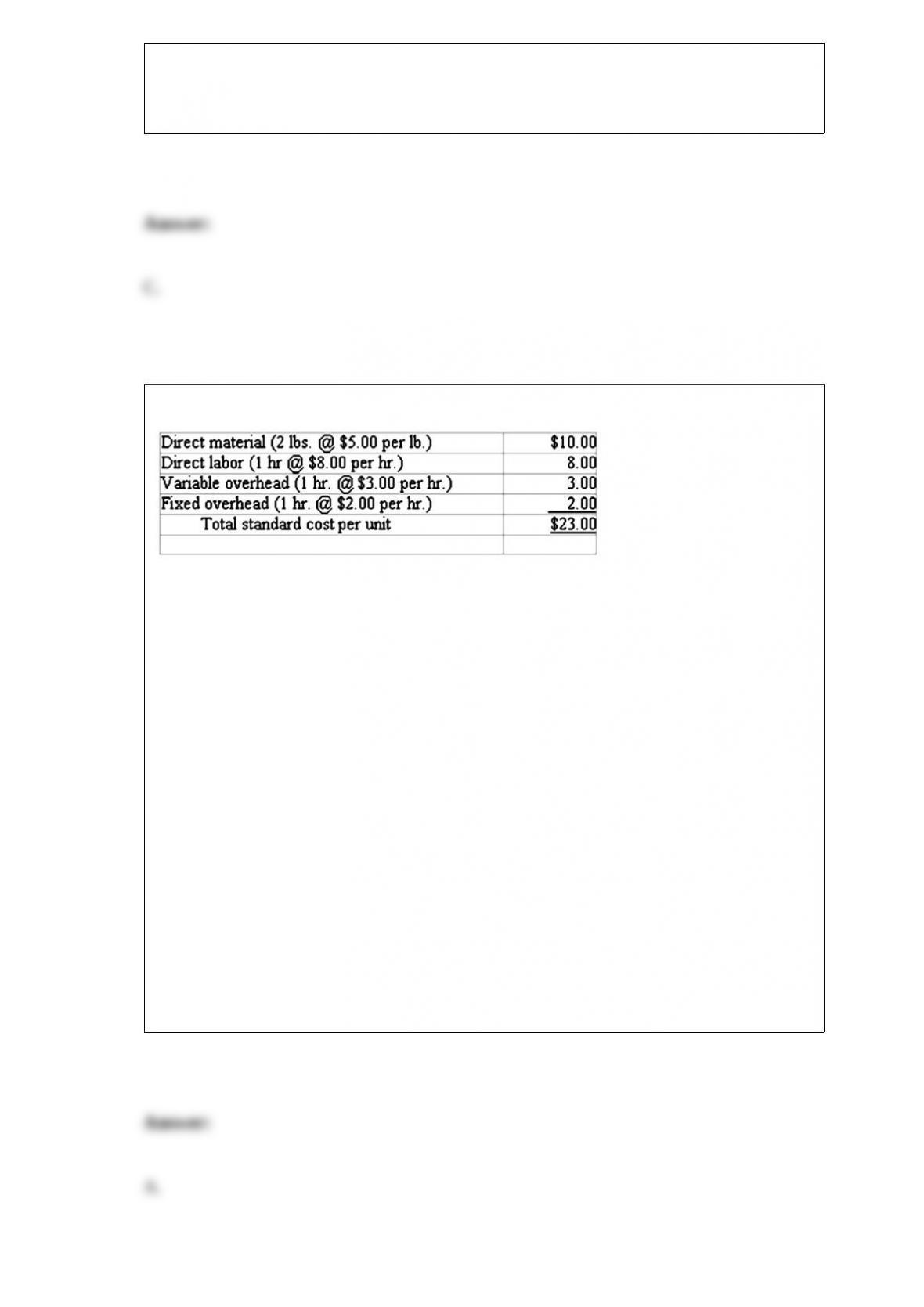
The following standard cost card is provided for Navid Company’s Product A:
The fixed overhead rate is based on total budgeted fixed overhead of $12,000. During
the period, the company produced and sold 5,800 units at the following costs.
Direct material 12,200 pounds @ $4.80 per pound
Direct labor 5,950 hours @ $8.00 per hour
Overhead $29,920
The standard manufacturing cost per unit is $23.00 while the actual manufacturing cost
per unit was (Do not round intermediate calculations):
A. $23.46.
B. $36.16.
C. $17.96.
D. Cannot be determined from the information provided.

Which of following practices is not considered an effective means of reengineering
business systems?
A. Identifying the best practices used by world-class competitors
B. Improving the accuracy of cost allocations
C. Increasing non-value added activities
D. All of these are effective means of reengineering business systems.
Burke Company produced 8,000 units of inventory and sold 6,000 of them. The
company incurred the following production costs:
Variable manufacturing cost: $6.00 per unit
Fixed manufacturing overhead cost: $24,000
Assuming the company sells its product at a price of $15 per unit, and incurred $10,000
in selling and administrative costs, what is the amount of net income under absorption
costing?
A. $38,000
B. $14,000
C. $24,000
D. $26,000

Costs that might be incurred by service, merchandising, and manufacturing companies
are described below:
Required:
Classify each cost as variable (V) or fixed (F) with respect to volume or level of
activity.
Sales commissions paid to sales associates in a department store
Shipping cost for Amazon
Electricity cost to heat and light a law firm
Rent on a storeroom used by Turf Pros to store lawn equipment
Salary of a supervisor in a Best Buy distribution center
Wages paid to production workers in a General Motors plant
Insurance on a Hershey factory
Fuel costs for Southwest Airlines
Depreciation of office equipment by Microsoft Corporation
Dishwashing in an Olive Garden restaurant
Salary of the CEO of Microsoft
Lubricants used to maintain machinery in a textile factory
Cost of metal cans used in a dog food factory
Cost of pizza boxes for Domino’s Pizza
Material handling costs for Frito Lay
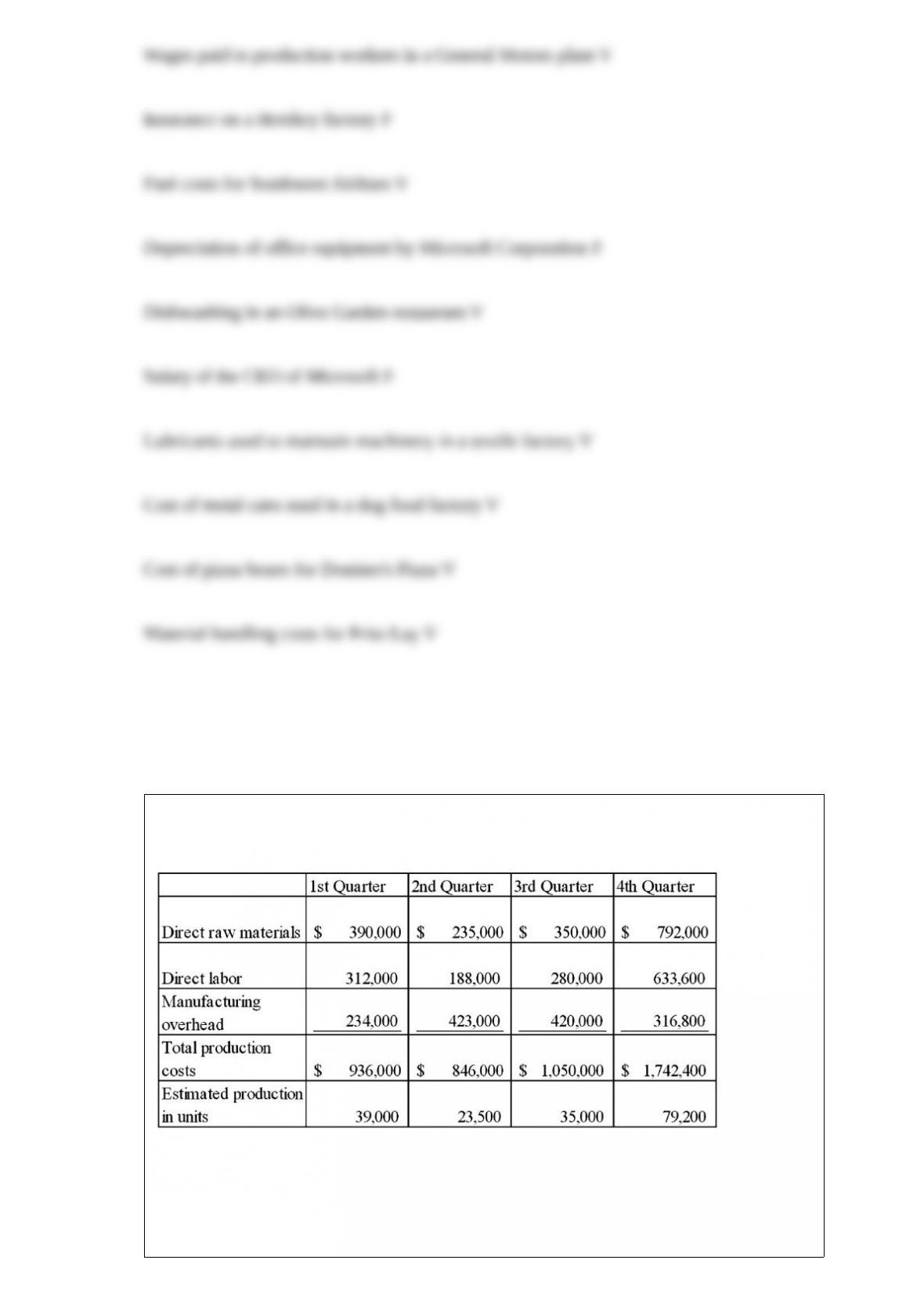
Lake Manufacturing estimated its product costs and production volume for the
upcoming year by quarter as follows:
The company expects a significant increase in volume in the fourth quarter due to
holiday sales. The company does not expect overhead costs, which are predominately
fixed, to vary with production volume or to vary significantly from previous years.
Selling prices are established using a cost plus pricing strategy where cost is the
product’s estimated quarterly cost. However, the company finds the wide variations in
short-term unit cost difficult to use. Specifically, unit cost fluctuations complicate
pricing decisions and many other decisions where cost is a consideration.
Required:
1) Compute the company’s expected cost per unit for each quarter of the year.
2) How would you suggest that overhead costs be estimated to solve the company’s unit
cost problem? Calculate the unit cost per quarter based on your recommendation.
Bonnie’s Bakery is a relatively small company that makes pies, cakes, and cookies sold
in supermarkets. Sales employees’ bonuses are determined based on meeting or
exceeding the budget. For the coming year, sales employees have set a budget target of
3 percent for sales growth. The market has been growing at 6 percent, and the company
has averaged 10 percent growth for the last two years. What is the problem here, and
how can it be fixed?
Indicate whether each of the following statements is true or false.
Standards for direct materials and direct labor should be set by a company’s accounting
department.
Standards for direct materials and direct labor should be re-evaluated frequently in
order to remain relevant and useful.
Historical information is of little use in establishing standards.
A standard represents what should be, not what is or was.
Managers should consider behavioral implications when developing standards.
Oregon Company started the month of August with 4,000 units in beginning work in
process; these units were 60 percent complete on August 1. During the month, 16,000
units were completed and transferred to Finished Goods. The ending work in process
was 2,000 units that were 20% complete.
Required:Calculate Oregon’s equivalent whole units for the month of August.