
Which of the following situations would require auditors to add an other-matter
paragraph to their report on comparative financial statements?
A. An unmodified opinion is issued in the current year while a qualified opinion was
issued in prior years.
B. A qualified opinion is issued in the current year because of a scope limitation;
because this limitation was not encountered in prior years, the opinion issued in those
years was unmodified.
C. The updated opinion issued on prior-years’ financial statements differs from the
opinion originally issued on those financial statements.
D. The auditors’ unmodified opinion issued on prior-years’ financial statements is still
considered to be appropriate.
In performing an attestation engagement, a CPA typically
A. supplies litigation support services.
B. assesses control risk at a low level.
C. expresses a conclusion on an assertion about some type of subject matter.
D. provides management consulting advice.
In which of the following circumstances would the auditor most likely use variables
sampling?
A. Identifying the susceptibility of the account balance to misstatement

B. Evaluating the operating effectiveness of specific control procedures
C. Evaluating the operating design of specific control procedures
D. Determining whether the client’s accounts receivable balance is correctly recorded
As a result of tests of controls, an auditor assessed control risk too low and decreased
substantive procedures. This assessment occurred because the true deviation rate in the
population was
A. more than the risk of overreliance based on the auditor’s sample.
B. more than the deviation rate in the auditor’s sample.
C. less than the risk of overreliance based on the auditor’s sample.
D. less than the deviation rate in the auditor’s sample.
Which of the following responses to an accounts receivable confirmation at December
31 would cause an audit team the most concern?
A. “This amount was paid on December 30th.”
B. “We received this shipment on January 2nd.”
C. “These goods were returned for credit on November 15th.”
D. “The balance does not reflect our sales discount for paying by January 5th.”

Auditors would not normally issue a qualified opinion on the entity’s financial
statements when
A. an accounting principle at variance with generally accepted accounting principles is
used.
B. the auditors lack independence with respect to the audited entity.
C. a scope limitation prevents the auditors from completing an important auditing
procedure.
D. the entity has undertaken a change in accounting principle with which the auditor
does not agree.
The mail which includes payments should be opened by two people. This control is
called
A. separation of duties.
B. joint custody.
C. anti-collusion.
D. lapping.

In order for auditors to be able to recognize potential fraud, they must be aware of the
basic characteristics of fraud. Which of the following is not a characteristic of fraud?
A. Intentional deception
B. Taking unfair or dishonest advantage of other people
C. Perpetration for the benefit or detriment of the organization
D. Negligence on the part of executive management
Which of the following provides the best method of obtaining an understanding of a
continuing client’s business for planning an audit?
A. Performing tests of details of transactions and balances
B. Reviewing prior year audit documentation and the permanent file for the client
C. Reading specialized industry journals
D. Reevaluating the client’s internal control environment
Assume that the audit team wishes to determine the extent to which a particular control
policy was functioning as intended. Identifying applications of the control throughout
the period under audit would be most closely related to which of the following steps in
sampling?

A. Determining the objective of sampling
B. Defining the characteristic of interest
C. Defining the population
D. Determining the sample size
Firm A performs audits of 60 public entities, while firm B performs audits of 120 public
entities. How often must each firm undergo a PCAOB inspection?
A. Both firm A and firm B will be inspected every other year.
B. Firm A will be inspected annually and firm B will be inspected every three years.
C. Firm A will be inspected every three years and firm B will be inspected annually.
D. Both firm A and firm B will be inspected annually.
Which of the following factors that affect sample size can be determined by considering
the recorded account balance of the account or class of transactions as well as the
relationship between the recorded account balance or class of transactions with
important financial statement subtotals?
A. Expected misstatement
B. Population size
C. Risk of incorrect acceptance

D. Tolerable misstatement
Tracing a sample of time clock cards to payroll registers (journals) is a procedure
designed to obtain evidence about the transaction assertion(s) of
A. occurrence only.
B. occurrence and accuracy only.
C. completeness only.
D. accuracy only.
Which of the following types of transactions would be routine and computerized?
A. Capital stock sales and repurchases
B. Credit sales and billings
C. Income tax expense and liability
D. Bank loan transactions

Auditors ordinarily ascertain whether payroll checks are properly endorsed during the
audit of
A. clock cards.
B. the voucher system.
C. cash in bank.
D. accrued payroll.
When auditors are engaged to examine an entity’s financial statements but decide to
issue a disclaimer of opinion because of a scope limitation, the report would not
A. identify management’s responsibility for the financial statements.
B. refer to any scope limitation in an additional paragraph.
C. modify the Auditor’s Responsibility section to identify the basis for the disclaimer.
D. indicate that the auditors were engaged to audit the financial statements.
Which of the following would be consistent with an employee taking cash receipts from
customers on account?
A. The total of the accounts receivable subsidiary ledger balances is less than the
accounts receivable control account.

B. The total of the accounts receivable subsidiary ledger balances is greater than the
accounts receivable control account.
C. Total cash receipts from customers for the month are less than credit sales for the
month.
D. Total cash receipts from customers for the month are greater than credit sales for the
month.
An auditor traces the serial numbers on equipment to a nonissuer’s sub-ledger. Which of
the following management assertions is supported by this test?
A. Valuation and allocation.
B. Completeness.
C. Rights and obligations.
D. Presentation and disclosure.
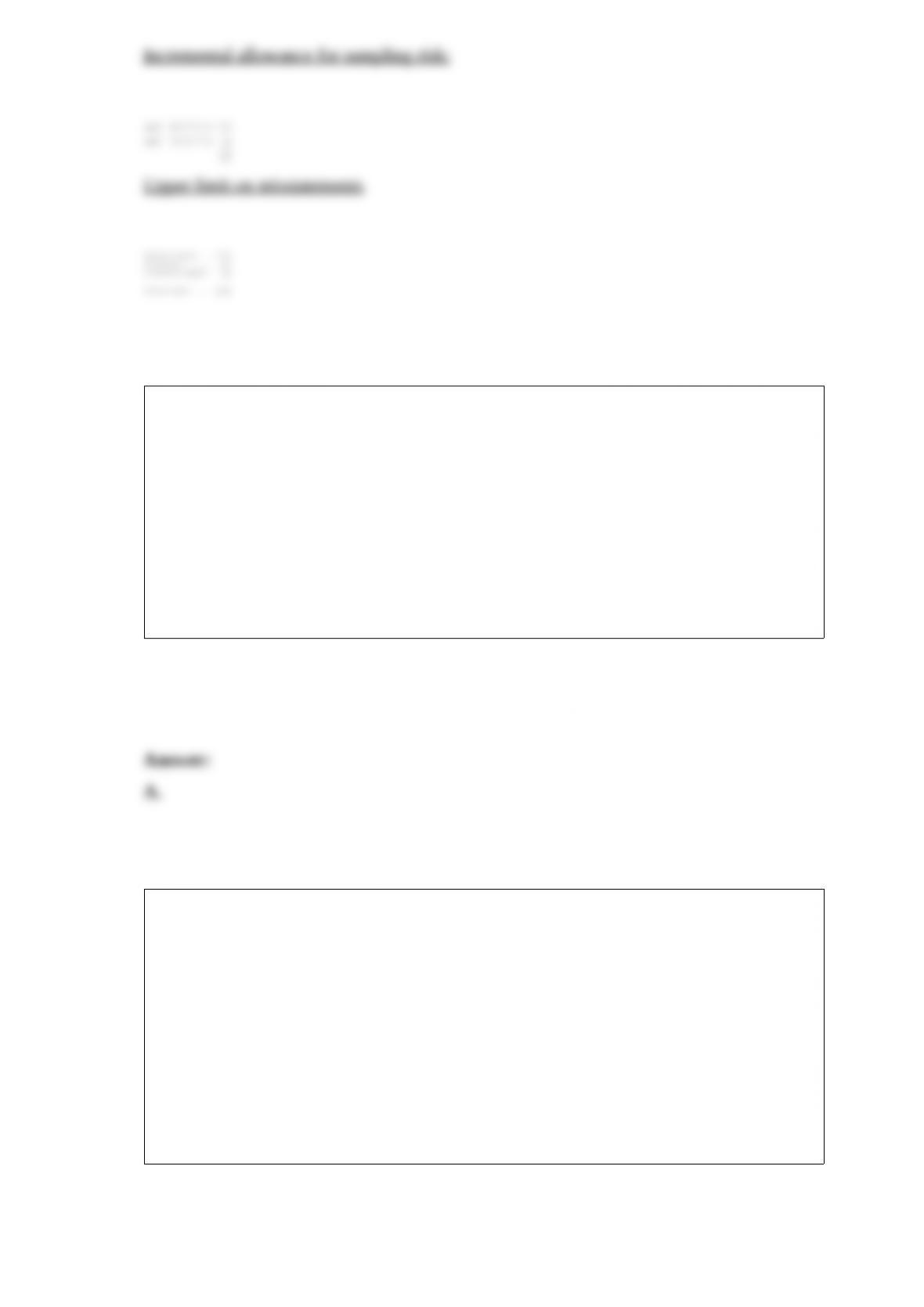
You are planning to use monetary unit sampling to evaluate accounts receivable for
Violet Company. The accounts receivable account totals $3,000,000. You have assessed
a risk of incorrect acceptance of 5%, a tolerable misstatement of $120,000, and an
expected misstatement of $24,000.
a. Calculate the sample size and sampling interval.
b. Regardless of your answer to (a), use a sample size of 125 and the related sampling
interval and calculate the upper limit on misstatements assuming you found the
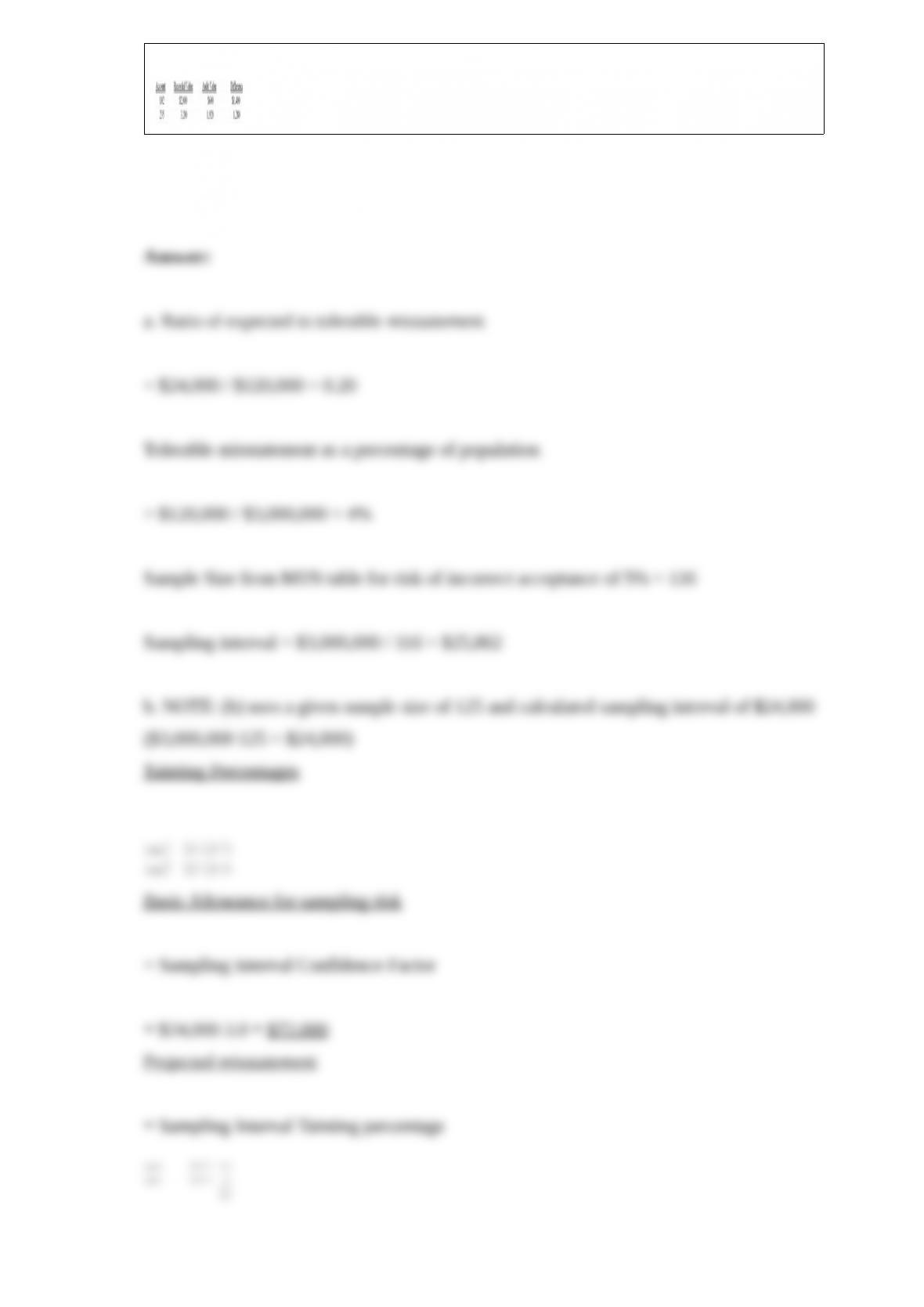
following differences.
In an audit of a municipality the auditor is most important audit objective is
A. the municipality is in compliance with laws, regulations, and the municipality’s
policy and procedures.
B. the municipality’s internal controls are operating effectively.
C. the municipality as sufficient documentation to support all purchases.
D. purchases made by the municipality have sufficient encumbrances.
Which of the following questions would auditors most likely include on an internal
control questionnaire for notes payable?
A. Are assets that collateralize notes payable critically needed for the entity’s continued
existence?
B. Are two or more authorized signatures required on checks that repay notes payable?
C. Are the proceeds from notes payable used for the purchase of noncurrent assets?
D. Are direct borrowings on notes payable authorized by the board of directors?

All of the following statements are true regarding generally accepted auditing standards
(GAAS) except
A. departures from auditing standards that impose presumptively mandatory
requirements on auditors are not permitted under any circumstances.
B. Interim Auditing Standards, issued by the AICPA, may serve as an appropriate
source of GAAS for the audits of public entities.
C. separate auditing standards have been developed for the audits of U.S. governmental
entities and foreign entities.
D. Interpretive Publications, which are officially considered less authoritative and less
binding than auditing standards, are included as part of GAAS.
The tests of controls for inventory records would include the following procedures.
A. Existence.
B. Rights.
C. Completeness.
D. Valuation.
E. Presentation and disclosure.
For each of the procedures, place the letter of the correct PCAOB assertion(s). Only one
letter per procedure should be used.

The auditors should insist that a representative of the client be present during the
inspection and count of securities to
A. lend authority to the auditors’ directives.
B. detect forged securities.
C. coordinate the return of all securities to proper locations.
D. acknowledge the receipt of securities returned.
In the revenue and collection cycle, the auditor checks the numerical sequence of
shipping documents. This procedure is related to which of the following assertions?
A. Existence.
B. Completeness.
C. Rights and obligations.
D. Valuation or allocation.

Tracing bills of lading to sales invoices provides evidence that
A. shipments to customers were invoiced.
B. shipments to customers were recorded as sales.
C. recorded sales were shipped.
D. invoiced sales were recorded as sales.
The auditor’s judgment concerning the overall fairness of the presentation of financial
position, results of operations, and cash flows is applied within the framework of
A. quality control.
B. generally accepted auditing standards, which include the concept of materiality.
C. the auditor’s evaluation of the audited company’s internal control.
D. the applicable financial reporting framework (i.e., GAAP in the United States).
A university received a significant grant from the state in which it resides. Which of the
following would be of greatest interest to a governmental auditor auditing that grant at
the university?
A. Cash received by the university was deposited in the appropriate account.
B. The grant is properly recorded on the university’s financial statements.
C. Grant money was spent in accordance with the purpose of the grant.
D. The person applying for the grant was the person that was utilizing the grant money.
An important role of the Public Company Accounting Oversight Board is to oversee the
A. issuance of statements by the Financial Accounting Standards Board.
B. preparation and grading of the Uniform CPA Examination.
C. peer review of member firms of the Private Companies Practice Section.
D. regulation of firms that audit public entities.
Tracing shipping documents to prenumbered sales invoices provides evidence that
A. no duplicate shipments or billings occurred.
B. shipments to customers were properly invoiced.
C. all goods ordered by customers were accounted for.
D. all prenumbered sales invoices were accounted for.

On the basis of attributes sampling, an auditor decided to increase the assessed level of
control risk from the level originally planned. To achieve an overall audit risk level that
is substantially the same as the original planned level of audit risk, the auditor would
A. increase inherent risk.
B. increase overall materiality levels.
C. decrease substantive procedures.
D. decrease detection risk.