
______________ standards allow inefficiencies from prior years to be incorporated into
the budget, thus providing little incentive for improvement.
A. Ideal
B. Engineered
C. Attainable
D. Past experience
When a firm buys land on which there is a building, and the building is torn down so
that an appropriate new building can be constructed on the land:
A. any of the purchase cost allocated to the old building is reported as a loss.
B. the cost assigned to the land excludes the cost of the old building.
C. the total cost of the land and old building are capitalized as land cost.
D. any of the purchase cost allocated to the old building is capitalized as part of the cost
of the new building.
If the net present value of a proposed investment is positive:
A. the investment not will be made.
B. the cost of capital is higher than the internal rate of return.
C. the cost of capital is positive.
D. the cost of capital is less than the expected rate of return.
Management’s statement of responsibility:
A. usually refers to the company’s system of internal controls.
B. emphasizes that the auditors are responsible for the financial statements.
C. includes a disclaimer of responsibility for the level of the P/E ratio of the company’s
common stock.
D. gives the president of the company an opportunity to explain why profits changed.

A cost that is incurred because of a long-range policy decision is known as a:
A. discretionary cost.
B. committed cost.
C. continuous cost.
D. standard cost.
Which of the following requires an explanatory paragraph in the independent auditors’
report?
A. Basing the opinion on the work of another auditor.
B. Uncertainties about the outcome of a significant event that would have affected the
presentation of the financial statements.
C. Substantial doubt about the entity’s viability to continue as a going concern.
D. None of the above.
E. Items A, B and C are correct.
A ledger:
A. is where transactions are initially recorded.
B. is where transactions are posted to after they are initially recorded.
C. is the same as a chart of accounts, with each account numbered to facilitate frequent
references that are made to it.
D. is the same as a source document, such as an invoice from a supplier or a copy of a
credit purchase made by a customer.
Once the standard cost for a unit of product is determined:
A. standards may remain unchanged for many years.
B. standards may be reviewed and revised on an annual basis.
C. standards may be reviewed and revised every 2-3 years.
D. all of the above.

The Sarbanes-Oxley Act (SOX) of 2002 does not specifically prohibit an independent
auditor from performing the following non-audit function(s) for an audit client:
A. financial information systems design and implementation.
B. internal audit outsourcing services.
C. tax services.
D. “expert” services.
E. SOX specifically prohibits an independent auditor from performing all of the
non-audit services for an audit client.
ABC Company estimates total overhead costs to be $1,200,000 and will apply overhead
to units produced based on 200,000 estimated machine hours. During the year ABC
Company incurred actual overhead costs of $1,250,000 and achieved 250,000 machine
hours. ABC Company’s predetermined overhead rate is:
A. $4.80 per machine hour.
B. $5.00 per machine hour.
C. $6.00 per machine hour.
D. $6.25 per machine hour. MOH application rate = $1,200,000 estimated
costs/200,000 estimated MH = $6/MH
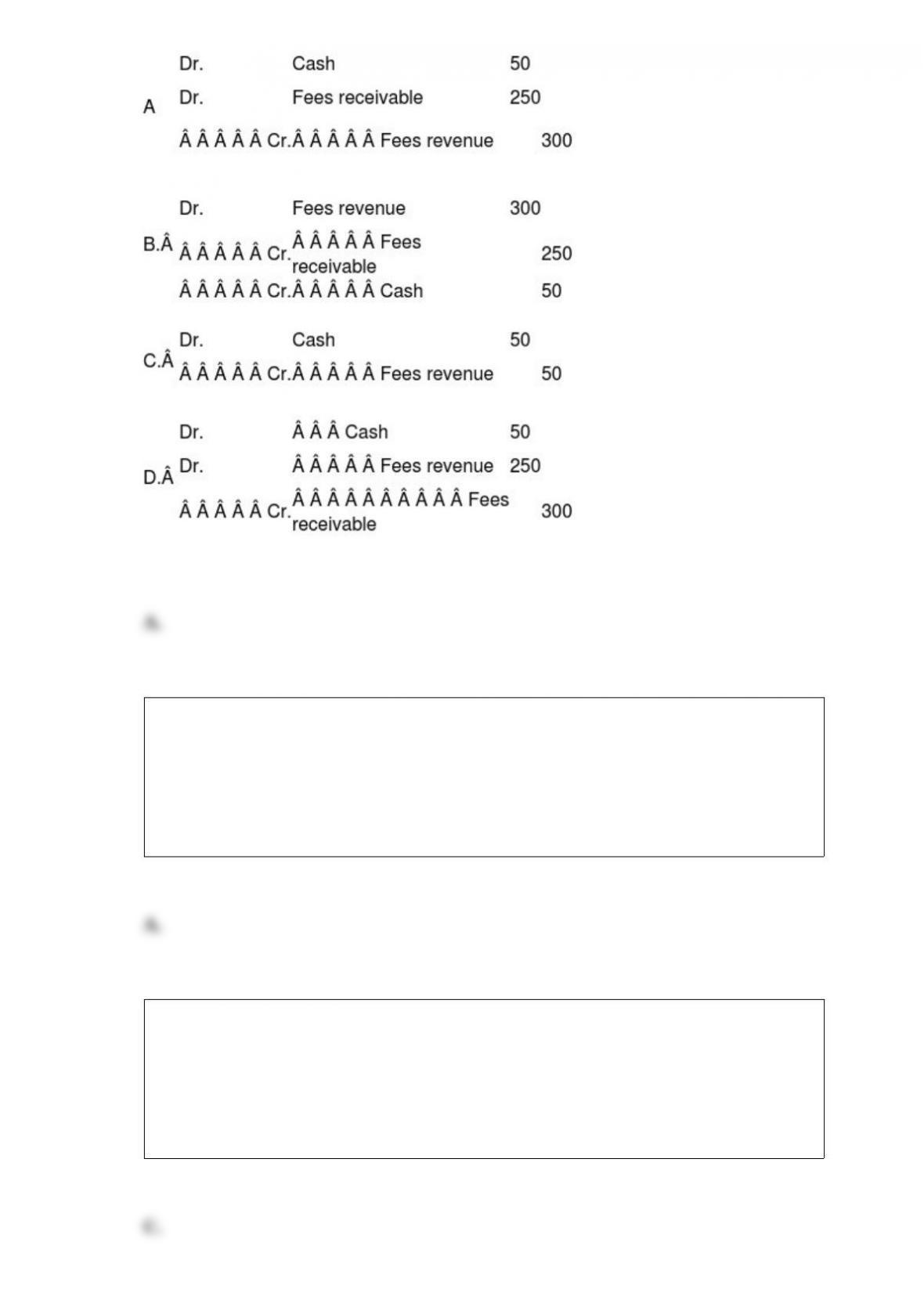
An engineering consultant provided $300 of services to a client; the client paid $50
when the bill was submitted and will pay the balance within a week. The consultant will
record this transaction by:
If a project promises to generate a higher rate of return than the firm’s cost of capital,
accepting the project will:
A. increase ROI.
B. decrease ROI.
C. increase payback.
D. decrease payback.
The principle of consistency means that:
A. the accounting methods used by an entity never change.
B. the same accounting methods are used by all firms in an industry.
C. the effect of any change in an accounting method will be disclosed in the financial
statements or notes thereto.
D. there are no alternative methods of accounting for the same transaction.
A capital budgeting decision method that considers the time value of money is the
A. accounting rate of return method.
B. return on stockholders’ equity method.
C. cash payback method.
D. internal rate of return method.
Assume that you own 1,700 shares of $10 par value common stock and the company
has a 2-for-1 stock split when the market price per share is $52.
Required:
(a.) How many shares of common stock will you own after the stock split?
(b.) What will probably happen to the market price per share of the stock?
(c.) What will probably happen to the par value per share of the stock?
In an inflationary economic environment, the selling price set for a firm’s products will:
A. not be affected by the cost flow assumption used.
B. be higher if LIFO is used than if FIFO is used.
C. be higher if FIFO is used than if LIFO is used.
D. be derived from the weighted average cost of inventory.

Which of the following costs are included in the cost classification that is based on the
time frame perspective?
A. Variable cost and fixed cost.
B. Direct cost and indirect cost.
C. Product cost and period cost.
D. Committed cost and discretionary cost.
Product X sells for $80 per unit in the marketplace and ABC Company requires a 35%
minimum profit margin on all product lines. In order to compete in this market, the
target cost for Product X must be equal to or lower than:
A. $28.
B. $45.
C. $52.
D. $80. $80 – ($80 * .35) = $52
Which of the following is(are) an example of a measure of leverage?
A. Debt yield.
B. Debt payout ratio.
C. Preferred dividend coverage ratio.
D. Debt/equity ratio.
Greenland Sports, Inc. has been asked to submit a bid to the National Hockey League
on supplying 1,000 pairs of professional quality skates. The cost per pair of skates has
been determined as follows:
Direct materials $80 Direct labor 60 Variable overhead 30 Fixed overhead (allocated)
20
Other non-manufacturing costs associated with each pair of skates are:

Variable selling cost (commission) $25 Fixed selling and administrative cost 10
Assume the commission on the sale of skates to the National Hockey League would be
reduced to $15 per pair and that available production capacity exists to produce the
1,000 pairs of skates, the lowest price the firm can bid is some price greater than:
A. $185.
B. $190.
C. $215.
D. $225. Costs that could not be avoided: $80 + $60 + $30 + $15 = $185
One of the principal reasons for selecting the LIFO cost flow assumption instead of the
FIFO cost flow assumption in an inflationary economic environment is that:
A. net income will be higher.
B. income taxes will be lower.
C. balance sheet inventory values will be higher.
D. a higher selling price can be established.
The earnings per share of common stock calculation:
A. is made by dividing net income by the number of shares of common stock
outstanding at the end of the year.
B. is complicated by the declaration of cash dividends during the year.
C. includes gains or losses from treasury stock transactions.
D. is complicated by the presence of preferred stock in the capital structure.
Capital budgeting techniques using present value techniques are useful in helping
management:
A. decide which costs are most relevant in decision making.
B. identify investment alternatives that will contribute most to future profitability.
C. determine an accounting rate of return.
D. determine an investments payback period.

The contribution margin ratio always decreases when the:
A. break-even point decreases.
B. fixed expenses increase.
C. selling price increases and the variable costs remain constant.
D. variable cost increase and the selling price remains constant.
The time frame associated with an income statement is:
A. a point in time in the past.
B. a past period of time.
C. a future period of time.
D. a function of the information included in it.
Retained Earnings represents:
A. the amount invested in the entity by the stockholders.
B. cash that is available for dividends.
C. cumulative net income that has not been distributed to stockholders as dividends.
D. par value of common stock outstanding.
The accountant at Abco, Inc. made an adjusting entry at the end of February to accrue
interest on a note receivable from a customer. The effect of this entry is to:
A. decrease ROI for February.
B. increase ROI for February.
C. decrease working capital at February 28.
D. decrease the acid-test ratio at February 28.

A working capital loan will generally:
A. not have an interest rate.
B. require that interest (if any) be paid monthly.
C. not affect working capital.
D. be classified as a noncurrent liability.
A leveraged buyout refers to:
A. one firm issues stock to take over another firm.
B. one firm trades its stock for the stock of another firm.
C. a firm goes heavily into debt in order to obtain the funds to purchase the shares of
the public stockholders and thus take the firm private.
D. one firm pays cash for the shares of a takeover firm’s shares.
Significant accounting policies are described in the notes to the financial statements
because:
A. there isn’t enough space for them to be included in the captions of the financial
statements.
B. if the accrual basis of accounting is used, “matching” of revenues and expenses may
not take place.
C. the reader must be aware of which of the alternative generally accepted accounting
practices have been used.
D. none of the above.