The Allowance for Doubtful Accounts:
A) is a contra-revenue account.
B) has a normal debit balance.
C) is not listed on the chart of accounts of a company that uses the direct write-off
method.
D) is reported on the Income Statement.
The potential disadvantages of extending credit include all of the following except:
A) increased bad debt costs.
B) customers buying too much.
C) the need to hire employees to undertake collection efforts.
D) higher wage costs in the accounting department.
Which of the following statements about bond terminology is correct?
A) The face value of a bond is what it is currently worth in the market.
B) The stated interest rate is expressed as an annual interest rate even if the bonds pay
semiannual interest payments.
C) The stated rate of interest always presents the amount that investors are willing to
pay for the bond on the issue date.
D) The carrying value of the bond is always equal to the face value of the bond.
What is the annual rate of interest being charged on a 9-month note receivable of
$50,000 if the total interest is $3,000?
A) 6%
B) 8%
C) 12%
D) 10%
For a business to be considered a corporation:
A) its stock must be sold in very large amounts.
B) it must be organized as a separate legal entity.
C) it must issue both common and preferred stock.
D) it must pay dividends.
Which of the following statements about the debit/credit framework is correct?
A) Stockholders ‘ Equity = Assets + Liabilities.

B) The total value of credits in all accounts must always equal the total value of debits
in all accounts.
C) The normal balance for an account is the side on which it decreases.
D) A decrease in Common Stock would be recorded with a credit.
Choose the appropriate letter to match the term and the definition. There are more
definitions than terms.
Term
1> ____ Inventory
2> ____ Purchase Discount
3> ____ Purchase Returns and Allowances
4> ____ Sales Discount
5> ____ Sales Returns & Allowances
6> ____ Shrinkage
Definition
A. The sum of beginning inventory and purchases for the period.
B. The cost of inventory lost to theft, fraud, and error.
C. A reduction in the cost of inventory purchases associated with unsatisfactory goods.

D. A cash discount received for prompt payment of a purchase on account.
E. Refunds and price reductions given to customers after goods have been sold and
found unsatisfactory.
F. Assets acquired for resale to customers.
G. A sales price reduction given to customers for prompt payment of their account
balance.
H. Presents important subtotals, such as gross profit, to help distinguish core operating
results from other, less significant items that affect net income.
I. Net sales minus cost of goods sold. It is a subtotal, not an account.
J. A ratio indicating the percentage of profit earned on each dollar of sales, after
considering the cost of products sold.
On March 3, Year 3, your company purchases supplies on account for $4,000. Payment
is due on April 2, Year 3.
Required:
Part a. Is this an accounting transaction on March 3, Year 3? Why or why not?
Part b. When this transaction is recorded, what accounts are affected and by how much
each?
Accounts receivable:
A) arise from the purchase of goods or services on credit
B) are amounts owed to a business by its customers.
C) will be collected within the discount period or when due.
D) are reported on the income statement.
A company ‘s trial balance included the following account balances:
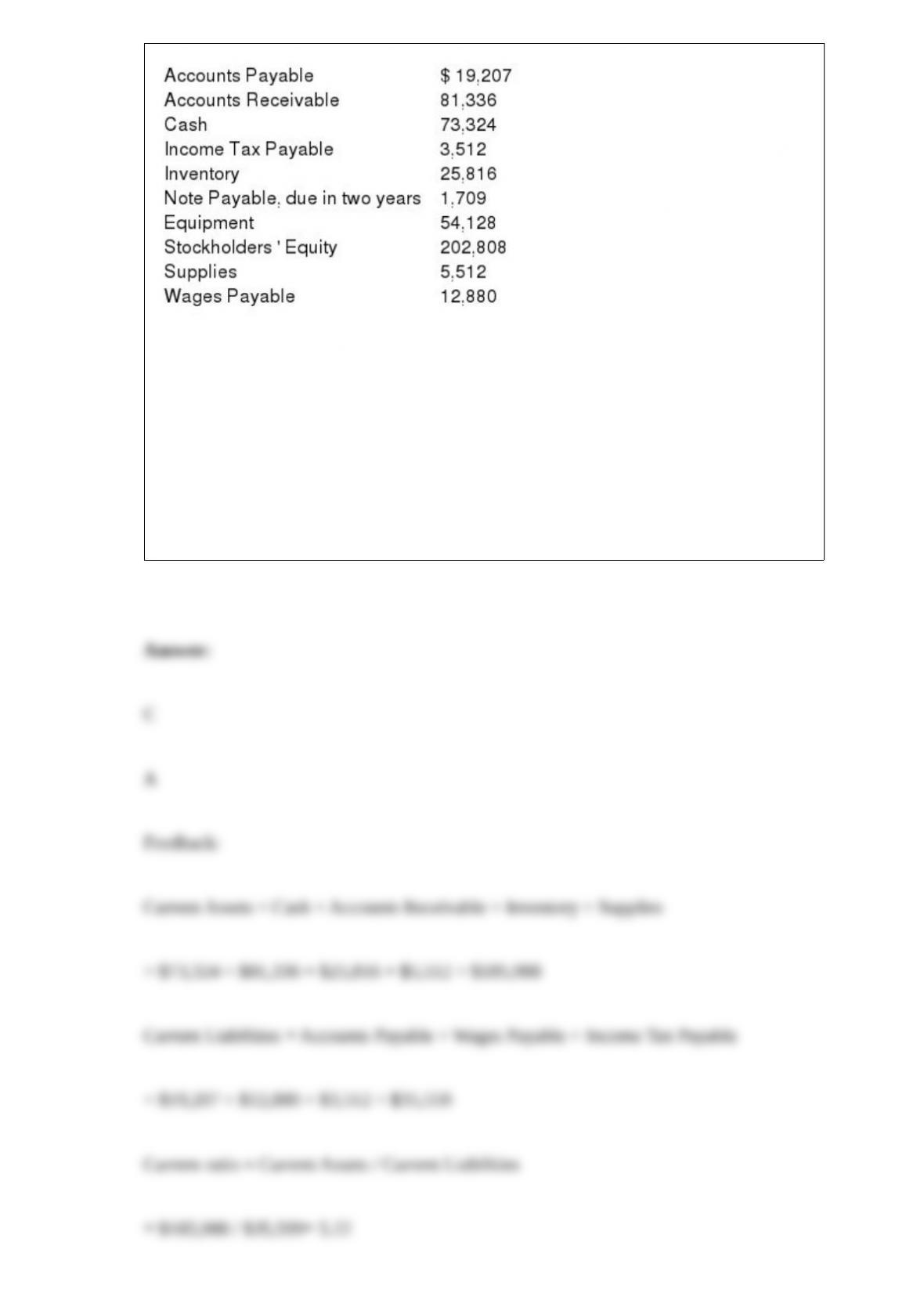
Use the information above to answer the following question. What is the amount of the
current ratio (round to two decimal places)?
A) 8.05
B) 6.44
C) 5.22
D) 1.00

Criminally minded employees have been known to override internal controls or do
which of the following to get around them?
A) Collude
B) Segregate duties
C) Disarm
D) Restrict access
Your company contracted for a 30-second commercial (an advertisement) that aired
during the Super Bowl at a cost of $1.2 million. It is legally obligated to pay for the
commercial, but has not yet done so. How is your company’s balance sheet affected on
the day the commercial aired?
A) It increases both assets and liabilities by $1.2 million.
B) It increases assets and decreases stockholders’ equity by $1.2 million each.
C) It does not affect the balance sheet.
D) It increases liabilities and decreases stockholders’ equity by $1.2 million each.
Your company purchases $50,000 of inventory from a wholesaler who allows you 45
days to pay. In addition, the wholesaler offers a 3% discount if payment is made within
12 days. These payment terms would be expressed as:
A) 0.03/12, n/45.
B) n/45, 3/12.
C) n/45, 0.03/12.
D) 3/12, n/45.