A company’s break-even point will not be changed by:
A. a change in total fixed costs.
B. a change in the number of units produced and sold.
C. a change in the variable cost ratio.
D. a change in the contribution margin ratio.
E. a change in the product mix.
Answer:
The Heavenly Gifts Company, a maker of Holiday novelties, needs your help
immediately. The company’s accountant resigned without leaving adequate records or
explanations for what she did. In reviewing the records, you find the following
information for May:
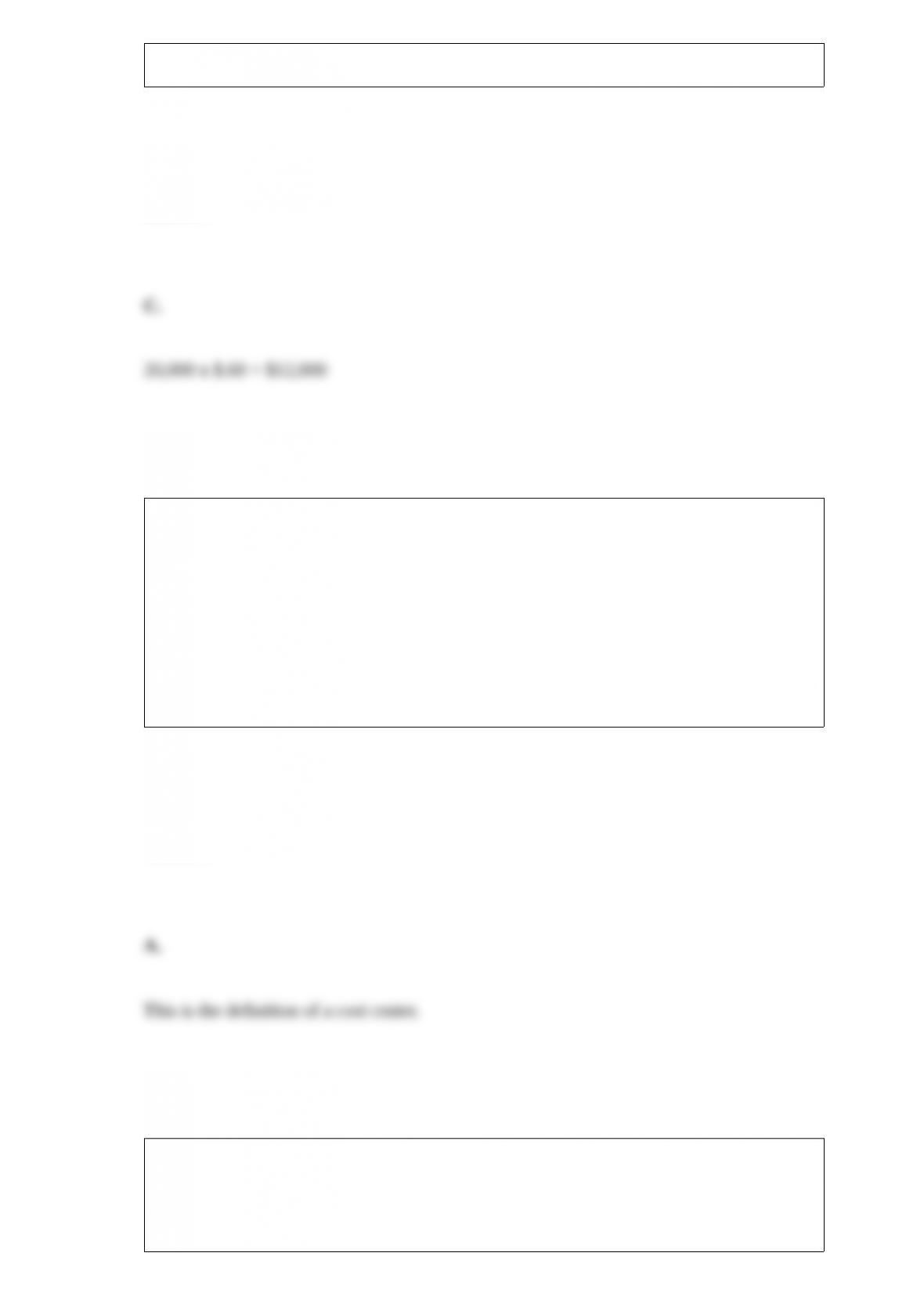
You find a copy of the budget which shows that materials were budgeted at $0.60/unit.
You know that the materials price variance is recorded at the time of purchase and you
find some handwritten notes among the accountant’s work papers, which indicate the
following:
What was the total standard cost of direct materials purchased during May?
A. $9,150
B. $11,800
C. $12,000
D. $12,200
Answer:
An operating unit that is responsible for only costs is commonly referred to as a(n)
A. cost center.
B. revenue center.
C. profit center.
D. asset center.
Answer:
Which of the following statements is (are) true?
(A) Divisional income statements do not include allocated common costs.
(B) The gross margin ratio is computed by dividing operating income by sales.
A. Only A is true.
B. Only B is true.
C. Both A and B are true.
D. Neither A nor B is true.
Answer:
Allocated joint costs are useful for
A. setting the selling price of a product.
B. determining whether to continue producing an item.
C. controlling user department costs.
D. evaluating management by means of a responsibility reporting system.
E. determining inventory cost for accounting purposes.
Answer:
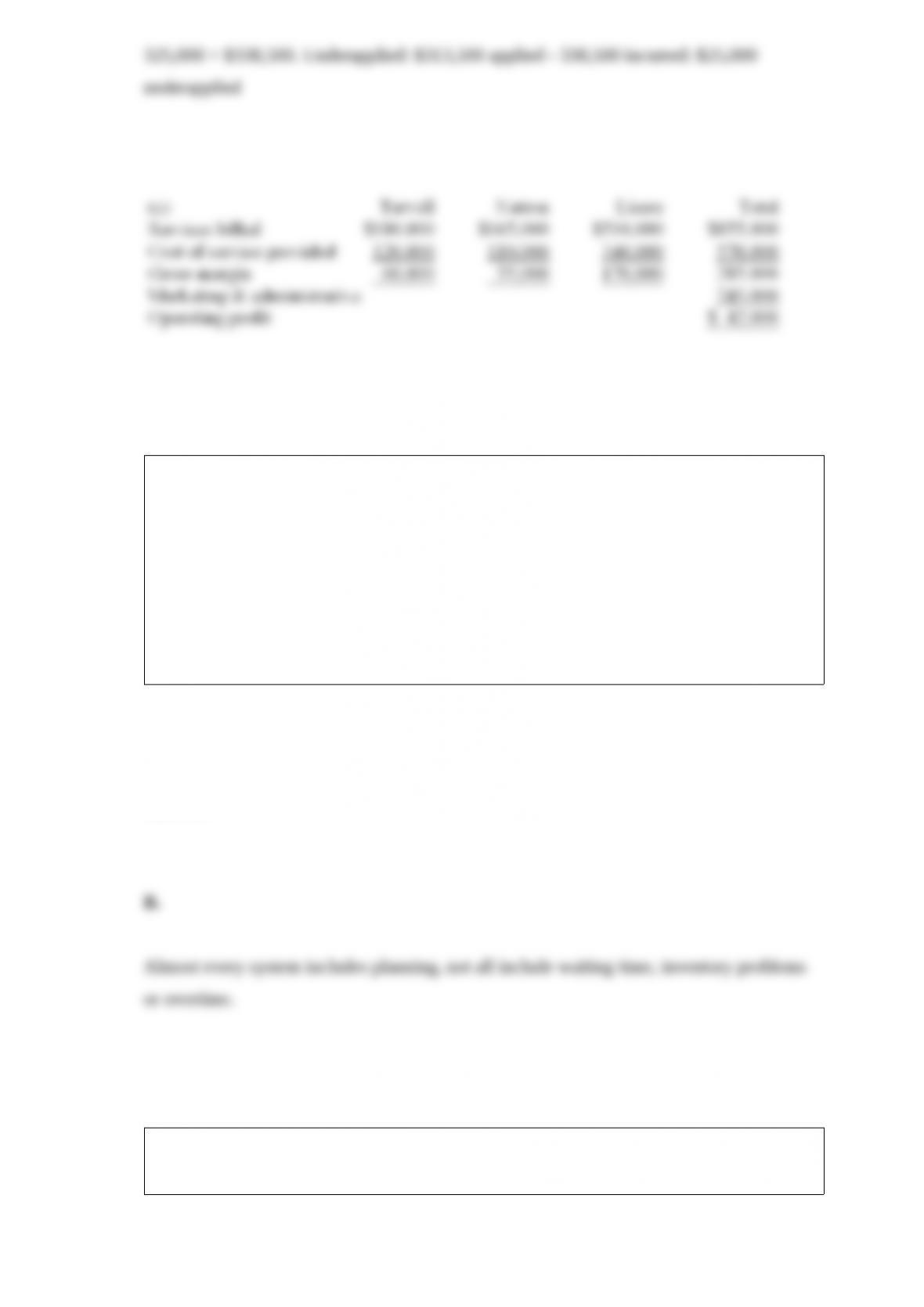
In February, Forester Engineering worked on three contracts: 1,200 hours for Tarvell
Company, 1,100 hours for Natron LLC and 3,400 for Lisere Corp. Forester bills clients
at the rate of $150 per hour; labor cost for its engineering staff is $45 per hour. The total
number of hours worked in February was 6,000 (any untraced hours are considered
overhead), and non-labor overhead costs were $325,000. Overhead is applied to clients
at $55 per labor-hour. In addition, Forester had $243,000 in marketing and
administrative costs. All transactions are on account. All services were billed.
Required:
a) the cost of each of the three jobs.
b) What is the amount of over- or underapplied overhead?
c) How much operating profit did Forester make in February? Assume the over- or
underapplied overhead is not closed out each month.
Answer:
Which of the following items is included in almost all quality control systems?
A. Quality-related waiting time
B. Quality planning and analysis
C. Excess or obsolete inventory
D. Quality-related overtime
Answer:
Matisse Co. has provided the following information for last year:
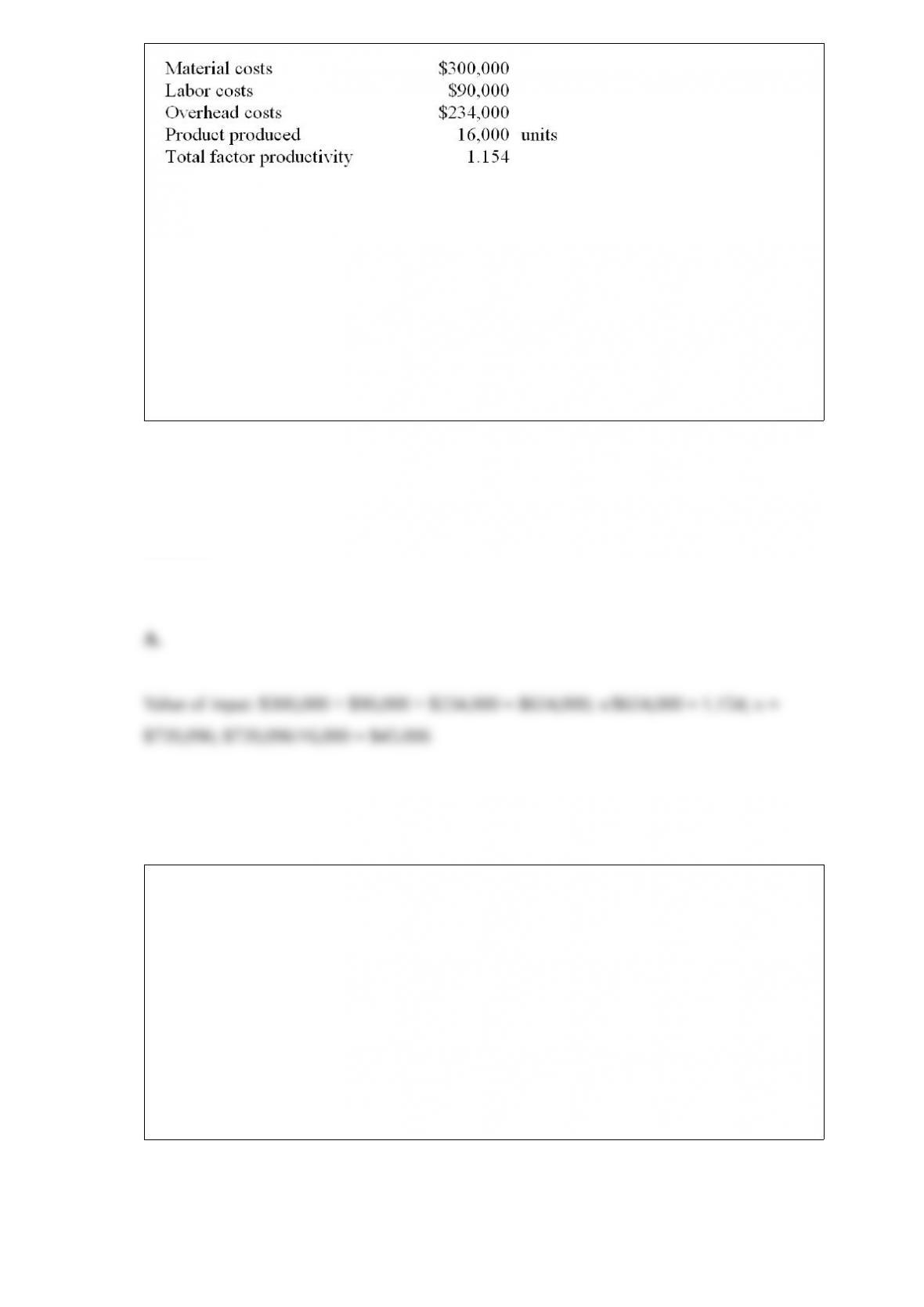
The selling price of the product (rounded) is:
A. $45.01
B. $33.80
C. $39.00
D. $28.13
Answer:
The computation of the material yield variance does not require the
A. standard material mix.
B. standard material price.
C. standard output units.
D. total material actually used.
E. total material actually acquired.
Answer:
Which of the following is not a product cost under full-absorption costing?
A. Direct materials used in the current period
B. Rent for the warehouse used to store direct materials
C. Salaries paid to the top management in the company
D. Vacation pay accrued for the production workers
Answer:
The predetermined manufacturing overhead rate for 2010 was $4.00 per direct labor
hour; employees were paid $5.00 per hour. If the estimated direct labor cost was
$75,000, what was the estimated manufacturing overhead?
A. $15,000
B. $60,000
C. $75,000
D. $93,750
Answer:
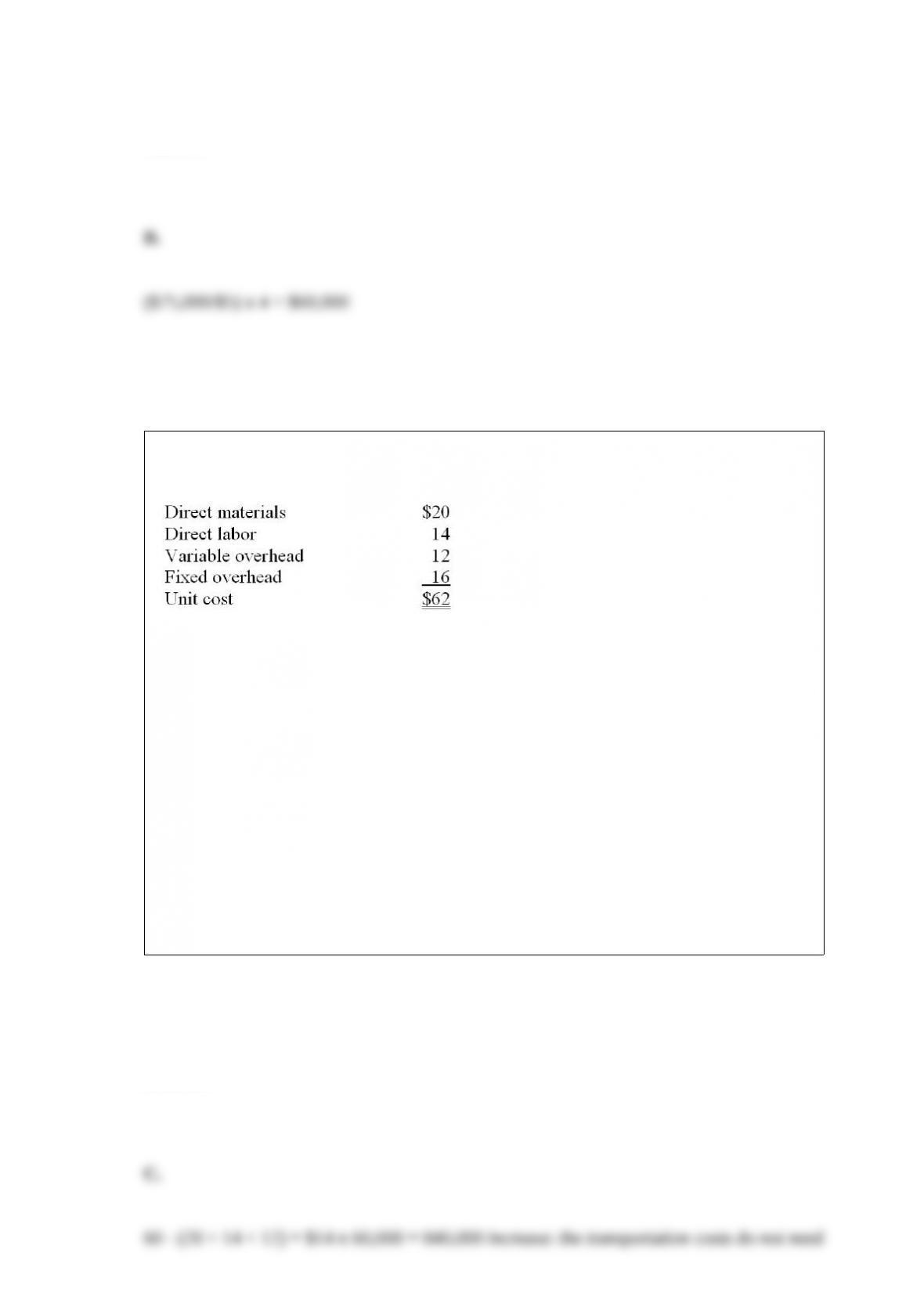
The following information relates to a product produced by Ashland Company:
Fixed selling costs are $1,000,000 per year. Although production capacity is 500,000
units per year, Ashland expects to produce only 400,000 units next year. The product
normally sells for $80 each. A customer has offered to buy 60,000 units for $60 each.
The customer will pay the transportation charge on the units purchased. If Ashland
accepts the special order, the effect on income would be a
A. $120,000 increase
B. $360,000 increase
C. $840,000 increase
D. $1,200,000 decrease
Answer:
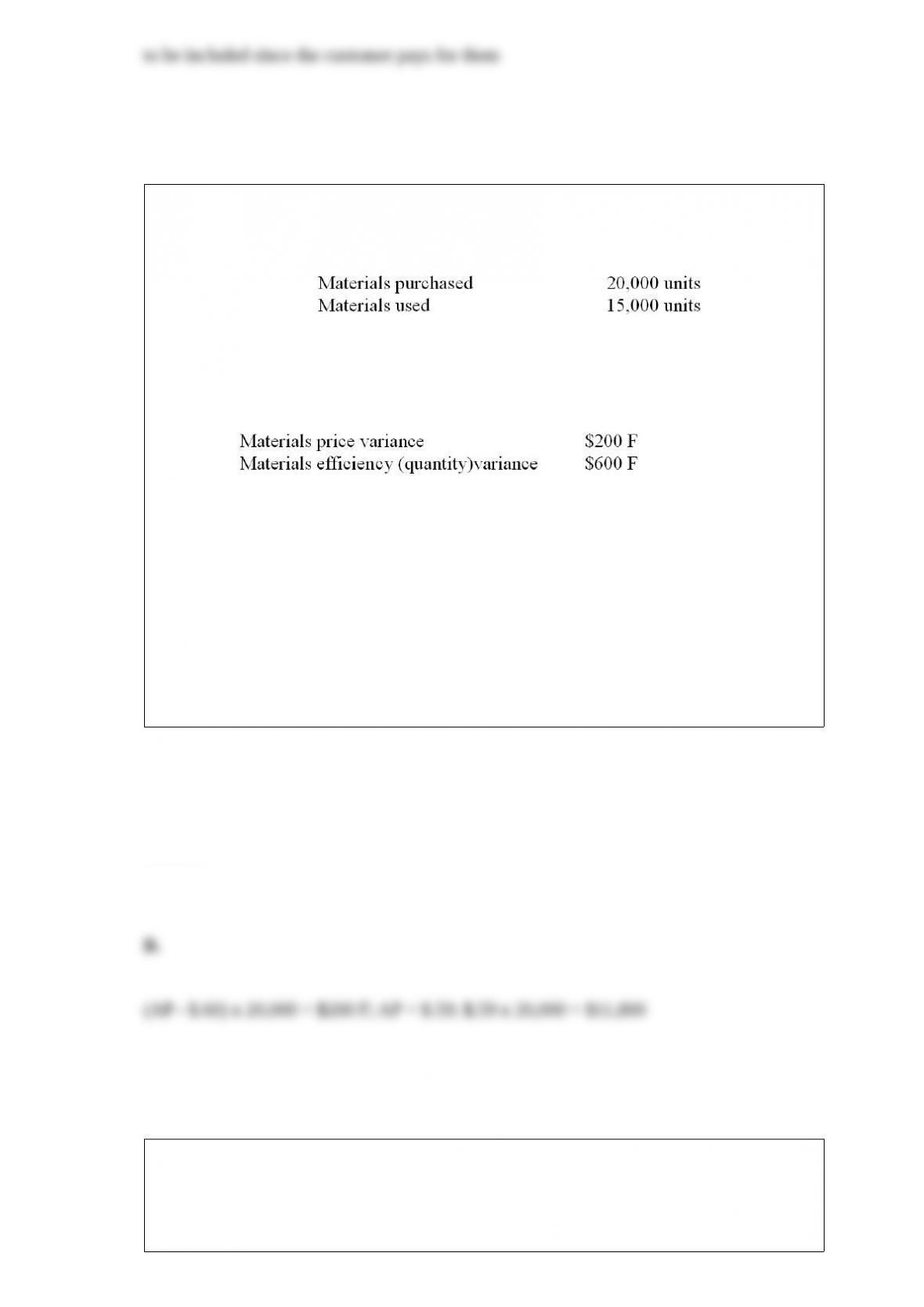
The Heavenly Gifts Company, a maker of Holiday novelties, needs your help
immediately. The company’s accountant resigned without leaving adequate records or
explanations for what she did. In reviewing the records, you find the following
information for May:
You find a copy of the budget which shows that materials were budgeted at $0.60/unit.
You know that the materials price variance is recorded at the time of purchase and you
find some handwritten notes among the accountant’s work papers, which indicate the
following:
What was the total actual cost of the direct materials purchased during May?
A. $9,000
B. $11,800
C. $12,000
D. $12,200
Answer:
The human resources department for Hammond Corp. provides personnel services for
two departments in the Chicago office. The following budget has been prepared for the
month.
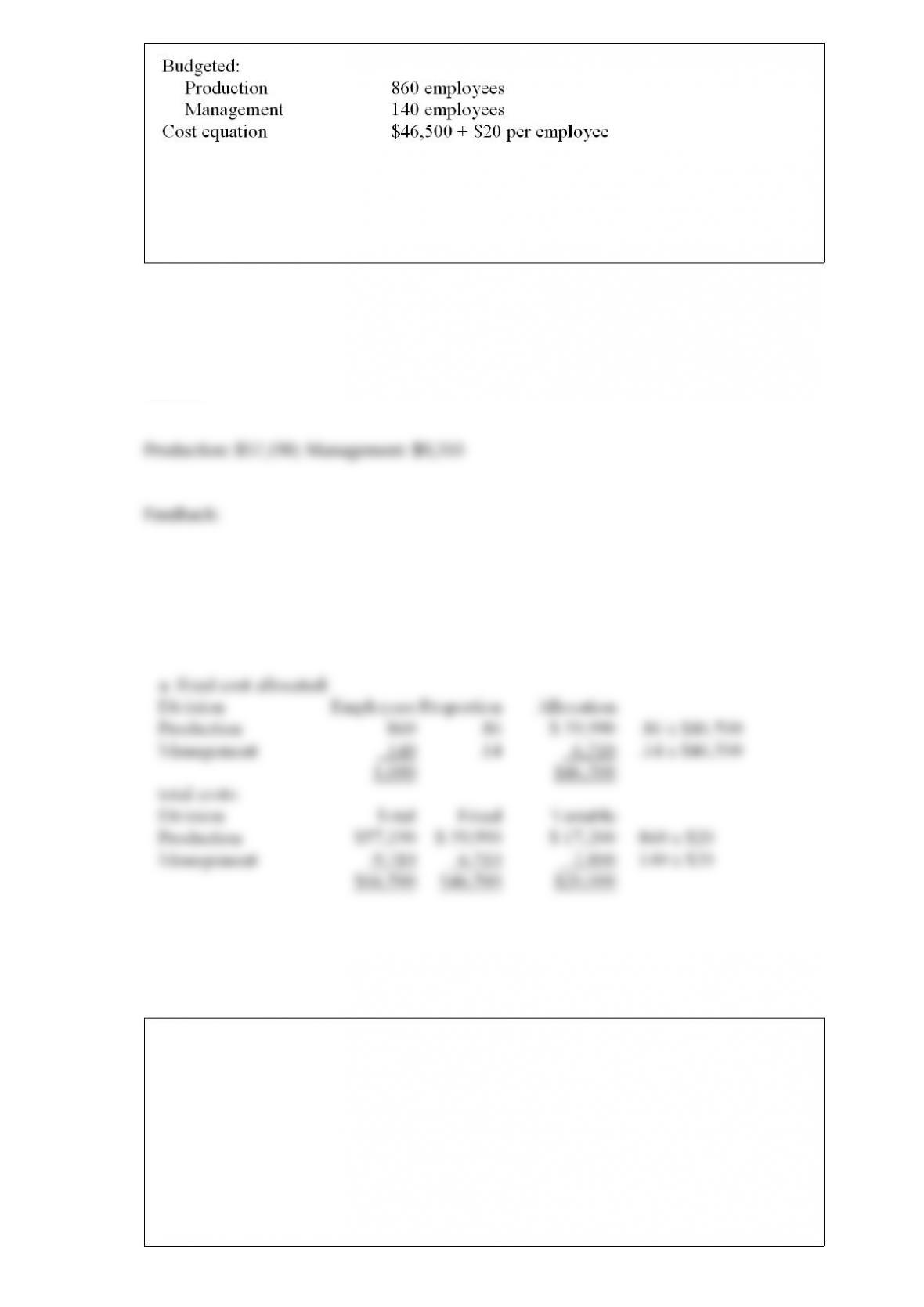
Required (use three decimal places in your calculations):
a) If Hammond uses a dual rate for allocating its costs based on employees, how much
cost will be allocated to the two departments?
Answer:
The Task Company is to begin operations in April. They have budgeted April sales of
$30,000. May sales of $34,000, June sales of $40,000, July sales of $42,000, and
August sales of $38,000. 10% of each month’s sales will represent cash sales; 75% of
the balance will be collected in the month following the sale, 17% the second month,
6% the third month and the balance is bad debts.
What is the amount of cash to be collected in the month of July?
A. $34,022
B. $38,022
C. $42,000
D. $37,580
Answer:
Black Company’s cost management and product costing procedures follow
activity-based costing (ABC) principles. Activities have been identified and classified
as being either value-added or nonvalue-added for each product. Which of the
following activities, used in Black’s production process, is nonvalue-added? (CPA
adapted)
A. Drill press activity
B. Heat treatment activity
C. Design engineering activity
D. Raw materials storage activity
Answer:
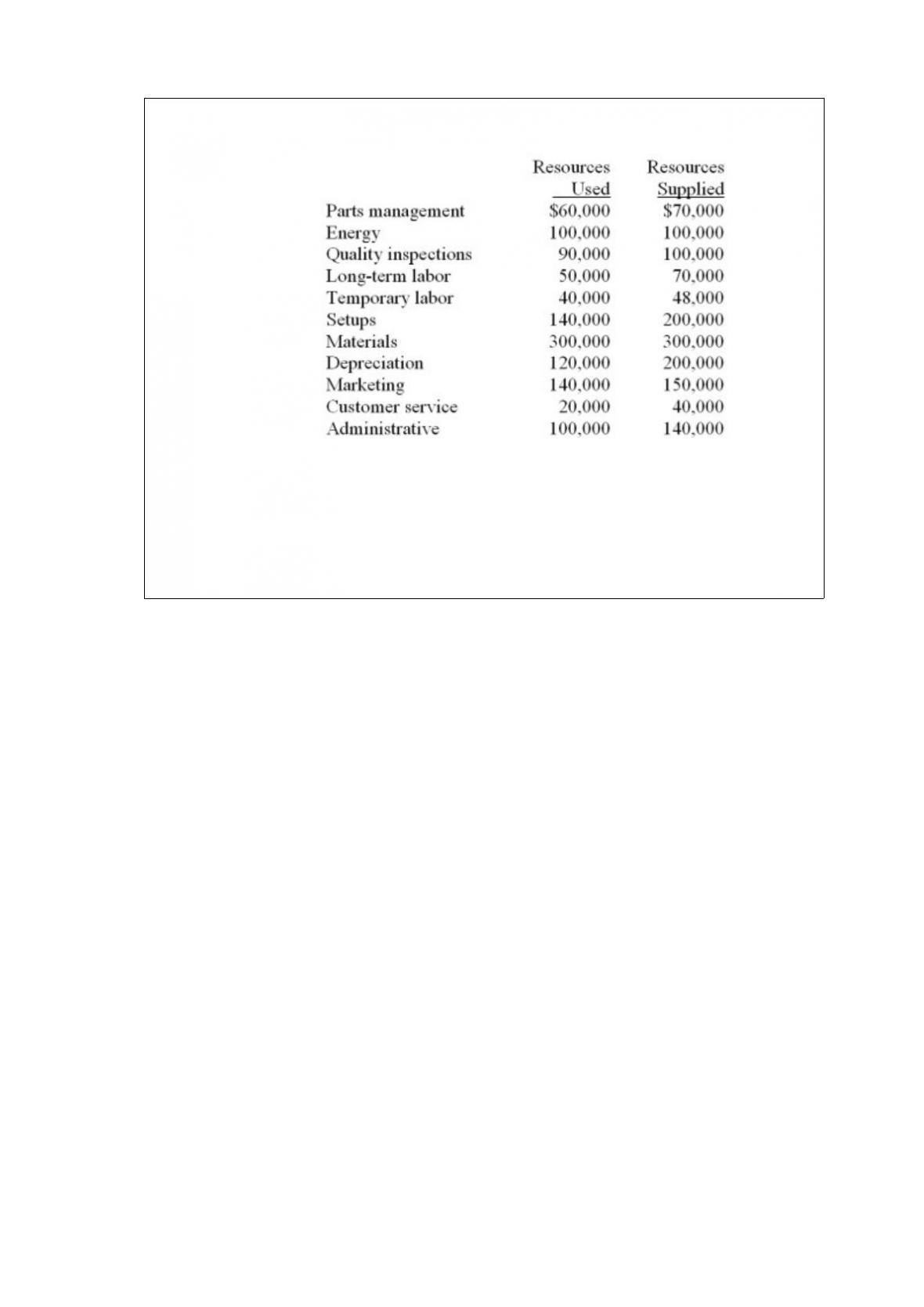
Boyceville Corporation manufactures motor brackets. Information regarding resources
for the month follows:
In addition, Boyceville spent $25,000 on 40 engineering changes with a cost driver rate
of $600.
Required
a) Prepare an analysis of the unused resource capacity for the month.
Answer:
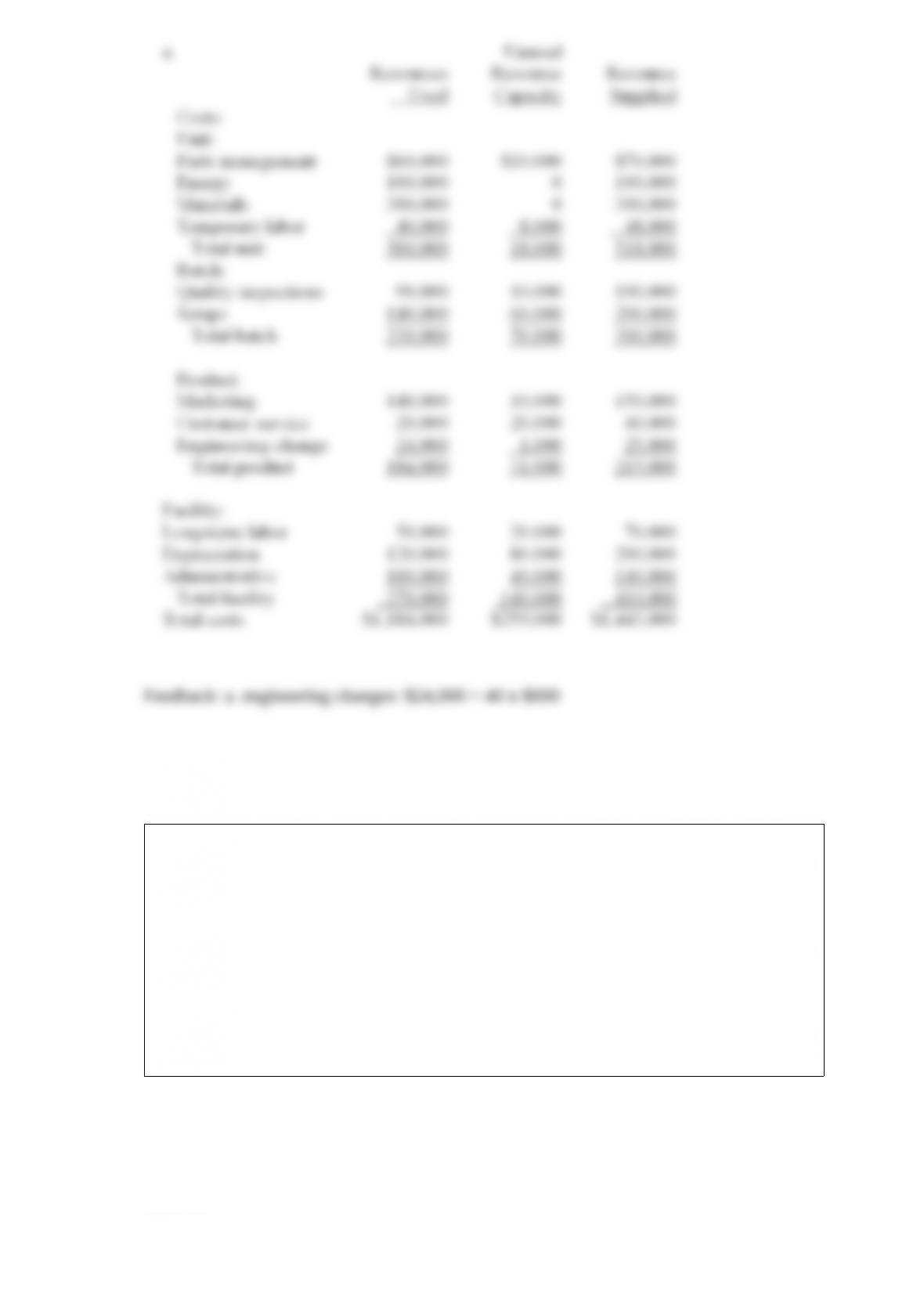
KR Sales had $1,200,000 in sales last month. The variable cost ratio was 60% and
operating profits were $80,000. What is KR’s margin of safety?
A. $200,000
B. $300,000
C. $500,000
D. Cannot determine with the information given.
Answer:
Direct labor would be part of the cost of the ending inventory for which of these
accounts?
A. Work-in-Process.
B. Finished Goods.
C. Direct Materials and Work-in-Process.
D. Work-in-Process and Finished Goods.
E. Direct Materials, Work-in-Process, and Finished Goods.
Answer:
Department A had no Work-in-Process at the beginning of the period, 1,000 units were
completed during the period, 200 units were 50% completed at the end of the period,
and the following manufacturing costs were debited to the departmental
Work-in-Process account during the period
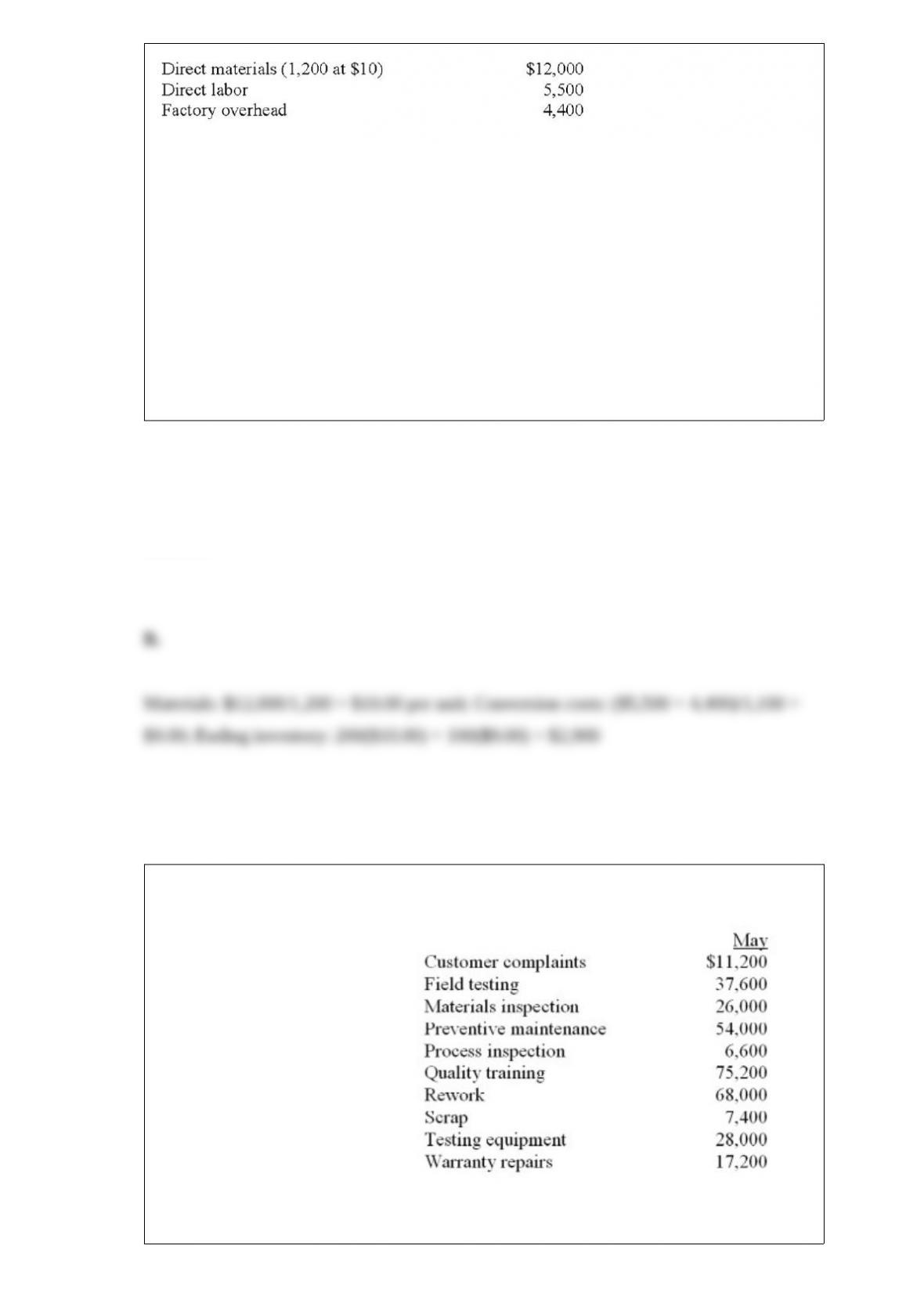
Assuming that all direct materials are placed in process at the beginning of production
and Department A uses weighted-average process costing, what is the total cost of the
departmental Work-in-Process Inventory at the end of the period?
A. $3,650
B. $2,900
C. $2,000
D. $1,825
Answer:
The following represents the financial information of Tool-Box Corporation, a
manufacturer of testing equipment:
Required
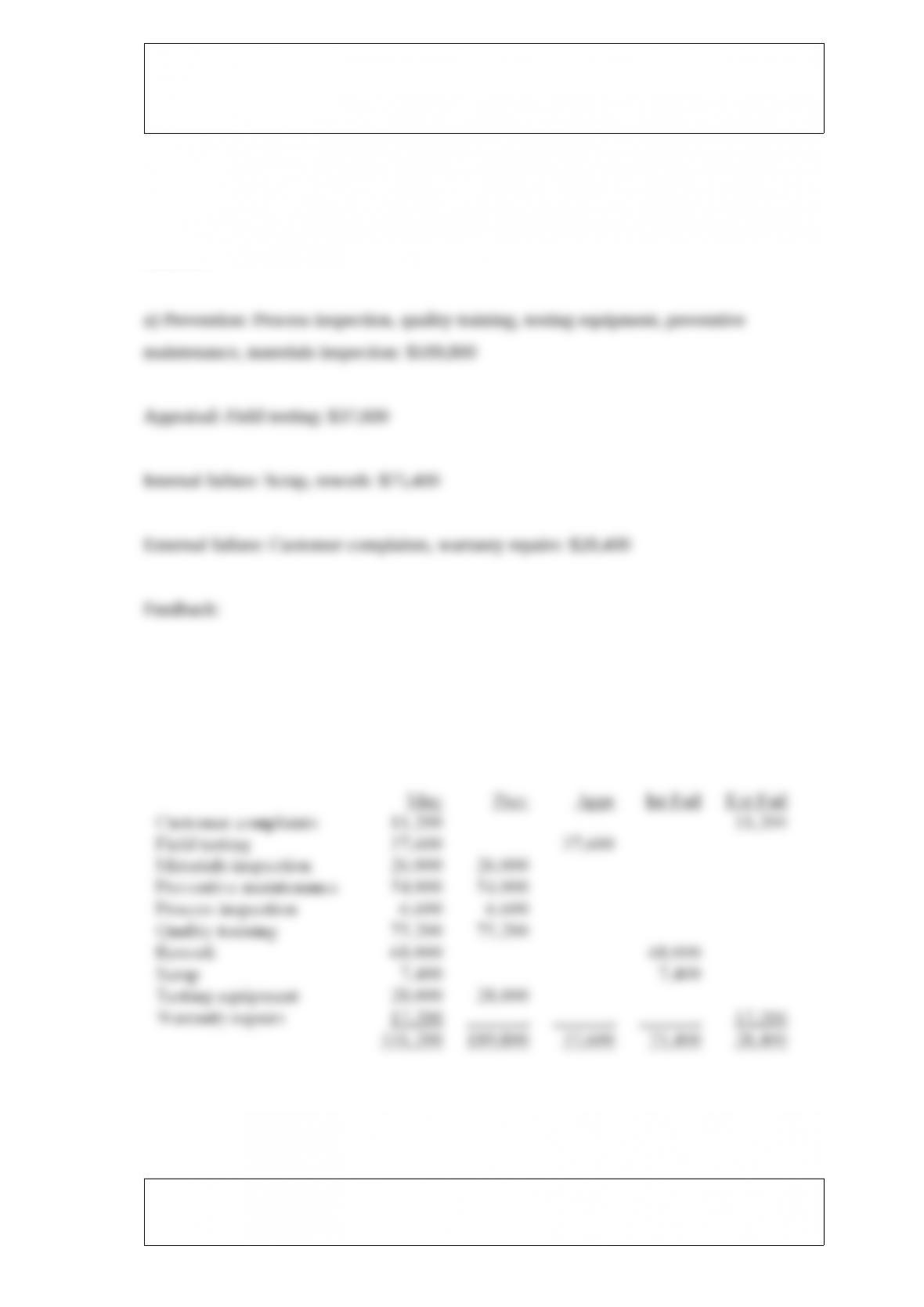
a) Classify these items into prevention, appraisal, internal failure, or external failure
costs. Determine the total cost of each category.
Answer:
Which of the following statements is (are) true regarding product costing?

(A) A job is a cost object that can be easily and conveniently distinguished from other
cost objects.
(B) Job cost sheets are used in accounting systems as a subsidiary ledger for the
Work-in-Process account.
A. Only A is true.
B. Only B is true.
C. Both A and B are true.
D. Neither A nor B is true.
Answer:
Moving of inventory is an example of a(n)
A. cost-benefit analysis
B. value-added activity
C. activity-based cost
D. nonvalue-added activity
Answer:
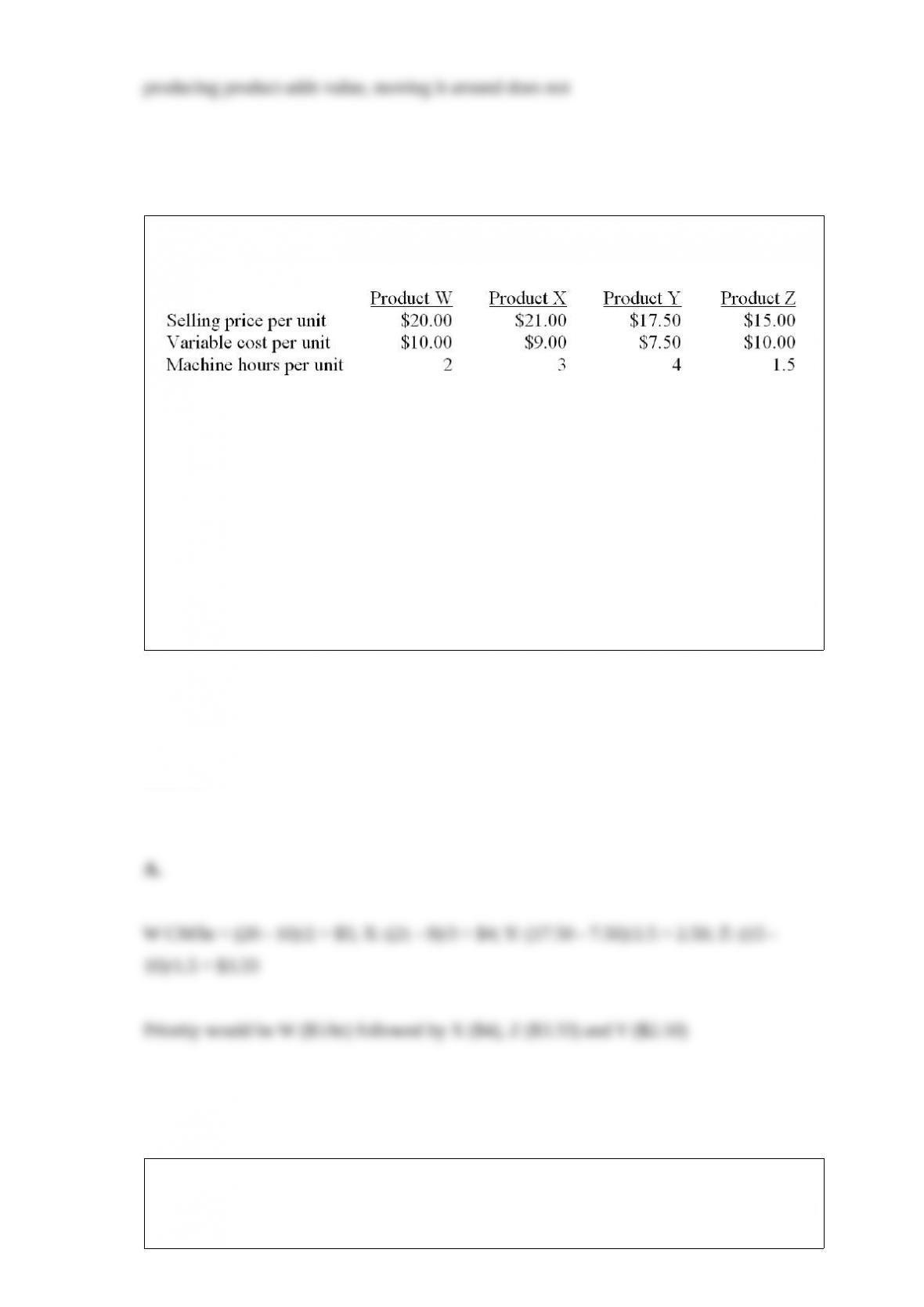
Winton Inc has 12,000 machine hours available each month. The following
information on the company’s four products is available:
If market demand exceeds the available capacity, in what sequence should orders be
filled to maximize the company’s profits?
A. Product W first, product X second, product Z third, and product Y last.
B. Product Z first, product W second, product X third, and product Y last.
C. Product X first, product W second, product Y third, and product Z last.
D. Product X first, product Z second, product Y third, and product W last.
Answer:
Which of the following items is not part of the continuous improvement philosophy?
A. Eliminate activities that are nonvalue-added.

B. Improve the efficiency of activities that are value-added.
C. Use benchmarking to identify activities that need improvement.
D. Provide bonus incentives to managers for accurate performance reports.
Answer:
The ALG Manufacturing Company has gathered the following information for the
month of September:
– 6,000 units in the beginning Work-in-Process Inventory (75% complete as to
materials, 1/3 complete with respect to the conversion costs)
– 60,000 units were started into production
– 50,000 units were completed and transferred to the next department
– The ending Work-in-Process Inventory is complete as to materials but only 3/8
complete with respect to conversion costs.
What are the equivalent units of production (EUP) for materials in the month of
September assuming ALG uses weighted-average process costing?
A. 52,000
B. 64,500
C. 66,000
D. 61,500
Answer:
Which of the following income statement items is analyzed using the sales mix and the
sales quantity variances?
A. operating expenses.
B. cost of goods sold.
C. gross margin.
D. contribution margin.
Answer:
Looman Inc. is a management consulting firm that specializes in management training
programs. In-Line Mfg has approached Looman to contract for management training
for a year period. Last year’s income statement for Looman is as follows:
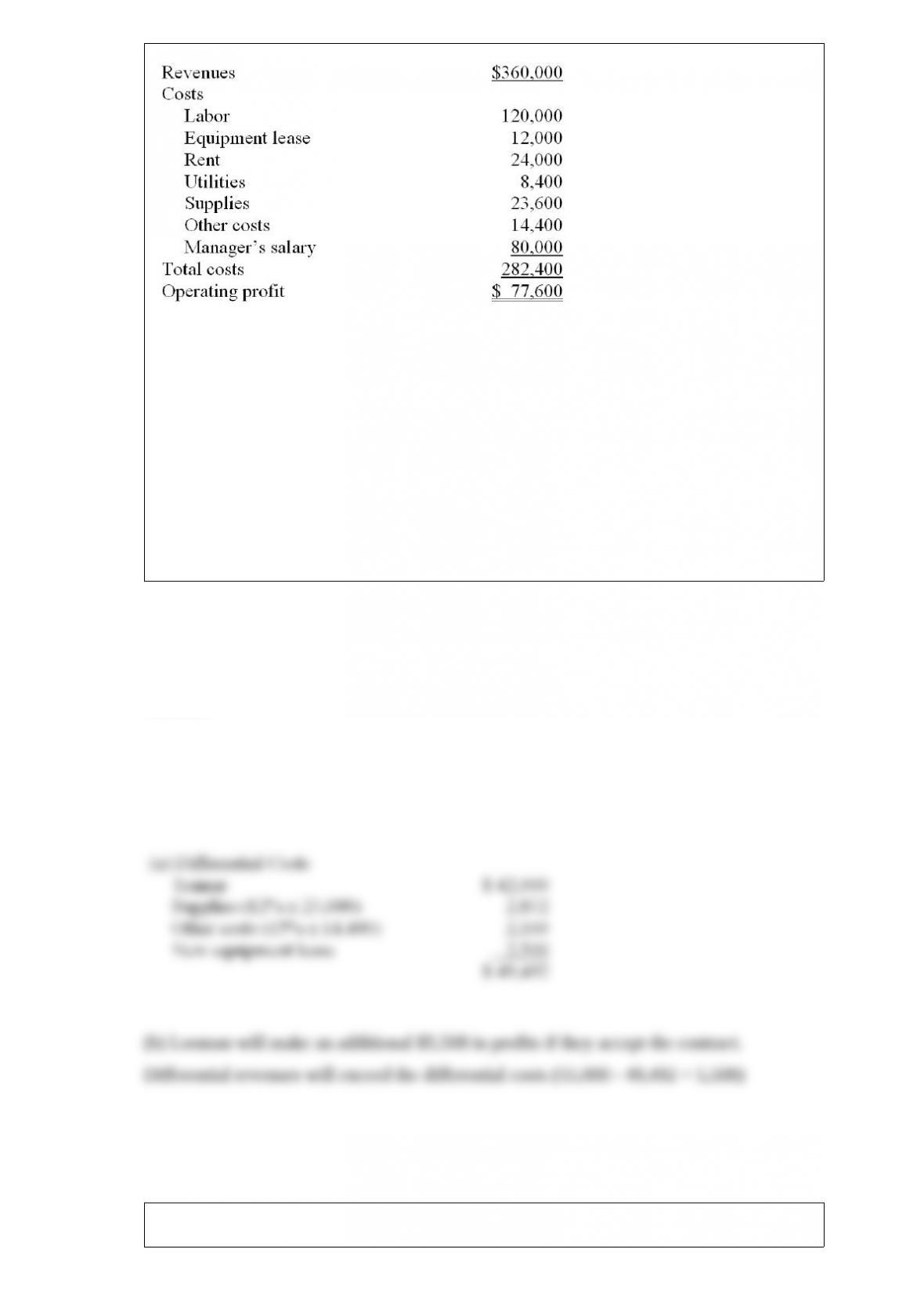
To satisfy the In-Line contract, another part-time trainer will need to be hired at
$42,000. Supplies will increase by 12% and other costs by 15%. New equipment of
$2,500 will need to be lease.
Required:
(a) What are the differential costs that would be incurred as a result of taking the
In-Line contract?
(b) If In-Line will pay $55,000 for one year, should Looman accept the contract?
Explain your answer.
Answer:
Residual income is a better measure for performance evaluation of an investment
center manager than return on investment because (CMA adapted)
A. The problems associated with measuring the asset base are eliminated.
B. Desirable investment decisions will not be neglected by high-return divisions.
C. Only the gross book value of assets needs to be calculated.
D. The arguments about the implicit cost of interest are eliminated.
Answer:
Which one of the following accounts is not used in an activity-based costing (ABC)
system?
A. Materials Inventory
B. Work-in-Process Inventory
C. Finished Goods Inventory
D. Overhead Applied
E. Allocations Incurred
Answer:
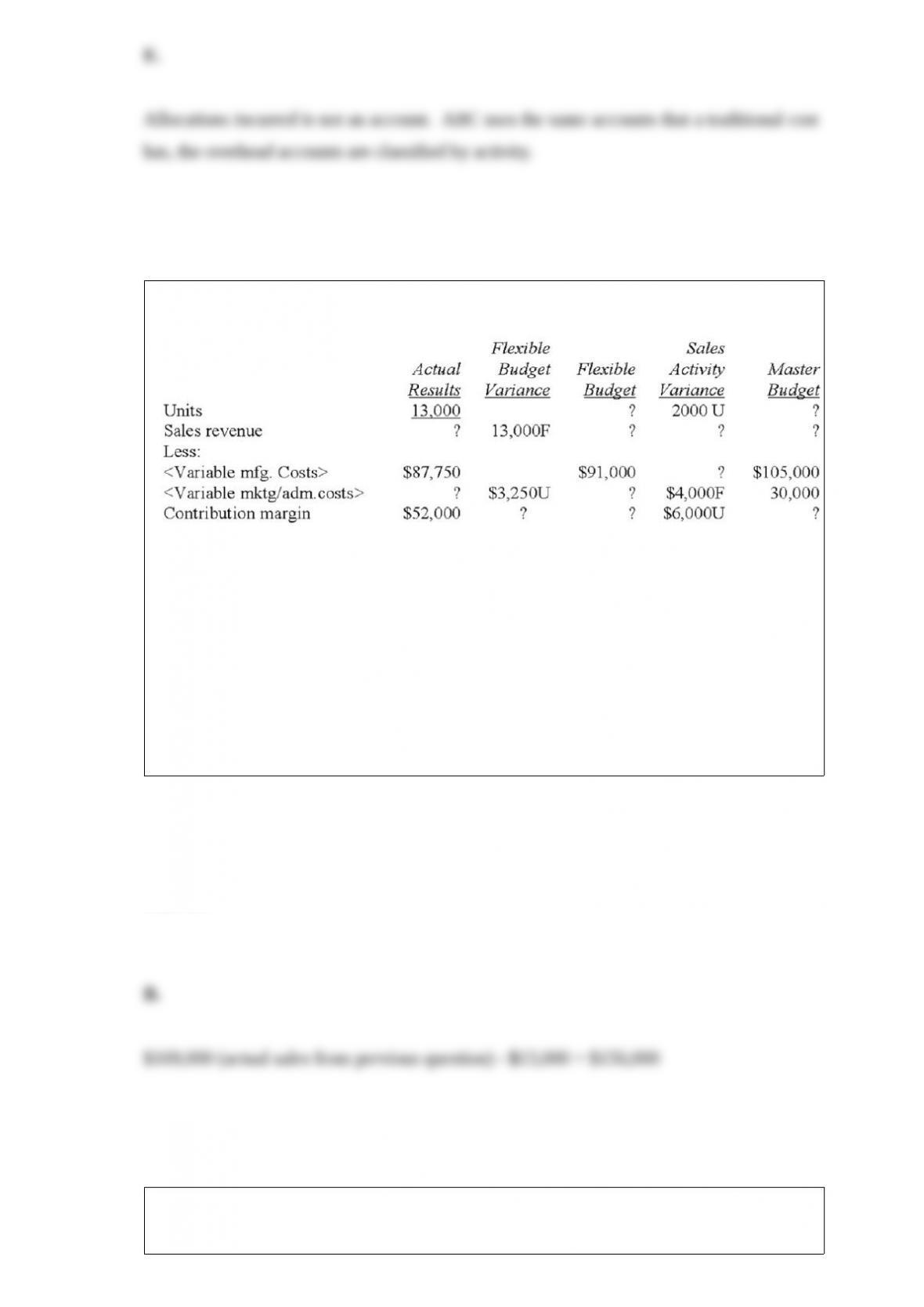
What is the sales revenue in the flexible budget?
A. $139,000.
B. $156,000.
C. $169,000.
D. $180,000.
Answer:
A company’s break-even point will not be increased by:
A. an increase in the number of units produced and sold.
B. a decrease in the selling price per unit.
C. an increase in the variable cost per unit.
D. an increase in the variable cost ratio.
E. an increase in total fixed costs.
Answer: