
Which of these falls under the responsibility of top management?
A.assuring the integrity of financial information presented to outsiders.
B.maintaining adequate internal control.
C.unintentional errors in preparing financial statements.
D.assuring the integrity of financial information presented to outsiders and maintaining
adequate internal control.
Which of the following is not an underlying assumption of cost-volume-profit analysis?
A.Fixed costs will not change over a wide range of activity.
B.All costs behave linearly.
C.Sales prices change in the relevant range.
D.Sales mix must remain constant.
To reduce subjectivity in the budgeting process and gather as much information as
possible, management often enters past sales data into which of the following
regression models to obtain a statistical estimate of factors affecting sales?
A.econometric model.
B.input-output model.
C.Delphi model

D.none of the above.
Which of the following are Canadian designations that are similar to the CPA
designation in the United States?
I. CA
II. CMA
III. CGA
IV. CASB
A.I & II
B.I & III
C.III & IV
D.I & IV
A not-for-profit company purchased an asset at a cost of $60,000. Annual operating
cash flows are expected to be $20,000 each year for 4 years. At the end of the asset life,
there will be no residual (salvage) value. Ignore income taxes. What is the net present
value if the cost of capital is 10 percent?
A.$(1,960.)
B.$3,397.

C.$12,400.
D.$23,400.
What is true concerning applications of incentive compensation plans to nonprofit
organizations?
A.These plans are usually based on performance on nonfinancial dimensions.
B.These plans lack relevant, market-based comparisons.
C.These plans are usually based on adherence to rules set down by top authorities.
D.All of the answers are correct.
Surveys of global corporate transfer pricing practices indicate that nearly half use
A.cost, about one-third use market price, and the rest use negotiations.
B.market price, about one-third use cost, and the rest use negotiations.
C.negotiations, about one-third use cost, and the rest use market price.
D.negotiations, about one-third use market price, and the rest use cost.

Which of the following influences should not be considered in short-run pricing
decisions?
A.The value customers place on the product
B.The pricing strategies of competitors
C.The costs of the product
D.Total fixed costs allocated to the specific product
The impact of employee and management fraud is staggering both in terms of dollar
costs and effect on the victims. Presented below are three independent cases of
employee wrong doing. a. A retail store that was part of a national chain experienced an
abnormal inventory shrinkage in its electronics department. The internal auditors,
noting this shrinkage, included an in-depth evaluation of the department in the scope of
their audit of the store. During the review, the auditors were “tipped” by an employee
that a particular customer bought a large number of small electronic components, and
that the customer always went to a certain cashier’s checkout line. The auditor’s work
revealed that the cashier and the customer had colluded to steal a number of
components. The cashier did not record the sale of several items the customer took from
the store.
b. Internal auditors discovered a payroll fraud in a large hospital when they observed,
on a surprise basis, the distribution of paychecks. The supervisors of each department
distribute paychecks to employees and are supposed to return unclaimed checks to the
payroll department. When the auditors took control of and followed up on an unclaimed
paycheck for an employee in the food service department, they discovered that the
employee had quit four months previously. The employee and the supervisor had an
argument, and the employee had simply left and never returned. The supervisor had
continued to turn in a time card for the employee and, when the paychecks came for
distribution, had taken the unclaimed checks and cashed them.
c. While performing an audit of cash disbursements in a manufacturing firm, internal
auditors discovered a fraud perpetrated by an accounts payable clerk. The clerk had
made copies of supporting documents and used the copies to support duplicate
payments to a vendor of materials used in the manufacturing process. The clerk, who
had opened a bank account in a name similar to that of the vendor, took the duplicate
checks and deposited them in the bank account. For each of the three situations
presented above, describe the recommendations that the internal auditors should make
to prevent similar problems in the future.

The agency theory of motivation deals with relationships between supervisors and
workers where the principals assign responsibility to the workers and the workers work
on behalf of the supervisors. Examples of principals and agents includes
A.board of directors and top management.
B.top management and division managers.
C.division managers and department managers.
D.All of the answers are correct.
Which of the following is an example of a make-or-buy decision?
A.Adding a product line
B.Dropping a segment
C.Subcontracting work in place of using the company’s own employees
D.Hiring skilled labor in place of unskilled labor
Which of these is a disadvantage for compensating on future performance?
A.a short-term orientation.
B.a disincentive to invest in new technology.
C.a focus of attention on the long-run.
D.rewards that come too far in the future to be motivational.
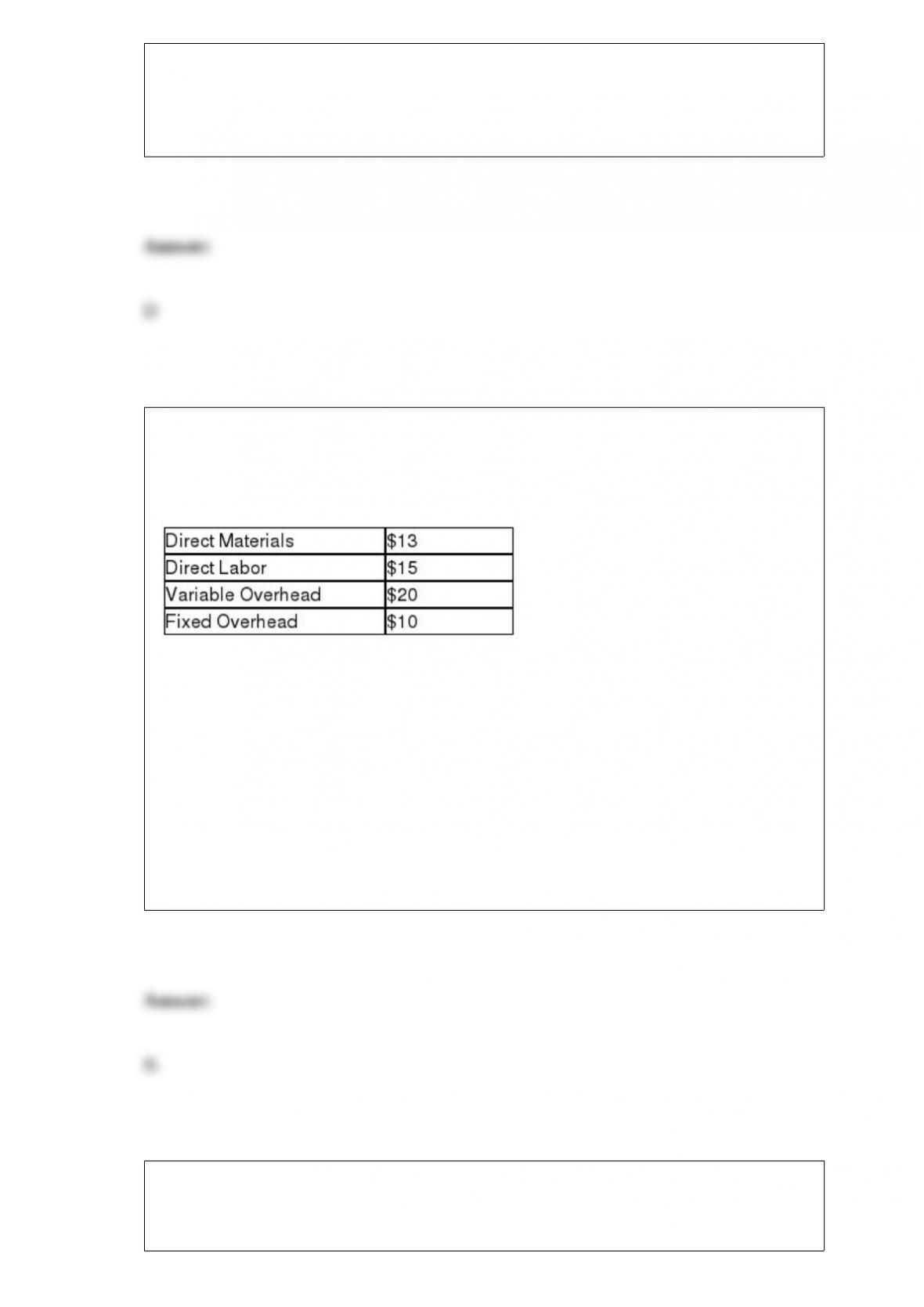
M Corporation makes automobile engines. The company’s records show the following
costs to
manufacture part #308FD:
Another manufacturer has offered to supply M Corporation with part #308FD for a cost
of $50 per unit. M Corporation uses 1,000 units annually. If M Corporation accepts the
offer, what will be the short-run impact on operating income?
A.Decrease in profits equal to $8,000.
B.Decrease in profits equal to $2,000.
C.Increase in profits equal to $8,000.
D.Increase in profits equal to $2,000.
Which of the following statements is true?
A.Semi-fixed costs increase in steps.

B.Semi-fixed costs usually involve a change in long-term assets.
C.Semi-fixed costs are curvilinear functions.
D.Semi-fixed costs have both fixed and variable components.
Why are incentive compensation plans often criticized?
A.managers may take actions to improve short-run performance only.
B.managers may take actions to improve long-run performance only.
C.stock options affect market prices.
D.they are ineffective in motivating managers.