Accrued revenues recorded at the end of the current year:
A) often result in cash receipts from customers in the next period.
B) often result in cash payments in the next period.
C) are also called Unearned Revenues.
D) are recorded in the current year when cash is received.
Which of the following is a set of regulations passed by Congress in 2002 in an attempt
to improve financial reporting and restore investor confidence?
A) Enron Act
B) Federal Accounting Standards Board Act
C) Sarbanes-Oxley Act
D) Securities and Exchange Act
An example of an account that could be included in an accrual adjustment for expense
is:
A) Accounts Receivable.
B) Interest Payable.
C) Prepaid Insurance.
D) Accumulated Depreciation.
Which of the following will happen if the accrual adjusting entry is not made for
revenue earned but not yet recorded?
A) Assets will be understated and revenues will be overstated.
B) Revenues will be understated and assets will be overstated.
C) Both revenues and assets will be overstated.
D) Both revenues and assets will be understated.
Which of the following statements about depreciation methods is not correct?
A) The amount of depreciation expense recorded in each year of an asset’s life depends
on the method that is used.
B) Different depreciation methods can be used for different classes of assets provided
the methods are used consistently over time so that financial statement users can
compare results across periods.
C) At the end of an asset’s life, after it has been fully depreciated, the total amount of
depreciation will equal the asset’s depreciable cost.
D) The amount of net income reported each year will be the same regardless of the
depreciation method used.
Husain, Inc.’s income statement and other financial information for the current year is
presented below.
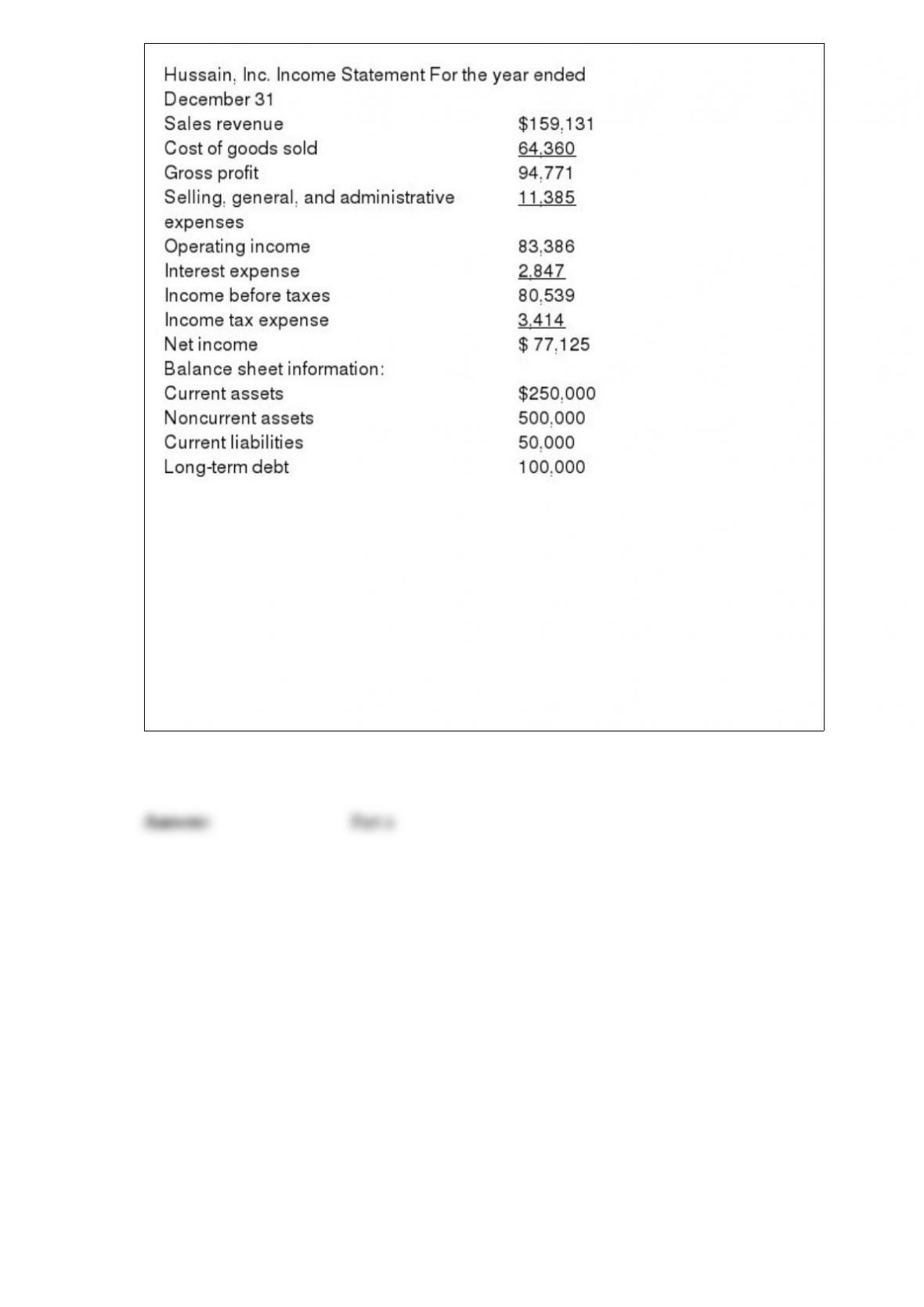
Required:
Part a. Perform vertical analysis of the income statement. (Round to the nearest whole
percentage.)
Part b. Calculate the debt-to-assets ratio. (Round to two decimal places.)
Part c. Calculate the times interest earned ratio. (Round to two decimal places.)
Part d. Evaluate the company’s solvency.
A company bought a piece of equipment for $40,000 and expects to use it for eight
years. The company then plans to sell it for $3,500. The company has already recorded
depreciation of $35,995. Using the double-declining-balance method, what is the
company’s annual depreciation expense for the upcoming year?
A) $1,001
B) $9,125
C) $505
D) $10,000
On January 1, a company lends $90,000 to a customer for one year at a 7% annual
interest rate. The note requires the payment of interest twice each year on June 30 and
December 31. The company records adjusting entries on a monthly basis. At the end of
each month in which the company does not receive any interest payments, the
company:
A) records an entry with a debit to Cash of $525 and a credit to Interest Revenue of
$525.
B) records an entry with a debit to Notes Receivable of $525 and a credit to Cash of
$525.
C) records an entry with a debit to Interest Receivable of $525 and a credit to Interest
Revenue of $525.
D) does not record an adjusting entry, since no transaction has occurred.
Your company has previously averaged about 26% of its accounts receivable in the
“over 90 days past due” category. This year, the company hired a new collections
manager and, as a result, management forecasts that only 18% of its accounts receivable
will be in this category at the end of the current year. The company uses the aging of
accounts receivable method of estimating Bad Debt Expense. If the total of credit sales
and year-end balance in accounts receivable remain unchanged from the previous year
and no write offs were made during the current year, this year’s bad expense will:
A) increase over the estimate for previous months.
B) decrease over the estimate for previous months.
C) not change.
D) will depend on the percentage of credit sales deemed uncollectible.
Which of the following statements is correct?
A) Specific identification is the most practical, but least accurate, measure of cost and
net income.
B) When unit costs are increasing, the weighted average cost method yields a cost of
goods sold between that of FIFO and LIFO.
C) FIFO will lead to the highest net income if unit costs are falling.
D) LIFO will always yield a smaller net income than FIFO.