Job-order cost systems are used by many service businesses; process cost systems are
not applicable to service businesses.
Pepperdine Company paid factory rent of $10,000. At the time this transaction
occurred, it did not affect total assets or net income.
When a comparison of static and flexible budgets shows an unfavorable sales volume
variance, the variable cost volume variance will also be unfavorable.
The future value of $1 table should be used to discount lump sum cash flows expected
to occur in the future.
Natalie purchased a concert ticket recently for $50. She is trying to decide whether to
drive, take a taxi, or ride the public transit bus. The cost of driving to the concert is a
sunk cost because Natalie purchased her car several years ago.
Voluntary costs refer to internal and external failure costs.
A cost variance is unfavorable if actual cost exceeds standard cost.
Product cost information for manufacturing companies affects the income statement but
does not affect the balance sheet.
The pro forma income statement gives managers an advance estimate of a company’s
profitability.
A net decrease in the equipment account indicates that equipment must have been sold
at a loss during the year.
The market value of equipment owned by a company is a sunk cost and should not be
taken into account in deciding whether or not to replace the equipment.
If a company has both fixed and variable costs, their operating leverage will always be
greater than 1.
Which of the following accounts would appear on the sales budget and the pro forma
income statement?
A. Selling and administrative expenses
B. Sales revenue
C. Accounts receivable
D. Both sales revenue and accounts receivable are correct
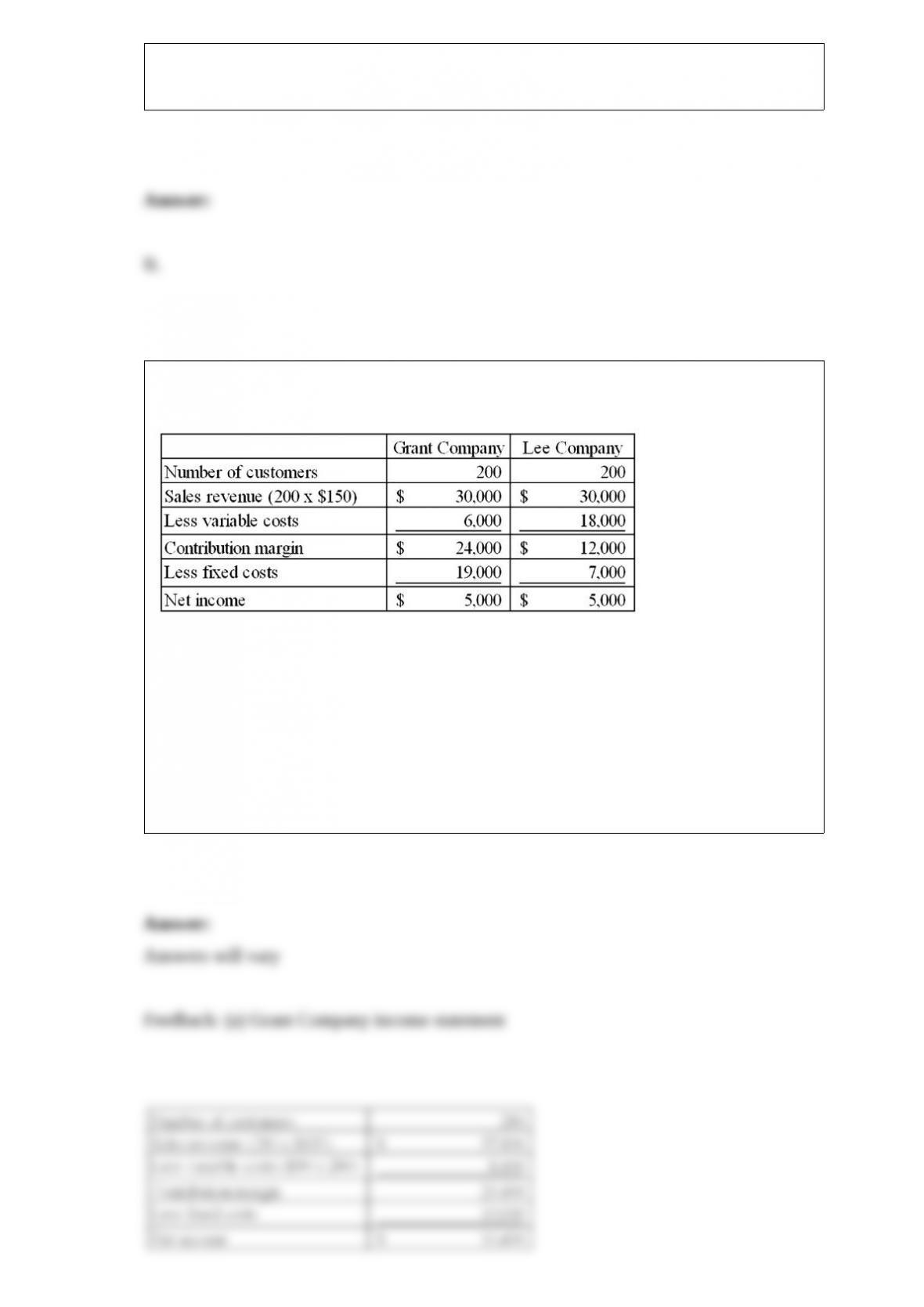
Grant Company and Lee Company compete in the same market. The following
budgeted income statements illustrate their cost structures.
Required:(a) If Grant Company lowers its price to $135, it will lure 80 customers away
from Lee Company. Prepare Grant’s income statement based on 280 customers.
(b) If Lee Company lowers its price to $135 (assuming that Grant Company is still
charging $150 per customer), Lee would lure 80 customers away from Grant. Prepare
Lee’s income statement based on 280 customers.
(c) Which of the companies would benefit more from lowering its sales price to attract
more customers, and why?
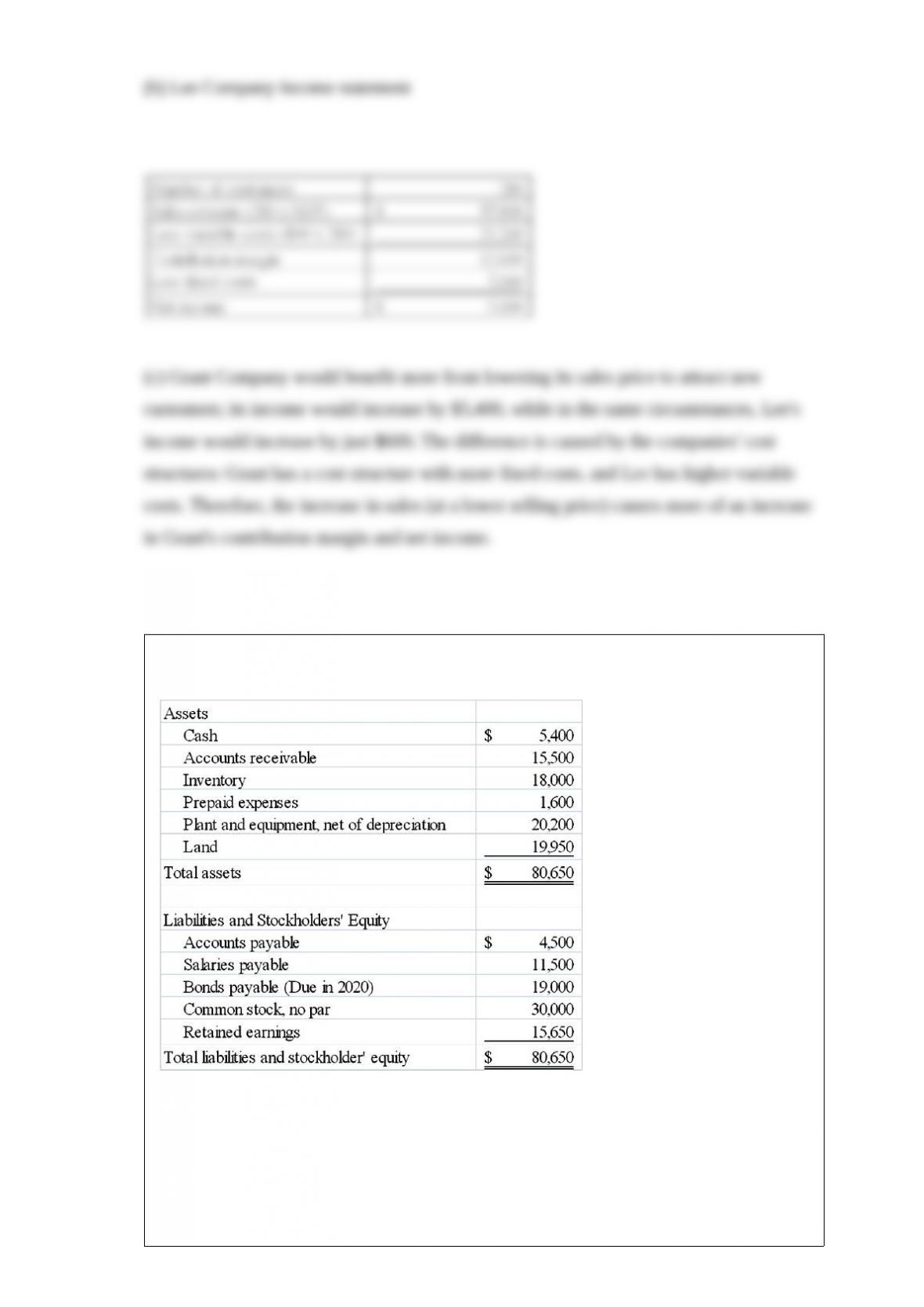
The following balance sheet information is provided for Duke Company for 2014:
What is the company’s current ratio?
A. 1.16
B. 1.31

C. 2.53
D. 3.79
The minimum amount of total quality costs is achieved when the:
A. marginal voluntary expenditures exceed marginal failure costs.
B. marginal voluntary expenditures equal the marginal savings on failure costs.
C. marginal voluntary expenditures are less than the marginal savings on failure costs.
D. none of the other answers are correct.
Bates Company plans to add a new item to its line of consumer product offerings. Two
possible products are under consideration. Each unit of Product A costs $6 to produce
and has a contribution margin of $3, while each unit of Product B costs $12 and has a
contribution margin of $4. What is the differential revenue for this decision?
A. $7
B. $1
C. $6
D. $9
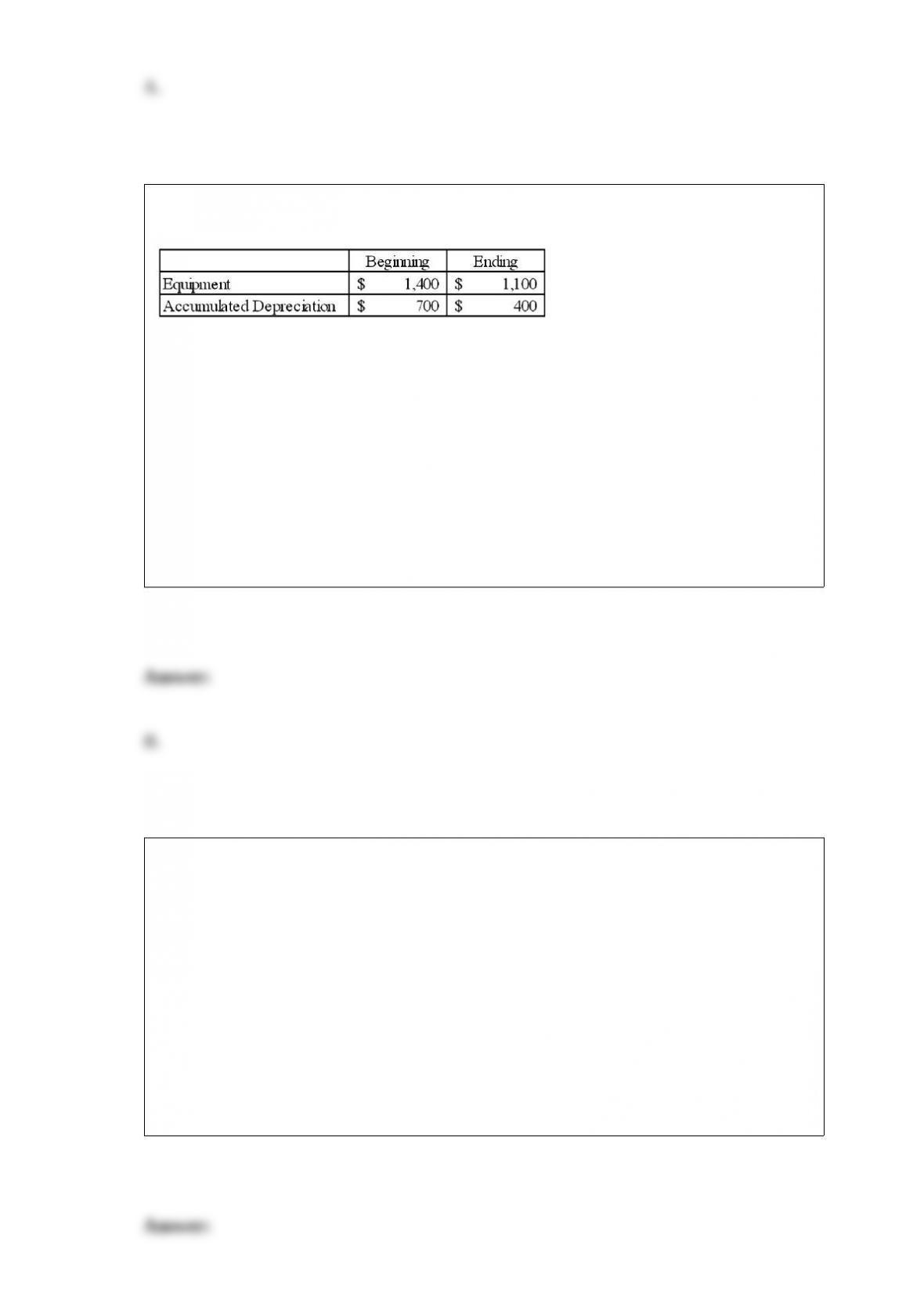
The following beginning and ending balances were drawn from the records of Grimes
Company:
If Grimes Company sold equipment that had an original cost of $600 and accumulated
depreciation of $300 for $250, how much did Grimes pay for new equipment?
A. $255
B. $300
C. $200
D. $550
As a Certified Management Accountant, Grace is bound by the standards of ethical
conduct issued by the Institute of Management Accountants. If she accepts an expensive
gift from a vendor trying to win a contract with her firm, which of the following
standards will she violate?
A. Integrity
B. Confidentiality
C. Competence
D. Objectivity
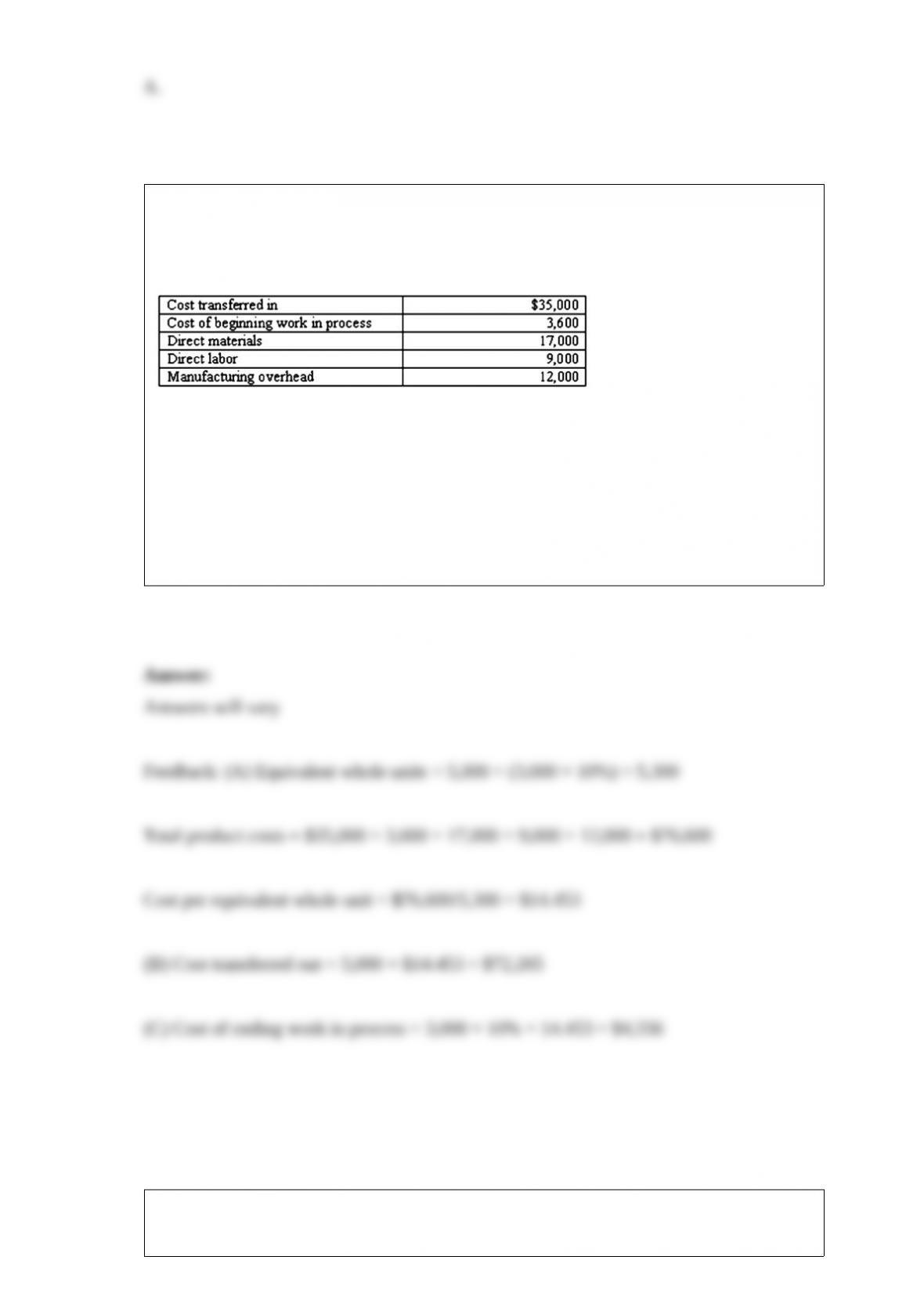
For the month of November 2014, Department B completed and transferred to the next
department 5,000 units of product. Department B’s ending work in process was 3,000
units that were 10 percent complete. The following cost information is available for the
period:
Required:
(A) Determine the cost per equivalent whole unit for the month of November. Round
your answer to three decimal places.
(B) Determine the cost transferred out during the month.
(C) Calculate the cost assigned to the ending work in process at the end of the month.
Round your answer to the nearest dollar.
Longwood Company had a current ratio of 3:1 at the end of 2013. The asset section of
the company’s balance sheet is provided below:
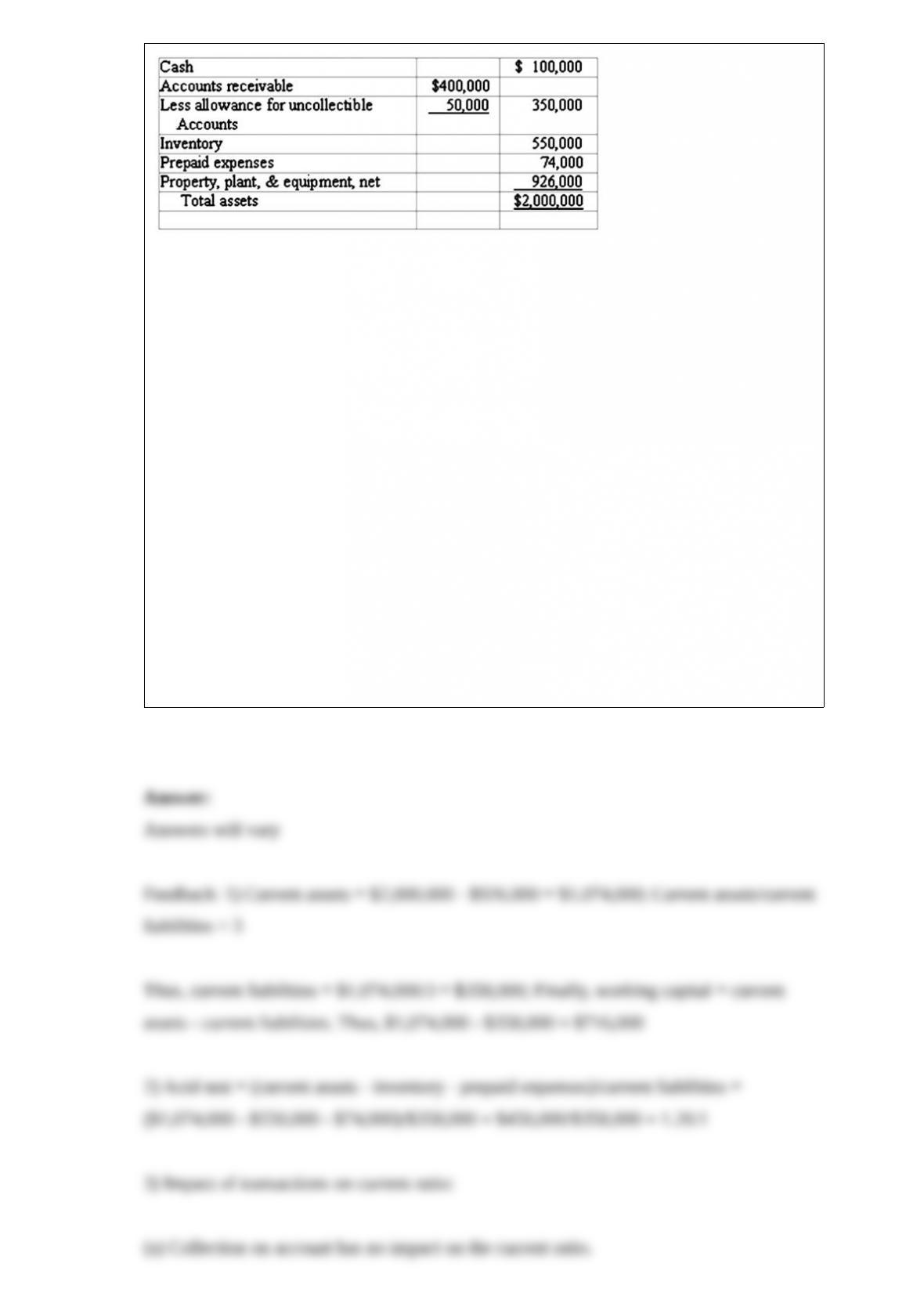
Required:
1) Compute Longwood Company’s end-of-year working capital.
2) Compute the company’s quick (acid-test) ratio.
3) The company has a debt agreement with its bank that authorizes the bank to call in
its loan to the company if the company’s current ratio falls below 3:1 as of the last day
of any month during the term of the loan. During January 2014, the company engaged
in the three following transactions:
(a) Collected $100,000 on account;
(b) Purchased inventory on account, $50,000
(c) Paid accounts payable, $60,000
Will the company be in default after completing these transactions? Justify your answer.
Round your answers to two decimal places.
The Miller Company reported gross sales of $850,000, sales returns and allowances of
$15,000 and sales discounts of $5,000. The company has total assets of $500,000, of
which $250,000 is property, plant, and equipment. What is the company’s asset turnover
ratio?
A. 3.32 times
B. 1.67 times
C. 1.66 times
D. 1.7 times
Which method is used by majority of US companies to report cash flows from
operating activities?
A. Accrual method
B. Direct method
C. Indirect method
D. Computational method
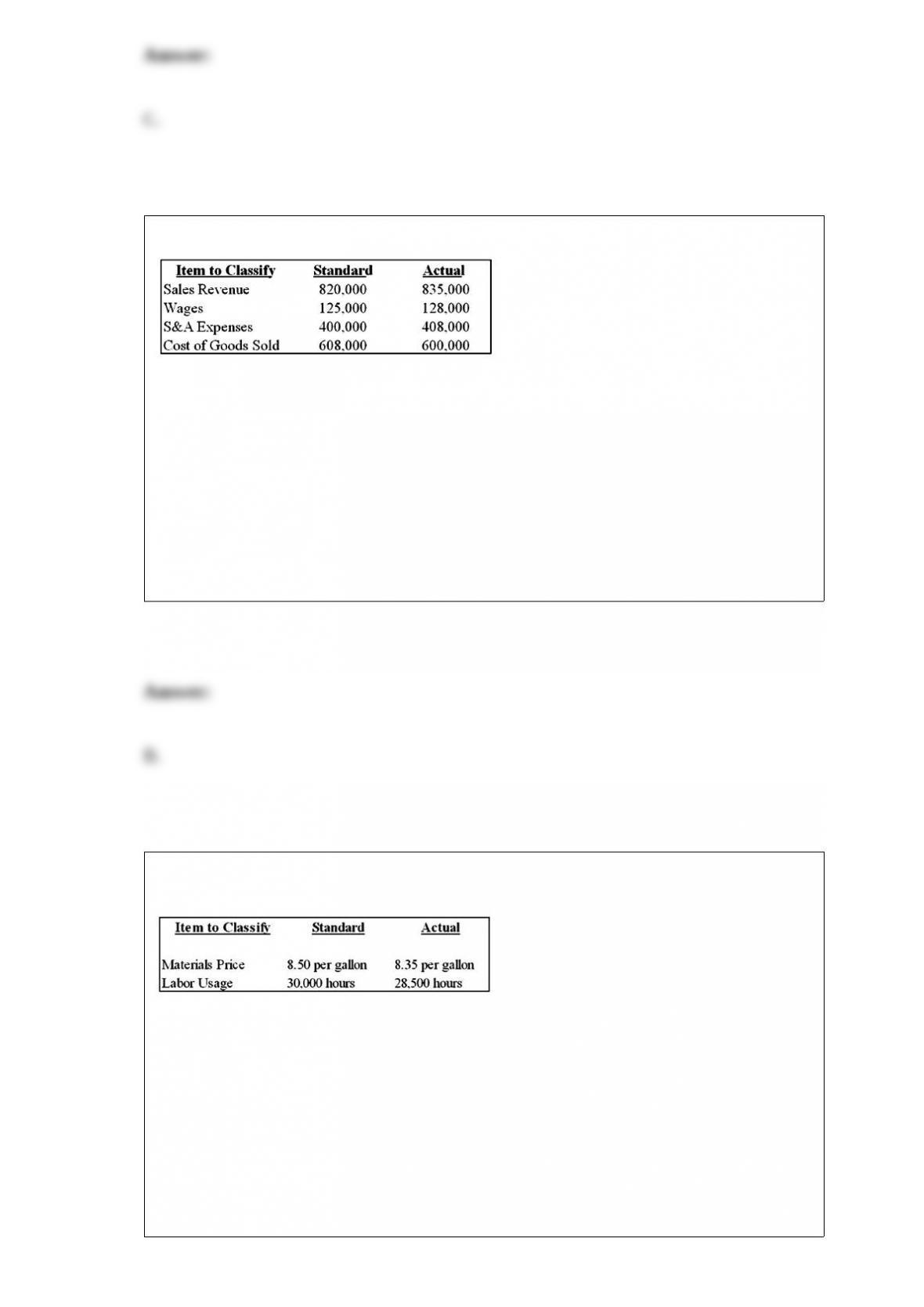
Which of the following statements is incorrect?
A. The cost of goods sold variance is favorable.
B. The S&A expense variance is favorable.
C. The sales revenue variance is favorable.
D. The wage expense variance is unfavorable.
The Bach Company provides the following standard and actual cost relating to material
price and labor usage.
Based on the above information, which statement is correct?
A. Both the material price variance and the labor usage variance are unfavorable.
B. Both the materials price variance and the labor usage variance are favorable.
C. The labor usage variance is unfavorable.
D. The materials price variance is unfavorable.

What is the formula for calculating contribution margin ratio?
A. Contribution margin/net income
B. Contribution margin/fixed costs
C. Contribution margin/desired profit
D. Contribution margin/sales
Which of the following is not a factor in explaining why the present value of a future
dollar is less than one dollar?
A. Inflation
B. Interest
C. Risk of failure to receive expected cash inflows
D. Historic cost

For most businesses, quality means:
A. the degree to which products or services exceed customer expectations.
B. absolutely no defects.
C. the degree to which products or services conform to design specifications.
D. none of these answers is correct.
Which of the following costs is an example of a product-level cost?
A. Machine setup costs
B. Patent filing costs
C. Materials and labor costs
D. Shipping and handling costs
Danforth Manufacturing Company uses a cost-plus pricing strategy. At the beginning of
2013, Danforth estimated that total annual fixed overhead costs would amount to
60,000. Further, Danforth estimated that the annual volume of production would be
1,000 units of product. Based on these estimates, Danforth computed a predetermined
overhead rate that was used to allocate overhead cost to the products made throughout
the year. As predicted, the actual volume of production amounted to 1,000 units of
product. However, actual fixed overhead costs amounted to $56,000. Based on this
information alone:
A. a lower than appropriate selling price was assigned to products in 2013.
B. a higher than appropriate selling price was assigned to products in 2013.
C. the correct selling price was assigned to products in 2013.
D. the answer cannot be determined from the information provided.
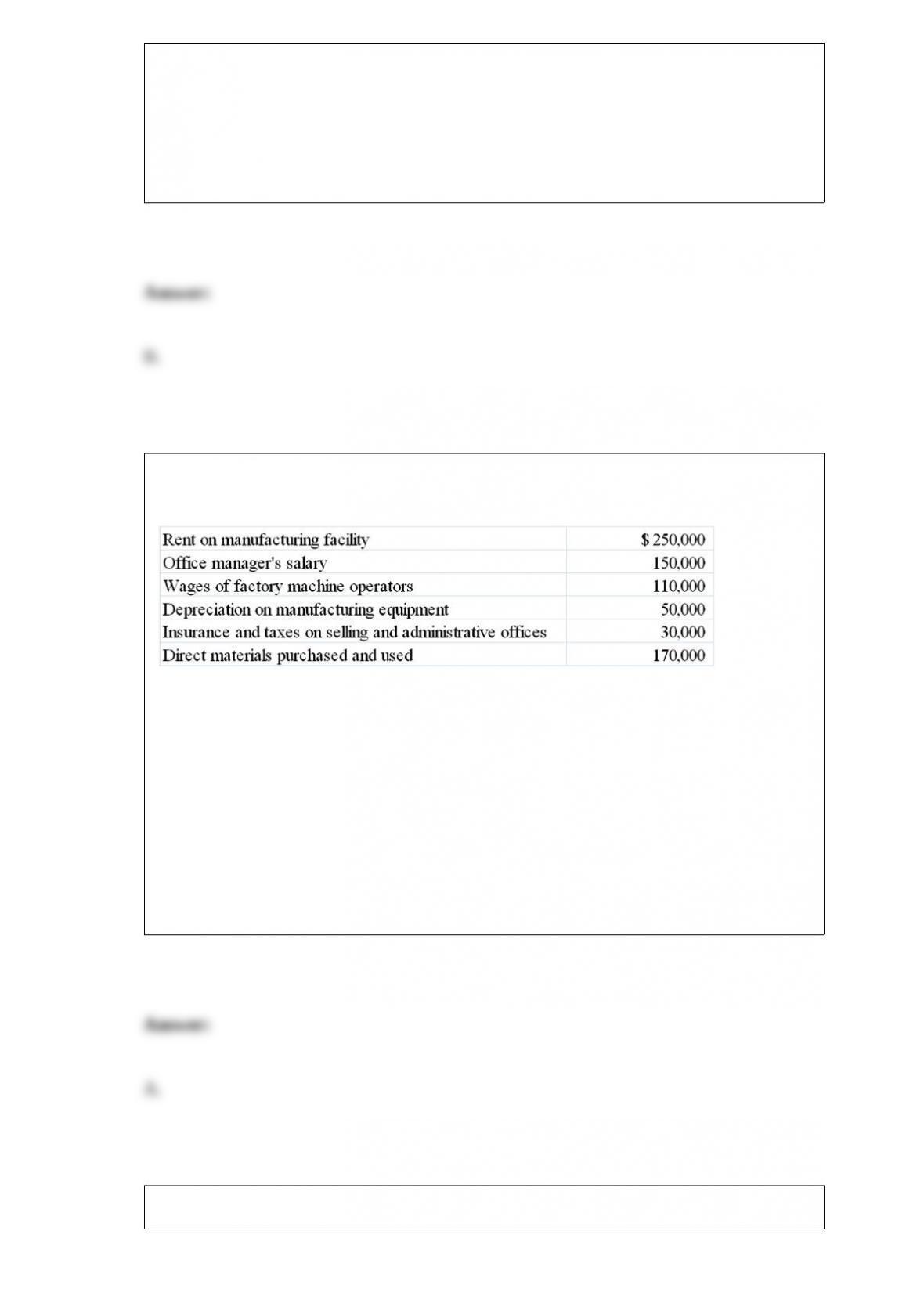
Steuben Company produces dog houses. During 2013, Steuben Company incurred the
following costs:
Wages paid to factory machine operators in producing the dog houses should be
categorized as:
A. a product cost and recorded in the inventory account
B. a period cost and recorded on the income statement
C. a product cost and recorded on the income statement
D. a period cost and recorded in the inventory account
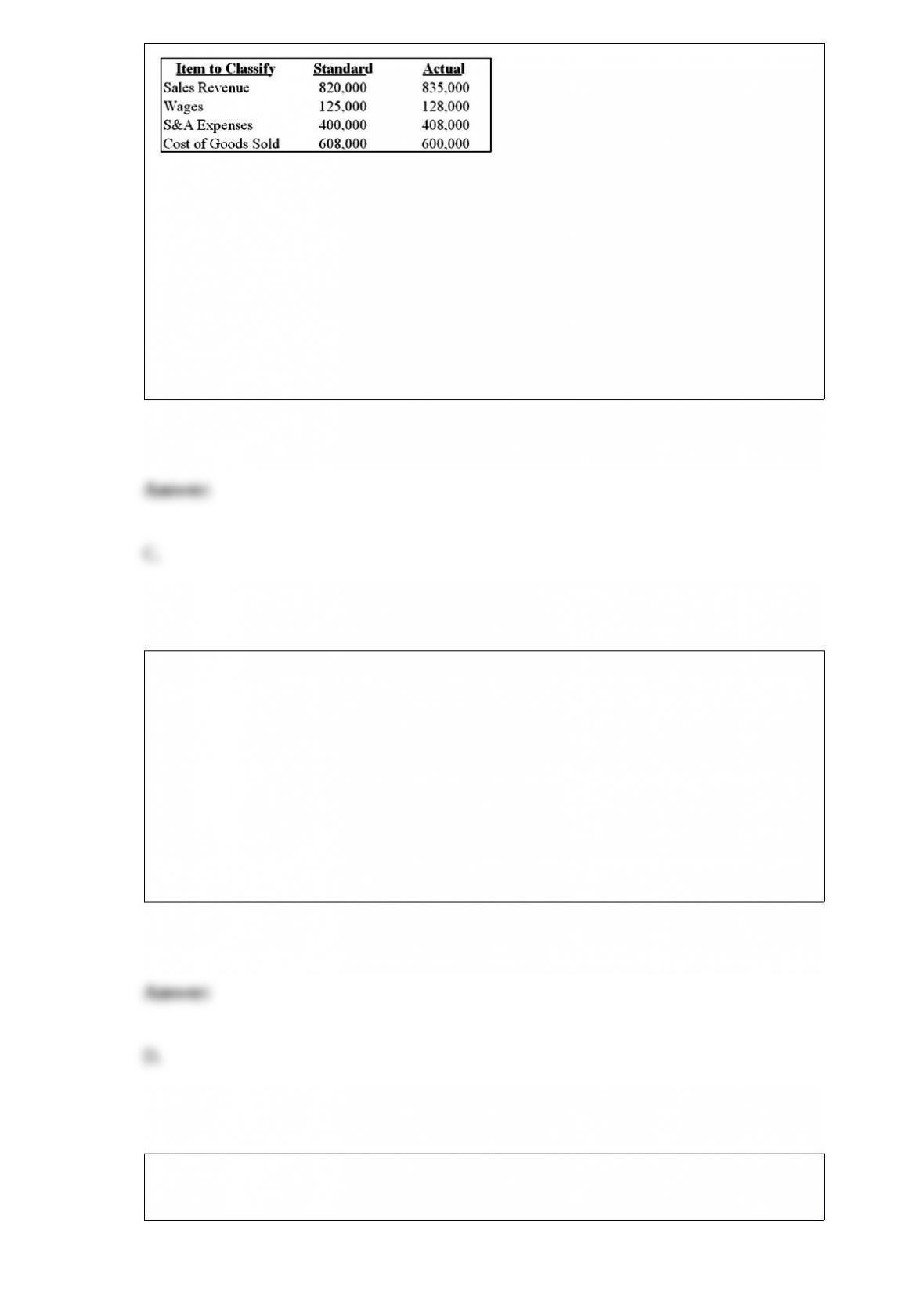
The sales volume variance was:
A. $15,000 unfavorable.
B. $7,000 favorable.
C. $15,000 favorable.
D. $7,000 unfavorable.
The source document used to record the amount of time worked by an employee on a
job is called the:
A. Requisition sheet.
B. Pay stub.
C. Job cost sheet.
D. Work ticket.
Easton Company makes and sells scooters. Easton incurred the following costs in its
most recent fiscal year:
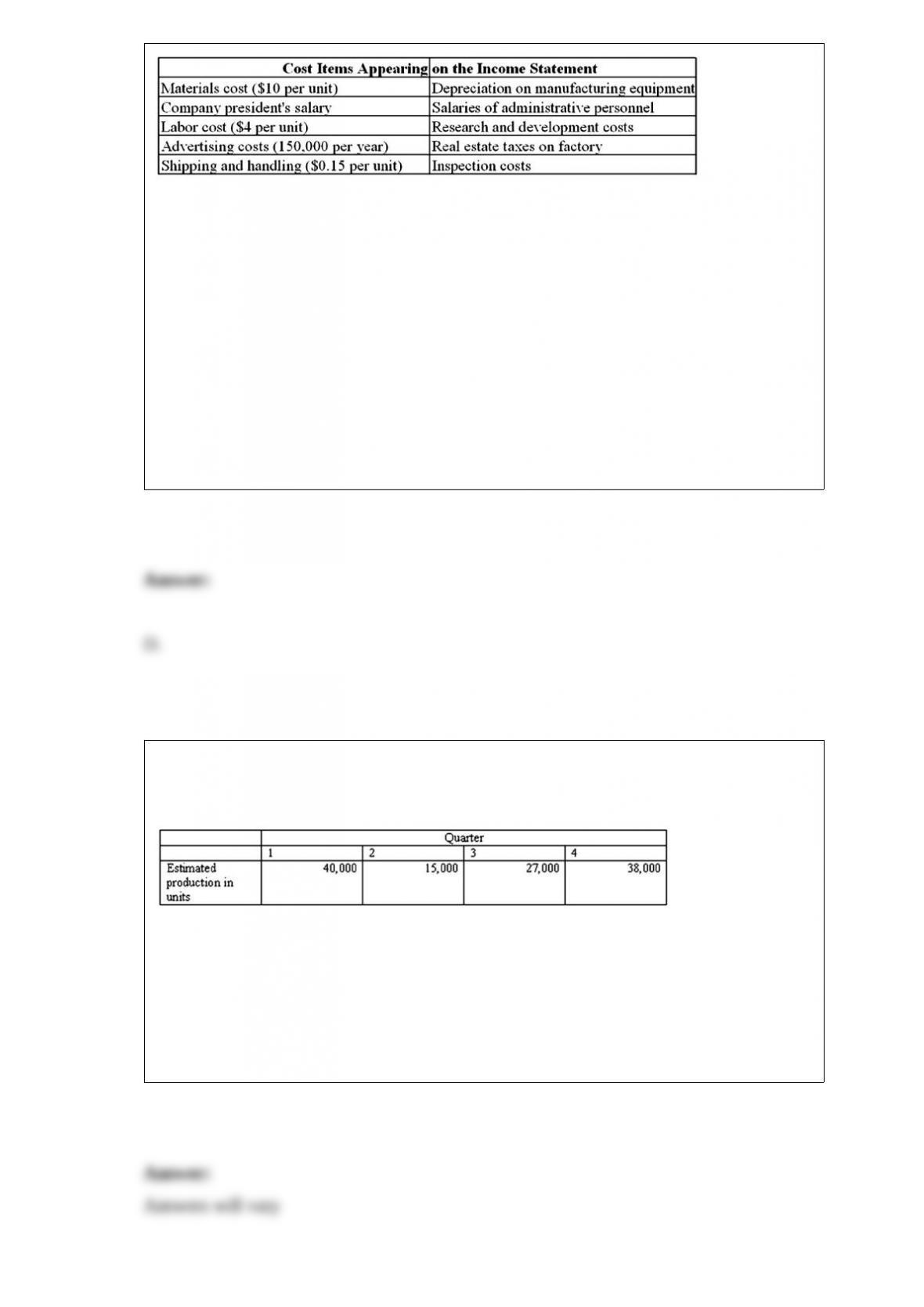
Easton can currently purchase the scooters it makes from Weston Company. If the
company purchases the scooters, Easton would still continue to use its own logo, sales
staff, and advertising programs. If Easton outsources the scooters to Weston, which of
the following costs would be relevant to the outsourcing decision?
A. Materials cost
B. Shipping and handling
C. Inspection costs
D. All of these.
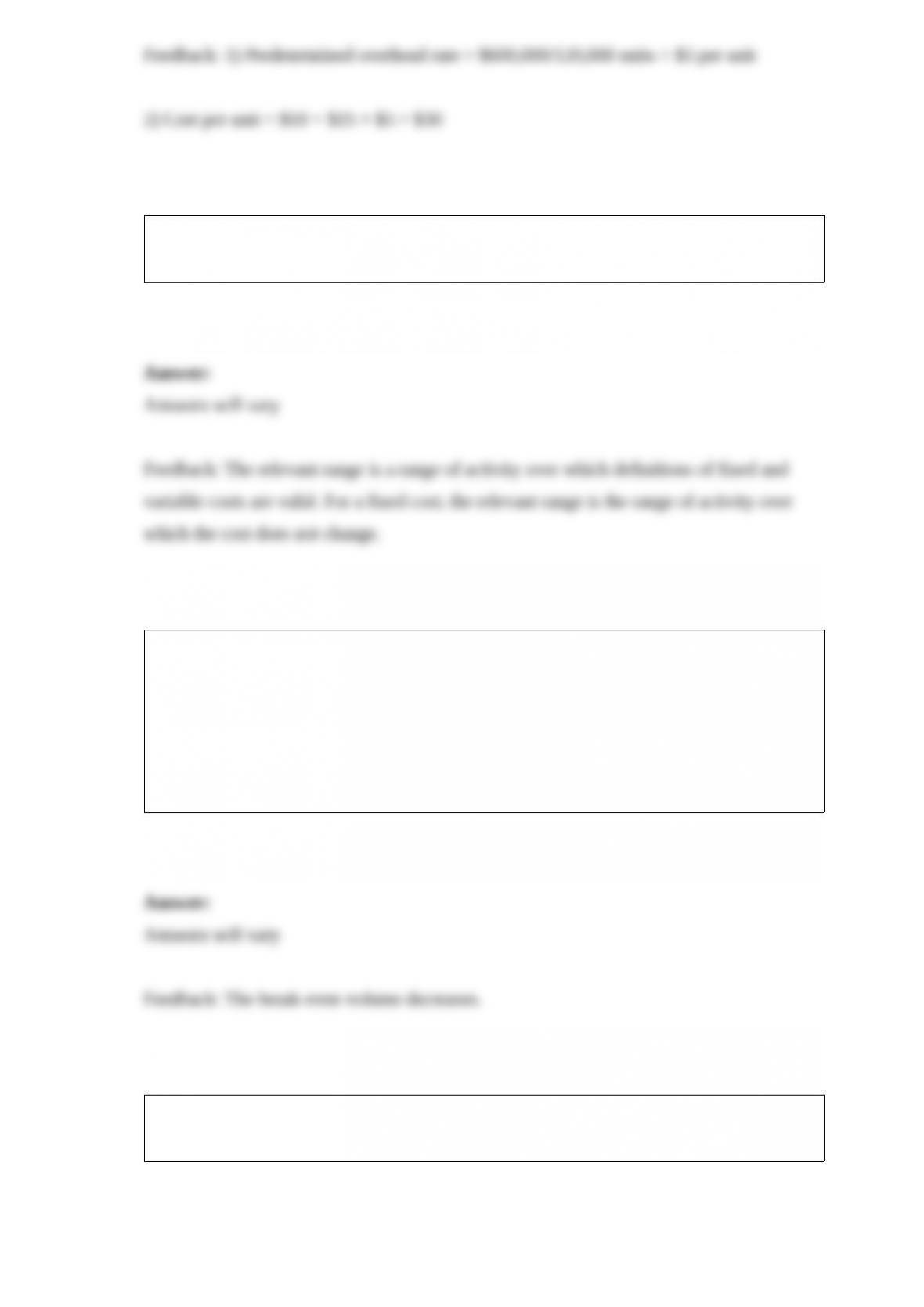
Morris Company makes one product, and it expects to incur a total of $600,000 in
indirect (overhead) costs during 2014. Production of the product for the year is
expected to be:
Required:
1) Calculate a predetermined overhead rate based on the number of units of product
expected to be made during 2014.
2) Assuming that direct materials and direct labor costs are $10 and $15, respectively,
determine the total cost per unit using the overhead rate you calculated in part a.
What is meant by the phrase, “relevant range?” How does the concept of relevant range
affect fixed costs?
Company A makes and sells a single product, unless otherwise indicated. For each of
the following changes, indicate whether the break-even point increases (i.e., break even
would occur at a higher volume of sales), decreases, is not affected, or the direction of
change cannot be determined from the information given. Assume that nothing changes
except the given item(s).
What happens to the break-even volume when the variable cost per unit decreases?
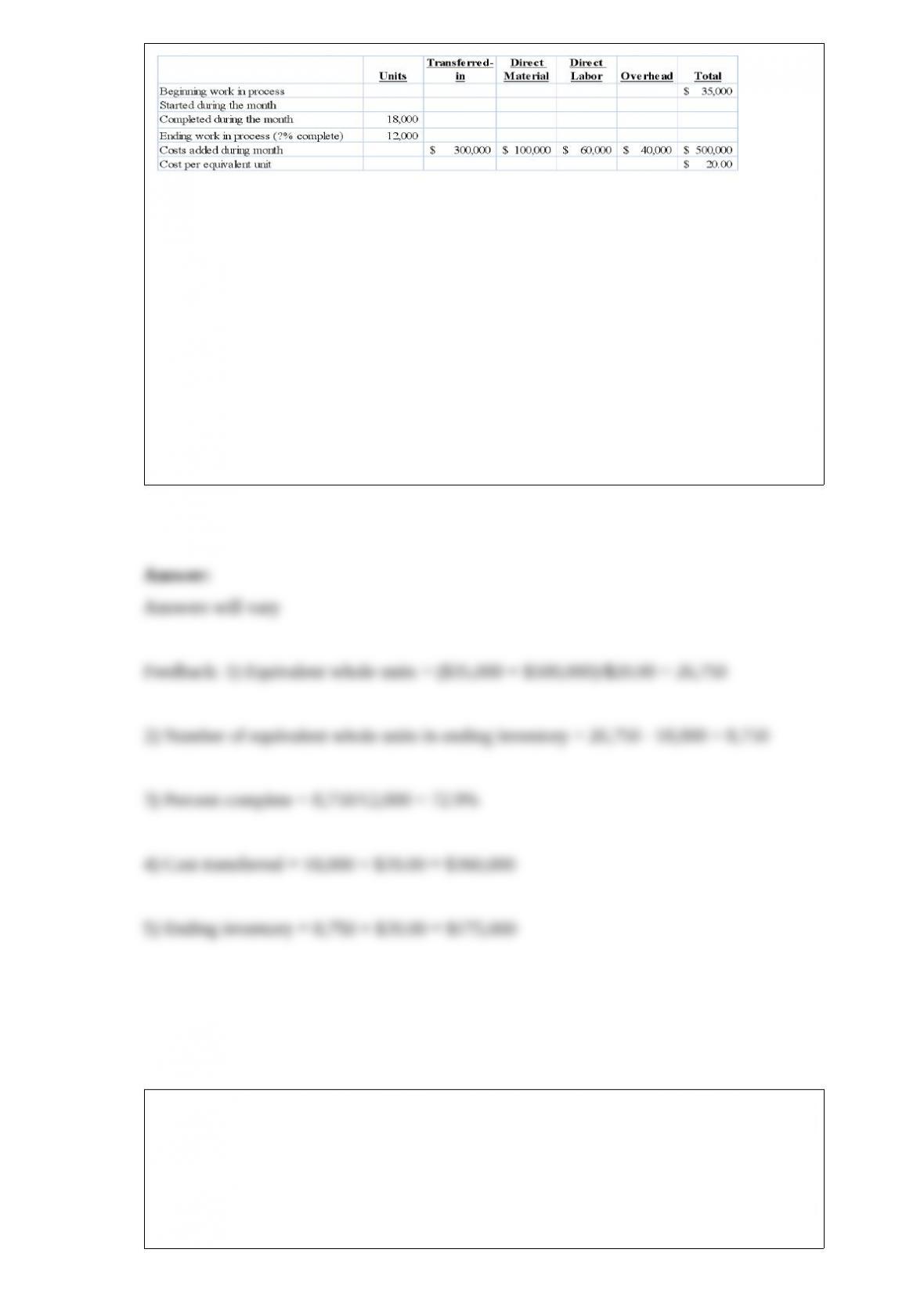
Bacon Manufacturing Company has two departments, Assembly and Finishing.
Consider the following data for the Finishing Department for April 2014:
Required:
1) Compute the equivalent whole units for the Finishing Department.
2) Compute the number of equivalent whole units for the department’s ending
inventory.
3) At what state of completion (percentage) are the units in the department’s ending
inventory? Round your answer to one decimal place (i.e. 24.6%).
4) Compute the amount of cost that should be transferred out.
5) Compute the cost that should be assigned to the department’s ending inventory.
Indicate whether each of the following statements is true or false.
A process cost system does not use the same inventory accounts as a job-order cost
system.
A process cost system accumulates product costs by jobs or batches of products.
A company using a process cost system would keep a work in process account for each
production department.
In a process cost system, the cost of raw materials used is debited to work in process.
A company using job-order costing must maintain a separate work in process account
for each department.
Indicate whether each of the following statements is true or false.
The further into the future a cash receipt is expected to occur, the higher is its present
value.
The return on investment measures the compensation a company expects to receive
from investing in capital assets.
Most companies use their cost of capital to estimate the minimum return on investment
required from capital investments.
When a company invests in capital assets, it sacrifices present dollars for the
opportunity to receive future dollars.
The required rate of return on a capital investment is also referred to as the hurdle rate
or discount rate.
Indicate whether each of the following statements about process costing systems is true
or false.
The number of equivalent whole units can be calculated by the FIFO method or by the
weighted average method.
For Company X, the cost in beginning work in process was $18,000; costs incurred
during the month were $52,100; the number of equivalent whole units for the month
was 8,400. Company X calculates equivalent whole units by the weighted average
method. The cost per equivalent whole unit was $6.20.
The allocation of costs between products transferred out and those still in process at the
end of the period is shown on a cost of production report.
The weighted average method of calculating equivalent whole units takes into account
the stage of completion of beginning work in process but not ending work in process.
Many companies use the weighted average method to calculate equivalent whole units
because the method is relatively easy to use.
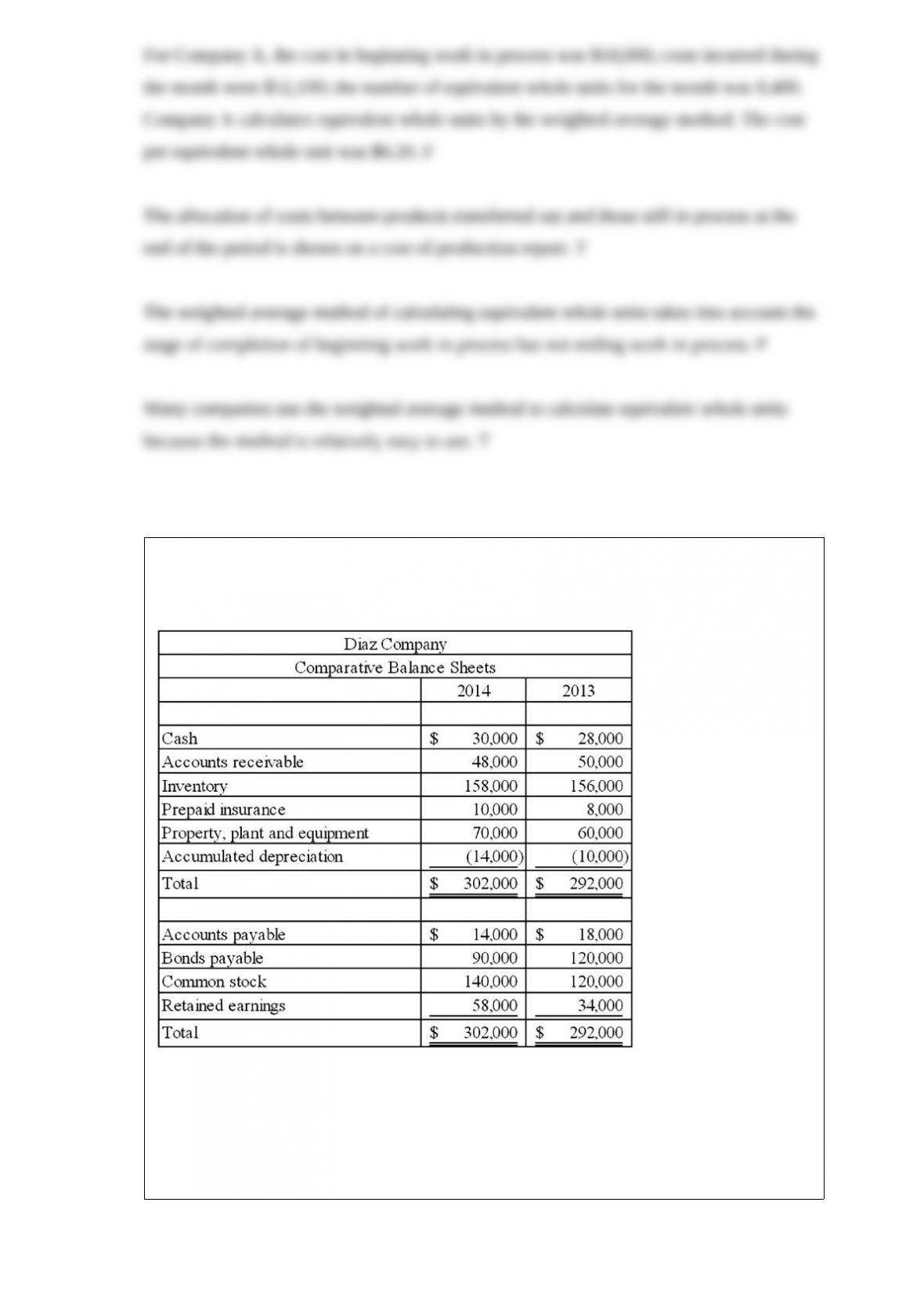
Diaz Company had the following comparative balance sheet information for 2014 and
2013:
Diaz reported net income for 2014 of $40,000. No property, plant, & equipment was
disposed of during the year. Diaz uses the indirect method to prepare the statement of
cash flows.
Calculate Diaz’s cash flow from investing activities for 2014.
What is the object of allocating fixed overhead costs to products?