Which of the following statements regarding posting and classification is correct?
A) Posting journal entries involves copying the dollar amounts from the ledger into the
journal.
B) If a $100 debit is erroneously posted to an account as a $100 credit, the accounts will
be out of balance by $100.
C) If a $5,000 credit to a stockholders ‘ equity account is misclassified as a $5,000
credit to a liability, the accounting equation will still balance.
D) If a purchase of supplies on account for $100 is recorded with a debit to Supplies of
$10 and a credit to Accounts Payable for $10, the accounting equation will not balance.
On July 1, Darin Company sold inventory costing $4,500 to Dee Company for $6,000,
terms 2/10, n/30. Both companies use a periodic inventory system. What journal entry
will be recorded by Dee Company on July 1?
A) Debit Purchases and credit Accounts Payable for $6,000
B) Debit Inventory and credit Accounts Receivable for $6,000
C) Debit Inventory and credit Accounts Payable for $6,000
D) Debit Cost of Goods Sold and credit Inventory for $4,500
Which of the following items on a bank reconciliation would require a journal entry?
A) An error by the bank
B) Outstanding checks
C) A bank service charge
D) A deposit in transit
Debentures are:
A) unsecured bonds.
B) secured bonds.
C) serial bonds.
D) callable bonds.
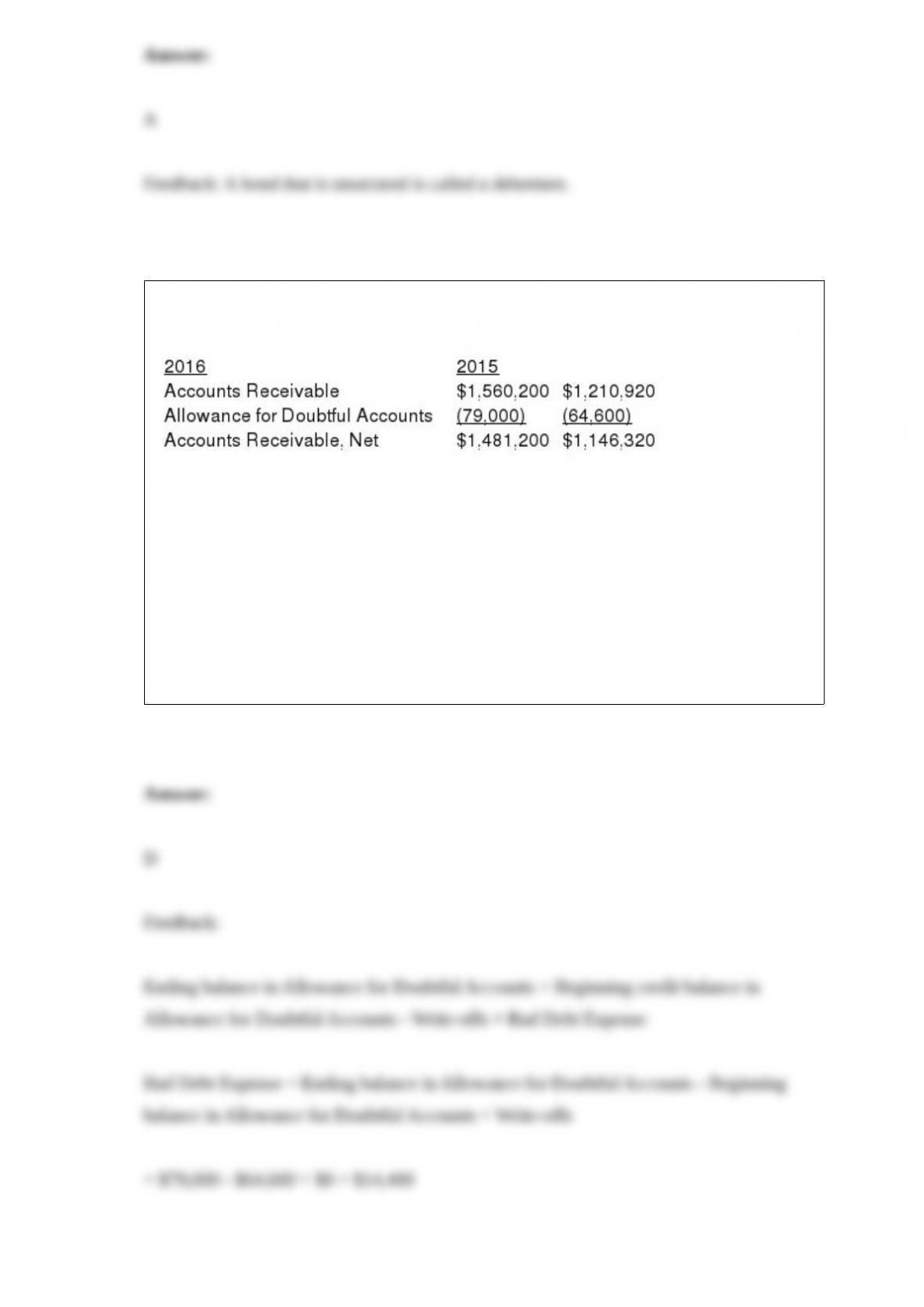
Assume the Murtha Company reported the following adjusted account balances at
year-end.
Assume the company recorded no write-offs or recoveries during 2016. What was the
amount of Bad Debt Expense reported in 2016?
A) $79,000
B) $64,600
C) $28,800
D) $14,400

Which concept should be applied when reporting a piece of land that was bought for
$50,000 five years ago, and which would probably now sell for $80,000?
A) The cost principle
B) The accounting equation
C) The separate entity concept
D) The monetary concept
Almost all U.S. companies have used the indirect method of preparing the statement of
cash flows:
A) because most users of the financial statements do not understand the direct method.
B) in spite of the FASB’s stated preference for the direct method.
C) because it usually requires less space in the annual report.
D) so that stockholders cannot determine how much cash was spent on executives’
salaries.
Accounts Receivable, Net (or Net Accounts Receivable) equals Accounts Receivable
(gross) minus:
A) Cost of Goods Sold.
B) Bad Debt Expense.
C) Allowance for Doubtful Accounts.
D) Current Liabilities.
If a company does not have any accumulated other comprehensive income (loss),
stockholders’ equity is the:
A) amount the company received in exchange for all stock issued plus the amount of
Retained Earnings minus the cost of treasury stock.
B) amount the company received for all stock authorized plus the amount of Retained
Earnings and treasury stock.
C) par value the company received for all stock issued plus the amount of Retained
Earnings minus treasury stock.
D) amount the company received for all stock when issued minus the amount of
Retained Earnings and treasury stock.
Which of the following events does not create a liability?
A) Buying goods and services on credit
B) Obtaining a short-term loan
C) Issuing long-term debt
D) Remitting sales tax to the government
The first year of operations for a company was Year 1. The net income for the year Year
1 was $20,000 and dividends of $12,000 were paid. In Year 2, the company reported net
income of $34,000 and paid dividends of $5,000. At the end of Year 1, the company had
total assets of $150,000. At the end of Year 2, the company had total assets of $240,000.
Use the information above to answer the following question. What was the amount of
retained earnings at the end of Year 1?
A) $20,000.
B) $8,000.
C) $150,000.
D) $155,000.
Closing entries:
A) are prepared before financial statements are prepared.
B) reduce the number of permanent accounts.
C) cause the revenue and expense accounts to have zero balances.
D) summarize the activity in every account.