
Materiality is used to help decide the scope of testing, help determine the sample size
and to help
A) develop the audit report.
B) decide which analytical review calculations to use.
C) evaluate the results of testing.
D) conduct understanding of business tests.
Fraud risk factors are examples of factors that increase the risk of fraud. Which of the
following is an example of a management “incentives or pressures” risk factor?
A) Customer demand for a new product line was significantly less than expected.
B) Management and the auditors disagree upon how to value a large contract in
progress.
C) There is only one board member who understands financial statements, and she has
suffered a heart attack.
D) There has been significant turnover in the accounting department in the last year.
Audit risk is a measure of
A) the auditor’s assessment of the likelihood that a material misstatement might occur in

the first place.
B) the probability that the financial statements contain errors.
C) how willing the auditor is to accept that the financial statements may be materially
misstated after the audit is completed.
D) the probability that errors in the financial statements that were not detected by the
internal controls of the firm are not detected by the auditor.
To test whether the client has fulfilled its legal obligation in submitting payments for all
payroll withholdings, the auditor must first
A) contact client’s independent legal counsel.
B) know the dates when tax payments are due.
C) trace these payments to the imprest payroll account.
D) determine the client’s requirements for submitting the payments.
The PA is having a discussion with his client about the outcome of several lawsuits that
are presently in progress. The client has requested that the comments during the
discussion be removed from the audit file. The client would like the only documentation
in the audit file to be the legal letter from the client, and brief comments with respect to
the auditor’s judgments with respect to the quality of disclosure in the financial
statements. The client is concerned that

A) only high quality audit working papers be included in the working paper files.
B) auditors may breach confidentiality and disclose information about the client.
C) the auditor’s working paper files may be subpoenaed by the courts.
D) the audit firm does not have adequate quality control procedures.
Testing to ensure that bank transfers are recorded in both the receiving and disbursing
banks helps to detect evidence
A) that would reduce inherent risk to a minimum.
B) associated with an attempt to conceal a theft of cash.
C) that increases reliability with respect to the accuracy of the transfer schedule.
D) that would warrant decreasing control risk to a minimum.
An aspect of analytical procedures is referred to as “attention-directing” when it
highlights
A) errors.
B) irregularities.

C) areas of improvement.
D) areas that need more detailed procedures.
Ordinarily, it is unnecessary to test the valuation of capital assets recorded in prior
periods because
A) it will not affect the current valuations.
B) they were verified in previous audits.
C) the related amortization calculations for the current period are more important.
D) the emphasis of the audit is on the income statement items, not the balance sheet
items.
Paul is in the process of performing procedures to obtain the necessary understanding of
the client’s internal controls. As part of this process, Paul received from the client
completed narratives, flowcharts and internal control questionnaires. Paul can use this
information from the client
A) if the entity level controls and tone at the top were found to be effective.
B) if there has not been any significant change in the internal controls since the prior
year.
C) as long as any subsequent reliance on controls is adequately substantiated with

testing.
D) since it was prepared by management who are unbiased.
The reason auditors accumulate evidence is to
A) defend themselves in the event of a lawsuit.
B) justify the conclusions they have otherwise reached.
C) satisfy the requirements of the relevant provincial securities regulations.
D) enable them to reach conclusions about the fairness of the financial statements and
issue an appropriate audit report.
When labour is a significant part of inventory, verifying the proper accounting of these
costs should be tested in the
A) inventory and distribution cycle.
B) human resources and payroll cycle.
C) acquisitions and payments cycle.
D) cash cycle.

After the auditor has identified the key internal controls and weaknesses and assessed
control risk, it is appropriate to decide whether
A) substantive tests will be increased sufficiently to justify the cost of performing tests
of controls.
B) substantive tests will be reduced sufficiently to justify the cost of performing tests of
controls.
C) tests of controls will be increased sufficiently to justify the cost of performing
substantive tests.
D) tests of controls will be reduced sufficiently to justify the cost of performing
substantive tests.
The auditor evaluates the internal transfer of assets and related costs during the
A) acquisition and payments cycle.
B) human resources and payroll cycle.
C) sales and collection cycle.
D) inventory and distribution cycle.

Disbursements on the bank transfer schedule should be correctly included in or
excluded from year-end bank reconciliations as outstanding cheques. Understating
outstanding cheques on the bank reconciliation indicates
A) the possibility of kiting.
B) a cut-off error in the bank account.
C) an understatement of the bank balance.
D) an increase in inherent risks associated with cash.
IFRS uses specific terminology to refer to the likelihood of the occurrence of an
organizational event. Which of the following would require note disclosure in the
financial statements adjusted?
A) likely to occur and the amount can be estimated
B) possible that an outflow of resources is not required
C) likelihood is remote
D) amount is yet to be confirmed

The exception rate the auditor will permit in the population and still be willing to use
the assessed level of control risk is called the
A) tolerable exception rate.
B) estimated population exception rate.
C) acceptable risk of overreliance.
D) sample exception rate.
The CAS require the auditor to review the other information in the annual report to
ascertain its consistency with the financial statements. If there is a material
inconsistency, the client should be requested to change the information. If the client
refuses, the auditor should
A) issue an adverse opinion.
B) issue a qualified opinion.
C) consider what further action is warranted, including making contact with the audit
committee.
D) issue an unqualified opinion, bill the client, and withdraw from any future
engagements.

With respect to working on an engagement to examine a financial forecast or projection
included in a prospectus or other public offering document, the public accountant and
the client should agree upon
A) allocation of the responsibility of creating the assumptions to the public accountant.
B) the period of time to be covered.
C) delegation of forecast preparation to the public accountant.
D) the fact that the forecast may not be prepared in accordance with standards.
CAS 530 has a very specific definition of sampling. Assuming that each item (described
as a sampling unit) in the populations below could be selected as part of the sample,
which of the following illustrates the other part of the CAS 530 definition of sampling?
A) looking at 50 sales invoices from the current population of 100,000
B) recalculating interest calculations for notes payable
C) estimating the gross profit by product for all company products
D) inspecting all legal invoices for potential contingent liabilities
When auditing merchandise inventory at year-end, the auditor performs a purchase
cutoff test to obtain evidence that

A) all goods purchased before year-end are received before the physical inventory
count.
B) no goods held on consignment for customers are included in the inventory balance.
C) no goods observed during the physical count are pledged or sold.
D) all goods owned at year-end are included in the current period inventory balance.
The most reliable evidence from confirmations is obtained when they are sent
A) several months before the year-end, so the auditor will have adequate time to
perform alternate procedures if they are required.
B) at various times throughout the year to different sections of the sample, so that the
entire sample is representative of account balances scattered throughout the year.
C) as close to the balance sheet date as possible.
D) at various times throughout the year to the same group in the sample, so that the
sample will not have a time bias.
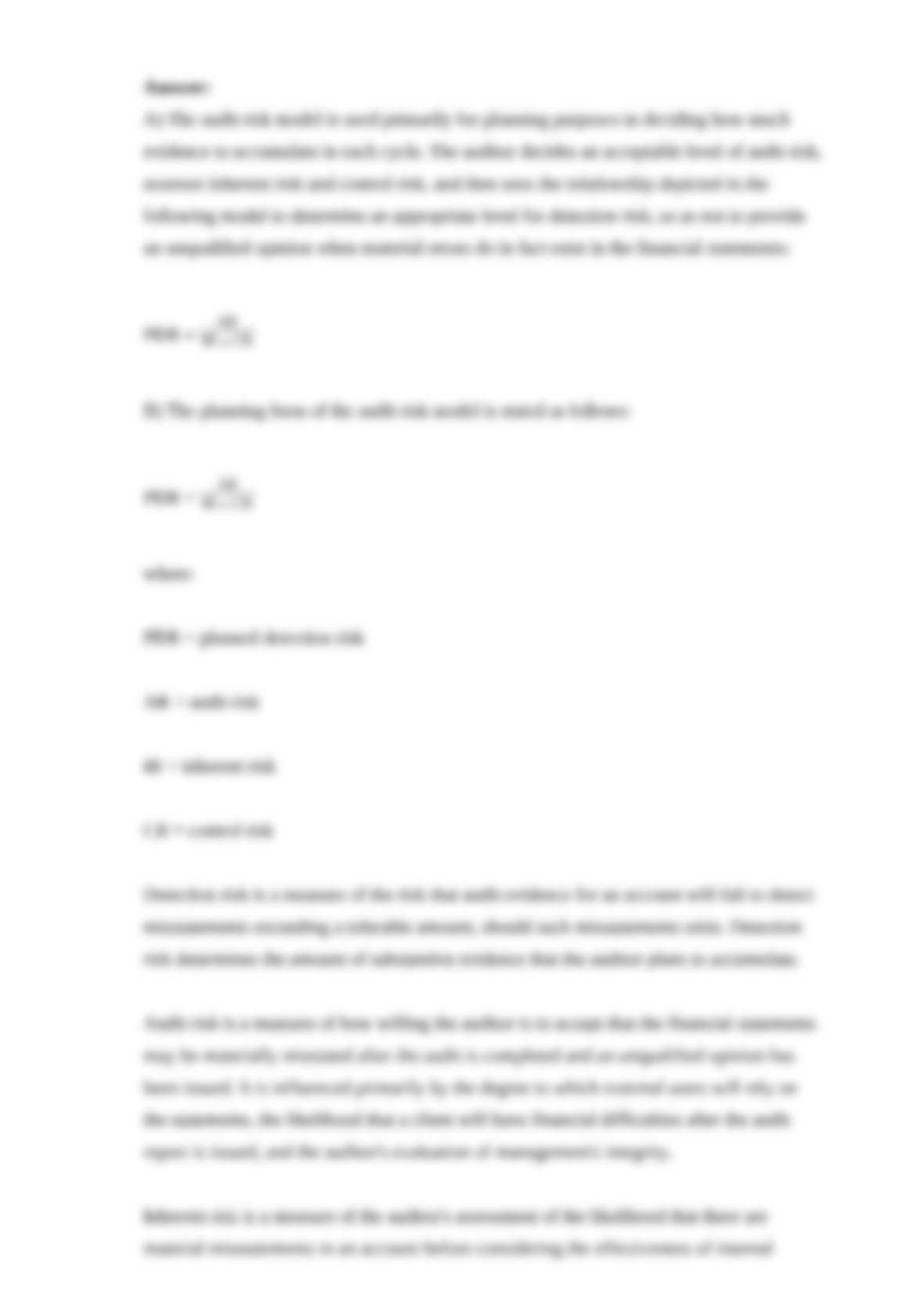
A) Explain how auditors use the audit risk model when planning an audit.
B) Describe the audit risk model and each of its components.

Larger audits may have established procedures that utilize an audit committee whenever
there is a dispute between management and the auditors. What is the purpose of such
procedures?
A) make sure that the auditor understands management’s point of view
B) improves the competence of the financial statement auditors
C) facilitate the auditors’ independence from management
D) helps make sure the audit is conducted following GAAS
An abnormal fluctuation in gross profit that might suggest the need for extended audit
procedures for sales and inventories would most likely be identified in the planning
phase of the audit by the use of
A) tests of details of balances.
B) procedures to obtain an understanding of internal controls.
C) specialized audit programs.
D) analytical procedures.

Which of the following documents and records is used to record the packages, weights
and sizes shipped using an external trucking company?
A) remittance advice
B) shipping advice containing shipment tracking number
C) returns receiving report
D) bill of lading
An example of a breach of contract would be
A) a bank’s claim that an auditor had a duty to uncover material errors in financial
statements that had been relied on in making a loan.
B) an auditor’s refusal to return a client’s records until the client paid last year’s audit
fees.
C) a public accounting firm’s failure to deliver a tax return on the agreed-upon date
because the firm had a backlog of other work which was more lucrative.
D) an auditor’s failure to complete the audit by the agreed-upon date because the client’s
financial records had been destroyed.

An increase in the sample size has the effect of decreasing the sampling error if the
A) actual sample exception rate increases.
B) actual sample exception rate does not increase.
C) number of exceptions in the sample does not increase.
D) number of exceptions in the sample increases.
George had a conversation with the accounting personnel and documented information
about how the accounting systems function. He has also placed copies of accounting
forms in his files. George is performing which task?
A) accounting procedures
B) evidence gathering
C) tax audit
D) audit report preparation
Which of the following components of an engagement letter would apply to both a
review engagement and a compilation engagement?

A) negative assurance will be provided, so there is no assurance that fraud will be
detected
B) no assurance will be provided, since only mathematical accuracy will be verified
C) procedures used during the engagement will be limited to analytical review and
inquiry
D) a statement that an audit is not to be performed and that no opinion will be expressed
Jibbery Company has numerous transactions with related parties. For example, it has
borrowed money from shareholders, purchases raw materials from a subsidiary
company, and sells finished goods to its parent company. Which of the following
describes one of the impacts upon risk assessment of these transactions?
A) inherent risk would be set as low
B) inherent risk would be set as high
C) control risk would be set as low
D) audit risk would be decreased