
1) Investment center managers are evaluated on their use of center assets to generate
income.
2) The last step in the four-step accounting procedure for process costing is the
calculation of equivalent units of production.
3) To prepare consolidated financial statements when a U. S. parent company has an
international subsidiary, the international subsidiary’s financial statements must be
translated into U.S. dollars.
4) Basic bank services such as bank accounts, bank deposits, and checking contribute to
the control and safeguarding of cash.
5) If a department that uses process costing starts the reporting period with 100,000
physical units that were 20% complete with respect to direct labor, it must add 80%
direct labor in the current period to complete the units.
6) The business entity assumption means that a business is accounted for separately
from other business entities, including its owner or owners.
7) Cowers reported net sales of $2,463 million and average total assets of $1,546
million. Its total asset turnover equals 1.59.
8) The entry to increase the balance in petty cash from $50 to $75 would include a
credit to Petty Cash of $25.
9) A company that produces a large number of standardized units would normally use a
job order cost accounting system.
10) Sellers generally prefer to receive notes receivable rather than accounts receivable
when the credit period is long and the receivable is for a large amount.
11) The financial budgets include the cash budget and the capital expenditures budget.
12) Net income occurs when revenues exceed expenses.
13) The budgets within the master budget must be prepared in a definite sequence as
dictated by GAAP.
14) If a long-term investment in an equity security gives the investor significant
influence over the investee, the investment is classified as available-for-sale.
15) The focus of financial accounting is on an organization’s projects, processes, and
subdivisions, and the focus of managerial accounting is on the whole organization.
16) The statement of cash flows explains the difference between the beginning and
ending balances of cash and cash equivalents.
17) Cabot Company collected the following data regarding production of one of its
products. Compute the fixed overhead cost variance.
A.$18,300 favorable
B.$18,000 favorable
C.$18,000 unfavorable
D.$18,300 unfavorable
E.$14,300 unfavorable
18) Which of the following statements related to U.S. GAAP and IFRS is incorrect?
A.Both U.S. GAAP and IFRS include guidance for adjusting entries
B.Both U.S. GAAP and IFRS prepare the same four financial statements
C.U.S. GAAP does not require items to be separated by current and noncurrent
classifications on the balance sheet
D.U.S. GAAP balance sheets report current items first
E.IFRS balance sheets normally present noncurrent items first
19) On January 1, Leyden Corporation leased a truck, agreeing to pay $15,252 every
December 31 for the six-year life of the lease. The present value of the lease payments,

at 6% interest, is $75,000. The lease is considered a capital lease.
(a) Prepare the general journal entry to record the acquisition of the truck with the
capital lease.
(b) Prepare the general journal entry to record the first lease payment on December 31.
(c) Record straight-line depreciation on the truck on December 31, assuming a 6-year
life and no salvage value.
20) Bradford Company budgeted 4,000 pounds of material costing $5.00 per pound to
produce 2,000 units. The company actually used 4,500 pounds that cost $5.10 per
pound to produce 2,000 units. What is the direct materials price variance?
A.$400 unfavorable
B.$450 unfavorable
C.$2,500 unfavorable
D.$2,550 unfavorable
E.$2,950 unfavorable
21) The purchases journal is used for recording:
A.Credit purchases
B.Credit sales
C.Cash sales
D.Cash purchases
E.Cash disbursements
22) A company received payment of $9,800 from a customer within the discount period.
Identify the journal the transaction would be recorded in.
A.Cash disbursements journal
B.Sales journal
C.Cash receipts journal
D.Purchases journal
E.General journal

23) A company pays $15,000 per period to rent a small building that has 10,000 square
feet of space. This cost is allocated to the company’s three departments on the basis of
the amount and value of the space occupied by each. Department One occupies 2,000
square feet of ground-floor space, Department Two occupies 3,000 square feet of
ground-floor space, and Department Three occupies 5,000 square feet of second-floor
space. If rents for comparable floor space in the neighborhood average $2.20 per square
foot for ground-floor space and $1.10 per square foot for second-floor space and the
rent is allocated based on the total value of the space, Department One should be
charged rent expense for the period of:
A.$4,400
B.$4,000
C.$3,000
D.$2,200
E.$2,000
24) Metro Express has 5 sales employees, each of whom earns $4,000 per month and is
paid on the last working day of the month. Each employee’s wages are subject to FICA
social security taxes of 6.2% and Medicare taxes of 1.45% on all wages. Withholding
for each employee also includes federal income tax of 16% and monthly medical
insurance premiums of $110 for each employee.
a. Prepare the general journal entry to accrue the monthly sales salaries expense at
January 31.
b. The employer payroll taxes for Metro Express include FICA taxes, federal
unemployment taxes of 0.8% of the first $7,000 paid each employee, and state
unemployment taxes of 4.0% of the first $7,000 paid to each employee. Prepare the
journal entry to record the employer’s payroll taxes at January 31 for Metro Express.
(Assume that none of the employees has reached the unemployment limit of $7,000.)
25) The amount of federal income taxes withheld from an employee’s paycheck is
determined by:
A.The amount of the employee’s current earnings for the pay period and number of
withholding allowances the employee claims
B.The employer’s merit rating
C.The amount of social security taxes
D.Multiplying the gross pay by 6.2%
E.All of these
26) A disadvantage of using the payback period to compare investment alternatives is
that:
A.It ignores cash flows beyond the payback period
B.It includes the time value of money
C.It cannot be used when cash flows are not uniform
D.It cannot be used if a company records depreciation
E.It cannot be used to compare investments with different initial investments
27) Classify each of the following items as either:
1>Current liability A.30-day promissory note
2>Current liability B.Payment of a 4-year term loan due this year
3>Current liability C.Salaries payable
4>Not a liability D.Debt guarantees
5>Current liability E.FICA taxes payable
6>Current liability F.Income taxes payable
7>Not a liability G.Payment of a 30-year term loan due this year
8>Long-term liability H.Payment of a 30-year term loan due next year (The company’s
operating cycle is 2 months.)
9>Current liability I.Warranty work completed this year
10>Current liability J.Accounts payable
28) The inventory turnover ratio:
A.Is used to analyze profitability
B.Is used to measure solvency
C.Reveals how many times a company turns over (sells) its merchandise inventory
D.Validates the acid-test ratio
E.Calculation depends on the company’s inventory valuation method

29) Internal control systems are:
A.Developed by the Securities and Exchange Commission for public companies
B.Developed by the Small Business Administration for non-public companies
C.Developed by the Internal Revenue Service for all U.S. companies
D.Required by Sarbanes-Oxley (SOX) to be documented and certified if the company’s
stock is traded on an exchange
E.Required only if a company plans to engage in interstate commerce
30) The three major cost components of a manufactured product are:
A.Marketing, selling, and administrative costs
B.Indirect labor, indirect materials, and miscellaneous factory expenses
C.Direct materials, direct labor, and factory overhead
D.Differential costs, opportunity costs, and sunk costs
E.General, selling, and administrative costs
31) A cost that cannot be avoided or changed because it arises from a past decision, and
is irrelevant to future decisions, is called a(n):
A.Uncontrollable cost
B.Incremental cost
C.Opportunity cost
D.Out-of-pocket cost
E.Sunk cost
32) Days’ sales in inventory:
A.Is also called days’ stock on hand
B.Focuses on average inventory rather than ending inventory
C.Is used to measure solvency
D.Is calculated by dividing cost of goods sold by ending inventory
E.Is a substitute for the acid-test ratio
33) On June 30 of the current year, the assets and liabilities of Phoenix, Inc. are as
follows: Cash $20,500; Accounts Receivable, $7,250; Supplies, $650; Equipment,
$12,000; Accounts Payable, $9,300. What is the amount of owner’s equity as of July 1

of the current year?
A.$8,300
B.$13,050
C.$20,500
D.$31,100
E.$40,400
34) The right of common shareholders to protect their proportionate interest in a
corporation by having the first opportunity to buy additional proportionate shares of
common stock issued by the corporation is called a:
A.Preemptive right
B.Proxy right
C.Right to call
D.Financial leverage
E.Voting right
35) On January 1, a company issues bonds dated January 1 with a par value of
$300,000. The bonds mature in 5 years. The contract rate is 9%, and interest is paid
semiannually on June 30 and December 31. The market rate is 8% and the bonds are
sold for $312,177. The journal entry to record the first interest payment using
straight-line amortization is:
A.Debit Interest Payable $13,500; credit Cash $13,500.00
B.Debit Interest Expense $12,282.30; debit Discount on Bonds Payable $1,217.70;
credit Cash $13,500.00
C.Debit Interest Expense $14,717.70; credit Premium on Bonds Payable $1,217.70;
credit Cash $13,500.00
D.Debit Interest Expense $14,717.70; credit Discount on Bonds Payable $1,217.70;
credit Cash $13,500.00
E.Debit Interest Expense $12,282.30; debit Premium on Bonds Payable $1,217.70;
credit Cash $13,500.00
36) The following information is available for the Millennium Corporation for the
current year:
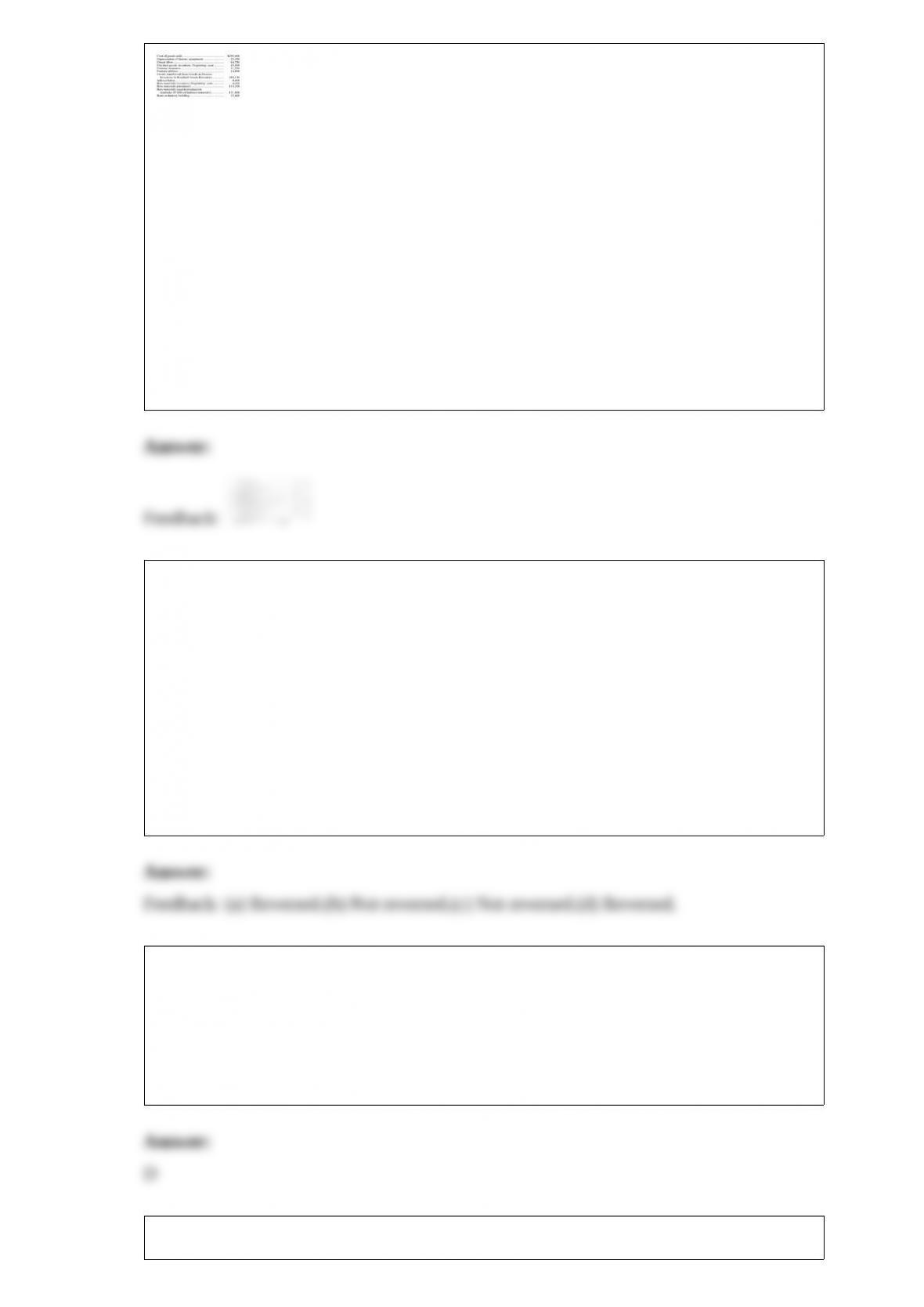
Millennium Corporation uses a predetermined overhead rate of 150% of direct labor
cost. Prepare journal entries for the following transactions and events:
(a) Purchase of raw materials on account.
(b) Assignment of materials costs to Goods in Process Inventory and Factory Overhead.
(c) Payment of Factory Payroll in cash.
(d) Assignment of Factory Payroll to Goods in Process Inventory and Factory
Overhead.
(e) Recording of other factory overhead. Assume that all items other than depreciation
are paid in cash.
(f) Assignment of Factory Overhead to Goods in Process Inventory.
(g) Transfer of goods completed to Finished Goods Inventory.
(h) Recording cost of goods sold.
(i) Assignment of over- or underapplied overhead to Cost of Goods Sold.
37) The following information has been gathered for Stylish Co. to assist in preparing
its year-end adjusting entries at December 31:
(a) The company has earned $2,500 of rental revenue that has not yet been received or
recorded.
(b) Stylish has recorded $3,200 of unearned service fees. At year-end, $1,500 of this
amount has been earned.
(c) Depreciation on equipment for the year is $7,800.
(d) Employees have earned but have not yet been paid $2,750 in salaries.
Identify which of the above accounting adjustment would be reversed assuming Stylish
Co. uses reversing entries.
38) A direct cost is a cost that is:
A.Identifiable as controllable
B.Variable with respect to the volume of activity
C.Fixed with respect to the volume of activity
D.Traceable to a cost object
E.Sunk with respect to a cost object
39) A company paid $37,800 plus a broker’s fee of $525 to acquire 8% bonds with a

$40,000 maturity value. The company intends to hold the bonds to maturity. The cash
proceeds the company will receive when the bonds mature equal:
A.$37,800
B.$38,325
C.$40,000
D.$40,525
E.$43,200
40) On August 9, Pierce Company receives a $8,500, 90-day, 8% note from customer
Eric Simms as payment on his account. Compute the amount due at maturity for the
note.
A.$8,628
B.$8,192
C.$8,613
D.$8,500
E.$8,670
41) A company’s sales in Year 1 were $250,000 and in Year 2 were $287,500. Using
Year 1 as the base year, the sales trend percent for Year 2 is:
A.87%
B.100%
C.115%
D.15%
E.13%
42) Selected information from the budget of the Khalid Corp. at the beginning of the
year follows:
Calculate the predetermined overhead allocation rate if the company uses the following
as a basis:
(a) Direct labor hours.
(b) Direct labor cost.
(c) Machine hours.
43) Belgrade Lakes Properties is developing a golf course subdivision that includes 225
home lots; 100 lots are golf course lots and will sell for $95,000 each; 125 are street
frontage lots and will sell for $65,000. The developer acquired the land for $1,800,000
and spent another $1,400,000 on street and utilities improvement. Compute the amount
of joint cost to be allocated to the street frontage lots using value basis.
A.$1,724,800
B.$1,777,920
C.$2,018,920
D.$1,422,080
E.$1,475,200
44) Wiffery Company had the following trading securities in its portfolio at December
31. The Fair Value Adjustment – Trading account had a balance of zero prior to year-end
adjustment. Prepare the appropriate adjusting journal entry.
45) Explain the preparation of journal entries to record the issuance of par value, stated
value, and no-par value common stock.
46) The treasurer of a company is responsible for cash management. List five cash
management principles that are essential for effective cash management.
47) A company sends a $1,500 bill to a customer for delivery services rendered. Set up
the necessary T-accounts below and show how this transaction would be recorded
directly in those accounts.
48) A company reported net income of $478,000 and paid $5,500 in preferred cash
dividends during the current year. The company had 100,000 common shares issued,
and 10,000 common shares in treasury during the year. The year-end market price per
common share was $43.05. Calculate the company’s price-earnings ratio.
49) Investments in equity securities where the investor has a significant, but not
controlling influence, are accounted for using the _______________ method.
50) Information for Reedy Manufacturing is presented below. Compute both the cost of
goods manufactured and the cost of goods sold for Reedy Manufacturing.
