
Activity-based management can reduce customer response time by all of the following,
except for
A.identifying those activities that consume the most resources.
B.making activities more efficient.
C.identifying non-value added activities.
D.identifying fraudulent activities.
Audits that compare the estimates made in the capital budgeting process with the actual
results
A.identify what estimates were wrong.
B.can serve as the basis to identify and reward good planners.
C.create an environment in which planners will not be tempted to inflate their estimates
of the benefits associated with the project to get it approved.
D.all of the above.
Which of the following is an example of non-value added activities?
A.Storage.
B.Moving items.
C.Waiting for work.
D.All of the answers are correct.
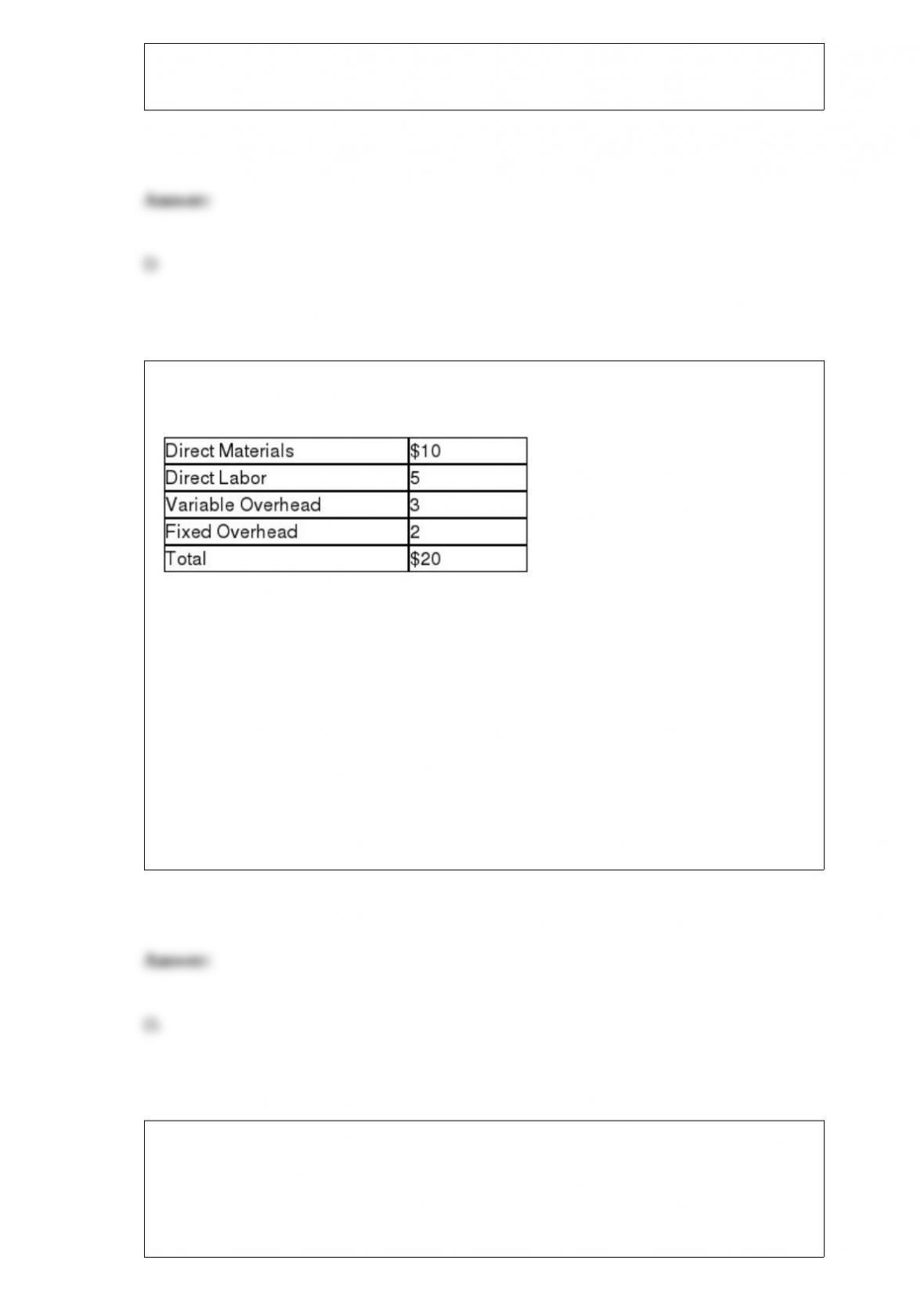
Kandy Corporation sells a product for $25 per unit and has the following costs for the
product
Kandy received a special order for 100 units of the product. The order would require
rental of a special tool which costs $200. What is the minimum price per unit the
company should charge for this special order if they wish to earn a $600 profit? Assume
Kandy is currently producing and selling at maximum capacity.
A.$23
B.$24
C.$26
D.$28
Doug’s Delivery Company
Doug’s Delivery Company reports the following information for 2010:
Actual:
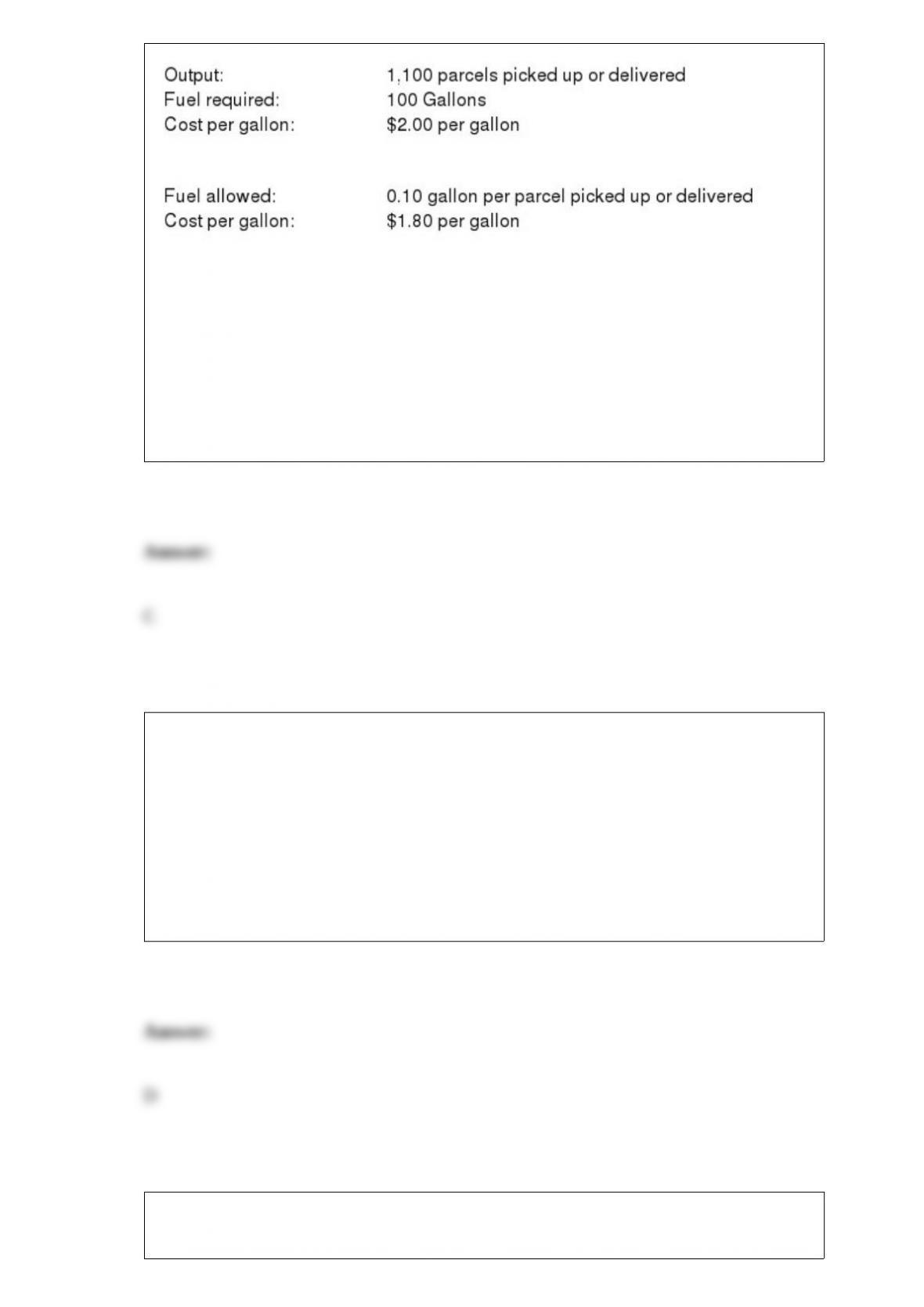
Standard:
Refer to Doug’s Delivery Company. What is the actual fuel cost for March 2010?
A.$240.00
B.$220.00
C.$200.00
D.$180.00
Which of the following are true regarding activity-based costing (ABC)?
A.ABC deals with learning about the cost of activities.
B.ABC rests on the premise that products require activities.
C.ABC rests on the premise that activities consume resources.
D.All of the answers are correct.
In calculating return on investment (ROI), the use of book values of assets€particularly
fixed assets€in the ROI denominator

A.is the preferable method.
B.may cause a manager of a division with fully depreciated assets to be reluctant to
replace the assets with more costly assets.
C.is required by generally accepted accounting principles.
D.may cause a manager of a division with fully depreciated assets to replace the assets
with newer, more efficient, but more costly assets.
How is cost, as used in managerial accounting, distinguished from expense, as used in
financial accounting?
A.A cost is a sacrifice of resources and expenses are recorded in accounting records, but
not all costs appear in accounting records.
B.All expenses are costs, but not all costs are expenses in the period of incurrence, even
though they will become expenses in some later period.
C.Managerial accounting deals primarily with costs, not expenses, while financial
accounting primarily deals with expenses for financial reporting as defined by generally
accepted accounting principles.
D.All of the answers are correct.
All of the following correctly describe accounting information used for managerial
purposes except:
A.Most managerial decisions require more detailed data than external financial reports

provide.
B.Managers must use the same accounting data for their decision making, planning, and
other managerial activities as they present in tax returns and financial statements.
C.€One size fits all€ does not apply to accounting information used for managerial
accounting purposes.
D.Many companies develop managerial accounting information systems independent of
financial accounting information systems.
Which of the following is the most prominent American award given for total quality
management?
A.ISO 9000 certification.
B.The Deming Prize.
C.The Baldrige Award.
D.The AQM Prize.
Marlow Company
The following information pertains to the three divisions of Marlow Company:
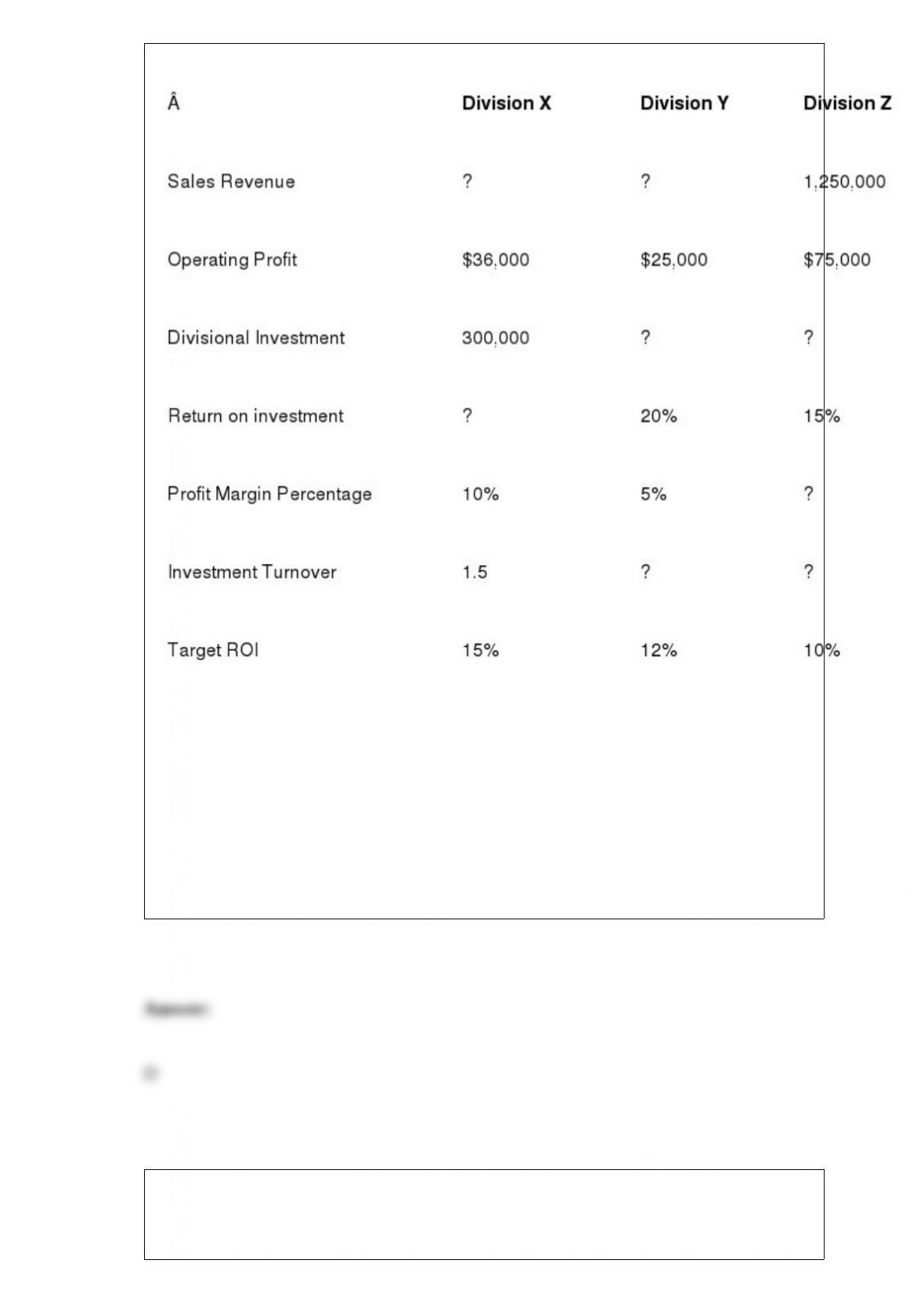
Refer to Marlow Company. What is the profit margin percentage for Division Z?
A.1.5%
B.100.0%
C.15.0%
D.6.0%
Which of the following is the major assumption as to cost and revenue behavior
underlying conventional cost-volume-profit calculations?

A.variability of fixed costs.
B.variability of unit prices and efficiency.
C.curvilinearity of relationships.
D.linearity of relationships.
Examples of value-added activities include all of the following except:
A.Assembly activities.
B.Machinery set-up activities.
C.The establishment of efficient distribution channels.
D.Product design.
Which of the following is not a control that can be instituted to prevent financial fraud?
A.Separate duties
B.Encourage collusion
C.Internal audits
D.Independent audits

The objective of the theory of constraints is to increase throughput contribution (sales
dollars minus direct materials costs), minimize investments, and manage production by
A.letting the bottleneck set the pace for the rest of operations.
B.hiring more direct labor.
C.increasing distribution channels.
D.increasing production facilities.
To analyze variances, the variable cost variance model is applied to the calculation of
which of the following?
A.Direct materials variances.
B.Direct labor variances.
C.Variable manufacturing overhead price and efficiency variances.
D.All of the above.

In recording costs by departments, the accounting system has served its functions of
providing data for department performance evaluation, and also assigns costs to
products for managerial decision making, such as
A.evaluating a product’s quality.
B.evaluating a product’s profitability.
C.evaluating a product’s integrity.
D.evaluating a product’s effectiveness.
The nursing station on the fourth floor of Columbia Hospital for Women is responsible
for the care of patients who have just given birth. The costs of drugs administered by
the nurses to patients would be classified as
A.direct costs.
B.indirect costs.
C.overhead costs.
D.period costs.
Which of the following is considered to be fraudulent financial reporting?
A.intentional conduct resulting in materially misleading financial statements.
B.embezzlement or theft of assets.

C.unintentional errors in preparing financial statements.
D.None of the answers is correct.