
Ending merchandise inventory for LIFO will be the same dollar amount under a
periodic inventory system as under a perpetual inventory system.
Mineral deposits are subject to a process called depletion.
Trading securities are valued on the balance sheet at market value.
It is possible for horizontal analysis to indicate an increase in revenues from one year to
another and a decrease in net income.
The effective interest method produces a constant dollar amount of bond interest
expense to be reported each interest period.

A debit to Accumulated Depreciation will increase the carrying value of an asset.
The heading for a balance sheet might include the line “For the Month Ended
December 31, 20–.”
The adjusting entries involving Rent Receivable and Salaries Payable could be
reversed.
Dividends in arrears on cumulative preferred stock are not paid until after dividends are
paid on common stock.

The double-entry system is possible because all business transactions have at least two
equal and opposite aspects.
Net income can be used to assess a company’s progress in meeting the goal of
profitability.
A trial balance is normally prepared at the end of each business day.
Purchase requests and purchase orders are economic events, and as such they affect a
company’s financial position, and are recognized in the accounting records.
Following a lenient credit-granting policy will probably result in fewer defaults by
customers.

If the partnership agreement does not describe the method of income and loss
distribution, the partners must share income and losses equally.
The quality of earnings refers to the substance of earnings and their sustainability into
future periods.
The book value of one share of callable preferred stock is equal to the call value of the
preferred share minus any dividends in arrears.
If a partnership agreement does not specify how income and losses are to be distributed,
the partners share them equally.

Asset turnover measures how efficiently assets are used to produce revenues.
The interest coverage ratio and the debt to equity ratio are measures of profitability.
Driveways and parking lots are properly included in the Land account because they are
not subject to depreciation.
The present value of a bond is always less than the face value of the bond.
A discounted note represents a contingent liability to the original holder.

Treasury stock usually is recorded at cost when purchased.
An advantage of the partnership form of business is that the life of the partnership is
limited.
When salary and interest allocations exceed net income, a net loss has occurred.
In computing book value per share of common stock, common stock distributable is
included in the divisor.

A retail operation would not have to take a physical inventory if it uses a perpetual
inventory system.
The primary purpose of an expense is to generate revenue.
When earnings from the investment exceed the interest payments on an investment,
negative financial leverage has occurred.
When the dividends yield is relatively low, investors must expect some of their return to
come from increases in the price of the shares.

If liquidation of a partnership results in a negative balance in a partner’s account, the
partner must pay into the partnership the amount of the negative balance.
The market interest rate is the rate that an issuer of bonds actually will have to bear and
that an investor (purchaser) actually will earn over the bond’s life.
The par value of stock is an arbitrary amount assigned to each share of stock.
The choice of accounting methods does not affect cash flows except for possible
differences in income taxes.
Creditors’ equities is another term for liabilities.

If a company uses LIFO for tax purposes, it need not use LIFO for financial reporting
purposes.
When bonds are purchased between interest dates, the buyer must pay (in addition to
the bonds’ cost) the amount of interest that has accrued since the last interest payment
date.
The lower the current ratio, the more likely the company will be able to meet its
liabilities.
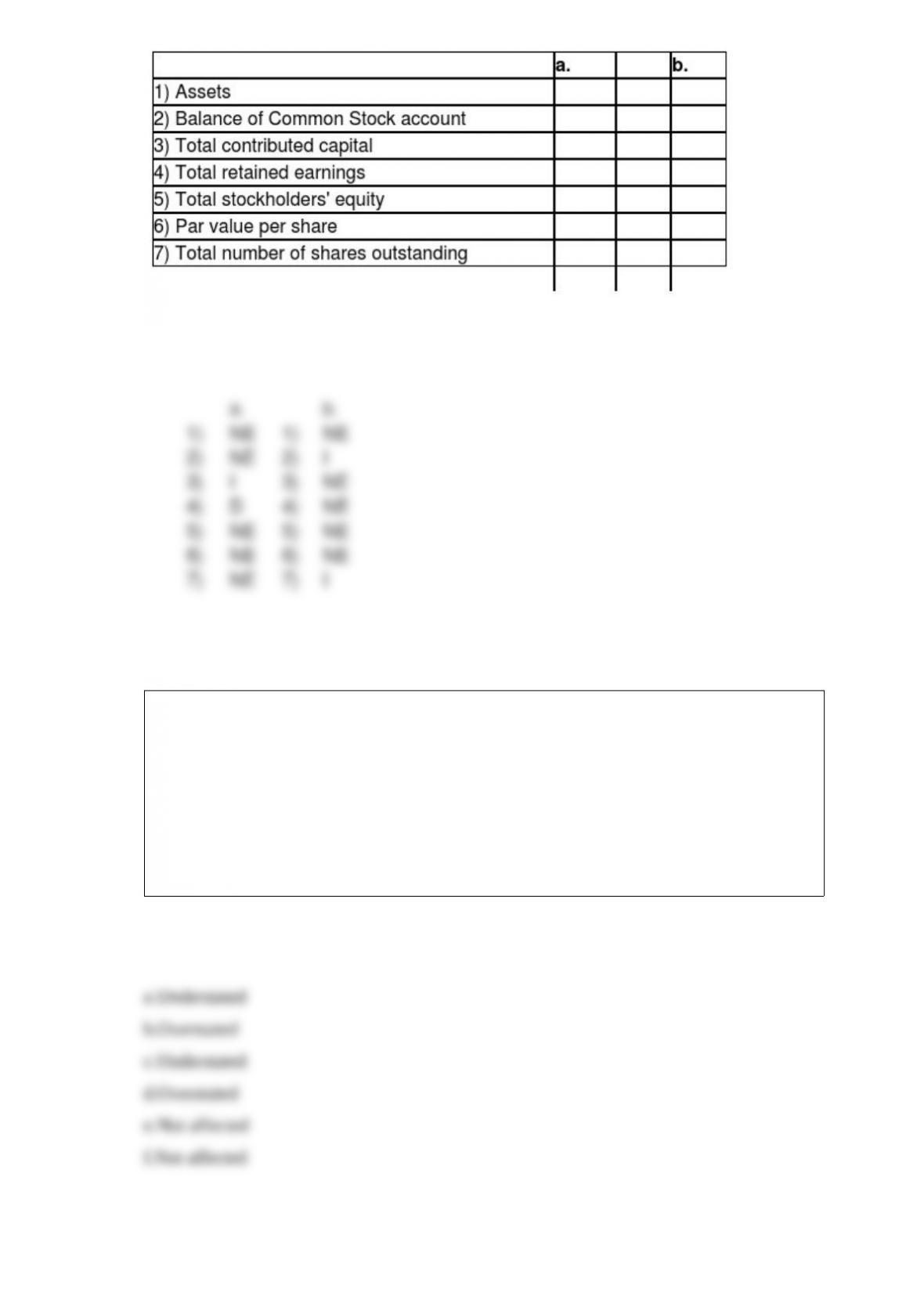
a. Indicate on the blanks below the effect (I = increase, D = decrease, NE = no effect) of
the entry to record the declaration of a common stock dividend on each of the items
listed.
b. Indicate on the blanks below the effect (I = increase, D = decrease, NE = no effect) of
the entry to record the distribution of a (previously declared and recorded) common
stock dividend on each of the items listed.
For each of the following oversights, state whether total assets will be understated,
overstated, or not affected.
______ a.Failure to record revenue earned but not yet received
______ b.Failure to record expired rent
______ c.Failure to record accrued interest in the bank
______ d.Failure to record depreciation
______ e.Failure to record accrued wages
______ f.Failure to convert unearned revenue to earned revenue
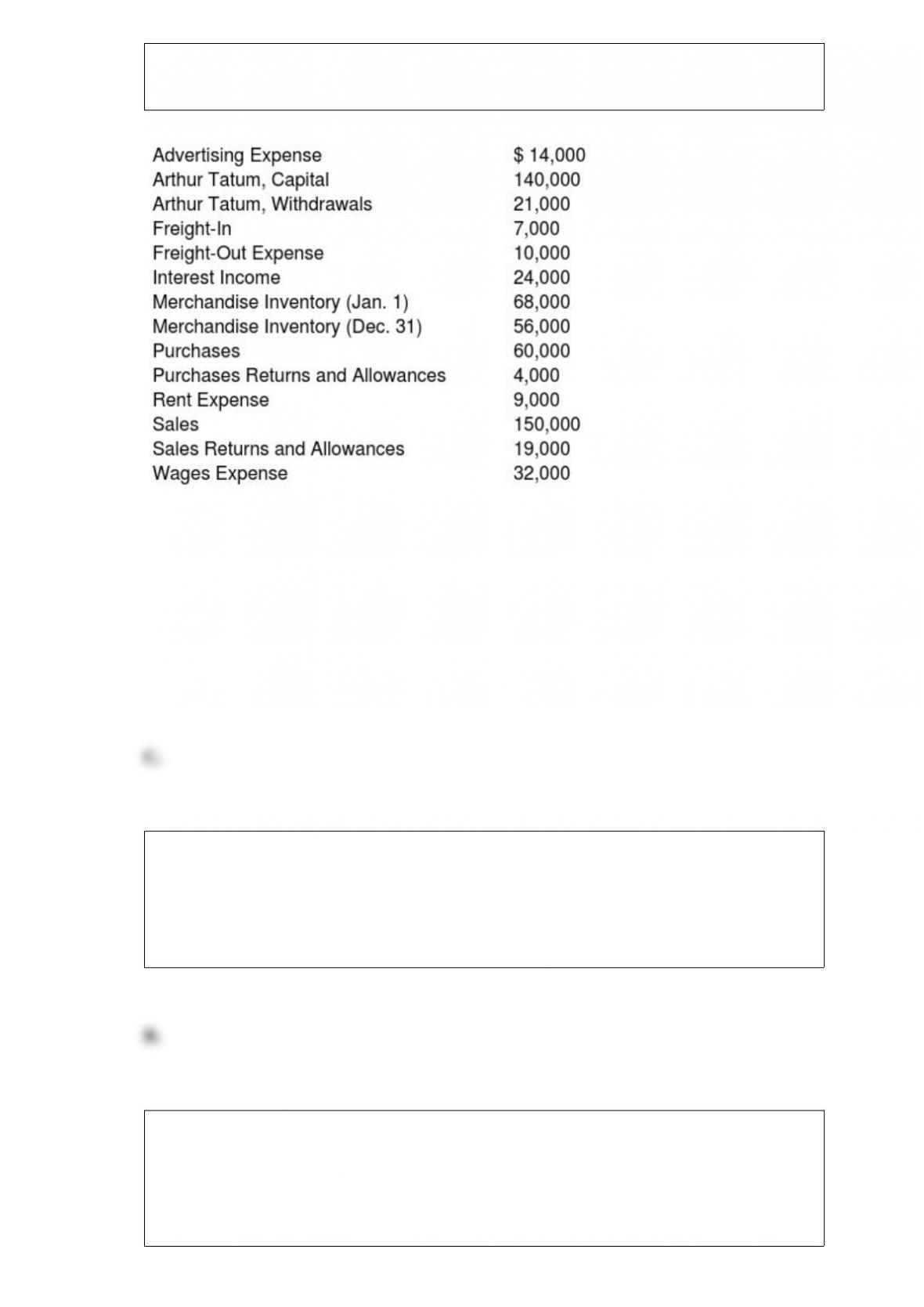
Use this information to answer the following question.
The selected accounts and balances for Keystone Market appear as follows:
Cost of goods available for sale would appear on the income statement as
A. $124,000.
B. $71,000.
C. $131,000.
D. $61,000.
Free cash flow is
A. a financial ratio.
B. an important measure of a company’s ability to finance long-term assets.
C. what remains after deducting dividends declared from net income.
D. an important measure of a company’s ability to invest in short-term assets.
Goodwill would appear in which balance sheet section?
A. Investments
B. Property, plant, and equipment
C. Current assets
D. Intangible assets
Zach has bought Biannca’s interest in the A&B Partnership for a $120,000 direct
payment to Biannca. Zach and Biannca’s capital balances before the sale were $48,000
and $72,000, respectively. The entry to record the purchase of interest in partnership is:
Which of the following bank reconciliation items would not result in a journal entry?
A. Service charge
B. NSF check of a customer
C. Collection of a note by the bank
D. Deposits in transit
On June 3, Addison Company purchased merchandise worth $1,600 on credit, terms
2/10, n/30. The account was paid on June 10. What is the required journal entry to
record the payment under the periodic inventory system?
A. Accounts Payable 1,568
Purchases Discounts 32
Cash 1,600
B. Accounts Payable 1,600
Purchases Discounts 32
Cash 1,568
C. Cash 1,568
Purchases Discounts 32
Accounts Payable 1,600
D. Cash 1,600
Applying the lower-of-cost-or-market rule follows which of the following accounting
conventions?
A. Full disclosure
B. Matching
C. Materiality
D. Conservatism
Assuming that the current ratio was 1.6 times and the quick ratio was 1.4 times before
this transaction, the entry to record the payment of a previously declared and recorded
cash dividend will
A. increase the current ratio and the quick ratio.
B. decrease the current ratio and the quick ratio.
C. increase the current ratio but have no effect on the quick ratio.
D. have no effect on the current ratio or the quick ratio.
Which of the following is not classified properly as property, plant, and equipment?
A. Land improvements, such as parking lots and fences
B. Natural resources
C. Land used in ordinary business operations
D. A truck held for resale by an automobile dealership

Total partners’ equity will not change when a withdrawing partner
A. withdraws assets equal to his or her capital balance
B. withdraws assets amounting to less than his or her capital balance
C. sells his or her interest to a new or remaining partner
D. withdraws assets amounting to greater than his or her capital balance
Legal capital is a descriptive phrase for
A. stockholders’ equity.
B. residual equity.
C. market value.
D. par value.
A revenue expenditure results in a
A. debit to an expense account.
B. credit to an expense account.
C. debit to an asset account.
D. credit to an asset account.
An NSF check should appear in which section of the bank reconciliation?
A. Deductions from the balance per books
B. Deductions from the balance per bank
C. Additions to the balance per books
D. Additions to the balance per bank
An amount would not appear opposite the Withdrawals account in which of the
following work sheet columns?
A. Trial Balance

B. Income Statement
C. Balance Sheet
D. Adjusted Trial Balance
Gomez Company purchases a piece of equipment on Jan. 2, 2014, for $30,000. The
equipment has an estimated life of eight years or 50,000 units of production and an
estimated residual value of $3,000. Lester uses a calendar fiscal year. The entry to
record the amount of depreciation for 2014, using the straight-line method, is
A. debit to Depreciation Expense, 3,750; credit to Cash, 3,750
B. debit to Depreciation Expense, 3,375; credit to Accumulated Depreciation, 3,375
C. debit to Depreciation Expense, 2,500; credit to Accumulated Depreciation, 2,500
D. debit to Accumulated Depreciation, 2,250; credit to Cash, 2,250
In a trend analysis, an index number of 139 for 20×5 sales indicates that
A. sales for 20×5 were 139 percent higher than sales for the same company in the base
year.
B. sales for 20×5 for this company were 139 percent of the sales figure of another
company being used in the comparison.
C. sales for 20×5 were 139 percent of the sales for the same company in the base year.
D. actual sales for 20×5 exceeded budgeted sales for 20×5 by 39 percent.
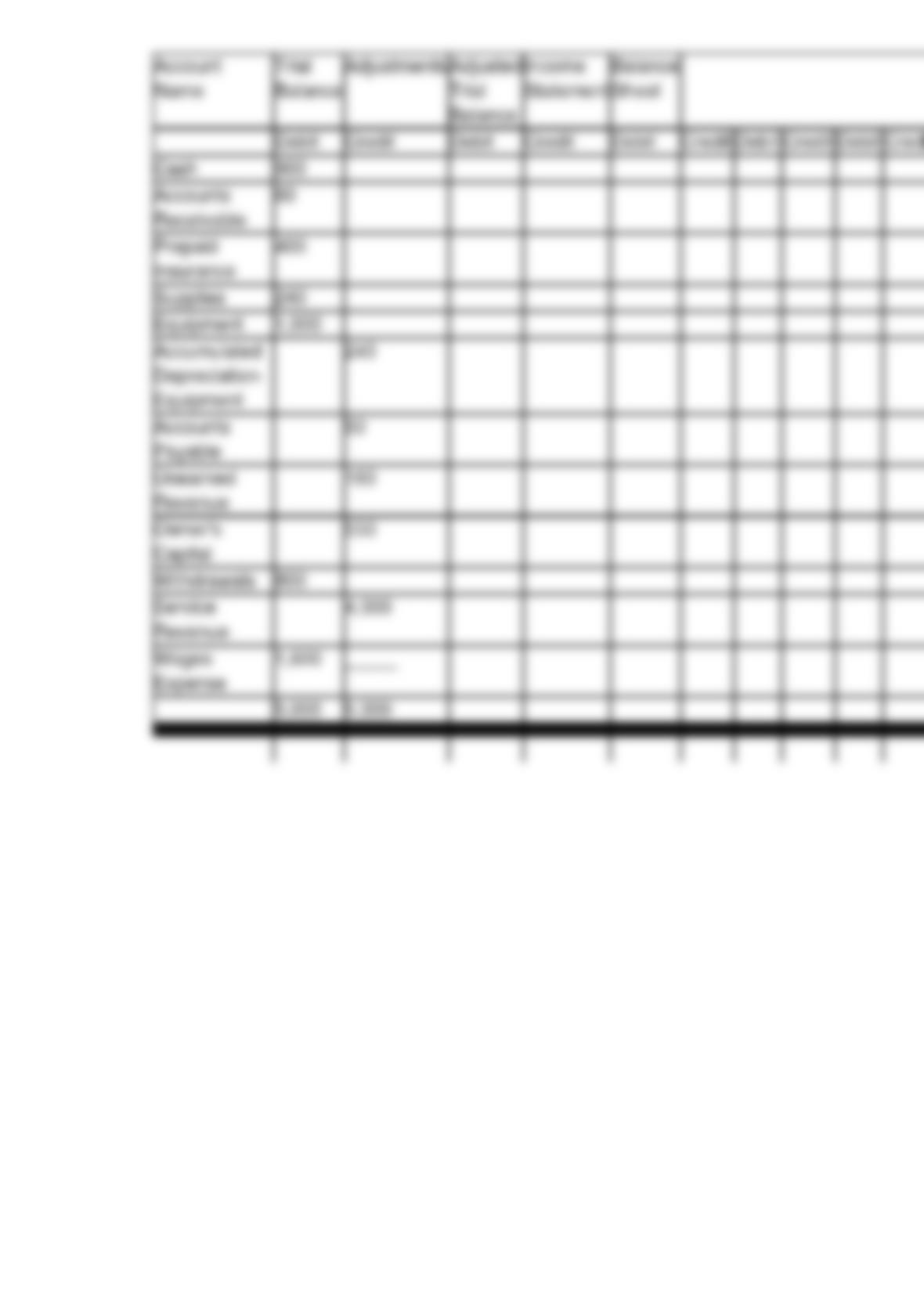
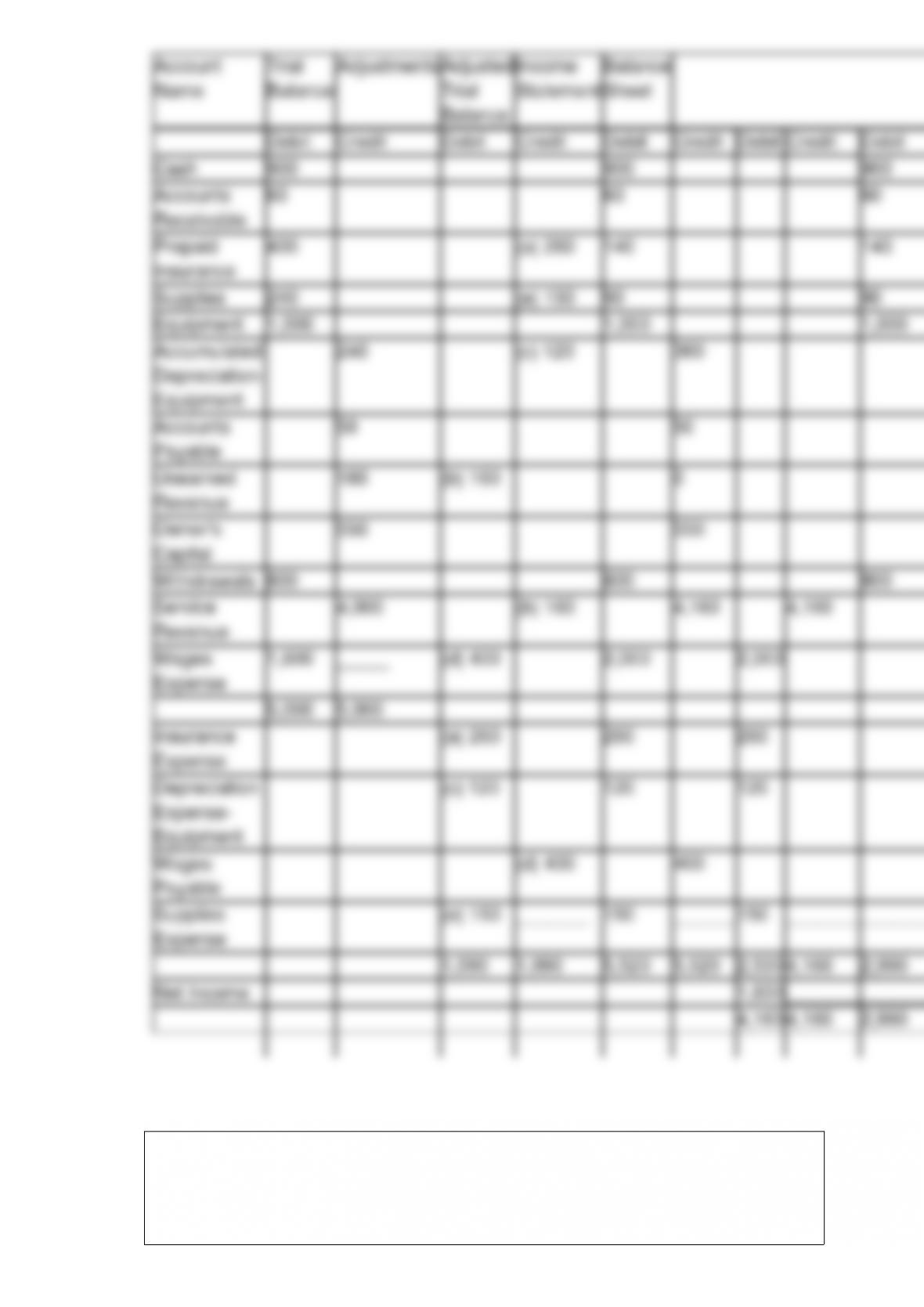
Using the following information and the trial balance accounts and balances in the work
sheet provided, complete the work sheet.
a. Expired insurance totals $260.
b. Of the unearned revenue, all has been earned by the balance sheet date.
c. Estimated depreciation of equipment is $120.
d. Accrued wages equal $400.
e. Unused supplies on hand are $90.
A general rule in choosing among alternative investments is the greater the risk taken,
the
A. greater the return required.
B. lower the potential expected.

C. greater the price of the investment.
D. lower the profits expected.
If Year 1 equals $2,800, Year 2 equals $3,108, and Year 3 equals $3,668, the index
number to be assigned for Year 3 in trend analysis, assuming that Year 1 is the base
year, is
A. 100.
B. 141.
C. 131.
D. 136.
If creditors’ payment terms are 60 days, financing period is 20 days, and it takes 30
days to collect the amount from customers. What time does it take to sell the inventory?
A. 60 days.
B. 20 days.
C. 30 days.
D. 50 days.
An American company makes a credit sale of goods to a company in London for 20,000
British pounds. On the date of sale, the exchange rate was $1.60 per pound. However,
on the date payment was received, the exchange rate had risen to $1.70 per pound. As a
result, the American company would record
A. an exchange gain of $2,000.
B. an exchange loss of $200.
C. an exchange loss of $2,000.
D. no exchange gain or loss.

Cost of goods sold equals $250,000, and average inventory equals $100,000. Days’
inventory on hand equals
A. 91.3 days.
B. 146.0 days.
C. 821.9 days.
D. 912.5 days.
Plum Corporation issues $400,000 of 7 percent, five-year bonds on January 1, 20×5,
and sells them on the same date for their face value. The bond indenture states that
interest is to be paid on January 1 and July 1 of each year. The entry to record the
issuance includes
A. a credit to Cash.
B. a credit to Bonds Payable.
C. a credit to Interest Expense.
D. All of these choices.
The return on assets and the asset turnover ratios are used to analyze
A. leverage.
B. long-term solvency.
C. profitability.
D. liquidity.
Quality Heating Company has the following liabilities at year end:
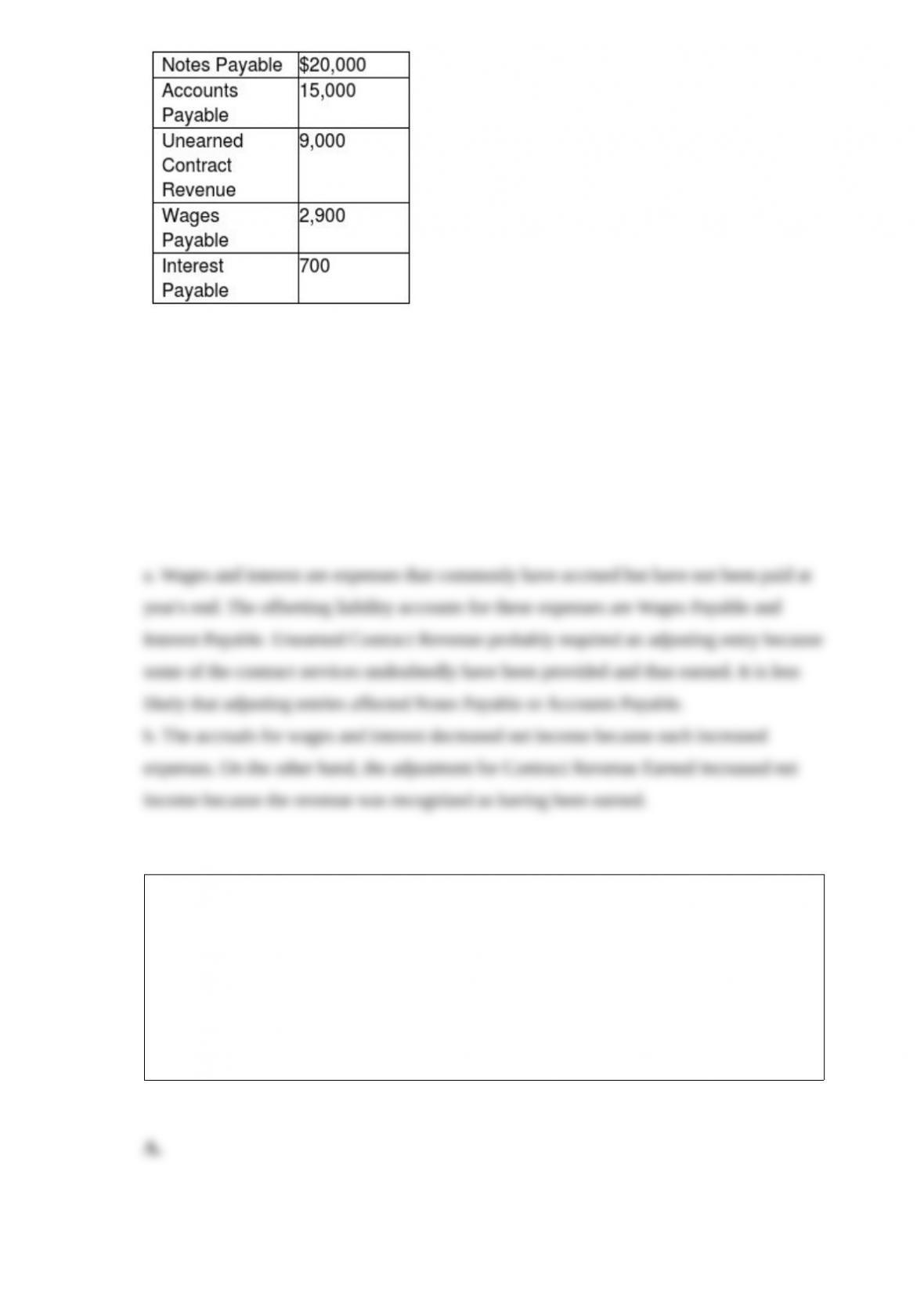
a. Which of these accounts probably was/were created at the end of the fiscal year as a
result of an accrual? Which probably was/were adjusted at year end? Explain your answer.
b. Which adjustments probably reduced net income? Which probably increased net
income? Explain your answers.
Assume the direct method is used to compute net cash flows from operating activities.
For this item extracted from the financial statements—Decrease in Accrued Liabilities
—indicate the effect on cash payments for operating expenses by choosing one of the
following:
A. Add to operating expenses to arrive at cash payments for operating expenses.
B. Subtract from operating expenses to arrive at cash payments for operating expenses.
C. Not used to adjust operating expenses to arrive ay cash payments for operating
expenses.
A merchandiser will earn an operating income of exactly $0 when
A. gross margin equals operating expenses.
B. net sales equals cost of goods sold.
C. cost of goods sold equals gross margin.
D. operating expenses equal net sales
Which of the following categories of investments can be both debt and equity
securities?
A. Available-for-sale securities
B. Trading securities
C. Held-to-maturity securities
D. Both available-for-sale and trading securities
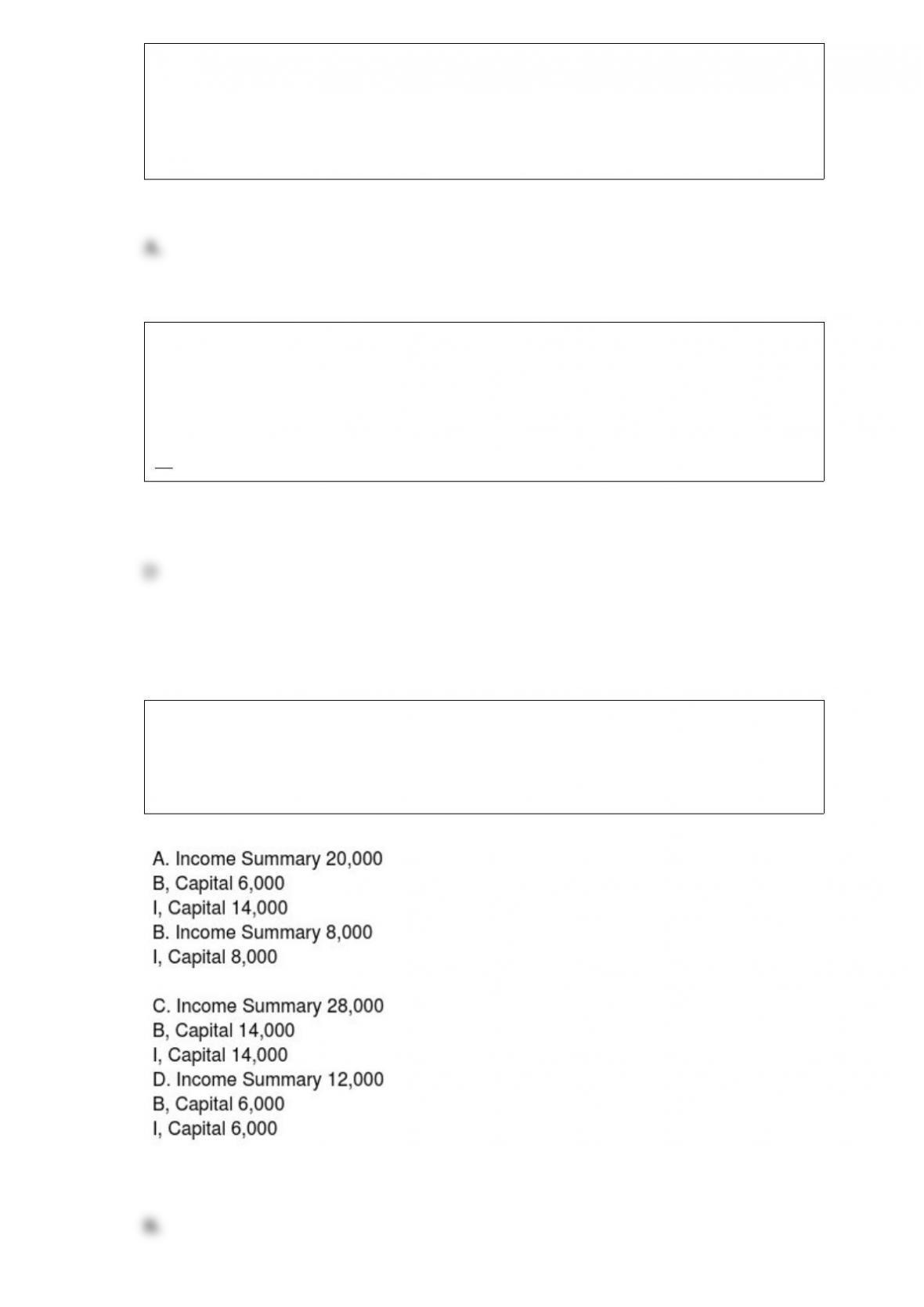
Partners K and R receive an interest allowance of $20,000 and $30,000, respectively,
and divide the remaining profits and losses in a 3:1 ratio. If the company sustained a net
loss of $22,000 during the year, the entry to close the income or loss into their capital
accounts is:
Which costing method will produce different results under perpetual and periodic
systems?
A. Specific identification
B. Average-cost
C. FIFO
D. Both FIFO and specific identification
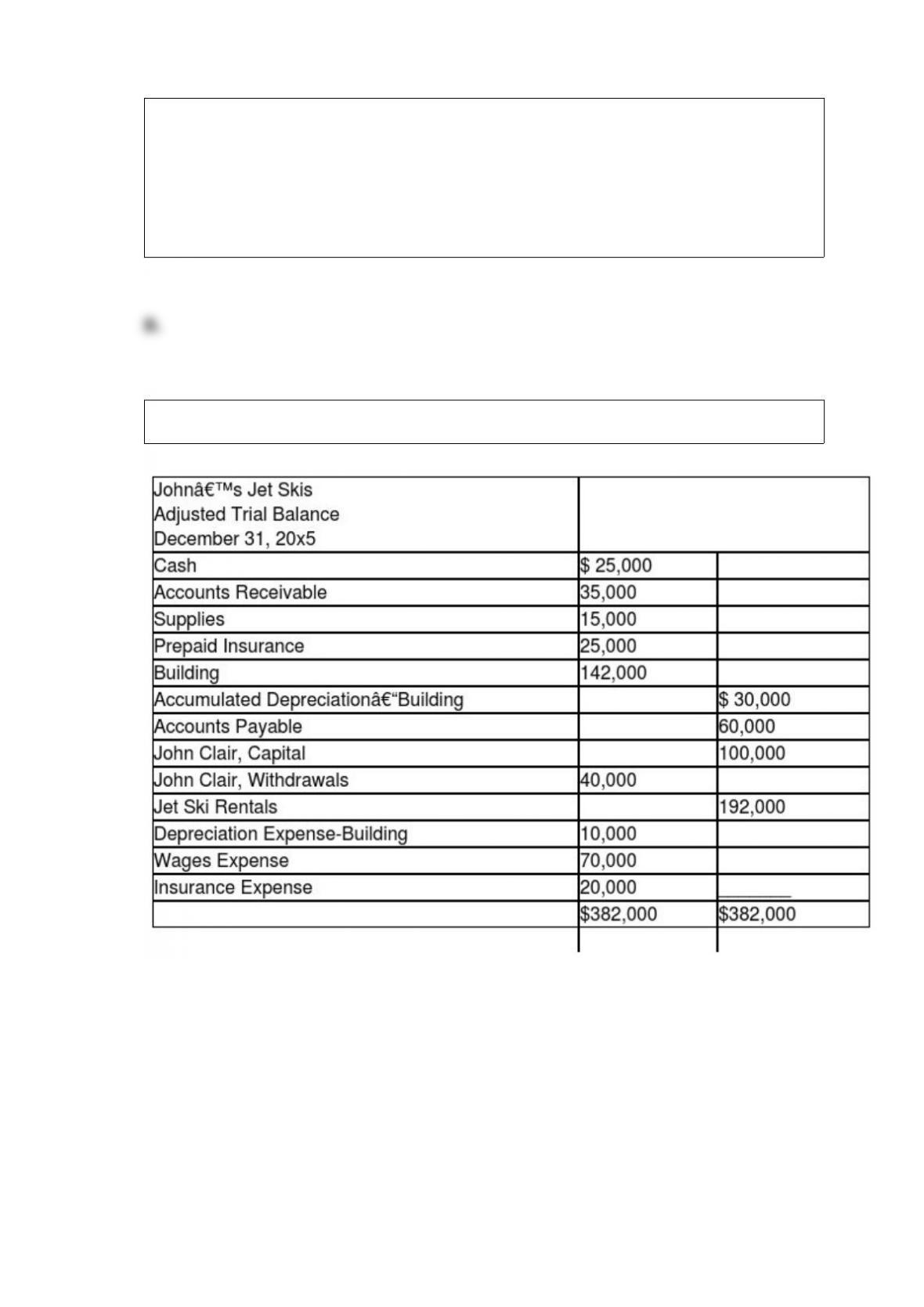
Use the following adjusted trial balance to answer the question below.
The entry to close Income Summary is
A. Income Summary 92,000
John Clair, Capital 92,000
B. John Clair, Withdrawal 142,000
Income Summary 142,000
C. John Clair, Capital 182,000
Income Summary 182,000
D. John Clair, Capital 92,000