1) Consider the following transactions:
1> Pay employees salaries.
2> Repay borrowing to the bank.
3> Purchase equipment with note payable.
4> Provide services to customers on account.
5> Pay dividends to stockholders.
6> Collect cash from customers for services provided.
7> Purchase supplies on account.
8> Pay for supplies purchased in transaction 7 above.
For each transaction, indicate the type of cash flow involved based on the
classifications in the statement of cash flows. If a transaction does not involve cash,
write No Cash.
2) Explain the difference between vertical and horizontal analysis.
3) A company had the following transactions during the year:
1> Paid rent for the next two years, $8,000.
2> Purchased office supplies on account, $2,400.
3> Purchased equipment, paying $12,000 cash and issuing a note payable for $4,000.
4> Borrowed from the bank, $6,000.
5> Paid employee salaries, $7,200.
6> Paid $2,000 on account related to transaction 2 above.
7> Paid dividends to stockholders, $2,800.
8> Sold land for $10,000 that was purchased in a prior year for $7,500.
9> Collected cash from customers for services provided, $25,700.
Calculate cash flows from operating activities, investing activities, and financing
activities.
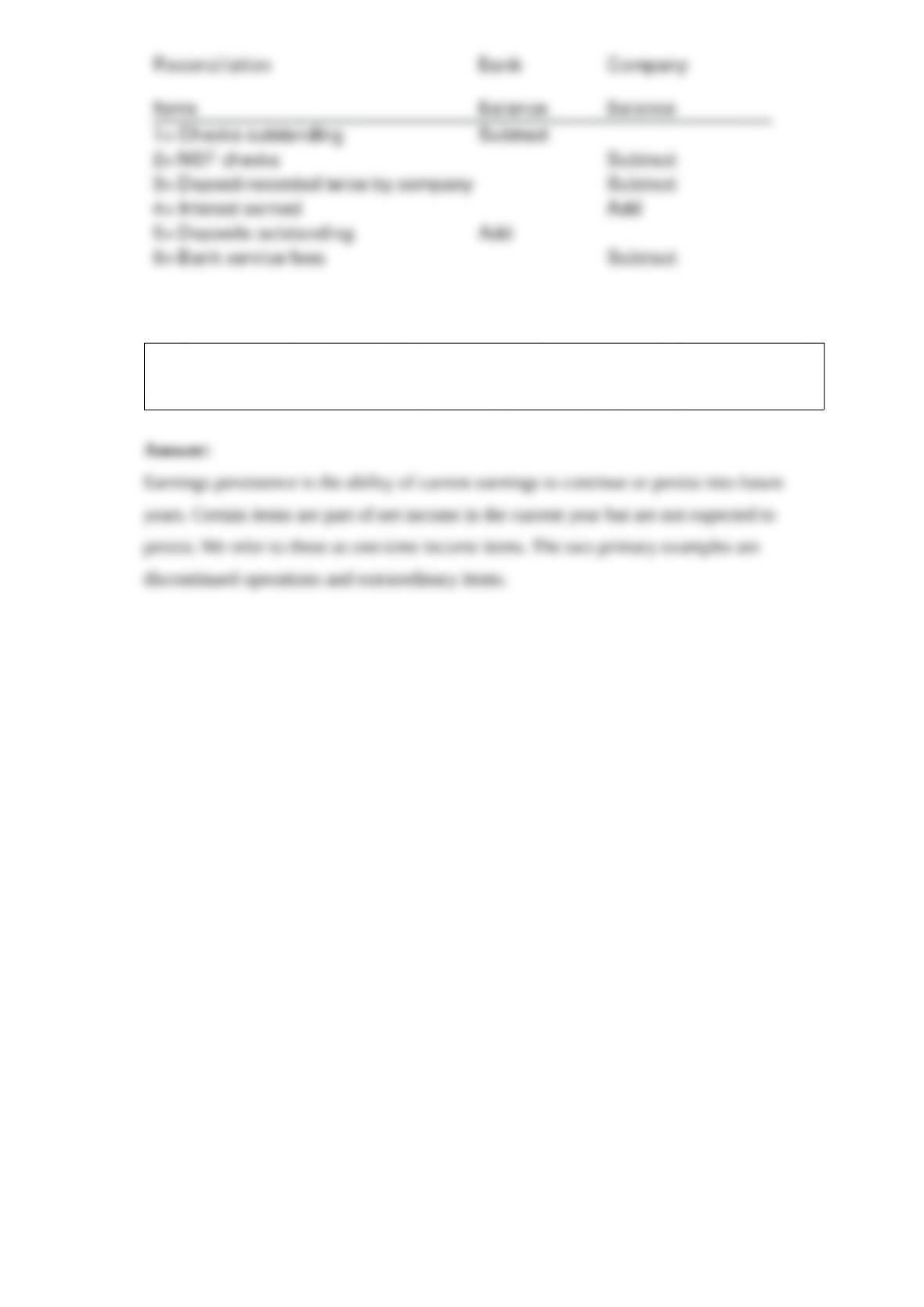
4) Indicate whether the firm should add or subtract each item below from its balance of
cash or the banks balance of cash in preparing a bank reconciliation.
5) Define earnings persistence. How does earnings persistence relate to the reporting of
discontinued operations and extraordinary items?