
The amount of uncollectible accounts at the end of the year is estimated to be $25,000,
using the aging of accounts receivable method. The balance in the Allowance of
Doubtful Accounts account is an $8,000 credit before adjustment. What should the
account balance in the Allowance for Doubtful Accounts be after adjustment?
A. $8,000.
B. $17,000.
C. $25,000.
D. $33,000.
Answer:
Your company wrote off $350 in accounts receivable two months ago when a customer
went bankrupt. That customer reorganizes and now pays the $350. Your company
should:
A. debit Bad Debt Expense and credit Cash.
B. debit Accounts Receivable and credit Bad Debt Expense and then debit Cash and
credit Allowance for Doubtful Accounts.
C. debit Cash and credit Accounts Receivable.
D. debit Accounts Receivable and credit Allowance for Doubtful Accounts and then
debit Cash and credit Accounts Receivable.
Answer:
For the current year, the first year of operations, a company sold $100,000 of goods to
customers and received $90,000 in cash from customers. The remainder is owed to the
company at the end of the year. The company incurred $70,000 in expenses for the year
and paid $65,000 of these in cash. The remainder is owed by the company at the end of
the year. Based on this information, what is the amount of net income for the year?
A. $25,000
B. $35,000
C. $20,000
D. $30,000
Answer:
A company reported net income of $5.6 million. At the beginning of the year, 3.4
million shares of common stock were outstanding and at the end of the year, 3.6 million
shares were outstanding. No dividends were declared. The EPS is approximately:
A. $1.60.
B. $1.56.
C. $1.65.
D. $1.40.
Answer:
The primary objective of external financial reporting is:
A. to enhance the ability of the company to acquire financial capital from external
sources.
B. to accurately provide financial results for tax purposes.
C. to comply with external regulations and requirements of government and
professional associations.
D. to provide useful information to decision makers, especially investors and creditors.
Answer:
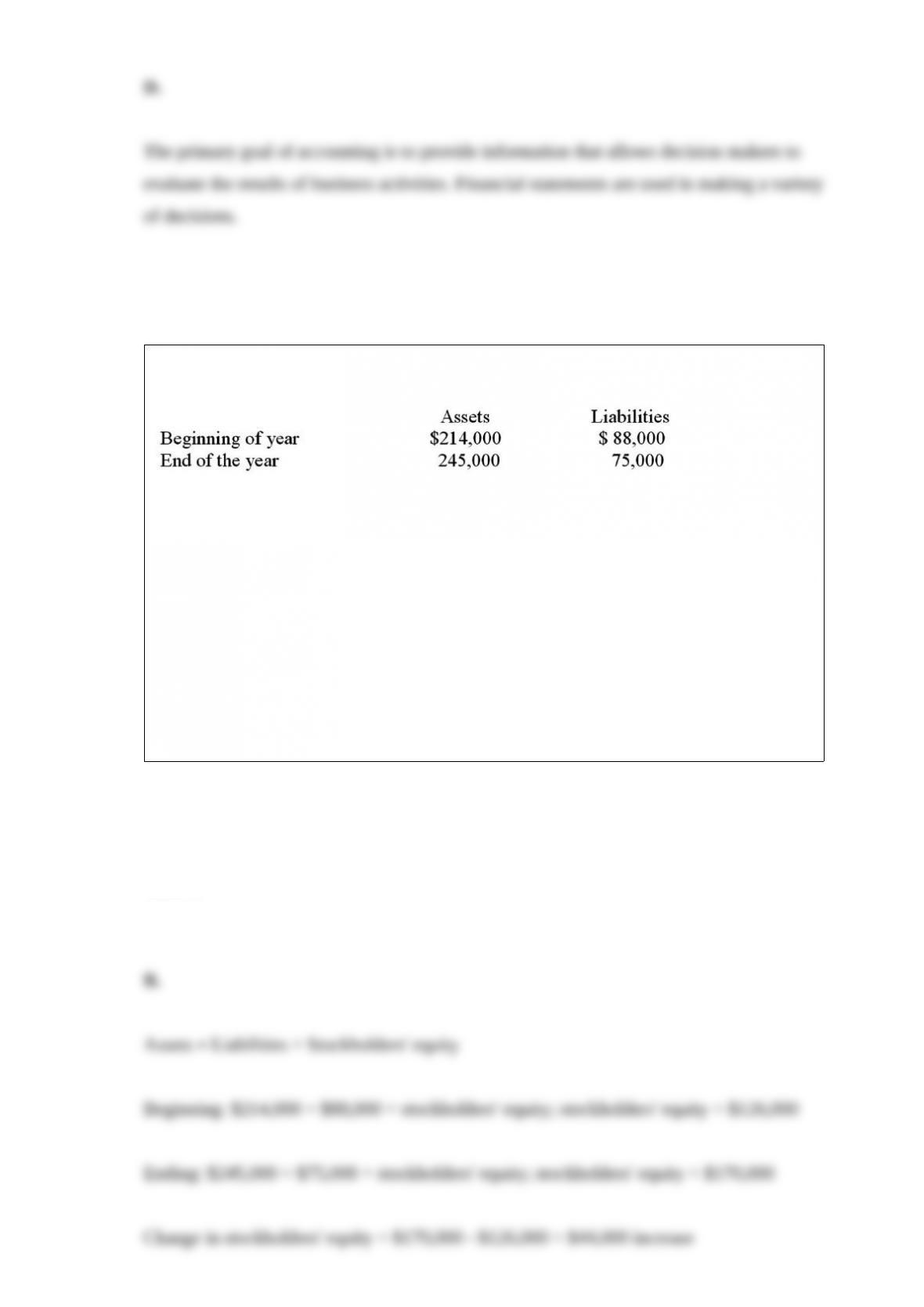
A company had the following assets and liabilities at the beginning and end of the
current year:
Stock was issued for $15,000 cash and dividends of $5,000 were paid during the year.
What is the amount of net income for the year?
A. $44,000
B. $34,000
C. $24,000
D. $54,000
Answer:
Purrfect Pets had a beginning balance in its retained earnings account of $385,600.
During the year, the company declared and paid a $4,700 dividend, and at the end of the
year, it reported retained earnings of $399,860. The company’s net income for the year
was:
A. $14,260.
B. $18,960.
C. $9,560.
D. $0.
Answer:
Which of the following is not a purpose of a cash count sheet?
A. To determine any cash shortage or overage.
B. To determine the amount of cash available for deposit in the bank.
C. To determine the amount of cash to be reported on the balance sheet.
D. To document cash received.
Answer:
Extraordinary repairs
A. are revenue expenditures.
B. extend an asset’s life beyond the original estimate.
C. are expensed as incurred.
D. are credited to accumulated depreciation.
Answer:
Your company has net sales revenue of $36 million during the year. At the beginning of
the year, fixed assets are $8 million. At the end of the year, fixed assets are $10 million.
What is the fixed asset turnover ratio?
A. 4.5
B. 4.0
C. 2.0
D. 3.6
Answer:
A company had the same amount of assets at the end of 2014 and 2015, $300,000. In
2015, net income was $40,000 and sales revenue was $390,000. At the end of 2015,
total liabilities are $120,000.
The net profit margin ratio for 2015 is closest to:
A. 0.10
B. 0.13
C. 0.33
D. 9.75
Answer:
A deferred tax liability:
A. is only disclosed in the notes to the financial statements.
B. is recorded in a contra-liability account.
C. represents income tax amounts that are deferred to future years because of temporary
differences between GAAP rules and IRS rules.
D. is never a current liability.
Answer:
The amount of beginning retained earnings is equal to which of the following?
A. The beginning retained earnings of the prior year.
B. The ending retained earnings of the prior year.
C. The beginning retained earnings of the next year.
D. The ending retained earnings of the next year.
Answer:
Which of the following ratios is a solvency ratio?
A. Net profit margin ratio.
B. Current ratio.
C. Asset turnover ratio.
D. Debt to assets ratio.
Answer:
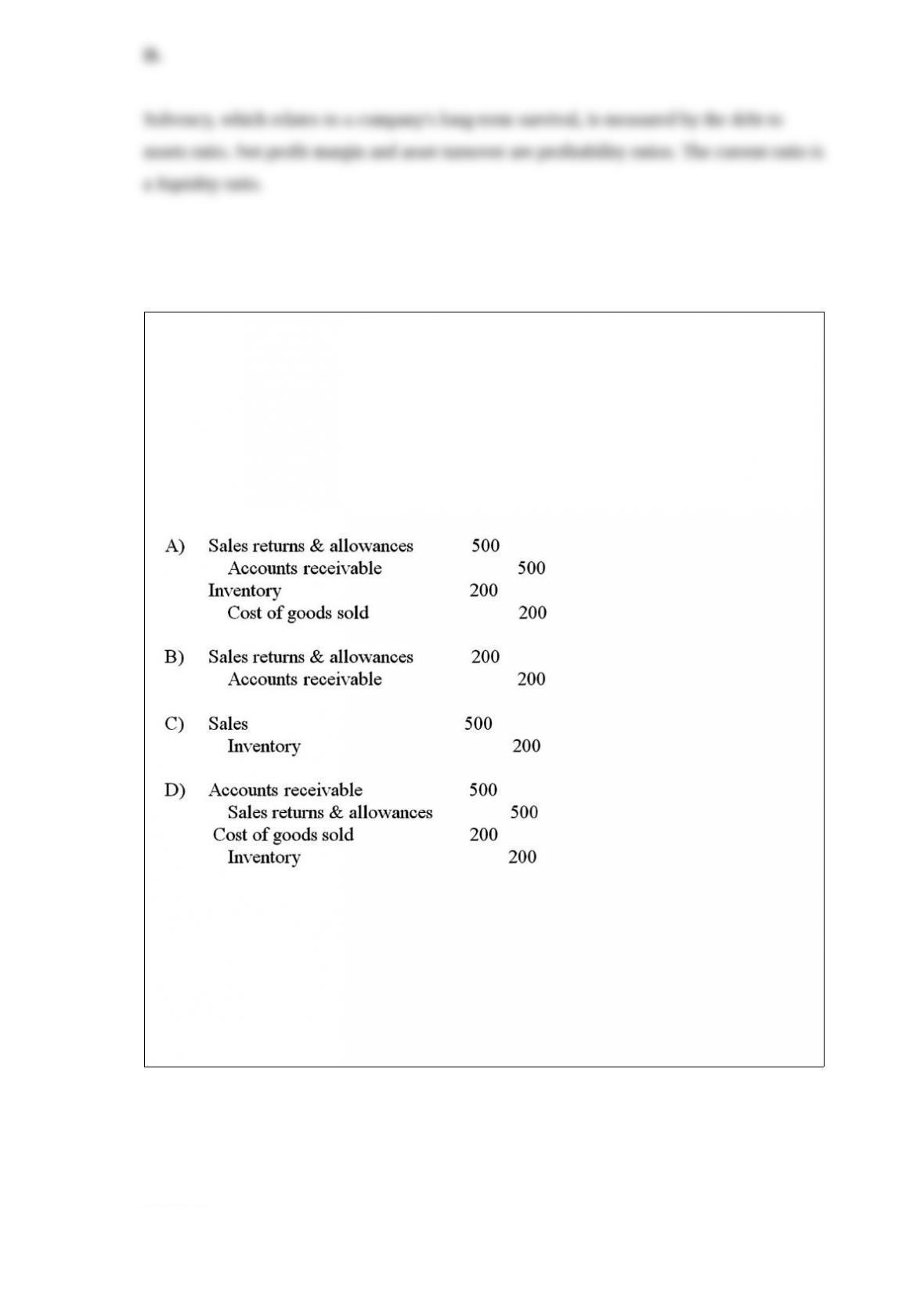
On October 1, B. Darin Company sold merchandise in the amount of $6,500 to S. Dee
Company, terms 2/10, n/30. The items cost B. Darin $4,200 and the company uses the
perpetual inventory method. On October 4, S. Dee returns some of the merchandise.
This merchandise had a selling price of $500 and a cost of $200. On October 8, S. Dee
Company paid B. Darin Company the correct amount due.
Use the information above to answer the following question. What is the journal entry
that B. Darin Company makes on October 4 to record the sales return?
A. Option A
B. Option B
C. Option C
D. Option D
Answer:
Merchandise costing $3,000 is sold for $4,000 on terms 2/10, n/30. If the buyer pays
within the discount period, what amount will be reported on the income statement as net
sales?
A. $3,920
B. $4,000
C. $1,000
D. $3,200
Answer:
Purrfect Pets, Inc., had the following transactions. Prepare the required journal entries.
a. October 1: Sold $10,000 of merchandise on account, 1/10, n/30 to Fabulous Felines.
b. November 1: Accepted a $10,000, 90-day, 10% promissory note from Fabulous
Felines in exchange for its account receivable.
c. December 31: Accrued interest on the note. Round to the nearest whole dollar
amount.
d. January 31: Received payment in full of principal and interest on the note from
Fabulous Felines.
Answer:
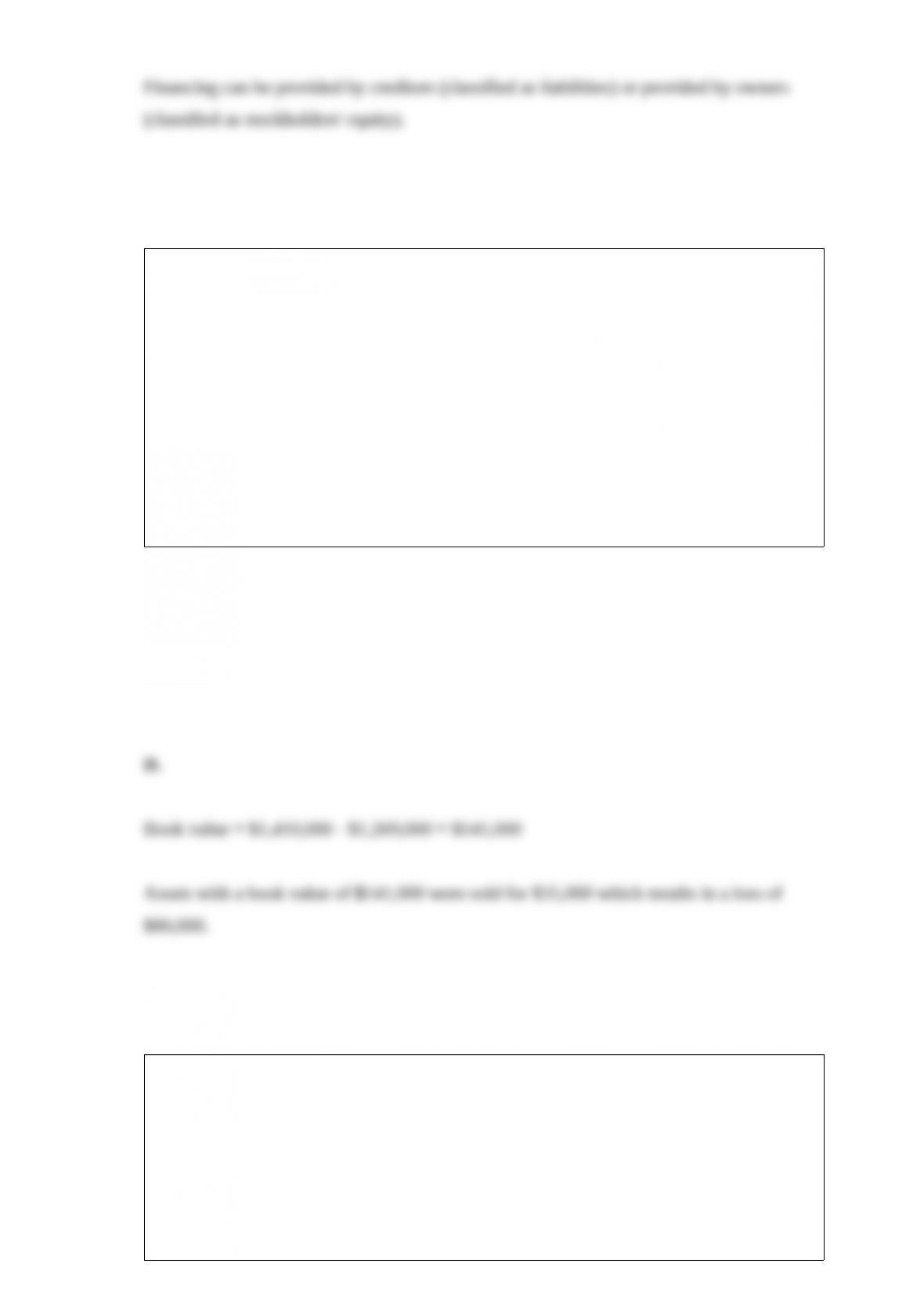
The following information is taken from the 2014 income statement of Muir Company:
Based on this information, what is the amount of net cash flow from operating

activities?
A. $149,000
B. $140,000
C. $146,000
D. $134,000
Answer:
Financing that individuals or institutions have provided to a company is
A. always classified as liabilities.
B. classified as liabilities when provided by creditors and stockholders’ equity when
provided by owners.
C. always classified as equity.
D. classified as stockholders’ equity when provided by creditors and liabilities when
provided by owners.
Answer:
A trucking company sold its fleet of trucks for $55,000. The trucks had originally cost
$1,410,000 and had accumulated depreciation of $1,269,000 through the date of
disposal. What gain or loss did the trucking company record when it sold the fleet of
trucks?
A. Gain of $86,000.
B. Gain of $55,000.
C. Loss of $55,000.
D. Loss of $86,000.
Answer:
A company’s sales in 2013 are $200,000 and in 2014 sales are $285,000. The
percentage change is:
A. 42.5%.
B. 70%.
C. 29.8%.
D. 130%.
Answer:
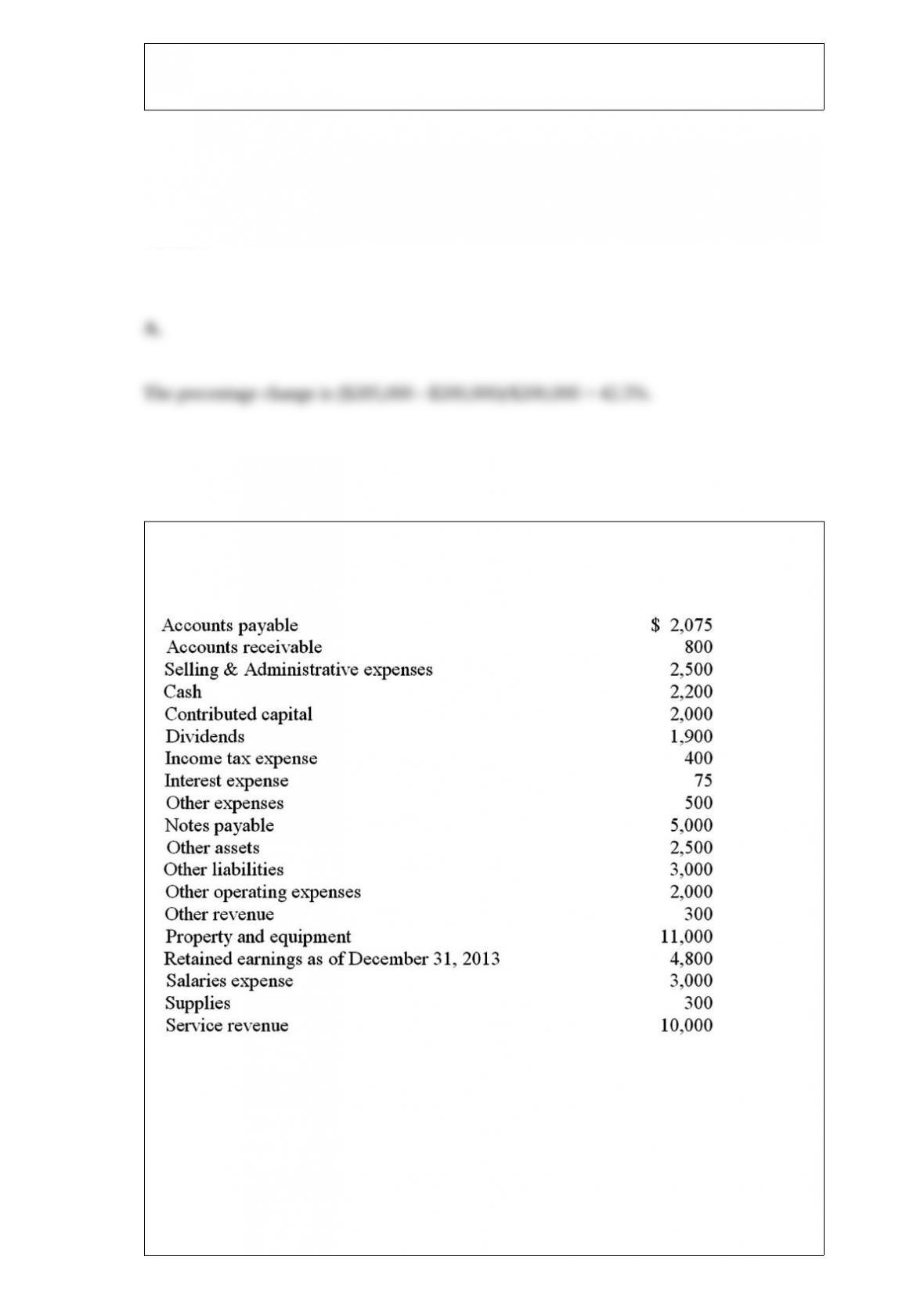
The following accounts are taken from the December 31, 2014 financial statements of a
company.
What is the amount of total liabilities at the end of 2014?
A. $7,075
B. $10,075
C. $9,075
D. $12,975
Answer:
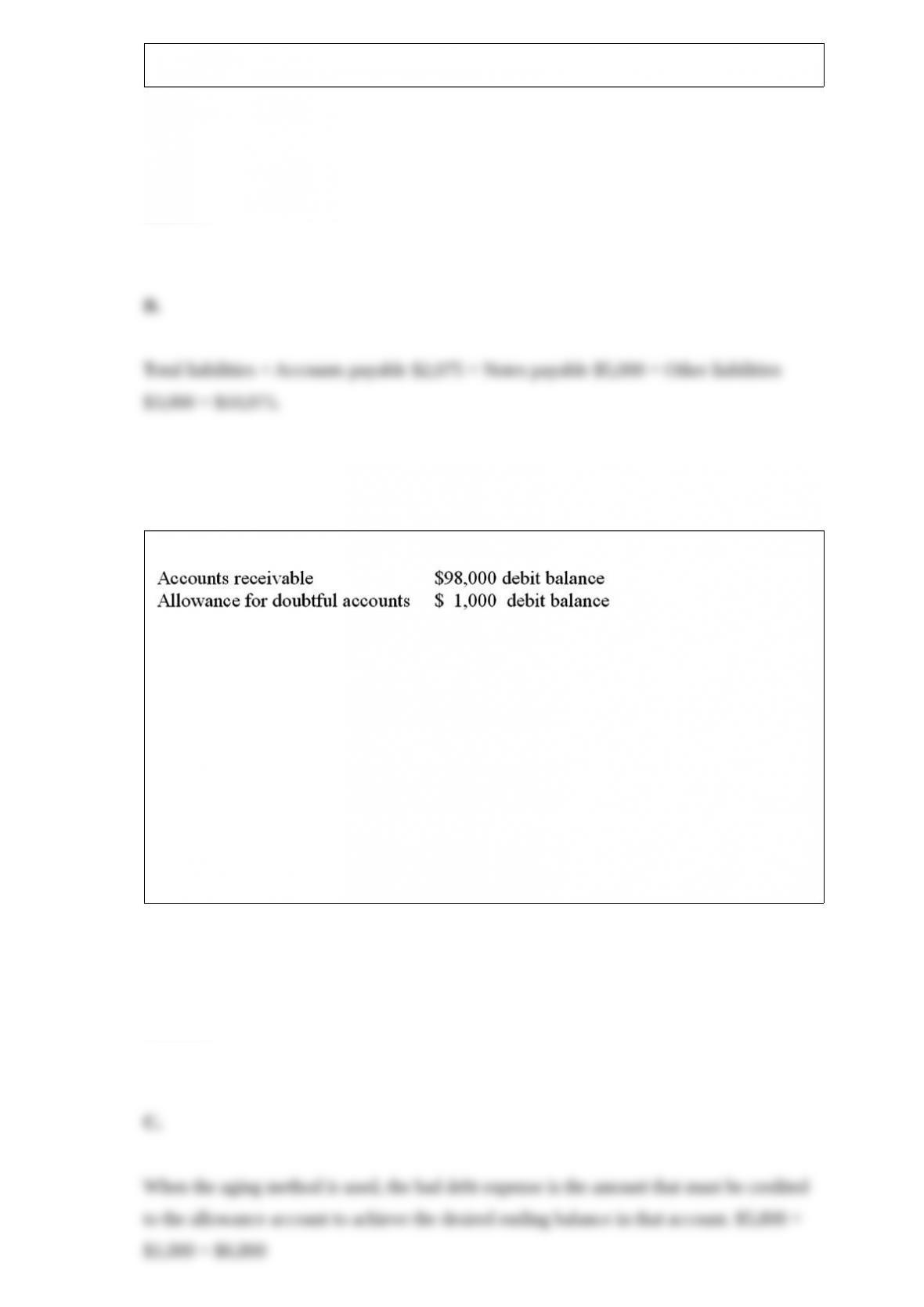
A company’s unadjusted trial balance at the end of the year includes the following:
The company uses the allowance method and has completed the aging schedule which
indicates $5,800 of accounts are estimated uncollectible. What is the amount of bad
debt expense to be recorded for the year?
A. $5,800
B. $4,800
C. $6,800
D. $7,800
Answer:
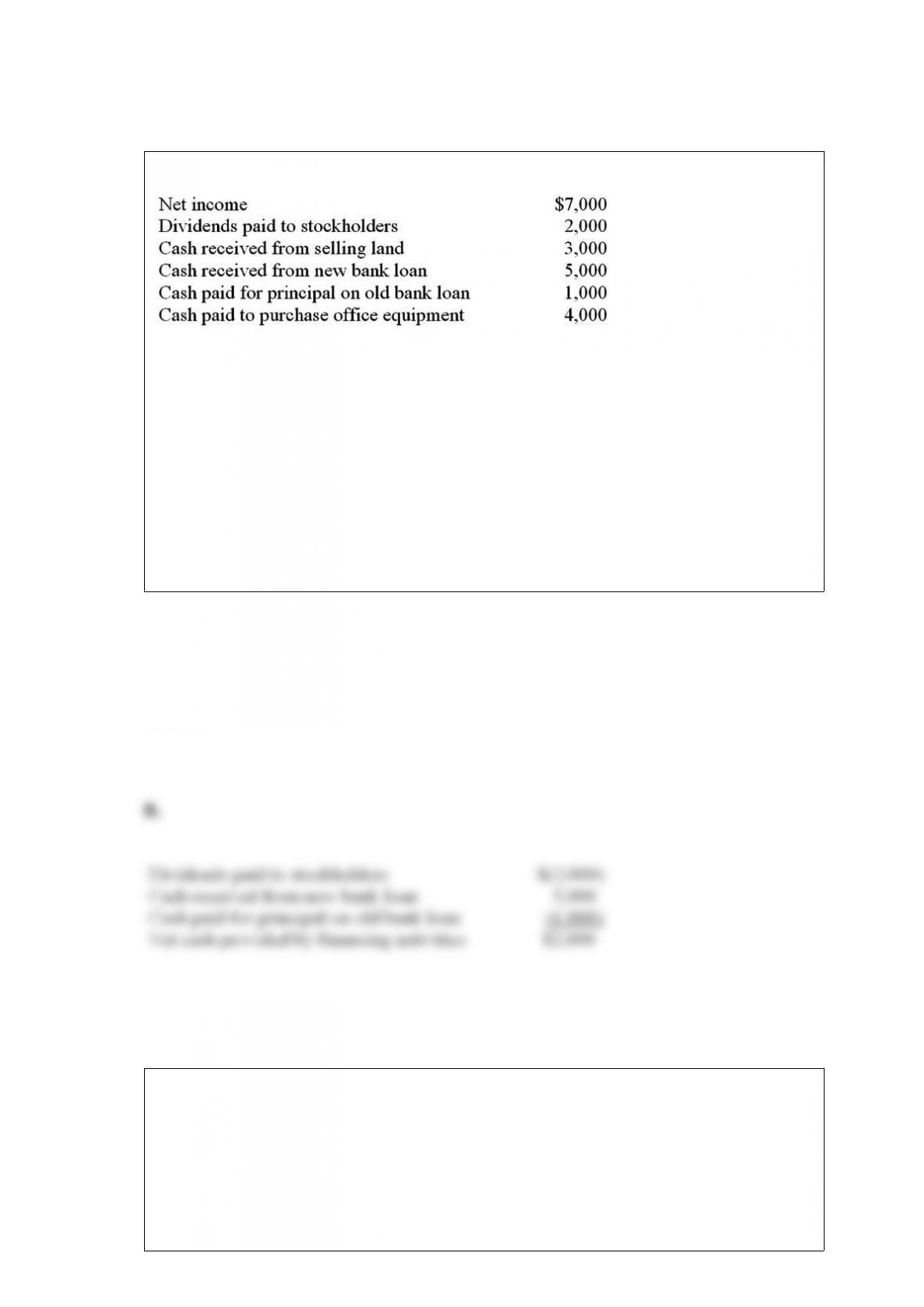
Use the information above to answer the following question. The company would
report net cash provided by (used in) financing activities of:
A. $(2,500)
B. $2,000
C. $5,000
D. $6,000
Answer:
A company had 300,000 shares of $10 par value common stock outstanding. The
amount of additional paid-in capital is $1,500,000, and retained earnings is $450,000.
The company issues a 2-for-1 stock split. The market price of the stock is $13. What is
the balance in the common stock account after this issuance?
A. $6,000,000
B. $6,900,000
C. $3,000,000
D. $4,500,000
Answer:
ShadyZ Corporation uses the unit-of-production method to estimate depreciation. A
new asset is purchased for $18,000 that will produce an estimated 100,000 units over its
useful life. Estimated residual value is $2,000. What is the depreciation rate per unit?
A. $1.60
B. $1.80
C. $0.16
D. $0.18
Answer:
Company A receives $10,000 in advance this month for work to be performed next
month. This month, the company should:
A. Debit Cash $10,000 and credit Service Revenue $10,000.
B. Debit Cash $10,000 and credit Unearned Revenue $10,000.
C. Debit Cash $10,000 and credit Accounts Receivable $10,000.
D. Debit Prepaid Expense $10,000 and credit Cash $10,000.
Answer:
To record estimated uncollectible accounts using the allowance method, the adjusting
entry would normally be a debit to:
A. Accounts Receivable and a credit to Allowance for Doubtful Accounts.
B. Bad Debt Expense and a credit to Allowance for Doubtful Accounts.
C. Allowance for Doubtful Accounts and a credit to Accounts Receivable.
D. Bad Debt Expense and a credit to Accounts Receivable.
Answer:
Sparkling Pools received a bill for $1,200 for running newspaper ads during the last two
weeks of July; the bill will be paid on August 1. Advertising expense should be:
A. credited for $1,200 in July.
B. credited for $1,200 in August.
C. debited for $1,200 in July.
D. debited for $1,200 in August.
Answer:
Assets reported on the balance sheet would include which of the following?
A. Accounts receivable, sales revenue and cash
B. Equipment, supplies expense and cash
C. Accounts payable, retained earnings and cash
D. Accounts receivable, equipment and cash
Answer:
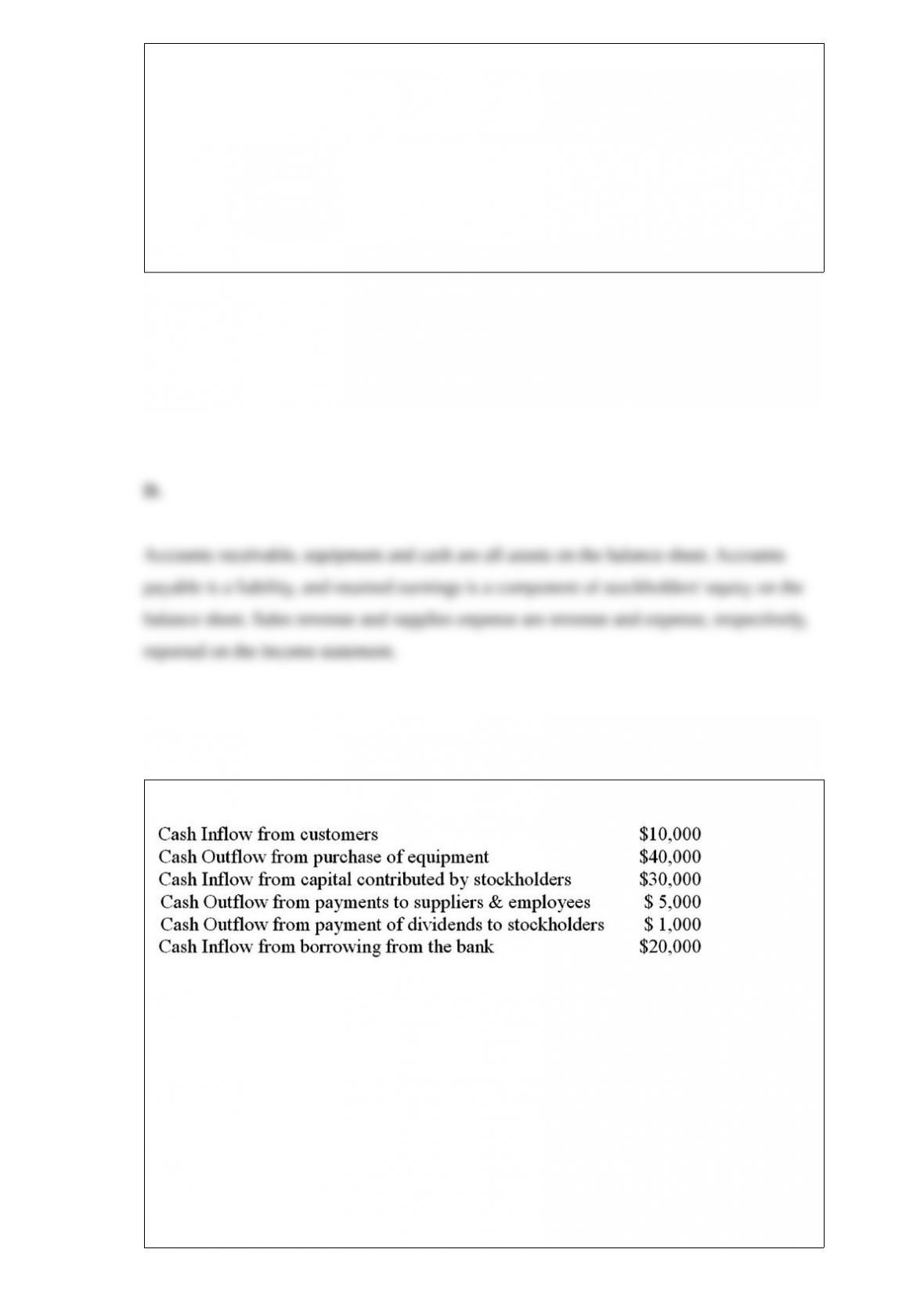
The Statement of Cash Flows for the current year contained the following:
The change in cash for the current year was an increase of $14,000.
What was the amount of Cash Flows from Operating Activities?
A. Cash inflow of $5,000
B. Cash inflow of $35,000
C. Cash inflow of $25,000
D. Cash inflow of $4,000

Answer:
A company issues 1 million shares of preferred stock with a par value of $2 and a
market price of $26 per share. The issuance should be recorded as:
A. a debit to Cash of $26 million and a credit to Preferred Stock of $26 million.
B. a debit to Cash of $2 million and a credit to Preferred Stock of $2 million.
C. a debit to Cash of $26 million, a credit to Additional Paid-in Capital of $2 million,
and a credit to Preferred Stock of $24 million.
D. a debit to Cash of $26 million, a credit to Preferred Stock of $2 million, and a credit
to Additional Paid-in Capital of $24 million.
Answer:
Cash had a beginning balance of $68,900. During the month, Cash was credited for
$16,000 and debited for $18,300. At the end of the month, the balance is:
A. $71,200 credit.
B. $71,200 debit.
C. $66,600 debit.
D. $66,600 credit.
Answer:
All else being equal, when the current stock price for a company’s stock falls and net
income falls:
A. EPS decreases and ROE increases.
B. EPS and ROE both decrease.
C. EPS increases and ROE decreases.
D. EPS and ROE both increase.
Answer: