Companies A and B both report net income growth of 12% per year. Company A has a
receivables turnover ratio of 5.6, which is smaller than its previous year. Company B
has a receivables turnover ratio of 11.3, which is higher than its previous year. All other
things being equal:
A. Company A appears to be better managed.
B. Company A will have the lower days-to-collect measure.
C. Company B appears to be better managed.
D. Company B’s days-to-collect measure is rising.
Answer:
When a company uses a perpetual inventory system, purchase returns will be recorded
by:
A. debiting inventory.
B. debiting purchase returns.
C. crediting accounts payable.
D. crediting inventory.
Answer:
A company pays its workforce on Fridays for a five day workweek. The payroll for a
week is $100,000. If the accounting year-end falls on a Tuesday, the adjusting journal
entry to record this will include a
A. debit to Salaries Expense $100,000.
B. debit to Salaries Expense $40,000.
C. credit to Salaries Payable $60,000.
D. credit to Salaries Payable $100,000.
Answer:
The Statement of Cash Flows for the current year contained the following:
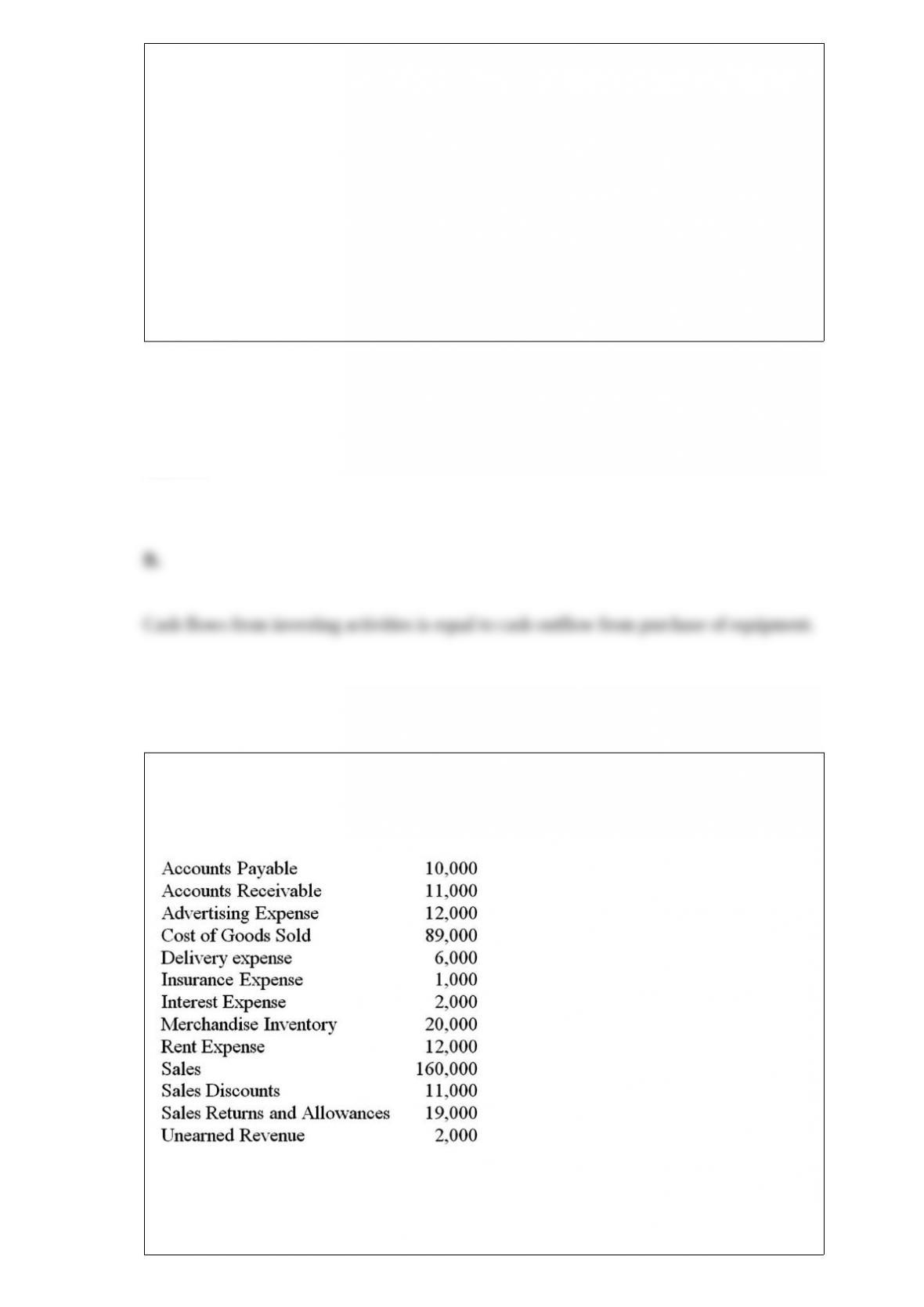
The change in cash for the current year was an increase of $14,000.
What was the amount of Cash Flows from Investing Activities?
A. Cash Outflow of $1,000
B. Cash Outflow of $40,000
C. Cash Outflow of $10,000
D. Cash Inflow of $10,000
Answer:
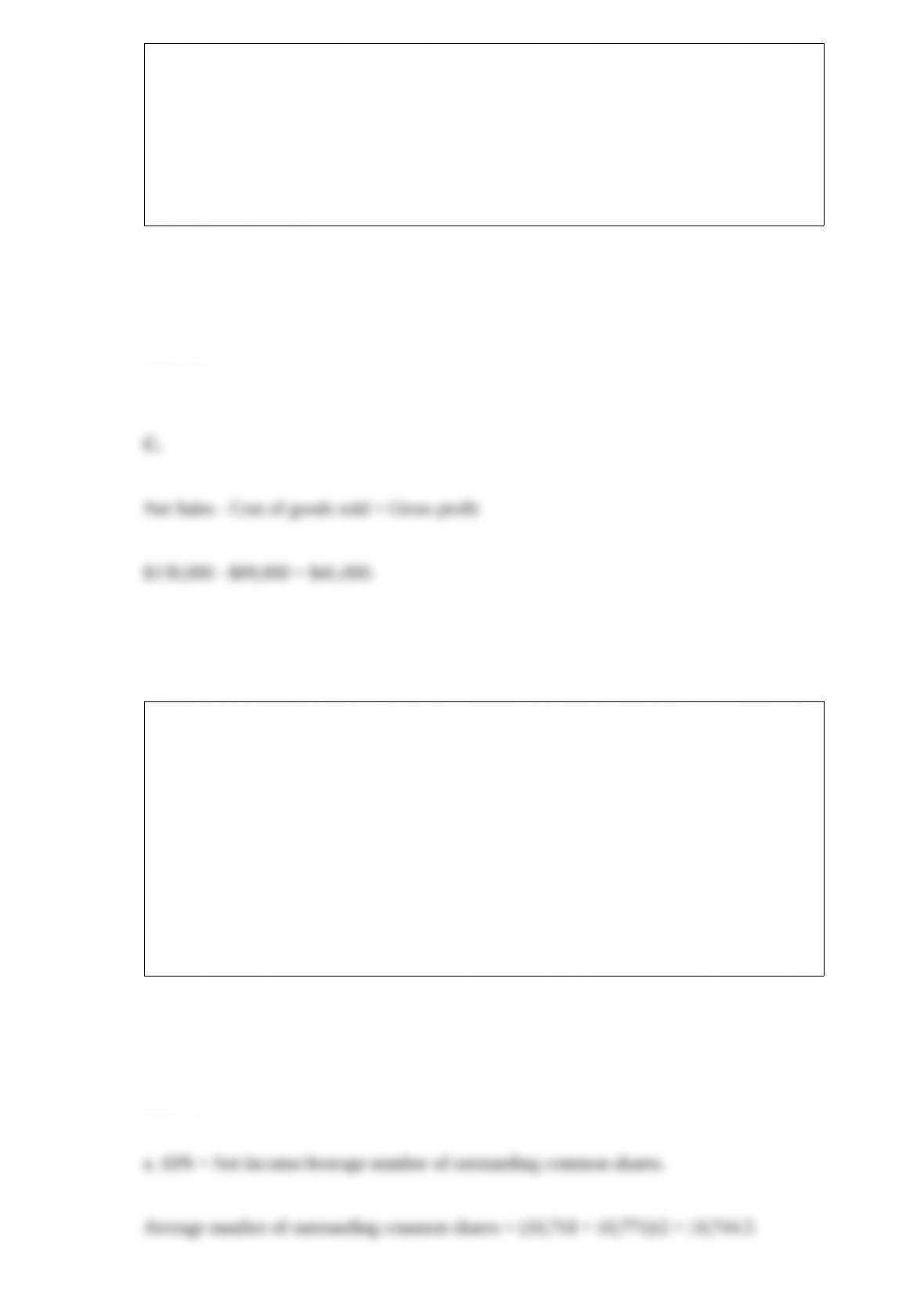
The following is a listing of some of the balance sheet accounts and all of the income
statement accounts for Mulberry Street Sportswear as they appear on the 12/31/14
adjusted trial balance.
Use the information above to answer the following question. Gross profit for 2014
would be
A. $35,000.
B. $37,000.
C. $41,000.
D. $71,000.
Answer:
Phelps, Inc., had assets of $67,646 and liabilities of $15,466 at the close of 2013 with
10,718 shares of outstanding common stock. Net income for 2013 was $7,829. At the
end of 2014, assets were $79,571, liabilities were $18,551, and the company had 10,771
shares of outstanding stock trading at a price of $10 per share. Net income for 2014 was
$9,993.
a. Calculate EPS for 2014.
b. Calculate ROE for 2014.
c. Calculate the Price/Earnings Ratio for 2014.
Answer:
Which of the following items appear on more than one financial statement?
A. Ending cash and ending retained earnings.
B. Ending cash and beginning retained earnings.
C. Beginning cash and ending retained earnings.
D. Beginning cash and beginning retained earnings.
Answer:
A company has liquid assets of $600,000 and current liabilities of $500,000. What is the
effect on the quick ratio if the company records an accrual adjustment for salaries of
$100,000 and pays accounts payable in the amount of $50,000?
A. The quick ratio will not change as a result of either of these transactions.
B. The accrual adjustment will cause the quick ratio to decrease and the payment of
accounts payable will cause an increase in the quick ratio.
C. The accrual adjustment will cause the quick ratio to increase and the payment of
accounts payable will not affect the quick ratio.
D. The accrual adjustment and the payment of accounts payable will both cause the
quick ratio to decrease.
Answer:
Which of the following measures would assist in assessing the profitability of a
company?
A. Debt-to-assets ratio.
B. Fixed asset turnover ratio.
C. Receivables turnover ratio.
D. Current ratio.
Answer:
Which of the following is calculated by dividing cost of goods sold by average
inventory and then dividing this result into 365 days?
A. Inventory turnover.
B. Current ratio.
C. Days to collect ratio.
D. Days to sell ratio.
Answer:
Before the closing entries are prepared, the retained earnings balance in the adjusted
trial balance is equal to:
A. the balance of retained earnings at the beginning of the year.
B. the balance of retained earnings after adding revenues and subtracting expenses but
before subtracting dividends.
C. the balance of retained earnings at the end of the year.
D. the balance of retained earnings at the beginning of the next year.
Answer:
After adjusting entries are prepared and posted, but before closing entries are prepared
and posted, the balance in retained earnings is equal to
A. zero.
B. the difference between total assets and total liabilities.
C. the amount that is to be reported in the current year’s balance sheet.
D. the amount that was reported on the previous year’s balance sheet.

Answer:
The following activities occurred during the current year, 2013, for the Maverick Law
Firm.
– On February 1, 2013, received cash of $5,000 from clients in payment of their
accounts from 2012.
– In 2013, received cash of $13,000 for law services rendered in 2013.
– At the end of 2013, billed customers $4,000 for services rendered in 2013. This
amount was unpaid as of the end of the year.
– In November of 2013, received cash of $2,000 from clients as a deposit on law
services to be performed in 2014.
Based on the activities above, stockholders’ equity of the Maverick Law Firm in 2013
will be
A. increased by $20,000.
B. decreased by $5,000.
C. increased by $17,000.
D. decreased by $2,000.
Answer:
BD One Company entered into the following transactions. Choose the one which
represents an accounting error.
A. A shareholder of BD One Company purchases a new car, but this was not recorded
by the company.
B. Revenue was recognized when a customer received services from BD One Company.
C. Cash received from a customer in payment of his account was debited to Cash and
credited to Accounts Receivable.
D. BD One Company ordered inventory and the order was recorded by a debit to
Inventory and a credit to Accounts Payable.
Answer:
A company entered into the following transactions:
– Borrowed $5,000 from the bank by signing a promissory note
– Issued stock to owners for $10,000
– Purchased $1,000 of supplies, on account

– Paid $400 to suppliers as payment on account for the supplies purchased
What is the amount of total liabilities?
A. $6,000
B. $15,600
C. $16,000
D. $5,600
Answer:
IBM issues 200,000 shares of stock with a par value of $0.01 for $150 per share. Three
years later, it repurchases these shares for $80 per share. IBM records the repurchase in
which of the following ways?
A. Debit Common Stock for $2,000, debit Additional Paid-in Capital for $29,998,000
and credit Cash for $30 million.
B. Debit Treasury Stock for $16 million and credit Cash for $16 million.
C. Debit Common Stock for $2,000, debit Additional Paid-in Capital for $15,998,000
and credit Cash for $16 million.
D. Debit Stockholders’ Equity for $30 million, credit Additional Paid-in Capital for $16
million and credit Cash for $16 million.
Answer:
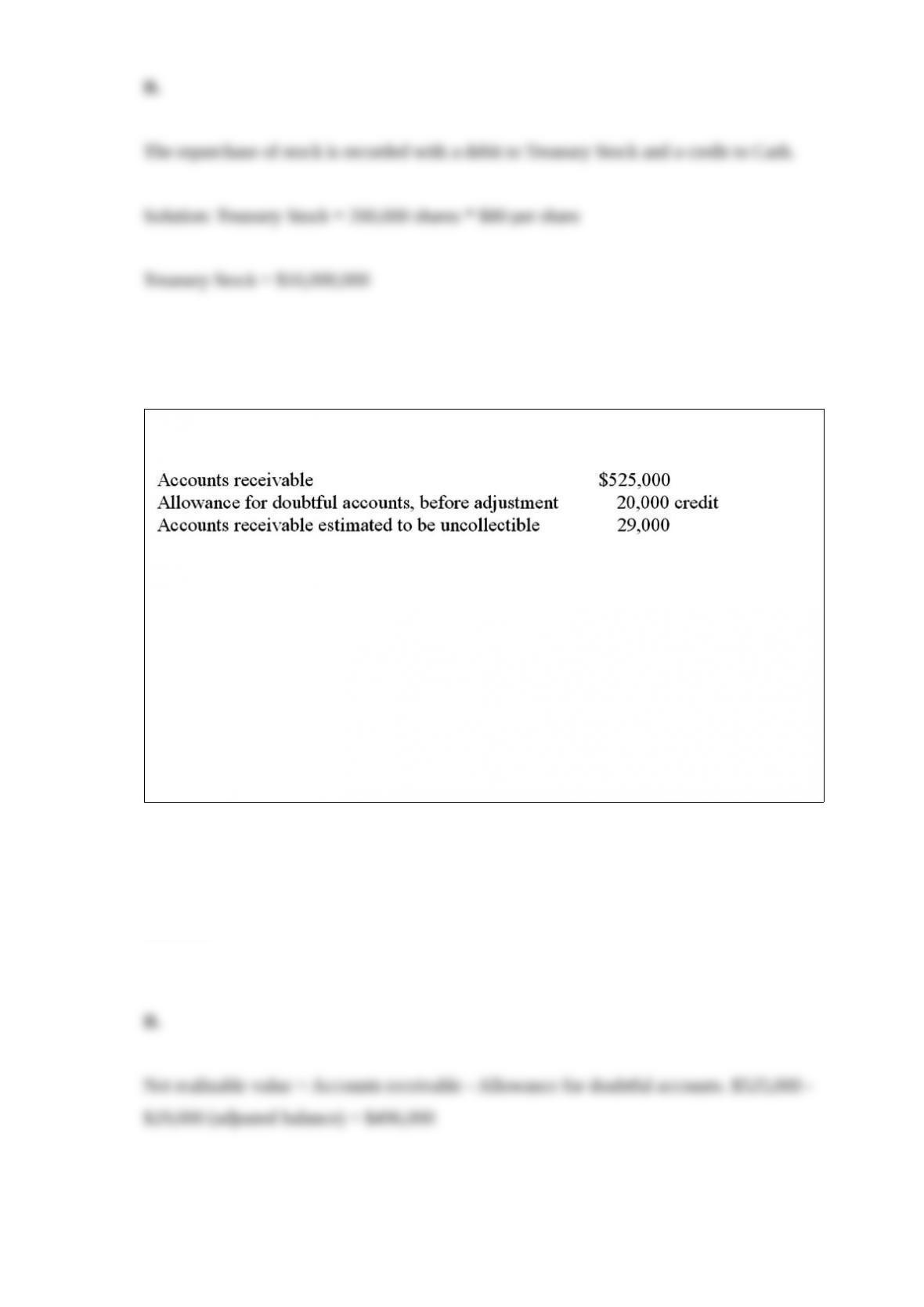
A company performed an aging of accounts receivable on December 31 and gathered
the following information:
What is the net realizable value of accounts receivable to be reported on the balance
sheet at December 31?
A. $505,000
B. $496,000
C. $467,000
D. $516,000
Answer:
Which of the following items appearing on a bank reconciliation would require journal
entries to bring the cash account up to date?
A. Deposits in transit.
B. Checks from customers returned as NSF.
C. Outstanding checks.
D. An error made by the bank in recording a deposit.
Answer:
When using the spreadsheet approach for the indirect method to calculate cash flows
from operating activities, net income would be found as:
A. a debit to the Retained Earnings account.
B. the difference between revenues and expenses.
C. a credit to the Retained Earnings account.
D. the difference between gains and losses.
Answer:
A stock dividend transfers:
A. contributed capital to retained earnings.
B. retained earnings to assets.
C. contributed capital to assets.
D. retained earnings to contributed capital.
Answer:
On October 31, 2013, your company’s records say that the company has $16,451.03 in
its checking account. A review of the bank statement shows you have three outstanding
checks totaling $5,643.01, and the bank has paid you interest of $12.19 and charged you
$9.00 in fees. The bank statement dated October 31, 2013 would report a balance of:
A. $22,090.85.
B. $16,454.22.
C. $22,097.23.
D. $10,804.83.
Answer:
On April 6, Lopez Co. purchased $5,000 of merchandise, terms 1/15, n/30. Lopez Co.
paid for the purchase on April 26. The entry to record the payment on April 26 in a
perpetual inventory system includes which of the following?
A. A credit to inventory for $50.
B. A debit to accounts payable for $4,900.
C. A credit to accounts payable for $5,000.
D. A credit to cash for $5,000.
Answer:
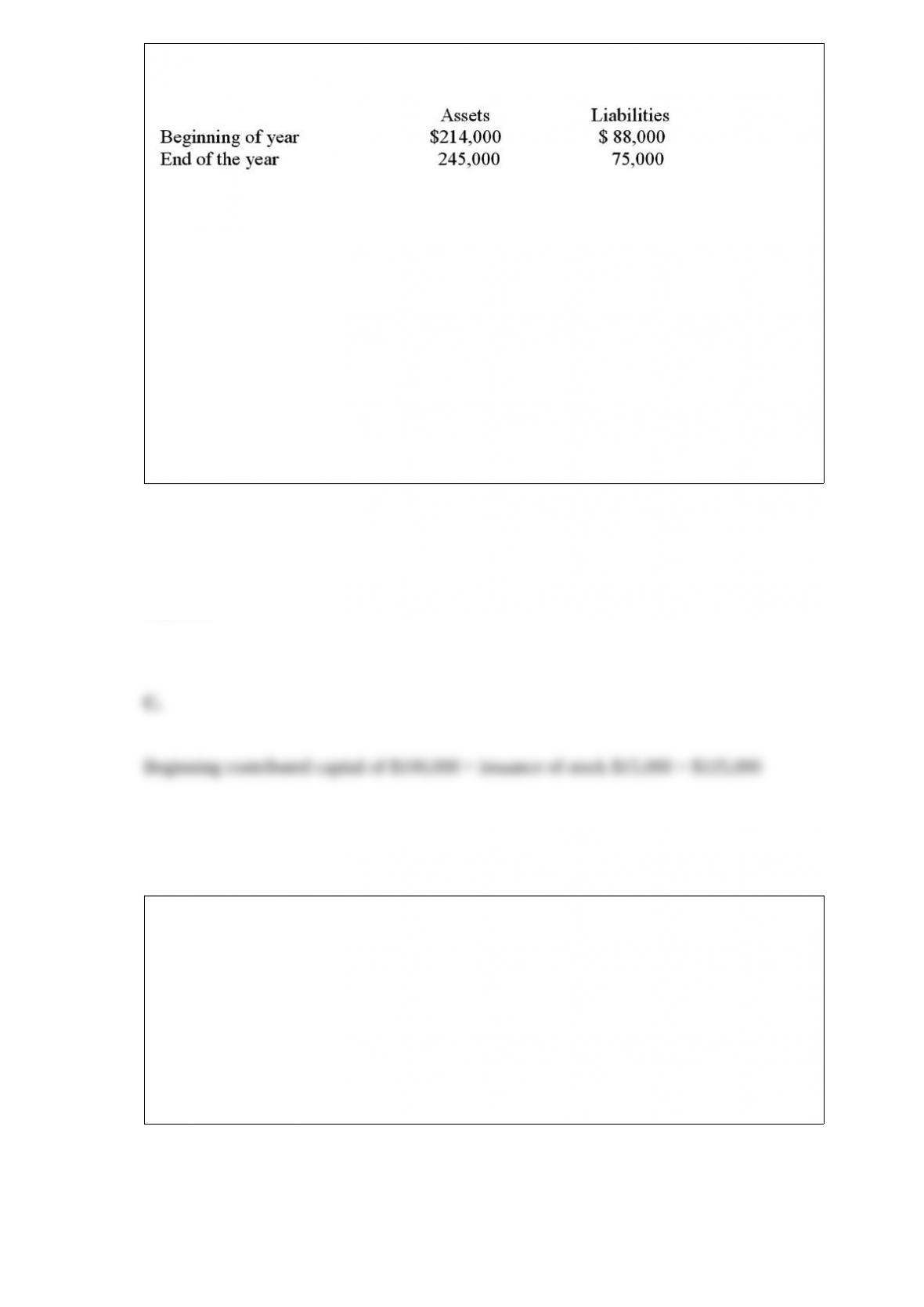
A company had the following assets and liabilities at the beginning and end of the
current year:
Stock was issued for $15,000 cash and dividends of $5,000 were paid during the year.
If contributed capital was $100,000 at the beginning of the year, what was the amount at
the end of the year?
A. $100,000
B. $110,000
C. $115,000
D. $170,000
Answer:
Which of the following is performed first at the end of each accounting period?
A. Prepare adjusting entries.
B. Prepare a post closing trial balance.
C. Prepare closing journal entries.
D. Prepare the statement of retained earnings.
Answer:
Adjusting entries:
A. affect only balance sheet accounts.
B. affect only income statement accounts.
C. affect only cash flow accounts.
D. affect both income statement and balance sheet accounts.
Answer:
If a fully depreciated asset with no residual value is retired without receiving any cash
on retirement:
A. a gain on disposal will be recorded.
B. depreciation must be recorded as though the asset were still on the books.
C. a loss on disposal will be recorded.
D. no gain or loss on disposal will be recorded.
Answer:
Which of the following accounts does not have a normal debit balance?
A. Wages Expense
B. Service Revenue
C. Accounts Receivable
D. Cash
Answer:
Company X has net sales revenue of $780,000, cost of goods sold of $343,200, and all
other expenses of $327,600. The gross profit percentage is closest to:
A. 32%.
B. 56%.
C. 86%.
D. 14%.
Answer:
Which of the following is not an asset?
A. Cash
B. Notes receivable
C. Contributed capital
D. Land
Answer:
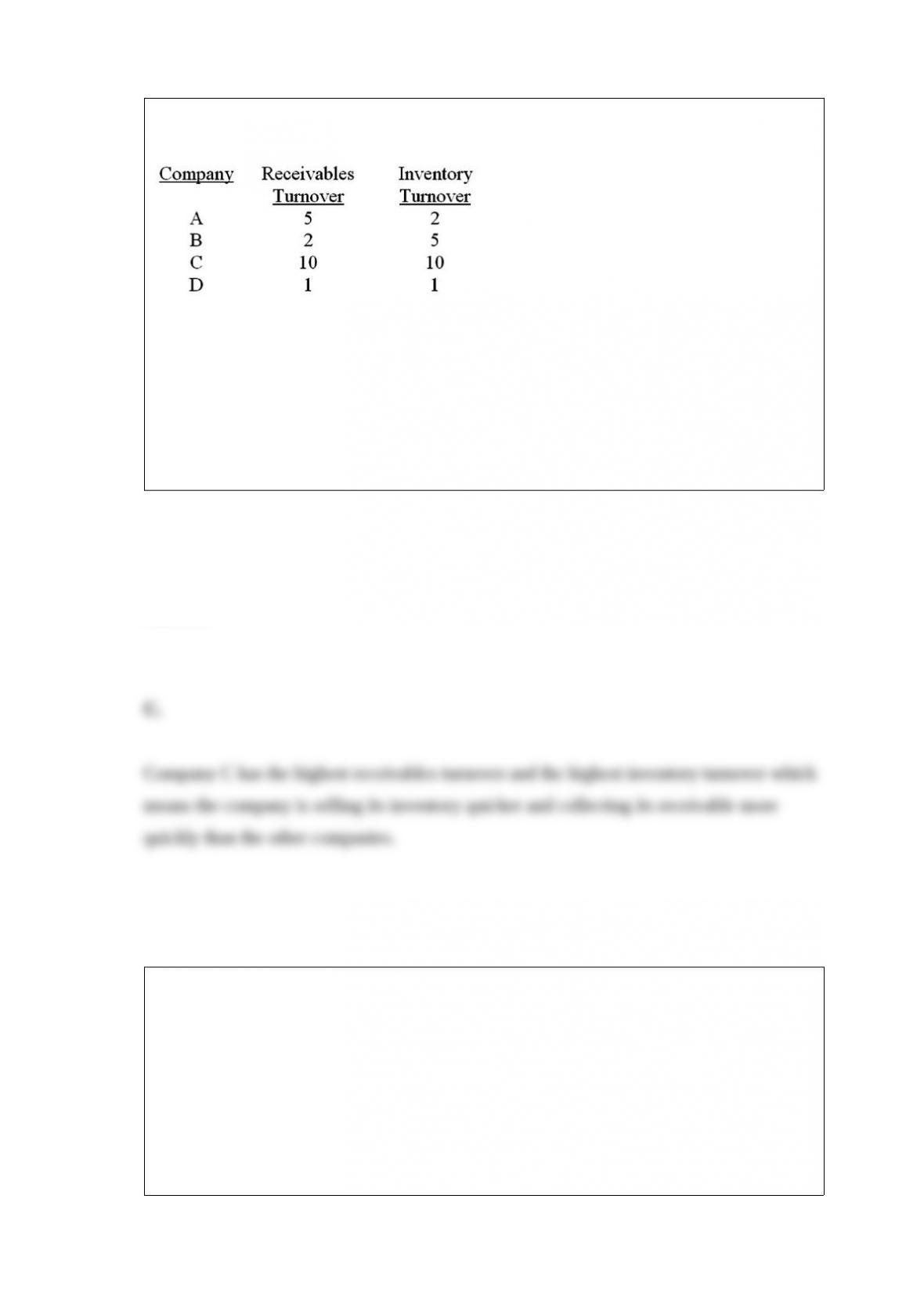
Judging only from the ratios below, which of the following clothing wholesalers is least
likely to be having cash flow problems?
A. Company A
B. Company B
C. Company C
D. Company D
Answer:
If net income is rising, but sales and the gross profit percentage remain the same, then:
A. operating expenses are falling.
B. operating expenses are rising.
C. cost of goods sold is falling.
D. cost of goods sold is rising.
Answer: