
A firm has used LIFO for several years during which costs have trended higher. If this
firm achieves a substantial reduction in inventory quantities in 2017 by selling more
merchandise than it purchases, the effect on 2017 net income of the inventory
reduction, compared to having no change in inventory quantity from the beginning to
the end of 2017, is:
A. net income for 2017 will be greater if the inventory quantity declines.
B. net income for 2017 will be less if the inventory quantity declines.
C. net income for 2017 will not be affected because of the inventory quantity decline.
D. can’t tell from the information given.
On January 31, an entity’s balance sheet showed total assets of $2,250 and liabilities of
$750. Stockholders’ equity at January 31 was:
A. $1,500
B. $3,000
C. $1,250
D. $750
Which of the following accounting concepts/principles is most significant in the
development of a capitalization policy?
A. Matching of revenue and expense.
B. Materiality.
C. Original Cost.
D. Consistency.
The contribution margin format income statement:
A. results in a larger amount of operating income than the traditional income statement
format.
B. uses a behavior pattern classification for costs rather than a functional cost
classification approach.
C. is most frequently used for financial statement reporting purposes.
D. emphasizes that all costs change in proportion to any change in revenues.

A favorable materials quantity variance would occur if:
A. more material is purchased than is used.
B. actual pounds of materials used were less than the standard pounds allowed.
C. actual labor hours used was greater than the standard labor hours allowed.
D. actual pounds of materials used was greater than the standard pounds allowed.
The part of the variable overhead budget variance due to the difference between actual
hours required and standard hours allowed for the work done is called the:
A. variable overhead spending variance.
B. variable overhead budget variance.
C. variable overhead efficiency variance.
D. variable overhead volume variance.
A common size income statement:
A. uses the same dollar amount of revenues for each year.
B. expresses items as a percentage of revenues.
C. makes comparisons between years more difficult.
D. is useful in estimating the impact of inflation.
The allowance for uncollectible accounts is a(n):
A. asset.
B. contra current asset.
C. expense.
D. contra revenue.

As the level of activity increases:
A. fixed cost per unit increases.
B. variable cost per unit increases.
C. variable cost per unit decreases.
D. fixed cost per unit decreases.
When a machine having a net book value of $15,000 is sold for $12,000:
A. current assets decrease, equipment (net) increases, and net income increases.
B. current assets increase, equipment (net) decreases, and net income increases.
C. current assets increase, equipment (net) decreases, and net income decreases.
D. current assets increase, equipment (net) increases, and net income decreases.
At the beginning of the year, paid-in capital was $164 and retained earnings was $94.
During the year, the stockholders invested $48 and dividends of $12 were declared and
paid. Retained earnings at the end of the year were $104.
Net income for the year was:
A. $20
B. $22
C. $30
D. $40
Expenses are:
A. cash disbursements.
B. decreases in net assets from uninsured accidents.
C. decreases in net assets from dividends to stockholders.
D. decreases in net assets resulting from usual operating activities.

Many companies use accelerated depreciation for tax purposes because:
A. it is easier to calculate than straight-line depreciation.
B. it reflects the amount of cash used in depreciation.
C. it results in lower taxable income than straight-line depreciation.
D. it is used for determining net income reported to stockholders.
Financial leverage:
A. arises because most borrowed funds have a fixed interest rate.
B. arises because most borrowed funds have a variable interest rate.
C. usually has no bearing on the risk associated with a company.
D. is a concept that does not apply to individuals.
A stock dividend is similar to a cash dividend in that:
A. the stockholder’s equity in the firm’s net assets is reduced by each.
B. the stockholder’s cash is increased by each.
C. the stockholder’s equity in the firm’s net assets is increased by each.
D. retained earnings and the amount of potential future dividends is reduced by each.
A loan discount is:
A. a loan used to purchase a bond at a discount.
B. a discount market interest rate on a loan.
C. the same as a bond discount.
D. none of the above.

The accounting concept or principle applied when an allowance is provided for
estimated uncollectible accounts receivable is:
A. consistency.
B. matching revenue and expense.
C. original cost.
D. objectivity.
Which of the following activities is not part of the management planning and control
cycle?
A. data collection and performance feedback.
B. implementation of plans.
C. providing information to investors and creditors.
D. revisiting plans.
With respect to the write-off of an uncollectible account receivable against the
allowance for bad debts, a sound system of internal control would require:
A. the write-off be approved by two employees.
B. an investigation of why credit was extended to this customer in the first place.
C. a lawsuit to be initiated to recover the uncollectible amount.
D. the write-off to be made within six months after the date of sale.
Which of the following statements best describes the process of accounting for
depreciation?
A. A process that attempts to recognize loss in economic value over a period of time.
B. A process for setting aside cash so funds will be available to replace the asset.
C. A process for recognizing the cost of an asset that should be matched against revenue
earned as a result of using the asset.
D. A process for recognizing all of the cost associated with using an asset in a revenue
generating activity.
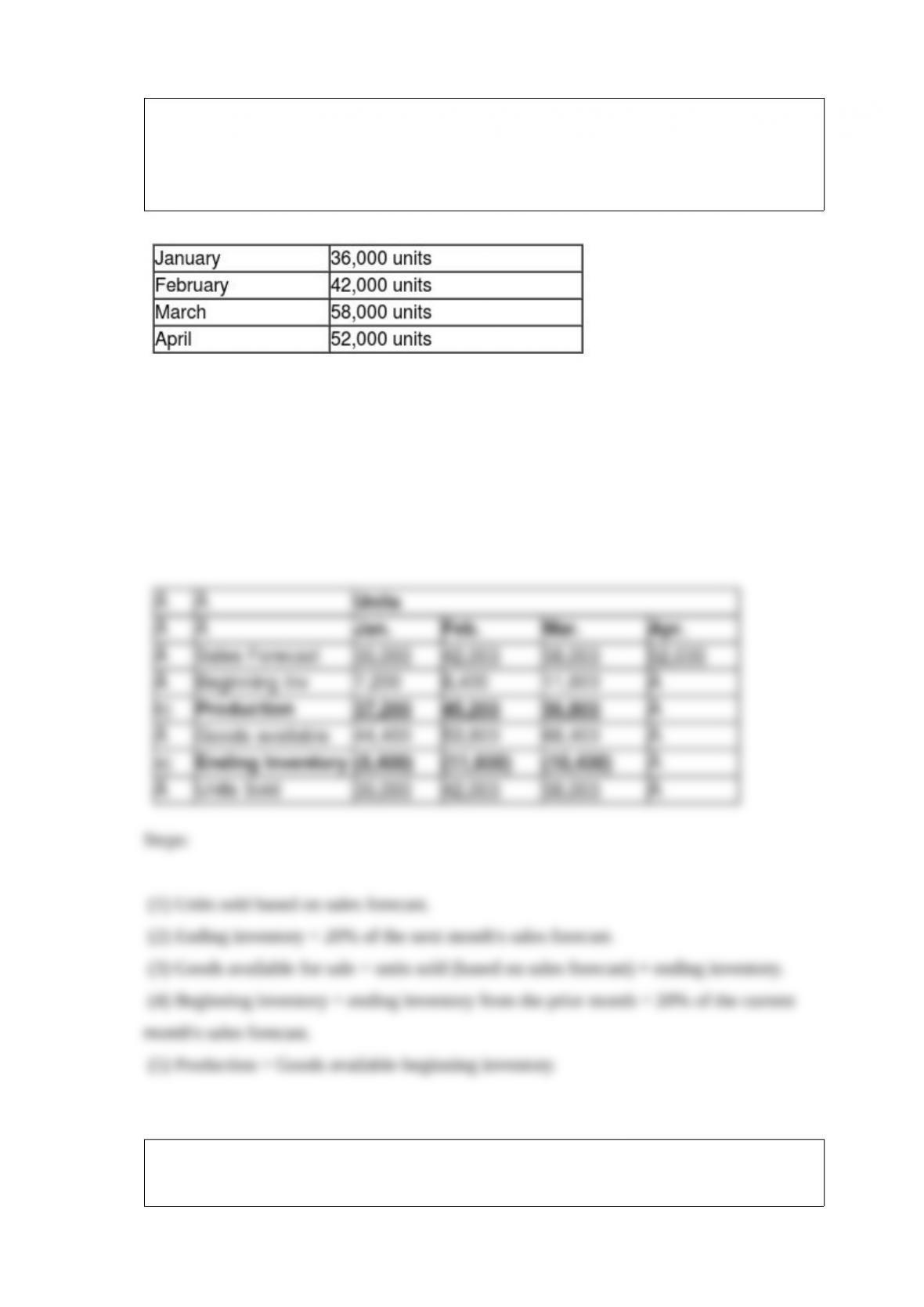
Breaded Oak, Inc. has a policy that requires 20 percent of the expected sales of its
product to be on hand at the end of the prior month. Forecasted sales, in units, for the
months of January through April are as follows:
(a.) Calculate the number of units planned for ending inventory for January, February, and
March.
(b.) Calculate the number of units budgeted to be produced in January, February, and
March.
Webster World Products uses the following account titles:
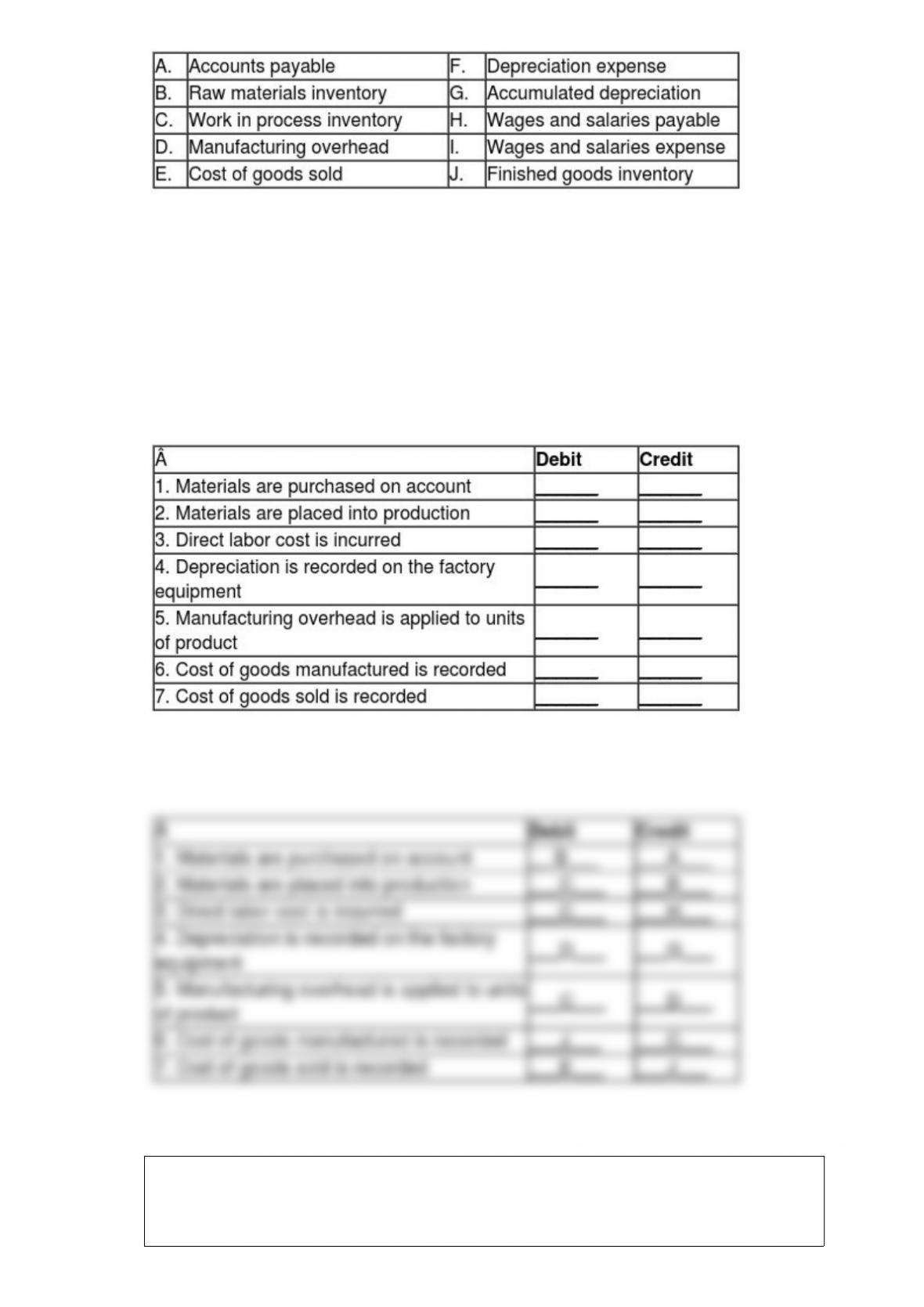
For each transaction described below, indicate which accounts would be debited and
credited under a job order cost system:
Lessee, Inc., acquired the use of a machine by agreeing to pay the manufacturer of the
machine $20,000 per year for 5 years. At the time the lease was signed, the interest rate
for a 5-year loan was 8%.

Required:
(a.) Use the appropriate factor from Table 6-5 to calculate the amount that Lessee, Inc.
could have paid at the beginning of the lease to buy the machine outright.
(b.) What causes the difference between the amount you calculated in part (a.) and the
total of $100,000 ($20,000 per year for 5 years) that Lessee, Inc. will pay under the
terms of the lease?
(c.) What is the appropriate amount of cost to be reported in Lessee, Inc’s balance sheet
(at the time the lease was signed) with respect to this asset?
A cost classified “for decision-making purposes” would include:
A. period cost.
B. opportunity cost.
C. controllable cost.
D. inventoriable cost.
A budget adjusted to reflect a budget allowance based on actual activity achieved rather
than the planned level of activity in the original budget is a:
A. static budget.
B. rolling budget.
C. controllable budget.
D. flexible budget.
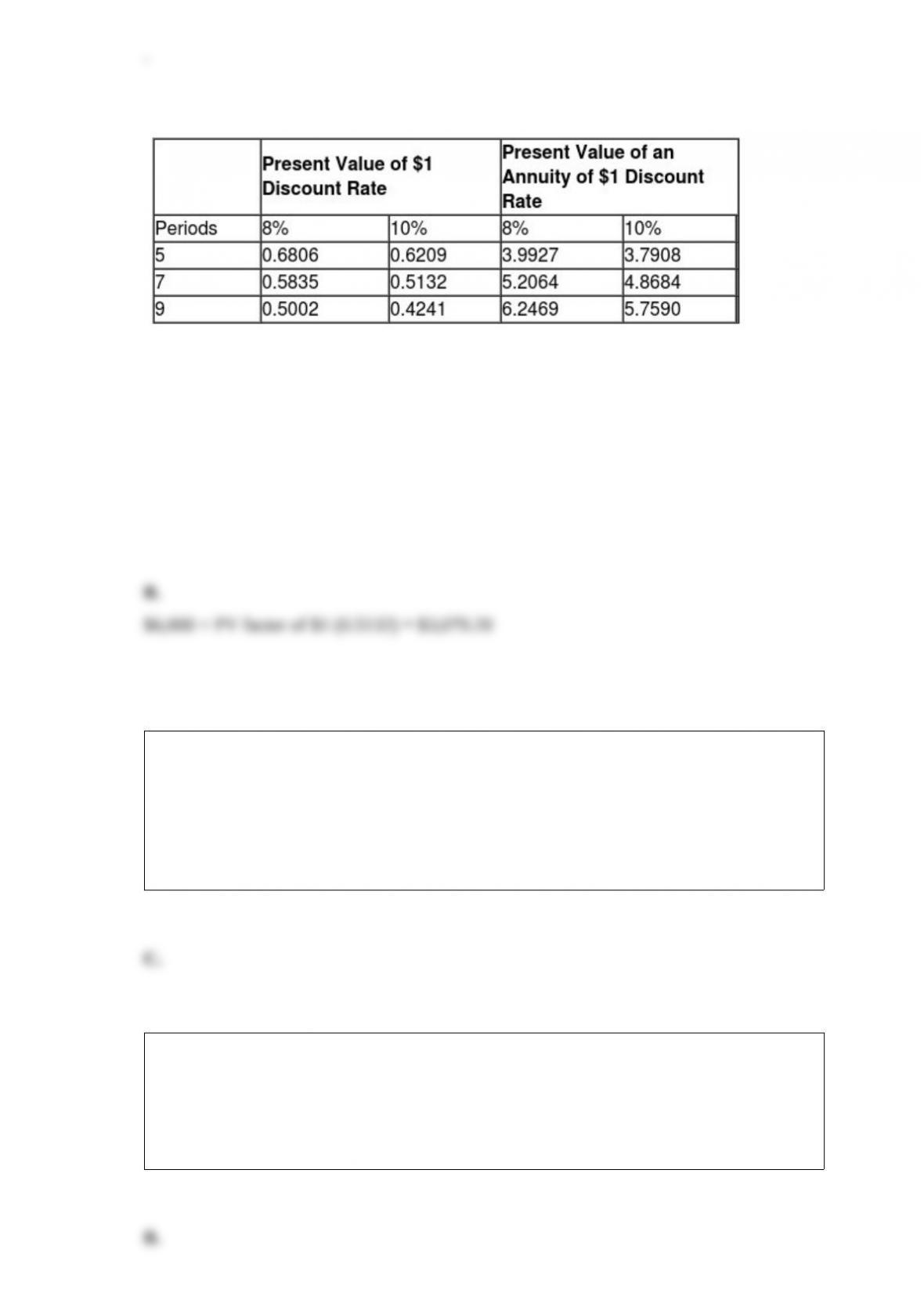
The present value of $6,000 to be received in 7 years at 10% is:
A. $1,232.44
B. $3,079.20
C. $6,000.00
D. $11,691.34
If a firm’s debt ratio was 25%, its debt/equity ratio would be:
A. 25%.
B. 50%.
C. 33.33%.
D. 75%. Debt ratio = liability/(liabilities + equity) = 25/100 = a debt ratio of 25% so,
debt/equity ratio is calculated by liabilities/equity = 25/75 = 33.33%
Capital budgeting differs from operational budgeting because:
A. depreciation calculations are required.
B. it considers the time value of money.
C. operating expenses are not relevant.
D. capital budgets don’t affect cash flow.

If the P/E ratio of a company’s common stock were 12, and its earnings were $2.50 per
common share:
A. the market value of the common stock would be $20.83 per share.
B. the market value of the common stock would be $25.00 per share.
C. an increase in earnings of $0.20 per share, with no change in the multiple, would
result in a market price increase of $2.40 per share.
D. an increase in earnings of $0.20 per share, with no change in the multiple, would
result in a market price increase of $1.67 per share. 12 * 2.5 = $30 compared to 12 * 2.7
= $32.40.
Which of the following is more relevant to management accounting than to cost
accounting?
A. accumulation and determination of product or service cost.
B. income measurement and inventory valuation.
C. generally accepted accounting principles.
D. providing managers information for planning and control purposes.