Which of the following statements about equity and debt financing is correct?
A) Equity financing is always better than debt financing.
B) Equity financing requires dividends to be paid.
C) Dividends are tax deductible.
D) Equity financing can change stockholder control.
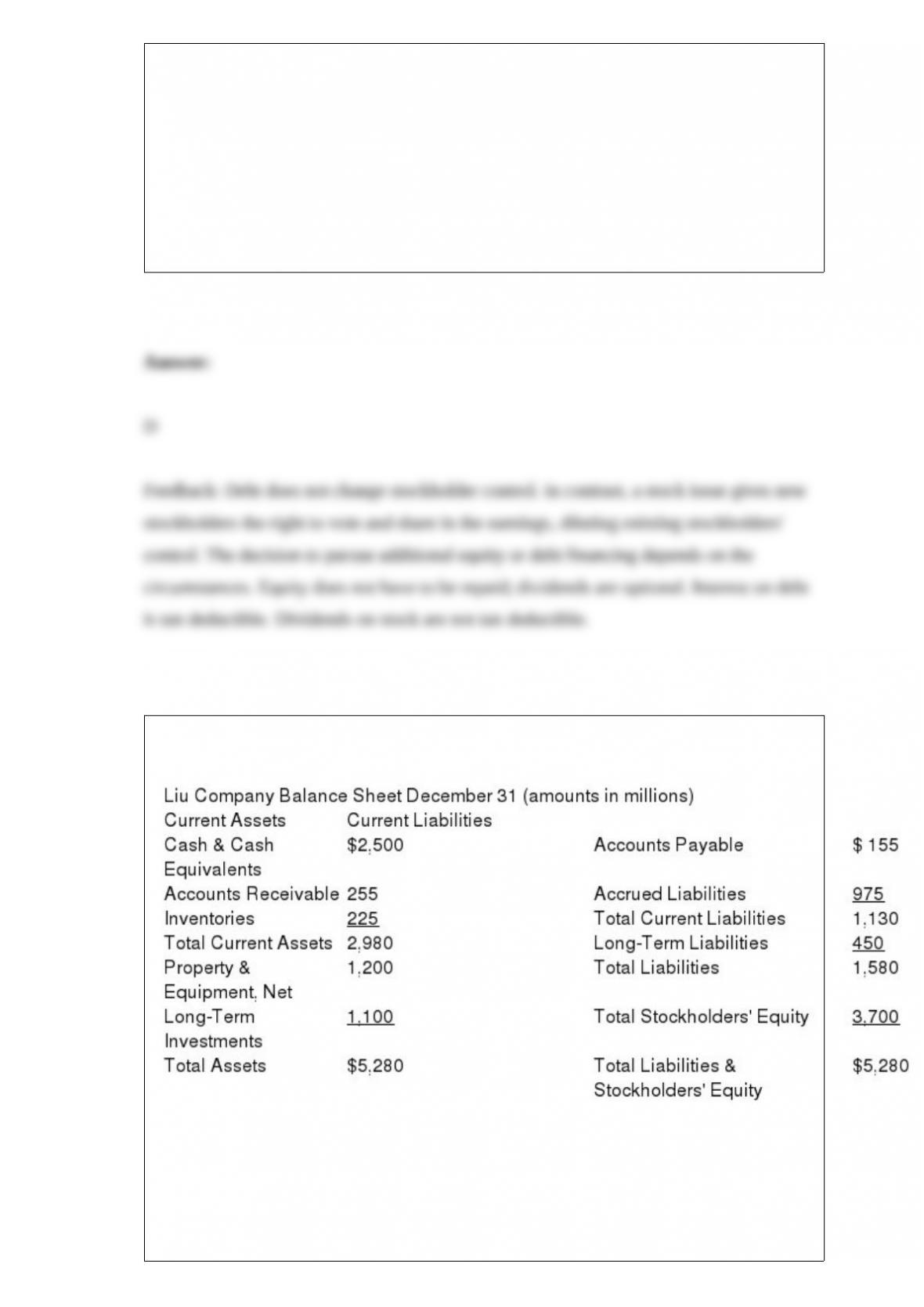
A condensed balance sheet for Liu Company is presented below:
Required:
Part a. Prepare a vertical analysis of the balance sheet above. Round to the nearest
whole percent.
Part b. Interpret your analysis. Identify significant items. Comment on key
relationships.
When several parties can reach similar values in financial statements by using similar
methods, the information is said to be:
A) comparable.
B) understandable.
C) verifiable.
D) timely.
A company sells a bond with a face value of $10,000 and receives a premium of $800.
Using simplified effective-interest amortization, what journal entry is used to record the
issuance of the bonds?
A) Debit Cash for $10,800 and credit Bonds Payable, Net for $10,800
B) Debit Cash for $10,800, credit Bonds Payable, Net for $10,000, and credit Premium
on Bond Payable for $800
C) Debit Cash for $10,000, debit Interest Expense for $800, credit Bonds Payable, Net
for $10,000, and credit Premium on Bonds Payable for $800
D) Debit Cash for $10,000, debit Interest Expense for $800, credit Bonds Payable for
$10,000, and credit Premium on Bonds Payable for $800
A company sells 1 million shares of common stock with no par value for $15 a share. In
recording the transaction, it would debit:
A) Cash and credit Additional Paid-in Capital for $15 million.
B) Cash and credit Common Stock for $15 million.
C) Common Stock and credit Cash for $15 million.
D) Common Stock and credit Additional Paid-in Capital for $15 million.
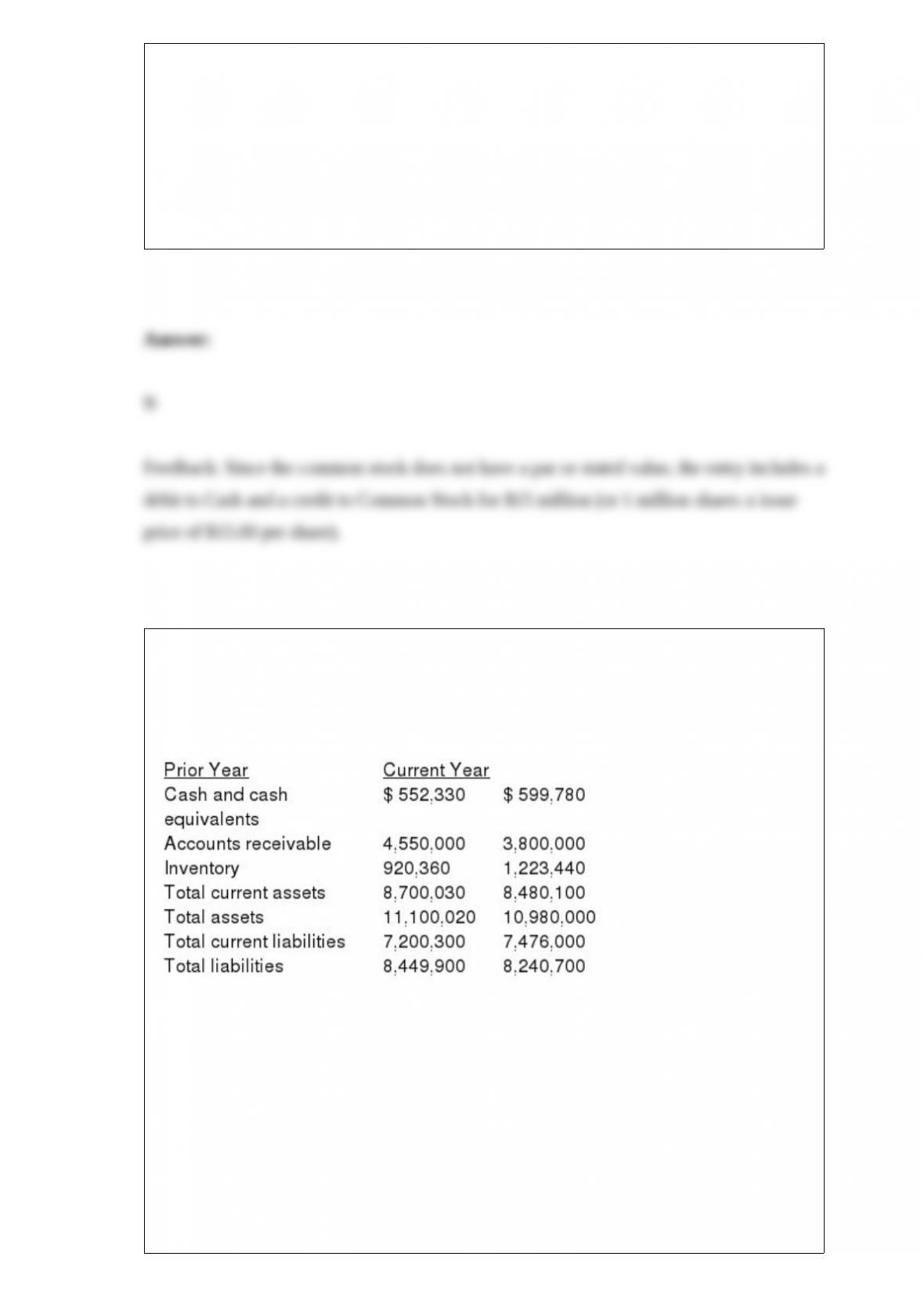
The financial information below presents selected information from the financial
statements of Pelican Company. Sales revenue during the current year was $13,700,300
and cost of goods sold was $8,905,195. All of Pelican’s sales are made on account and
are due within 30 days.
Required:
Part a. Current ratios as of the end of the current and prior year.
Part b. Calculate the receivables turnover ratio for the current year.
Part c. Calculate the days to collect for the current year.
Part d. Calculate the inventory turnover ratio for the current year.
Part d. Calculate the days to sell for the current year.
Part e. Evaluate the company’s liquidity position at the end of the current year. Cite any
additional information not given in the problem that would be helpful in evaluating the
company’s liquidity.
Round all ratios to two decimal places.
Stockholders ‘ equity in a corporation consists of:
A) Amounts invested and reinvested by a company ‘s owners.
B) Resources presently owned by a business that generate future economic benefits.
C) Amounts invested in assets that will be used for one or more years.
D) Amounts presently owed by a business.
Which of the following statements about the benefits enjoyed by the owners of common
stock is not correct?
A) Some classes of common stock can carry more votes than others.
B) Investors in a corporation are called stockholders.
C) Stockholders receive a share of the corporation’s profits when distributed as
dividends.
D) If the company ceases operations, stockholders share in any assets remaining before
creditors have been paid.
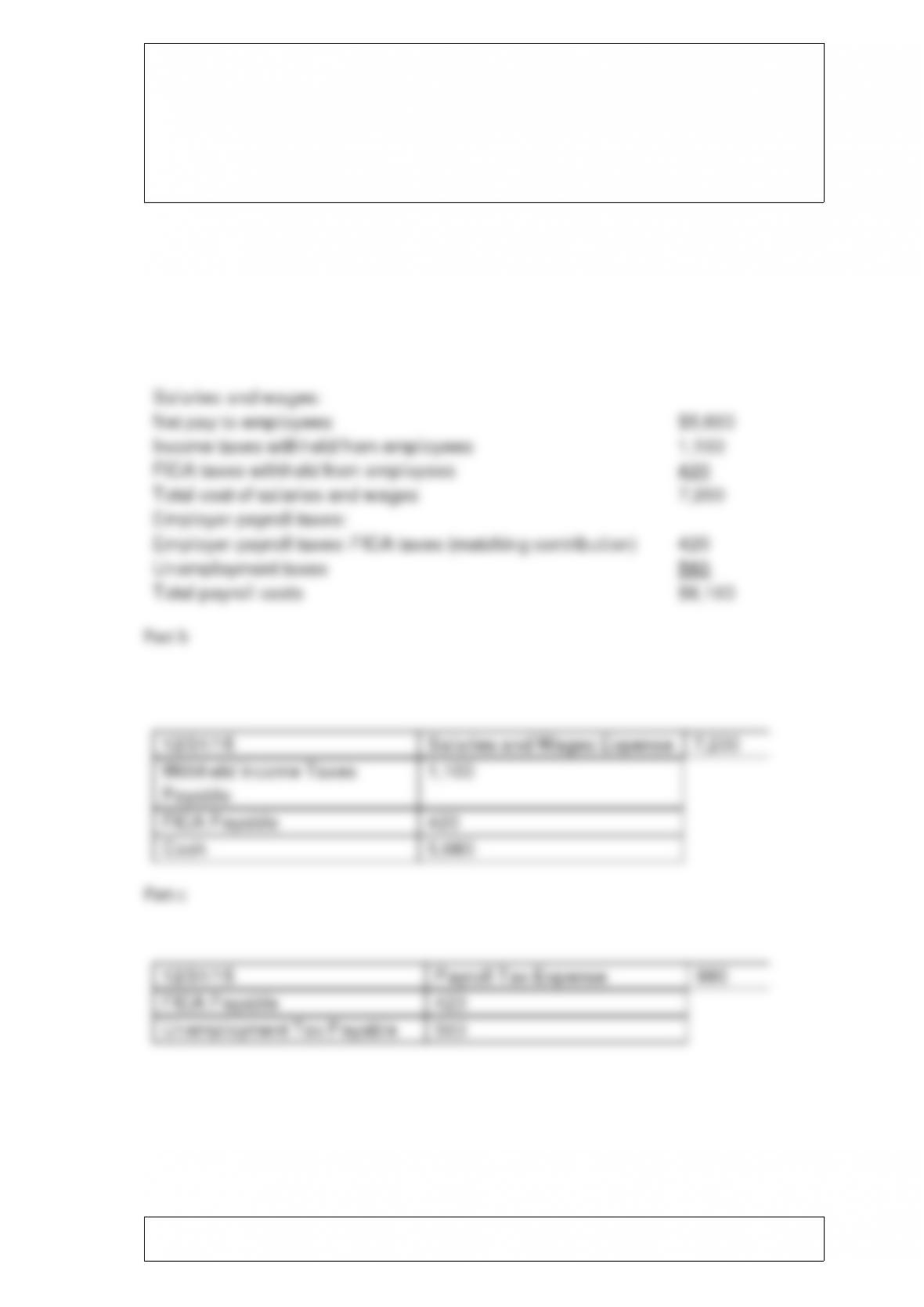
Wade Industries reported the following information in its accounting records on
December 31, 2015:
The employees were paid $5,680 on December 31, 2015, but the withholdings have not
yet been remitted nor have the matching employer FICA contributions.
Required:
Part a. Compute the total payroll costs relating to the period from December 29-31.
(Assume $560 in total unemployment taxes.)
Part b. Show the accounting equation effects and give the journal entries on December
31 to adjust for salaries and wages relating to December 29-31, 2015.
Part c. Show the accounting equation effects and give the journal entries on December
31 to adjust for payroll taxes relating to December 29-31, 2105.
Equipment, beginning of year $170,000
Equipment, end of year 210,000
Accumulated depreciation, beginning of year 95,000
Accumulated depreciation, end of year 92,000
Equipment with a cost of $10,000 and a book value of $3,000 was sold during the year
for cash of $9,000. Additional equipment was purchased during the year for cash.
Use the information above to answer the question below. The company uses the indirect
method in preparing the statement of cash flows. What is the amount of depreciation
expense that will be reported in the operating activities section of the statement?
A) $4,000
B) $11,000
C) $7,000
D) $10,000
When goods are sold to a customer with credit terms of 2/15, n/30, the customer will
receive a:
A) 15% discount if they pay within 2 days.
B) 2% discount if they pay 15% of the amount due within 30 days.
C) 15% discount if they pay within 30 days.
D) 2% discount if they pay within 15 days.
Assume that a perpetual inventory system is in use. Which of the following statements
regarding the journal entries prepared is correct?
A) “Freight-out” or delivery costs associated with sales should be included in Cost of
Goods Sold.
B) When a company receives payment from a customer for a sale, Cash is debited and
Accounts Payable is credited.
C) When a company grants an allowance to a customer, Inventory is credited when
using a perpetual inventory system.
D) When a customer returns inventory, the seller debits Sales Returns & Allowances
under a perpetual inventory system.
In its most basic form, the earnings per share ratio is calculated as:
A) dividends paid on common stock divided by the average number of outstanding
common shares.
B) the difference between net income and preferred dividends divided by the average
number of outstanding common shares.
C) total dividends paid divided by the average number of total stock shares.
D) net income divided by average stockholders’ equity.
Consider each of the following transactions.
Required:
Indicate how each transaction will affect the elements of the accounting equation by
answering increase, decrease, or no effect.
Assets Liabilities Stockholders’ Equity
a. The company uses the direct write-off method and writes off specific receivables that
have been identified as uncollectible.
b. The company uses the allowance method and records the Bad Debt Expense for the
year in an adjusting entry.
c. The company receives a one-year promissory note from a customer in payment of his
account because he needs additional time to pay.
d. The company receives a payment from a different customer on her account; the
account had been previously written off as worthless.
e. The company accrues interest earned on the note received in (c) in an adjusting entry.