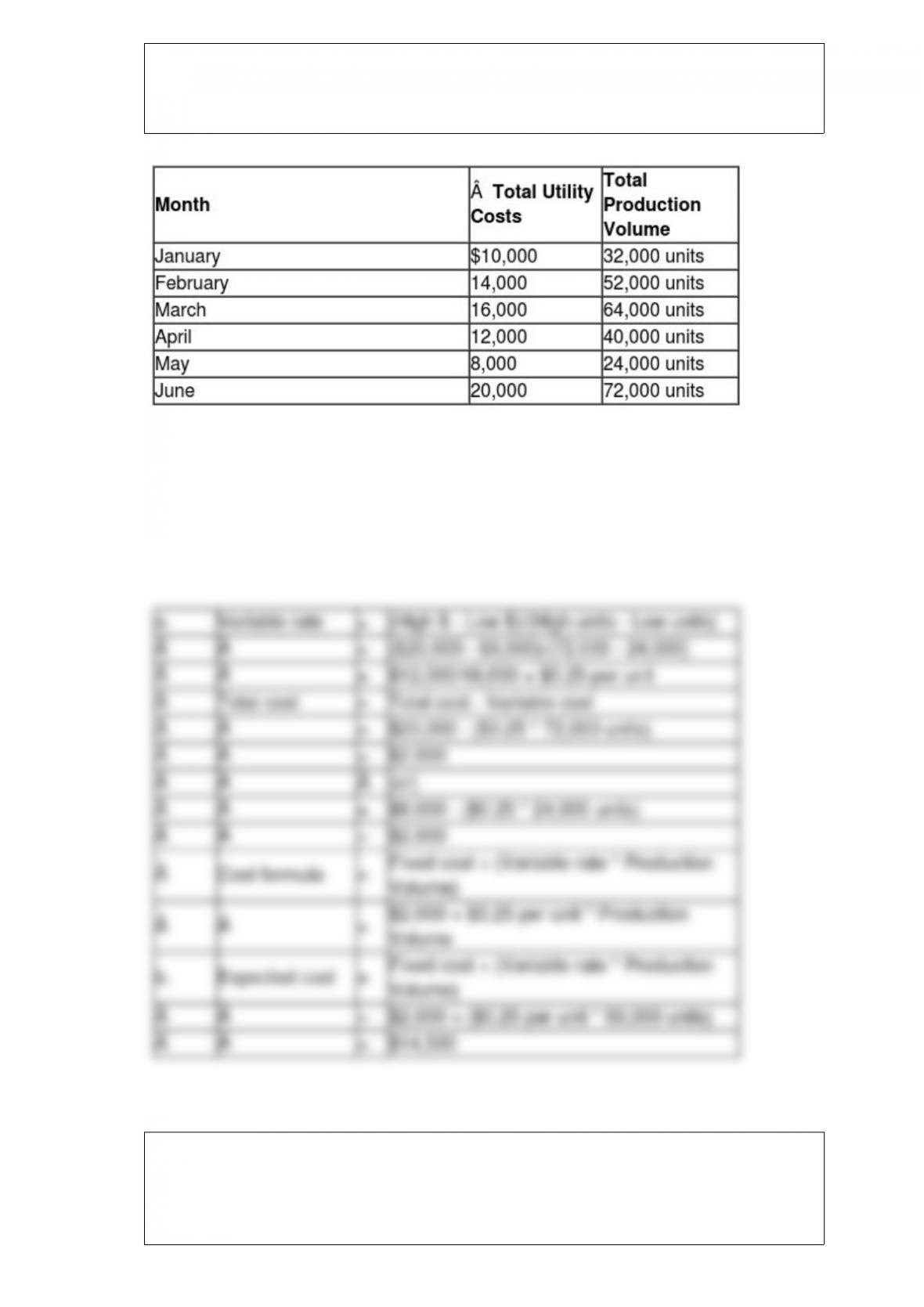
During the months of January through June, the following total utility costs were paid at
various production volumes:
a. Use the high-low method to calculate the cost formula utility costs.
b. If the production volume were expected to be 50,000 units for the month of July, what
amount of total costs would be expected?
When the high-low method of estimating a cost behavior pattern is used:
A. cost and volume data must be reviewed for outliers.
B. the direct result of the high-low calculations is the fixed expense amount.
C. the highest and lowest sales price and volume amounts are used in the calculation.
D. the resulting cost formula will explain total cost accurately for every value between
the high and low volumes.
The net book value of a depreciable asset is:
A. the fair value of the asset.
B. the amount for which the asset should be insured.
C. the difference between the asset’s cost and accumulated depreciation.
D. the difference between the asset’s cost and depreciation expense.
ABC Company’s standard direct labor cost per unit includes 3 hours @ $15 per hour.
During May ABC Company produced 380 units and incurred total labor cost of $16,200
for 1,200 actual direct labor hours worked. ABC’s labor efficiency variance for May is:
A. $0.
B. $900 U.
C. $300 U.
D. $900 F.
Cassady, Inc. borrowed $25,000 for 3 months at an APR of 10%. The amount of interest
paid on this loan was:
A. $1,200
B. $600
C. $625
D. $2.500

Which of the following is an accurate statement regarding a statement of cash flows?
A. Only cash items that affect the income statement are included.
B. Only material cash items that affect the income statement are included.
C. All material operating, investing, and financing activities are included.
D. Immaterial financing activities that affect cash do not need to be included.
The noncurrent Deferred Tax Liability account arises because:
A. some book income will never be subject to income tax.
B. some expenses are deducted for tax purposes before they are deducted for book
purposes.
C. income tax rates change from year to year.
D. the company has not paid income taxes currently due.
The accrual of interest on short-term marketable securities results in:
A. an increase in current assets and a decrease in net income.
B. an increase in current assets and an increase in net income.
C. an increase in noncurrent assets and an increase in liabilities.
D. an increase in current liabilities and an increase in net income.
Preppy Co. makes and sells a single product. The current selling price is $30 per unit.
Variable costs are $21 per unit, and fixed expenses total $90,000 per month. Sales
volume for July totaled 12,000 units.
a. Calculate the operating income for July.
b. Calculate the break-even point in units sold and total revenues.
c. Management is considering the use of automated production equipment. If this were
done, variable costs would drop to $15.00 per unit, but fixed expenses would increase
to $100,000 per month.
(1.) Calculate operating income at a volume of 12,000 units per month with the new
cost structure.
(2.) Calculate the break-even point in units with the new cost structure
The discount rate used to determine the present value of an investment proposal being
analyzed is also known as the:
A. present value ratio.
B. earnings growth rate.
C. payback rate.
D. hurdle rate.
Depreciation on the office equipment would appear in which of the following budgets?
A. production budget.
B. manufacturing overhead budget.
C. operating expense budget.
D. cash budget.
With respect to the write-off of an uncollectible account receivable against the
allowance for bad debts, a sound system of internal control would require:
A. the write-off be approved by two employees.
B. an investigation of why credit was extended to this customer in the first place.
C. a lawsuit to be initiated to recover the uncollectible amount.
D. the write-off to be made within six months after the date of sale.
Use the appropriate factors from Table 6-4 or Table 6-5 to answer the following
questions.
(a.) What is the present value of $100,000 in ten years using a discount rate of 8%?
(b.) How much should be invested today at a return on investment of 16% compounded
annually to have $60,000 in ten years?
Which of the following is(are) an example of a measure of leverage?
A. Debt yield.
B. Debt payout ratio.
C. Preferred dividend coverage ratio.
D. Debt/equity ratio.

The relevant range concept refers to:
A. a firm’s range of profitability.
B. a firm’s range of sales.
C. a firm’s range of rates of return.
D. a firm’s range of activity.
The advantage of a continuous budget is:
A. that it is less costly to produce.
B. that it eliminates the need for annual planning.
C. that it saves time for other management activities.
D. that the final budget for any quarter should be more accurate.
When common stock has a par value:
A. the liability of the stockholders is limited to the par value.
B. there will probably be additional paid-in capital on the balance sheet.
C. the market value of the stock will be higher than if there is no par value.
D. the paid-in capital will equal the par value of the number of shares issued.
The best reason for flexing a budget is to:
A. permit a more accurate determination of variances.
B. revise a budget at the beginning of a period.
C. adjust actual results so they are closer to budgeted amounts.
D. recognize the cost behavior pattern of budgeted amounts.
When borrowing money, the most important objective of the borrower should be to:
A. minimize monthly payments.
B. minimize the APR.
C. avoid borrowing on a discount basis.
D. make the maturity date as far in the future as possible.
When a firm uses the LIFO inventory cost flow assumption:
A. cost of goods sold will be greater than if FIFO were used.
B. net income will be greater than if FIFO were used.
C. cost of goods sold will be the same as if FIFO were used.
D. better matching of revenue and expense is achieved than under FIFO.
ROI used to evaluate the performance of an investment center manager can sometimes
lead to suboptimization. A performance measure designed to avoid the risk of
suboptimization is:
A. operating income.
B. residual income.
C. segment income.
D. the DuPont model.
Depreciation expense is not a cash flow item but it will affect the calculation of which
cash flow item?
A. initial investment.
B. income taxes.
C. salvage value.
D. working capital.
When the firm’s activity requires it to operate at a level above the upper boundary of the
relevant range, fixed expenses are likely to:
A. increase.
B. decrease.
C. remain the same.
D. be eliminated.
A common size income statement:
A. uses the same dollar amount of revenues for each year.
B. expresses items as a percentage of revenues.
C. makes comparisons between years more difficult.
D. is useful in estimating the impact of inflation.
The three components of product costs are:
A. direct material, supervisor salaries, selling expenses.
B. direct labor, manufacturing overhead, indirect material.
C. direct material, direct labor, manufacturing overhead.
D. manufacturing overhead, indirect material, indirect labor.
Common costs pertain to costs that:
A. are directly traceable to a cost object.
B. are not directly traceable to a cost object.
C. are commonly incurred.
D. are direct costs.
A cash equivalent is a current asset that:
A. will be converted to cash within one year.
B. will be converted to cash within one month.
C. is readily convertible into cash with a minimal risk.
D. is readily convertible into cash with a substantial risk.
E. none of the above.
Moped, Inc. purchased machinery at a cost of $44,000 on January 1, 2017. The
expected useful life is 5 years and the asset is expected to have salvage value of $4,000.
Moped depreciates its assets using the double-declining balance method.
What is the firm’s gain or loss if the machinery is sold for $22,000 on December 31,
2018?
A. Gain of $8,000
B. Gain of $6,160
C. Loss of $1,200
D. Loss of $8,000
Which of the following captions would be not be reported on a single step income
statement?
A. Net sales
B. Income from operations
C. Income before taxes
D. Net income
The scattergram allows cost-volume relationships to be visually scanned for outlier
observations that should be:
A. included in the calculation of the cost formula of a mixed cost.
B. ignored in the calculation of the cost formula of a mixed cost.
C. included in the calculation of the fixed cost component of the mixed cost.
D. included in the calculation of the variable rate component of the mixed cost.
In a make or buy decision, which of the following costs would be considered relevant?
A. avoidable costs.
B. unavoidable costs.
C. sunk costs.
D. allocated costs.
Standard costs are used in which of the following phases of the management process?
A. planning.
B. control.
C. organizing.
D. both a and b.
An example of a cost likely to have an indirect relationship with products being
manufactured is:
A. production labor costs.
B. raw material costs.
C. electricity costs for packaging equipment.
D. none of the above.
Once standard costs for products or services have been developed:
A. they must be updated monthly to be useful.
B. they can be used for more than planning and control purposes.
C. they need not be revised unless the product or service is modified.
D. performance reports must be issued if the standards are to be useful.