1) The accounting equation for an agency fund is
A) Current assets – Current liabilities = Fund Balance
B) Assets – Liabilities = Equity
C) Assets = Equity + Liabilities
D) Assets = Liabilities
2) Paris Corporation purchased 80% of the outstanding voting common stock of
Sanders Corporation on January 1, 2011, at a cost of $400,000. The stockholders’ equity
of Sanders Corporation on this date consisted of $200,000 of Capital Stock and
$100,000 of Retained Earnings. Book values were equal to fair values except for land
and inventory. The book value of Sanders’ land was $10,000, and fair value was
$22,000. The book value of Sanders’ inventory was $30,000, and fair value was
$25,000.
Assume Paris’s inventory account had a book value of $40,000 and a fair value of
$44,000 on January 1, 2011 . Using the parent company theory, what was the amount
reported on the consolidated balance sheet for inventories on January 1, 2011?
A) $65,000
B) $66,000
C) $69,000
D) $70,000
3) In a not-for-profit, private university, the federal grant funds given directly to
students for financial aid are an example of
A) a bequest
B) an agency transaction
C) unrestricted revenue
D) a restricted contribution

4) Which statement is correct in describing the rank order of payments as specified by
the Uniform Partnership Act?
A) Payments to partners are ranked equally, regardless of underlying basis
B) Payment to partners with excess capital balances may be placed ahead of payments
to creditors
C) Payments to creditors other than partners are ranked ahead of payments to partners
D) After payments are made to other creditors and partners with loans to the
partnership, payment up to the same amount can be made to partners with capital
interests
5) The fixed assets and long-term liabilities associated with Proprietary Funds are
reported on the
A) financial statements of governmental funds
B) financial statements of fiduciary funds
C) financial statements of proprietary funds
D) financial statements of trust funds
6) If a parent company and outside investors purchase shares of a subsidiary in relation
to existing stock ownership (ratably), then
A) there will be an adjustment to additional paid-in capital if the stock is sold above
book value
B) there will be no adjustment to additional paid-in capital regardless whether the stock
is sold above or below book value
C) there will be an adjustment to additional paid-in capital if the stock is sold below
book value
D) there will be the elimination of a gain
7) An entity which qualified for fresh-start accounting is not required to disclose which
of the following items in their initial financial statements?
A) Adjustments from historical cost of assets and liabilities
B) Amount of debt of the prior entity forgiven
C) Amount of ending retained earnings/deficit of the prior entity
D) Changes to the management team from the prior entity

8) On January 1, 2012 Saffron Co. recorded a $40,000 profit on the upstream sale of
some equipment that had a remaining four-year life under the straight-line depreciation
method. The equipment has no salvage value. Saffron had separate income of $100,000
in 2012 . The parent company, Pommel Incorporated, owns 90% of Saffron. Pommel
would report investment income from Saffron in 2012 of
A) $54,000
B) $63,000
C) $90,000
D) $126,000
9) The collapse of the subprime mortgage market increased the spread between Baa and
default-free US Treasury bonds This is due to
A) a reduction in risk
B) a reduction in maturity
C) a flight to quality
D) a flight to liquidity
10) According to the liquidity premium theory of the term structure, a slightly upward
sloping yield curve indicates that short-term interest rates are expected to
A) rise in the future
B) remain unchanged in the future
C) decline moderately in the future
D) decline sharply in the future
11) A summary balance sheet for the Lemon, Mango, and Nobb partnership appears
below. Lemon, Mango, and Nobb share profits and losses in a ratio of 2:3:5,
respectively.
Assets
Cash$ 100,000
Marketable securities200,000
Inventory125,000
Land100,000
Building-net500,000
Total assets$1,025,000
Equities
Lemon, capital$ 425,000
Mango, capital400,000
Nobb, capital200,000
Total equities$1,025,000
The partners agree to admit Oran for a one-fifth interest. The fair market value of
partnership land is appraised at $200,000 and the fair market value of inventory is
$175,000. The assets are to be revalued prior to the admission of Oran and there is
$30,000 of goodwill that attaches to the old partnership.
By how much will the capital accounts of Lemon, Mango, and Nobb increase,
respectively, due to the revaluation of the assets and the recognition of goodwill?
A) The capital accounts will increase by $50,000 each
B) The capital accounts will increase by $60,000 each
C) $36,000, $54,000, and $90,000
D) $40,000, $50,000, and $60,000
12) A(n) ________ in the liquidity of corporate bonds will ________ the price of
corporate bonds and ________ the yield on corporate bonds, all else equal
A) increase; increase; decrease
B) increase; decrease; decrease
C) decrease; increase; increase
D) decrease; decrease; decrease
13) What basis of accounting is used to prepare Government-wide financial statements?
A) Modified accrual basis
B) Accrual basis
C) Cash basis
D) Fiduciary basis
14) On January 1, 2010, Shrimp Corporation purchased a delivery truck with an
expected useful life of five years, and a salvage value of $8,000. On January 1, 2012,
Shrimp sold the truck to Pacet Corporation. Pacet assumed the same salvage value and
remaining life of three years used by Shrimp. Straight-line depreciation is used by both
companies. On January 1, 2012, Shrimp recorded the following journal entry:
Debit Credit

Cash50,000
Accumulated depreciation18,000
Truck53,000
Gain on Sale of Truck15,000
Pacet holds 60% of Shrimp. Shrimp reported net income of $55,000 in 2012 and Pacet’s
separate net income (excludes interest in Shrimp) for 2012 was $98,000.
In preparing the consolidated financial statements for 2012, the elimination entry for
depreciation expense was a
A) debit for $5,000
B) credit for $5,000
C) debit for $15,000
D) credit for $15,000
15) Pull Incorporated and Shove Company reported summarized balance sheets as
shown below, on December 31, 2011 .
Pull Shove
Current assets$420,000 $210,000
Noncurrent assets670,000 430,000
Total assets $1,090,000$640,000
Current liabilities$230,000$50,000
Long-term debt 350,000 150 000
Stockholders’ equity 510,000 440,000
Total liabilities and equities$1,090,000$640,000
On January 1, 2012, Pull purchased 70% of the outstanding capital stock of Shove for
$392,000, of which $92,000 was paid in cash, and $300,000 was borrowed from their
bank. The debt is to be repaid in 10 annual installments beginning on December 31,
2012, with each payment consisting of $30,000 principal, plus accrued interest.
The excess fair value of Shove Company over the underlying book value is allocated to
inventory (60 percent) and to goodwill (40 percent).
Required: Calculate the balance in each of the following accounts, on the consolidated
balance sheet, immediately following the acquisition.
a.Current assets
b.Noncurrent assets
c.Current liabilities
d.Long-term debt
e.Stockholders’ equity
16) On November 1, 2010, Athom Corporation purchased 5,000 television sets for its
merchandise inventory from Sockk, a South Korean firm, at a total quoted cost of
600,000,000 won (W). On this date, the spot rate for the won was $1 = 1,080W. On the
same day, Athom invested $500,000 cash in a non-interest bearing account with a
Japanese bank, to hedge its exposed liability position. The account payable to Sockk is
due on January 30, 2011 . The exchange rates on December 31, 2010 and January 30,
2011 were $1 = 1,060W, and $1 = 1,030W, respectively. Athom agreed to pay Sockk in
won. The bank deposit made by Athom will be held in won, but will be withdrawn in
dollars by Athom on January 30th. Assume that Athom has a December 31 year-end.
Assume this is a fair value hedge.
Required:
Prepare all the journal entries for Athom Corporation’s General Journal on November 1,
2010, December 31, 2010, and January 30, 2011 . Round entries to the nearest whole
dollar. If no entry is required on a particular date, indicate “No entry” in the General
Journal.
17) The balance sheet of the Maude, Ned, and Oscar partnership on November 1, 2011
(before commencement of partnership liquidation) was as follows:
Cash$12,000Georgia, capital (40%)$36,000
Holly, capital (30%)6,000
Festus, capital (50%)31,000
Total assets$90,000Total liab./equity$90,000
Cash$70,000Accounts payable$42,000
Inventory60,000Notes payable68,000
Loan to Maude10,000Maude, capital(20%)30,000
Loan to Oscar18,000Ned, capital(20%)32,000
Plant assets-net80,000Oscar, capital(60%)66,000
Total assets$238,000Total liab./equity$238,000
Liquidation events in November were as follows:
– All the inventory was sold for $10,000 above book value;
– Plant assets with a book value of $60,000 were sold for $34,000.
Required:
Determine how the available cash on November 31, 2011 should be distributed.
18) Pfeifer Corporation acquired an 80% interest in Stern Corporation several years ago
when the book values and fair values of Stern’s assets and liabilities were equal. At the
time of acquisition, the cost of the 80% interest was equal to 80% of the book value of
Stern’s net assets. Separate company income statements for Pfeifer and Stern for the
year ended December 31, 2011 are summarized as follows:
PfeiferStern
Sales Revenue$1,000,000 $600,000
Investment income from Stern85,000
Cost of Goods Sold(600,000)(300,000)
Expenses(200,000)(200,000)
Net Income$285,000 $100,000
During 2010, Pfeifer sold merchandise that cost $120,000 to Stern for $180,000. Half of
this merchandise remained in Stern’s inventory at December 31, 2010 . During 2011,
Pfeifer sold merchandise that cost $150,000 to Stern for $225,000. One-third of this
merchandise remained in Stern’s December 31, 2011 inventory.
Required:
Prepare a consolidated income statement for Pfeifer Corporation and Subsidiary for
2011 .
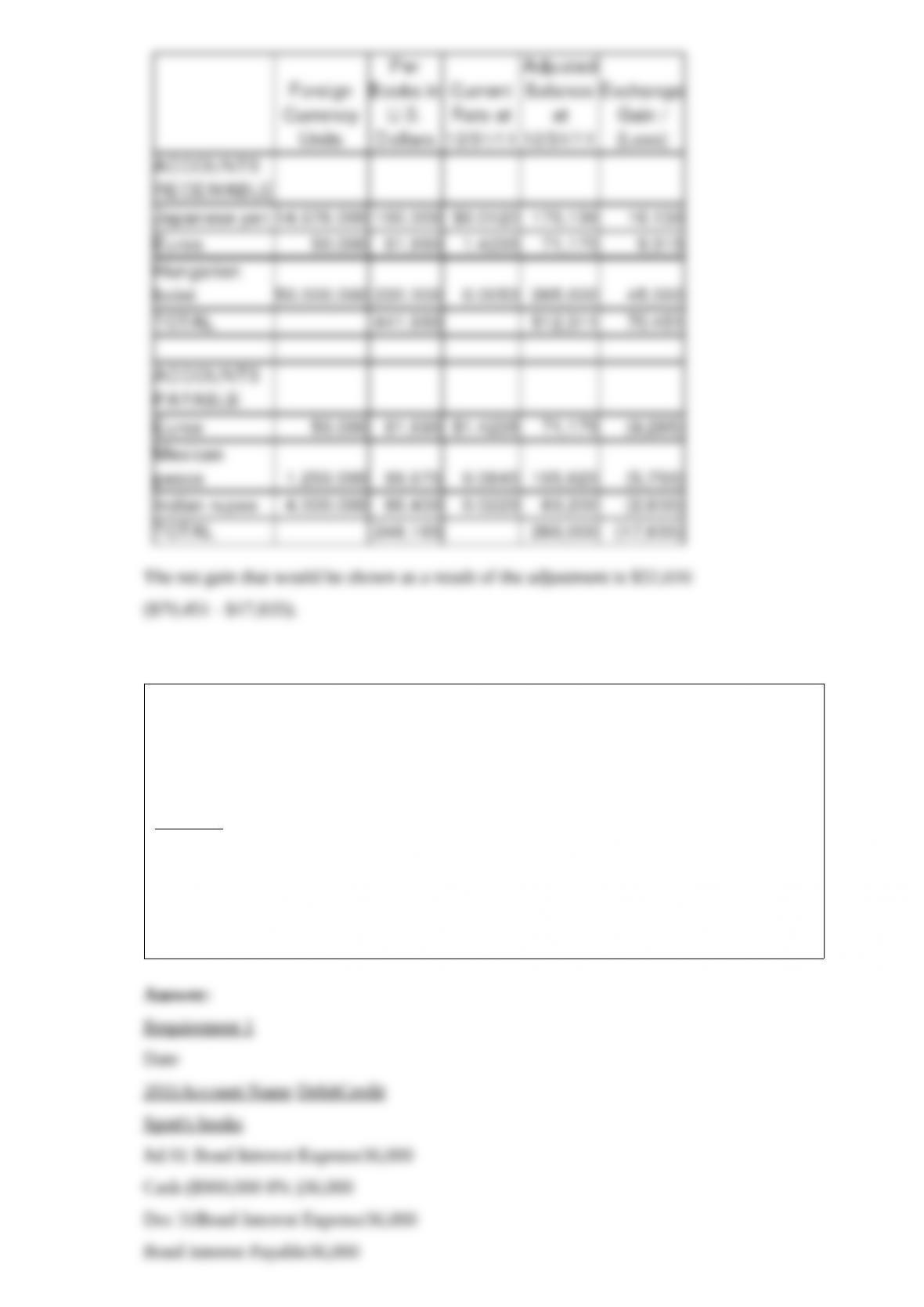
19) Lincoln Corporation, a U.S. manufacturer, both imports needed materials and
exports finished products. Their receivables and payables are listed below, prior to
year-end adjustments or preparation of the closing entries.
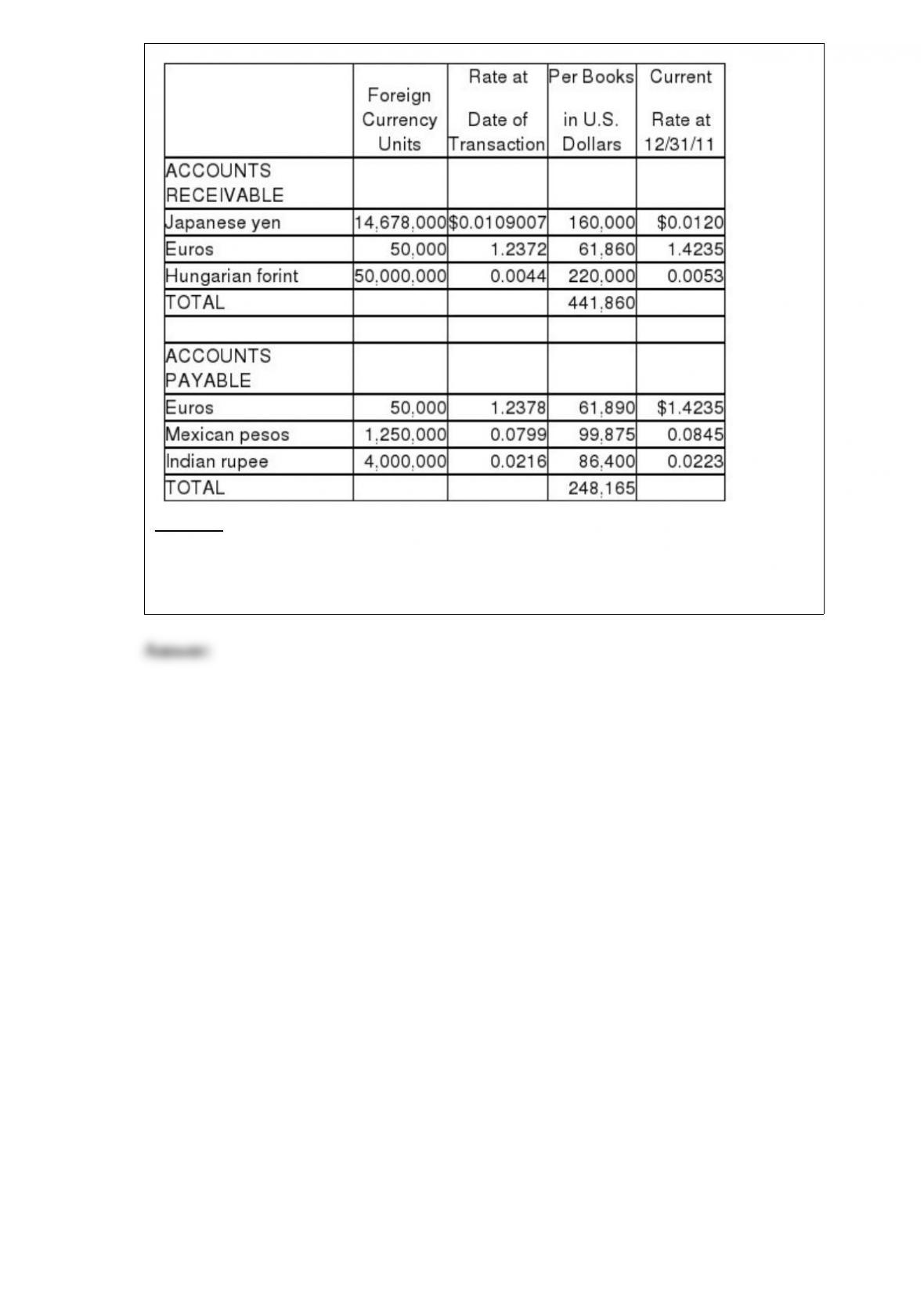
Required:
Determine the amount at which receivables and payables should be reported on
December 31, 2011, and the net exchange gain or loss that would be reported as a result
of year-end adjustments.
20) Spott is a 75%-owned subsidiary of Penthal. On January 1, 2010, Spott issued
$900,000 of $1,000 face amount 8% bonds at par. The bonds have interest payments on
January 1 and July 1 of each year and mature on January 1, 2014 . On July 2, 2011,
Penthal purchased all 900 bonds on the open market for $1,020 per bond. Both
companies use straight-line amortization.
Required:
With respect to the bonds, use General Journal format to:
1>Record the 2011 journal entries from July 1 to December 31 on Spott’s books.
2>Record the 2011 journal entries from July 1 to December 31 on Penthal’s books.
3>Record the elimination entries for the consolidation working papers for the year
ending December 31, 2011 .