1) (Appendix) The direct method of allocating service department costs assigns indirect
costs to products in two stages. In the first stage, production department costs are
allocated to the service departments.
2) Contribution margin is the best measure of the controllable contribution of a profit
center toward organizational profit.
3) If a company is deciding whether to outsource a part, the reliability of the supplier is
an important factor to consider.
4) While costs are measured for individual jobs in a job order costing system, they are
measured for individual process stages in a process costing system.
5) The 40-1 rule demonstrates that the top customers generate revenues at a rate of 40-1
over all other customers.
6) Target costing is a comprehensive approach to profit planning and cost management.
7) Target costing uses the total-life-cycle concept by making it a key goal to minimize
the cost of ownership of a product over its useful life.
8) Management accounting information allows managers to compare actual and
planned costs and to identify areas and opportunities for process improvement.
9) The labor efficiency variance is likely to be favorable if higher-skilled workers are
put on a job.
10) Once the company selects and defines its objectives for the four BSC perspectives,
it can select measures for each objective.
11) Gain sharing is a system for distributing cash bonuses from a pool when the total
amount available is a function of performance relative to some target.
12) Sunk costs are always irrelevant costs for decision making.
13) Unused capacity should be treated as a general cost to be shared across all product
lines.
14) A job that shows low profitability may be the result of all of the following except:
A) inefficient use of direct materials
B) inefficient direct manufacturing labor
C) overpricing the job
D) over-allocating overhead costs
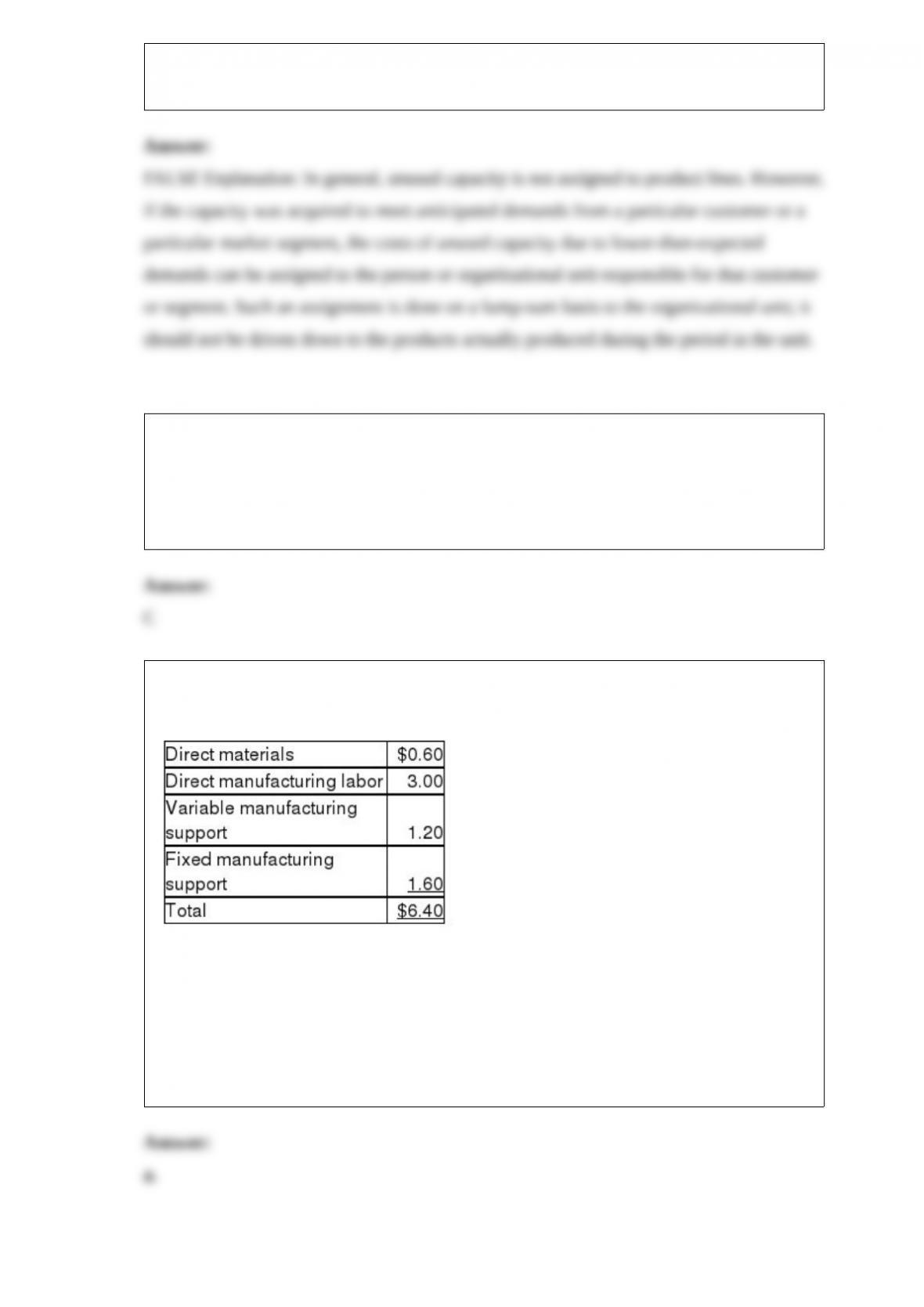
15) Kirkland Company manufactures a part for use in its production. When 10,000 units
are produced, the costs per unit are:
Mike Company has offered to sell to Kirkland Company 10,000 units of the part for
$6.00 per unit. The plant facilities could be used to manufacture another item at a
savings of $9,000 if Kirkland accepts the offer. In addition, $1.00 per unit of fixed
manufacturing support on the original item would be eliminated.
Required:
a. What is the relevant cost per unit for the original part?
b. Which alternative is best for Kirkland Company? By how much?
16) A key element of any organization’s strategy is identifying:
A) its potential shareholders
B) its target customers
C) competitor’s products
D) employee needs
17) The break-even point in units is:
A) total costs divided by variable costs per unit
B) contribution margin per unit divided by revenue per unit
C) fixed costs divided by contribution margin per unit
D) (fixed costs plus variable costs) divided by contribution margin per unit
18) Place the following steps for the implementation of target costing for a product in
order:
A= Derive a target cost
B= Develop a target selling price
C= Perform value engineering
D= Determine target profit margin
A) B D A C
B) B A D C
C) A D B C
D) A B C D
19) Customer profitability:
A) is reflected by gross margin
B) are most accurately measured using traditional costing
C) are most accurately measured using activity based costing
D) are most accurately measured using a combination of traditional costing and activity
based costing
20) ________ describe(s) specifically how success in achieving objectives in a
Balanced Scorecard is determined.
A) Measures
B) The value proposition
C) Targets
D) The Balanced Scorecard
21) ________ bases a period’s expenditure level for a discretionary item on the amount
spent on that item during the previous period.
A) Zero-based budgeting
B) Periodic budgeting
C) Incremental budgeting
D) Continuous budgeting

22) Brilliant Accents Company manufactures and sells three styles of kitchen faucets:
brass, chrome, and white. Production takes 25, 25, and 10 machine hours to
manufacture 1000-unit batches of brass, chrome, and white faucets, respectively. The
following additional data apply:
BRASSCHROME WHITE
Projected sales in units#30,000#50,000#40,000
PER UNIT data:
Selling price$40$20$30
Direct materials$ 8$ 4$ 8
Direct labor$15$ 3$ 9
Overhead cost based on direct labor hours
(traditional system) $12$ 3$ 9
Hours per 1000-unit batch:
Direct labor hours 401030
Machine hours 252510
Setup hours1.00.51.0
Inspection hours 3020 20
Total overhead costs and activity levels for the year are estimated as follows:
ActivityOverhead costsActivity levels
Direct labor hours2,900 hours
Machine hours2,400 hours
Setups$465,50095 setup hours
Inspections$405,0002,700 inspection hours
$870,500
a.Using the traditional cost system, determine the operating profit per unit for each style
of faucet.
b.Determine the activity cost driver rates for setup overhead costs and inspection
overhead costs.
c.Using the ABC system, for each style of faucet:
1> compute the estimated overhead costs per unit; and
2> compute the estimated operating profit per unit.
d.Explain the differences between the profits obtained from the traditional cost system
and the ABC system. Which system provides a better estimate of profitability? Why?
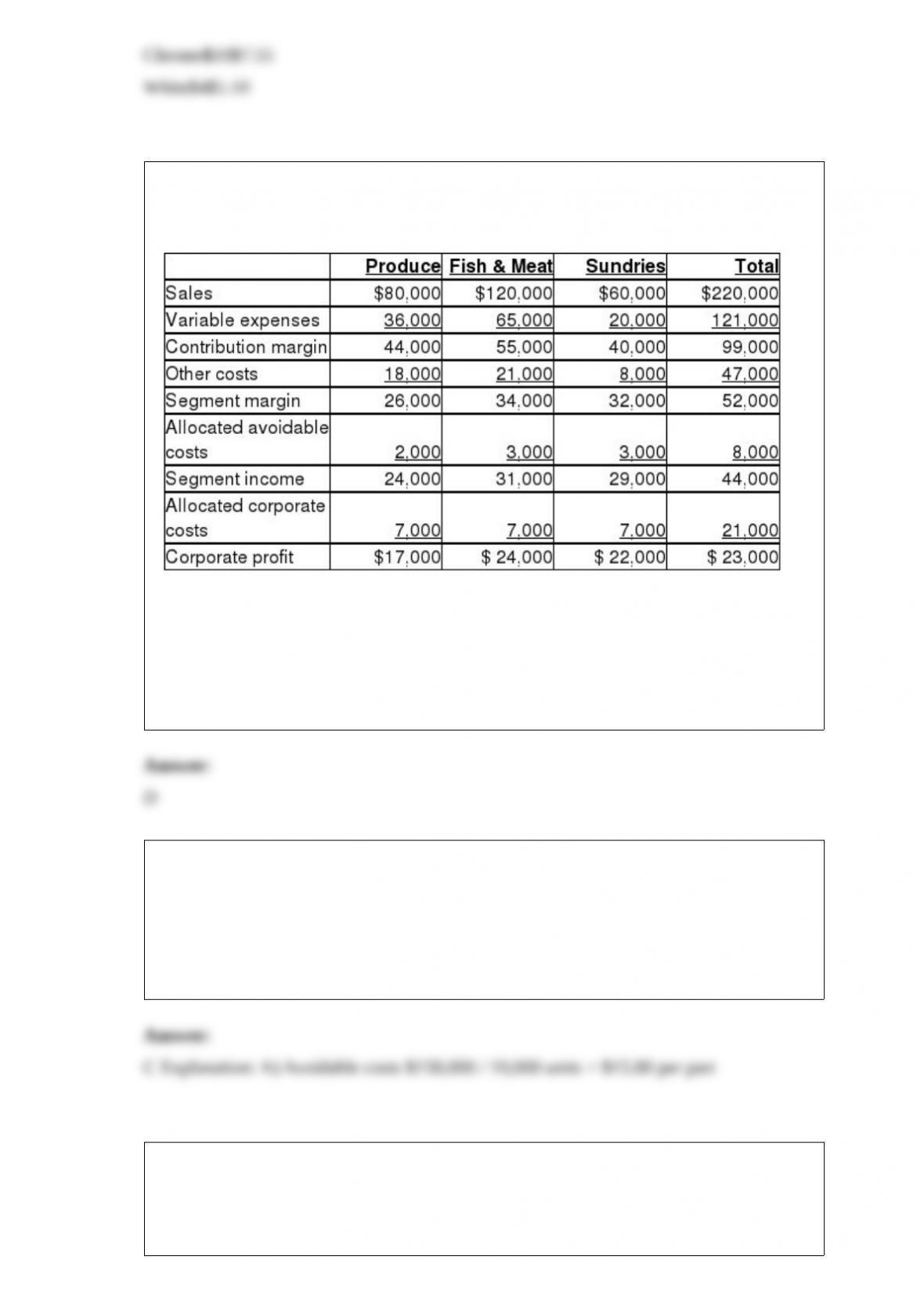
23) The management accountant for the Martino Organics has prepared the following
segmented income statement for the most current year.
If a company subscribes to the controllability principle, then it would be best to
evaluate product line management on:
A) contribution margin
B) corporate profit
C) segment income
D) segment margin
24) The maximum price that Fair Engineering Company should be willing to pay the
outside supplier for each unit of part QE767 is:
A) $10
B) $15
C) $15.80
D) $16
25) Sanchez & Ryan, Inc, sells a single product. This year, 20,000 units were sold
resulting in $130,000 of sales revenue, $60,000 of variable costs, and $17,500 of fixed
costs.
The break-even point in units for a year is:
A) 2,000 units
B) 3,000 units
C) 5,000 units
D) 10,000 units
26) For the next quarter, Charter Manufacturing projects the following information (in
units).
JulyAug.Sept.
Retail demand8,0008,00012,000
Dealer demand16,00020,00024,000
Shop capacity26,00026,00026,000
Painting capacity1242,00024,00024,000
Demand drives production for that month and cannot be carried over from one month to
another. Retail customers are satisfied first.
Required:
a.Prepare a schedule that shows the number of retail and dealer units to be made and
sold each month.
b.Review the above information and comment on your observations. What suggestions
do you have for Charter Manufacturing?
27) For the next six months, Kurtz Company projects the following information (in
units).
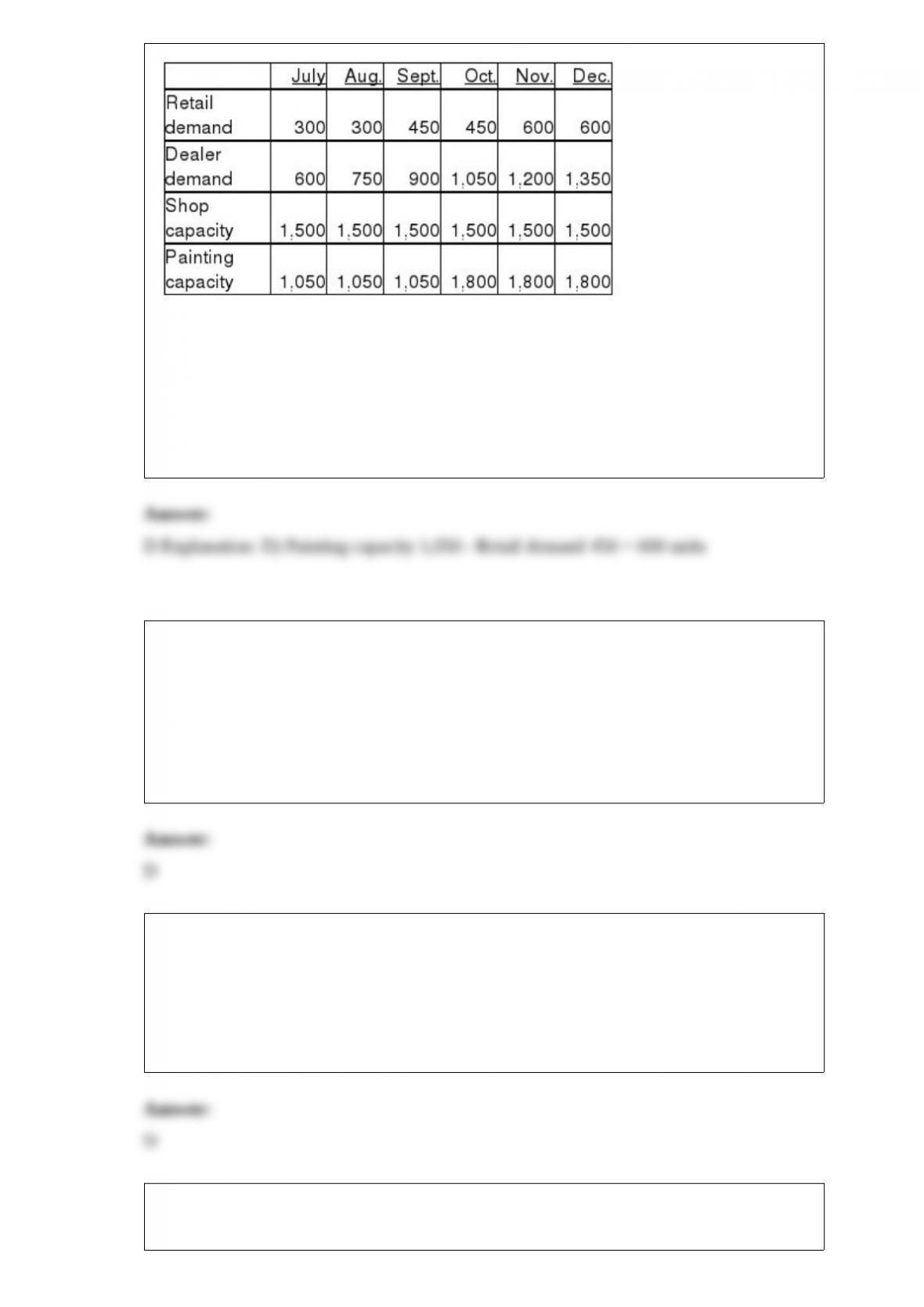
Demand drives production for that month and cannot be carried over from one month to
another. Retail customers are satisfied first.
The number of dealer units that will be produced and sold in September is:
A) 900 units
B) 1,050 units
C) 1,500 units
D) 600 units
28) All the statements below are true regarding Kaizen costing EXCEPT that:
A) cost-variance analysis compares target Kaizen costs with actual cost reduction
amounts
B) cost reductions apply to all variable costs
C) workers are assumed to have the best knowledge to improve processes and reduce
costs
D) cost reduction targets are set and applied on an annual basis
29) The relevance of information in a MACS includes providing all of the following
EXCEPT:
A) the most accurate information possible
B) a global framework that can be applied uniquely to each division or unit
C) feedback on performance measures in a timely fashion
D) different costing methods for each division
30) The dimensions of motivation that are important in designing jobs and specific task
include all of the following EXCEPT:
A) persistence
B) control
C) direction
D) intensity
31) ________ are generally written as action phrases and may also include the means
and desired results.
A) Mission statements
B) Objectives
C) Targets
D) Strategies
32) Measure of financial control highlight:
A) falling profits
B) poor quality
C) high prices
D) unsatisfactory service
33) Knowledge-based pay for employees is a form of:
A) input-based reward
B) output-based reward
C) outcome-based reward
D) None of the above is correct
34) All of the following are true regarding the labor hiring and training plan EXCEPT
that it:
A) may include retraining plans to redeploy employees to other parts of the
organization
B) determines discretionary spending for research and development
C) works backward from the date when personnel are needed
D) can include plans for both expansion and contraction
35) ________ include the cost of raw-materials inspections and assembly-line
inspections.
A) Prevention costs
B) Appraisal costs
C) Internal failure costs
D) External failure costs
36) Return on investment (ROI) can be increased by:
A) increasing sales
B) decreasing operating assets
C) decreasing operating income
D) decreasing asset turnover
37) When a change is introduced, employees tend to:
A) embrace the change
B) be indifferent to the change
C) exhibit no change in behavior
D) resist the change
38) Under reciprocal cost allocation method:
A) the first step is to develop a reciprocal cost equation
B) the first step is to allocate the service department costs to the production departments
C) one service department is chosen to allocate costs first
D) service department costs are allocated directly to the production departments
39) A company produces three products; if one product is undercosted then:
A) one product is overcosted
B) one or two products are overcosted
C) two products are overcosted
D) no products are overcosted
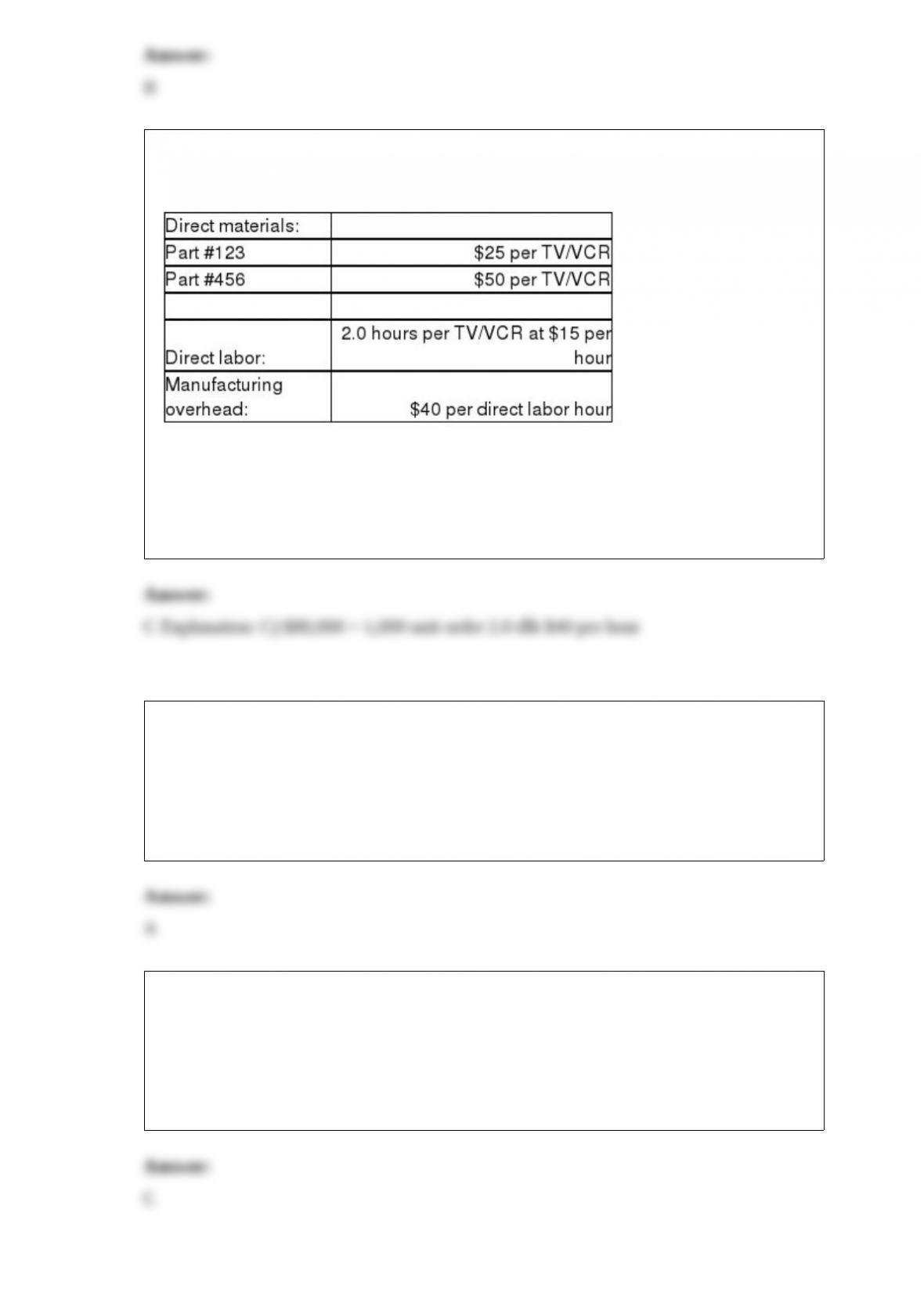
40) Wisconsin Electronics has received an order for 1,000 specially designed TV/VCR
combinations. The following standards were compiled for this order:
The estimated manufacturing overhead cost assigned to this order totals:
A) $30,000
B) $40,000
C) $80,000
D) $115,000
41) Emerging customer needs are assessed and ideas generated for new products during
the ________ stage of research, development, and engineering.
A) market research
B) product design
C) product development
D) service
42) The ________ perspective of the Balanced Scorecard asks, “How is success
measured by our shareholders?”
A) learning and growth
B) customer
C) financial
D) shareholder
43) Sun Inc. sells a single product. The company’s 2012 income statement is given
below.
Sales (4,000 units) $800,000
Less flexible (variable) expenses $200,000
Less capacity-related (fixed) expenses $300,000
In an attempt to improve performance, Jo, the manager is considering a number of
alternative actions. Each situation is to be evaluated separately.
Required:
a. Calculate operating income and the break-even point in units and dollars for 2012
b. Jo believes that a $100,000 increase in equipment improvements will increase sales
considerably. How much must sales increase to justify this capital expenditure?
c. Jo believes that flexible costs can be decreased by 10%. As a result, she wants to
reduce the selling price by 2% in anticipation of a 5% increase in sales. What are
projected profits if these proposals are implemented?
44) Describe operating and financial budgets and give at least two examples of each
that are discussed in the textbook.
45) Compare target costing and Kaizen costing.
46) In general, factories producing a more varied and complex mix of products have
higher costs than factories producing only a narrow range of products. Explain why this
is generally true.
47) Explain when a manager would use what-if analysis.
48) Are sunk costs considered relevant when choosing among alternatives? Explain.
49) Does adding more cost pools always result in better overhead costs estimates? Why
or why not?
50) Based on the following company data, what is the net promoter score?
ScoreNumber of Responses
102,564
95,060
85,016
7912
62,192
51,972
41,428
3252
2168
1 436
20,000
51) What is stretch budgeting? Why is it used?
52) Explain why it is important to integrate the organizational code of ethics into the
management accounting and control system.
53) How are cost drivers selected in activity-based costing systems?