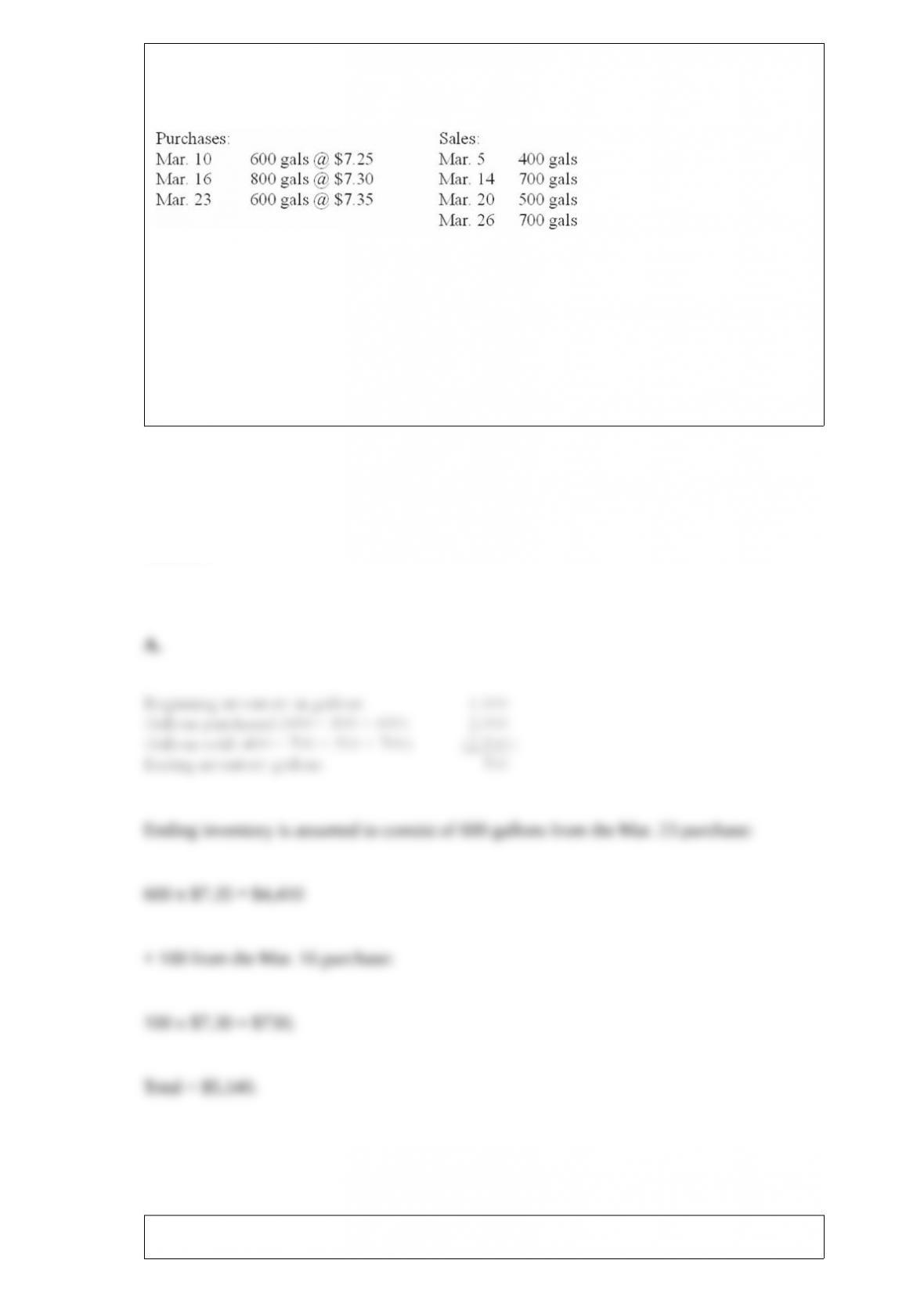
Inventory records for Herb’s Chemicals revealed the following:
March 1, 2013, inventory: 1,000 gallons @ $7.20 = $7,200
The ending inventory assuming FIFO is: A. $5,140.
B. $5,080.
C. $5,060.
D. $5,050.
Answer:
Short Corporation purchased Hathaway, Inc., for $52,000,000. The fair value of all

Hathaway’s identifiable tangible and intangible assets was $48,000,000. Short will
amortize any goodwill over the maximum number of years allowed. What is the annual
amortization of goodwill for this acquisition? A. $100,000.
B. $400,000.
C. $200,000.
D. $0.
Answer:
Cain Corporation owns $10,000 of IBM bonds. Some bonds are held for immediate
sale, but others are held in terms of long-term appreciation. Which of the following is
true about how Cain should account for this investment? A. Cain should account for all
the bonds as FV-NI.
B. Cain should account for all the bonds as FV-OCI.
C. Cain should determine the primary business purpose of the bonds, and account for
the bonds according to that purpose, as all of a particular type of debt should be
accounted for the same way.
D. Cain should determine the business purpose of each bond, and account for it
according to that business purpose.
Answer:

The FASB’s standard-setting process includes, in the correct order: A.Exposure draft,
research, discussion paper, Accounting Standards Update.
B.Research, exposure draft, discussion paper, Accounting Standards Update.
C.Research, discussion paper, exposure draft, Accounting Standards Update.
D.Discussion paper, research, exposure draft, Accounting Standards Update.
Answer:
Which of the following is a characteristic of a contract for purposes of revenue
recognition? A. Nonverbal.
B. Reasonable profit margin.
C. Notarized within the company’s state of incorporation.
D. Commercial substance.
Answer:

The common stock account in a company’s balance sheet is measured as: A. The
number of common shares outstanding multiplied by the stock’s par value per share.
B. The number of common shares outstanding multiplied by the stock’s current market
value per share.
C. The number of common shares issued multiplied by the stock’s par value per share.
D. None of the above is correct.
Answer:
Masterlink Co., in applying the lower of cost or market method, reports its inventory at
net realizable value. Which of the following statements is correct?
A. Option a
B. Option b
C. Option c
D. Option d
Answer:

Indiana Co. began a construction project in 2013 that will provide it $150 million when
it is completed in 2015. During 2013, Indiana incurred $36 million of costs and
estimates an additional $84 million of costs to complete the project.
Using the percentage-of-completion method, Indiana: A. Recognized no gross profit or
loss on the project in 2013.
B. Recognized $6 million loss on the project in 2013.
C. Recognized $9 gross profit on the project in 2013.
D. Recognized $36 million loss on the project in 2013.
The project is expected to make a gross profit of $30 million (i.e., $150 million – $36
million – $84 million) and the % completed is 30% (i.e., $36 million/$120 million).
Therefore, 30% x $30 million = $9 million.
Answer:
Which of the following describes defined benefit pension plans? A. They raise few
accounting issues for employers.
B. Retirement benefits depend on how much money has accumulated in an individual’s
account.
C. They are simple to construct.
D. Retirement benefits are based on the plan benefit formula.

Answer:
Gains and losses can occur with pension plans when:A. Either the PBO or the return on
plan assets turns out to be different than expected.
B. Either the ABO or the return on plan assets turns out to be different than expected.
C. Either the PBO, the ABO, or the return on plan assets turns out to be different than
expected.
D. Either the PBO or the ABO turns out to be different than expected.
Answer:
Which of the following is not usually part of the pension formula under a defined
benefit plan? A. Age at retirement.
B. Number of years of service.
C. Seniority at time of retirement.
D. Compensation level.
Answer:

The single accounting number in the annual report that receives the most attention by
investors is: A. Total revenue.
B. Book value per share.
C. Equity per share.
D. Earnings per share.
Answer:
Under the retail method, the denominator in the cost-to-retail percentage does not
include: A. Purchases.
B. Purchase returns.
C. Abnormal shortages.
D. Freight-in.
Answer:
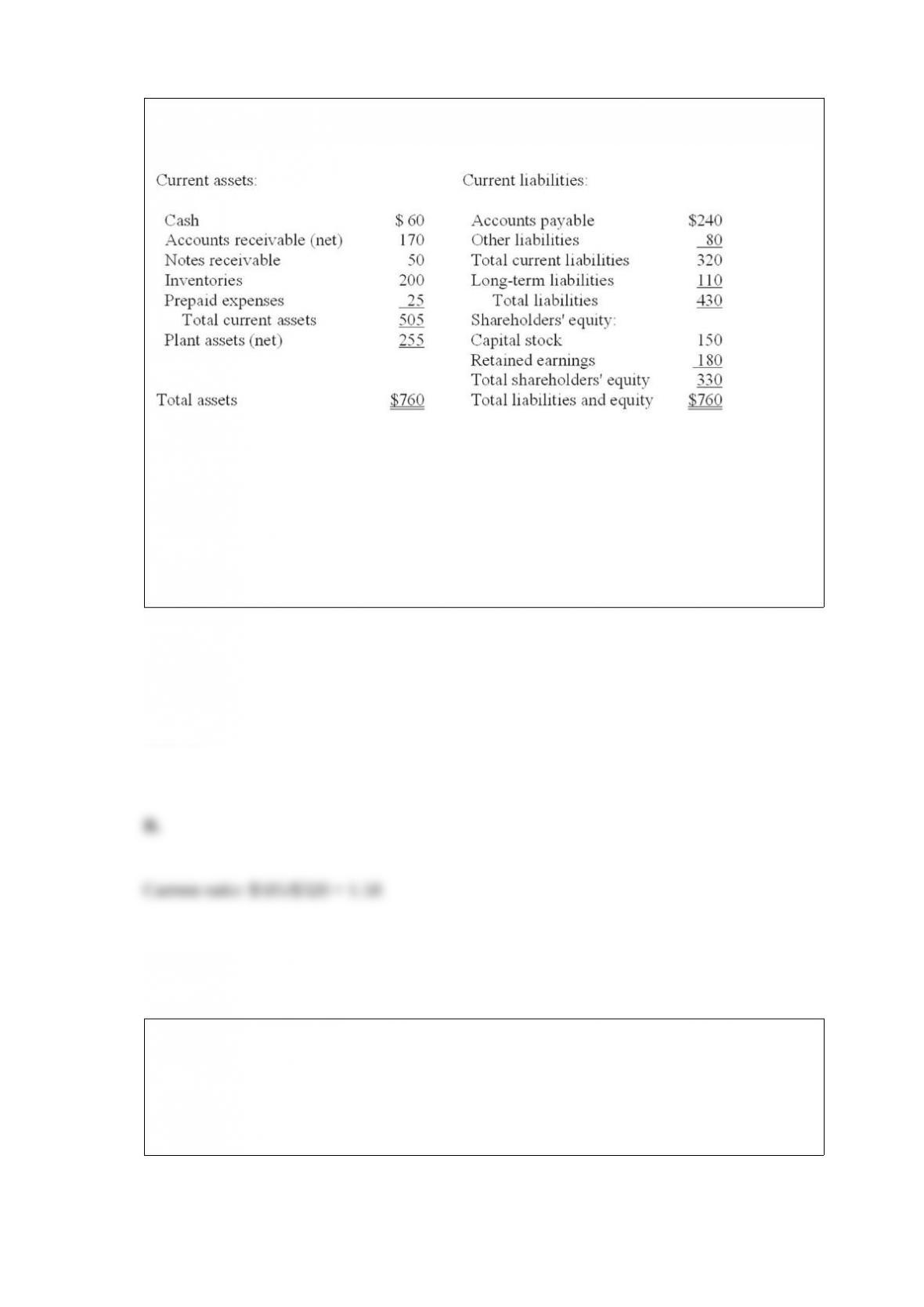
The following partial balance sheet ($ in thousands) for Paisano Seafood Inc. is shown
below.
The current ratio is (rounded): A. 1.98.
B. 1.58.
C. 1.17.
D. 0.66.
Answer:
(a.) What is the most significant change in operating cash outflow activity in 2012
relative to 2011?
(b.) What balance sheet accounts would likely have changed during 2012 in relation to
the cash flow change that you identify in (a)?

Answer:
Rebound Inc. reports under IFRS. In 2013 Rebound recognized an impairment of
$200,000 due to a troubled debt restructuring. In 2014 Rebound was pleased to
determine that more cash flows would be received from the receivable than was
previously thought, such that, if the total impairment were to be calculated in 2014, it
would be estimated as $150,000 rather than $200,000. How should Rebound treat this
in its 2014 income statement? A. Rebound should ignore the change, given that
recovery of its previous impairments is not allowed under IFRS.
B. Rebound should make a prior period adjustment of 2013 income, given that the
impairment charge was in error.
C. Rebound should recognize an increase in 2014 net income of $50,000.
D. None of the above is correct.
Answer:
Refer to the following lease amortization schedule. The 10 payments are made annually
starting with the inception of the lease. Title does not transfer to the lessee and there is
no bargain purchase option or guaranteed residual value. The asset has an expected
economic life of 12 years. The lease is noncancelable.
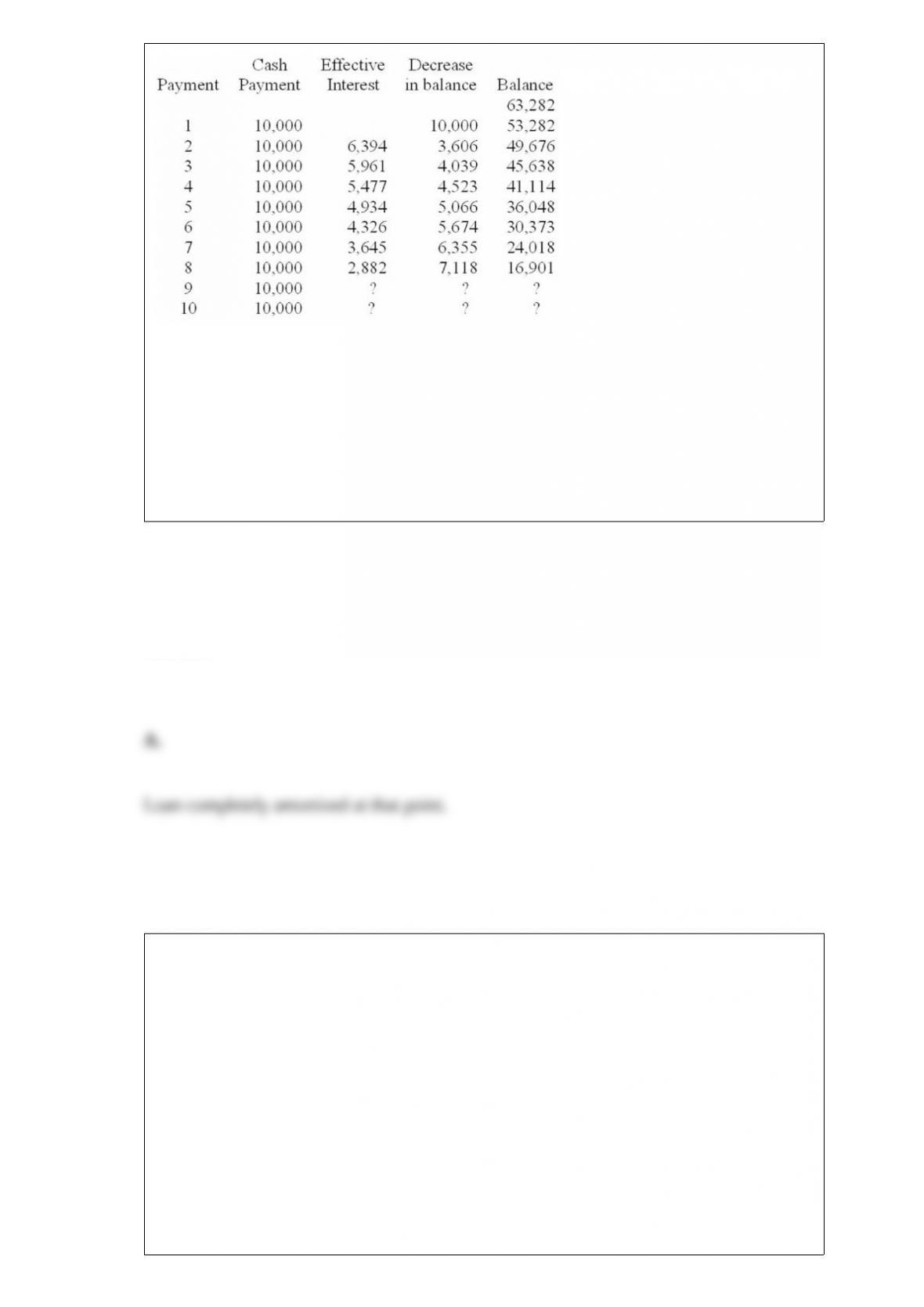
What would be the outstanding balance after payment 10? A. $0.
B. $2,028.
C. $8,929.
D. $10,000.
Answer:
Listed below are five terms followed by a list of phrases that describe or characterize
each of the terms. Match each phrase with the correct term. 1) Prospective approach
2) Changes in accounting principle
3) Changes in reporting entity
4) Error corrections
5) Disclosure note
A. The approach now used for changes in depreciation methods

B. Required for all material accounting changes and error corrections
C. Accounting changes always handled retrospectively
D. Most are handled under the retrospective approach
E. Involves consolidated financial statements
Answer:
In a perpetual inventory system, the cost of purchases is debited to: A. Purchases.
B. Cost of goods sold.
C. Inventory.
D. Accounts payable.
Answer:
Due to an error in computing depreciation expense, Crote Corporation understated
accumulated depreciation by $60 million as of December 31, 2013. Crote has a tax rate
of 40%. Crote’s retained earnings as of December 31, 2013, would be: A. Overstated by
$36 million.
B. Understated by $36 million.

C. Overstated by $24 million.
D. Understated by $24 million.
Answer:
Two independent situations are described below. Each involves future deductible
amounts and/or future taxable amounts produced by temporary differences:
The enacted tax rate is 40% for both situations.
Required:
For each situation determine the:
(a.) Income tax payable currently.
(b.) Deferred tax asset – balance at year-end.
(c.) Deferred tax asset change dr or (cr) for the year.
(d.) Deferred tax liability – balance at year-end.
(e.) Deferred tax liability change dr or (cr) for the year.
(f.) Income tax expense for the year.
Answer:

On December 31, 2013, the end of Larry’s Used Cars’ first year of operations, the
accounts receivable was $53,600. The company estimates that $1,200 of the year-end
receivables will not be collected. Accounts receivable in the 2013 balance sheet will be
valued at: A. $53,600.
B. $54,800.
C. $52,400.
D. $1,200.
Answer:
Goodwill is: A. Amortized over the greater of its estimated life or 40 years.
B. Only recorded by the seller of a business.
C. The excess of the fair value of a business over the fair value of all net identifiable
assets.
D. None of the above.
Answer:
Listed below are five independent situations. For each situation indicate (by letter)
whether it will create (A) a deferred tax asset, (L) a deferred tax liability, or (N) neither.
Answer:
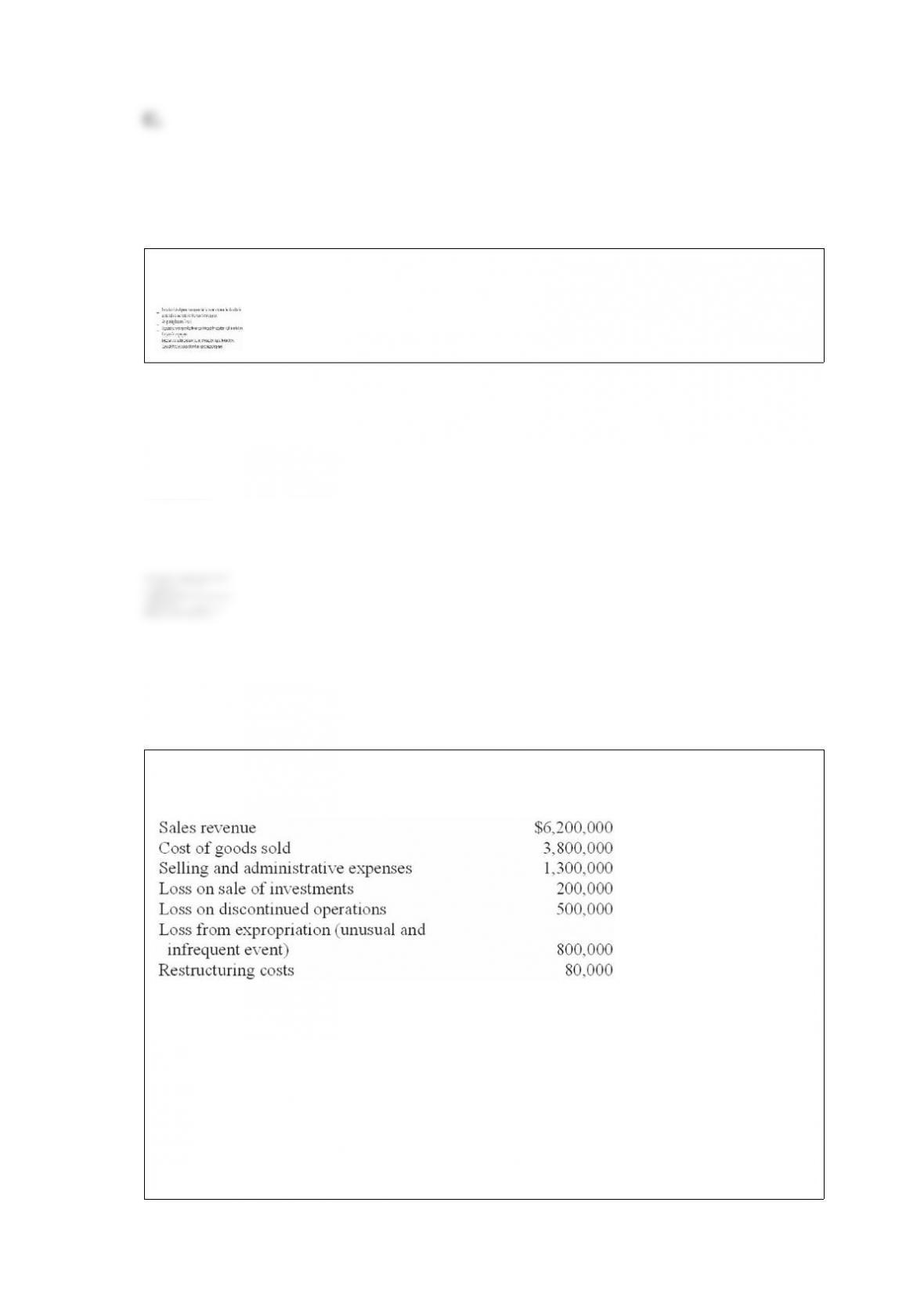
Cendant Corporation’s results for the year ended December 31, 2013, include the
following material items:
Cendant Corporation’s income from continuing operations before income taxes for 2013
is: A. $900,000.
B. $880,000.
C. $820,000
D. $320,000.
Answer:
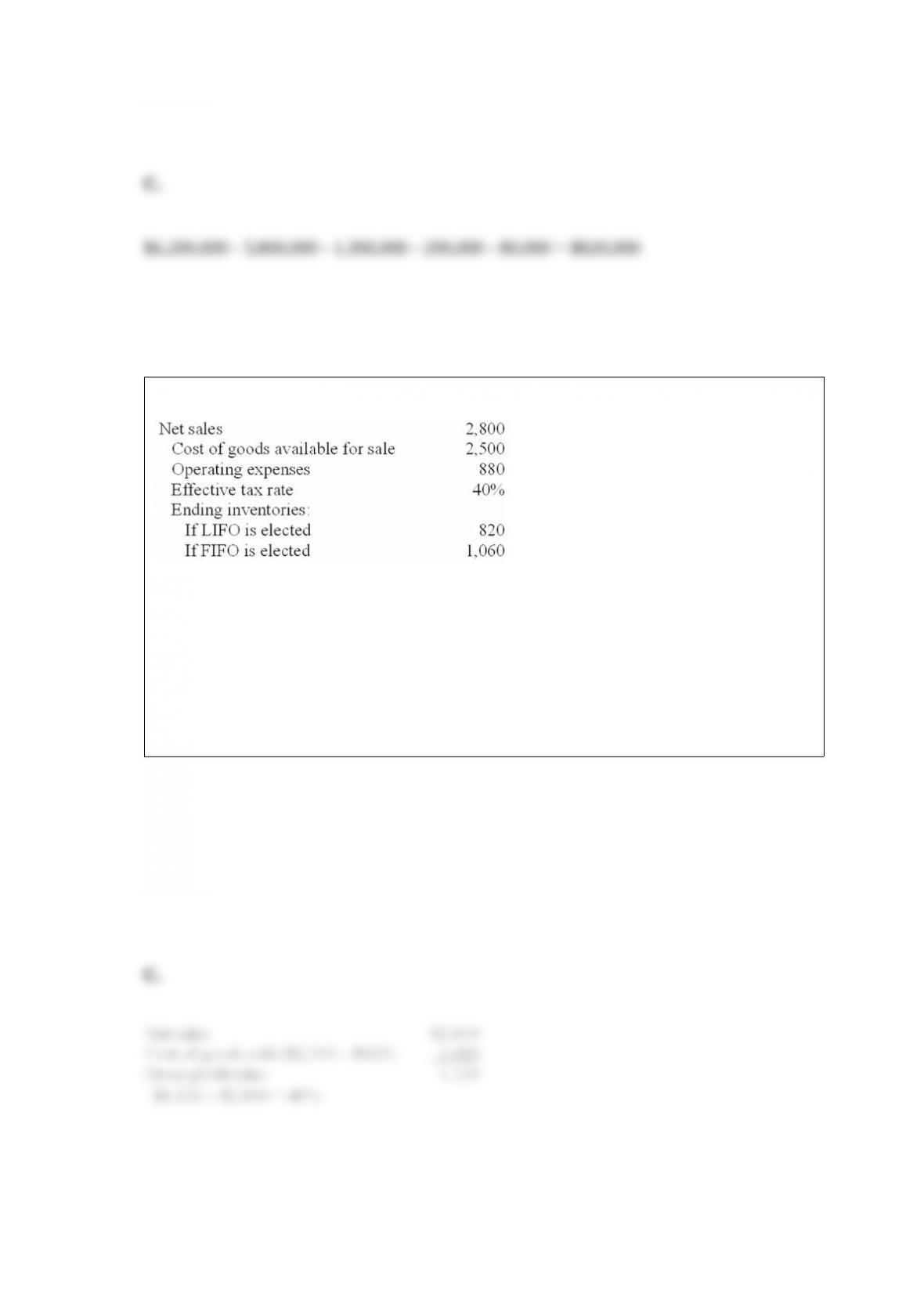
Nu Company reported the following pretax data for its first year of operations.
What is Nu’s gross profit ratio if it elects LIFO? A. 80%.
B. 49%.
C. 40%.
D. 5%.
Answer:

Which of the following changes would not be accounted for using the prospective
approach? A. A change to LIFO from average costing for inventories.
B. A change from the individual application of the LCM rule to aggregate approach.
C. A change from straight-line to double-declining balance depreciation.
D. A change from double-declining balance to straight-line depreciation.
Answer:
Comprehensive income is the change in equity from: A. Owner transactions.
B. Nonowner transactions.
C. Owner or nonowner transactions.
D. Capital transactions.
Answer:
The inventory method that will always produce the same amount for cost of goods sold
in a periodic inventory system as in a perpetual inventory system would be: A. FIFO.
B. LIFO.

C. Weighted average.
D. None of the above.
Answer:
Under its executive stock option plan, N Corporation granted options on January 1,
2013, that permit executives to purchase 15 million of the company’s $1 par common
shares within the next eight years, but not before December 31, 2015 (the vesting date).
The exercise price is the market price of the shares on the date of grant, $18 per share.
The fair value of the options, estimated by an appropriate option pricing model, is $4
per option. No forfeitures are anticipated. Ignoring taxes, what is the effect on earnings
in the year after the options are granted to executives? A. $0.
B. $20 million.
C. $60 million.
D. $90 million.
Answer:
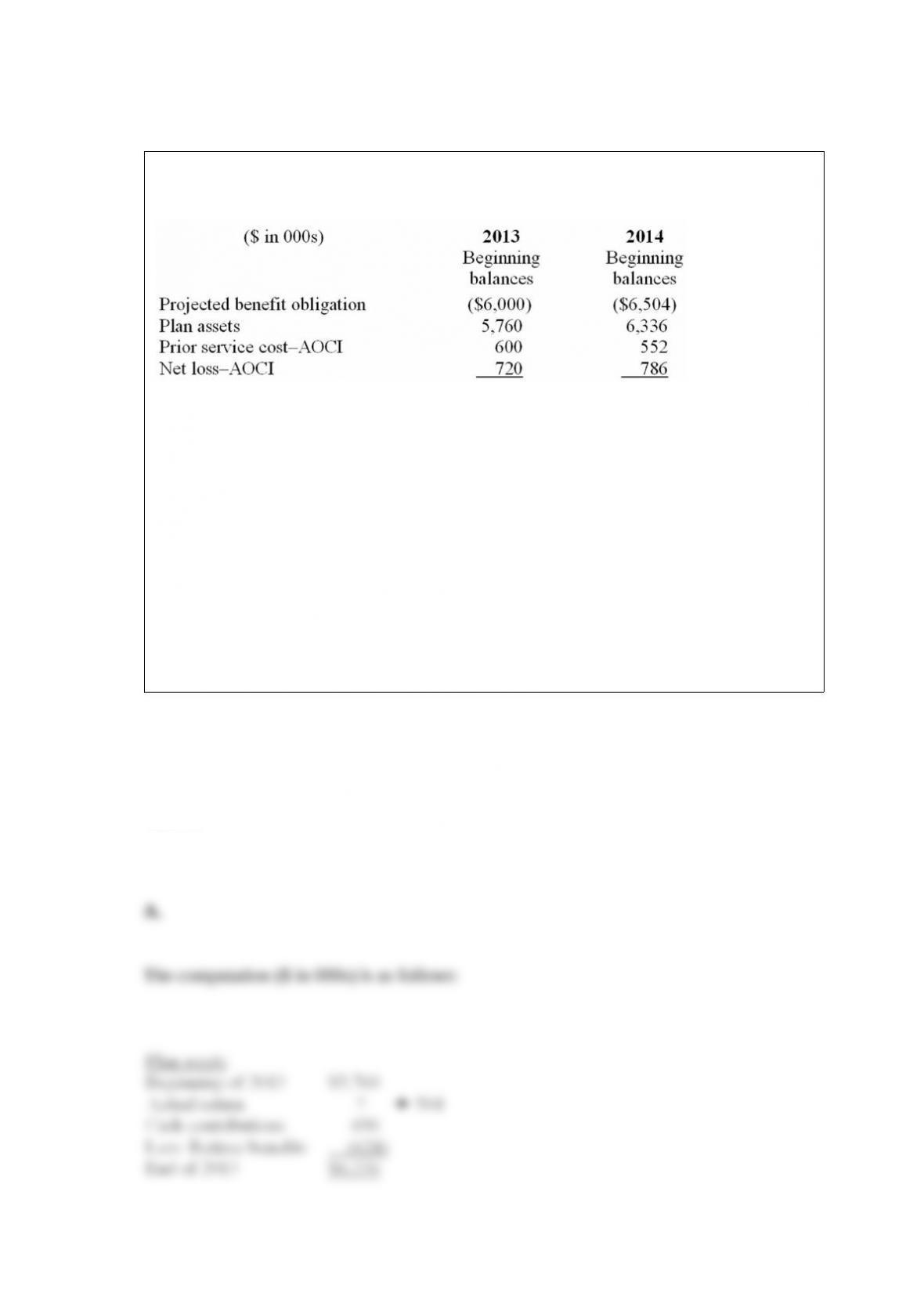
The following information pertains to Havana Corporation’s defined benefit pension
plan:
At the end of 2013, Havana contributed $696 thousand to the pension fund and benefit
payments of $624 thousand were made to retirees. The expected rate of return on plan
assets was 10%, and the actuary’s discount rate is 8%. There were no changes in
actuarial estimates and assumptions regarding the PBO.
What is Havana’s 2013 actual return on plan assets?A. $504 thousand.
B. $618 thousand.
C. $1,128 thousand.
D. None of the above is correct.
Answer:
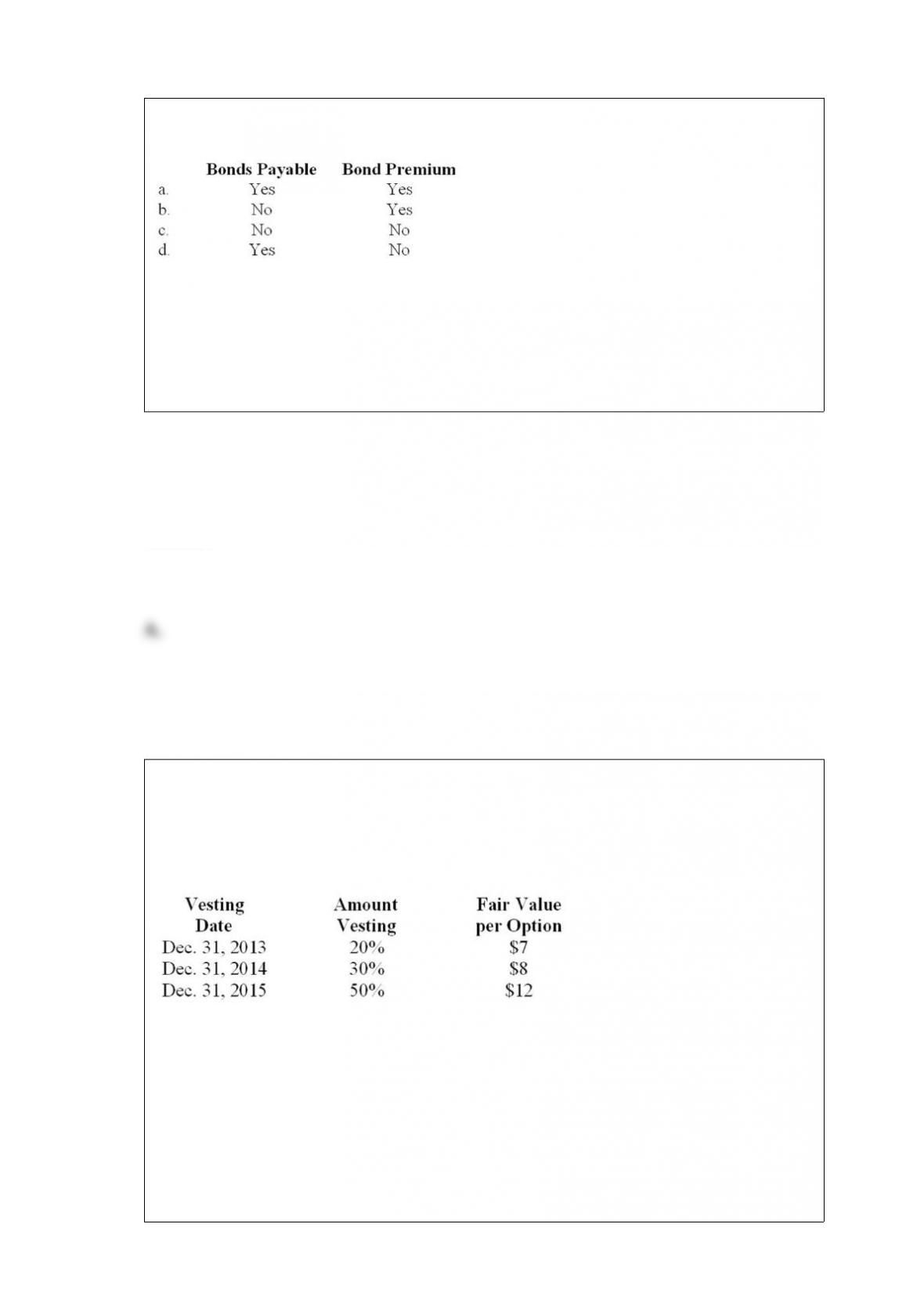
When outstanding bonds are converted into common stock, under either the book value
method or the market value method, the same amount would be debited to:
A. Option a
B. Option b
C. Option c
D. Option d
Answer:
Green Company is a calendar-year U.S. firm with operations in several countries. At
January 1, 2013, the company had issued 40,000 executive stock options permitting
executives to buy 40,000 shares of stock for $25. The vesting schedule is 20% the first
year, 30% the second year, and 50% the third year (graded-vesting). The fair value of
the options is estimated as follows:
Assuming Green uses the straight-line method, what is the compensation expense
related to the options to be recorded in 2014? A. $130,667.
B. $200,000.
C. $333,333.
D. $400,000.

Answer:
Wilson Inc. developed a business strategy that uses stock options as a major
compensation incentive for its top executives. On January 1, 2013, 20 million options
were granted, each giving the executive owning them the right to acquire five $1 par
common shares. The exercise price is the market price on the grant date$10 per share.
Options vest on January 1, 2017. They cannot be exercised before that date and will
expire on December 31, 2019. The fair value of the 20 million options, estimated by an
appropriate option pricing model, is $40 per option. Ignore income tax.
If the options have a vesting period of five years, what would be the balance in “Paid-in
CapitalStock Options” three years after the grant date? A. A credit of $4.8 million.
B. A credit of $16.2 million.
C. A debit of $4.8 million.
D. A debit of $16.2 million.
Answer:
A statement of comprehensive income does not include: A. Net income.
B. Losses from the return on assets exceeding expectations.
C. Losses from changes in estimates regarding the PBO.
D. Prior service cost.
Answer:
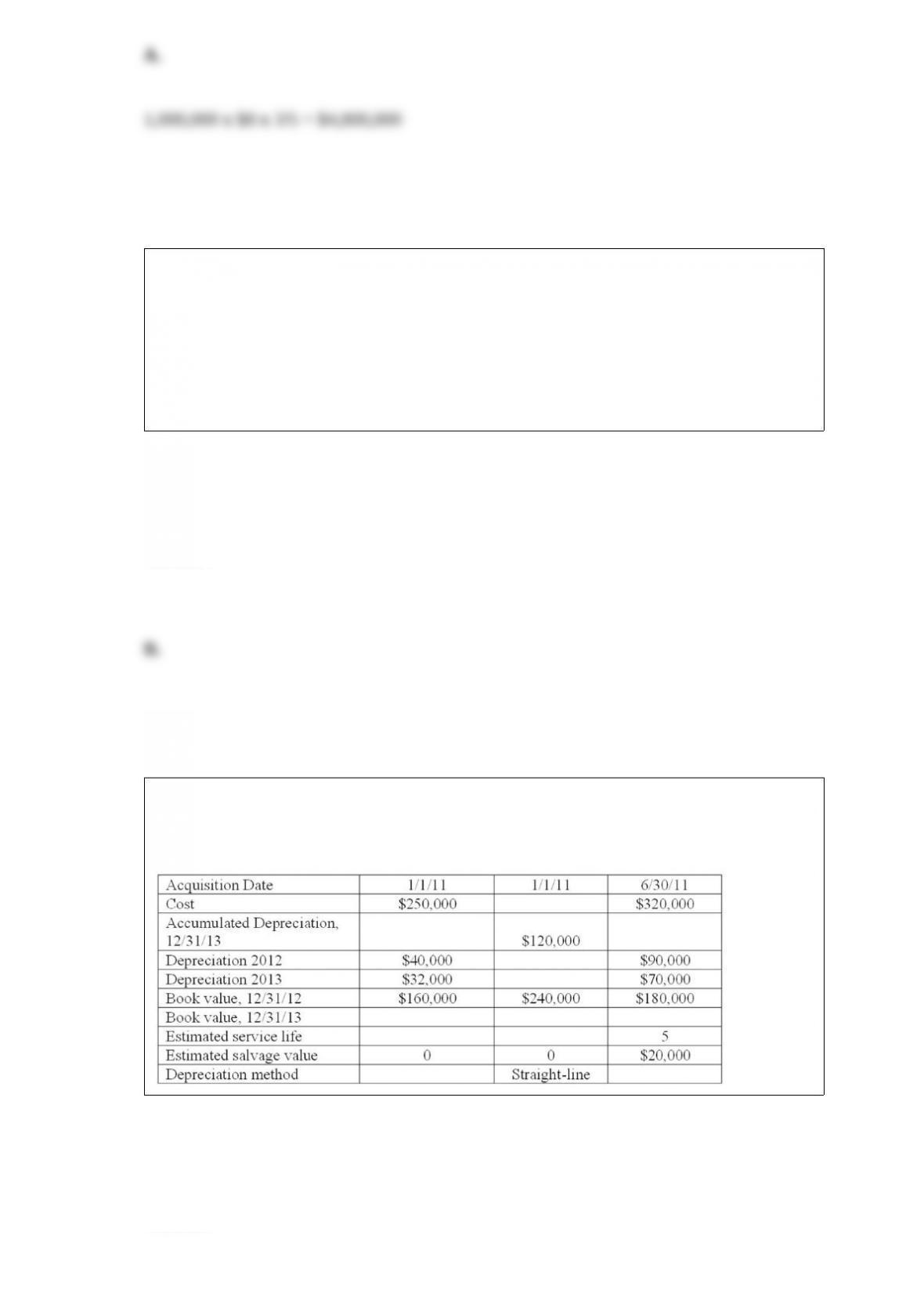
The table below contains data on depreciation for machinery.
Required:
Fill in the missing data in the table.
Answer:
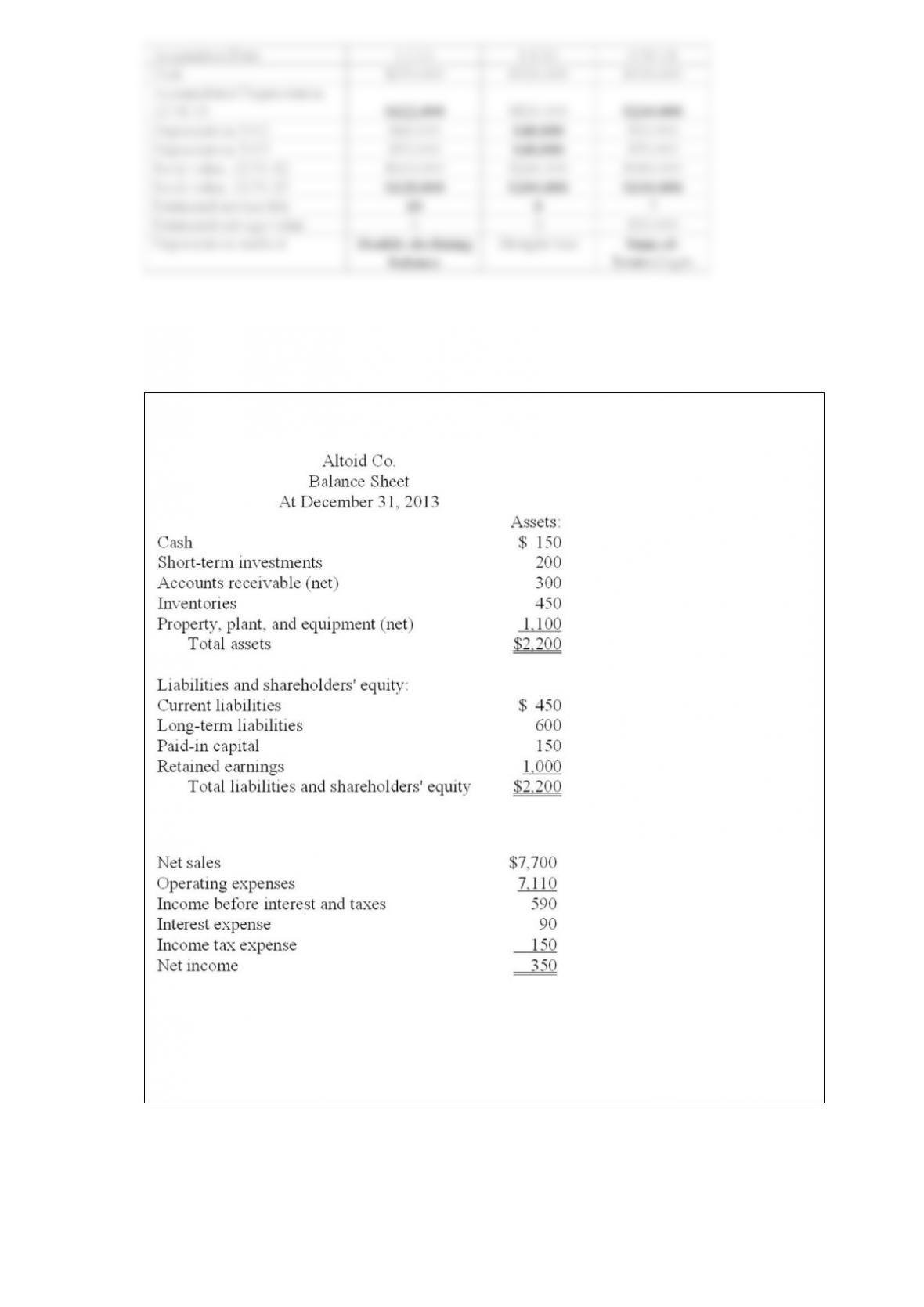
The balance sheet for Altoid Co. is shown below.
Selected 2013 income statement information for Altoid Co. includes:
Required:
Compute the following financial statement ratios for 2013:
Altoid Co.’s times interest earned ratio. Round your answer to two decimal places.
Answer:
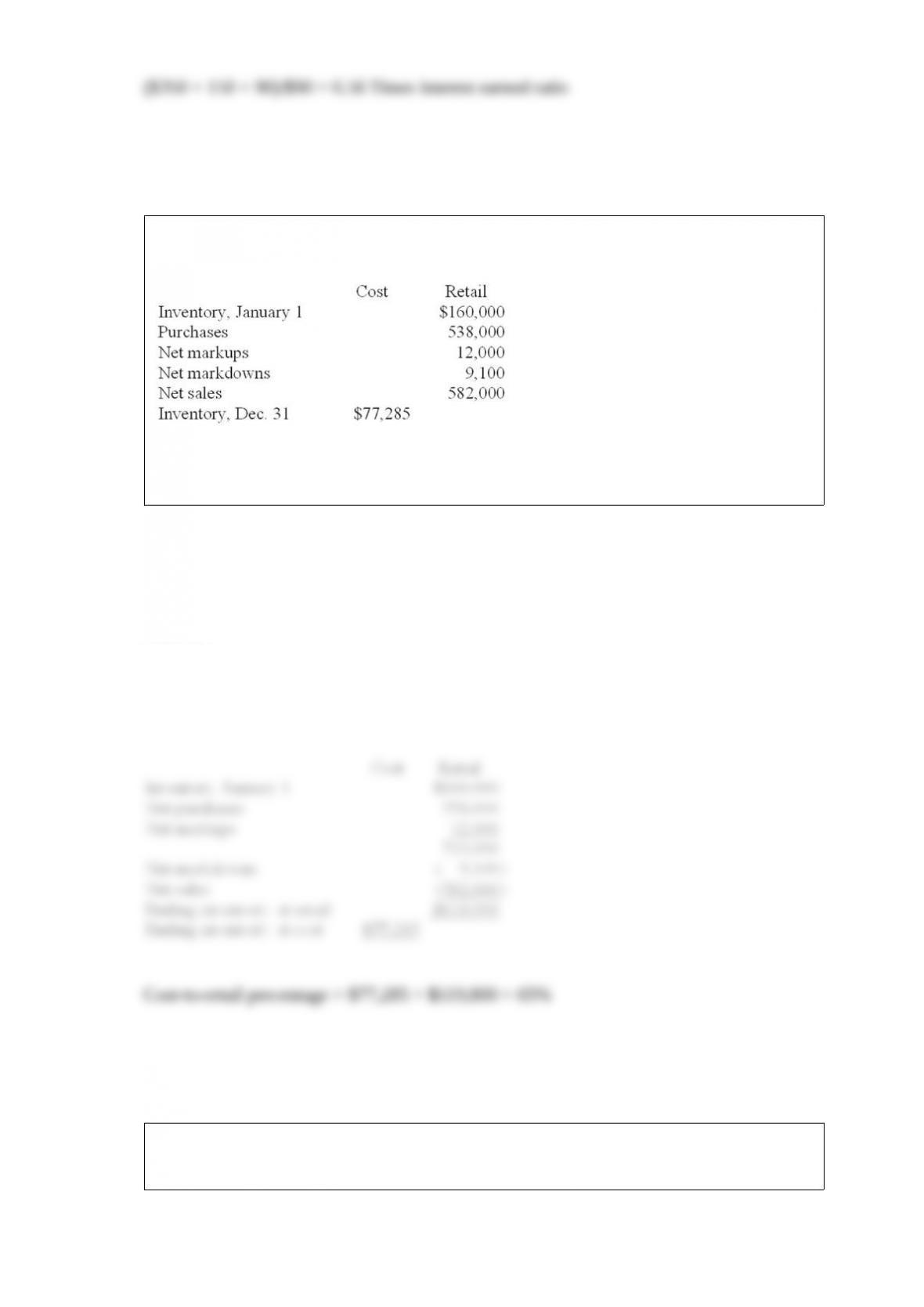
New York Sales Inc. uses the conventional retail method to estimate its ending
inventories. The following data has been summarized for December 31, 2013:
Required:
Compute the cost-to-retail percentage used by New York Sales Inc.
Answer:
Prepare the summary entries necessary to determine the amount of cash paid to
suppliers for each of the four independent situations below.
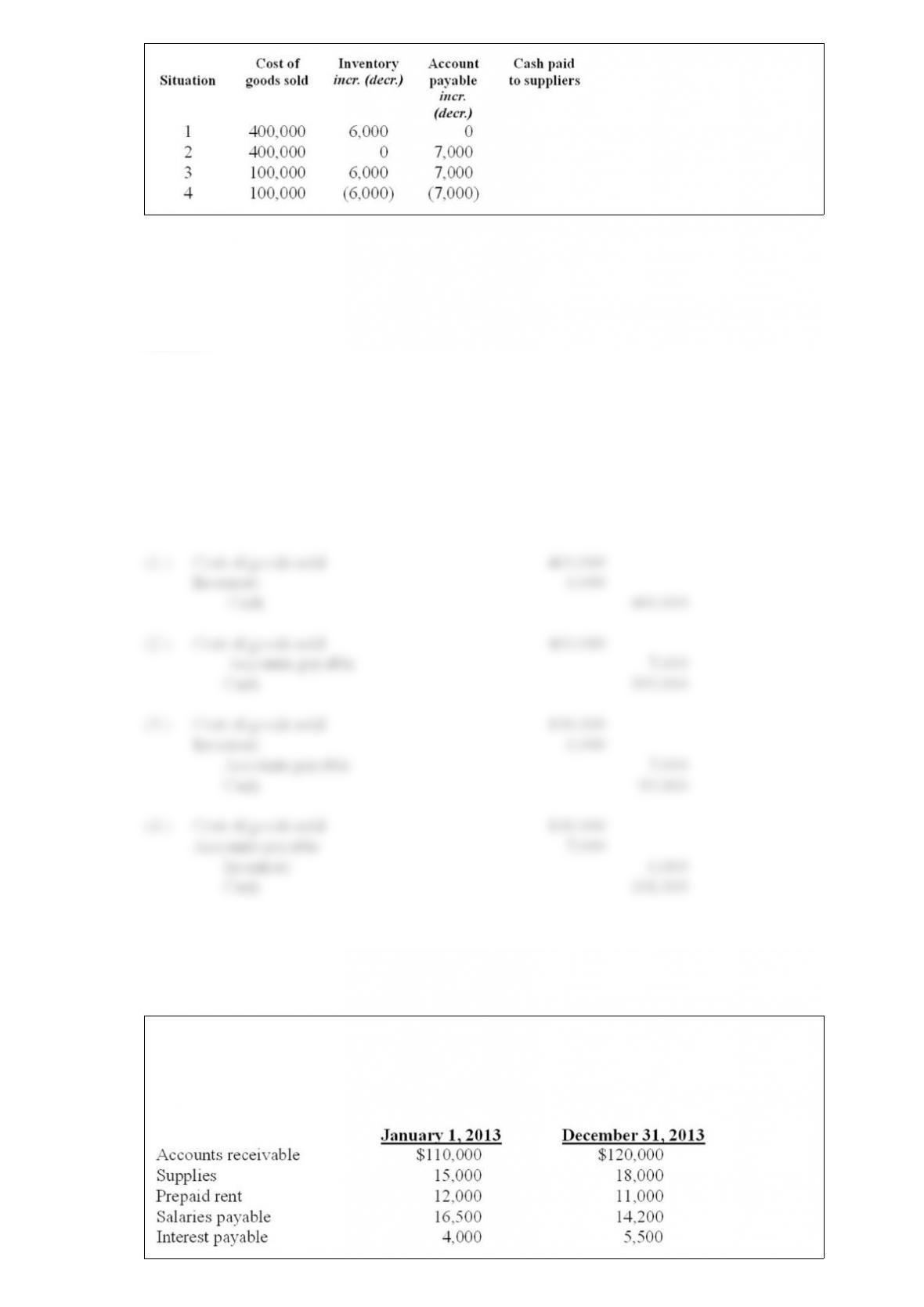
Answer:
Claymore Corporation maintains its book on a cash basis. During 2013, the company
collected $825,000 in fees from its clients and paid $512,000 in expenses. You are able
to determine the following information about accounts receivable, supplies, prepaid
rent, salaries payable, and interest payable:
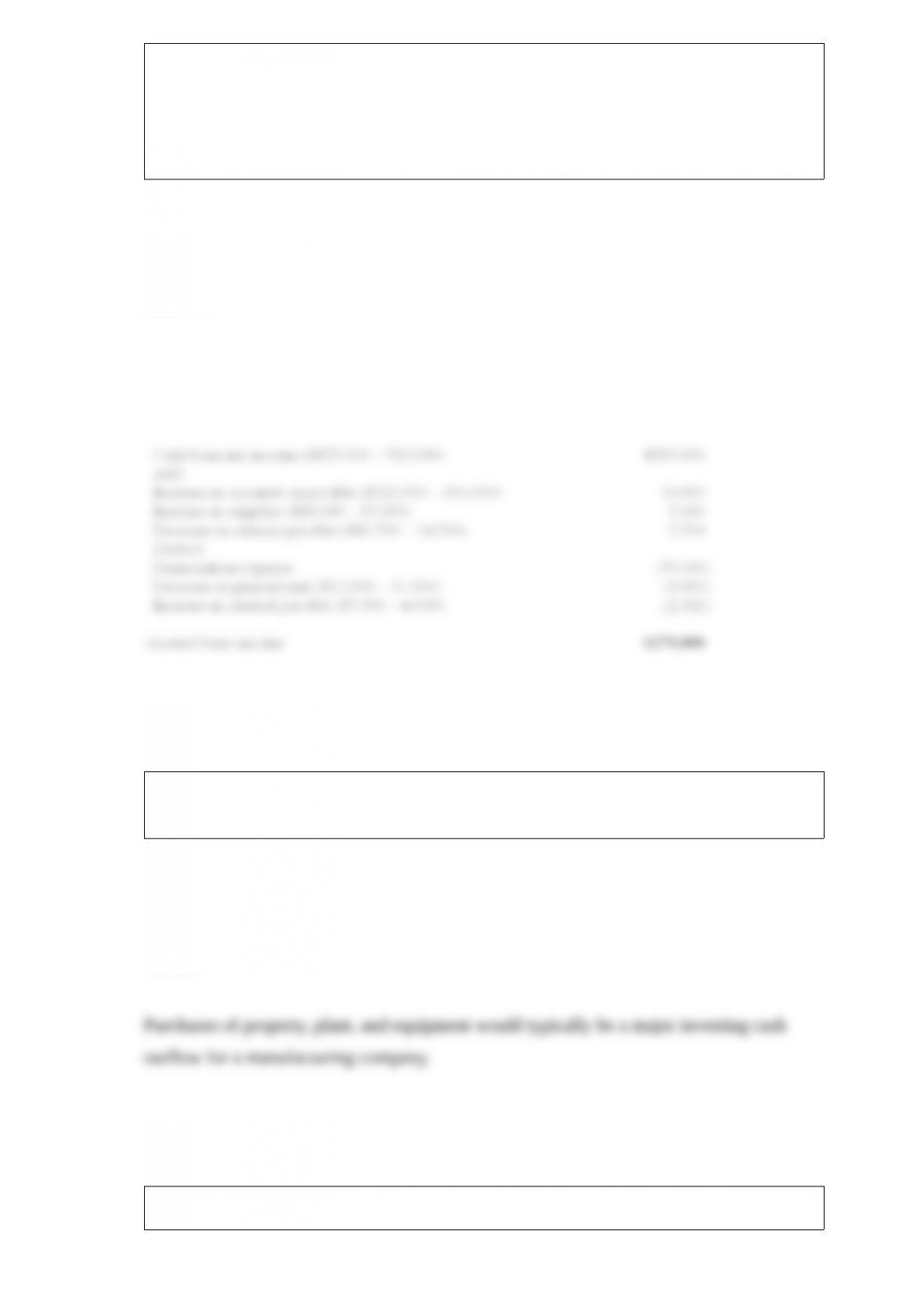
In addition, 2013 depreciation expense on office equipment and furniture is $55,000.
Required:
Determine accrual basis income for 2013.
Answer:
Give an example of a major investing activity cash outflow that would be reported in
the statement of cash flows for a manufacturing company.
Answer:
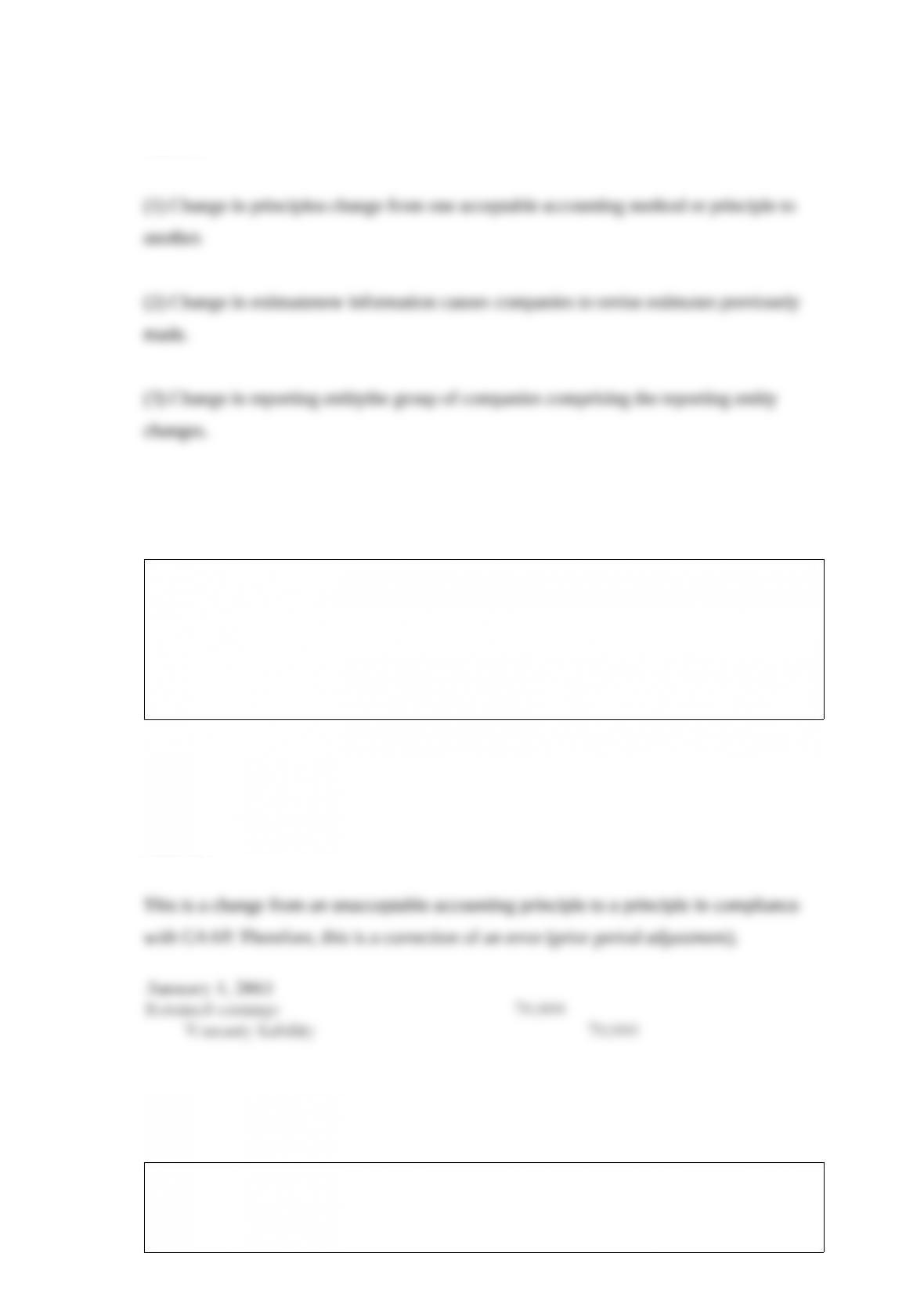
Name and briefly describe the three categories of accounting changes.
Answer:
Nash Industries changed its method of accounting for warranties from the cash basis to
the accrual basis on January 1, 2013. The company’s accountant determined that a
liability of $70,000 should be established. Ignore income taxes.
Required:
Prepare the journal entry to record the accounting change.
Answer:
Top Foods has an underfunded pension plan. The pension expense is $58 million. This
amount includes a $60 million service cost, a $40 million interest cost, a $45 million
reduction for the expected return on plan assets, and a $3 million amortization of a prior
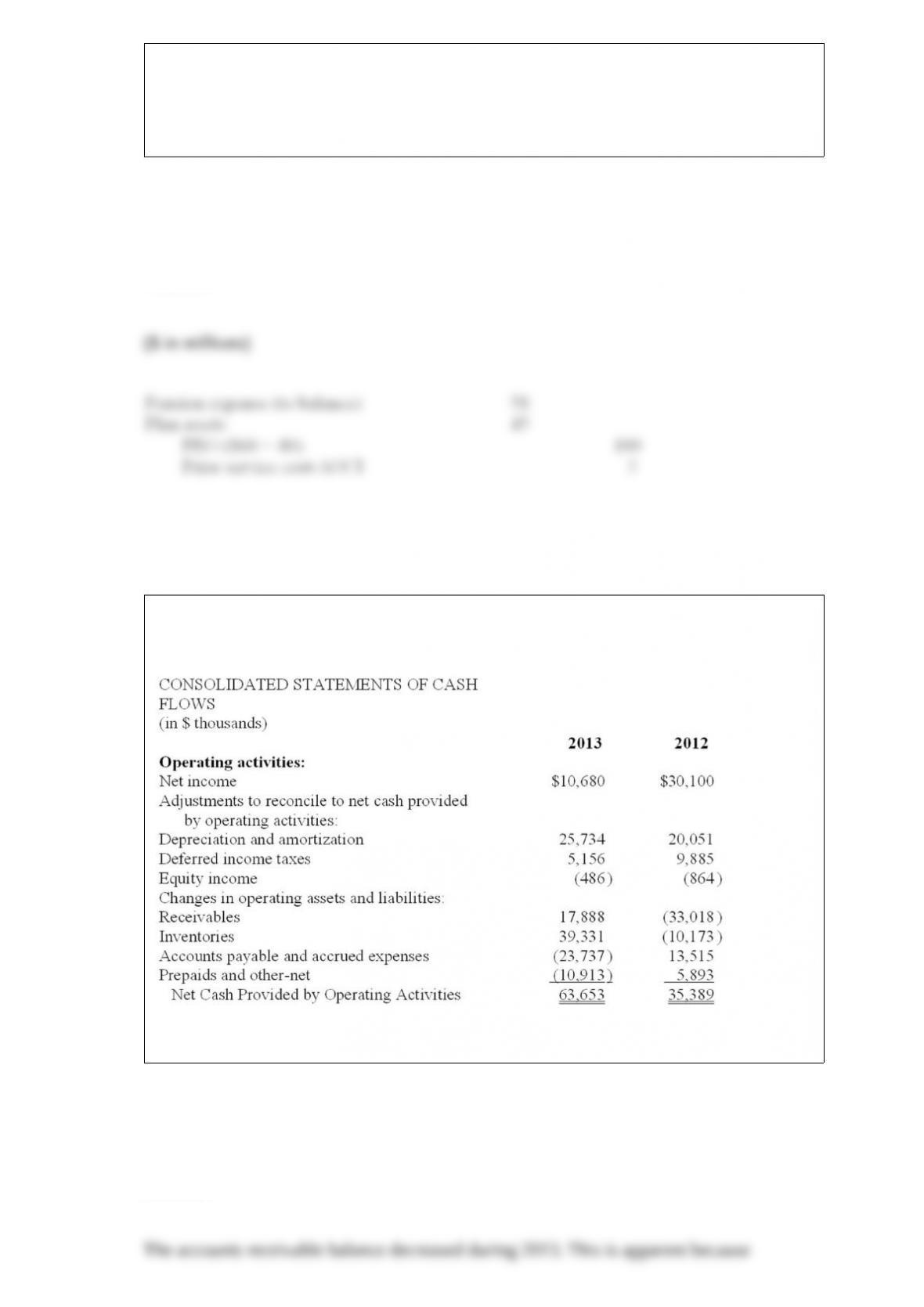
service cost.
Required:
Prepare the appropriate journal entry to record Top’s pension expense.
Answer:
In its 2013 Annual Report to Shareholders, Sisters Corporation included the following
information on cash flows from operations:
Did accounts receivable increase or decrease during 2013?
Answer:

Indicate whether each of the actions listed below will immediately increase (I), decrease
(D), or have no effect (N) on the ratios shown. Assume each ratio is greater than 1.0
before the action is taken.
Answer:
Wendell Corporation exchanged an old truck and $25,500 cash for a new truck. The old
truck had a book value of $6,000 (original cost of $25,000 less $19,000 in accumulated
depreciation) and a fair value of $7,700.
Required:
1) Prepare the journal entry to record the exchange. Assume the exchange has
commercial substance.
2) Prepare the journal entry to record the exchange assuming that the exchange lacks
commercial substance.
Answer:
Fredo, Inc., purchased 10% of Sonny Enterprises for $1,000,000 on January 1, Sonny
recognized a total of $400,000 net income during 2013, paid $30,000 of dividends to
Fredo during 2013, and at December 31, 2013, the market value of the Sonny
investment increased to $1,040,000.
Required:
Prepare the journal entries necessary to account for the Sonny investment, assuming
that Fredo accounts for that investment as (1) an available-for-sale investment, and (2)
elects the fair-value option.
Answer:

On January 1, 2013, Whittington Stoves issued $800 million of its 8% bonds for $736
million. The bonds were priced to yield 10%. Interest is payable semiannually on June
30 and December 31. Whittington records interest at the effective rate and elected the
option to report these bonds at their fair value. On December 31, 2013, the fair value of
the bonds was $752 million as determined by their market value on the NYSE.
Required:
1) Prepare the journal entry to record interest on June 30, 2013 (the first interest
payment).
2) Prepare the journal entry to record interest on December 31, 2013 (the second
interest payment).
3) Prepare the journal entry to adjust the bonds to their fair value for presentation in the
December 31, 2013, balance sheet.
Answer:
Below is a list of accounts in no particular order. Assume that all accounts have normal

balances.
Required:
In column A, indicate whether a debit will:
1. Increase the account balance, or
2. Decrease the account balance.
In column B, classify each account according to the following scheme. For contra
accounts, indicate the classification of the account to which it relates.
1. A current asset in the balance sheet.
2. A noncurrent asset in the balance sheet.
3. A current liability in the balance sheet.
4. A long-term liability in the balance sheet.
5. A permanent equity account in the balance sheet.
6. A revenue account in the income statement.
7. An expense account shown in the income statement.
8. Account does not appear in either the balance sheet or the income statement.
Property taxes payable
Answer: