An organization’s foundation includes all of the following EXCEPT:
a. organizational culture.
b. business definition.
c. vision.
d. core values.
e. mission.
Answer:
An inventory-management system whereby the supplier determines the product amount
and assortment a retailer needs and automatically delivers the appropriate items is
referred to as __________.
a. supplier-managed inventory
b. supply chain inventory
c. logistics-managed inventory
d. just-in-time inventory management
e. vendor-managed inventory
Answer:
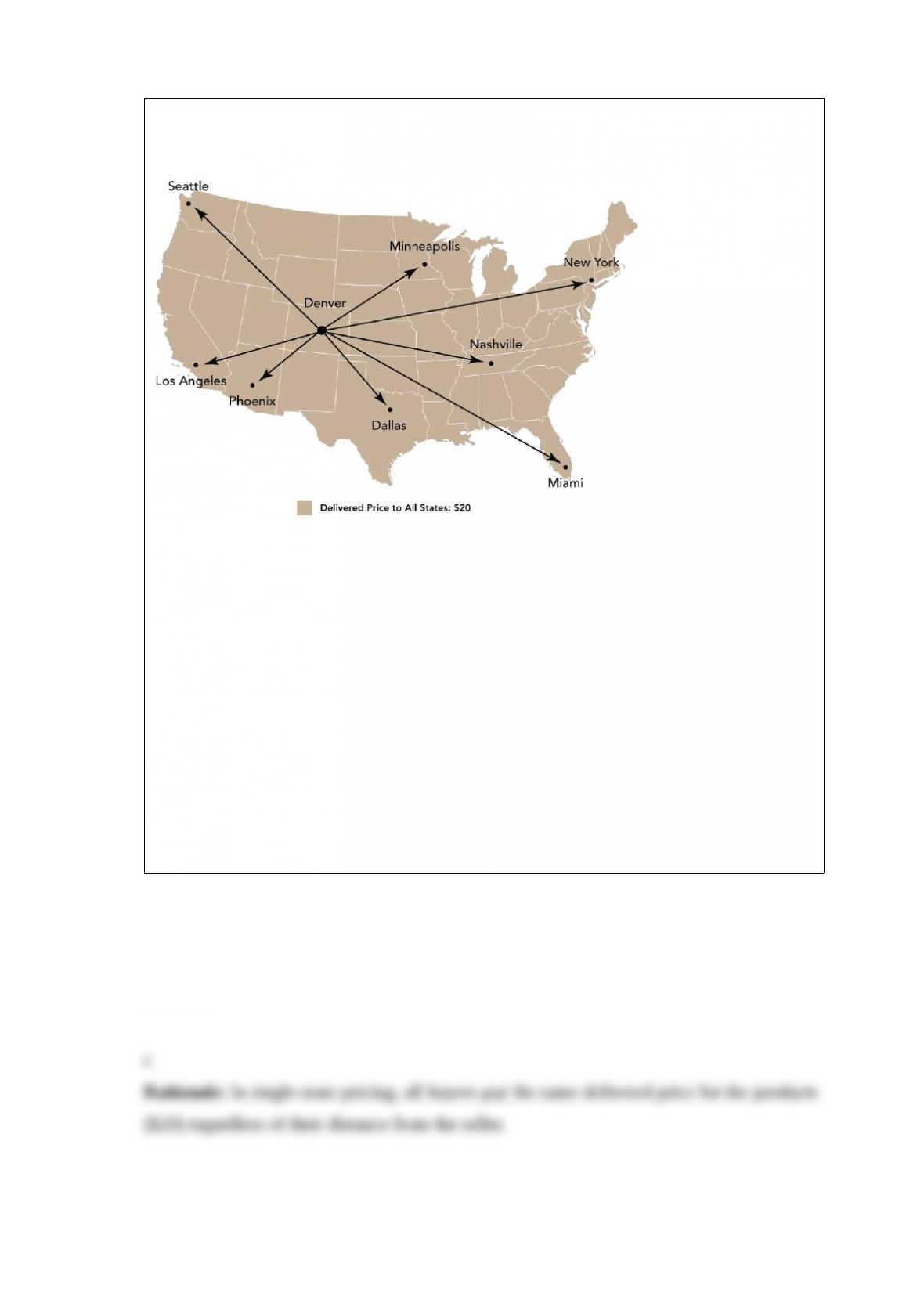
Geographical Pricing Map A
According to the Geographical Pricing Map A above, if the plant in Denver charges $20
to ship its products to all of the identified cities, it is most likely using which type of
pricing?
a. FOB origin pricing
b. multiple-zone pricing
c. single-zone pricing
d. freight absorption pricing
e. basing-point pricing
Answer:
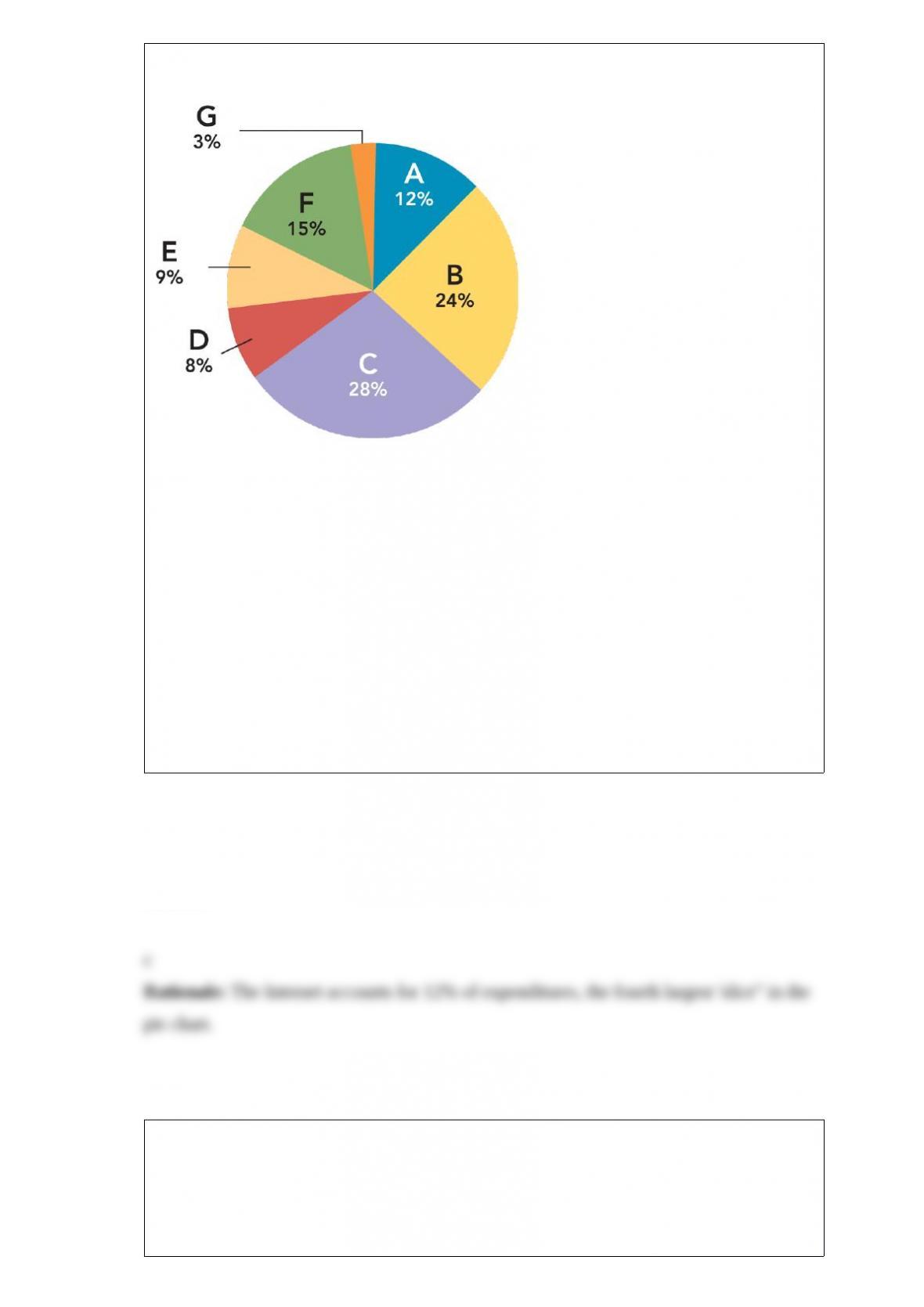
Figure 1.B
With respect to Figure 1.B above, __________ spending accounts for 12% of all
advertising expenditures?
a. newspaper
b. television
c. Internet
d. direct mail
e. magazine
Answer:
A study conducted by C&R Research on behalf of Disney Online has identified four
segments of mothers based on their Internet usage. The Mrs. Net Skeptic segment
represents __________ of online moms.
a. 12 percent
b. 14 percent
c. 20 percent
d. 31 percent
e. 35 percent
Answer:
The average U.S. household now receives __________ direct-mail items or catalogs
each week.
a. 18
b. 24
c. 32
d. 39
e. 47
Answer:
Taco Bell introduced its new low-fat Border Lights fare by giving away 8 million free
tacos and burritos in one day. In this example, Taco Bell used a sales promotion
technique called
a. a self-liquidating premium.
b. a special deal.
c. a rebate.
d. sampling.
e. product placement.
Answer:
One of the sales growth strategies Amazon considered early on is __________.
a. sales of books
b. sales of consulting services
c. sales of original paintings and wall art
d. selling Amazon’s distribution centers
e. sales of greeting cards and invitations
Answer:
Regulation refers to
a. the restrictions that state and federal laws place on business with regard to the
conduct of its activities.
b. constraints placed on businesses for activities that are legal but unethical.
c. society’s values and standards that are enforceable in the courts.
d. requirements concerning which customers a firm may serve or not serve.
e. the moral principles and values that govern the actions and decisions of an individual
or group.
Answer:
The means (salesperson, advertising media, or public relations tools) of conveying a
message to a receiver is referred to as a(n) __________.
a. vehicle
b. field of experience
c. channel of communication
d. direct feedback loop
e. information highway
Answer:
During the maturity stage of the product life cycle, profit declines PRIMARILY
because __________.
a. there are fewer and fewer competitors in the market
b. promotional expenditures increase
c. production costs increase the more a firm has to manufacture the same product
d. there is fierce price competition among sellers
e. more consumers enter the market seeking bargains
Answer:
Not so many years ago, many U.S. consumers thought Americans who purchased
Japanese-made radios, televisions, and other electronic equipment were behaving not
only inappropriately, but also immorally. U.S. consumers who thought buying Japanese
products was wrong were exhibiting
a. back translation.
b. consumer ethnocentrism.
c. the trade feedback effect.
d. consumer bias.
e. cultural ethnocentricity.
Answer:
Two important disadvantages of secondary data are that it is __________ and
__________.
a. inexpensive; up-to-date.
b. not up-to-date; not specific enough for the project.
c. low cost; saves time.
d. tailor-made to specifications; out of date.
e. none of the above.
Answer:
Discounts refer to reductions from the __________ that a seller gives a buyer as a
reward for some activity of the buyer that is favorable to the seller.
a. final price
b. list price
c. manufacturer’s suggested retail price
d. manufacturer’s cost
e. retailer’s cost
Answer:
A channel that includes intermediaries that are between the producer and consumer and
perform numerous channel functions is referred to as a(n)
a. indirect channel.
b. direct channel.
c. multilevel channel.
d. full-service channel.
e. limited-service channel
Answer:
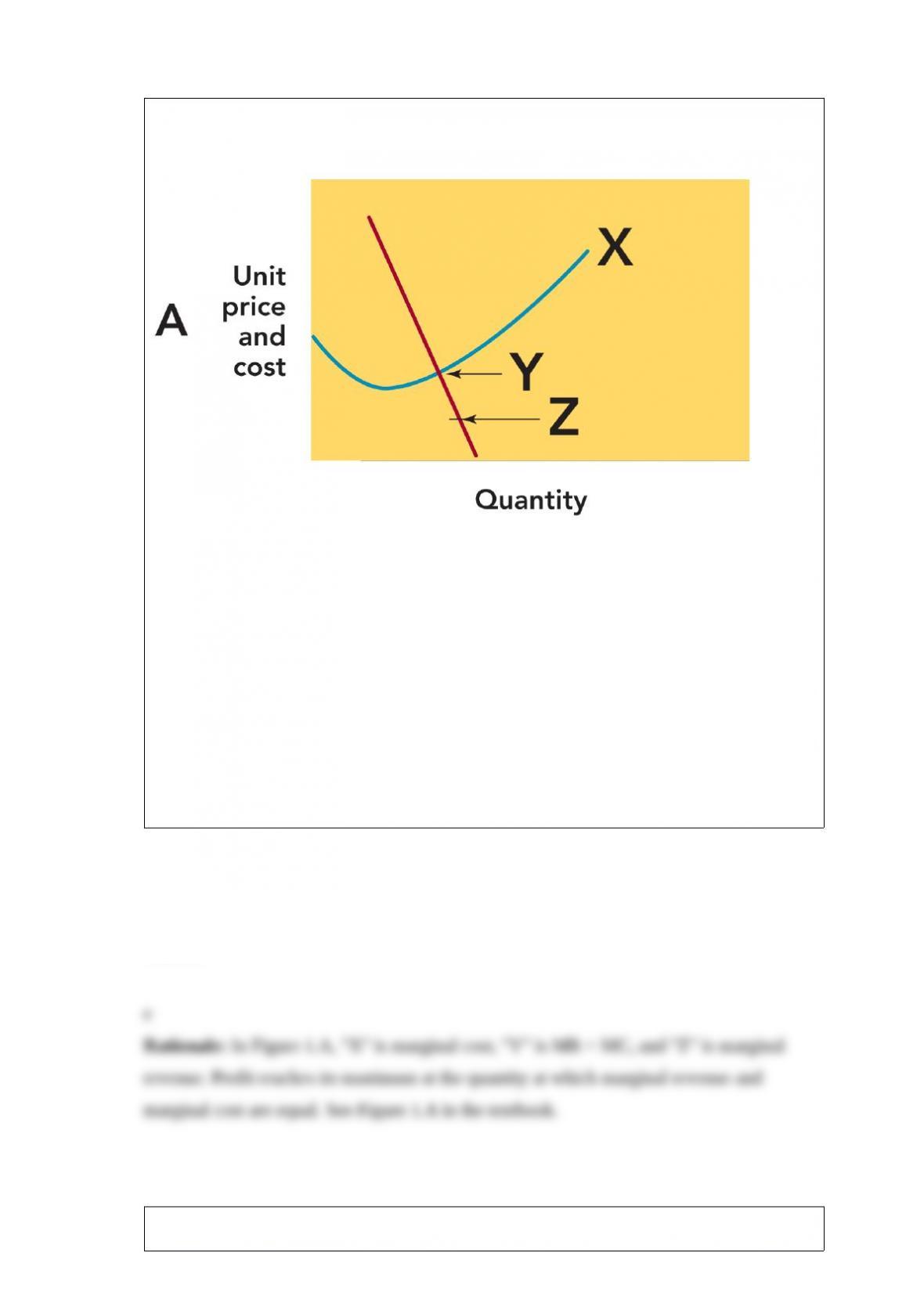
Figure 1.A
In Figure 1.A above, “Z” represents
a. MR = MC
b. fixed cost
c. marginal cost
d. variable cost
e. marginal revenue
Answer:
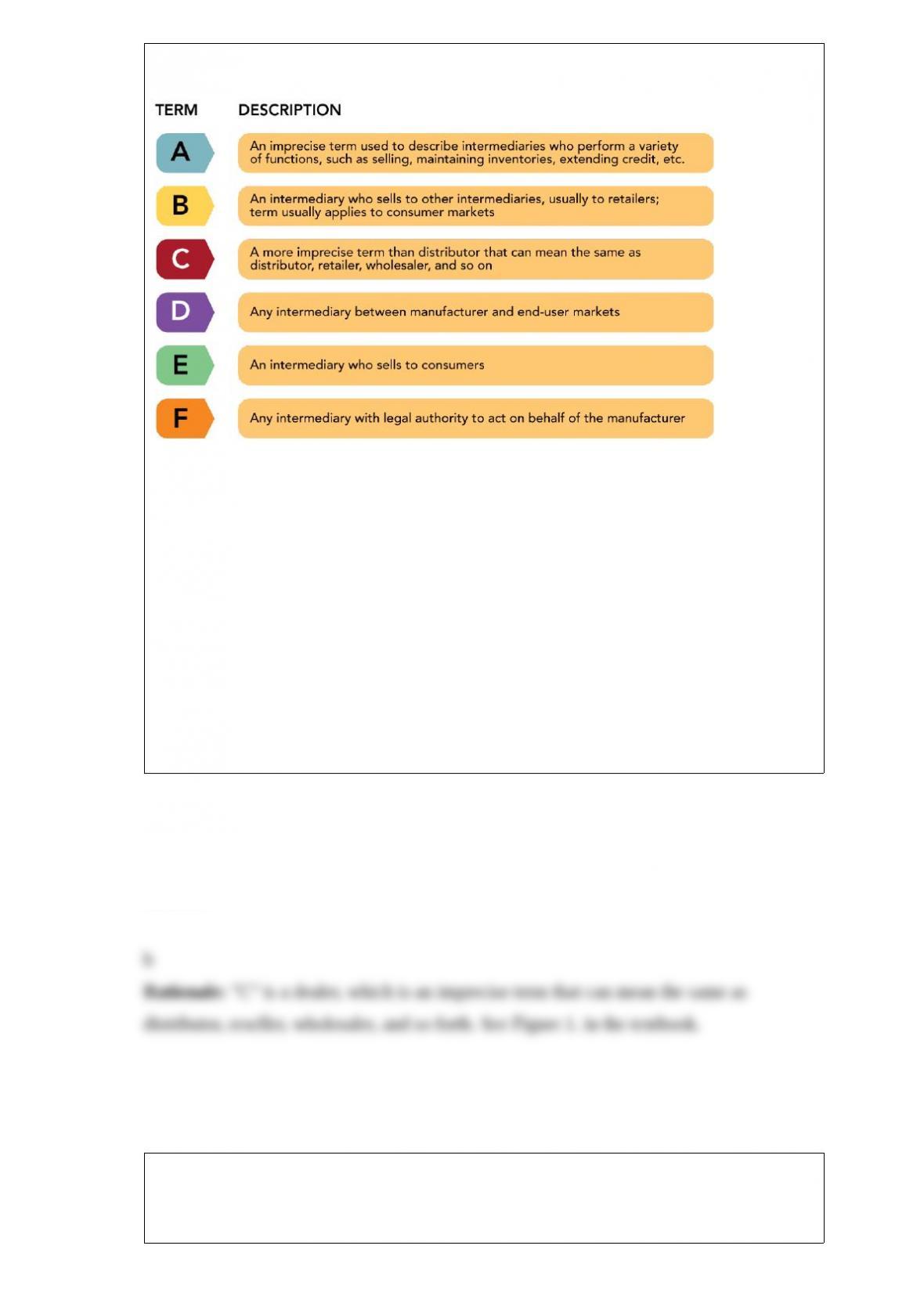
Figure 1.
A variety of terms are used for marketing intermediaries. According to Figure 1. above,
“C” represents a(n) __________.
a. retailer
b. dealer
c. wholesaler
d. distributor
e. agent or broker
Answer:
The restrictions that state and federal laws place on business with regard to the conduct
of its activities are referred to as
a. jurisprudence.
b. competitive constrains.
c. barriers to entry.
d. restraints of trade.
e. regulation.
Answer:
The amount added to the cost the retailer paid for a product to reach the final selling
price is referred to as a(n) __________.
a. markup
b. markdown
c. original markup
d. maintained markup
e. cost-plus markup
Answer:
The key idea behind diffusion of innovation is that __________.
a. not all consumers accept a new product at the same time; adoption of a product
spreads slowly throughout the population
b. once a product enters the market, the time span between awareness and purchase is
incredibly short
c. the introduction of an entire new product class almost always diffuses the importance
of its predecessor within a matter of months
d. adoption of a new product line does not change the diffusion rate of older lines in the
market
e. the rate of adoption is independent of other product form innovations or competitive
products in the marketplace
Answer:
Figure 1.
Figure 1. above represents the six steps in the price-setting process. Which letter
represents the step where a firm would offer allowances?
a. “F”
b. “E”
c. “D”
d. “C”
e. “B”
Answer:
The first major federal legislation passed to encourage competition in the United States
was the
a. Sherman Antitrust Act.
b. Lanham Act.
c. Federal Trade Commission Act.
d. Robinson-Patman Act.
e. Clayton Act.
Answer:
Which of the following groups would be the LEAST LIKELY target market for a
company producing canned food in single serving sizes?
a. single adults
b. school kitchens
c. campers
d. senior citizens
e. vending machine owners
Answer:
The demand for industrial products and services that is driven by demand for consumer
products and services is referred to as
a. derivative marketing.
b. derived demand.
c. derived supply.
d. demand elasticity.
e. sequential demand.
Answer:
In some cases, manufacturers design products for different price points and retailers
apply __________ to achieve the three or four different price points offered to
consumers.
a. progressively higher markup percentages
b. different markup percentages depending how long the item remains on their shelves
c. above-, at-, or below-market pricing
d. approximately the same markup percentages
e. elasticity of demand pricing calculations
Answer:
The existence of reciprocal arrangements, long-term contracts, and in some cases,
buyer-seller relationships that evolve into supply partnerships, are all examples of
a. illegal activities that are a common weakness of organizational buying.
b. illegal activities that result from collusion between buyers and sellers.
c. activities that are strictly governed by the NAICS.
d. activities that can result from relationships between buyers and sellers in
organizational buying.
e. activities that result from extreme competition between manufacturers when there are
too few sellers.
Answer:
Kimberly-Clark developed its Avert Virucidal tissues that contained vitamin C
derivatives, which were scientifically designed to kill cold and flu germs when users
sneezed, coughed, or blew their noses into them. Unfortunately, people didn’t believe
the claim and were frightened by the “cidal” in the brand name. The reason for this
product failure was
a. an insignificant point of difference.
b. too little market attractiveness.
c. poor execution of the marketing mix.
d. poor product quality.
e. incomplete market and product protocol.
Answer:
If the cash discount terms for a $500 purchase are 4/10 net 30, the number $500 refers
to
a. the original price owed on the merchandise.
b. the total amount owed if paid within 10 days.
c. the total discount in dollars if the bill is paid on time in 30 days.
d. the manufacturer’s suggested wholesale price.
e. the total penalty in dollars if the bill is paid after 10 days.
Answer:
In a recent issue of AARP The Magazine, a print ad for State Farm Insurance annuities
advises readers that “The company has helped you enjoy your time with the kids and it
can now help you enjoy your time without them.” The ad is most likely targeted toward
which generational cohort?
a. Generation X
b. baby busters
c. Generation Y
d. the Greatest Generation
e. baby boomers
Answer:
Changing the place an offering occupies in consumers’ minds relative to competitive
products is referred to as
a. product placement.
b. perceptual mapping.
c. product positioning.
d. product repositioning.
e. product differentiation.
Answer: