
Who wouldn”t want to eat Garlic Cake? Garlic Cake was supposed to be served as an
hors d”oeuvre with sweet breads, spreads, and meats, but somehow the company forgot
to tell and explain this to potential consumers. This product failure demonstrates
a. not satisfying customer needs on critical factors.
b. poor product quality.
c. an insignificant point of difference.
d. bad timing
e. poor execution of the marketing mix.
Answer:
Advertising agencies that specialize in one aspect of the advertising process such as
providing creative services to develop advertising copy, buying previously unpurchased
media space, or providing Internet services are referred to as __________.
a. full-service agencies
b. in-house agencies
c. modified-service agencies
d. promotional firms
e. limited-service agencies

Answer:
In marketing, each __________ consists of people who are relatively similar to each
other in terms of their consumption behavior.
a. market segment
b. demographic cluster
c. organizational buyer group
d. ultimate consumer group
e. qualified prospect group
Answer:
The purpose of a reminder advertisement is to
a. promote a specific brand’s features and benefits.
b. tell people what a product is, what it can do, and where it can be found.
c. state the position of a company on an issue.

d. reinforce previous knowledge of a product.
e. promote the advantages of one product class over another.
Answer:
The three types of companies that populate and compete in the global marketplace are
international firms, __________ firms, and transnational firms.
a. multiethnic
b. domestic
c. multinational
d. ethnocentric
e. decentralized
Answer:

Which of these promotional elements has the inherent weakness of extremely high
expense per exposure?
a. advertising
b. sales promotion
c. publicity
d. direct marketing
e. personal selling
Answer:
Research objectives are __________.
a. goals conjectures regarding outcomes
b. general research guidelines
c. solutions to be evaluated
d. specific and measurable
e. research dashboards
Answer:

With interactive marketing,
a. the seller controls the kind and amount of information presented to the buyer.
b. buyers and sellers communicate face-to-face in the traditional marketplace.
c. media convergence is necessary for an exchange to take place.
d. the buyer controls the kind and amount of information received from the seller.
e. real time transactions are impossible.
Answer:
Porter’s four generic business strategies are differentiation, __________, differentiation
focus, and cost leadership.
a. cost focus
b. diversification
c. service leadership
d. quality leadership
e. competition-focus
Answer:

As traditional media have become more expensive and cluttered, advertisers have been
attracted to a variety of nontraditional advertising options called place-based media or
_________.
a. out-of-home advertising
b. invasive placements
c. electronic advertising
d. product placements
e. cooperative advertising
Answer:
With respect to the history of American business, the __________ era began in the late
1950s when marketing became the motivating force among many firms.
a. production
b. sales
c. customer relationship
d. market orientation
e. marketing concept
Answer:
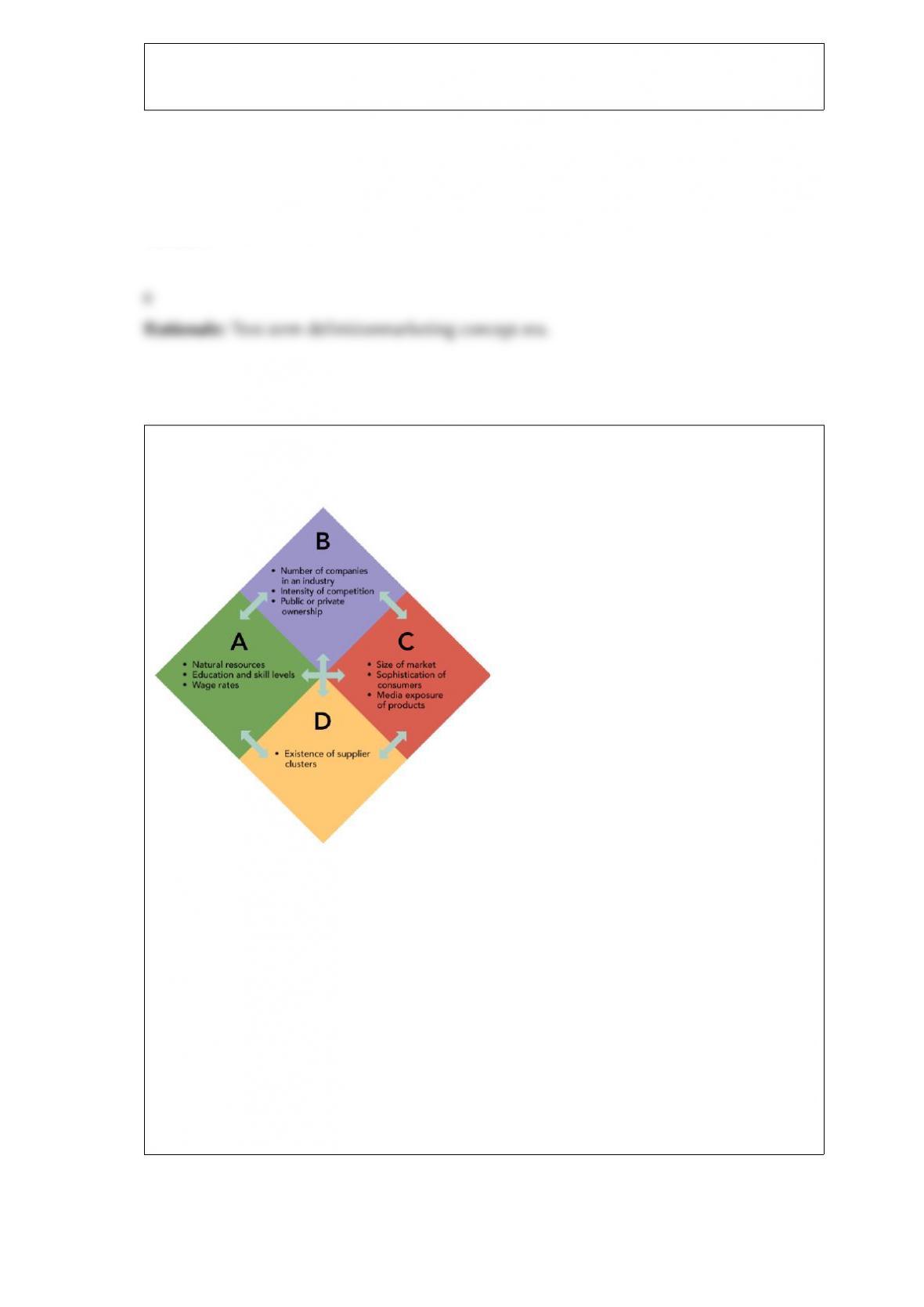
Figure 1.
According to Michael Porter’s diamond in Figure 1. above, quadrant “C” represents
a. factor conditions.
b. related and supporting industries.
c. demand conditions.
d. managerial conditions.
e. company strategy, structure, and rivalry.

Answer:
General Mills is concerned with both selling its products and brands in countries around
the world and obtaining ideas for new products from anyone, anywhere who has a great
product or technology. You can send General Mills your great new product or
technology idea through its Internet portal if the product or technology can
a. fit into the General Mills or Nestl distribution systems.
b. be copyrighted or patented in North America and Western Europe.
c. be fully developed and be on the market somewhere in the world.
d. be a totally new product category outside of General Mills’ existing product lines.
e. facilitate the new General Mills diversification strategy by being a product or
technology unrelated to consumer foods.
Answer:

Price elasticity of demand is determined by a number of factors, such as whether the
item is a luxury product or service, the necessity of the product or service, the cash
outlay of purchase relative to a person’s disposable income, and
a. the stage of the product or service in its product life cycle.
b. the degree of carrying costs for the manufacturer or distributor.
c. the availability of substitutes.
d. the financial resources of the organization itself.
e. the ability of the organization to meet sudden increases in demand.
Answer:
What are the three types of prospects?
a. leads, prospects, and buyers
b. leads, prospects, and qualified prospects
c. cold, warm, and hot
d. awareness, trial, and adoption
e. primary leads, secondary leads, and final leads
Answer:
Many retailers take a markdown as soon as sales fall to free valuable selling space and
cash. This concept of retail pricing based on _________.
a. timing
b. demand
c. availability
d. bargain hunting
e. customer value
Answer:
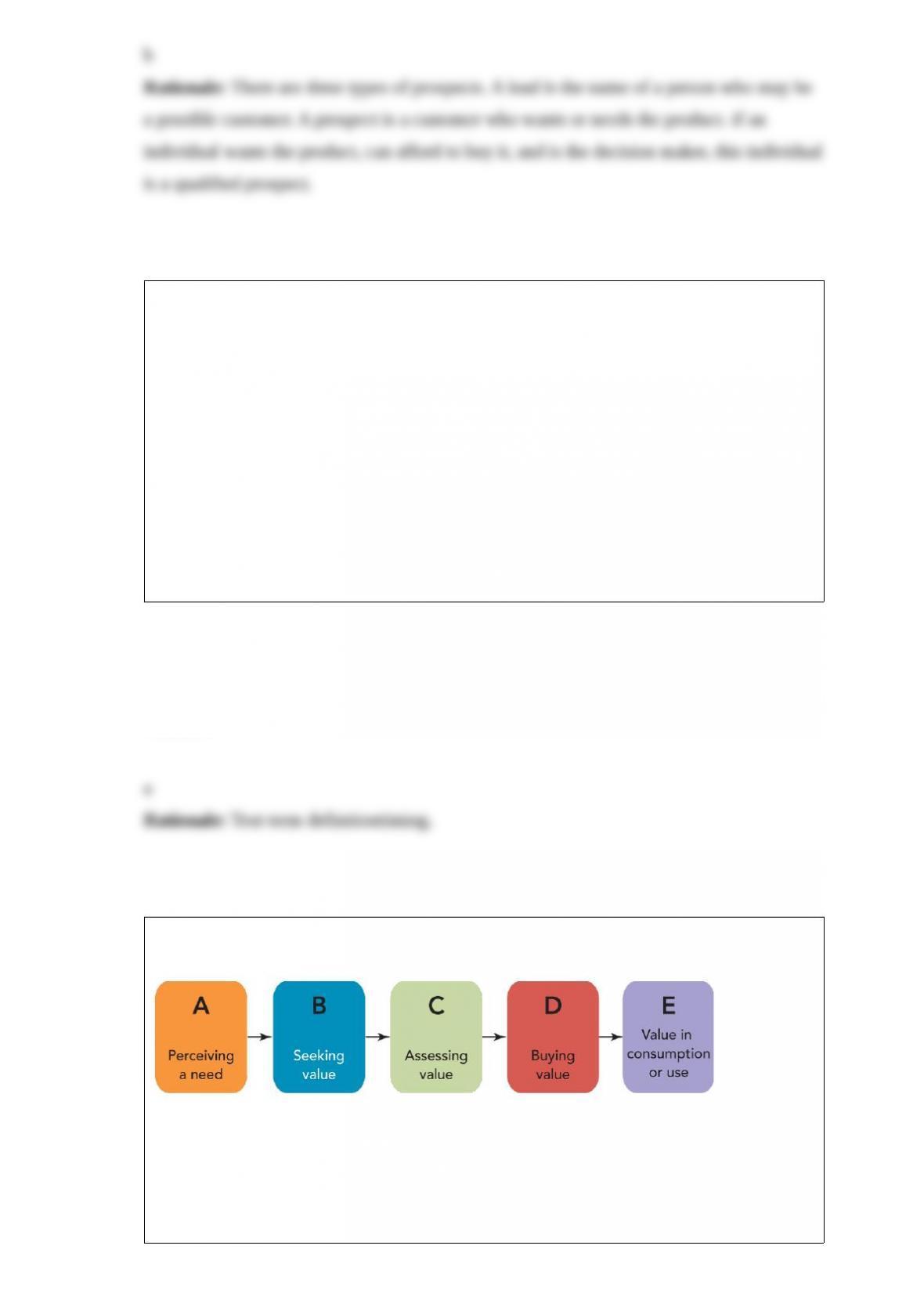
Figure 1.
In Figure 1. above, “B” represents which stage of the consumer purchase decision
process?
a. purchase decision

b. information search
c. problem recognition
d. alternative evaluation
e. postpurchase behavior
Answer:
The Economic Espionage Act
a. allows the World Court in The Hague to adjudicate trade disputes on behalf of United
Nations’ members and requires the home country to impose any penalties.
b. imposes a personal fine on a convicted U.S. citizen of up to $10 million.
c. targets espionage activities that are commonplace in any industry that holds
governmental contracts.
d. makes the theft of trade secrets by foreign entities a federal crime in the United
States.
e. is well-intended in theory, but is virtually impossible to enforce.
Answer:

Any word, device (design, sound, shape, or color), or combination of these used to
distinguish a seller’s goods or services is referred to as a __________.
a. brand name
b. copyright
c. trade name
d. trade mark
e. label
Answer:
The __________ stage of the product life cycle occurs when a product is launched to its
intended target market.
a. concept
b. introduction
c. growth
d. maturity
e. decline
Answer:

The addition of Clorox II bleach to Tide laundry detergents is an example of
a. discontinuous innovation.
b. bundled innovation.
c. dynamically continuous innovation.
d. disruptive innovation.
e. continuous innovation.
Answer:
Last year, the Parker family used to eat at nice restaurants almost four times a week.
Even though Mr. Parker received a 5 percent raise, the cost of living rose by 7 percent.
As a result, the family now eats most of their meals at home, dining out only four times
a month. This reflects
a. a decrease in the number of fine restaurants that can stay in business during times of
economical downturn.
b. a reaction to a loss of discretionary income.
c. a significant drop in disposable income since there was a negative gain in income.
d. a rise in deflation.
e. a shift from spending to investing.

Answer:
A web page that serves as a publicly accessible personal journal and online forum for an
individual or organization is referred to as a
a. wiki.
b. blog.
c. net platform.
d. Facebook page.
e. “tweet.”
Answer:
Powerful buyers exist when
a. there are many buyers.
b. switching costs are low.
c. the product represents a small share of the buyer’s total costs.

d. the product is critical to the buyer.
e. preemptive practices exist.
Answer:
Wholesalers who simply solicit orders from retailers and other wholesalers and have the
merchandise shipped directly from a producer to a buyer are referred to as __________.
a. cash and carry wholesalers
b. rack jobbers
c. drop shippers
d. truck jobbers
e. manufacturer’s representatives
Answer:

The Beef Council promotes a series of ads in which the tag line is “Beefit’s what’s for
dinner.” The purpose of these ads is to encourage the audience to eat more beef. This
type of ad is a(n) _____________.
a. reminder institutional ad
b. pioneering institutional ad
c. product institutional ad
d. competitive institutional ad
e. advocacy ad
Answer:
Which of the following statements about comparative advertising is MOST accurate?
a. Comparative advertisements increase the perceived quality of the advertiser’s brand.
b. Comparative advertisements now constitute over 90% of all television ads.
c. Comparative advertisements attract less consumer attention in the advertiser’s brand.
d. Comparative advertisements have been banned by the Federal Trade Commission.
e. Comparative advertisements can, and often do, cause more harm than good.
Answer:

Movie studios use tracking studies in which prospective moviegoers are asked
questions about an upcoming film release to help them forecast sales. This is an
example of
a. movie advertising.
b. marketing research.
c. tactical support.
d. cross-movie research.
e. movie audits.
Answer:
Frequently used Facebook measures include __________ (the number of people who
have opted in to a brand’s messages at a given time) and __________ (if someone visits
five times in one day, he or she is counted once).
a. followers; fans
b. unique fans; visitors
c. fans; unique visitors
d. fans; unique page views
e. visitors; unique visitors

Answer:
The new integrated marketing communications approach for Mountain Dew utilizes
a. iconic television advertising.
b. traditional promotion tools and new social media.
c. traditional promotion tools only.
d. new social media only.
e. word-of-mouth advertising only.
Answer:
At which stage of the organizational buying decision process would purchasing and
engineering personnel visit potential suppliers to assess their facilities?
a. problem recognition
b. information search
c. purchase decision

d. postpurchase behavior
e. alternative evaluation
Answer:
Several marketing data services provide information on household demographics and
lifestyle, purchases, TV viewing behavior, etc. The principle advantage of these services
is that
a. one service can collect, analyze, interrelate, and present this information.
b. all data collection and analysis is computerized, so the results are almost
instantaneous.
c. members of the firm can be included in the analysis of data, making the results more
reliable.
d. the service gets paid on a percentage basis; the better the information, the higher the
fee.
e. firms using these services get discounts if they share their customer data with
competitors.
Answer:
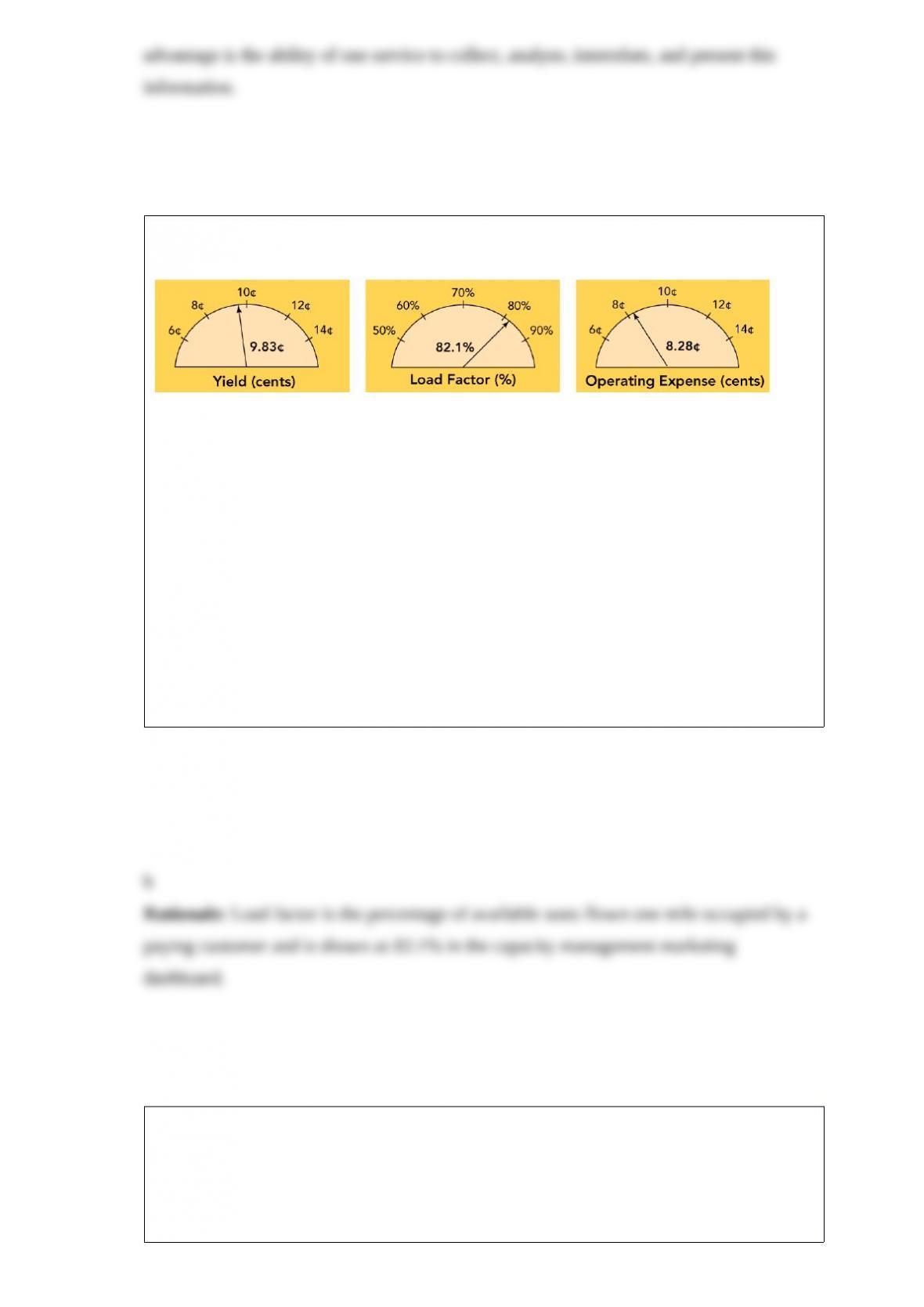
Capacity Management Marketing Dashboard
The percentage of available seats flown one mile occupied by a paying customer is
shown in the capacity management marketing dashboard above as __________.
a. 9.83%
b. 82.1%
c. 8.28%
d. 18.11%
e. 1.%
Answer:
If a customer is reluctant to try a new product because she’s afraid it might make her ill,
the company is most likely facing a __________ barrier.
a. usage

b. risk
c. value
d. emotional
e. psychological
Answer: