The axes on a perceptual map are
a. two product attributes, each listed in terms of their opposites.
b. market share and market growth rate.
c. sales and profitability.
d. customer perceptions of the firm’s product versus the average of all brands in the
industry.
e. customer perceptions of the firm’s product versus the brand of the firm’s principal
competitor.
Answer:
Linear trend extrapolation is similar to trend extrapolation except
a. the pattern changes from year to year.
b. the pattern is always a straight line.
c. the slope of the line is tied directly to profits.
d. the shape of the pattern is a hyperbola.
e. the pattern follows an “S-shaped” curve.
Answer:
Shrinkage refers to
a. the declining number of small privately owned retail stores due to economic hard
times.
b. breakage, theft, and fraud by customers and employees.
c. the percentage of inventory that is damaged or unsalable because of product failure or
problems in shipping.
d. loss of profits in clothing items that are returned because of inferior materials.
e. polycarbonate packaging that encases products with a tamper-resistant plastic seal.
Answer:
Recently, a project team for Cosco, the world’s largest children’s products company,
developed a high chair that could be used as an infant feeding seat, a youth chair, a play
chair, a booster chair, and when reclined, an infant bed. Its design could be made and
sold for $49. The marketing manager, in consultation with other middle managers,
decided to have the prototypes checked out by Cosco employees who had small
children. This was the only product testing performed on the product. Before Cosco
pulled the unsafe chair from the market, several children were injured and some died as
a result of using the chair. Cosco was charged with being unconcerned about
consumers’ right to
a. choose.
b. be informed.
c. be treated courteously.
d. safety.
e. happiness.
Answer:
Consumers often view central business district shopping as less convenient because of
the lack of parking, higher crime rates, and __________.
a. out-dated stores
b. a lack of ambiance
c. fewer quality restaurants
d. few public restrooms
e. exposure to the weather
Answer:

Pricing constraints refer to
a. barriers that must be overcome in order to set pricing objectives.
b. competitive pricing advantages one firm has over another.
c. different pricing strategies for each of the firm’s products.
d. factors that limit the range of prices a firm may set.
e. barriers to entry a firm faces when launching a new product.
Answer:
Four factors are required for marketing to occur: (1) two or more parties (individuals or
organizations) with unsatisfied needs; (2) a desire and ability on their part to be
satisfied; (3) __________; and (4) something to exchange.
a. a way for the parties to communicate
b. a healthy competitive environment
c. government approval
d. a sense of social responsibility
e. an ability to see hidden potential within an environmental force
Answer:

A durable good is defined as a(n)
a. item consumed in one or a few uses.
b. item that usually lasts over an extended number of uses.
c. item that lasts at least one year without becoming obsolete.
d. product purchased only for the use of ultimate consumers.
e. product used in the production of other products.
Answer:
The fifth stage in the hierarchy of effects is __________.
a. interest
b. awareness
c. adoption
d. trial
e. evaluation
Answer:
About __________ of Internet users ages 15 and older shop online in the United States.
a. 19%
b. 29%
c. 48%
d. 67%
e. 90%
Answer:
Showing ad copy to a panel of consumers and having them rate how they liked it, how
much it drew their attention, and how attractive they thought it was, takes place during
__________.
a. focus groups
b. portfolio tests
c. jury tests
d. theater tests
e. performance tests
Answer:
Which of the following is an example of how Generation Y members are different from
other generations?
a. They are parents of the baby boomers.
b. They represent the first generation that has less than the previous generation.
c. They represent the greatest generation: parents of post-WWII babies.
d. They have little interest in communication relative to other generations.
e. They are attracted to purposeful work where they have control.
Answer:
At the weekly meeting for Choice Hotels (the company that owns Clarion Hotel,
Quality Inn, Comfort Inn, Comfort Suites, Sleep Inn, and Mainstay Inn), the marketing
manager said, “We need an inexpensive creative way to increase awareness of our
hotels among people who travel by automobile. To do that, I want to find some new
media that the other hotel chains are not using.” The purchase of this new media for the
hotel chains’ advertising would be an example of a
a. new buy.
b. straight rebuy.
c. converted rebuy.
d. modified rebuy.
e. standard rebuy.
Answer:
A company that uses an organizational structure based on __________ uses functional
groupings.
a. specific product types or product offerings
b. a particular method of distribution
c. a specific type of customer
d. areas of geographic location
e. different departments or business activities within the firm
Answer:
Setting list or quoted prices would occur during __________ of the price-setting
process.
a. Step 1
b. Step 2
c. Step 3
d. Step 4
e. Step 5
Answer:
In terms of the diffusion of innovation, laggards account for __________ of product
adopters.
a. 2.5%
b. 13.5%
c. 16%
d. 34%
e. 50%
Answer:
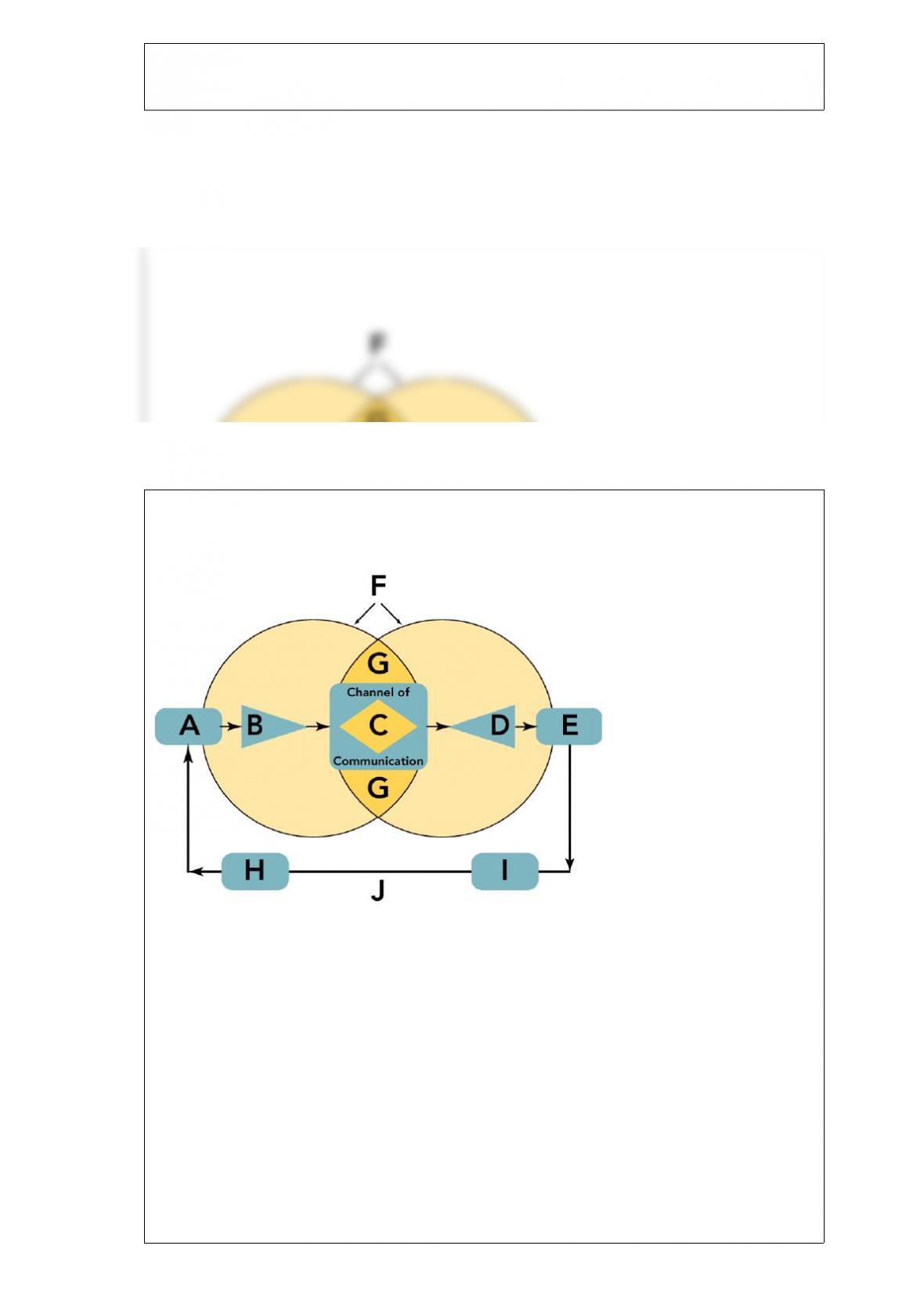
Figure 1.
Figure 1. above depicts the communication process, which consists of ten key elements
(“A” through “J”). The position labeled “F” is referred to as __________.
a. the response
b. the message
c. the feedback loop
d. the field of experience
e. feedback

Answer:
What would most likely occur at the preapproach stage in a business selling situation?
a. The order getter would make initial contact with the order taker.
b. The search for and qualification of prospects would begin.
c. The initial meeting would transpire and business would be concluded.
d. A decision would be made concerning whether the sale was to be a straight rebuy, a
modified rebuy, or a new buy.
e. The buying role of the prospect, important buying criteria, and the prospect’s
receptivity to a presentation would be determined.
Answer:
All of the following are examples of stakeholders EXCEPT:
a. government
b. competitors
c. shareholders
d. suppliers
e. customer
Answer:
What do a security guard, a plumber, and a management consultant share in common?
a. They are all tangible services.
b. They are all people-based services.
c. They do not have problems with idle production capacity.
d. They are all equipment-based services.
e. They never use off-peak pricing.
Answer:
Self-concept refers to
a. the degree to which a person is influenced by situational influences.
b. the need for personal fulfillment.
c. the way people see themselves and the way they believe others see them.
d. the degree to which a person trusts his or her own judgment in a purchase situation.
e. the way people see others.
Answer:
A cluster of neighborhood stores that serves people within a 5-to 10-mile radius is
referred to as a(n)
a. suburban shopping mall.
b. strip mall.
c. mini-mart.
d. hypermarket.
e. central business district.
Answer:
“To contribute to human welfare by application of biomedical engineering in the
research, design, manufacture, and sale of instruments or appliances that alleviate pain,
restore health, and extend life” is Medtronic’s ___________.
a. core value proposition
b. corporate culture
c. functional goals
d. sustainability doctrine
e. mission statement
Answer:
Intangibles such as a sense of belonging, excitement, style, or warmth are considered to
be __________ of a store’s image.
a. functional qualities
b. sociological qualities
c. psychological attributes
d. antecedent attributes
e. personality elements
Answer:
You respond by saying courteously, “You”re absolutely right, and I am going to make it
my business to be sure that never happens again.” Which method have you used to
handle the customer’s objection?
a. postpone
b. denial
c. agree and neutralize
d. ignore
e. convert
Answer:
The representations of ideas and concepts to which different cultures often attach
different meanings are referred to as
a. universal symbols.
b. symbolic concepts.
c. ideological representations.
d. cultural representations.
e. cultural symbols.
Answer:
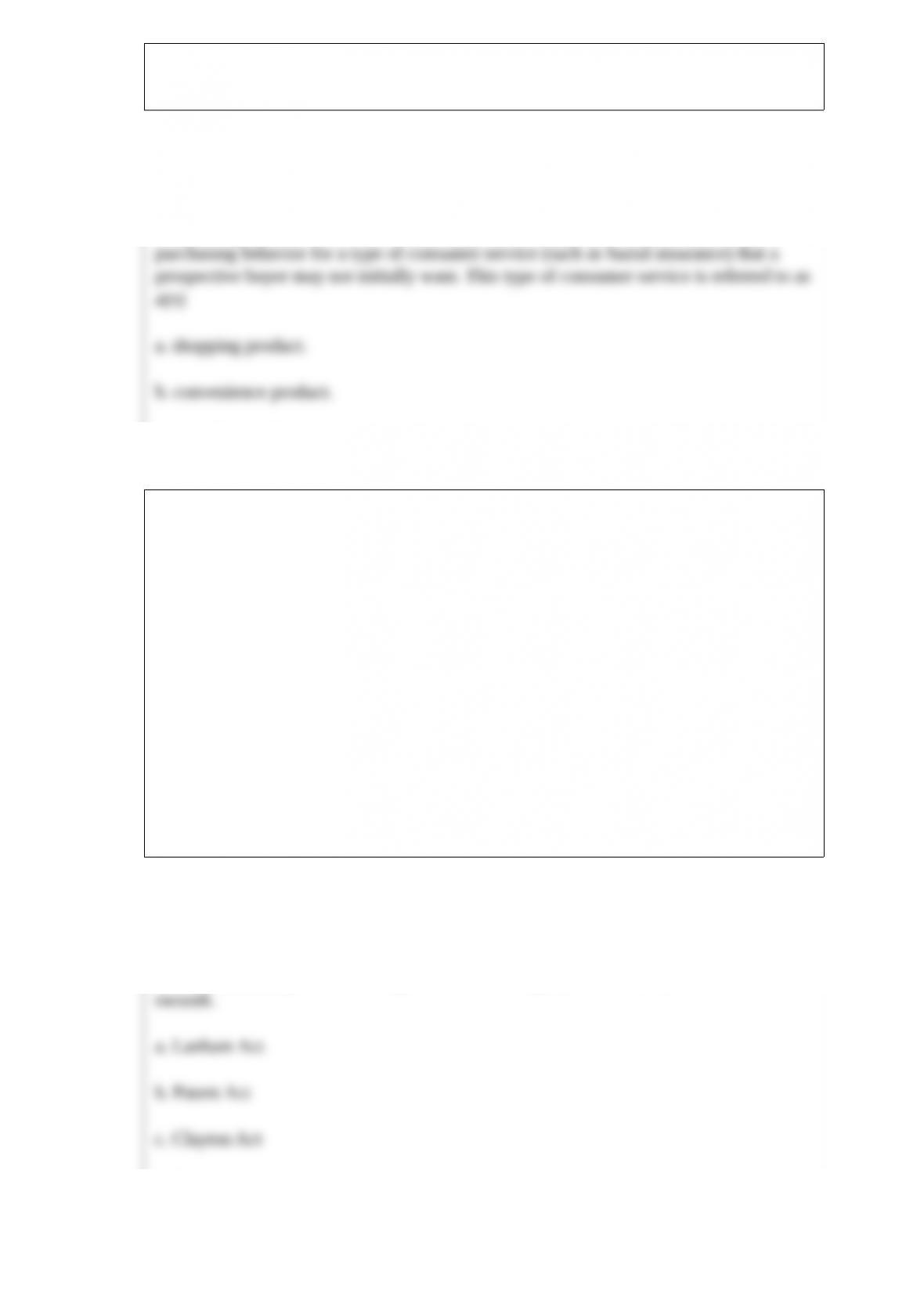
Figure 1.B
Figure 1.B above illustrates which type of pricing approach?
a. skimming
b. penetration
c. cost-plus
d. price lining
e. prestige
Answer:
Very infrequent purchases with some comparison shopping are characteristic of the
purchasing behavior for a type of consumer service (such as burial insurance) that a
prospective buyer may not initially want. This type of consumer service is referred to as
a(n)
a. shopping product.
b. convenience product.
c. specialty product.
d. support product.
e. unsought product.
Answer:
The __________ provides for registration of a company’s trademark, such as the Nike
swoosh.
a. Lanham Act
b. Patent Act
c. Clayton Act
d. Sherman Antitrust Act
e. Miller-Tydings Act
Answer:
Customer value refers to
a. the need of a customer to receive the highest quality product at the lowest possible
price.
b. the degree to which a customer is willing to sacrifice quality for price.
c. a statement that, before product development begins, identifies (1) a well-defined
target market; (2) specific customers’ needs, wants, and preferences; and (3) what the
product will be and do to satisfy consumers..
d. the unique combination of benefits received by targeted buyers that includes quality,
convenience, on-time delivery, and both before-sale and after-sale service at a specific
price.
e. the cluster of benefits that an organization promises customers to satisfy their needs.
Answer:

A situation analysis refers to
a. taking stock of where the firm or product has been recently, where it is now, and
where it is headed in terms of the organization’s marketing plans and the external forces
and trends affecting it.
b. an appraisal of an organization’s internal and external strengths and weaknesses and
its internal and external opportunities and threats.
c. the process of continually acquiring information on events occurring outside the
organization to identify and interpret potential trends.
d. a technique that managers use to quantify performance measures and growth targets
to analyze its clients’ strategic business units (SBUs) as though they were a collection of
separate investments.
e. the process where a firm searches for growth opportunities from among current and
new markets as well as current and new products.
Answer: