China is the world’s largest tobacco-producing country and has 300 million smokers.
Approximately 700,000 Chinese die annually from smoking-related illnesses. This
figure is expected to rise to more than 2 million by 2025. China restricts tobacco
imports. U.S. trade negotiators advocate free trade, thus allowing U.S. tobacco
companies to market their products in China. The U.S. trade negotiators are acting
a. ethically but illegally.
b. ethically and legally.
c. unethically and illegally.
d. unethically but legally.
e. in ways that cannot be determined by the information provided.
Answer:
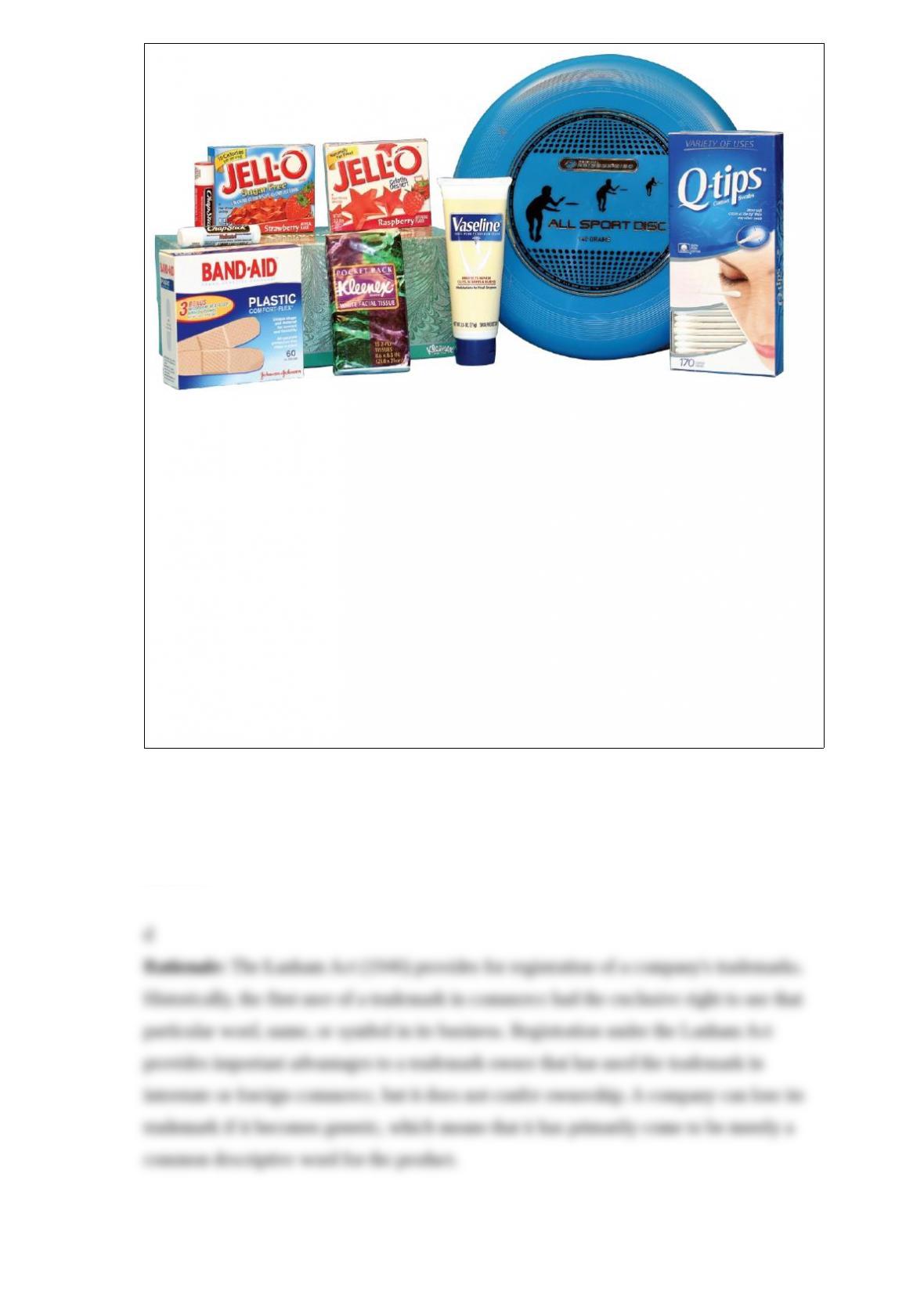
Generics Photo
In the Generics photo above, the manufacturers of these products are concerned that
their brand names will become generic. The legislation most likely to address this issue
is the __________.
a. Sherman Antitrust Act
b. Patent Act
c. Clayton Act
d. Lanham Act
e. Miller-Tydings Act
Answer:
Conflict that occurs between two different levels in a marketing channel is referred to as
a. lateral conflict.
b. horizontal conflict.
c. vertical conflict.
d. distributor conflict.
e. contractual conflict.
Answer:
Facilitating function activities include
a. buying and selling.
b. assorting, sorting, and storing.
c. financing, grading, and marketing information and research.
d. risk taking.
e. transportation.
Answer:
iVillage.com is an independent Web community for women, and includes topics such as
career management, personal finances, parenting, relationships, beauty and health. This
is an example of _______________, the fourth reason why consumers buy and shop
online.
a. control
b. customization
c. convenience
d. choice
e. communication
Answer:
The office of SFX Entertainment, a talent promoter, needs a new fax machine that will
print at three seconds a page (instead of five seconds per page like the one it is using
now) and has both local and network printing capabilities. The purchase of a
replacement fax machine would be an example of a
a. new buy.
b. straight rebuy.
c. make-buy.
d. modified rebuy.
e. standard reorder.
Answer:
Which of the following illustrates movement along the demand curve?
a. Prices remain the same, but there is a significant increase in demand.
b. Prices remain the same, but there is a significant decrease in demand.
c. As the price is raised, the quantity demanded increases, assuming all else stays the
same.
d. As the price is lowered, the quantity demanded increases, assuming all else stays the
same.
e. Movement along the curve rather than a shift of the curve indicates that some
significant event has taken place outside the organization that has affected demand.
Answer:
Differentiation positioning requires a product to
a. emphasize unique product attributes to compete directly with competitors.
b. compete directly with competitors on similar product attributes in the same target
market.
c. compete with competitors on similar product attributes but in a different market.
d. seek a less-competitive, smaller market niche in which to locate a brand.
e. develop marketing actions to move a product or brand to an ideal position.
Answer:
Each month, the owner of a carwash pays $2,500 in rent, $500 in utilities, $750 interest
on the business loan, an insurance premium of $200, and $250 on advertising on local
bus routes. A full-service carwash is priced at $10.50. Unit variable costs for the
carwash are $7.50. At what level of revenue will the carwash break even?
a. $4,200
b. $10,500
c. $14,700
d. $30,000
e. $39,900
Answer:
A straight commission compensation plan is well-suited to sales positions in which
__________.
a. nonselling activities are minimal
b. there is lively competition in the industry
c. no technological background is necessary
d. most salespeople are working towards management positions
e. extensive nonselling activities are essential for closing a sale
Answer:
The solicitation of a consumer’s consent (called “opt-in”) to receive e-mail and
advertising based on personal data supplied by the consumer is referred to as
__________.
a. collaborative marketing
b. personalization
c. viral marketing
d. buzz marketing
e. permission marketing
Answer:
A retailer bought a collectible Precious Moments figurine for $26. She sets the initial
selling price at $60. The final selling price was $52. What was the original markup?
a. $8
b. $16
c. $26
d. $34
e. $86
Answer:
Ace Shoe Company sells heel replacement kits for men’s shoes. It has fixed costs of $6
million and unit variable costs of $5 per pair. Ace would like to earn a profit of $2
million; how many pairs must they sell at a price of $15?
a. 100,000 kits
b. 400,000 kits
c. 600,000 kits
d. 800,000 kits
e. 1,400,000 kits
Answer:
Figure 1.
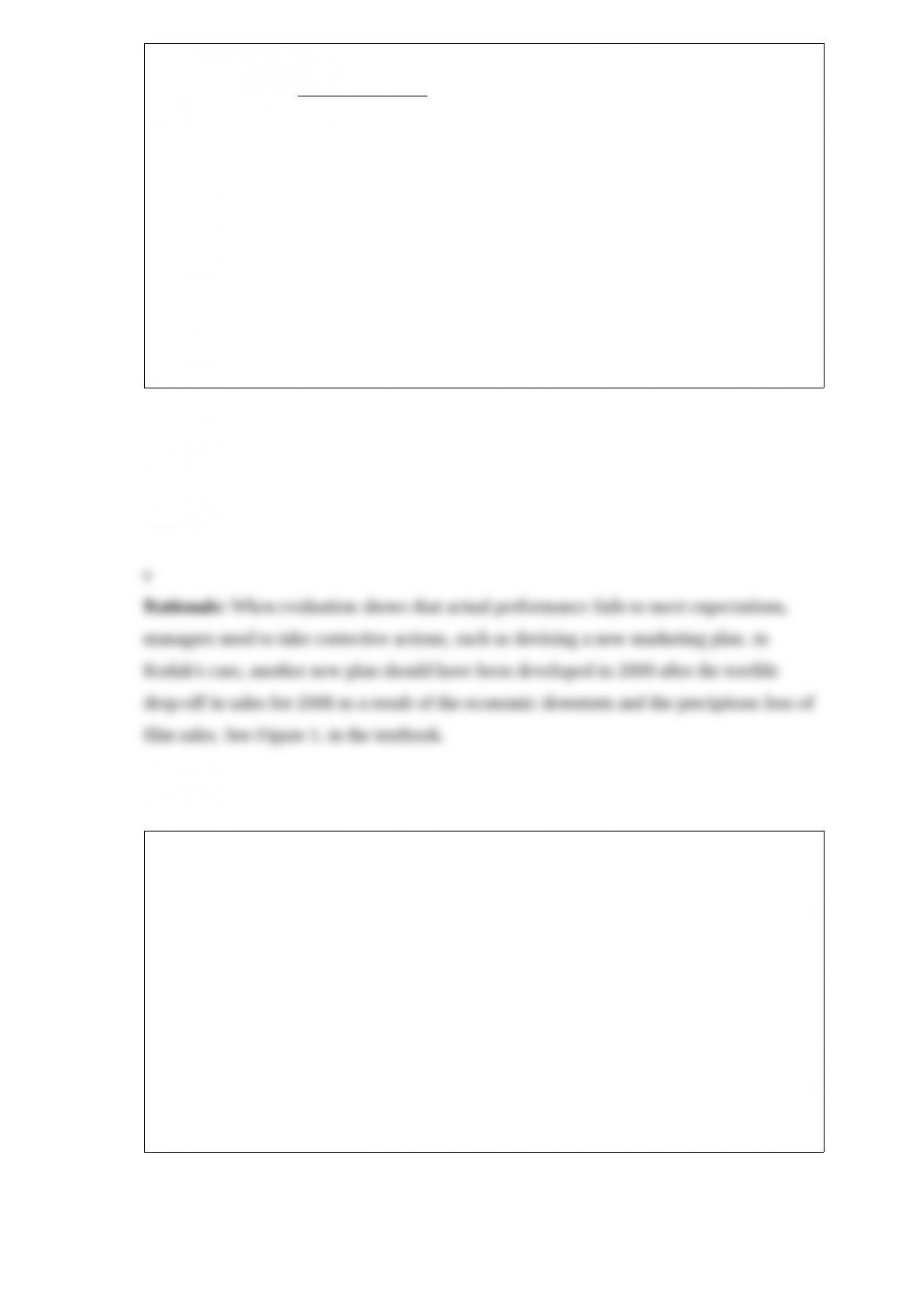
Based on the sales revenue data shown in Figure 1. above, as a marketing manager for
Kodak, you would MOST LIKELY conclude that
a. the planning gap is narrowing.
b. the actual sales results (line BE) are on track with the new plan (line BD).
c. the actual sales results (lines AB and BE) are on track with the plan in place since
2003 (line BC).
d. sales are increasing significantly since 2003 (line BD).
e. another new plan should have been implemented in 2009 since the planning gap
(wedge DBC) is widening each year thereafter.
Answer:
Walmart and Home Depot emphasize consistently low prices and eliminate most
markdowns with a retail pricing strategy called
a. low-margin.
b. value based.
c. everyday low pricing.
d. everyday fair pricing.
e. markdown pricing.
Answer:
There are six commonly used techniques to deal with objections: acknowledge and
convert the objection; postpone; __________; accept the objection; denial; and ignore
the objection.
a. redirect the conversation
b. defer to a supervisor
c. agree and neutralize
d. probe by asking additional questions
e. distract by identifying competitor shortcomings
Answer:
Sam’s Club and Costco are examples of __________.
a. supercenters
b. hypermarkets
c. warehouse clubs
d. single-price retailers
e. outlet stores
Answer:
With respect to the history of American business, the __________ era covered the early
years of the United States up until the 1920s.
a. production
b. sales
c. marketing concept
d. customer relationship
e. market orientation
Answer:
What was responsible for reversing Xerox’s decline?
a. frequent sales calls on its retailers to build trust
b. a sales organization that focused on customer relationships
c. the gathering of competitive intelligence
d. a reactive approach to establishing channels of distribution
e. the effective use of cold canvassing sales calls
Answer:
Reverse auctions
a. are seller-initiated.
b. benefit the sellers significantly more than the buyers.
c. have an increasing number of bidders as the auction progresses.
d. have sequential bidding.
e. have many buyers.
Answer:
Cultural symbols are things that
a. can be protected by international copyrights.
b. cannot be expressed by words or characters.
c. represent values that exist solely within a nation.
d. words that represent pictures or designs.
e. represent ideas and concepts.
Answer:
Travelocity.com provides almost immediate access to and confirmation of travel
arrangements and accommodations. This shows how electronic commerce contributes
to customer value through the creation of _________.
a. service utility
b. form utility
c. place utility
d. possession utility
e. time and possession utility
Answer:
Which phase of the strategic marketing process does a firm obtain resources, design the
marketing organization, develop schedules, and execute the marketing program?
a. planning phase
b. implementation phase
c. evaluation phase
d. strategic phase
e. tactics phase
Answer:
Price discrimination refers to
a. the practice of charging different prices to different buyers for goods of like grade
and quality.
b. an arrangement a manufacturer makes with a reseller to handle only its products and
not those of a competitor.
c. the practice of charging a very low price for a product with the intent of driving
competitors out of business.
d. a conspiracy among firms to set prices for a product or service.
e. a seller’s requirement that the purchaser of one product also buy another product in
the line.
Answer:
When Pizza Hut designed its marketing website, it wanted to make it as easy and
user-friendly as possible. In particular, it did not require repeat customers to have to
enter in their addresses, telephone numbers, and payment options every time they make
an online purchase. Rather, it wanted its website to recognize each customer by name
every time he or she visited the site to place an order. The website was designed to
retrieve all the information about the customer automatically whenever he or she placed
an order. To accomplish this task, Pizza Hut used a __________.
a. cookie
b. portal
c. gopher
d. spider
e. bot
Answer:
Tailoring goods or services to the tastes of individual customers on a high-volume scale
is referred to as
a. family branding.
b. mass customization.
c. “Tiffany/Walmart” marketing.
d. economies of scale marketing.
e. build-to-order.
Answer:
Factors influencing personal moral philosophy and ethical behavior include societal
culture and norms, business culture and industry practices, and __________.
a. religious beliefs and practices
b. corporate culture and expectations
c. national and regional legislation
d. universal core values
e. the universal concept of good vs. evil
Answer:
The customer service concept suggests that firms should
a. automate customer service.
b. maximize customer service levels.
c. minimize customer service levels.
d. minimize total logistics costs and let customer service follow.
e. provide superior customer service while controlling logistics costs.
Answer:
In marketing, an idea is
a. a thought that leads to a product or action.
b. an inspiration that evolved from market research.
c. an observation about a series of events.
d. a concept explaining the behavior of an individual or group.
e. an observation about an individual or group and how they use a service or product.
Answer:
Segmentation that is based on some objective physical (gender, ethnicity), measurable
(age, income), or other classification attribute (occupation) of prospective customers is
referred to as
a. personality segmentation.
b. demographic segmentation.
c. usage segmentation.
d. needs segmentation.
e. behavioral segmentation.
Answer:
The manager of a small gasoline station observes that while gasoline sales have been
steady, the service side of the business has fallen off, and mechanics are often idle. He
decides to offer a promotiona $20 off coupon for an oil change that is to be mailed to
800 households within a two-mile radius from the gas station. The cost of printing and
mailing is $1,000. The normal cost of an oil change is $40. Materials and labor per oil
change cost $15. How many additional maintenance service jobs must result for the
promotion to break even?
a. 25 jobs
b. 40 jobs
c. 50 jobs
d. 67 jobs

e. 200 jobs
Answer: