There are three general forms of retail ownership: contractual system, independent
retailer, and __________.
a. dual ownership
b. industry consortium
c. retailing cooperative
d. multi-national cartel
e. corporate chain
Answer:
Central Ice Machine Company is located in Omaha, Nebraska and sells Frick, Sullair,
York, and Fes Fuller ammonia refrigeration parts. The company ships these parts using
FOB origin pricing. Which of the following statements about the shipment of a Frick
reciprocating compressor is true?
a. Central Ice Machine will pay all shipping costs.
b. Central Ice Machine splits the shipping costs with its customers no matter where the
compressor is shipped.
c. It will cost Central Ice Machine more to ship to Charlotte, North Carolina than to
Topeka, Kansas.
d. A buyer in Albany, New York, will pay significantly more shipping charges than a
buyer in Lincoln, Nebraska.
e. All buyers will pay the same shipping costs, regardless of the destination.
Answer:
Kraft Foods distributes Starbucks coffee in U.S. supermarkets and internationally using
__________.
a. multichannel distribution
b. a direct marketing channel
c. a cooperative distribution channel
d. a strategic channel alliance
e. a dual distribution agreement
Answer:
The first flat-panel HD (high definition) TV is an example of which type of innovation?
a. continuous innovation
b. dynamically continuous innovation
c. discontinuous innovation
d. insignificant innovation
e. interruptive innovation
Answer:
New-product strategy development calls for INGenius Co. to develop a battery recycler
for the business market. Which is the most likely stage of the new-product process in
which manufacturing issues regarding the new product become an especially important
element?
a. development
b. market testing
c. idea generation
d. screening and evaluation
e. business analysis
Answer:
The total expense incurred by a firm in producing and marketing a product, which
equals the sum of fixed cost and variable cost, is referred to as
a. overhead cost.
b. total cost.
c. unit cost.
d. average cost.
e. marginal cost.
Answer:
A product line is a group of product or service items that are closely related because
they satisfy a class of needs, __________, are sold to the same customer group, are
distributed through the same type of outlets, or fall within a given price range.
a. are made of similar components
b. are used together
c. have one SKU number
d. require high levels of R&D
e. made from the same formulations
Answer:
Which of the following statements about comparative advertising is true?
a. Comparative advertisements now constitute over 90% of all television ads.
b. Comparative advertisements attract less consumer attention for the advertiser’s brand.
c. Comparative advertisements need market research to provide legal support for their
claims.
d. Comparative advertisements have been banned by the Federal Trade Commission.
e. Comparative advertisements can, and often do, cause more harm than good.
Answer:
In thinking about starting an ad campaign on Facebook, the brand manager considers
a. that each user who visits a Facebook Page will see the same advertisement.
b. whether the ad has a balance of text, audio, and video when it is placed on users’
Facebook Pages.
c. letting users specify ad positioning and placement on the Facebook Page.
d. tracking new sales produced by the ad by linking it to a coupon code, product, or
promotional offer.
e. that advertising on Facebook Pages is free and is an economical advertising strategy.
Answer:
In an attempt to sell more soft drinks and popcorn, a theater owner embedded very brief
messages during the movie trailers before showing the feature film. The messages,
which flashed on the screen for such a short time that moviegoers were not consciously
aware of the messages, urged consumers to “Drink Coke” and to “Eat Popcorn.”
Research showed the messages were largely ineffective. This example suggests that
a. selective perception overrides advertising messages.
b. selective exposure is difficult for marketers to surmount.
c. subliminal messages may have limited effects on behavior.
d. subliminal perception enables marketers to take advantage of consumers.
e. the messages violated the concept of selective comprehension.
Answer:
Adding a fixed percentage to the cost of all items in a specific product class is referred
to as
a. target profit pricing.
b. standard markup pricing.
c. target return-on-investment pricing.
d. customary pricing.
e. everyday low pricing.
Answer:
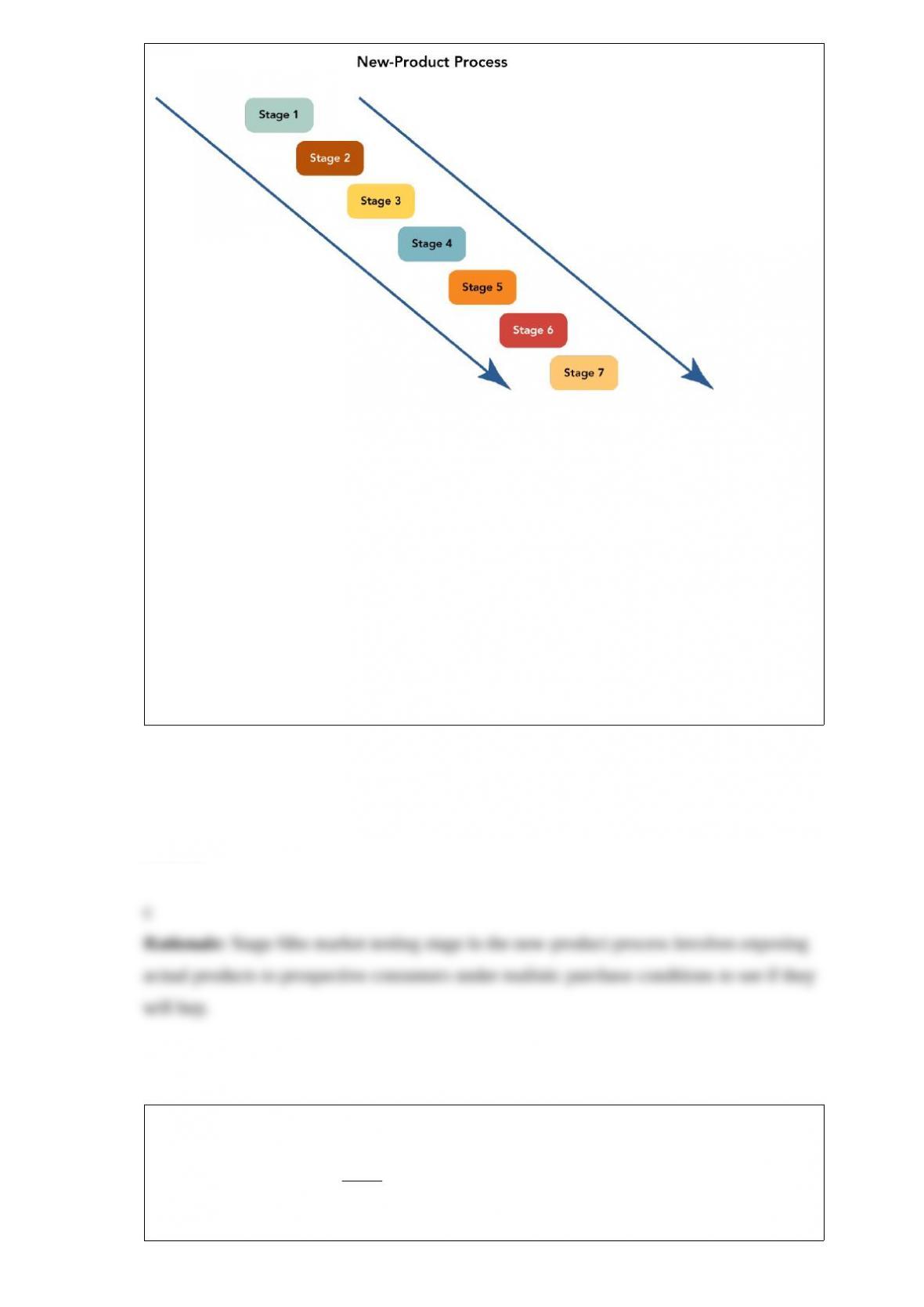
Figure 1.
Figure 1. above represents the seven stages of the new-product development process.
Stage 6 is the __________ stage.
a. business analysis
b. screening and evaluation
c. market testing
d. commercialization
e. development
Answer:
The late Steve Jobs oversaw or invented innovations that revolutionized six industries.
Which industry below is NOT one of these six?
a. music
b. smartphones
c. personal computers
d. television
e. tablet computing
Answer:
Figure 1.
As shown in Figure 1. above, “A” is the__________ stage in the personal selling
process.
a. approach
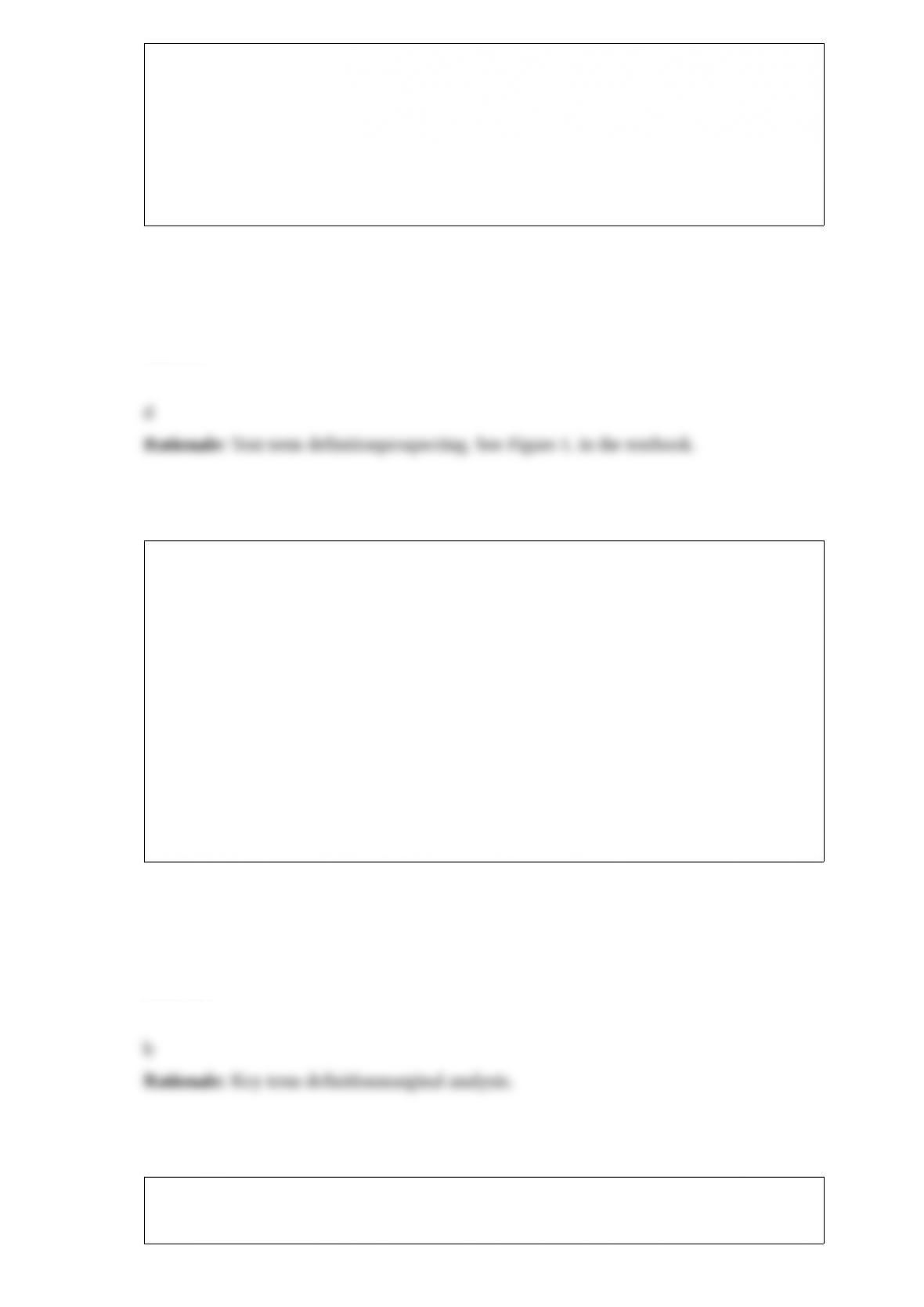
b. preapproach
c. presentation
d. prospecting
e. follow-up
Answer:
What idea is described as a continuing, concise trade-off of incremental costs against
incremental revenues?
a. break-even analysis
b. marginal analysis
c. demand analysis
d. cost-benefit analysis
e. situation analysis
Answer:
As product adopters, members of the late majority __________.
a. have a fear of debt and use neighbors and friends as information sources
b. are skeptical and have below average social status
c. are deliberate and use many informal social contacts
d. are leaders in social settings and have a slightly above average education
e. are venturesome, highly educated, and use multiple information sources
Answer:
The element of the marketing mix that describes a good, service, or idea to satisfy
consumers’ needs is known as
a. a product.
b. the price.
c. promotion.
d. the place or distribution.
e. a market segment.
Answer:
Hallmark was the official supplier of flowers at the last Winter Olympics. Hallmark
presented each Olympic winner with a special bouquet of roses designed to resemble
the Olympic torch. Consumers were able to buy a smaller version of this same bouquet
at the Hallmark website for $74.95. The Olympic bouquet that consumers could buy
contained two dozen yellow roses, yet you could buy the same two dozen yellow roses
for less than $35 at most supermarkets. If Hallmark is treating the Olympic bouquet as
an innovative product, then it is using which demand-oriented pricing approach?
a. bundle pricing
b. yield management pricing
c. skimming pricing
d. target return-on-sales pricing
e. penetration pricing
Answer:
A flowchart of the points of interaction between a customer and a service provider is
referred to as
a. a service continuum.
b. gap analysis.
c. a customer contact audit.
d. a customer contact continuum.
e. a service audit.

Answer:
The new-product process refers to
a. the informal process of “brain storming” to generate new-product concepts at a
marketing staff meeting.
b. the process of presenting cross-functional teams with a written new-product concept
statement and asking them to respond to it in writing.
c. the seven stages an organization goes through to identify business opportunities and
convert them into salable products or services.
d. the two stages an organization goes through from idea generation to
commercialization.
e. a formalized protocol for new-product development that begins at the corporate level
and ends at the functional level.
Answer:
Inconsistency of services refers to the fact that
a. there is no regulation of service industries in terms of basic standards of quality.
b. the quality of service provided by a firm is often inconsistent with its image.
c. the performance of one employee may vary from the performance of another
employee even though the same firm employs both.
d. training and standardization of service delivery procedures cannot be accomplished.
e. services have a varying degree of durability.
Answer:
A __________ contains specific goals assigned to a salesperson, sales team, branch
sales office, or sales district for a stated time period.
a. sales call report
b. selling expense report
c. sales quota
d. last year/current year sales ratio report
e. salesforce plan
Answer:
Which of the following statements about product lines is MOST accurate?
a. An advantage of a narrow product line is the ability to have a greater gap between
price points.
b. Product lines refer to consumer products; product mixes refer to industrial products.
c. An advantage of broad product lines is increased likelihood of access to large retail
chain distribution.
d. A benefit of having a narrow product line is that it enables both consumers and
retailers to simplify their buying decisions.
e. A broad product line reduces R&D costs.
Answer:
Which of the following is an example of a “Tiffany/Walmart” strategy?
a. College Football magazine selects different covers for essentially the same magazine
in order to appeal to different geographic markets in the U.S.
b. A new movie used several different movie trailers. One set of previews showed the
action scenes in order to attract one audience and the other set showed romantic scenes
to attract another audience.
c. Arm and Hammer Baking Soda can be used for baking and to remove odors from
refrigerators and litter boxes.
d. Gap’s Banana Republic chain sells blue jeans for $58, whereas its Old Navy stores
sell a slightly different version for $22.
e. Johnson’s Baby Oil is advertised as a skin softener for babies and as a makeup
remover for women.
Answer:
All of the following were strategic opportunities identified in IBM’s 2015 Road Map
EXCEPT:
a. the connected, ‘smarter planet.”
b. cloud and smarter computing.
c. a shift from software and services to PCs and hard disk drives.
d. business analytics and optimization.
e. growth markets such as China, India, Brazil, and Africa.
Answer:
Which of the following is a criterion used for selecting a target segment?
a. potential for increased profit
b. similarity of needs of potential buyers within a segment
c. difference of needs of buyers among segments
d. potential of a marketing action to reach a segment
e. compatibility with the organization’s objectives and resources
Answer:
Having a product or service where consumers want it is __________ utility.
a. form
b. place
c. time
d. possession
e. transactional
Answer:
The reseller market includes
a. manufacturers.
b. logistics and supply chain providers.
c. government agencies.
d. end-user service providers.
e. retailers and wholesalers.
Answer:
After examining a planning gap, firms typically attempt to
a. decide if the time horizon should be increased or decreased.
b. perform a SWOT analysis with their major competitor as the principal focus.
c. use statistical linear trend analysis to interpret the results.
d. exploit a positive deviation or correct a negative deviation.
e. adopt a market-product grid to analyze the sales results.
Answer:
Skimming pricing is a strategy that introduces a new or innovative product by
a. following a price elastic strategy.
b. creating multiple price points.
c. setting a high initial price.
d. setting a low initial price.
e. setting the price at the average of competitors’ prices.
Answer:
Two VALS segments stand apart; one represents the group with the highest resources
and innovation and the other represents the lowest resources and innovation. These two
groups are the__________ and the __________.
a. Thinkers; Believers
b. Strivers; Survivors
c. Achievers; Strivers
d. Innovators; Survivors

e. Experiencers; Makers
Answer: