
People who control the flow of information in the buying center, such as technical
experts and secretaries, can keep salespeople and information from reaching others in
the buying center and are referred to as __________.
a. deciders
b. obstructionists
c. gatekeepers
d. power-brokers
e. influencers
Answer:
Ideally, before a new product is developed, a firm should have a precise __________,
which is a statement that identifies: (1) a well-defined target market; (2) specific
customers’ needs, wants, and preferences; and (3) what the product will be and do to
satisfy consumers.
a. formula
b. contract
c. modus operandi
d. protocol
e. methodology
Answer:
One of Porter’s generic business strategies requires products to have significant points
of difference to charge a higher price while targeting a broad array of market segments.
This is referred to as a __________.
a. differentiation focus strategy
b. cost focus strategy
c. cost leadership strategy
d. differentiation strategy
e. supply focus strategy
Answer:
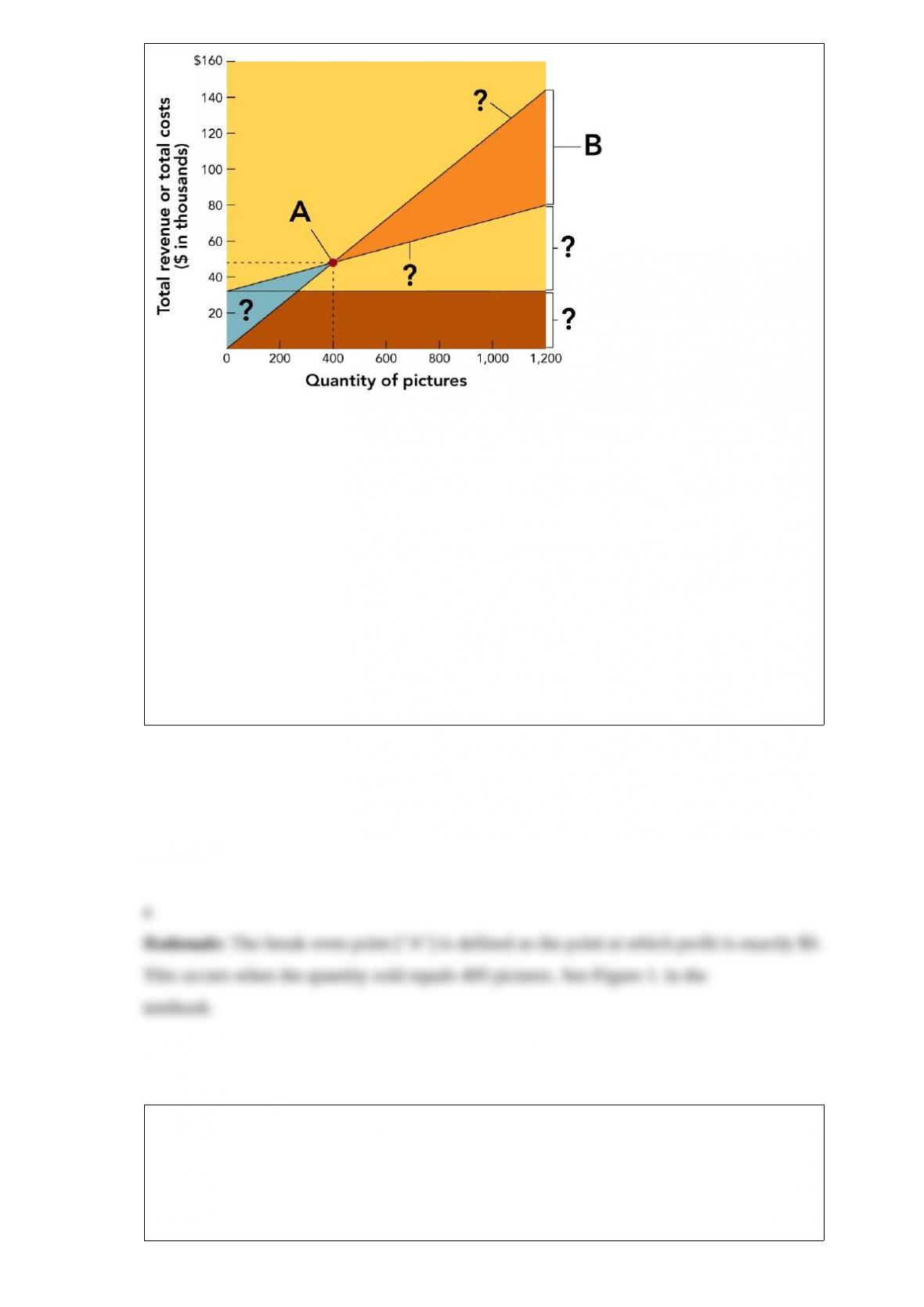
Figure 1.
According to Figure 1. above, how much profit will the firm make if it sells 400
pictures?
a. $48,000
b. $35,000
c. $20,000
d. $32,000
e. $0
Answer:
Percentage of sales budgeting refers to
a. matching a competitor’s absolute level of spending or the proportion per point of
market share.

b. allocating funds to a promotion only after all other budget items are covered.
c. allocating funds to a promotion as a percentage of past or anticipated sales, in terms
of either dollars or units sold.
d. determining a firm’s promotion objectives, outlining the tasks to accomplish these
objectives, and determining the advertising cost of performing these tasks.
e. allocating funds to a promotion based on expected profits generated from it.
Answer:
The ability of a website to modify itself to, or be modified by, each individual user is
referred to as __________.
a. connection
b. complexity
c. site actualization
d. customization
e. customerization
Answer:

Obtaining primary and secondary data would take place during which stage of the
five-step marketing research approach?
a. define the problem
b. develop the research plan
c. collect relevant information
d. develop findings
e. take marketing actions
Answer:
Which of the following data are collected from consumers to develop a perceptual map
for a particular product?
a. a listing of all prospective brands and products
b. the important attributes for a product or brand class
c. managerial judgments about how consumers perceive products
d. rank order of the ratings of an existing brand’s preference relative to its competitors
e. detailed explanations of why consumers make the choices they do
Answer:
The retailing mix refers to
a. the activities related to managing the store and the merchandise in the store, which
includes product, price, promotion, and place.
b. the activities related to managing the store and the merchandise in the store, which
includes the four utilities time, form, possession, and place.
c. the activities related to managing the store and the merchandise in the store, which
includes the colors, sizes, shapes, and perceived value of the store’s products.
d. the activities related to managing the store and the merchandise in the store, which
includes retail pricing, store location, retail communication, and merchandise.
e. the activities related to managing the store and the merchandise in the store, which
includes selection of store location, selection of merchandise, hiring and training of
employees, and promotion of both the store and products.
Answer:
Which of the following statements describes a key difference between advertising and
public relations?
a. Public relations is more expensive on a cost-per-contact basis than advertising.
b. Public relations is usually directly paid while advertising is usually indirectly paid.
c. Advertising is usually directly paid while public relations is usually indirectly paid.
d. Advertising provides an immediate feedback loop while public relations does not.
e. Public relations always has a much greater reach than advertising.
Answer:
The predominant person-to-person trading community in the world is
a. Kijiji.
b. Amazon.
c. NASDAQ.
d. Craigslist.
e. eBay.
Answer:
Which of the following responses does the textbook recommend a brand manager take
during a social media attack on a brand?
a. Respond immediately respond to the attack with aggression to get the attackers to
back down.
b. Ignore your detractors so they will stop commenting.
c. Communicate your solution through multiple social media platforms.
d. Use only traditional media to reach the target audience because the issues can be
explored in greater detail that way.
e. Accept whatever solution the attackers offer, as quickly as possible.
Answer:
Albertson’s Supermarket accepts debit and credit cards as well as cash and checks for
purchases. Its acceptance of various forms of payment provides its customers with
__________ utility.
a. time
b. place
c. possession
d. form
e. public
Answer:
The percentage of online shoppers
a. didn’t begin to show promise until 2007 when online security measures improved.
b. stabilized in 2009 when Internet penetration reached 98 percent of all U.S.
households.
c. grew rapidly during 2003-2005 and then declined sharply when the “dot.com bubble”
burst in 2006.
d. has grown year after year and is expected to continue to increase over the next few
years.
e. grew slowly for the first three years, spiked dramatically in 2008-2009, but is
expected to slow just as dramatically due to a downturn in the economy and the
implementation of new online-sales tax-collection laws.
Answer:
A company’s product mix is equal to the sum of its
a. marketing mix.
b. product class.
c. product items.
d. product lines.
e. SKUs.
Answer:
Which of the following statements describes the major difference between a prospect
and a qualified prospect?
a. Prospects are more likely than qualified prospects to become customers.
b. During the sales presentation, prospects are more likely to raise objections than
qualified prospects.
c. There are generally more qualified prospects than prospects.
d. Prospects have the need or desire for your product. Qualified prospects have not only
the need or desire for your product, but also the ability and authority to purchase it.
e. A qualified prospect has purchased your product in the past and a prospect has not.
Answer:

Synergy analysis incorporates two business analysis tools, which are diversification
analysis and __________.
a. Porter’s generic business strategy
b. the market-product grid framework
c. SWOT analysis
d. Porter’s competitive advantage
e. share point analysis
Answer:
The Madrid Protocol is
a. a method of registering a trademark with language adaptations for different countries.
b. the act of collectively seeking a trademark for an entire industry.
c. a form of national branding, i.e., “Chilean Sea Bass.”
d. a treaty that facilitates the protection of U.S. trademark rights throughout the world.
e. an agreement to stop piracy of noncopyrighted products abroad.
Answer:
If a purchase is a new buy for a manufacturer, the seller should expect a long time for a
buying decision to be reached, work with technical personnel, and
a. expect specifications to be changed many times before the buy is completed.
b. expect a lot of conflict.
c. focus on a good solution to the problem for the buyer.
d. expect to have to do some favors for the decision-makers.
e. avoid making concessions or compromises.
Answer:
ISO 9000 KNOWLEDGE
ISO 9000 refers to the
a. standards for the registration and certification of a manufacturer’s quality
management and assurance system developed by the U.S. Department of Commerce.
b. International Safety Organization responsible for establishing international guidelines
for products designed for and targeted at children.
c. worldwide standards for environmental quality and green marketing practices
developed by the International Standards Organization.
d. standards for registration and certification of a manufacturer’s quality management
and assurance system based on an on-site audit of practices and procedures developed
by the International Standards Organization.
e. 9,000 major product and industry classifications used in the WTO Product
Classification System.
Answer:
Marketers produce a customer experience through seven website design elements: (1)
context; (2) content; (3) community; (4) customization; (5) communication; (6)
__________; and (7) commerce.
a. creativity
b. control
c. consistency
d. connection
e. collaboration
Answer:
Two types of order takers exist. __________ visit customers and replenish inventory
stocks of resellers whereas __________ typically answer simple questions, take orders,
and complete transactions with customers.
a. Inside order takers; outside order takers
b. Inside order takers; outside order clerks
c. Outside order takers; inside order takers
d. Salesclerks; inbound telemarketers
e. Inside order clerks; outside order takers
Answer:
Analyzing the data obtained during the marketing research project and presenting the
findings take place during which step of the five-step marketing research approach?
a. collect relevant information
b. develop findings
c. take marketing actions
d. plan the budget
e. identify constraints
Answer:
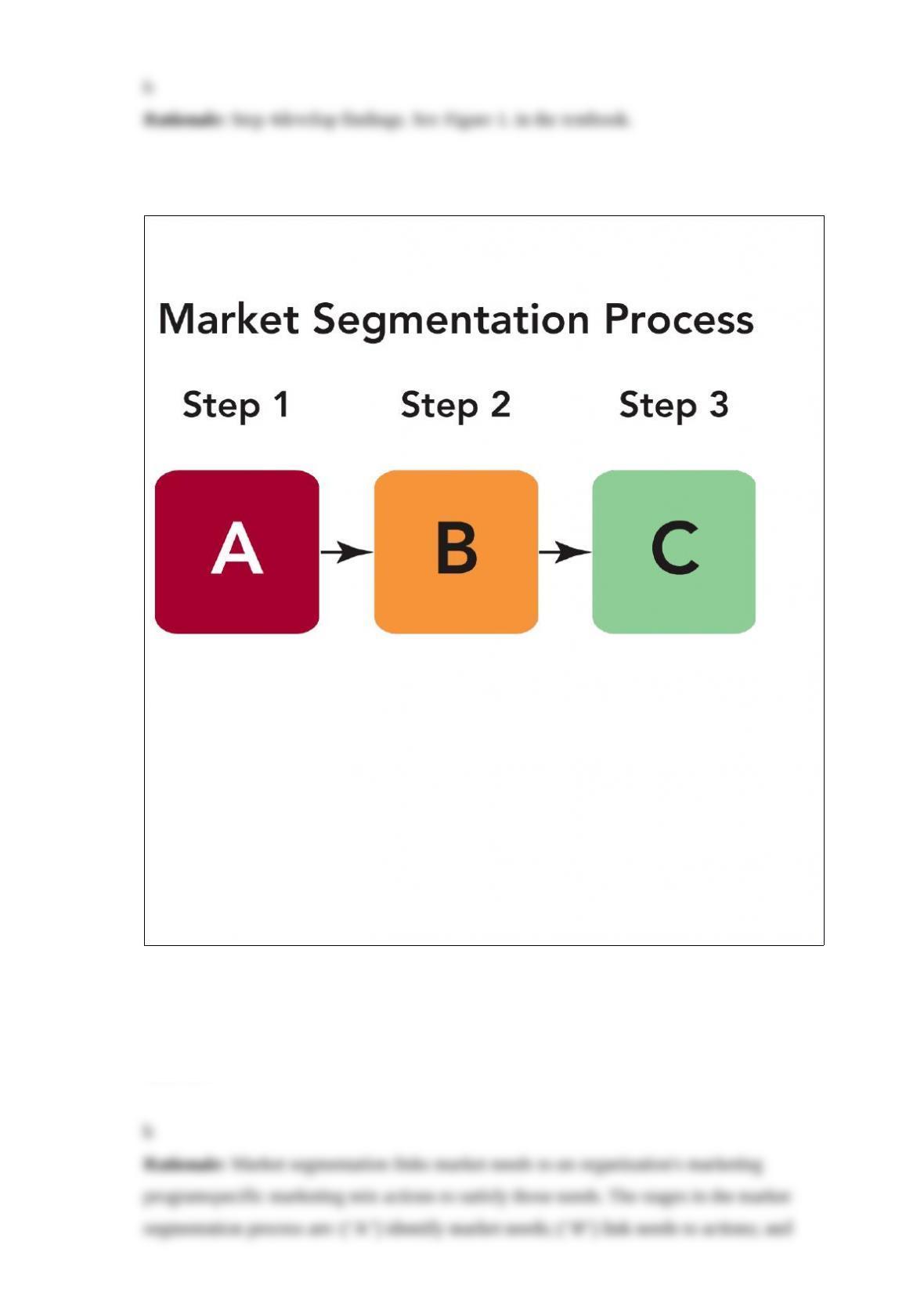
Figure 1.
In Figure 1. above, “A” represents which stage of the market segmentation process?
a. link needs to actions
b. identify market needs
c. establish a marketing protocol
d. execute marketing program actions
e. segment and select the target markets
Answer:
The output of a supply chain is the
a. units of products delivered.
b. total generated revenue.
c. service delivered to customers.
d. total number of customers served.
e. total profits realized.
Answer:
The back of a box of Hinode Harvest Blend rice mix suggests cooking with chicken
broth for added flavor. This is an example of
a. using a behavioral learning technique.
b. reducing perceived risk.
c. create stimulus generalization.
d. using a cognitive learning technique.
e. using an attitudinal learning technique.
Answer:
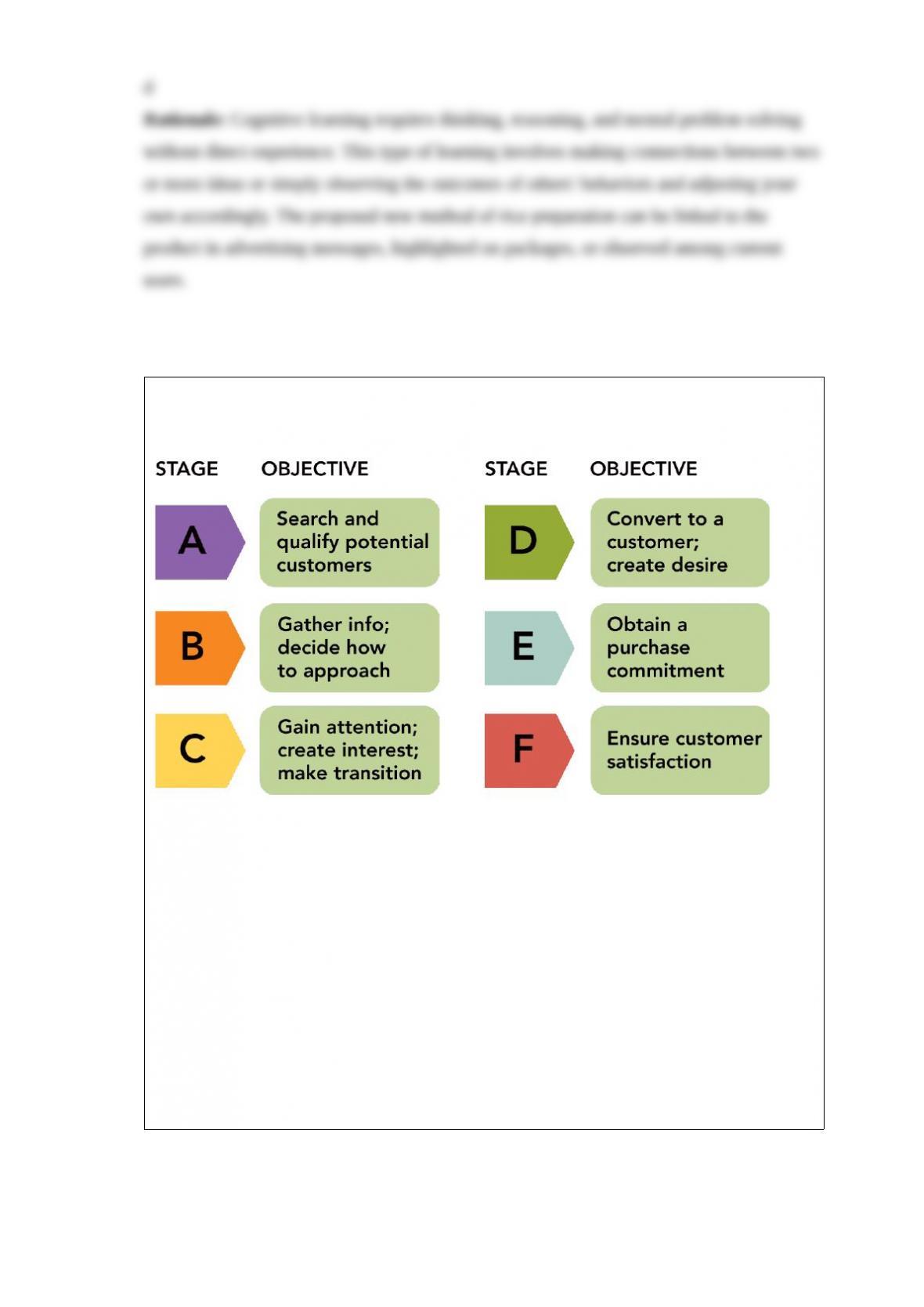
Figure 1.
As shown in Figure 1. above, “E” is the__________ stage in the personal selling
process.
a. close
b. preapproach
c. follow-up
d. approach
e. presentation
Answer:
Value consciousness refers to
a. the difference between perceived value and actual value of a product or service.
b. a fear of being subliminally influenced by marketing actions such as advertisements,
endorsements, etc.
c. a desire to pay the least amount possible for a product or service that meets minimum
performance requirements.
d. the concern for obtaining the best quality, features, and performance of a product or
service for a given price.
e. the concern for obtaining the best product or service regardless of the cost.
Answer:
SBUs with dominant shares of slow-growth markets that provide cash to cover the
organization’s overhead and to invest in other SBUs are referred to as __________.
a. cash cows
b. stars
c. question marks
d. dogs
e. hedgehogs
Answer:
A variation of off-price retailing includes __________.
a. discount wholesalers
b. outlet stores
c. discount retailers
d. supermarkets
e. hypermarkets
Answer:
Generally speaking, a(n) __________ firm markets its existing products and services in
other countries the same way it does in its home country.
a. meganational
b. international
c. multinational
d. transnational
e. intranational
Answer:
Multichannel marketing
a. creates greater elasticity of demand for its products.
b. can leverage the value-adding capabilities of different channels.
c. creates greater inelasticity of demand for its product.
d. allows firms to legally circumvent paying taxes on revenue generated by online sales.
e. allow customers to avoid shipping and handling charges.
Answer:
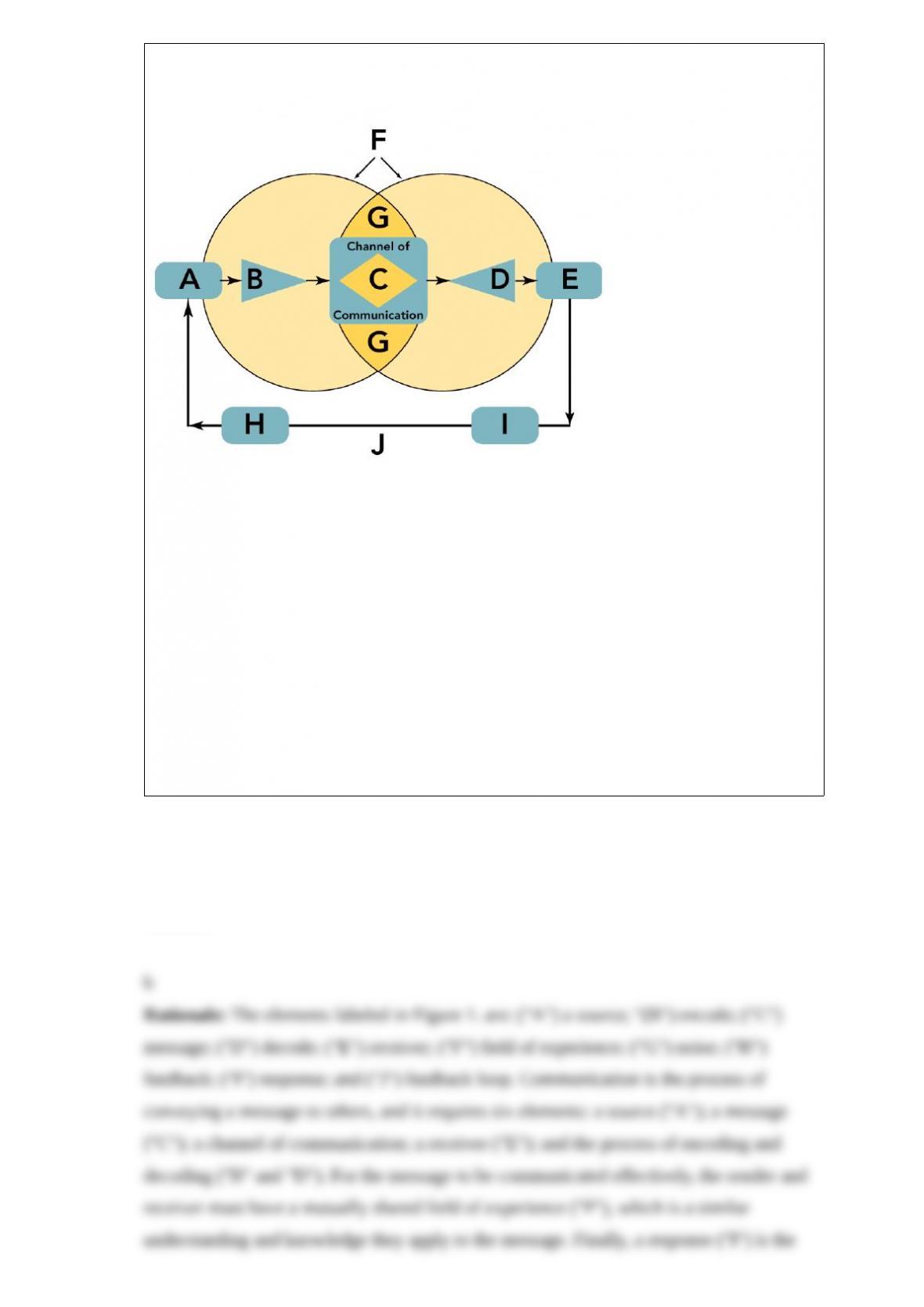
Figure 1.
Figure 1. above depicts the communication process, which consists of ten key elements
(“A” through “J”). The position labeled “C” is referred to as __________.
a. the source
b. the message
c. the receiver
d. the field of experience
e. feedback
Answer:
The greatest benefit to consumers when a firm chooses a one product, multiple market
segment strategy is __________.
a. improved service
b. increased number of choices
c. higher product quality and consumer value
d. lower retail prices because of lower marketing costs
e. lower retail prices because of lower production costs
Answer:
Large department store chains, such as Sears, generally use _________ pricing.
a. above-market
b. at-market
c. below-market
d. prestige pricing
e. everyday low pricing
Answer: