All of the following are reasons for the state of perceived ethical business conduct
EXCEPT:
a. a growing tendency for business decisions to be judged publicly by groups with
different values and interests.
b. the increased pressure on business people to make decisions in a society with diverse
value systems.
c. an increase in the public’s expectations of ethical business behavior.
d. ethical business conduct may have declined.
e. businesses are behaving more ethically during these difficult economic times.
Answer:
The fourth stage in the hierarchy of effects is __________.
a. interest
b. awareness
c. adoption
d. trial
e. evaluation
Answer:
Those activities that focus on getting the right amount of the right products to the right
place at the right time at the lowest possible cost are referred to as
a. strategic distribution.
b. distribution management.
c. tactical marketing planning.
d. value chain optimization.
e. logistics.
Answer:
An important social trend is the continued concern for health and well-being in the
United States. This is most likely evidenced by
a. First Lady Michelle Obama’s Let’s Move! initiative to eliminate childhood obesity.
b. the increased sales of Cigar Aficionado magazine.
c. the opening of more Starbucks coffee boutiques in supermarkets.
d. the upsizing of menu items at fast food restaurants.
e. the introduction of tablet devices such as the iPad.
Answer:
Today, __________ of all Americans live in central cities, __________ live in suburbs,
and __________ live in rural locations.
a. 30%; 30%; 40%
b. 20%; 50%; 30%
c. 50%; 30%; 20%
d. 20%; 30%; 50%
e. 30%; 50%; 20%
Answer:
Pizza Hut’s cost-conscious mothers look for a good quality product and _________.
Deal-seeking young adult males seek more of the food they love with _________ in the
process.
a. nutritional value; coupons and extra servings
b. a hassle-free eating experience; less time and cash invested
c. the lowest price possible; a great social experience
d. time with their children; the best price possible
e. friendly environment; free, fast, and easy delivery
Answer:
Ben & Jerry’s is founded on and dedicated to a sustainable corporate concept of linked
prosperity. Its mission consists of three interrelated parts: Ben & Jerry’s product mission
is to make, distribute, and sell the finest quality all natural ice cream and euphoric
concoctions with
a. milk obtained exclusively from large nationally certified bovine growth hormone
dairies.
b. the intent of making modest profits without sacrificing high product quality
standards.
c. ingredients that are all completely organic and are available only in Vermont to
ensure freshness.
d. a commitment to incorporating wholesome, natural ingredients and promoting
business practices that respect the earth and the environment.
e. ingredients that come exclusively from developed countries promoting Fair Trade
practices.
Answer:
When developing retailing strategies, marketers use what is called the retailing mix,
which includes
a. products, services, promotions, and retail communication.
b. promotions, publicity, and press releases.
c. retail pricing, store location, retail communication, and merchandise.
d. physical environment, people, process, and productivity.
e. direct mail, online stores, traditional stores, and outlet stores.
Answer:
During the introduction stage of the product life cycle, the place (distribution) element
of the marketing mix is highly involved with __________.
a. increasing inventory levels at warehouses and distribution centers to meet potential
demand
b. gaining as many retail distribution outlets as possible, even though many will be
reluctant to carry the new product
c. using an intermodal logistics system to get the products through the marketing
channel as quickly as possible
d. building storage warehouses and distribution centers to establish an efficient
infrastructure for the new product
e. obtaining contracts with independent sales agents and brokers instead of using the
firm’s salesforce
Answer:
Google developed two business practice tools __________ and __________ to (1) help
advertisers create ads and (2) help content providers generate advertising revenue.
a. AdWords; AdSense
b. AdPage; AdSense
c. AdLeaf; AdCall
d. AdFolio; AdSummon
e. AdRank; AdTag
Answer:
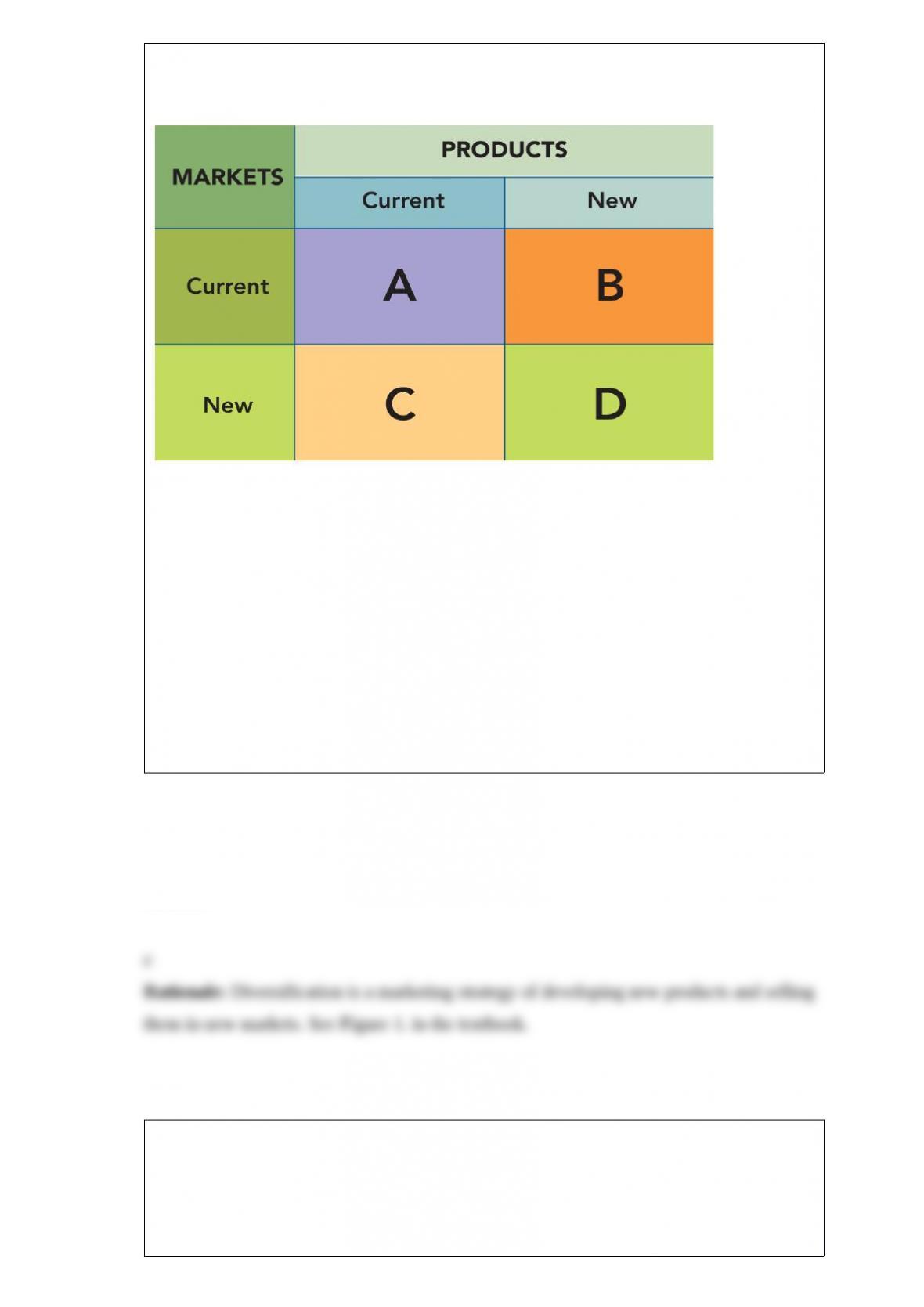
Figure 1.
Quadrant “D” in Figure 1. above represents the marketing strategy of __________.
a. market penetration
b. product penetration
c. market development
d. product development
e. diversification
Answer:
Services can be classified according to whether they are delivered by people or
equipment, they are __________, or they are government sponsored.
a. national or global
b. use independent contractors
c. privately owned or publicly owned
d. owned by individuals or corporations
e. for profit or nonprofit organizations
Answer:
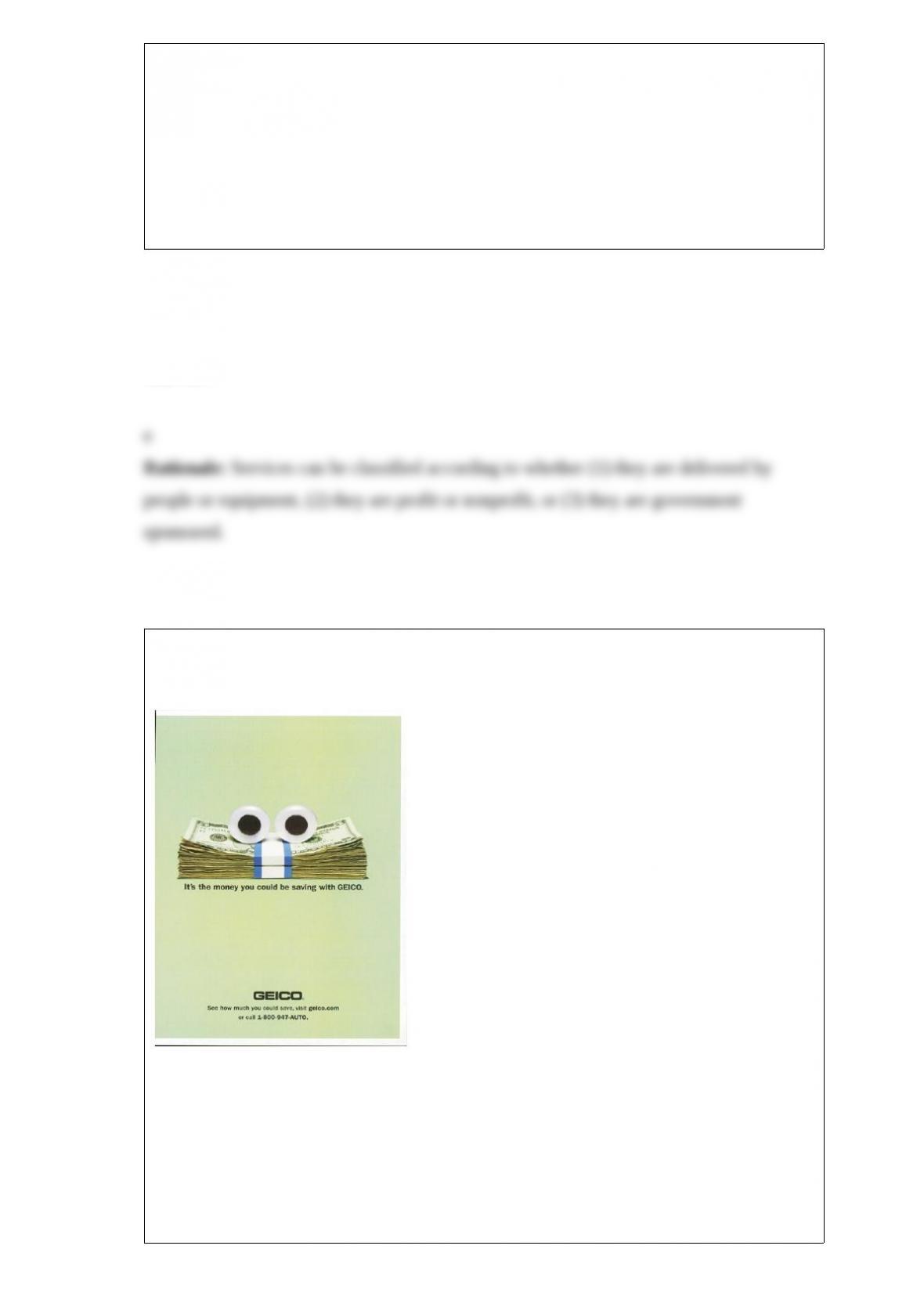
Geico Ad
The Geico ad shown above is an example of which type of appeal?
a. reminder
b. fear
c. sex
d. cognitive
e. humor
Answer:
When a marketing manager begins asking “what if” questions to determine how
changes in a factor like price or advertising affect marketing results like sales or profits,
she is performing a(n) __________ analysis.
a. marketing
b. environmental
c. structured
d. query
e. sensitivity
Answer:
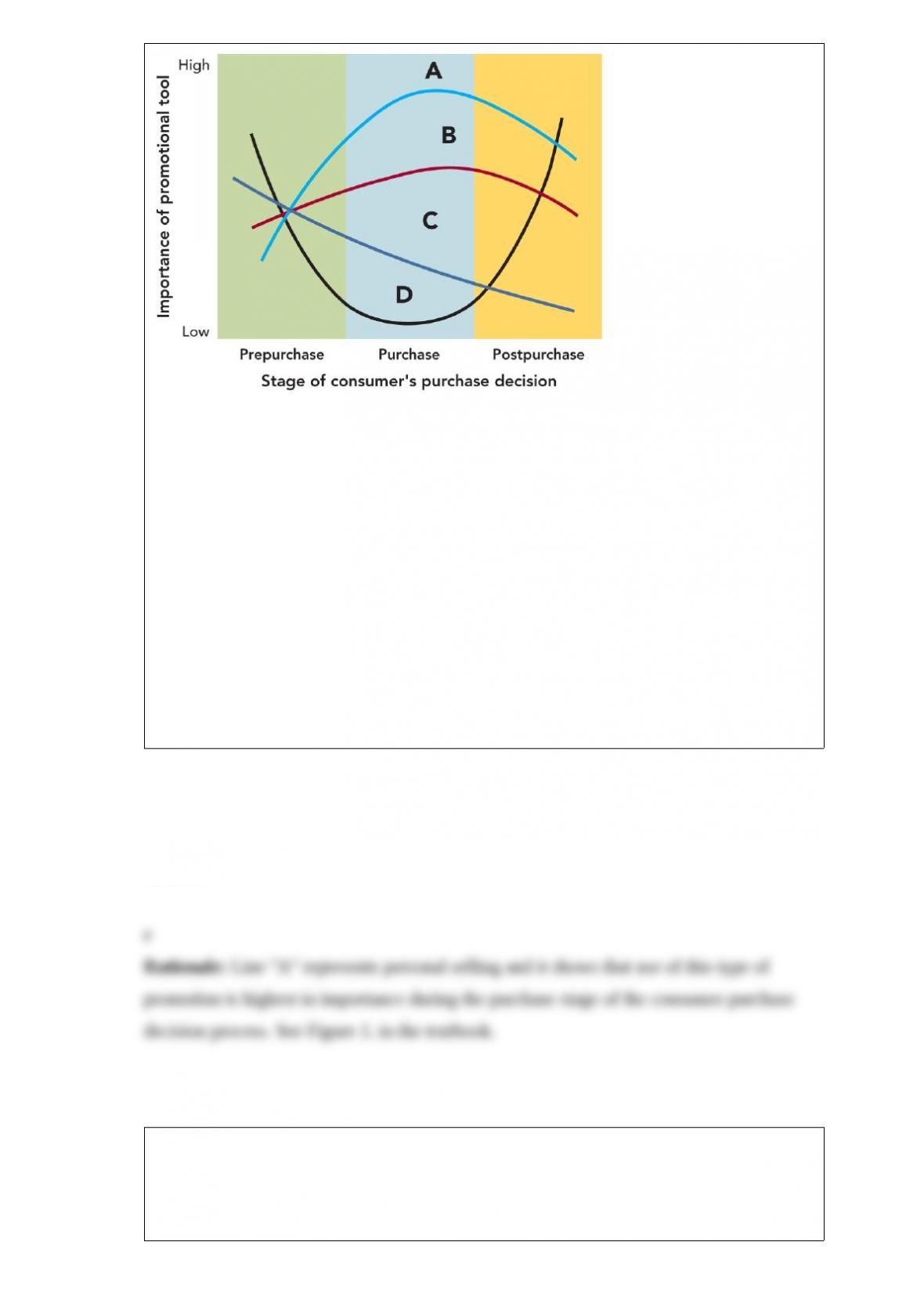
Figure 1.
In Figure 1. above, line “A” shows that __________, a tool of the promotion mix, is
highest in importance during the purchase stage of the consumer purchase decision
process.
a. advertising
b. public relations
c. communication
d. sales promotion
e. personal selling
Answer:
Itex Corporation, a marketer of Photostat products used in the graphic arts field, buys
photo sensitized paper from Eastman Kodak Company, packages it with the Photostat
brand name, and sells it directly to amateur photographers. In this context, Itex
Corporation is most accurately classified as a
a. manufacturer.
b. reseller.
c. service provider.
d. wholesaler.
e. industrial firm.
Answer:
A __________ is an individual that wants a product, can afford to buy it, and is the
decision maker.
a. qualified prospect
b. customer
c. lead
d. prospect
e. gatekeeper
Answer:
The third step of the marketing research approach is to __________.
a. develop findings
b. define the problem
c. take marketing actions
d. develop the research plan
e. collect relevant information
Answer:
Marketing channels help create value for consumers through four utilities. These
utilities are
a. product, price, promotion, and place.
b. form, function, risk taking, and selling.
c. time, place, form, and possession.
d. transactional, logistical, facilitating, and marketing.
e. buying, selling, storing, and transporting.
Answer:
Which of the following statements should the salesperson use as a denial response to a
prospect’s objection?
a. “I think I might be able to explain that better to you after showing you this diagram.”
b. “Yes, you”re right, it is lighter but that is done intentionally to make your work
easier.”
c. “That’s true. It does have a shorter shelf life, but that really hasn”t been a problem. It
is so popular it never stays on the shelf that long anyway.”
d. “Where did you hear that? Your source must have erroneous information.”
e. “As I was saying, .”
Answer:
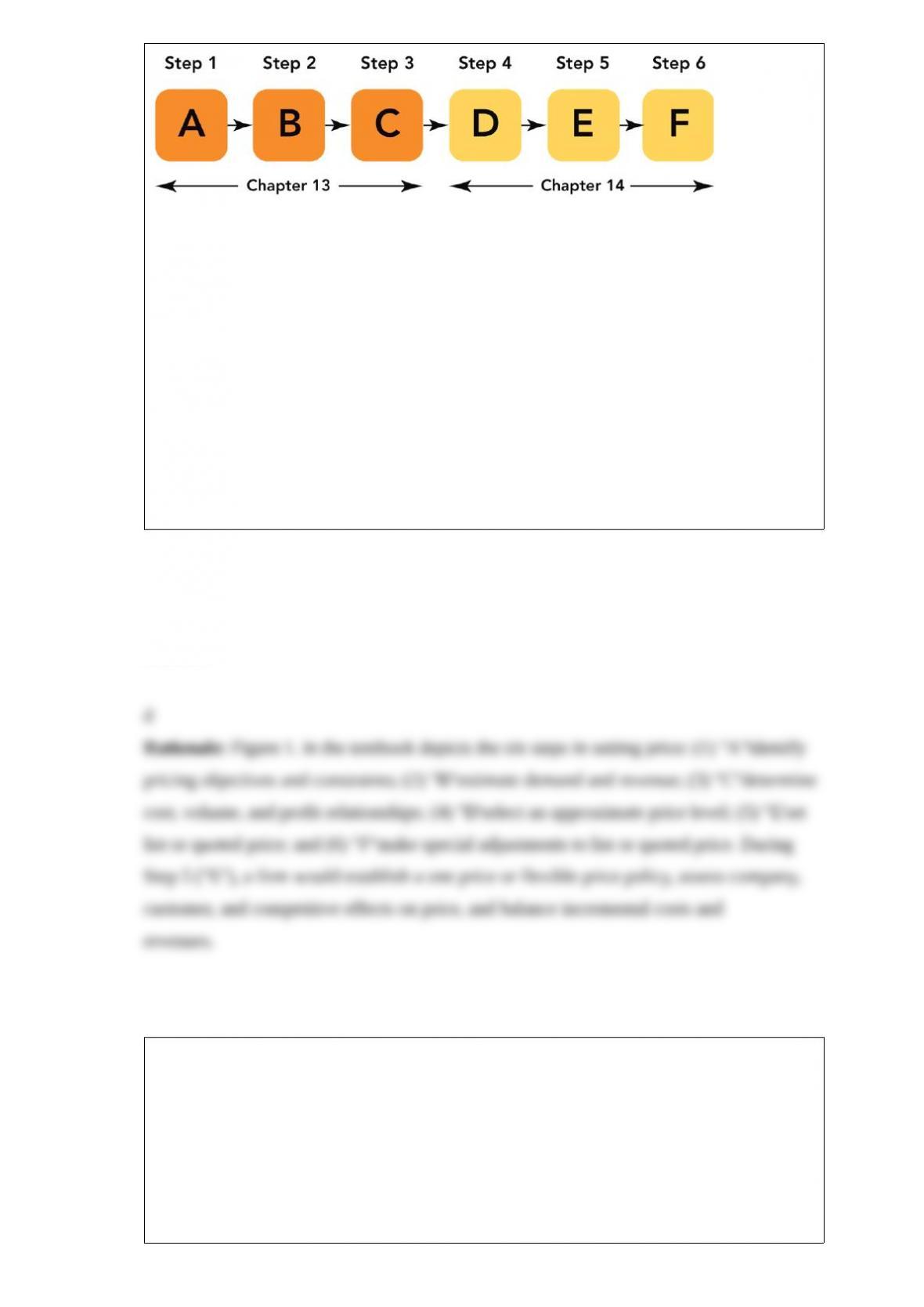
Figure 1.
Figure 1. above represents the six steps in the price-setting process. Which letter
represents the step where a firm would establish a one price or flexible price policy?
a. “A”
b. “F”
c. “C”
d. “E”
e. “D”
Answer:
You have been told that a company increased its marketing effort from $3 million to $5
million, resulting in increased sales revenue from $10 million to $20 million. Calculate
the company’s ratio of incremental sales revenue to incremental marketing effort.
a. 4:1
b. 1:5
c. 5:1
d. 1:4
e. 5:1.
Answer:
Which of the following statements best describes the relationship between the imports
into the United States and the exports from the United States during the last 30 years?
a. No accurate data has been made available from the WTO on trade imports and
exports.
b. The volume of both imports and exports has consistently decreased.
c. Imports into the United States and exports have been about equal, indicating balanced
trade.
d. Exports have exceeded imports, indicating a continuing trade surplus.
e. Imports have exceeded exports, indicating a continuing trade deficit.
Answer:
DirectProtect is an insurance provider that uses telemarketers rather than insurance
agents to sell its insurance and deal with claims. It wants to introduce its product into
new markets, but before it does so, it wants to predict how successful its sales efforts
will be. The first things researchers did was invite a group of eight insured people to its
headquarters to talk about home and auto insurance with a moderator. The purpose of
this exploratory research was to gather information about the group members’ attitudes
toward insurance and their awareness of DirectProtect. This was done by recording
respondents’ answers as well as having them answer questions using paper and pencil.
While additional research still needs to be done, the marketing researchers were able to
gather __________ data.
a. hypothetical
b. generative
c. evaluative
d. questionnaire
e. experiential
Answer:
The process of having the sender transform an idea into a set of symbols during the
communication process is referred to as __________.
a. decoding
b. encrypting
c. message formation
d. advertising
e. encoding
Answer:
A channel intermediary that does not carry inventory, typically performs only a sales
function, and is an alternative to agents and brokers is referred to as a __________.
a. brokering agent
b. cash and carry wholesalers
c. manufacturer’s sales office
d. manufacturer’s branch office
e. merchant wholesalers
Answer:
The European Union is an economic and political union of __________ member
countries located primarily in Europe that have eliminated most barriers to the free flow
of goods, services, capital, and labor across their borders.
a. 17
b. 20
c. 27
d. 30
e. 37
Answer:
An organization that focuses its efforts on: (1) continuously collecting information
about customers’ needs; (2) sharing this information across departments; and (3) using it
to create customer value is said to have a
a. societal marketing concept.
b. focus on macromarketing.
c. nonprofit orientation.
d. market orientation.
e. profit maximization orientation.
Answer:
The practice of charging different prices to different buyers for goods of like grade and
quality is referred to as
a. horizontal price-fixing.
b. resale price maintenance.
c. price discrimination.
d. predatory pricing.
e. bait and switch pricing.
Answer:
Reciprocity refers to
a. the practice whereby a seller requires the purchaser of one product to buy another
item in the line.
b. an industrial buying practice in which two organizations, in this case a manufacturer
and a supplier, agree to purchase each other’s products and services.
c. an arrangement a manufacturer makes with a reseller to handle only its products and
not those of competitors.
d. the illegal practice of refusing to purchase a seller’s products unless the seller agrees
not to purchase that product or any similar products from any other buyer.
e. when a supplier requires a buyer purchasing some of its products to also buy others.
Answer:
Three teenage girls spent hours at a store trying on various outfits, looking at possible
combinations, and asking each other, “How do you think this outfit looks on me?” This
situation is most closely related to which of the following situational influences?
a. purchase task
b. social surroundings
c. physical surroundings
d. temporal effects
e. antecedent states
Answer:
The process of seeing or hearing messages without being aware of them is referred to as
a. selective retention.
b. subliminal perception.
c. selective perception.
d. selective attention.

e. indifference.
Answer: