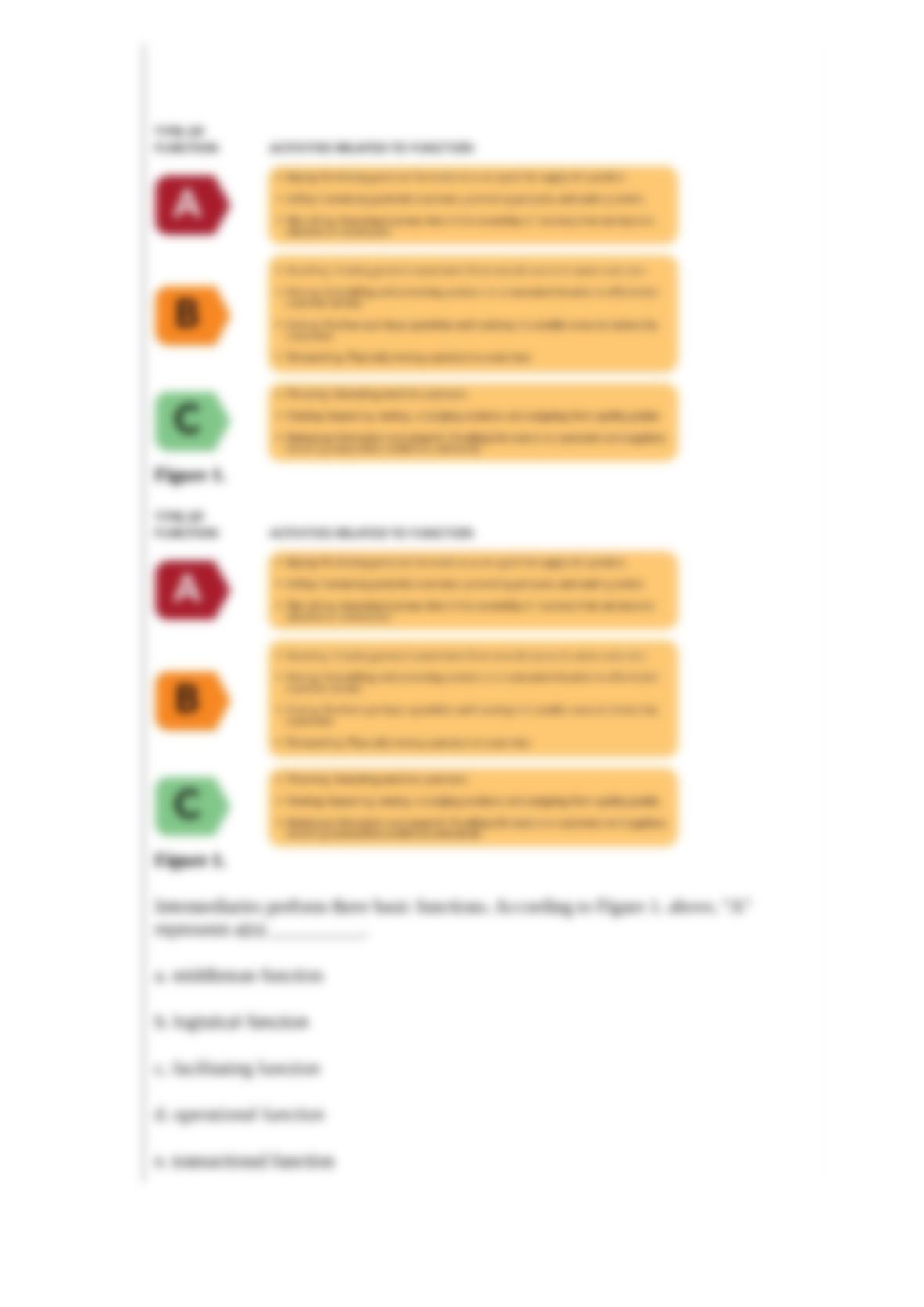
Figure 1.
Figure 1.
Intermediaries perform three basic functions. According to Figure 1. above, “A”
represents a(n) __________.
a. middleman function
b. logistical function
c. facilitating function
d. operational function
e. transactional function
Answer:
The North American Free Trade Agreement was designed to encourage free trade
between
a. North America, Central America, and South America.
b. the United States, Canada, and Mexico.
c. the United States and the European Union.
d. member countries originally from NATO (North Atlantic Treaty Organization).
e. North America and The Commonwealth of Independent States.
Answer:
An owner of a small publishing company allowed a friend who was starting a machine
embroidery business to load the publishing company’s copy of Microsoft Word on her
friend’s computer. This activity is
a. both legal and ethical.
b. caveat emptor.
c. illegal but ethical.
d. illegal and unethical.
e. sanctioned by the Business Software Alliance since only one copy is to be
transferred.
Answer:
The facts and figures obtained by asking people about their attitudes, awareness,
intentions, and behaviors are referred to as
a. primary data.
b. secondary data.
c. statistical inference.
d. observational data.
e. questionnaire data.
Answer:
Australia-based Renewable Energy Ltd. sells a $10 million device that converts manure
into energy. One of these devices is capable of generating energy equal to $2 million of
natural gas per year. The company believes its target market consists of businesses that
use a lot of energy like its first customer, a fertilizer manufacturer that was located in a
rural area. If the firm decides to expand to the U.S., it most likely will use which of the
following strategies to segment its market?
a. behavioral and geographic
b. number of employees and behavioral
c. purchase location and purchase type
d. NAICS code and geographic
e. behavioral and NAICS code
Answer:
Scanning your memory for previous experiences with products or brands is called
a. problem recognition.
b. alternative evaluation.

c. cognitive dissonance.
d. internal search.
e. external search.
Answer:
Countries moving from an agricultural to an industrial economy are referred to as
__________ countries.
a. primitive
b. emerging
c. developing
d. agrarian
e. evolving
Answer:
The marketing strategy to sell current products to new markets is referred to as
__________.

a. market penetration
b. market infiltration
c. market development
d. product development
e. diversification
Answer:
The FTC is concerned about the amount of personal information that is collected
through websites because the consumer is not made aware of how this information is
being used. Over 92 percent of websites collect personal information, yet only about
__________ make their customers aware of how that information is being used.
a. one-quarter
b. one-third
c. one-half
d. two-thirds
e. three-quarters
Answer:
Services are a significant part of the U.S. economy, exceeding __________ percent of
its gross domestic product.
a. 20
b. 25
c. 30
d. 40
e. 50
Answer:
Once an organization passes through the problem recognition stage of the
organizational buying decision process, it reaches the __________ stage.
a. information search
b. value analysis
c. alternative evaluation
d. purchase decision
e. behavioral learning
Answer:
There are six commonly used techniques to deal with objections: acknowledge and
convert the objection; postpone; agree and neutralize; accept the objection; denial; and
__________.
a. redirect the conversation
b. ignore the objection
c. probe by asking additional questions
d. defer to a supervisor
e. distract by identifying competitor shortcomings
Answer:
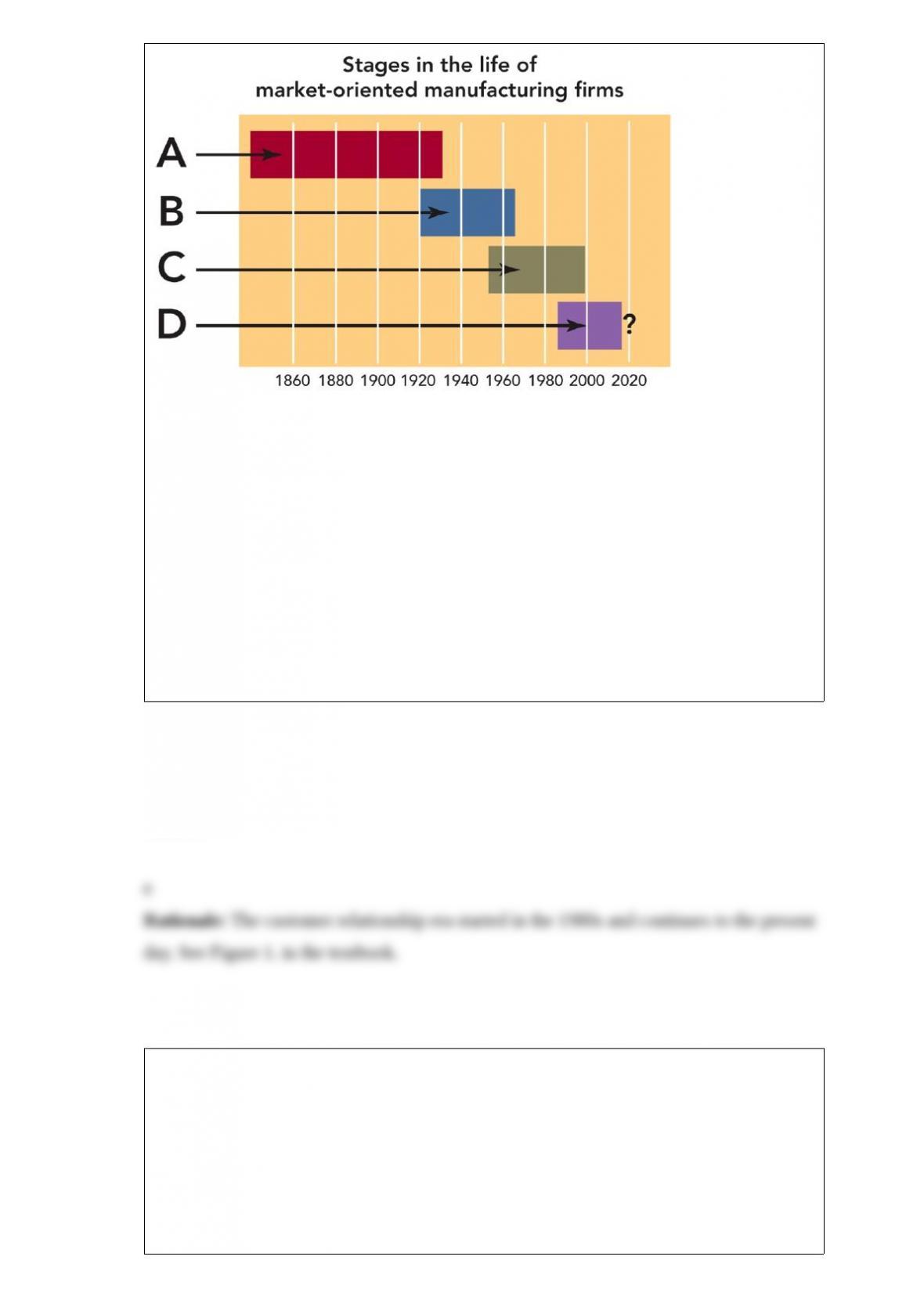
Figure 1.
In Figure 1. above, letter “D” represents which era in U.S. business history?
a. sales era
b. production era
c. age of consumerism
d. marketing concept era
e. customer relationship era
Answer:
The sales process at Xerox typically follows the six stages of the personal selling
process. During the first stage, Xerox identifies potential clients through __________.
a. responses to advertising, referrals, and telephone calls
b. sending their salesforce to visit competitors’ customers
c. sending their salesforce to visit former customers to win them back
d. an agreement with local repair shops that supply customer information in exchange
for the right to carry Xerox products in their stores
e. selling printer paper with the Xerox watermark to create brand awareness
Answer:
Effective decision makers rely on criteria or standards used in evaluating proposed
solutions to a problem, which are known as
a. marketing dashboards.
b. measures of success.
c. descriptive research.
d. constraints.
e. problem definitions.
Answer:
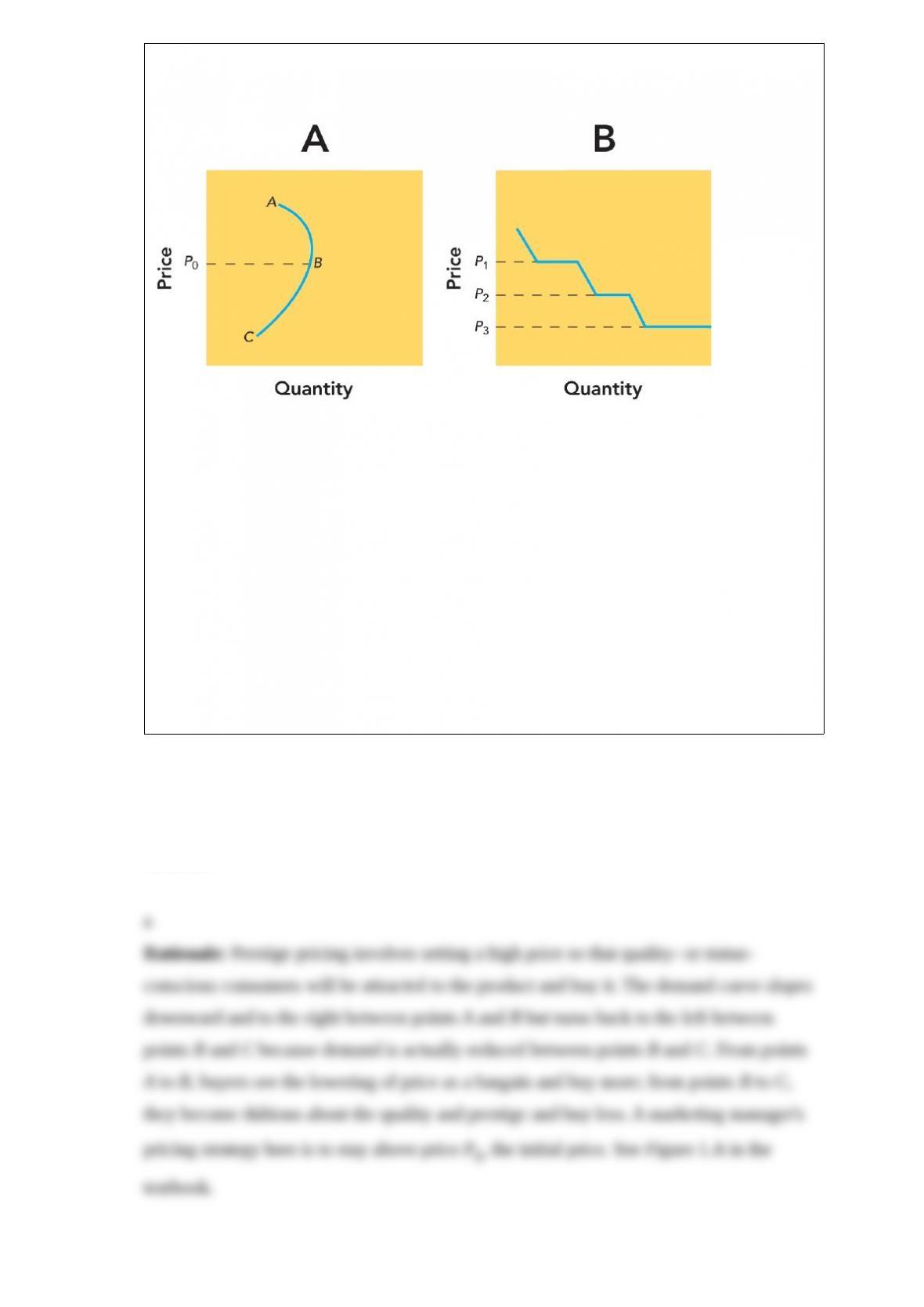
Figure 1.A
Figure 1.A above shows a demand curve that slopes downward and to the right, then
turns back to the left. Which pricing approach does Figure 1.A depict?
a. prestige pricing
b. skimming pricing
c. penetration pricing
d. price lining
e. reflexive pricing
Answer:

Customary pricing refers to
a. a pricing method where the price the seller quotes includes all transportation costs.
b. setting the same price for similar customers who buy the same product and quantities
under the same conditions.
c. deliberately selling a product below its list price to attract attention to it.
d. setting a price that is dictated by tradition, a standardized channel of distribution, or
other competitive factors.
e. pricing based on what the market will bear.
Answer:
A pioneering (or informational) ad
a. reinforces previous knowledge of a product.
b. assures current users they made the right choice.
c. promotes a specific brand’s features and benefits.
d. tells people what a product is, what it can do, and where it can be found.
e. shows one brand’s strengths relative to those of competitors.
Answer:
The name given to the group of consumers who are described as self-reliant, supportive
of racial and ethnic diversity, and better educated than previous generations is
__________.
a. Generation Z
b. Generation Y
c. millennials
d. Generation X
e. baby boomers
Answer:
The acronym RFID stands for
a. retail franchise identification designation.
b. required financial identification.
c. radar frequency identification.
d. radio frequency identification.
e. retail federation of independent department stores.
Answer:
In its research for Disney Online, C&R Research identified mothers who tend to be
Internet newbies and go online infrequently as the “__________” segment.
a. Tech Nester
b. Mrs. NetSkeptic
c. Passive Under Pressure
d. Drifting Surfers
e. Yes Mom
Answer:
One of Toyota’s top goals has been to develop advanced vehicle technologies to
complement existing ones. The G21 vision arose out of this goal, which eventually led
to the production of which of the following vehicles?

a. Lexus 450 all-electric car
b. Toyota Tundra gas-electric hybrid truck
c. Scion iQ micro-subcompact compressed natural gas car
d. Toyota Prius gas-electric hybrid car
e. Toyota Camry hydrogen fuel cell hybrid car
Answer:
Searching out, using, and training reputable medical device distributors across Asia to
call on cardiologists and medical clinics is an example of Medtronic’s
a. market segmentation and targeting strategy
b. price strategy
c. place strategy
d. promotion strategy
e. product/service strategy
Answer:
Which of the following is high in search properties?
a. clothing
b. TV repair
c. legal services
d. auto repair
e. medical diagnosis
Answer:
When Procter & Gamble introduced Crest toothpaste, the first fluoride toothpaste, it
was intended for use by children and was therefore given a child-appealing bubblegum
flavor. Sometime later, the same basic formula was given a fresh, minty flavor to appeal
to adults. What marketing strategy did P&G use in this example?
a. product segmentation
b. market expansion
c. product differentiation
d. usage segmentation
e. psychographic segmentation
Answer:
The highest-ranking person in an organization who oversees the organization’s daily
operations and spearheads its strategy planning efforts is often referred to as
a. the corporate executive overseer.
b. the chief executive officer.
c. the corporate executive official.
d. the chief marketing officer.
e. the coordinating executive officer.
Answer:

Media richness is __________ in face-to-face communication than telephone or e-mail
communications.
a. equal
b. lower
c. higher
d. more updated
e. less updated
Answer:
Which of the following would be a source of vertical conflict?
a. Foot Locker decides to open a retail outlet next to a Nike store in a shopping mall.
b. A restaurant serves both Coke and Pepsi to its patrons.
c. Ansible Technologies Ltd. sells its portable planetariums to both colleges and high
schools.
d. Microsoft provides HP laptops more prominent point-of-purchase locations in its
retail stores than comparable laptops from Sony.
e. Long John Silver’s decides to serve grilled burgers in addition to seafood.
Answer:
Bob’s friend Mike turns 21 next week. Bob decided to purchase Mike an MP3 music
player as a present. Because Bob has purchased several consumer electronic devices
over the past five years, he scanned his memory for various brand options. This is an
example of what part of the consumer purchase decision process?
a. memorization
b. external search
c. evaluative criteria
d. antecedent states
e. internal search
Answer:
There are five alternative marketing strategies that can be identified by market-product
grids: market-product concentration, __________, product specialization, selective
specialization, and full coverage.
a. diversification

b. selective distribution
c. market specialization
d. product reorientation
e. new product specialization
Answer:
Those needs that are represented by the need for achievement, status, prestige, and
self-respect are referred to as __________ needs.
a. physiological
b. safety
c. social
d. personal
e. self-actualization
Answer:
3M has over 80 percent of its worldwide manufacturing and service facilities that are
ISO 9000 certified. This certification gives 3M confidence that
a. its suppliers’ manufacturing systems and products are of consistent quality as well.
b. suppliers will always fill 3M orders before those of other buyers.
c. suppliers will not engage in reciprocity agreements.
d. suppliers must also meet ISO 14000 requirements.
e. 3M will be financially compensated for any orders that fail to meet assigned criteria.
Answer:
A custom kitchen cabinet storeowner wishes to use a target return-on-sales pricing
approach to establish a price for a typical section of cabinets. Assume that variable costs
total $200 per unit, fixed cost is $44,000, and the storeowner desires a target profit of
20 percent return on sales at an annual volume of 400 cabinets. What price should be
charged for a typical cabinet section?
a. $263.50
b. $311.
c. $387.50
d. $445.50
e. $775.00
Answer:
Many large, packaged goods marketers like Procter & Gamble, Kraft, and Pillsbury
have used the product manager (or brand manager) system of marketing organization
and implementation. Which of the following is the key advantage of this system?
a. Product managers have relatively little authority.
b. Product managers are short-term in their orientation.
c. Product managers have direct responsibility for research and development of new
products.
d. Product managers assume profit-and-loss responsibility for the performance of the
product line.
e. Product managers have line responsibility over sales managers.
Answer:
Which type of distribution lies between the two distribution extremes and means that a
firm selects a few retail outlets in a specific geographical area to carry its products?
a. intensive distribution
b. extensive distribution
c. exclusive distribution
d. selective distribution
e. concentrated distribution
Answer: