
Procter & Gamble is a consumer packaged goods company where innovation is a key
competitive advantage. This allowed the firm to develop new products like Crest
Whitestrips that consumers crave. P&G also uses its marketing expertise to develop
unique product placements on television shows that highlight its brands. A SWOT
analysis for P&G would indicate that the innovation that takes place within the firm is
a(n) __________.
a. strength
b. weakness
c. threat
d. opportunity
e. problem
Answer:
Infomercials refer to
a. public service announcements used to notify local citizens of impending danger due
to weather or other natural disasters.
b. a form of advertisement whose sole purpose is to entertain.
c. program-length (30-minute) advertisements that take an educational approach to
communication with potential customers.
d. direct-response TV and radio ads that air during the late night or weekend mornings.
e. educationally-formatted programming that consumers order privately by using the
“On Demand” button on their cable TV remote and DVR set-up box.
Answer:
Consumers accompanied by children
a. purchase twice as much as they normally would if shopping with other adults.
b. purchase about 40 percent more than when shopping alone.
c. spend more than when shopping alone to mitigate feelings of guilt about their
children’s disruptive behavior.
d. spend 40 percent less than when shopping alone.
e. spend exactly the same amount as when shopping alone.
Answer:
The period of American business history when firms could produce more goods than
they could sell and the focus was on hiring more salespeople to seek out new markets
and customers is referred to as the __________ era.
a. sales
b. marketing concept

c. production
d. goods
e. market orientation
Answer:
The moral principles and values that govern the actions and decisions of an individual
or group are referred to as
a. social norms.
b. cultural values.
c. ethics.
d. societal philosophy.
e. religion.
Answer:

What marketing metric determines whether a TV program like American Idol remains
on the Fox broadcast TV network?
a. appeal
b. cost per ad
c. rating
d. poll
e. frequency
Answer:
Five general criteria are often used to select target segments. They include: (1) the size
of the market; (2) expected growth of the market; (3) competitive position of the firm
with respect to the market; (4) cost of reaching the segment; and __________.
a. compatibility with the organization’s objectives and resources
b. potential of a marketing action to reach a segment
c. similarity of needs of potential buyers within a segment
d. difference of needs of buyers among segments
e. potential for increased profit
Answer:

The societal marketing concept
a. is the moral principles and values that govern the actions and decisions of an
organization.
b. is the idea that organizations are part of a larger society and are accountable to that
society for their actions.
c. actively tries to understand customer needs and satisfying them while satisfying the
firm’s goals.
d. involves conducting business in a way that protects the natural environment while
making economic progress.
e. is the view that an organization should satisfy the needs of consumers in a way that
provides for society’s well-being.
Answer:
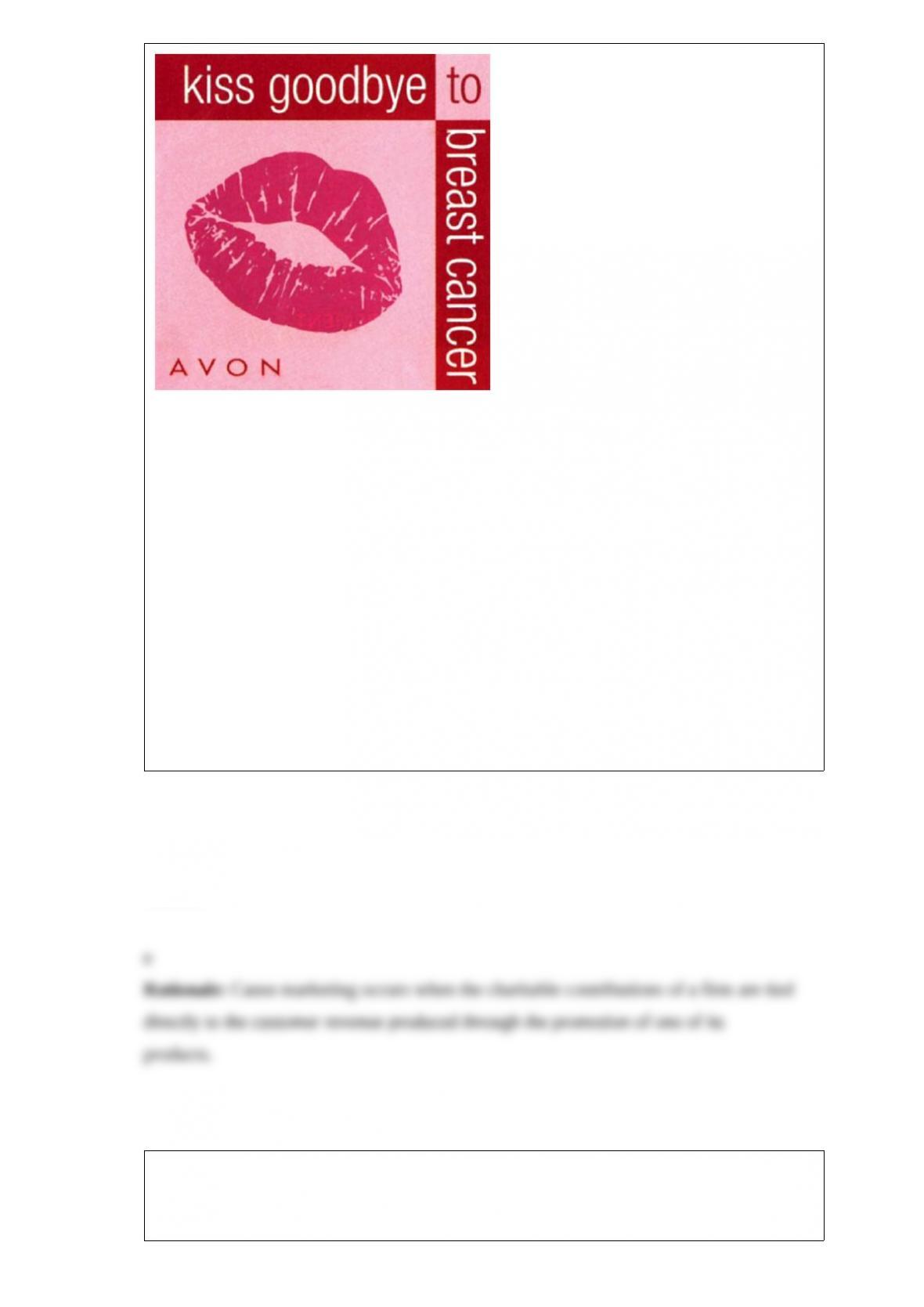
Avon Ad
Consider the Avon ad above. Avon has already donated millions toward breast cancer
research. One contributing factor was the sale of a bag designed by Marimekko
exclusively for the Avon Breast Cancer Crusade. One hundred percent of net profits
were donated to the crusade. This is an example of
a. philanthropic marketing.
b. corporate altruism.
c. the marketing concept.
d. green marketing.
e. cause marketing.
Answer:
Penetration pricing is considered to be a __________ approach to pricing.

a. demand-oriented
b. cost-oriented
c. profit-oriented
d. competition-oriented
e. service-oriented
Answer:
The particular type of competition dramatically influences the range of price
competition and, in turn,
a. the nature of product differentiation and extent of advertising.
b. the nature of product differentiation and extent of on-hand inventory.
c. the degree of involvement with each of the organization’s stakeholders.
d. the degree of involvement with both retailers and wholesalers.
e. the relationship between product lines and product classes.
Answer:

Which of the following best illustrates the concept of derived demand?
a. The number of retail stores in a downtown area decreases as demand for retail goods
increases.
b. An increase in the number of new, single-family homes results from a spurt in the
gross national product.
c. The heat wave results in an increased demand for air conditioners.
d. Container manufacturers experience an increase in sales because more HDTVs from
Japan and South Korea are being sold in the U.S. and must be transported by ship in
containers.
e. Honda reducing its car prices causes GM to do the same.
Answer:
If you were to buy one peach tree and one apple tree from the Stark Bros. fruit trees and
landscaping catalog in two separate orders, you would pay a total of $108.99. However,
if you order the peach and apple tree together in the same order, you pay only $89.99.
When purchasing the two trees together, what pricing strategy does Stark Bros.
employ?
a. product line pricing
b. prestige pricing
c. price lining
d. discount pricing
e. bundle pricing
Answer:
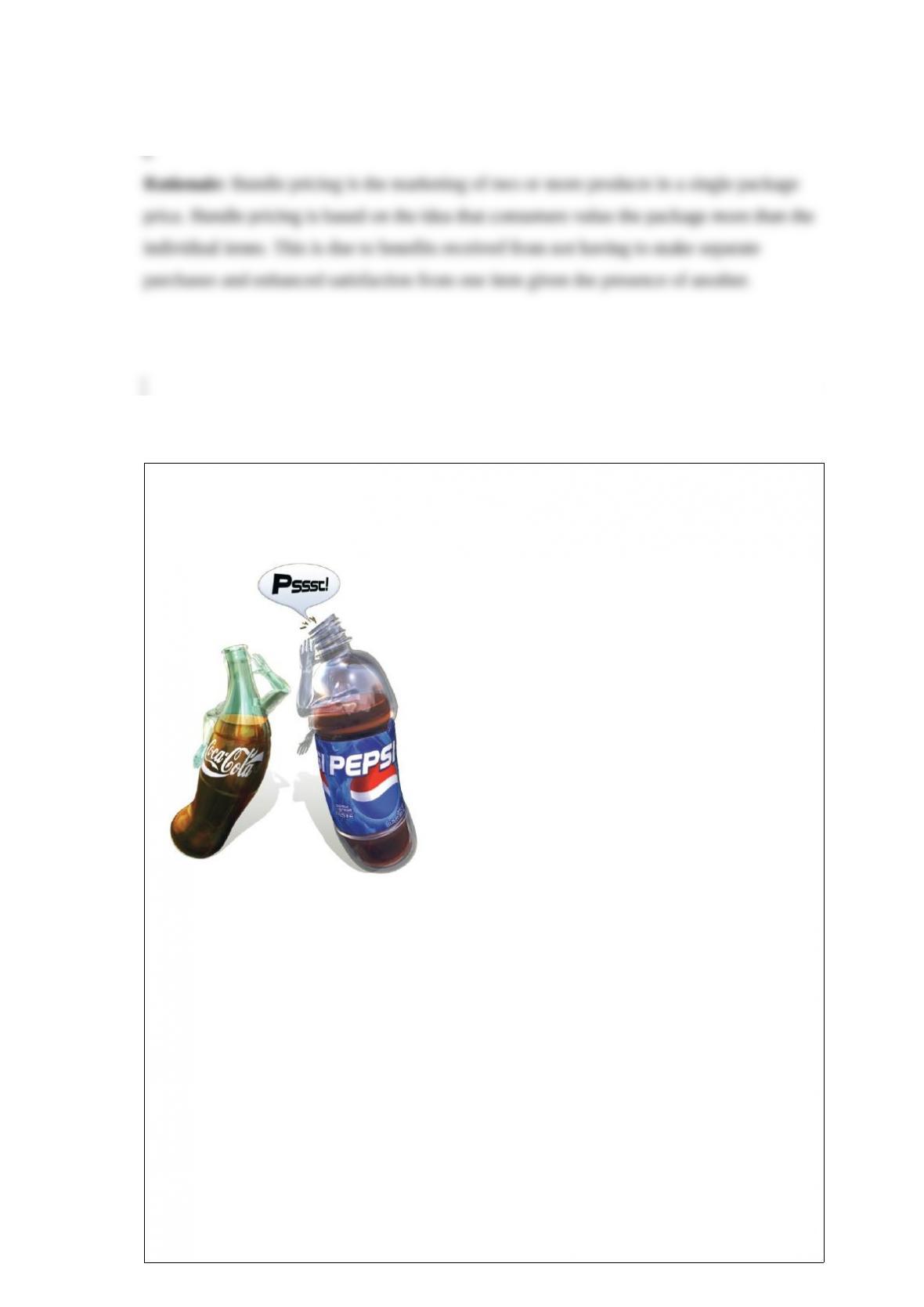
Coke-Pepsi Photo
Consider the Coke-Pepsi photo above. Thirty three percent of Pepsi’s marketing and
advertising executives say they would decline an offer to buy one of Coke’s marketing
plans and samples. Most said that they
a. thought they might go to work for Coke one day and didn’t want to spoil their
employment chances.
b. would prefer competing ethically so they could sleep at night.
c. were afraid the media would find out.
d. knew they would get fired.
e. didn’t want to disappoint their children.

Answer:
Rather than billing clients by the hour, some lawyers and their clients agree on a fixed
fee based on expected costs plus an agreed upon level of profit for the law firm. Which
pricing approach are they using?
a. target pricing
b. cost-plus pricing
c. customary pricing
d. experience curve pricing
e. bundle pricing
Answer:
In 1984, IBM launched the “PCjr,” its first low-priced, educational/home personal
computer. Sales were poor because IBM most likely violated which criterion of picking
a good brand name?
a. The name was not distinctive nor was it memorable.

b. The name did not fit the company image.
c. The name had too many legal restrictions.
d. The name was too confusing with both capital and lowercase letters.
e. The name failed to suggest the product benefits.
Answer:
Questions of legality regarding tying arrangements and exclusive dealing would most
likely occur in
a. corporate vertical marketing systems.
b. administered vertical marketing systems.
c. franchises.
d. horizontal marketing systems.
e. retail-sponsored cooperatives.
Answer:

The purpose of a cash discount is to
a. reward retailers for making large quantity purchases.
b. encourage purchasing items during periods of low demand.
c. prevent competitors from obtaining shelf space.
d. counteract the introduction of a new product by a competitor.
e. encourage retailers to pay their bills promptly.
Answer:
If you were responsible for marketing communications at a company that manufactures
office supplies and had to provide product literature to be distributed in France, you
would be wise to use ___________, whereby you have someone to translate your
literature from American English into French, and then have someone else in France
translate the French into American English.
a. back talk
b. back translation
c. double talk
d. double entendre
e. double indemnity
Answer:

In general, a visionary organization asks what three types of questions to specify its
foundation, set a direction, and formulate strategies?
a. why, when, where
b. what, by whom, how
c. why, what, how
d. how, when, where
e. who, why, when
Answer:
Permission marketing refers to
a. the interactive, Internet-enabled system that allows individual customers to design
their own products and services by answering a few questions and choosing from a
menu of product or service attributes, prices, and delivery options.

b. the consumer-initiated practice of generating content on a marketer’s website that is
custom-tailored to an individual’s specific needs and preferences.
c. an Internet-enabled digital environment characterized by face-to-screen exchange
relationships and electronic images and offerings.
d. the solicitation of a consumer’s consent to receive e-mail and advertising based on
personal data supplied by the consumer.
e. a process that automatically groups people with similar buying intentions,
preferences, and behaviors and predicts future purchases.
Answer:
Recent surveys of consumers have indicated that while customers of many services are
interested in being “relationship customers,” they require that the relationship be
balanced in terms of
a. honesty, a lack of prejudice, and empathy.
b. loyalty, benefits, and respect for privacy.
c. loyalty, honesty, and integrity.
d. financial benefits, product benefits, and preferential treatment.
e. financial benefits, product benefits, and personal benefits.
Answer:

When the John Deere Company employs 94 engineers who work full-time with the
company’s suppliers to improve their efficiency and quality and reduce their costs, it is
practicing
a. buyer development.
b. make-buy decisions.
c. supply partnerships.
d. supplier development.
e. directive purchasing.
Answer:
After an assessment of needs, a marketing manager must translate ideas from
consumers into concepts for products that a firm may develop. The concepts must then
be converted into a tangible
a. marketing strategy.
b. macromarketing program.
c. micromarketing program.
d. marketing program.
e. marketing concept.

Answer:
The key difference between the traditional marketplace and the new marketspace is that
the latter is a(n) __________ environment.
a. tangible
b. analog
c. physical
d. material
e. digital
Answer:
Forward integration means
a. a retailer owns a manufacturing operation.

b. a wholesaler owns a manufacturing operation.
c. retailers form a strategic channel alliance with manufacturers to purchase products at
better prices since they are able to place much larger orders.
d. a producer owns an intermediary at the next level down in the marketing channel.
e. all links in the distribution chain own stock in the manufacturer’s company.
Answer:
When Sherman bought gas, he noticed the convenience store offered him a 2 percent
reduction in price if he paid cash rather than if he used his credit card to pay for his
purchase. The convenience store was offering him a
a. trade discount.
b. cash discount.
c. promotional allowance.
d. rebate.
e. functional discount.
Answer:
As a business format franchisor, McDonald’s provides step-by-step procedures for most
aspects of the business and
a. provides an accounting system to pay the franchisee bills promptly.
b. shops for the best food values.
c. maintains the property.
d. guidelines for the most likely decisions a franchisee will face.
e. disciplines dishonest employees.
Answer:
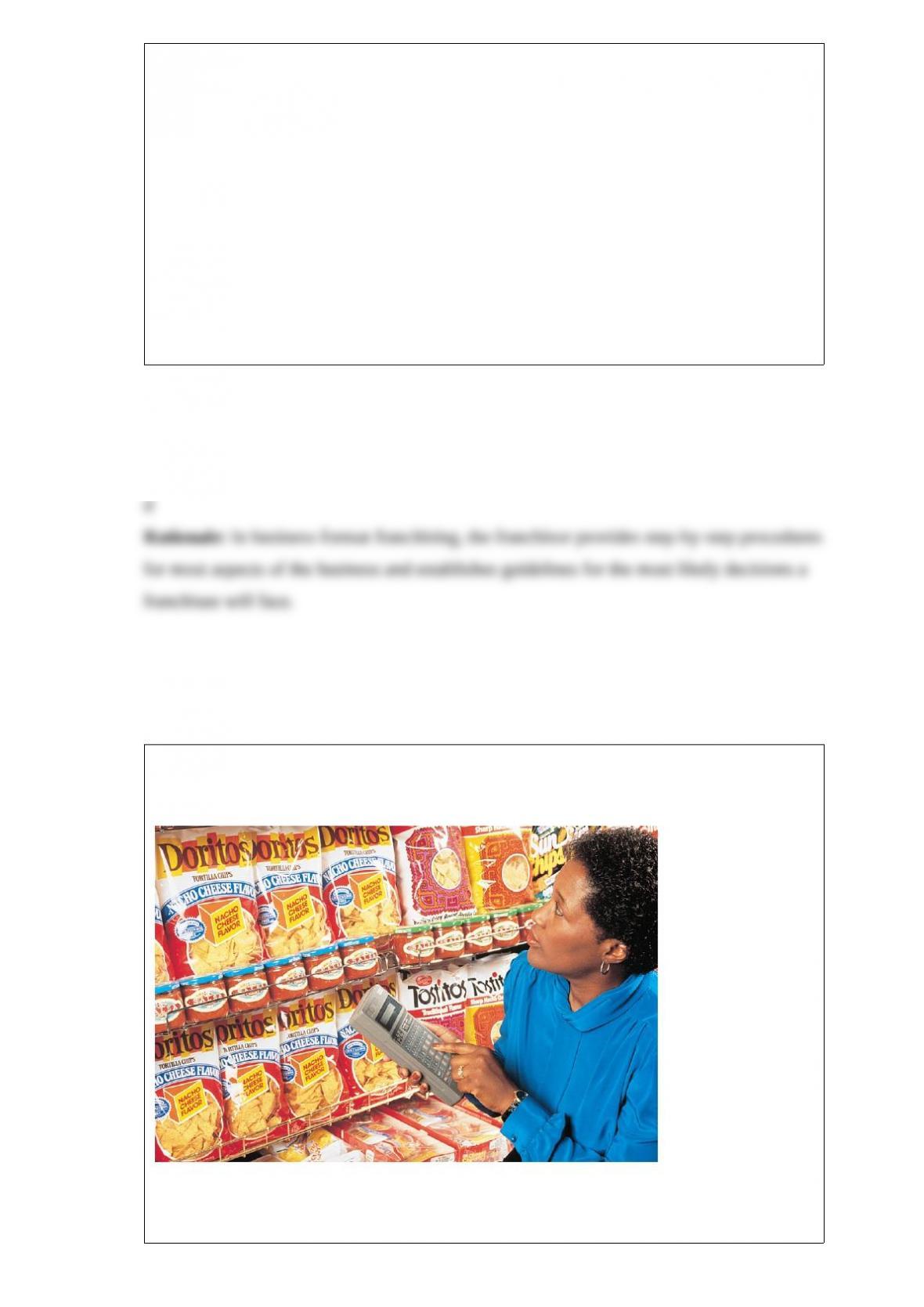
Frito-Lay Photo
The Frito-Lay salesperson shown in the photo above is an __________ who is taking

inventory of available products at a supermarket.
a. inside order taker
b. interactive order taker
c. outside order taker
d. order clerk
e. order getter
Answer:
In which type of industry would a marketing director be most likely to say, “We have to
let the customer know that our product is the only one that comes with its own tracking
device”?
a. pure monopoly
b. oligopoly
c. pure competition
d. monopolistic oligopoly
e. monopolistic competition
Answer:

During the introduction stage of the product life cycle, promotional expenditures are
made to stimulate consumer desire for an entire product class rather than for a specific
brand. The consumer demand that is stimulated is referred to as __________ demand.
a. selective
b. primary
c. derived
d. generic
e. secondary
Answer:
Segmentation based on some subjective mental or emotional attributes, aspirations, or
needs of prospective customers is referred to as
a. behavioral segmentation.
b. affective segmentation.
c. socioeconomic segmentation.
d. psychographic segmentation.
e. psychosocial segmentation.

Answer:
If a metropolitan statistical area contains a population of 2.5 million or more, it may be
subdivided into smaller areas called __________.
a. population subdivisions
b. metroplex divisions
c. metropolitan divisions
d. combined divisions
e. statistical divisions
Answer:
Global companies have five strategies for matching products and their promotion
efforts to global markets. Nescaf coffee is marketed using different coffee blends and
promotional campaigns to match consumer preferences in different countries. For
example, Nescaf generally emphasizes the taste, aroma, and warmth of shared moments
in its advertising around the world. However, in Thailand, Nescaf is advertised as a way
to relax from the pressures of daily life. This is an example of which type of global
product strategy?
a. product extension
b. product customization
c. product adaptation

d. dual adaptation
e. dual integration
Answer:
There are four commonly used forms of institutional advertising: advocacy, pioneering,
__________, and reminder.
a. differentiation
b. philanthropic
c. persuasive
d. competitive
e. informational
Answer: