If Ben & Jerry’s sold a line of new “Occupy Ben & Jerry’s” T-shirts targeted to college
students in Latvia, it would be using a __________ strategy.
a. product development
b. market development
c. market penetration
d. diversification
e. market saturation
Answer:
The Robinson-Patman Act covers promotional allowances as well as discounts. To
legally offer promotional allowances to buyers, the seller must do so on a(n)
__________ to all buyers businesses distributing the seller’s products.
a. proportionally equal basis
b. limited basis
c. disproportionally equal basis
d. geographical basis
e. across the board

Answer:
Culture refers to
a. the set of values, ideas, and attitudes that are learned and shared among members of a
group.
b. the music, art, theater, etc. that reflects the values of an entire nation.
c. the learned behaviors of a specific racial, ethnic, or religious group based on
commonly shared ethical principles and protected by laws.
d. the combination of beliefs and behaviors accepted as correct regardless of a person’s
age, sex, race, or religion.
e. the set of values, ideas, attitudes, and norms of behavior that is learned and shared
among the members of an organization.
Answer:
The primary focus of Zappos’ market segmentation strategy is to sell
a. a wide selection of shoes, clothes, accessories, and housewares to people who will
buy them online.
b. a wide selection of leather shoes and boots to retailers.
c. all types of shoes, accessories, and clothing to department stores.
d. Spanish novelties and accessories to organizations.
e. shoes in its own retailer stores.
Answer:
Price fixing is illegal per se under the
a. Sherman Act.
b. Consumer Goods Pricing Act.
c. Robinson-Patman Act.
d. Federal Trade Commission Act.
e. Clayton Act.
Answer:
According to the Direct Marketing Association, annual telemarketing sales exceed
__________.
a. $10 billion
b. $28 billion
c. $137 billion
d. $332 billion
e. $500 billion
Answer:
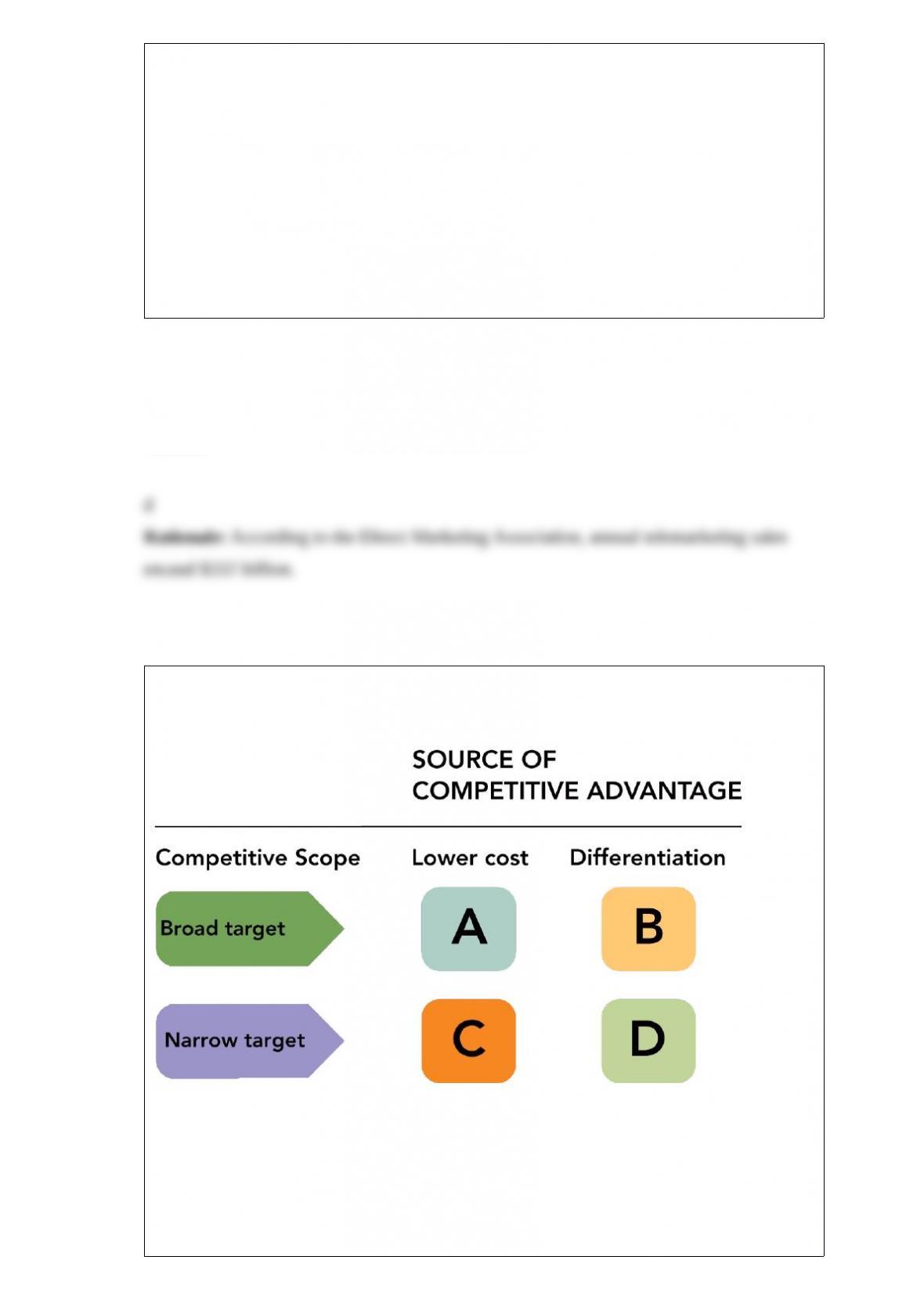
Figure 1.
In Porter’s generic business strategies shown in Figure 1. above, “C” refers to a
__________ strategy.
a. quality focus
b. cost leadership
c. differentiation
d. cost focus
e. differentiation focus
Answer:
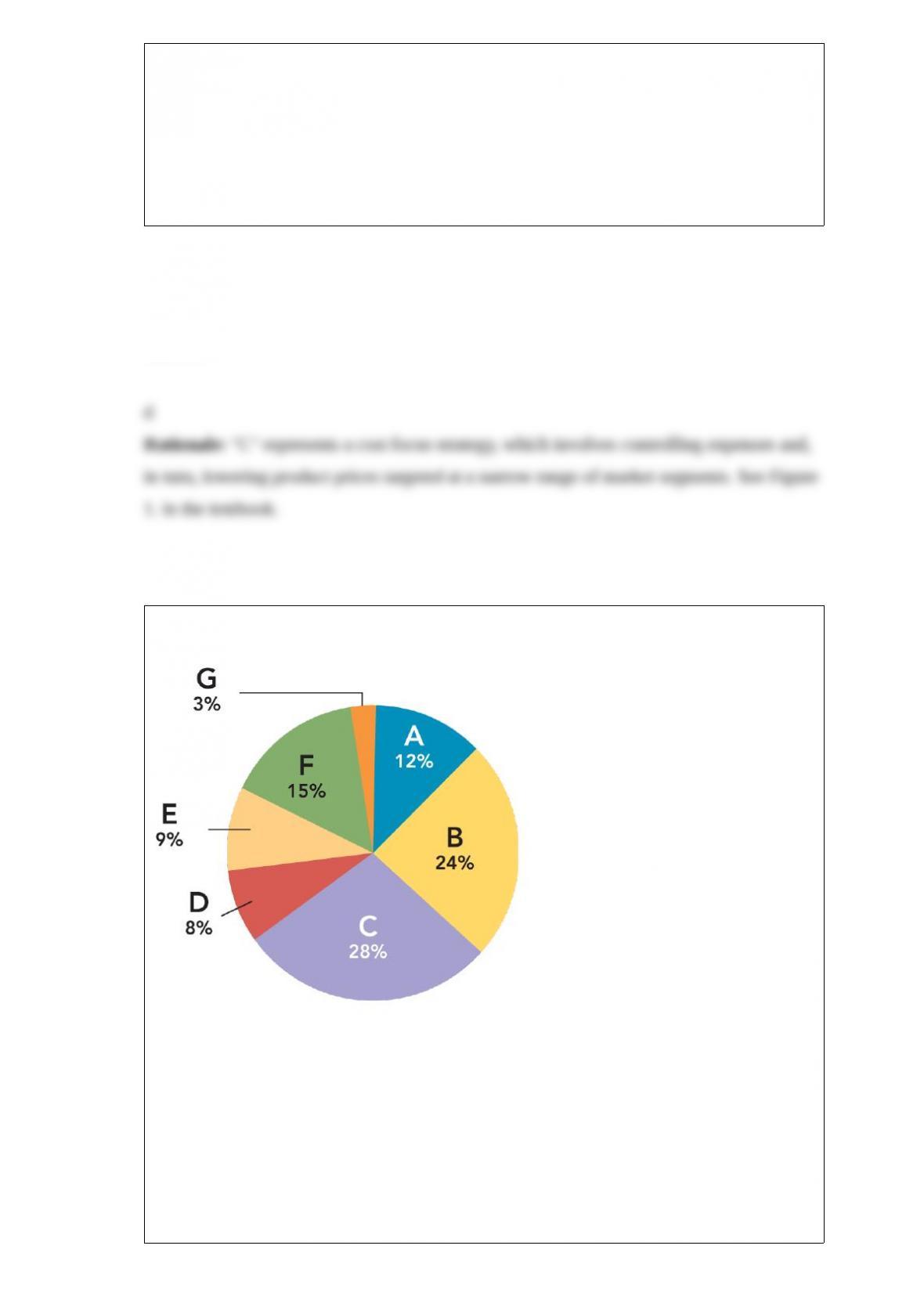
Figure 1.B
With respect to Figure 1.B above, __________ spending accounts for 15% of all
advertising expenditures?
a. Internet
b. television
c. direct mail
d. newspaper
e. magazine
Answer:
Demand for a product is likely to be more price elastic if
a. it is considered a necessity.
b. it has many substitutes.
c. it has few substitutes.
d. it requires a small cash outlay.
e. none of the above is true.
Answer:
In the VALS framework, consumers motivated by ideals are guided by knowledge and
principle. One segment of the two ideals-motivated groups, known as __________, are

mature, reflective, and well-educated people who value order, knowledge, and
responsibility.
a. Makers
b. Believers
c. Thinkers
d. Survivors
e. Achievers
Answer:
The __________ element of the marketing mix is demonstrated when a newspaper
carrier throws a paper on the front porch.
a. place
b. product
c. price
d. promotion
e. procurement
Answer:
The Fox Entertainment Group counts among its assets a thriving TV production unit, a
Hollywood movie studio, many TV stations, a half-dozen national cable networks, and
almost two dozen regional sports networks. Since most of the shows produced at its TV
production unit and many of the movies made at its studio are only televised on its
cable TV networks, Fox Entertainment Group is an example of a(n)
a. corporate vertical marketing system.
b. integrated marketing system.
c. contractual vertical marketing system.
d. corporate horizontal marketing system.
e. contractual horizontal marketing system.
Answer:
Pending federal legislation will require all online retailers to collect state sales taxes
from customers. This would affect online sellers such as Virtual Vineyards, which now
only collects state sales taxes from customers who reside in Californiaits home state.
This pending legislation would be an example of which environmental force?
a. social
b. economic
c. technological
d. competitive
e. regulatory
Answer:
A glass blowing studio makes fine pieces of art glass. It has decided on a retail list price
of $2,000 for one of its vases. They sell only to wholesalers and retailers who receive
50/10 terms. How much will the studio receive from selling this vase?
a. $2,000
b. $1,000
c. $900
d. $800
e. $100
Answer:
For high-involvement purchases, consumers typically do all of the following EXCEPT:
a. consider many product attributes.
b. participate in word-of-mouth communication.
c. consider few sellers.
d. consider many brands.
e. engage in extensive information search.
Answer:
There are seven commonly used organizational buying criteria. One of them is
__________.
a. price
b. loyalty
c. flexibility
d. adaptability
e. consumer demand
Answer:
The Lanham Act cannot protect the rights to a trademark if
a. the company is accused of violating the Sherman Antitrust Act.
b. the product patent is less than 17 years old.
c. the word, name, or symbol has become generic.
d. the statute of limitations has run out.
e. the government refuses to enforce violations.
Answer:
Products such as Yoplait’s Go-GURT portable low-fat yogurt in a tube demonstrate the
importance of the __________ in packaging.
a. perceptual benefits
b. communication benefits
c. functional benefits

d. technology
e. renewable resources
Answer:
Advertising programs in which a manufacturer pays a percentage of a retailer’s local
advertising expense for advertising the manufacturer’s products are referred to as
a. trade promotion programs.
b. consumer promotion programs.
c. cooperative advertising programs.
d. cause-related marketing programs
e. shared-responsibility programs.
Answer:
Why would an online consumer want to use a bot?
a. Bots help customers design one-of-a-kind products that fit their specific needs.
b. Bots increase the selection of products and services from which online consumers
can choose.
c. Bots allow online consumers to engage in an electronic dialogue with marketers.
d. Bots enhance the convenience of online shopping.
e. Bots allow marketers to record an online consumer’s visits to their websites.
Answer:
The change in total cost that results from producing and marketing one additional unit
of product is referred to as
a. fixed cost.
b. total cost.
c. marginal cost.
d. variable cost.
e. unit cost.
Answer:
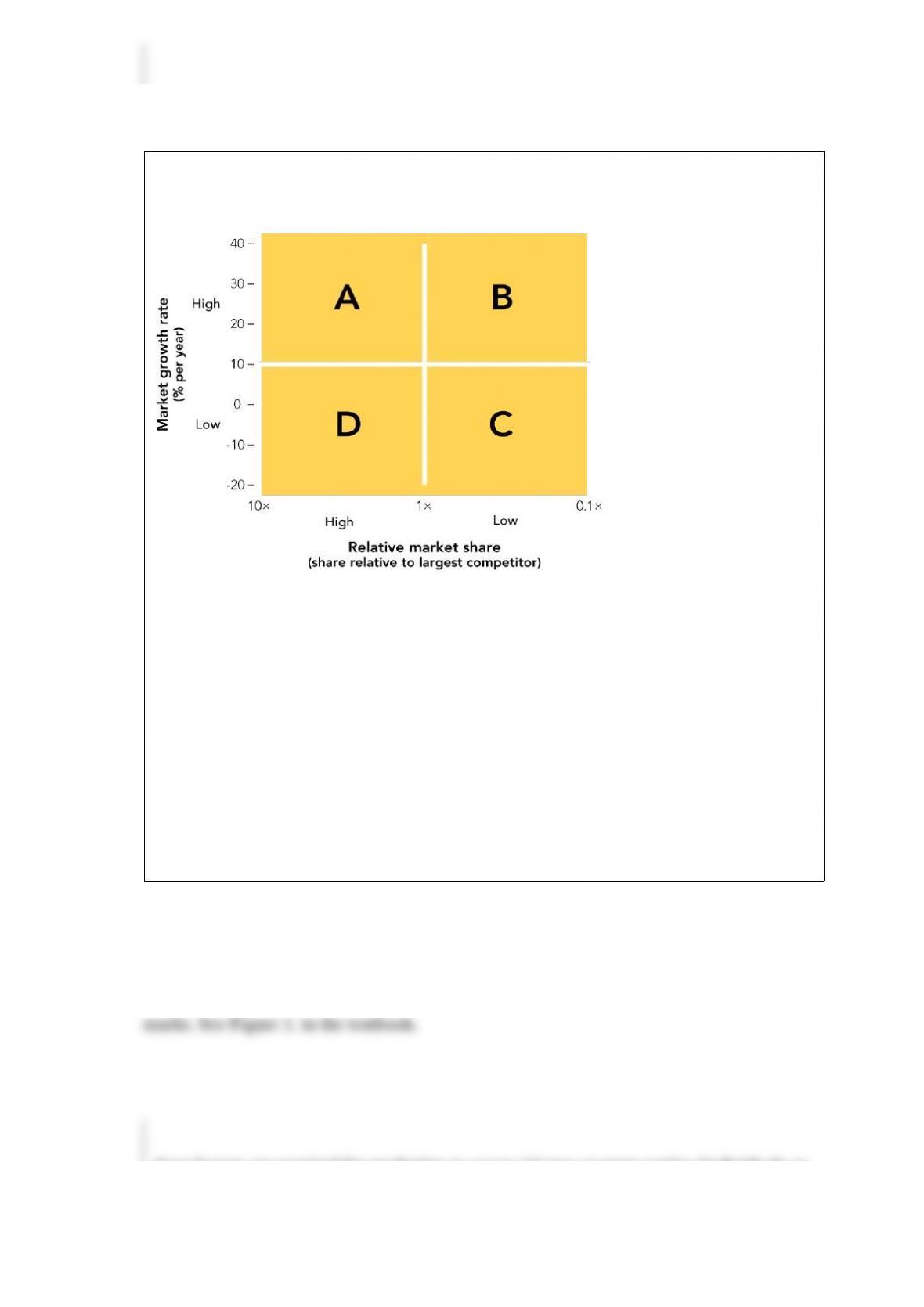
Figure 1.
In Figure 1. shown above, SBUs found in quadrant “B” would be called __________.
a. cash cows
b. stars
c. question marks
d. dogs
e. hedgehogs
Answer:
Four factors are required for marketing to occur: (1) two or more parties (individuals or
organizations) with unsatisfied needs; (2) __________; (3) a way for the parties to
communicate; and (4) something to exchange.
a. a healthy competitive environment
b. government approval
c. a sense of social responsibility
d. a desire and ability on their part to be satisfied
e. an ability to see hidden potential within an environmental force
Answer:
The __________ makes it unlawful to discriminate in prices charged to different
purchasers of the same product, where the effect may substantially lessen competition
or help to create a monopoly.
a. Fair Trade Act
b. Clayton Act
c. Lanham Act
d. Robinson-Patman Act
e. Unfair Practices Act

Answer:
The reverence that Japan shows towards its elderly is an example of the nation’s
__________.
a. values
b. beliefs
c. customs
d. religion
e. cultural diversity
Answer:
The information needed in market product focus and goal setting, Step 2 of the planning
phase includes: (1) __________, (2) market-product grids with target segments and
product groupings, and (3) positioning studies.
a. market potential studies
b. trends for industry and competitors
c. marketing mix actions
d. detailed plans to execute the marketing program
e. projected future sales, expenses, and profits
Answer:
Recent legislation, such as the Children’s Online Privacy Protection Act and the
Controlling the Assault of Non-solicited Pornography and Marketing (CAN-SPAM)
Act, are reforms that are
a. promotion-related.
b. price-related.
c. distribution-related.
d. self-regulated.
e. product-related.
Answer:

Which of the following statements about strategy is most accurate?
a. An organization can be all things to all people because it has access to all the
resources it needs to discover and satisfy the needs and wants of its target markets.
b. The marketing department helps to both set an organization’s direction and move it
there.
c. The American Marketing Association (AMA) recently has established the definition
of strategy.
d. Strategy is an organization’s short-term course of action designed to deliver a broad
customer experience while achieving its goals.
e. Only start-up organizations must develop strategies to help them (1) raise capital and
(2) focus and direct their efforts to accomplish their goals.
Answer:
An action item list refers to
a. an aid to implement a marketing plan that consists of four columns.
b. a tool that shows the relationships through time of the various program tasks.
c. a graphical representation of a program schedule.
d. a systematic method to itemize the “value” of products and services.
e. an aid to implementing a business plan and consisting of five columns.
Answer:
The four types of discounts are
a. quantity, trade-in, promotional, and cash.
b. quantity, seasonal, trade (functional), and cash.
c. quantity, seasonal, promotional, and FOB.
d. cash, trade-in, seasonal, and promotional.
e. trade-in, promotional, geographic, and functional.
Answer:
Most stores today are in one of five settings that include all of the following EXCEPT:
a. the regional shopping center.
b. the strip mall.
c. the uptown shopping center.
d. the community shopping center.
e. the power center.

Answer:
Volkswagen achieved spectacular success in the late 1990s by targeting the “nostalgia”
segment, 35- to 54-year-old baby boomers, with its technology-laden New Beetle.
Which of Porter’s generic business strategies did Volkswagen use to launch the New
Beetle?
a. differentiation focus
b. cost leadership
c. differentiation
d. cost focus
e. marketing focus
Answer: