
The Infant Formula Act, the Nutritional Labeling and Education Act, and the Fair
Packaging and Labeling Act are all examples of
a. consumer-oriented legislation.
b. pricing-related legislation.
c. distribution-related legislation.
d. requirement contracts.
e. fair trade legislation.
Answer:
The primary purpose of ISO 9000 standards is to
a. establish worldwide standards for environmental quality and green marketing
practices.
b. develop standards for registration and certification of a manufacturer’s quality
management and assurance system.
c. establish common definition for reciprocal trade agreements among members of the
WTO.
d. develop the communication interfaces between computer networks and extranets for
the sharing of data.
e. establish an international code of ethics.
Answer:
The dimension of service quality called __________ is the appearance of physical
facilities, equipment, personnel, and communication materials.
a. assurance
b. reliability
c. responsiveness
d. empathy
e. tangibility (tangibles)
Answer:
A disadvantage of a customer sales organization is __________.
a. the need to assign just one salesperson to local, regional, national, and global
territories
b. an increased need for multilingual salespeople
c. the smaller number of qualified sales managers
d. the need for close teamwork amongst a diverse salesforce
e. higher administrative costs and some duplication of selling effort
Answer:
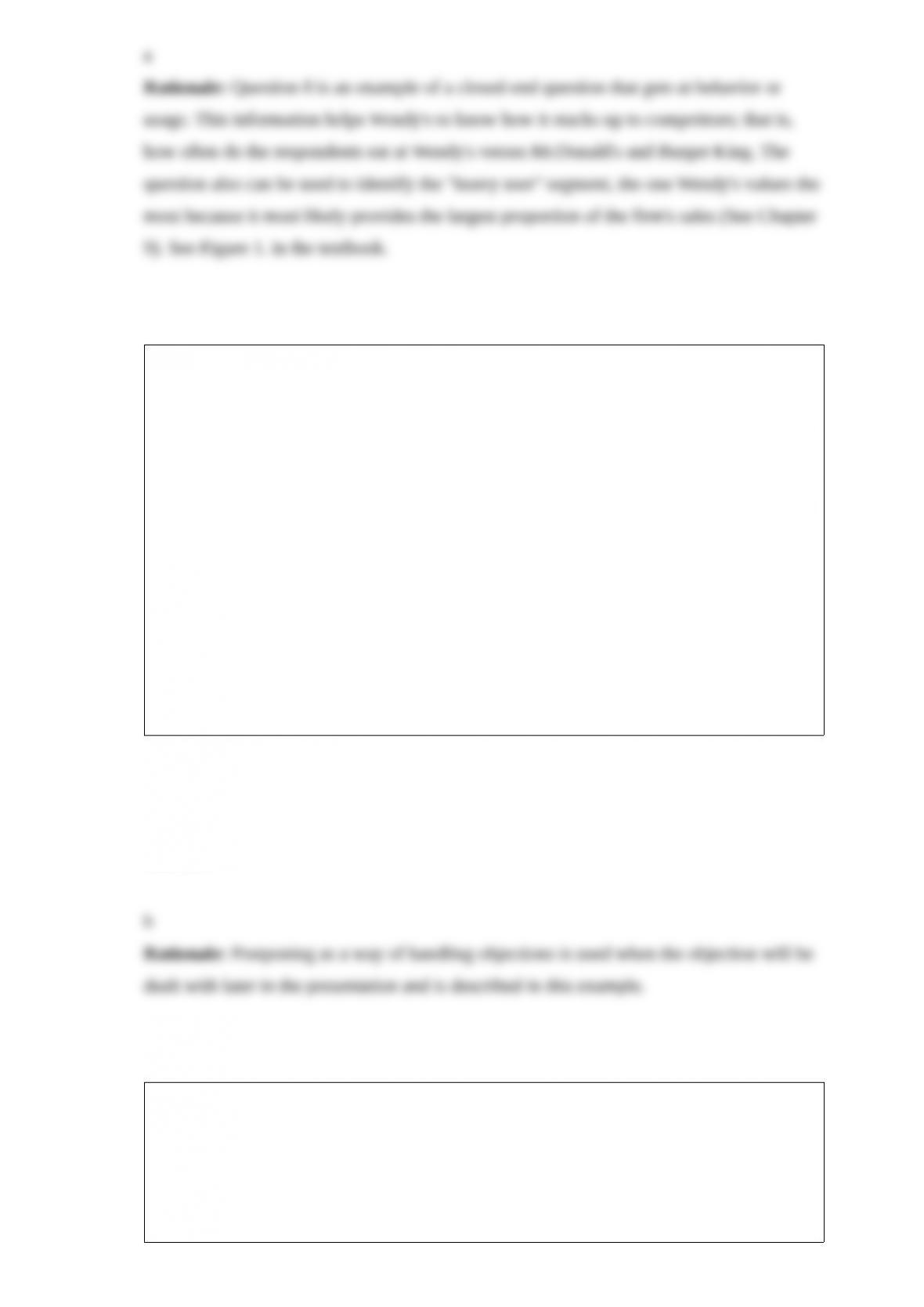
Figure 1.: Question 8
Consider Figure 1.: Question 8 above, which is part of a Wendy’s survey that assessed
fast-food restaurant preferences among present and prospective consumers. Which of
the following statements MOST LIKELY explains why Question 8 was included in the
questionnaire?
a. Wendy’s wanted to know how often people eat at Wendy’s and its competitors.
b. Wendy’s wanted to know why people were eating at its competitors.
c. Wendy’s wanted to know who eats at In N Out Burger.
d. Wendy’s wanted to estimate how many customers they could woo away from
McDonald’s.
e. Wendy’s wanted to find out if there was a relationship between coupons and customer
loyalty.
Answer:
During the sales presentation, the prospect interrupted the salesperson’s presentation
and said, “Wait a minute. This looks like it’s going to cost too much.” The salesperson
responded, “I think you”ll be delighted with how relatively inexpensive this program is.
I”ll address the subject of price in just a moment.” Which objection-handling technique
has the salesperson used?
a. acknowledge and convert the objection
b. postpone
c. agree and neutralize
d. denial
e. ignore the objection
Answer:
Warranties, money-back guarantees, extensive usage instructions, demonstrations, and
free samples are all ways in which companies __________.
a. lose money during the introductory stage of a product’s life cycle

b. convince laggards to try a new product
c. recoup research and development costs
d. influence the product life cycle of fashion products
e. attempt to overcome barriers to adoption
Answer:
When marketing channel members are engaged in gathering, sorting, and dispersing
products, they are performing __________ functions.
a. logistical
b. merchandising
c. facilitating
d. implementation
e. transactional
Answer:

Which of the following statements about are perceptual benefits conveyed by a
product’s packaging and labeling is NOT true?
a. Global brands can benefit from “country of origin or manufacture” perceptions since
consumers tend to hold stereotypes about country-product pairings that they judge
“best.”
b. Packaging and labeling have been shown to enhance brand recognition and facilitate
the formation of strong, favorable, and unique brand associations.
c. Packaging and labeling satisfy the legal requirements for the conveyance of
information.
d. Changes in packaging and labeling can uphold a brand’s image in consumers’ minds.
e. The color, shape, and graphics of a package or label distinguish one brand from
another.
Answer:
Anheuser-Busch’s commitment preserving the natural environment caused Fortune
magazine to rank it among the top companies for __________.
a. utilitarianism
b. social responsibility
c. moral idealism
d. green marketing
e. cause marketing
Answer:
Four new technologies are expected to have impact on marketing. These are
a. biotechnology, SmartGrids, natural user interfaces, and social networks.
b. neuron technology, lithium batteries, cloud computing, and wireless power.
c. crowdsourcing, genomics, QR codes, and CRT TVs.
d. books, video conferencing, solar cells, and quantum dots.
e. nanotechnology, autobots, cloud computing, and wireless power.
Answer:
The use of toll-free telephone numbers that customers call to obtain information about
products and make purchases is referred to as __________.
a. inbound telemarketing
b. outbound telemarketing
c. outbound videoconferencing

d. interactive marketing
e. multichannel selling
Answer:
Secondary data can be divided into two parts_________ and _________.
a. primary data; empirical data
b. empirical data; secondary data
c. secondary data; demographic data
d. demographic data; observational data
e. internal secondary data; external secondary data
Answer:
Marketers need to understand their firms’ buying centers. A series of questions can be
used to facilitate this process. Which of the following questions would be the LEAST
USEFUL when trying to understand the operations of a buying center?
a. “Which individuals are in the buying center for the product or service?”
b. “What is the relative influence of each member of the group?”
c. “What are the buying criteria of each member?”
d. “How does each member of the group perceive our firm, our products and services,
and our salespeople?”
e. “What criteria were used to select the members of the buying center?”
Answer:
What is an advantage of a geographical sales organization?
a. more effective, specialized customer support
b. minimized travel time, expenses, and duplication of selling effort
c. smaller costs for sales calls
d. reduced number of salespersons in the salesforce
e. few required sales managers
Answer:

Corporate culture refers to
a. a formalized method for controlling the marketing environment.
b. the set of accepted standards and practices within a given industry.
c. the fundamental, passionate, and enduring principles of an organization that guide its
conduct over time.
d. a set of values, ideas, and attitudes that is learned and shared among the members of
an organization.
e. the formal statement of ethical principles and rules of conduct adopted by an
organization.
Answer:
The largest, but poorest socioeconomic group of people in the world, is often referred to
as being at the
a. bottom of the pyramid.
b. pivot point of economic growth.
c. focal point of economic change.
d. bottom of the economic pool.
e. edge of global evolution.

Answer:
Men who tried the Gillette Fusion razor were so satisfied with it that 60 percent of them
adopted the product permanently. These men are known as __________ purchasers.
a. repeat
b. replicate
c. recurring
d. reiterate
e. die-hard
Answer:
The type of analysis that compares the differences between consumers’ expectations
about a service and their experience with it based on dimensions of service quality is
referred to as
a. customer relationship management.
b. service encounter differential.
c. gap analysis.

d. a customer contact audit.
e. a service audit.
Answer:
The purpose of the Clayton Act is to
a. provide incentives for interstate commerce.
b. forbid actions that are likely to lessen competition, although no actual harm has yet
occurred.
c. exact compensation from firms found guilty of violating fair trade practices.
d. repeal provisions of the Sherman Antitrust Act.
e. strengthen the Robinson-Patman Act.
Answer:
Which of the following statements about a flexible-price policy is most accurate?
a. A flexible-price policy is especially suited to low cost items where profit margins are
slim.
b. A flexible-price policy should not be used with large ticket items such as cars or real
estate.
c. When using a flexible-price policy, the seller may risk violating the
Robinson-Patman Act.
d. Flexible pricing is not a form of yield management pricing.
e. Flexible pricing is rarely used for online purchases because of the high cost to
develop information technology and data warehouses.
Answer:
Figure 1.
According to Figure 1. above, “A” is the definition for which type of advertising
agency?
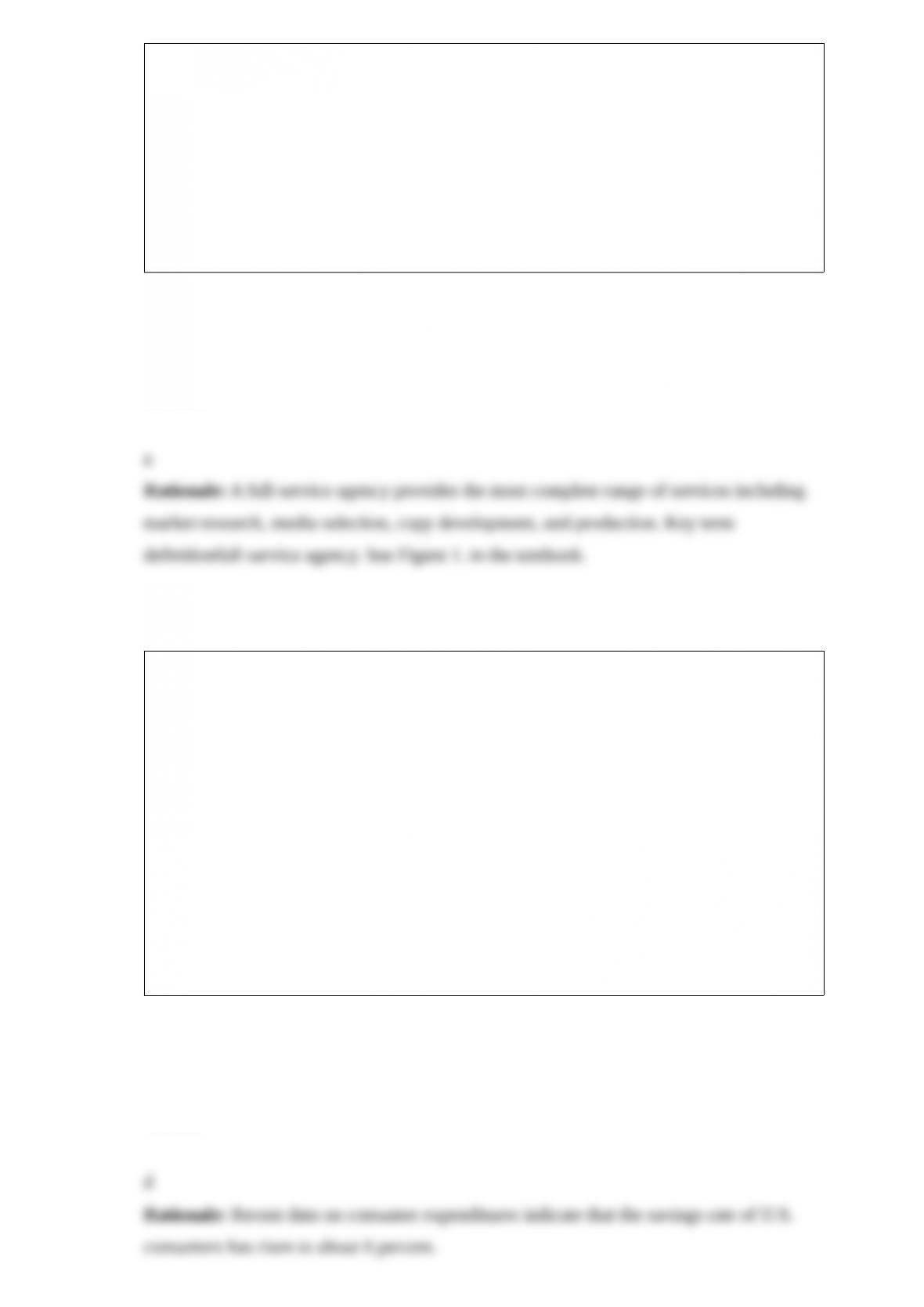
a. a full-service agency
b. a limited-service agency
c. an in-house agency
d. a multi-media agency
e. a social media agency
Answer:
Recent data on consumer expenditures indicate that the savings rate of U.S. consumers
has __________.
a. declined 6 percent; they are taking money from savings to pay current expenses on
necessities
b. remained flat at 0 percent
c. risen slightly at 2 percent
d. risen to 6 percent
e. exploded to 10 percent
Answer:

The term “minority” is currently defined as “a relatively small group of people who
differ from others with respect to race, religion, language, or political persuasion.” Why
will the term have different implications in the future?
a. There will be stronger limits on immigration, so the presence of minorities will be
less noticeable.
b. Members of Generation Y are more socially conscious and embrace diversity.
c. The term “minority” has become politically incorrect.
d. The meaning of the word won”t change at all; the group with the smallest population,
regardless of its absolute size, will always be labeled “minority.”
e. The size of most ethnic groups will double during the next two decades.
Answer:
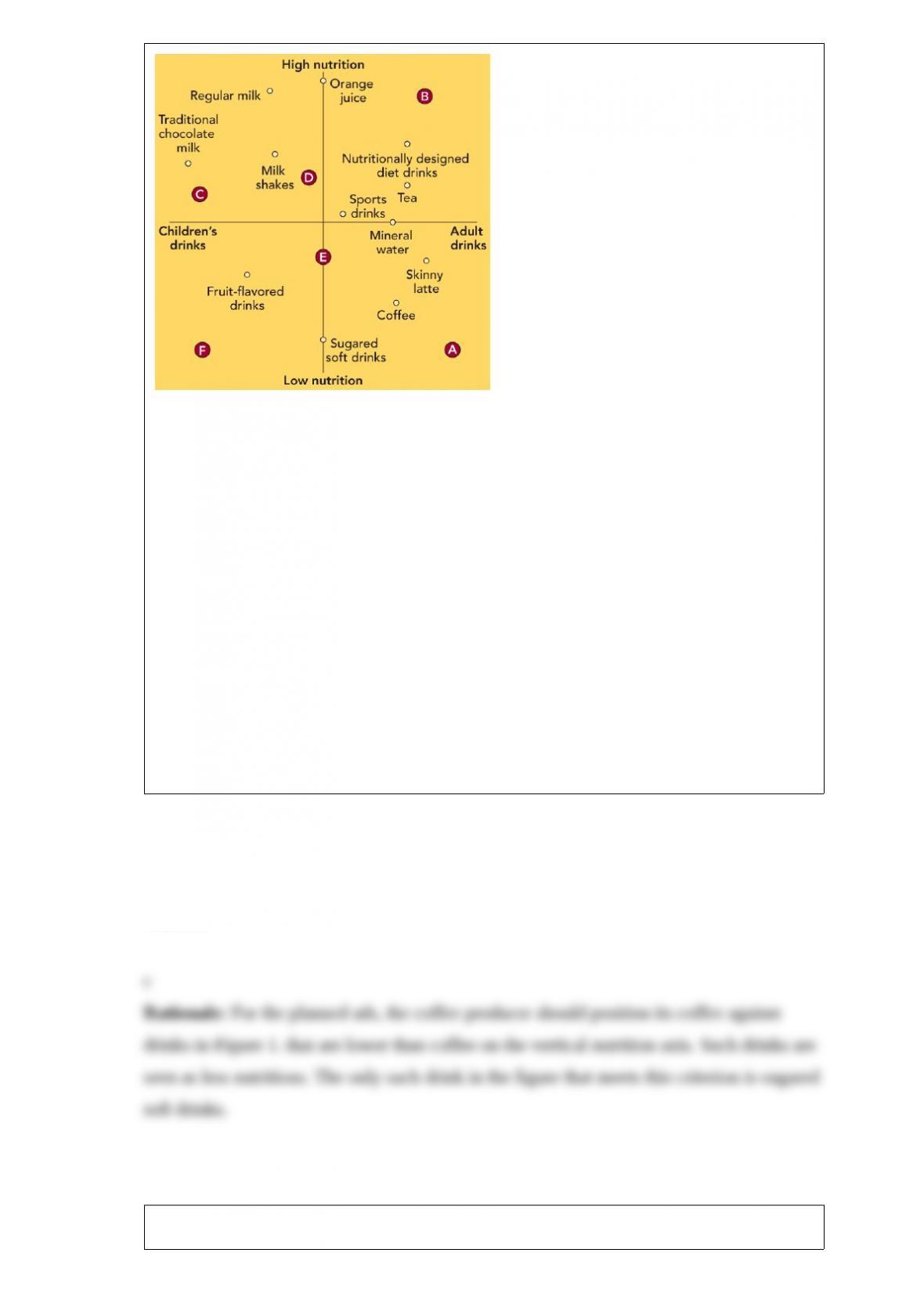
Figure 1.
The perceptual map in Figure 1. above shows how various drinks are seen in the minds
of adult consumers. Suppose a coffee producer wants to increase sales. As the account
executive for the coffee producer’s advertising agency, you want to create comparative
ads showing that coffee presently is healthier (has higher nutrition) than which
beverage?
a. skinny lattes.
b. fruit-flavored drinks.
c. sugared soft drinks.
d. sports drinks.
e. milk shakes.
Answer:

The first major federal legislation passed to forbid contracts, combinations, or
conspiracies in restraint of trade in the United States was the
a. Lanham Act.
b. Sherman Antitrust Act.
c. Federal Trade Commission Act.
d. Robinson-Patman Act.
e. Clayton Act.
Answer:
One disadvantage of using newspapers as an advertising medium is
a. their inability to cover local markets.
b. readers damage the newspaper when clipping its ads.
c. their short life span.
d. the high cost of ads.
e. their quick consumer response.
Answer:
In terms of the online customer experience, customization refers to
a. the consumer-initiated practice of generating content on a marketer’s website that is
custom-tailored to an individual’s specific needs and preferences.
b. the website’s ability to conduct sales transactions for products and services.
c. an interactive, Internet-enabled system that allows individual customers to design
their own products and services.
d. a website’s aesthetic appeal and functional look and feel, reflected in site layout and
visual design.
e. the ability of a website to modify itself to, or be modified by, each individual user.
Answer:
Ben & Jerry’s Marketing Dashboard (Dollar Sales)
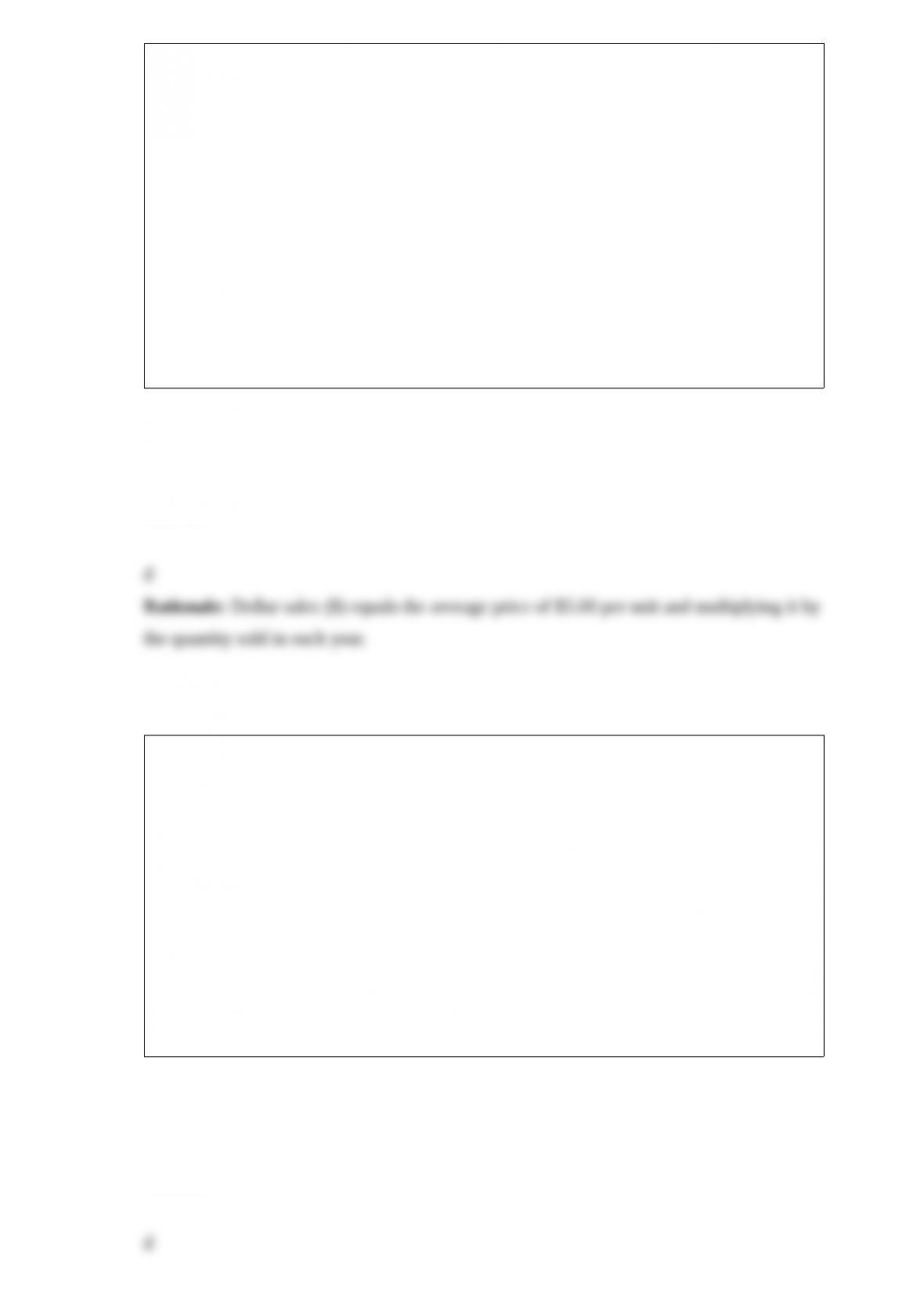
A marketing manager for Ben and Jerry’s has been provided with a marketing
dashboard display shown above. She notices that dollar sales for 2011 were $240
million and in 2012 they were $250 million. What was the formula used to calculate the
dollar sales for each of these two years?
a. Dollar sales ($) = average price multiplied by quantity manufactured.
b. Dollar sales ($) = average cost of goods sold minus fixed costs.
c. Dollar sales ($) = average price minus shrinkage rate.
d. Dollar sales ($) = average price multiplied by quantity sold.
e. Dollar sales ($) = average cost of goods sold minus variable costs.
Answer:
According to the price equation, a product’s or service’s final price equals its list price
minus incentives and allowances plus
a. profits.
b. commissions.
c. trade-ins.
d. extra fees.
e. taxes.
Answer:
Which of the following laws has the purpose of protecting competition?
a. Lanham Act.
b. Federal Trade Commission Act.
c. Fair Trade Act.
d. Unfair Practices Act.
e. Sherman Antitrust Act.
Answer:
Medication sensors have been developed that can dispense medicines by circulating
within the arteries of the body and sensing when the medication is needed. This is an
example of how __________ forces help improve or replace existing products and
companies.
a. ecological
b. regulatory
c. legal
d. competitive
e. technological

Answer:
Inventory management systems that are designed to reduce the retailer’s lead time for
receiving merchandise, which then lowers its inventory investment, improves customer
service levels, and reduces logistic expenses is referred to as __________.
a. efficient consumer response systems
b. order replenishment systems
c. customer logistics factors
d. minimum-inventory systems
e. web-based response systems
Answer:
What are the market entry strategy options available to a company seeking to enter the
global marketplace? How do they relate to each other in terms of profit potential, risk,
financial commitment required, and marketing control?
Answer:
Define cross-channel shoppers, explain why they are important to marketers, and list
the three reasons cross-channel shoppers research items online before buying in stores.
Answer:
What is the difference between cultural ethnocentricity and consumer ethnocentrism?
Answer:
Marketing managers used a combination of four tools in order to develop a complete
marketing program to reach consumers. Briefly define these four tools.
Answer:
Do college students have a choice in which classes they take to earn a degree? Use what
you have learned about the controllable and uncontrollable aspects of marketing in
terms of how they might relate to course selection decision-making. Incorporate
marketing terms in your response.
Answer:
List four problems that occur in the planning phase of a firm’s strategic marketing
process.
Answer:
What is standard markup pricing and when would it be used?
Answer:
Explain the difference between joint venture and direct investment market entry
strategies. What are the advantages and disadvantages of each approach?
Answer:
What are some of the methods marketers use to conduct research and solve marketing
problems? Be sure to include at least one specific print source.
Answer:
What is best approach for determining a promotion budget? What advantages does this
method offer that the other methods do not?
Answer:
What is the marketspace?
Answer:
In our free-enterprise society, which three specific groups benefit from effective
marketing?
Answer:
Explain the difference between breadth of line and depth of line. Be sure to include the
definition of scrambled merchandising in your explanation.
Answer:
Define spam and viral marketing. What are the advantages and disadvantages of using
each of these as a marketing strategy?
Answer:
The Apple iPhone 4S is rated by Consumer Reports as being one of the best
smartphones in the industry. Define customer value. In what ways do you think the
Apple iPhone 4S provides value for its customers?
Answer:
What is off-price retailing? Identify and give an example of the three variations of
off-price retailing.
Answer:
Compare push and pull strategies as alternative promotional methods for moving a
product through a channel of distribution.
Answer: