At the end of a recent year, Solectron, a big Milpitas, California, electronics contractor,
made half of its purchases under vendor-managed inventory programs. Solectron
A. had its suppliers perform all materials handing activities.
B. authorized its suppliers to eliminate as many wholesaling functions as possible from
the supply chain.
C. used a system in which its suppliers determined the product amount and assortment
that should be in stock.
D. authorized the use of distribution centers to provide quicker customer response
times.
E. balanced its total logistics cost by eliminating the convenience service factor.
Answer:
Jason decided to open a small Internet caf serving a variety of unusual nonalcoholic
beverages from around the world. He set a goal to break-even within the first six
months and make a moderate profit thereafter. Within a week of opening, every seat
was filled and he had to replenish inventory several times. At his six-month review, he
was devastated to find that despite huge sales, he had actually lost money. His math was
not wrong, but he had failed to include monthly expenses such as toilet paper, paper
towels, and hand soap in his calculations. These costs should have appeared as
__________ in his break-even analysis.
A. fixed costs
B. marginal costs
C. variable costs
D. overhead costs
E. sunk costs
Answer:
All of the following are examples of stakeholders EXCEPT:
A. government.
B. competitors.
C. shareholders.
D. suppliers.
E. customers.
Answer:
One of the eight primary marketing-related reasons for new-product failure is
__________.
A. not listening to the voice of the engineer
B. no economical access to buyers
C. too much advertising or too aggressive a tone for it
D. failure to anticipate competitors actions
E. insufficient funding for roll-out
Answer:
How might a marketing manager for a manufacturer of turboprop engines, used in
private jet planes, use the NAICS to help her with marketing planning?
A. Record the NAICS numbers for each of her firm’s best customers and then obtain
lists of companies with the same NAICS numbers.
B. Go to a library and find the NAICS numbers for all government units – federal, state,
and local.
C. Identify all NAICS numbers that reflect the classifications of her firm’s customers
and compare them to previous SIC codes.
D. Poll her field sales organization to see if her company’s sales representatives know
what NAICS numbers mean.
E. Forgo using the NAICS system because it has recently been replaced by the SIC
system, which is more useful in this scenario.
Answer:
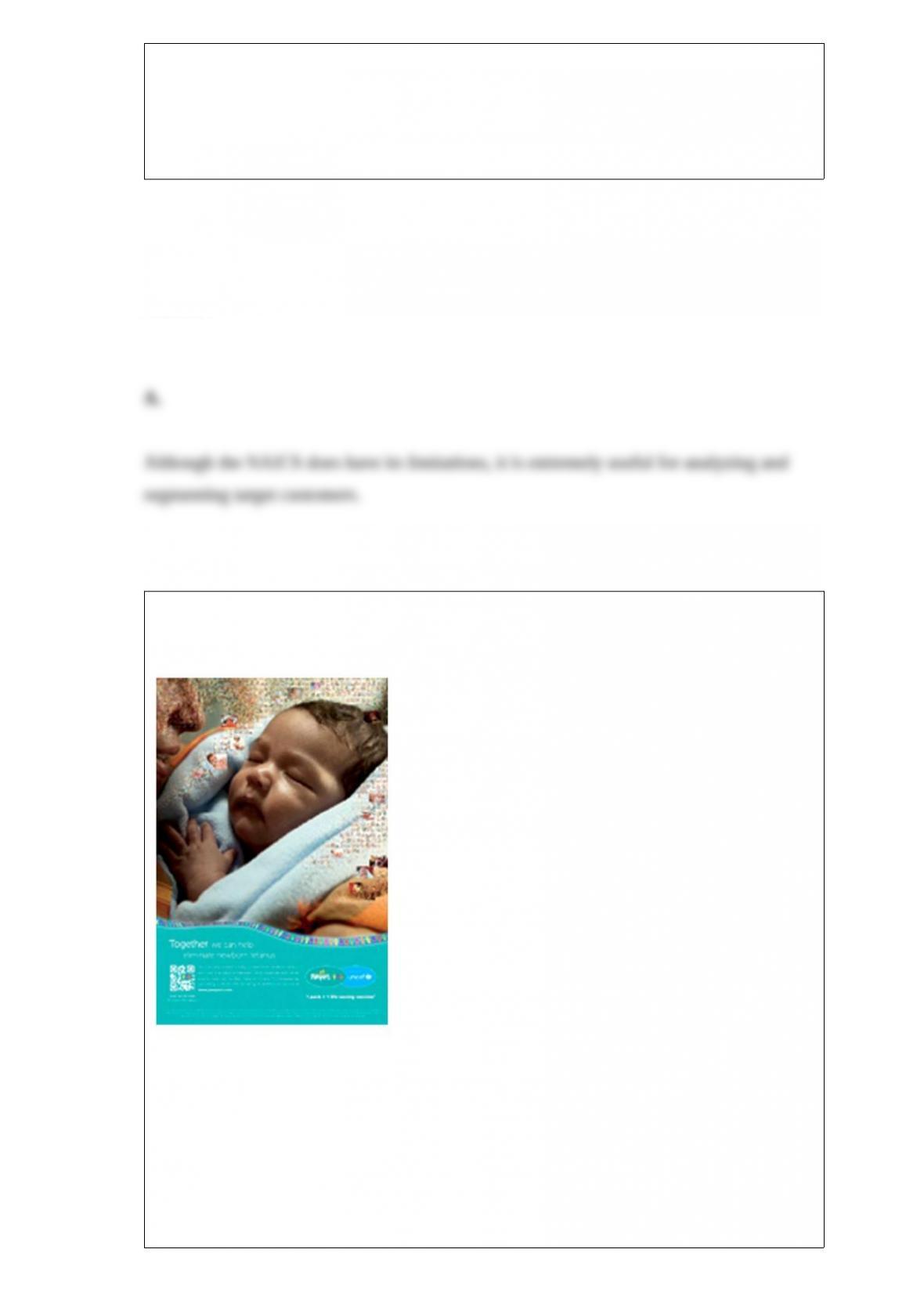
Pampers Ad
Consider the Pampers ad above. Since 2006, Procter & Gamble has developed a
successful brand campaign that includes the Pampers 1 Pack 1 Vaccine initiative, which
has protected 100 million women and their babies against maternal and neonatal
tetanus. This is an example of
A. philanthropic marketing.
B. corporate altruism.
C. the marketing concept.
D. green marketing.
E. cause marketing.
Answer:
Which of the following statements regarding stakeholders is most accurate?
A. Employees are typically not classified as a stakeholder group because they are
internal to the organization.
B. There are only three types of stakeholders: customers, suppliers, and distributors.
C. All stakeholders are external to the organization.
D. Stakeholders are a varied group; all are in some way affected by how well a
company performs.
E. Stakeholders are only those that have an ownership stake in an organization.
Answer:

The __________ is defined as the group of prospective buyers toward which a
promotion program is directed.
A. directed audience
B. intended audience
C. promotion audience
D. selling audience
E. target audience
Answer:
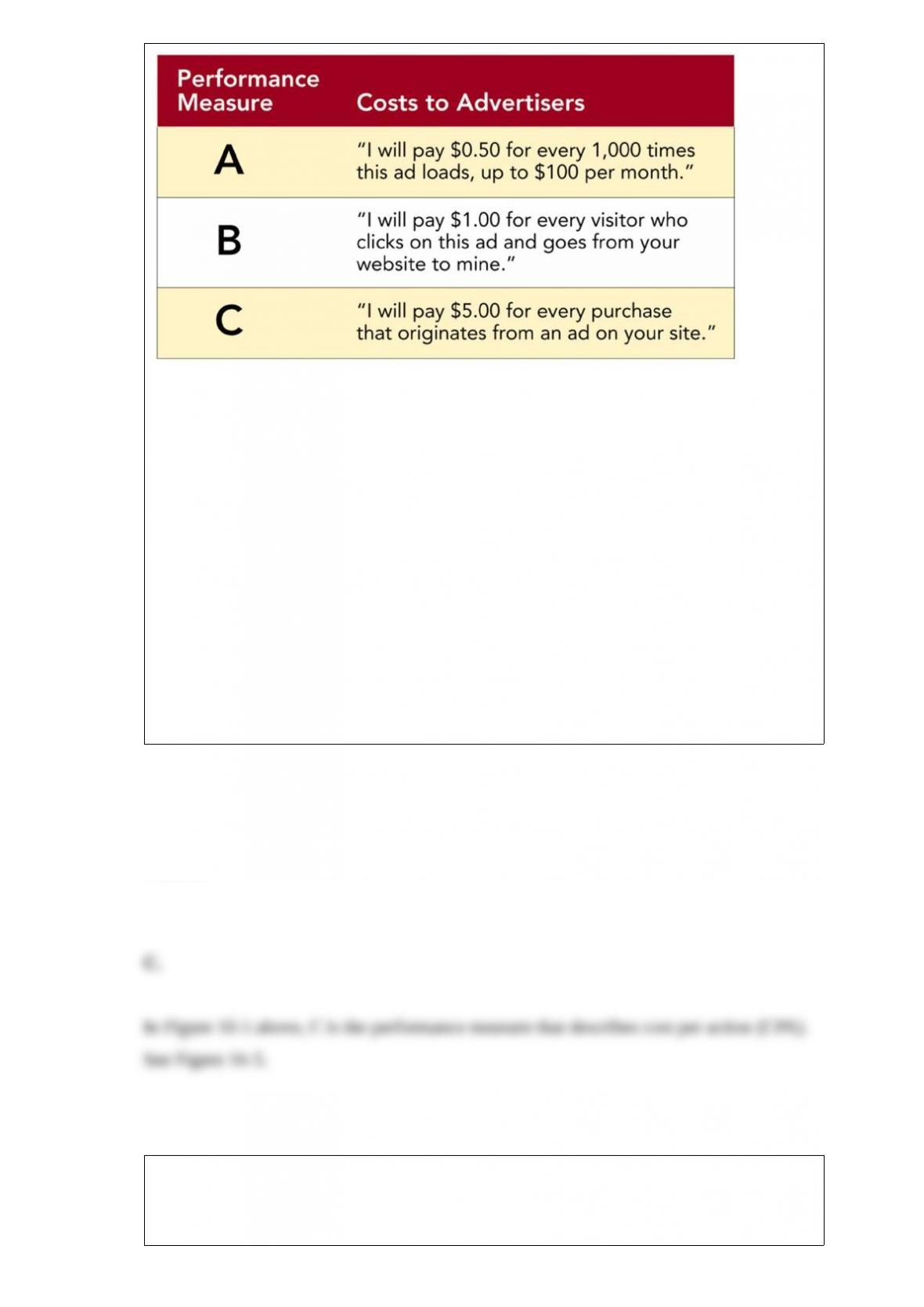
Figure 16-5
According to Figure 16-5 above, C is the performance measure described by the
accompanying quote “I will pay $5.00 for every purchase that originates from an ad on
your site” under the Cost to Advertisers heading:
A. cost per click
B. click through rate
C. cost per action
D. conversion rate
E. cost per thousand
Answer:
The four steps in the sequential process of building the brand equity pyramid include:
(1) developing positive brand awareness; (2) establishing a brand’s meaning in the
minds of consumers; (3) __________; and (4) creating an intense, active, and loyal
consumer-brand connection.
A. forming a brand personality
B. easing consumers’ decision making
C. developing brand licensing criteria
D. rewarding loyal customer behavior
E. eliciting the proper consumer responses to a brand’s identity and meaning
Answer:
Generally, as the proportion of middle-income households in a country increases, the
nation’s purchasing power __________.
A. levels off
B. decreases
C. increases
D. becomes less of an economic priority
E. becomes progressively unstable

Answer:
An inventory-management system whereby the supplier determines the product amount
and assortment a retailer needs and automatically delivers the appropriate items is
referred to as __________.
A. supplier-managed inventory
B. supply chain inventory
C. logistics-managed inventory
D. just-in-time inventory management
E. vendor-managed inventory
Answer:
Which of the following statements regarding pricing objectives is most accurate?
A. Pricing objectives should never change.
B. Pricing objectives may change depending on the financial position of the company.
C. Pricing objectives may change depending upon the relative market share of
competitors.
D. Pricing objectives are established exclusively by the marketing department.
E. Pricing objectives are extremely sensitive to even the slightest change in the local
economy.
Answer:
Consumers who read, hear, or see the message sent by a source during the
communication process are referred to as __________.
A. decoders
B. the target market
C. receivers
D. sources
E. encoders
Answer:

Downsizing reduces the __________.
A. quality of materials without changing the price
B. product’s price along with the quality of the materials
C. package content without changing its size while maintaining or increasing the
package price
D. number of product features
E. number of product items in a product line
Answer:
One of the advantages associated with television as an advertising medium is that it
A. is a low-cost medium.
B. has a short exposure time.
C. can target specific audiences.
D. has an unlimited amount of advertising time available.
E. can be used to convey complex messages.
Answer:
A software company has updated its logo. It now needs to order new letterhead and
business cards. This purchase would be a
A. modified rebuy.
B. straight rebuy.
C. new buy.
D. standard reorder.
E. class buy.
Answer:
The purpose of competitive institutional advertisements is to
A. promote a specific brand’s features and benefits.
B. tell people what a company is, what it can do, and where it is located.
C. state the position of a company on an issue.
D. reinforce previous knowledge of a product.
E. promote the advantages of one product class over another.
Answer:
In recent years, many large firms have changed the title of the head of marketing from
vice president of marketing to
A. chief executive officer.
B. corporate marketing official.
C. coordinating marketing officer.
D. chief marketing officer.
E. corporate marketing executive.
Answer:
From an organization’s perspective regarding its new products and innovations, which
of the following new-product strategies has the HIGHEST level of risk?
A. a radical invention
B. a brand extension
C. a product line extension
D. a jump in innovation
E. a product deletion
Answer:
Salespeople for Godiva Chocolates use __________ to process orders, plan time
allocations, forecast sales, and communicate with Godiva personnel and customers, thus
providing better customer service.
A. laptop computers
B. tablet devices
C. order processing software
D. presentation software
E. smartphones
Answer:
The European Union is an economic and political union of __________ member
countries that have eliminated most barriers to the free flow of products, services,
capital, and labor across their borders.
A. 17
B. 20
C. 28
D. 30
E. 37
Answer:
An effective sales plan objective should be
A. general, measurable, and flexible.
B. profitable, subjective, and measurable.
C. precise, profitable, and flexible.
D. precise, measurable, and time specific.
E. general, flexible, and profitable.
Answer:
When Sears places a multiple-page booklet in the local newspaper about its President’s
Day sale, it is using which element of the promotional mix?
A. advertising
B. sales promotion
C. publicity
D. personal selling
E. direct marketing
Answer:
Which of the following profiles would most likely describe an online consumer?
A. a tech-savvy high-school student living with her parents
B. a 21-year old high-school graduate earning $18,000 annually living in his own
apartment
C. a 28-year old chemical engineer living in the suburbs with her husband and two
children
D. a 55-year old factory worker living with his wife in an apartment
E. a 70-year old retired naval officer living in a retirement community
Answer:
Tests conducted after an advertisement has been shown to the target audience to
determine whether an ad accomplished its intended purpose, are referred to as
__________.
A. jury testing
B. tracking tests
C. exposure testing
D. posttesting
E. pretesting
Answer:
A publicity tool that is heavily relied on by nonprofit organizations, and which involves
free space or time donated by the media, is referred to as a __________.
A. public service announcement
B. cooperative advertisement
C. cause-related publicity tool
D. news conference
E. news release
Answer:
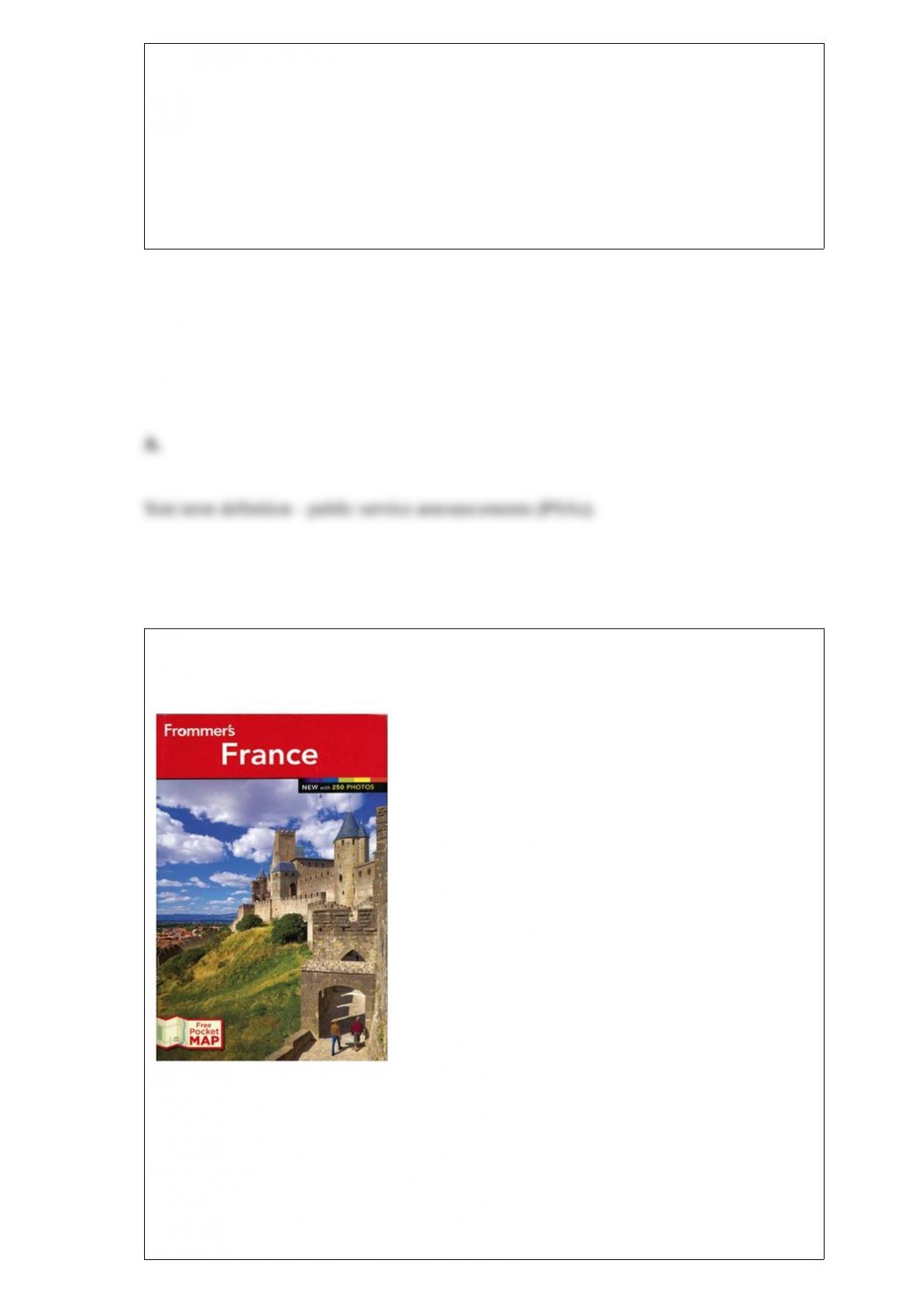
Frommer’s France Image
Consider the Frommer’s France image above. Travelers throughout the world have
relied on Frommer’s guides, which outline out-of-the-way, inexpensive restaurants and
hotels. This guide provides invaluable __________ to these establishments.
A. direct sales
B. publicity
C. direct marketing
D. personnel selling
E. public service announcement
Answer:
The __________ provided by retailers create value for consumers.
A. utilities
B. wholesaling functions
C. outsourcing
D. profits
E. synergies
Answer:
Businesses vary as to the amount of security they require or can afford in order to
protect their computer files. A company that sells a complete line of firewalls, from a
no-frills version to one that uses complex retinal scans, would most likely employ
which promotional element to effectively promote its product to businesses?
A. personal selling
B. advertising
C. sales promotion
D. public relations
E. social media
Answer:
When Tracy went to work as a new sales rep for Paradise Candles, she was told to use
the following speech in her sales presentations: “Hello, Mr./Ms. (customer name). My
name is (your name here). I’m calling on behalf of Paradise Candles. We carry the best
wax-burning mechanical candles available in the commercial decorating industry.”
Paradise Candles instructed Tracy to use

A. a formula selling presentation.
B. a stimulus-response presentation.
C. a needs-satisfaction presentation.
D. suggestive selling.
E. consultative selling.
Answer:
Consumers are buying hybrid gas-electric automobiles such as the Toyota Prius. This is
an example of which increasingly common cultural value?
A. Preserving the environment
B. Paying the least amount possible for products
C. Reducing inequality among competing brands
D. Believing in fate
E. Reducing cognitive dissonance
Answer:

A means of displaying or graphing in two dimensions the location of products or brands
in the minds of consumers to enable a manager to see how consumers perceive
competing products or brands, as well as its own product or brand, is referred to as a
A. perception matrix.
B. growth-share matrix.
C. market-product grid.
D. perceptual map.
E. product differentiation chart.
Answer:
Twitter can be a good source of information about a brand or product because of its
A. short message length.
B. photo-sharing capability.
C. ability to display user generated video content.
D. ownership of CoTweet.
E. ability to post professional profiles.
Answer:
A mother handed her college-aged son a clipped __________ and said, “Use this to get
25 cents off the Birds Eye lima beans I need you to pick up for dinner,” which shows
that Birds Eye has been successful in its attempt to stimulate demand.
A. coupon
B. rebate
C. sample
D. deal
E. premium
Answer: