Many retailers advocate a(n) __________ strategy, a pricing strategy that may not offer
the lowest prices but does try to create value for customers through its service and the
total buying experience.
A. customer loyalty
B. emphasize-value
C. everyday low pricing
D. low-margin
E. everyday fair pricing
Answer:
Many automobile dealerships employ a non-negotiable or no-haggle price strategy to
sell their cars. A customer who wants to buy a new or used car would pay the posted
price. These dealers probably adopted this pricing policy because
A. the industry was discussing the abandonment of self-regulation practices.
B. women have an intense dislike of price negotiation, yet still want to buy a car.
C. many recent immigrants into the United States are not accustomed to negotiation.
D. women distrust men in general and car salesmen in particular.
E. a sluggish economy guarantees that negotiations would produce negative profit per
vehicle.
Answer:
A firm that views the world as consisting of unique parts and markets to each part
differently is referred to as a(n)
A. meganational firm.
B. extranational firm.
C. international firm.
D. multinational firm.
E. transnational firm.
Answer:
One of the disadvantages associated with radio as an advertising medium is that it
A. has a short exposure time.
B. cannot target specific audiences.
C. cannot use humor or intimacy effectively.
D. has a very limited amount of advertising time available.
E. has not proven to be effective yet.
Answer:
The output of a supply chain is the
A. units of products delivered.
B. total generated revenue.
C. service delivered to customers.
D. total number of customers served.
E. total profits realized.
Answer:
Which of the following companies would be most likely to use target
return-on-investment pricing?
A. a farmer
B. a florist shop
C. a book publisher
D. a veterinarian
E. an automobile manufacturer
Answer:
A corporate vertical marketing system refers to
A. small, independent retailers that form an organization that operates a wholesale
facility cooperatively.
B. professionally managed geographically dispersed marketing channels that are
controlled through strategic channel alliances.
C. the combination of successive stages of production and distribution under a single
ownership.
D. professionally managed and centrally coordinated marketing channels designed to
achieve channel economies and maximum marketing impact.
E. a contractual arrangement between a parent company and an individual or firm that
allows the individual or firm to operate a certain type of business under an established
name and according to specific rules.
Answer:
Tiffany & Company knows that Japanese are superstitious about the number 4. As a
result, Tiffany sells its fine glassware and china in sets of five, not four, in Japan.
Tiffany has used its knowledge of __________ to avoid connecting its products with the
number 4.
A. trademarks
B. visual icons
C. cultural symbols
D. brand names
E. ethnic emblems
Answer:
Market segmentation refers to
A. identifying small groups of customers with dissimilar needs.
B. aggregating prospective buyers into groups and selecting only those whose needs
cannot be met by competitors’ products.
C. aggregating prospective buyers into groups that have common needs and will
respond similarly to a marketing action.
D. aggregating different products into more reasonable product groupings to better
serve consumers’ needs.
E. those characteristics of a product that make it superior to competitive substitutes.
Answer:
Although Recreational Equipment, Inc. (www.rei.com) has typical retail store hours, 35
percent of its orders are placed between the hours of 10:00 p.m. and 7:00 a.m. This
shows how electronic commerce contributes to customer value through the creation of
__________.
A. time utility
B. place utility
C. possession utility
D. form utility
E. financial utility
Answer:
Which of the following is a service business within the industrial market?
A. construction
B. mining
C. insurance
D. government
E. farming
Answer:
A retail outlet that focuses on one type of product at very competitive or discount prices
and often dominates the market is referred to as a __________.
A. general merchandise store
B. value outlet
C. hypermarket
D. category killer
E. department store
Answer:
All of the following comprise the seven Ps of services marketing EXCEPT:
A. product.
B. process.
C. profitability.
D. people.
E. physical environment.
Answer:
Most paint is neither biodegradable nor friendly to the environment because it is made
with petroleum solvents. A builder who decided to build a subdivision with 500 homes
and paint each with an environmentally-friendly, soy-based paint (even though it costs
more) would be practicing
A. profit responsibility.
B. cause marketing.
C. stakeholder responsibility.
D. mass marketing.
E. societal responsibility.
Answer:
When the marketing student said, “It’s really hard for me to get to class on time without
a car,” she was entering which stage of the consumer purchase decision process?
A. purchase decision
B. alternative evaluation
C. information search
D. problem recognition
E. postpurchase behavior
Answer:
Which of the following is a socializing force that dictates what is morally right and
just?
A. federal regulatory agencies like the FTC
B. federal, state, and local legislation
C. the U.S. Supreme Court
D. culture
E. organizational core values
Answer:
The Journal of Marketing Research and the Journal of Marketing provide
A. up-to-date tables for the latest data on consumer sales, listed by industry.
B. summaries of research methods and techniques valuable in addressing marketing
problems.
C. the latest data on marketing expenditures based on consumer geodemographics.
D. postings of professional marketing opportunities at universities and colleges.
E. an in-depth list of marketing positions and opportunities at major corporations.
Answer:
The most popular loyalty programs today are __________ reward programs.
A. fast food
B. airline travel
C. hotel accommodations
D. credit card
E. grocery store
Answer:
Functional discounts are offered to resellers in the marketing channel on the basis of
where they are in the channel and
A. the size of the order.
B. the frequency of the order.
C. when orders are placed during the year.
D. the length of the relationship with the manufacturer.
E. the marketing activities they are expected to perform in the future.
Answer:
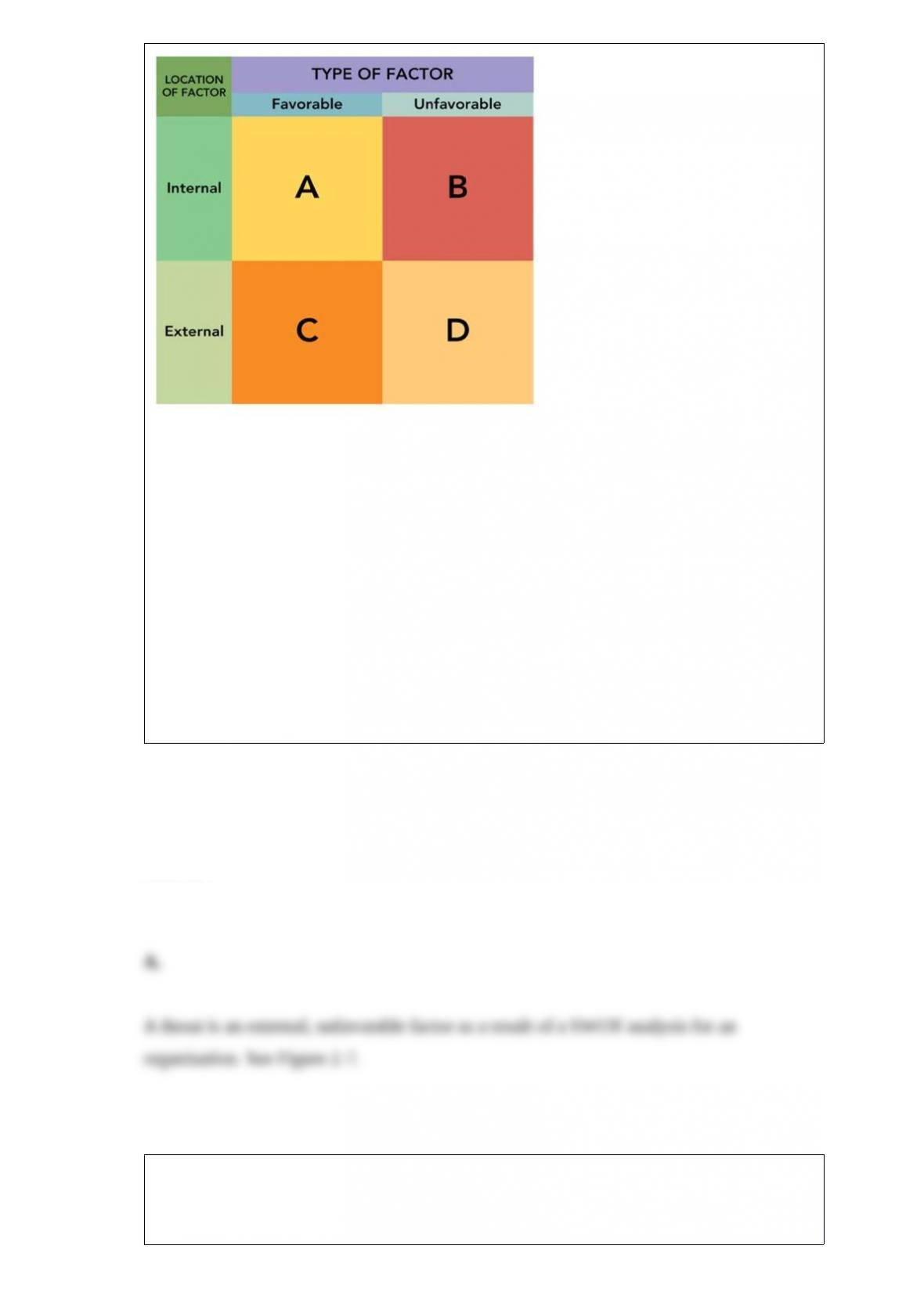
Figure 2-7
Quadrant D in Figure 2-7 above represents a(n) __________ in a SWOT analysis.
A. Threat
B. Weakness
C. Strength
D. Opportunity
E. Market segment
Answer:
The acronym RFID stands for
A. retail franchise identification designation.
B. required financial identification.
C. radar frequency identification.
D. radio frequency identification.
E. retail federation of independent department stores.
Answer:
All of the following are tools used by a firm’s public relations department EXCEPT:
A. annual reports.
B. contests.
C. lobbying efforts.
D. press conferences.
E. image management.
Answer:
In classifying social media, the degree of acoustic, visual, and personal contact between
two communication partners is referred to as
A. user generated content.
B. social value.
C. self-disclosure.
D. media richness.
E. emotive content.
Answer:
Cree LED Light Bulb Photo
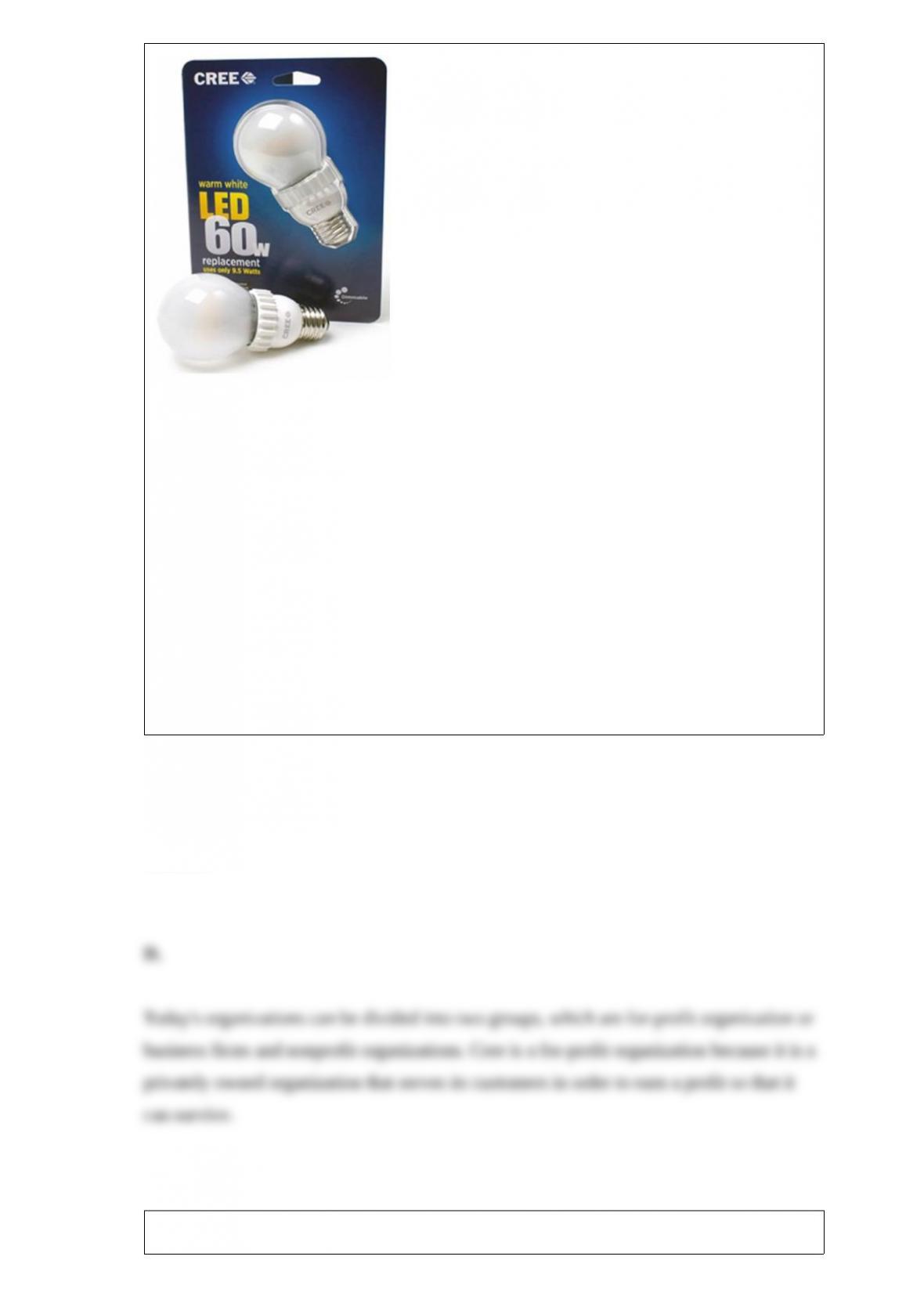
Cree markets LED (light-emitting diode) light bulbs (see the photo above) that replaces
the traditional incandescent bulb. The Cree LED 60w bulb is 84 percent more energy
efficient, lasts for 25,000 hours, and initially sold for about $12 at Home Depot. Cree is
an example of a(n) __________.
A. cooperative
B. industry
C. nonprofit organization
D. business firm
E. government agency
Answer:
A flexible-price policy refers to
A. setting the price of a line of products at a number of different specific pricing points.
B. setting the prices for all items in a product line to cover the total cost and produce a
profit for the complete line, not necessarily for each item.
C. deliberately selling a product below its customary price, not to increase sales, but to
attract customers’ attention in hopes that they will buy other products as well.
D. setting different prices for products and services depending on individual buyers and
purchase situations.
E. adding a fixed percentage to the cost of all items in a specific product class.
Answer:
Prexa was offended by the brand name of a new product for women. She believed the
name of the product was demeaning and that it reflected a negative attitude of the
manufacturer towards women in general. Although this may simply be the result of
__________, if other women interpreted the name choice the same way, it is likely this
product would fail.
A. selective retention
B. selective comprehension
C. selective exposure
D. selective analysis
E. stimulus discrimination
Answer:
The __________ element of the marketing mix includes features and packaging.
A. product
B. price
C. promotion
D. place
E. people
Answer:
A need-satisfaction presentation format that focuses on problem identification, where
the salesperson serves as an expert on problem recognition and resolution, is referred to
as
A. adaptive selling.
B. suggestive selling.
C. formula selling.
D. consultative selling.
E. relationship selling.
Answer:
When Allyn went to get his newspaper, he found the paper in a plastic bag along with a
box containing one dose of Alka-Seltzer Heartburn Relief medication. In this example,
which type of sales promotion is Alka-Seltzer using?
A. a sample
B. a deal
C. a premium
D. a point-of-purchase display
E. an introductory offer
Answer:
Organizations that develop similar offerings, when grouped together, create a(n)
A. conglomerate.
B. merger.
C. industry.
D. sector.
E. monopoly.
Answer:
Garlic Cake was supposed to be served as an hors d’oeuvre with sweet breads, spreads,
and meats, but at its introduction the company forgot to explain this to potential
consumers. This product failure demonstrates
A. not satisfying customer needs on critical factors.
B. poor product quality.
C. poor execution of the marketing mix.
D. an insignificant point of difference.
E. bad timing.
Answer:
What is the standard for measuring a meaningful marketspace company presence?
A. the sales compared to the marketplace alternative in a multichannel marketing
context
B. the quality of the website design
C. the shopping cart
D. the quality of the customer experience
E. the eight second rule
Answer:
An organization’s use of a name, phrase, design, symbol, or combination of these to

identify its products and distinguish them from those of competitors is referred to as
__________.
A. a label
B. branding
C. a trademark
D. a brand name
E. a trade name
Answer:
In behavioral learning, a(n) __________ is a stimulus or symbol perceived by
consumers.
A. drive
B. cue
C. attitude
D. response
E. reinforcement
Answer:
Buying a book at www.amazon.com to give as a birthday present is an example of a(n)
__________ transaction.
A. i-market
B. intranet
C. electronic commerce
D. extranet
E. marketplace
Answer: