Robin wants to find the perfect gift for her grandparents’ 50thwedding anniversary. She
started looking for the gift last month and expects to spend another couple of months if
needed to find a gift they both will like. Robin is engaging in
a. routine problem solving.
b. limited problem solving.
c. extended problem solving.
d. problem recognition.
e. integrated problem solving.
Answer:
A memorized, standardized message conveyed to every prospect is referred to as a
__________.
a. stimulus-response presentation
b. canned sales presentation
c. directed selling presentation
d. mnemonic sales format
e. standardized sales format
Answer:
A sales quota identifies _____.
a. the ratio of sales calls made to actual sales closed
b. the minimum number of sales that must be made before a salesperson can be paid
c. the maximum threshold for satisfactory performance during an annual performance
evaluation
d. the maximum number of sales that can be made before receiving a commission on
sales
e. the specific goals assigned to a salesperson, sales team, branch sales office, or sales
district for a stated time period
Answer:
A representative from AT&T called Dr. Michaels after he switched to its new U-verse
system. The firm wanted to make certain he was satisfied and asked if he had any
questions concerning his new service. This is an example of a __________ call.
a. assumptive
b. preemptive
c. follow-up
d. prospecting
e. courtesy

Answer:
Each strategic business unit has marketing and other specialized activities (e.g., finance,
manufacturing, or research and development) at the __________ level, where groups of
specialists actually create value for the organization.
a. strategic
b. corporate
c. functional
d. business unit
e. compartmental
Answer:
Tylenol and Advil are two manufacturers of over-the-counter products for ailments such
as colds, headaches, sore throats, arthritis aches, and general pain and fever. Both
manufacturers seek distribution of their products through pharmacies such as
Walgreens. These companies seek out channels and intermediaries that will satisfy a
buyer’s desire for
a. variety.
b. information.
c. pre-or postsale service.
d. convenience.
e. adaptability.
Answer:
The Apple innovation that stores all your digital content and then pushes it to where it
can then be sent to your other digital devices is referred to as
a. iPod
b. iCloud
c. iPad
d. iPhone
e. MacBook Air
Answer:
Communication is the process of conveying a message to others and it requires six
elements. These elements include: a source, a message, a channel of communication, a
receiver, and __________.
a. a concept
b. an offer
c. a slogan
d. a brand
e. the processes of encoding and decoding
Answer:
Today’s consumption orientation known as value consciousness is primarily due to
a. a rise in using debt to fund purchases.
b. the economic recession.
c. an expansion in the purchase of quality brand name products.
d. a cutback on the purchase of discretionary items like flat screen TVs.
e. a desire to purchase products of lesser quality to receive a lower price.
Answer:
The company that makes Breathe-Right nasal strips sells the same product in other
countries. This is an example of which type of global product strategy?
a. product customization
b. product extension
c. product adaptation
d. product invention
e. product integration
Answer:
A basic test of the usefulness of the market segmentation process is whether it leads to
tangible marketing actions that can
a. increase sales and profitability.
b. stand up to legal scrutiny.
c. be socially responsible.
d. create sustainable demand.
e. create innovation.
Answer:
A key to effectively positioning a product or brand is discovering its perception in the
minds of potential customers. To do this, companies take four steps: (1) __________;
(2) discover how target customers rate competing products or brands with respect to
these attributes; (3) discover where the company’s product or brand is on these
attributes in the minds of potential customers; and (4) reposition the company’s product
or brand in the minds of potential customers.
a. decide whether to keep or delete the market segment that your product offering
targets
b. identify the competitors’ brands that make up the consideration set
c. identify the important attributes for the product or brand class
d. create a marketing plan based on customers’ perceptions
e. identify market niches that were not previously selected during the market
segmentation process
Answer:
Reducing the number of features, qualities, or price when repositioning a product is
referred to as __________.
a. product paring
b. trading down
c. down trading
d. product deflation
e. product simplification
Answer:
__________ surveys are usually biased because those most likely to respond are those
who have had especially positive or negative experiences with the product or brand.
a. Personal interview
b. Online
c. Telephone
d. Fax
e. Mail
Answer:
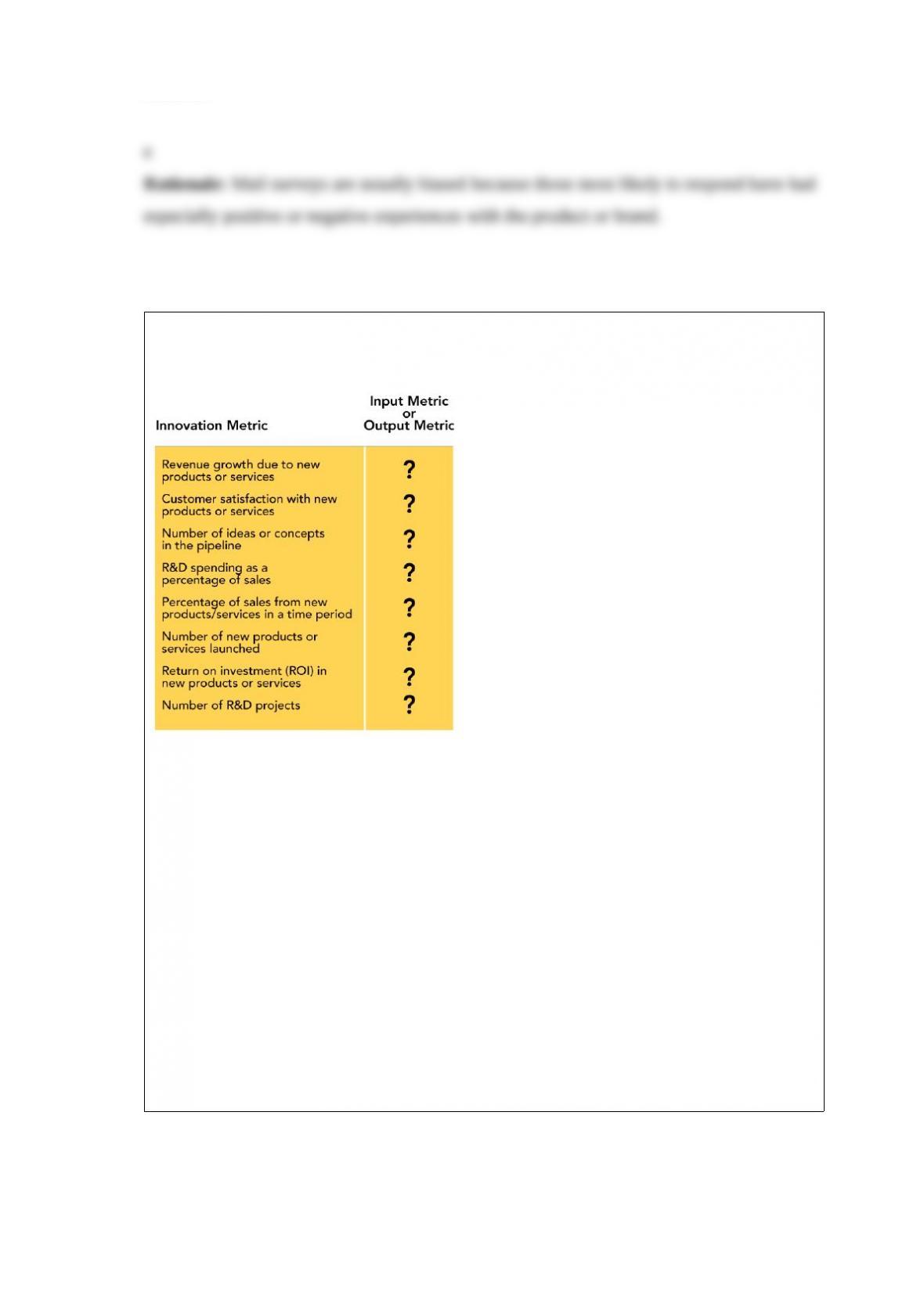
Figure 1.
In a recent survey, responding firms reported that on average they used eight metrics to
measure their innovation. Figure 1. above shows that among firms that use more than
three different innovation metrics, they use two different kindsoutput metrics and input
metrics. Which of the following is an input metric?
a. number of new products or services launched
b. R&D spending as a percentage of sales
c. return on assets (ROA) in the pipeline
d. customer satisfaction with new products or services
e. revenue growth due to new products or services
Answer:
A(n) __________ exists when producers and ultimate consumers deal one-on-one with
each other.
a. strategic channel alliance
b. direct channel
c. marketing channel
d. indirect channel
e. dual distribution channel
Answer:
Facts and figures that have already been recorded before the project at hand are referred
to as
a. primary data.
b. empirical data.
c. secondary data.
d. demographic data.
e. observational data.
Answer:
There are five stages in the consumer purchase decision process. The first stage is
__________.
a. information search
b. purchase decision
c. alternative evaluation
d. postpurchase behavior
e. problem recognition
Answer:

Setting different prices for products and services depending on individual buyers and
purchase situations is referred to as
a. price lining.
b. a flexible-price policy.
c. customary pricing.
d. price fixing.
e. discretionary pricing.
Answer:
Seven Cycles uses _________ to create customer value, build relationships, and
produce customer experiences in novel ways.
a. the Internet
b. just-in-time delivery
c. marketing dashboards
d. logistics management
e. customer relationship management
Answer:
All of the following are examples of pricing objectives EXCEPT:
a. market share.
b. survival.
c. unit sales.
d. social responsibility.
e. competitors’ prices.
Answer:
Organizations such as American Airlines, U.S. Bank, and Red Cross provide customers
with goods that are typically called a(n) __________.
a. utility
b. product
c. service
d. value
e. idea

Answer:
The pricing approach that: (1) estimates the price that ultimate consumers would be
willing to pay for a product; (2) works backward through markups taken by retailers
and wholesalers to determine what price to charge wholesalers; and (3) results in the
manufacturer deliberately adjusting the composition and features of the product to
achieve the target price to consumers is referred to as __________.
a. cost-benefit pricing
b. cost-plus percentage-of-cost pricing
c. target pricing
d. cost-plus fixed-fee pricing
e. product feature pricing
Answer:
Since global marketing is affected by economic considerations, a scan of the global
marketplace should include this factor:
a. an analysis of cultural diversity within the country under consideration.
b. regulatory constraints regarding contracts, mergers, and partnerships.
c. an assessment of language differences including dialect variation.
d. political and ideological differences between the countries involved.
e. an assessment of the economic infrastructure in these countries.
Answer:
A firm needs to drive down logistics costs as long as it can deliver expected
__________.
a. balance sheet results
b. customer service
c. low levels of expenses
d. product-market synergies
e. target market goals
Answer:
The best segmentation approach is the one that
a. makes it easiest to reach the segment.
b. maximizes the opportunity for future profit and ROI.
c. recognizes different needs of buyers among different segments.
d. recognizes similarities of needs of potential buyers within a segment.
e. is simplest and least costly in assigning potential buyers to segments.
Answer:
The benefits or customer value received by users of a product is called __________.
a. utility
b. synergy
c. consumerism
d. cost-benefit ratio
e. customer lifetime value
Answer:

When establishing product line pricing, the highest priced item is typically positioned
as
a. the oldest product item in the line.
b. the best-selling product item in the line.
c. the premium item in terms of quality and features.
d. the loss leader item for the rest of the product line.
e. the most price insensitive product item in the line.
Answer:
A direct forecast involves estimating the value to be forecast and
a. making decisions without any intervening steps.
b. halving the highest values and doubling the lowest values to determine an acceptable
forecast range.
c. selecting the alternative that holds the greatest consensus within the management
team.
d. then conducting a sensitivity analysis to determine price elasticity.
e. selecting the forecasting alternative that would allow a firm to survive financially
even if the forecasts are incorrect.
Answer:
Figure 1.
In Figure 1. above, “A” represents the
a. functional level.
b. board of directors.
c. corporate level.
d. CEO.
e. strategic business unit level.
Answer:
Savings to the consumer at off-price retailers are reported as high as __________ off
the prices of a traditional department store.
a. 50%
b. 60%
c. 70%
d. 80%
e. 90%
Answer:
Coca-Cola, Gillette razors, and Wrigley’s gum are virtually selling the same product in
other countries. This is an example of which type of international product strategy?
a. product customization
b. product adaptation
c. product extension
d. product integration
e. product invention
Answer:
The organizational __________ answers the question, “What will we do?”
a. foundation
b. direction
c. culture
d. strategy
e. mission
Answer:
A college student is taking a full course load, working 20 hours per week, and still has
to take out a student loan to cover tuition. One day, the student sees a classmate driving
a Lexus sports coupe and feels he just has to have one of his own. What factor is
MOST LIKELY to prevent a successful marketing exchange between the student and a
Lexus dealer?
a. The local Lexus dealer does not have any sports coupes in stock.
b. The student does not have the resources to qualify for a $50,000 auto loan.
c. Although the Lexus is a great car, there may be other cars with better gas mileage and
resale value.
d. He’s afraid that if someone at school sees him with the car, he might lose his student
loan.
e. His girlfriend wants him to drive a Kia Soul.
Answer:
MooreChem created a marketing dashboard for each of its sales representatives. These
dashboards included seven measuressales revenue, gross margin, selling expense,
profit, average order size, new customers, and customer satisfaction. Each metric was
gauged to show actual salesperson performance __________.
a. in terms of company rank
b. relative to the rest of the sales team
c. relative to target goals
d. plus expectations for the next two years
e. based upon previous years of experiences
Answer: