
In terms of promotion, which of the following type of consumer product stresses status
and uniqueness of brand?
a. specialty product
b. convenience product
c. shopping product
d. unsought product
e. discretionary product
Answer:
A __________ is a plan that integrates the marketing mix to provide a good, service, or
idea to prospective buyers.
a. marketing strategy
b. marketing program
c. macromarketing program
d. micromarketing program
e. customer relationship management
Answer:

Setting prices a few dollars or cents under an even number is referred to as
__________.
a. odd-even pricing
b. prestige pricing
c. price lining
d. above-, at-, or below-market pricing
e. every day fair pricing
Answer:
The dimension of service quality called __________ is caring, and individualized
attention provided to customers.
a. assurance
b. reliability
c. responsiveness
d. empathy
e. sympathy
Answer:
Relationship marketing provides several benefits for service customers, including: (1)
the continuity of a single provider; (2) customized service delivery; (3) reduced stress
due to a repetitive purchase process; and (4) __________.
a. no need for comparison shopping
b. implied warranties
c. discounted switching costs
d. an absence of switching costs
e. strict government quality performance guidelines
Answer:
With a __________ compensation plan, a salesperson is paid a fixed fee per week,
month, or year.
a. sales response
b. combination
c. straight salary
d. straight commission
e. market share
Answer:
Behavioral segmentation encompasses
a. lifestyles and demographics.
b. retailer and wholesaler behaviors.
c. geographic and demographic criteria.
d. product features and user status.
e. demand and supply.
Answer:
Internet-enabled technology employed in transmitting information from
marketer-to-consumer, consumer-to-consumer, and consumer-to-marketer is referred to

as _________.
a. broadcasting
b. distribution
c. communication
d. dispensing
e. efficiencies
Answer:
Which of the following statements would most likely be heard at the functional level of
an organization?
a. “We need to understand what our business model is.”
b. “How much money can we allot to the marketing department?”
c. “Make sure we buy a 30-second TV spot for the upcoming Super Bowl.”
d. “We should hire the most culturally diverse cross-functional team possible in order to
generate the best new-product ideas.”
e. “What are the projected sales figures for the next five years?”
Answer:
During the implementation phase of an IMC program, a firm will __________ and
carry out the promotion.
a. posttest the promotion
b. design the promotion
c. state the mission
d. identify possible advertising or promotional firms
e. pretest the promotion
Answer:
Figure 1.b
Which type of auction does Figure 1.b above represent?
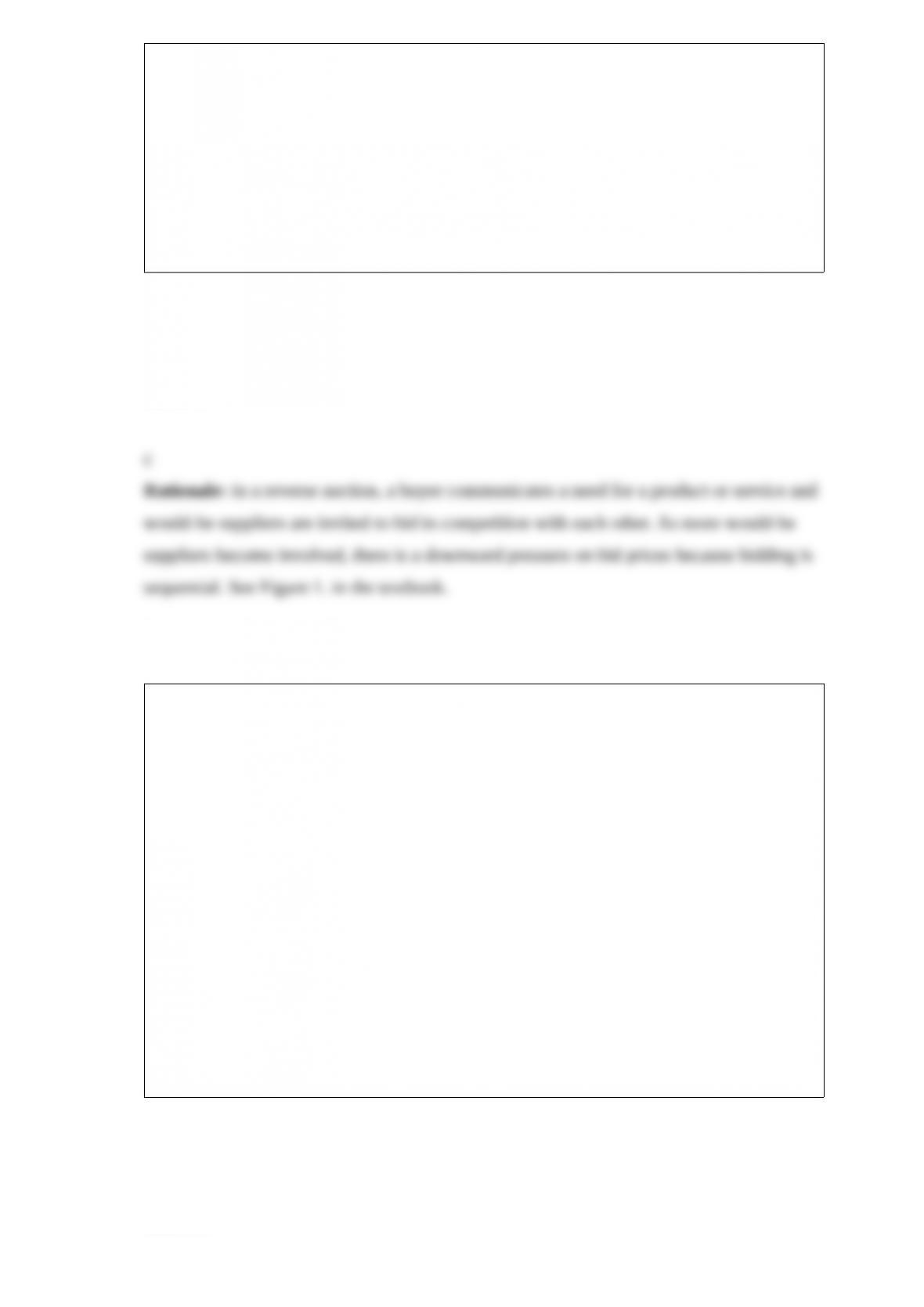
a. traditional auction
b. vertical auction
c. reverse auction
d. horizontal auction
e. reciprocal auction
Answer:
Despite the quality and benefits of Activeion’s Ionator, the company was faced with
several challenges. Which of the following is an example of one of Activeion’s
obstacles when marketing this new product?
a. The brand name didn’t really reflect the purpose of the product.
b. It was too difficult to reach Activeion’s primary target market since many cleaning
professionals are independent contractors.
c. There was not enough money in the budget for consumer advertising on TV.
d. It was difficult to define “clean” to customers relative to the competitive household
products market.
e. It was dangerous taking on large corporate competitors, which stood to lose millions
of dollars if the Ionator caught on with the general public.
Answer:
During the third stage of the organizational buying decision process, the organization
engages in
a. information search.
b. postpurchase behavior.
c. alternative evaluation.
d. purchase decision.
e. problem recognition.
Answer:
Two selling styles associated with the need-satisfaction presentation format are
__________.
a. adaptive selling and confrontational selling
b. adaptive selling and consultative selling
c. suggestive selling and canned selling
d. adaptive selling and suggestive selling

e. suggestive selling and consultative selling
Answer:
Which of the following statements concerning personal observation is most accurate?
a. Personal observation is more accurate than ethnopsychic research because the
observer/analyst is able to pick up subtleties in the respondent’s body language, speech
patterns, and facial movements that are often missed by other data collection methods.
b. Personal observation is especially suited for small businesses that need the research
data but cannot afford more expensive data collection methods.
c. Personal observation is very effective since it can reveal not only what people do, it
can effectively determine why they do it.
d. Personal observation is both useful and flexible, but has reliability issues when
different observers watching the same event report different results.
e. With personal observation, different observers will reliably report the same
conclusions when watching the same event, such as people brushing their teeth.
Answer:

Many consumers are committed to brands with a strong link to social action. An
example of this would be
a. McDonald’s “I”m Lovin It” campaign.
b. Brita’s “Filter for Good” campaign.
c. Imagine Babyz video game.
d. Liz Claiborne’s “Claiborne for Men” campaign.
e. Samsung’s “The Jitterbug” campaign.
Answer:
The most frequently used determinants of social class are
a. lifestyle, behavior patterns, and values.
b. occupation, education, and source of income.
c. lifestyle, education, and income.
d. education, ancestry, and income.
e. income, family background, and occupation.
Answer:
A vertical marketing system that involves a contractual relationship between a
wholesaler and small independent retailers to standardize and coordinate buying
practices, merchandising programs, and inventory management efforts is referred to as
a __________.
a. service-sponsored retail franchise system
b. retailer-sponsored cooperative
c. administered vertical marketing system
d. manufacturer-sponsored retail franchise system
e. wholesaler-sponsored voluntary chain
Answer:
Which of the following is a profit-oriented approach to pricing?
a. skimming pricing
b. target pricing
c. loss-leader pricing
d. target return-on-sales pricing
e. standard markup pricing
Answer:
If a firm’s marketing dashboard displays a BDI under 100 for a consumer packaged
good, such as General Mills’ Warm Delights Minis, this indicates which of the
following?
a. a weak brand position in a segment
b. a strong brand position in a segment
c. above-average product category purchases by a market segment
d. below-average product category purchases by a market segment
e. There is not enough information to make any conclusions.
Answer:
The marketing managers at Omaha Steaks used airlines’ databases to mail a special
offer to frequent flyers. Eight weeks after shipping the steaks to the frequent flyers who
responded to the offer, the company’s salespeople followed up by telephoning
customers to ask for new orders. This is an example of which types of nonstore
retailing?
a. direct selling and telemarketing
b. direct-mail and telemarketing
c. telemarketing and online retailing
d. online retailing and direct-mail
e. direct-mail and direct selling
Answer:
Which of the following trends identified in an environmental scan is a competitive
trend?
a. Online data collection leading to behavioral targeting will grow dramatically.
b. Microbusiness impact will increase through peer-to-peer websites.
c. International activity from Asia to Africa will grow as countries from these areas
become sources of economic growth.
d. There will be increasing regulatory guidance regarding green and environmental
marketing claims.
e. Consumer purchase decisions are becoming more values-based and focused on
improving the world.
Answer:
Five pricing practices are closely scrutinized because of potential unethical or illegal
actions. They include: (1) price fixing; (2) price discrimination; (3) deceptive pricing;
(4) predatory pricing; and (5) __________.
a. geographical pricing
b. price discounting
c. lateral price fixing
d. delayed payment penalties
e. price discrimination
Answer:
At the __________ stage in the personal selling process, a salesperson begins
converting a prospect into a customer by creating a desire for the product or service he
or she is selling.
a. preapproach

b. approach
c. presentation
d. close
e. follow-up
Answer:
A key difference between cause marketing and a charitable contribution is
a. a charitable contribution provides an organization with a lower tax deduction.
b. there is no limit to the amount of charitable deductions a firm can make, but a firm is
limited to the number of cause marketing efforts it can make during a fiscal year.
c. charitable donations are contributed at the sole discretion of the firm; cause
marketing is the amount is directly affected by consumers’ purchases.
d. cause marketing is generally linked to public causes and concerns while straight
charitable contributions are generally given to private institutions.
e. there is essentially no difference between a charitable contribution and cause
marketing.
Answer:
An action item list refers to an aid to implement a marketing plan that consists of four
columns: (1) the task, (2) the person responsible for completing the task, (3)
__________, and (4) what is to be delivered.
a. the budget
b. the points of difference
c. the promotional message
d. the date to finish the task
e. the product or service
Answer:
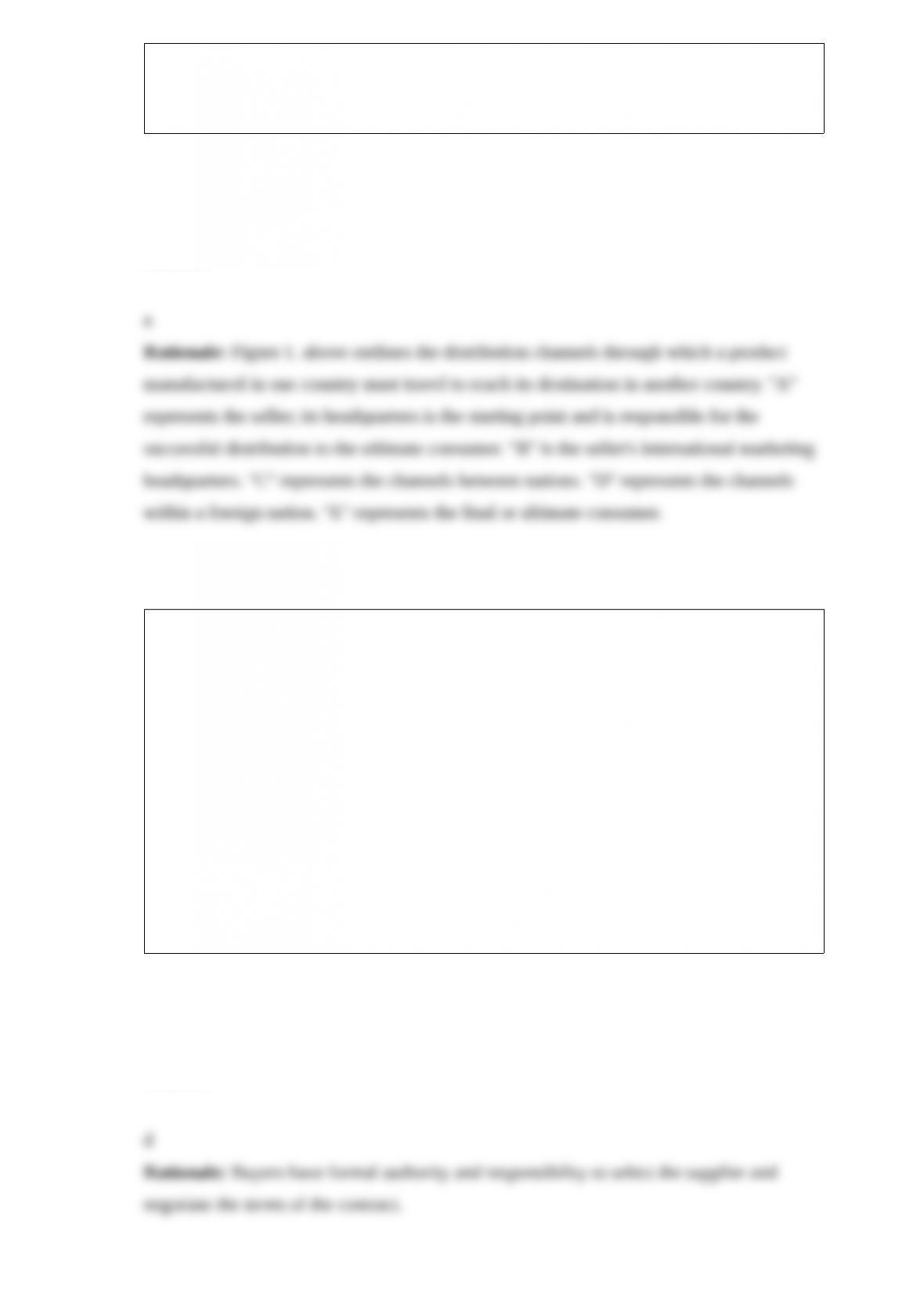
Figure 1.
Figure 1. above outlines the distribution channels through which a product
manufactured in one country must travel to reach its destination in another country. “A”
represents the
a. seller.
b. seller’s international marketing headquarters.
c. channels between nations.
d. channels within the foreign nation.
e. final customer.
Answer:
The purchasing manager of Ingram Printing has selected HP as the supplier of its new
high-speed printer and negotiated the terms of the contract. The purchasing manager is
the __________ for Ingram.
a. user
b. gatekeeper
c. influencer
d. buyer
e. decider
Answer:

Selecting one or more geographical locations from which the list price for products plus
freight expenses are charged to the buyer is referred to as __________.
a. FOB origin pricing
b. basing-point pricing
c. single-zone pricing
d. multiple-zone pricing
e. freight absorption pricing
Answer:
The third consideration in choosing a marketing channel is profitability, which is
determined by the margins earned for each channel member and for the channel as a
whole. Based on this information, which of the following statements would be most
accurate?
a. The more responsibilities a channel member takes in terms of distribution,
advertising, and selling expenses, the greater the potential for manufacturer
profitability.
b. The more responsibilities the manufacturer assumes relative to its channel members,
the greater the potential for profitability.
c. The extent to which channel members share costs determines the margins received by
each member and by the channel as a whole.
d. While channel members can increase profitability by taking on distribution and
selling expenses, advertising expenses should always remain with the manufacturer if a
firm is looking for the greatest profitability.
e. Profitability is not related to the length or nature of the distribution chain but

determined by the manufacturer.
Answer: