As the use of the Internet grows around the world, there must be as easy an exchange of
ideas and information as possible between countries. One important issue is opt-in
versus opt-out. In general, European websites have opt-in policies while U.S. websites
have opt-out policies. Opt-in means customers must ask to be involved in data
collection and marketing while opt-out companies automatically include customers in
data collection unless the customer specifically asks not to be included. Europeans
believe it is unethical to invade someone’s privacy. Americans are not nearly as
protective of their right to privacy. What ethical factor is illustrated by this example?
a. industry practices
b. social legislation
c. societal culture and norms
d. changes it international law
e. organizational culture and expectations
Answer:
GI Designs, a copper furniture manufacturer, increased the price on its copper table tops
by 20 percent for three months to see what the effect would be on their sales. The price
increase is the __________ in this three-month experiment.
a. “what-if”
b. dependent variable
c. independent variable
d. constraint
e. hypothesis
Answer:
Harris Interactive, a large U.S. research firm, has identified six distinct online consumer
lifestyle segments: (1) click-and mortar; (2) __________; (3) brand loyalists; (4)
time-sensitive materialists; (5) hooked, online and single; and (6) ebivalent newbies.
a. drifting surfers
b. desktop veterans
c. hunter-gatherers
d. media movers
e. digital collaborators
Answer:
Baby boomers can be defined as the generation of children born __________.
a. between 1918 and 1945
b. between 1946 and 1964
c. between 1965 and 1976
d. between 1977 and 1994
e. since 1995
Answer:
Three common forms of off-price retailers are
a. warehouse clubs, factory outlet stores, and hypermarkets.
b. warehouse clubs, factory outlets, and extreme value retailer.
c. factory outlets, single-price retailers, online auction services.
d. factory outlets, supercenters, hypermarkets.
e. extreme value retailers, buying clubs, online auction services.
Answer:
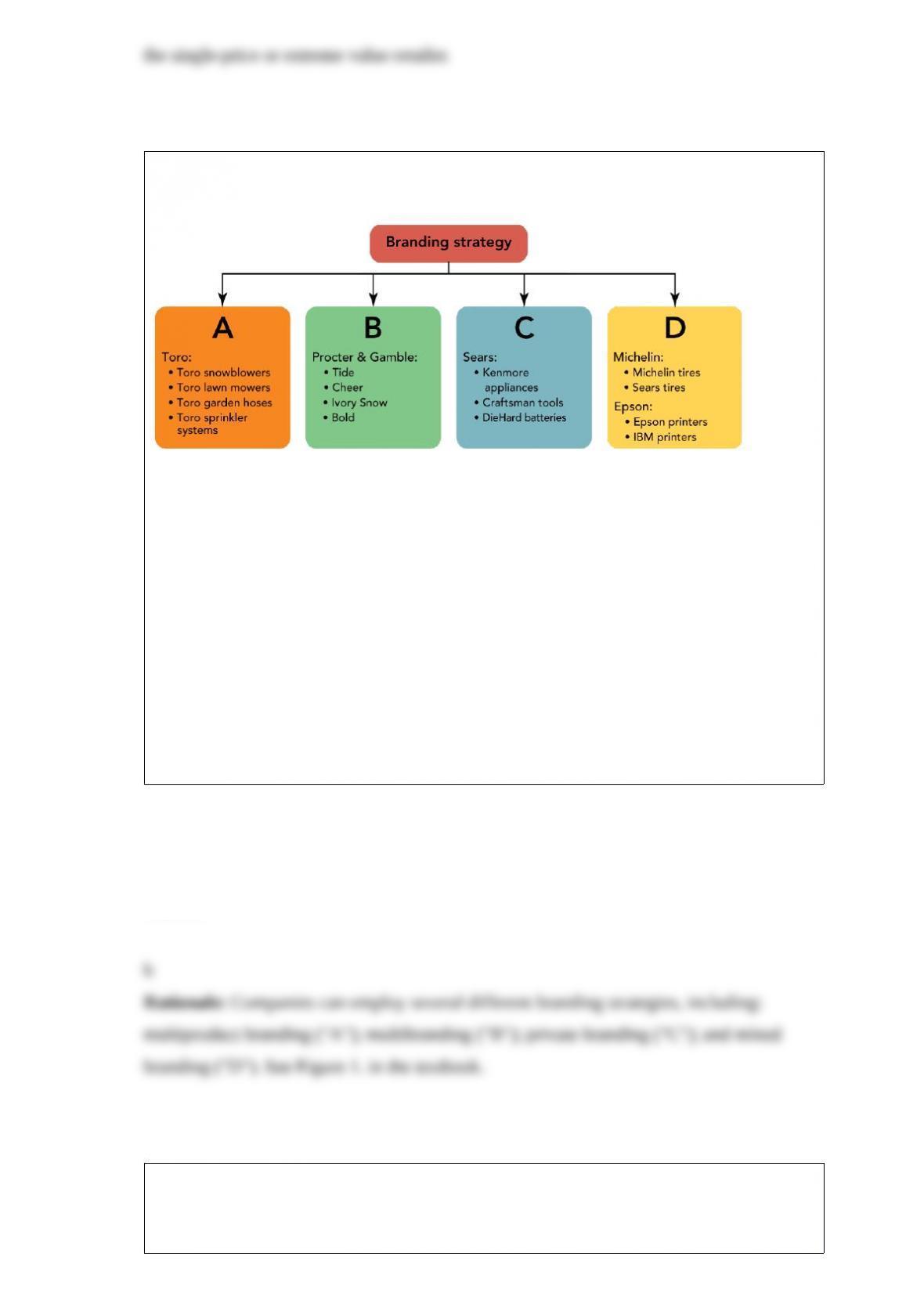
Figure 1.
Companies can employ several different branding strategies. In Figure 1. above, “A”
represents a __________ strategy.
a. retailer branding
b. multiproduct branding
c. multibranding
d. private branding
e. mixed branding
Answer:
Important product or service characteristics in organizational buying behavior include
which of the following?
a. A heavy emphasis is placed on quantity price discounts.
b. A heavy emphasis is placed on delivery time, technical assistance, and postsale
service.
c. Direct selling to organizational buyers is the rule.
d. Market sensitive pricing and sales incentives are used.
e. Online buying over the Internet is widespread.
Answer:
The money a consumer has left after paying taxes to use for necessities such as food,
shelter, clothing, and transportation is referred to as __________.
a. net income
b. disposable income
c. discretionary income
d. household income
e. gross income
Answer:
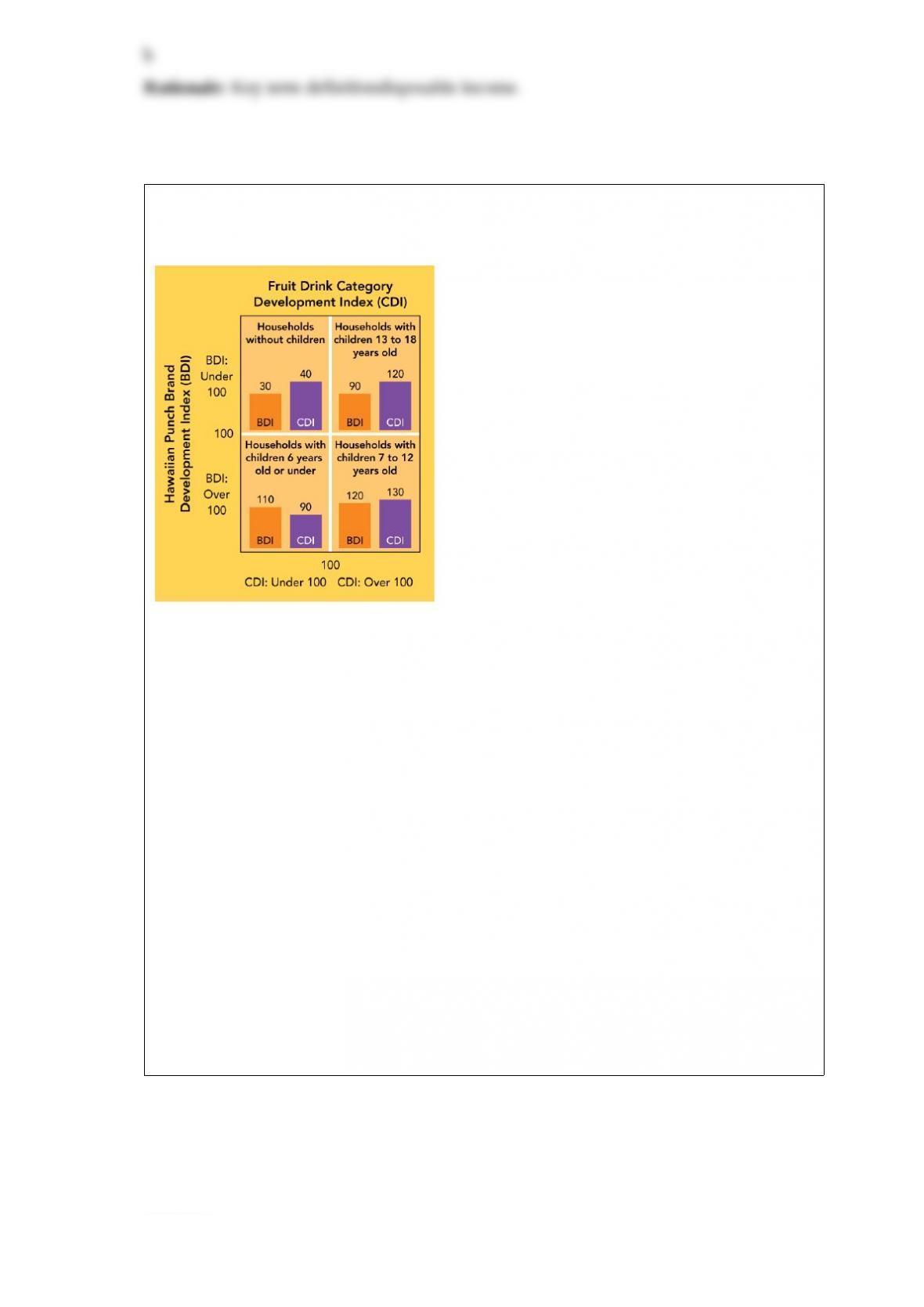
CDI/BDI Marketing Dashboard
As shown in the CDI/BDI marketing dashboard above, a BDI of 30 is determined by
__________.
a. finding the percent of the U.S. population in the “Households without children”
segment divided by the percent of Hawaiian Punch sold to households without children
in the U.S. multiplied by 100
b. finding the percent of Hawaiian Punch sold to households without children in the
U.S. divided by the percent of the U.S. population in the “Households without children”
segment multiplied by 100
c. subtracting the total number of non-users from the total number of users of Hawaiian
Punch sold to households without children
d. finding the difference in total sales of Hawaiian Punch between households who have
children with those who do not
e. using a chart provided in the category development index
Answer:
What pricing method is often used because of the difficulty in establishing a benchmark
of sales or investment to show how much of a firm’s effort is needed to achieve the
target?
a. target return-on-investment pricing
b. target return-on-sales pricing
c. standard markup pricing
d. target pricing
e. loss-leader pricing
Answer:
Logistical function activities include
a. buying and selling.
b. gathering, sorting, and dispersing products.
c. financing and grading.
d. risk taking.
e. marketing information and research.
Answer:
The objective and subjective attributes of a brand that consumers use to compare
different products and brands are referred to as
a. temporal states.
b. antecedent states.
c. information sources.
d. evaluative criteria.
e. the consideration set.
Answer:
Which of the following statements about global brands is most accurate?
a. A global brand is marketed under different names but uses identical ads for all
markets.
b. A global brand has centrally coordinated marketing programs.
c. A global brand alters the product formulation or service for each geographical region.
d. A global brand delivers multiple benefits based on the GDP of each country.
e. A global brand is a collaborative effort among several different national firms.
Answer:
Marketers recognize that people have an actual self-concept and __________.
a. a view of self determined by their peers
b. a view of self determined by their families
c. a perfect self-concept
d. an ideal self-concept
e. a flawed self-concept
Answer:
The second step in segmenting and targeting markets that link customer needs to
marketing actions is to
a. group potential buyers into segments.
b. develop a market-product grid and estimate size of the overall market.
c. select target markets.
d. take marketing actions to reach target markets.
e. group products to be sold into categories.
Answer:
Business marketing refers to
a. the marketing of goods and services to companies, governments, or ultimate
consumers for use in the creation of goods and services.
b. the marketing of goods and services to not-for-profit organizations at a reduced fee or
nominal cost for use in the creation of goods and services that they can produce and
market to others.
c. the marketing of goods and services to companies, governments, or not-for-profit
organizations for use in the creation of goods and services that they can produce and
market to others.
d. the marketing of services in the area of intellectual property such as legal, financial,
or creative consulting.
e. the marketing of an idea to create interest or generate goodwill, not just for an
individual brand but also for an entire industry or product class.
Answer:
There’s a new prescription drug on the market that helps reduce common allergy
symptoms. Ads for the medicine in magazines and in medical journals would be
primarily used to
a. remind customers that such a product exists.
b. increase the level of customer awareness for the product.
c. differentiate the product from all other allergy medications.
d. support a product penetration pricing strategy.
e. help in harvesting the product.
Answer:
The concept of the diffusion of innovation shows how a product “diffuses” or spreads
through the population over time. The consumer population is divided into five
categories of product adopters based on when they adopt (i.e., first buy) a new product.
Each product adopter category has a unique profile. Consumers who are deliberate
adopters with many informal social contacts are called __________.
a. innovators
b. early adopters
c. early majority
d. late majority
e. laggards
Answer:
Which of the following statements regarding warranties is most accurate?
a. Limited-coverage warranties are required for all manufactured products but not for
services.
b. Full warranties are required for all products and services regardless of the size of the
firm.
c. Warranties protect consumers but have limited benefits to producers.
d. Warranties benefit producers through enhanced reputations.
e. Warranties are relatively unimportant in light of product liability claims.
Answer:

If Ben & Jerry’s starts selling children’s clothing in Brazil to try to capitalize on its
brand name, this would be an example of __________.
a. product development.
b. product-market evolution.
c. market development.
d. market penetration.
e. diversification.
Answer:
The study of the aggregate flow of a nation’s goods and services to benefit society is
referred to as __________.
a. micromarketing
b. macromarketing
c. societal marketing
d. megamarketing
e. balance of trade
Answer:
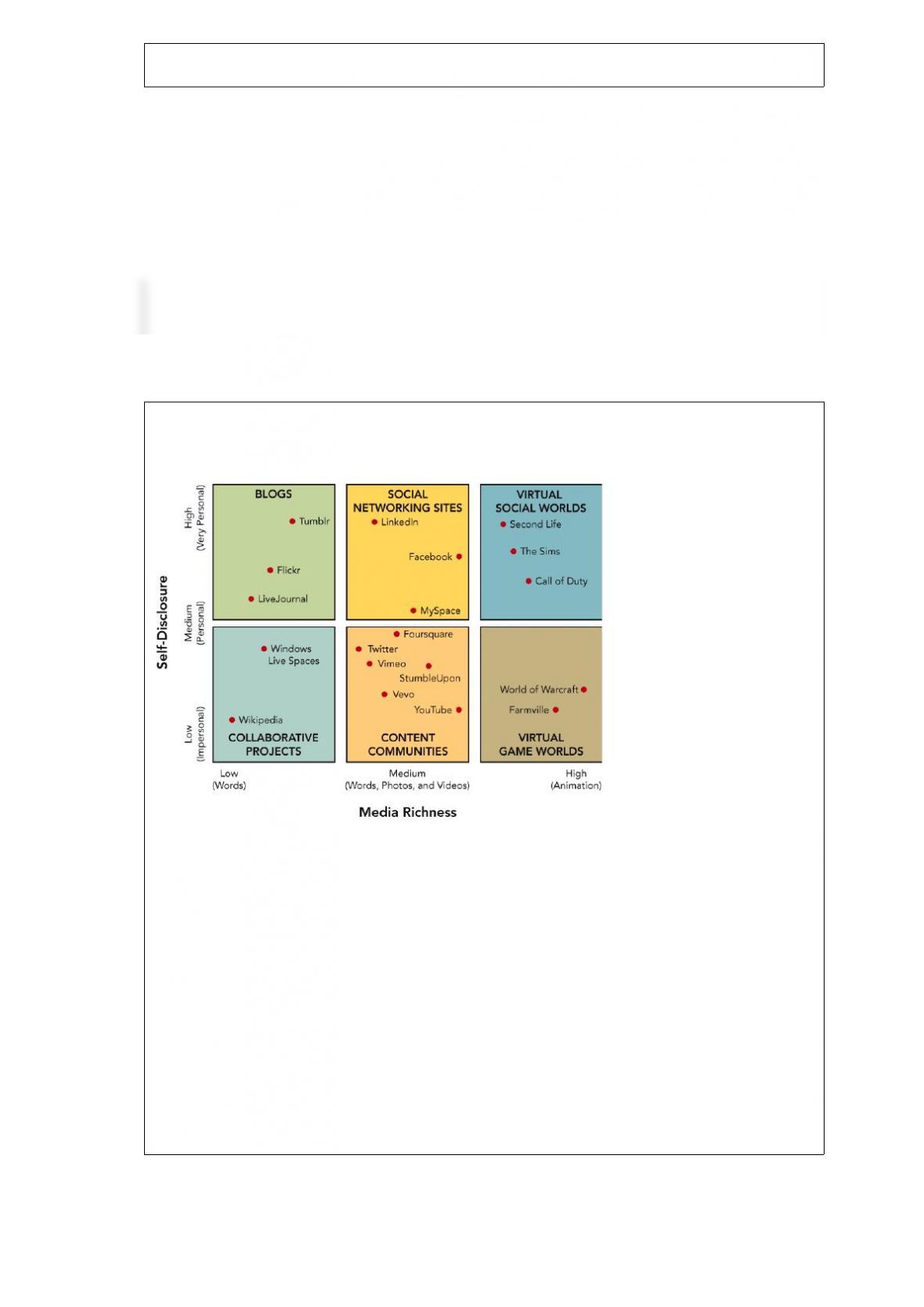
Figure 1.
Based on the social media identified in Figure 1. above, the social media site rated
highest in self-disclosure but lowest in media richness is
a. Facebook.
b. Tumblr.
c. Wikipedia.
d. Foursquare.
e. Farmville.
Answer:
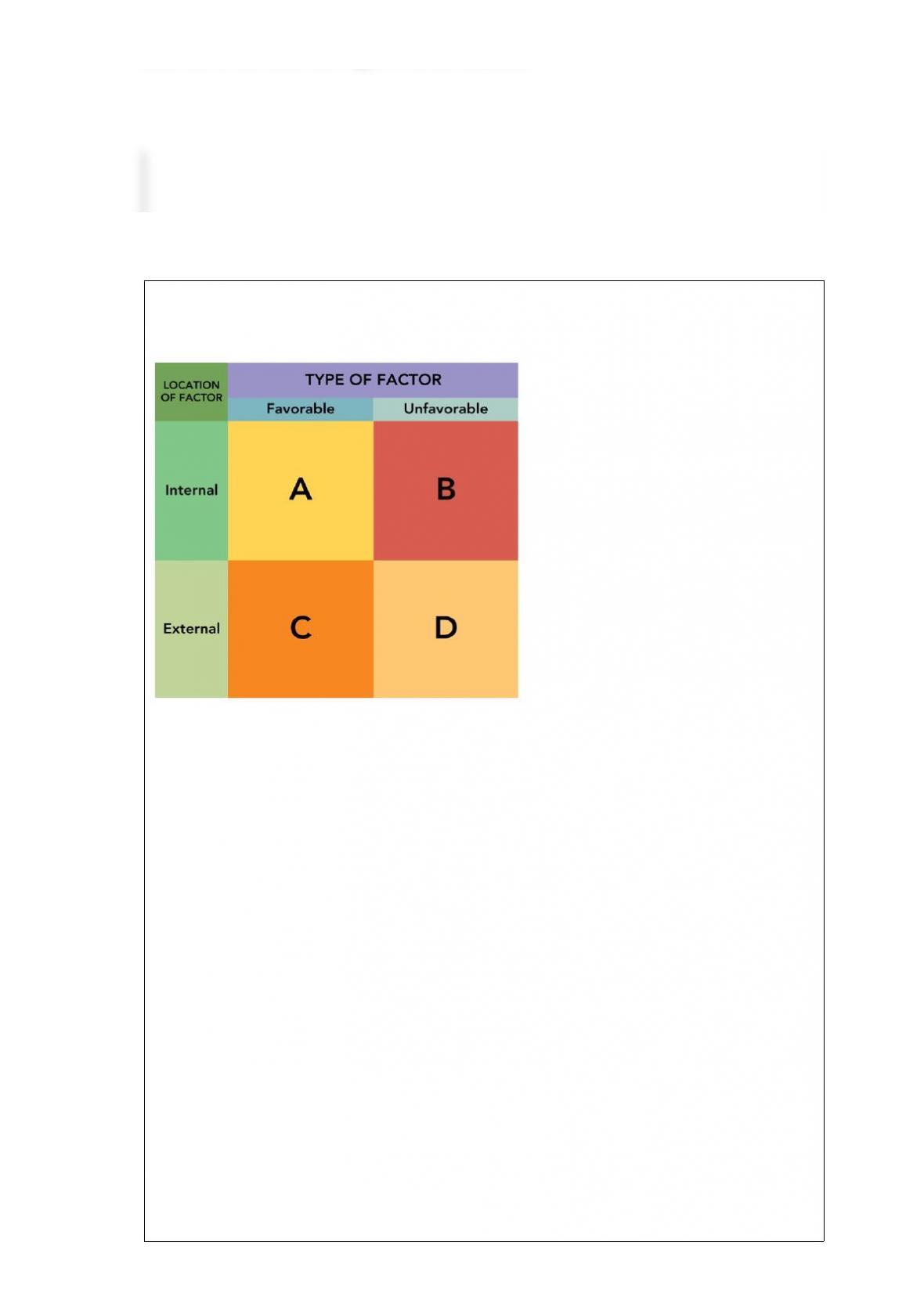
Figure 1.
Consider Figure 1. above. A Florida-based flashlight company has been extremely
successful due in part to the number of hurricanes in Florida that result in power
outages. The firm is thinking of expanding its product offerings to include other
emergency supplies such as generators and survival kits (consisting of food bars, a
water filtration system, first aid supplies, etc.). Before going ahead with this decision,
there were several factors that had to be taken into consideration: (1) The firm has a
great reputation with its flashlights and does not want to ruin it. (2) Its physical plant
could be refitted relatively easily to make small generators, but it would be rather
costly. (3) It would have to rely on another firm to manufacture and package the
survival kits. (4) Although there are nine named hurricanes scheduled for the upcoming
year, no one really can predict what will happen. The company’s need to refit its factory
would fall in which quadrant(s) of the SWOT analysis grid?
a. “A”
b. “B”
c. “C”
d. “D”

e. “A” and “D”
Answer:
When Tracy went to work as a new sales rep for Paradise Candles, she was told to use
the following speech in her sales presentations: “Hello, Mr./Ms. (customer name). My
name is (your name here). I”m calling on behalf of Paradise Candles. We carry the best
wax-burning mechanical candles available in the commercial decorating industry.”
Paradise instructed Tracy to use __________.
a. a formula selling presentation
b. a stimulus-response presentation
c. a needs-satisfaction presentation
d. suggestive selling
e. consultative selling
Answer:
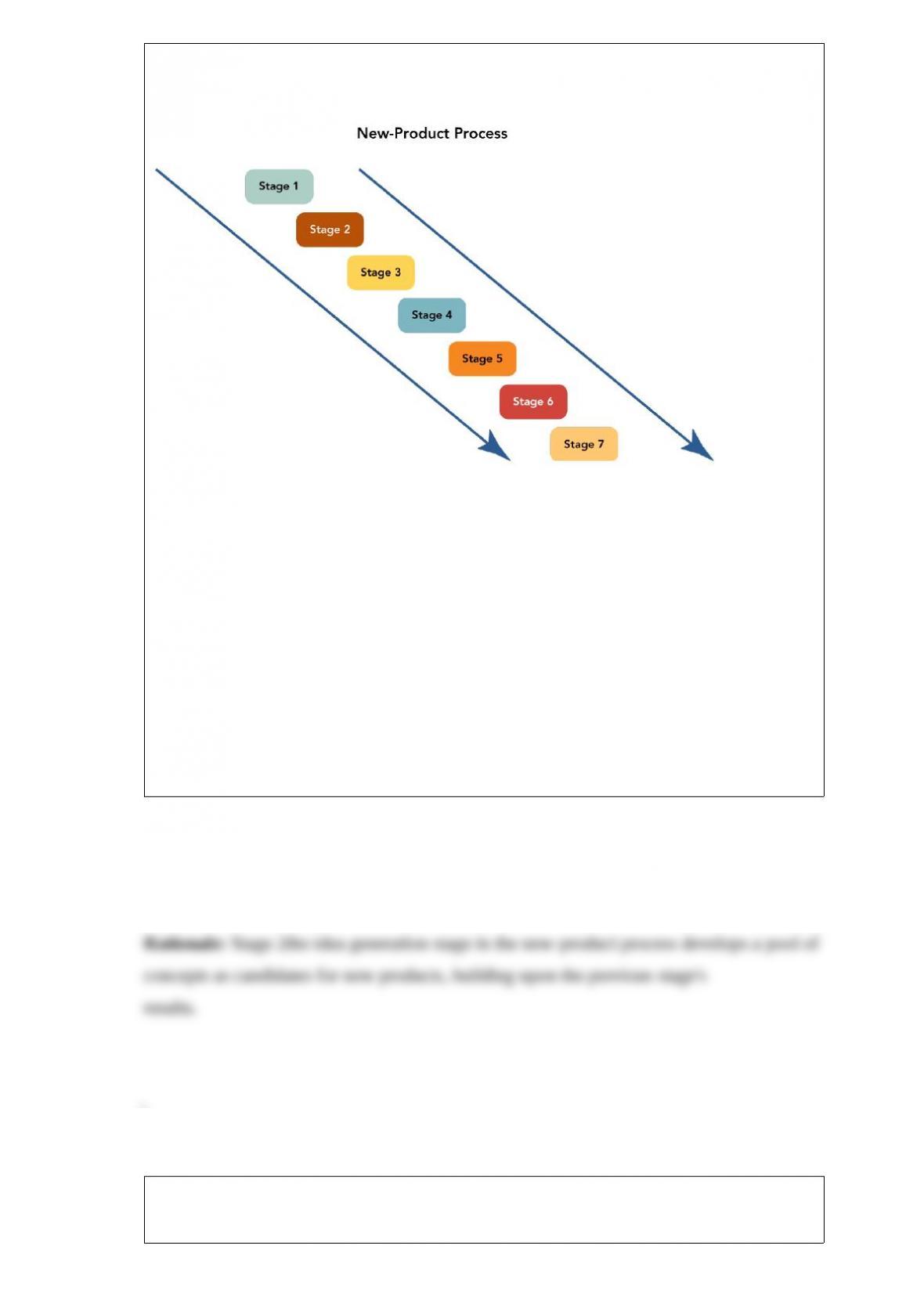
Figure 1.
Figure 1. above represents the seven stages of the new-product development process.
Stage 2 is the __________ stage.
a. idea generation
b. screening and evaluation
c. screening and analysis
d. new-product strategy development
e. product assessment
Answer:
Which of the following is the most important aspect conveyed by the FedEx brand?

a. its international experience
b. differentiation and an image of quality
c. the ownership of the company
d. the nonprofit aspect of the company
e. the patent for its service
Answer:
Two-thirds of the commercial transactions in Russia involve non-monetary forms of
payment. This is a function of the country’s __________.
a. capital infrastructure
b. political infrastructure
c. economic infrastructure
d. geopolitical network
e. financial exchange system
Answer:
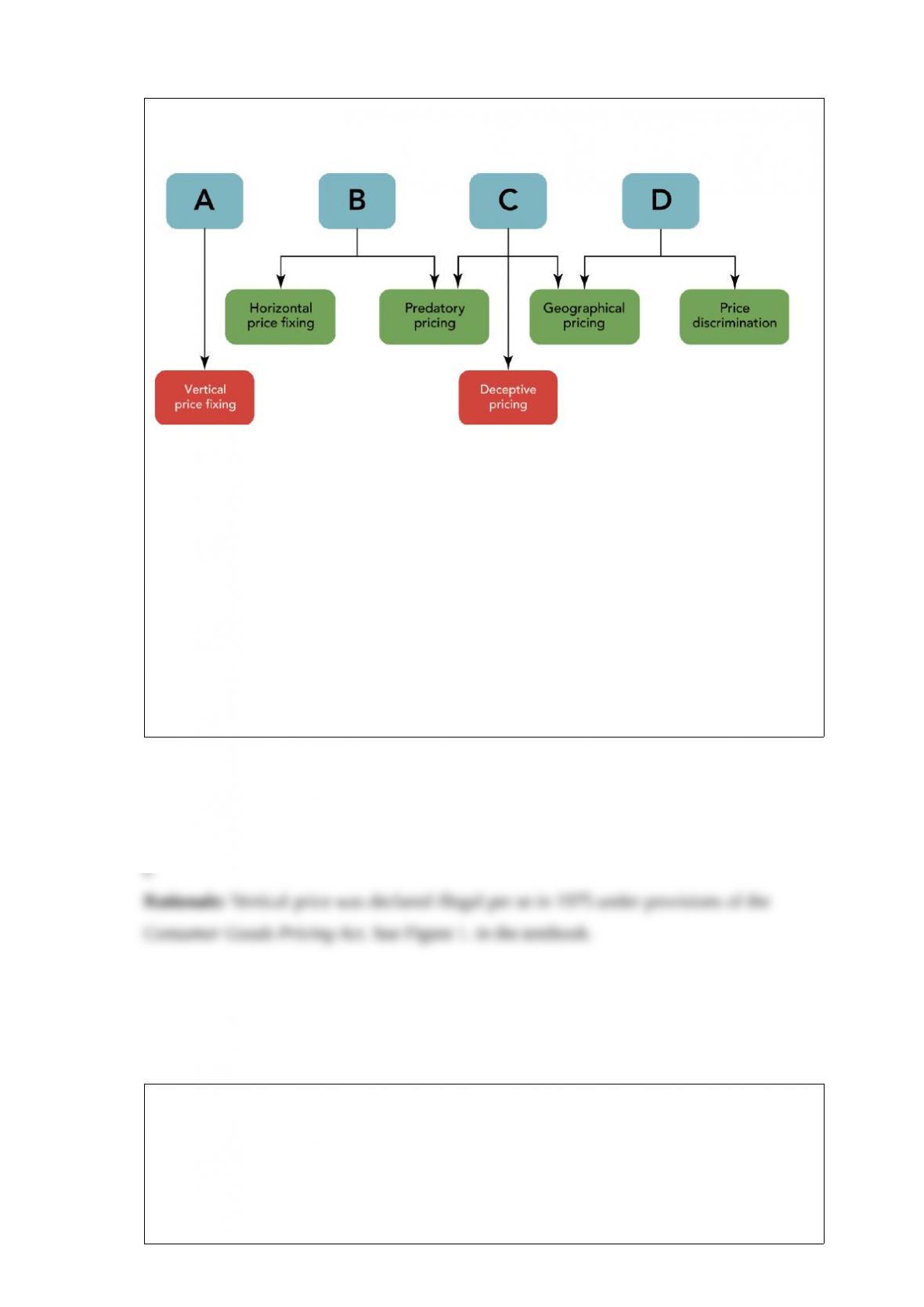
Figure 1.
Consider Figure 1. above. “A” represents which of the following legislative acts?
a. The Robinson-Patman Act
b. The Clayton Act
c. The Sherman Act
d. The Federal Trade Commission Act
e. The Consumer Goods Pricing Act
Answer:
Information in online databases consist of two categories: (1) indexes to articles in
periodicals, and (2) statistical or financial data on markets, products, and organizations.
These can be accessed either directly, via Internet search engines, or using
a. portals through keyword searches.

b. internal statistical data.
c. probability sampling data.
d. personal chat rooms.
e. social media like Facebook.
Answer:
Buy classes refer to three types of organizational buying situations, which are
a. buy, lease, and rent.
b. new buy, make-buy, and modified rebuy.
c. manufacturing contracts, consulting contracts, and service contracts.
d. new buy, straight rebuy, and modified rebuy.
e. new buy, internal make-buy, and modified rebuy.
Answer:

Among business products, support products are items used to assist in producing other
goods and services. These include installations such as
a. convenience products.
b. buildings and fixed equipment.
c. tools and office equipment.
d. raw materials and component parts.
e. maintenance, repair, and legal services.
Answer:
The strategy transnational firms employ that standardizes marketing activities when
there are cultural similarities and adapts them when cultures differ is referred to as a(n)
a. global marketing strategy.
b. integrated marketing strategy.
c. transnational marketing strategy.
d. meganational marketing strategy.
e. international marketing strategy.
Answer: