David Windorski, an inventor at 3M, questioned dozens of students about how they
study. They told him
a. to make sure new 3M products were available at mass merchandisers such as
Walmart.
b. that the average backpack was already too heavy to contain new 3M products.
c. it would be reasonable to combine Post-itFlags with a highlighter.
d. to develop similar study aid products offered by other office product competitors.
e. it would be NOT be reasonable to combine Post-itNotes with a ball point pen.
Answer:
Market share refers to
a. the ratio of the profit of the firm to the total profits of all firms in the industry,
excluding the firm itself.
b. the ratio of the profit of the firm to the total profits of all firms in the industry,
including the firm itself.
c. the ratio of sales revenue of the firm to the total sales revenue of all firms in the
industry, excluding the firm itself.
d. the ratio of sales revenue of the firm to the total sales revenue of all firms in the
industry, including the firm itself.
e. the ratio of the profits of all firms in an industry to the profits of the firm.

Answer:
Points of difference refer to
a. the fundamental, passionate, and enduring principles of an organization that guide its
conduct over time.
b. the cluster of benefits that an organization promises customers to satisfy their needs.
c. a unique strength relative to competitors that provides superior returns, often based
on quality, time, cost, or innovation.
d. those characteristics of a product that make it superior to competitive substitutes.
e. the use of percentage points of market share to allocate marketing resources
effectively for different product lines within the same firm.
Answer:
High-involvement purchases typically have which of the following sets of
characteristics?
a. The item is inexpensive, can have serious personal consequences, or could reflect on
one’s social image.
b. The item is inexpensive, has no serious personal consequences, but could reflect on
one’s social image.
c. The item is expensive, has no serious personal consequences, but could reflect on
one’s social image.
d. The item is expensive, can have serious personal consequences, or could reflect on
one’s social image.
e. The item is inexpensive, has no serious personal consequences, and would not reflect
on one’s social image.
Answer:
The increased customer value achieved through performing R&D-manufacturing
functions more efficiently is referred to as __________.
a. points of difference
b. proficiency
c. synergy
d. kiatsu
e. competitive advantage
Answer:
The difference between a brand name and a trade name is that __________.
a. brand names are legally registered and trade names are not
b. a trade name is the name under which a company does business
c. a brand name is only the word that is spoken to distinguish a seller’s goods or
services but a trade name consists of both the spoken and unspoken word(s) and
mark(s) that distinguishes a seller’s goods or services
d. a brand name can cover an array of company product items while a trade name can
only apply to a single SKU for a product item
e. trade names are protected by law but brand names are not
Answer:
The proper blend of elements in the promotion mix depends on a product’s
characteristics. Personal selling would most likely be used to sell __________.
a. dog dandruff shampoo
b. an aircraft
c. fresh produce
d. a bottle of soda
e. printer paper
Answer:
When most consumers who would buy a product are either repeat purchasers of the
item or have tried and abandoned it, what stage of the product life cycle is the product
in?
a. introduction
b. growth
c. maturity
d. decline
e. harvest
Answer:
The Trademark Law Revision Act (1988) addresses the right of a company to
a. sell to the highest bidder a trademark that has expired or been retired.
b. incorporate an unlimited number of new products under the same trademark.
c. secure rights to a name before the product is even in use.
d. alter its trademark in terms of color, design, or slogan without having to reapply for a
new trademark.
e. protects U.S. trademark rights throughout the world.
Answer:
A publishing company sponsors an informal one-time-only session with seven college
instructors who use a given principles of management textbook. The instructors meet
with a moderator who asks their opinions about the textbook, its study guide, and its
PowerPoint slides. This is an example of a(n)
a. jury of executive opinion.
b. consumer panel.
c. information forum.
d. focus group.
e. depth interview.
Answer:

A contractual agreement whereby one company (licensor) allows its brand name or
trademark to be used with products or services offered by another company (licensee)
for a royalty or fee is referred to as __________.
a. co-branding
b. generic branding
c. reseller licensing
d. mixed branding
e. brand licensing
Answer:
Figure 1.
The brand manager of Nikon’s newest camera product has decided create a video for an
advertising campaign to be presented to a narrow, sophistical target market on one of
the social networks. The best social network to reach his target audience of professional
photographers is
a. YouTube.
b. LinkedIn
c. Facebook.
d. Vimeo.
e. Instagram.
Answer:
A skimming pricing policy is likely to be most effective when: (1) enough customers
are willing to buy immediately at the high initial price; (2) lowering the price has only a
minor effect on increasing sales volume and reducing unit costs; (3) when the initial
high prices do not attract competitors; and (4) __________.
a. consumers perceive your product to be similar to other products on the market
b. a lower price will significantly reduce unit costs
c. when customers interpret the high price as signifying high quality
d. consumers tend to be price sensitive
e. it will be easier to set measurable sales unit goals
Answer:
Companies that successfully employ permission marketing adhere to three rules: (1)
opt-in customers only receive information that is relevant or meaningful to them; (2)
customers are given the option of opting out, or changing the kind, amount, or timing of
information sent to them; and (3) __________.
a. their customers are assured that their name or buyer profile data will not be sold or
shared with others
b. customers will receive a full 100 percent satisfaction guarantee of product quality
and performance for any product purchased online
c. customers will be guaranteed up to $1 million dollars in identity theft protection for
any product purchased online
d. opt-in customers will be guaranteed the lowest possible price for an item
e. customers will receive information on-line before that information is available to
customers at retail outlets
Answer:
The four major types of limited-service merchant wholesalers are rack jobbers, cash and
carry wholesalers, truck jobbers, and _________.
a. machine vendors
b. credit line wholesalers
c. drop shippers
d. transport vendors
e. container transport vendors
Answer:

What is a reason users have “unliked” a brand’s Facebook Page?
a. The brand ceases to be popular and users move on to a new brand’s Facebook Page.
b. The brand posts too frequently on trivial or controversial topics.
c. Users tire of not being able to contribute to the conversation.
d. Users want to protest the presence of advertisements on Facebook.
e. The Page isn”t updated and users lose interest.
Answer:
Companies use a “__________” to assess whether its products and brands are above, at,
or below the market.
a. customary price
b. prestige price
c. price premium
d. price lining
e. benchmark
Answer:
A new company projects that its sales will exceed its expenses within the first year of
operation. This is an example of which type of goal?
a. dollar sales revenue
b. profit
c. market share
d. unit sales
e. quality
Answer:
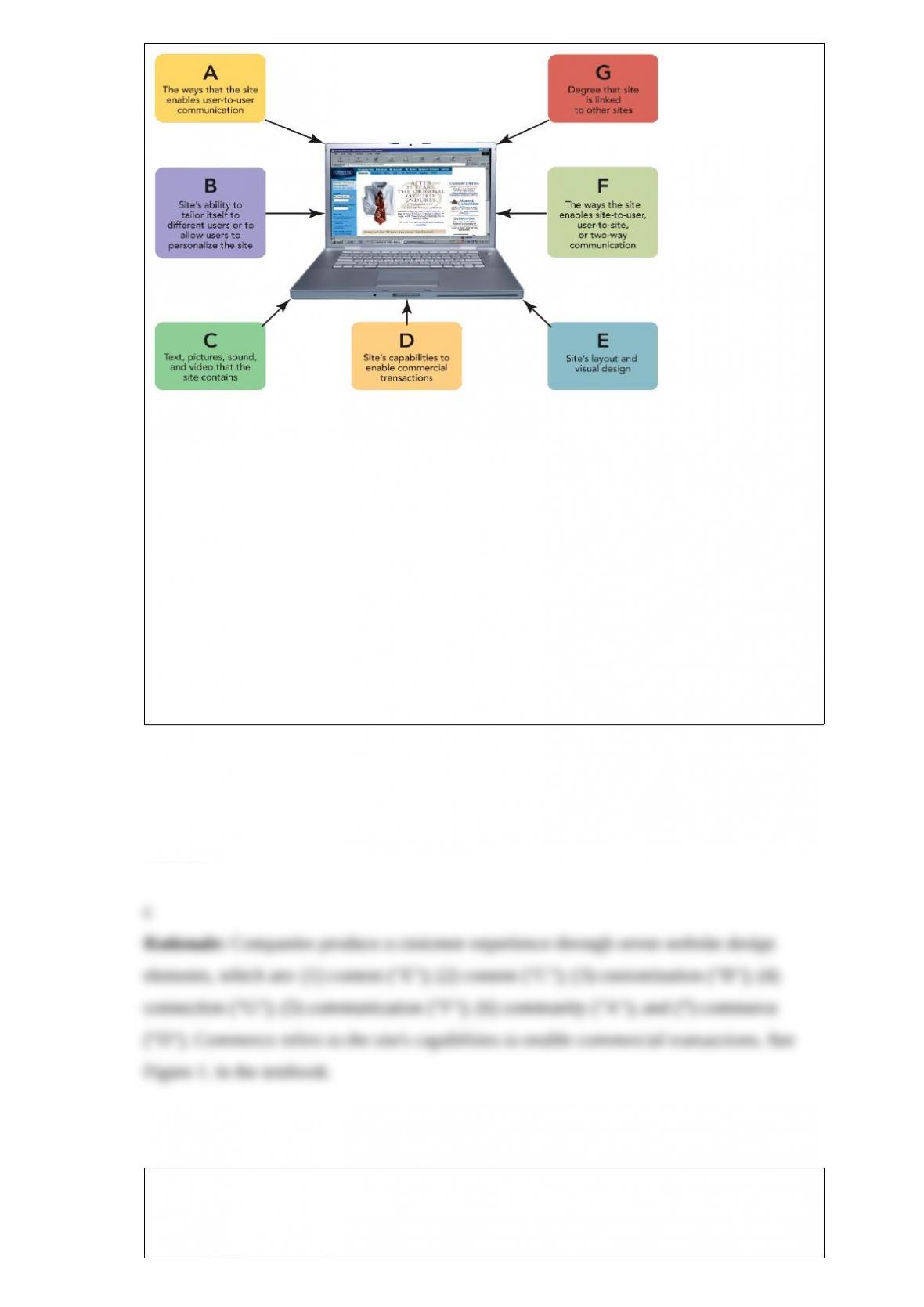
Figure 1.
Consider Figure 1. above. “D” refers to which of the following website design
elements?
a. context
b. content
c. commerce
d. customization
e. connection
Answer:
Which of the following statements about price elasticity of demand is most accurate?
a. Price elasticity with unitary demand is less than 1.
b. The more substitutes a product has, the less likely it is to be price elastic.
c. Unitary demand represents the relationship between the cash outlay necessary to
purchase a product relative to a person’s disposable income.
d. With inelastic demand, reducing price will result in a decrease of total revenue.
e. With inelastic demand, reducing price will result in an increase in total revenue,
although not necessarily an increase in profit.
Answer:
Sporting News Baseball Yearbook Covers
The Sporting News Baseball Yearbook uses 16 different covers featuring a baseball star
from each of its regions in the United States. Four covers are shown above. This is an
example of a(n)
a. sporting interest”based segmentation.
b. segmenting organizational markets.
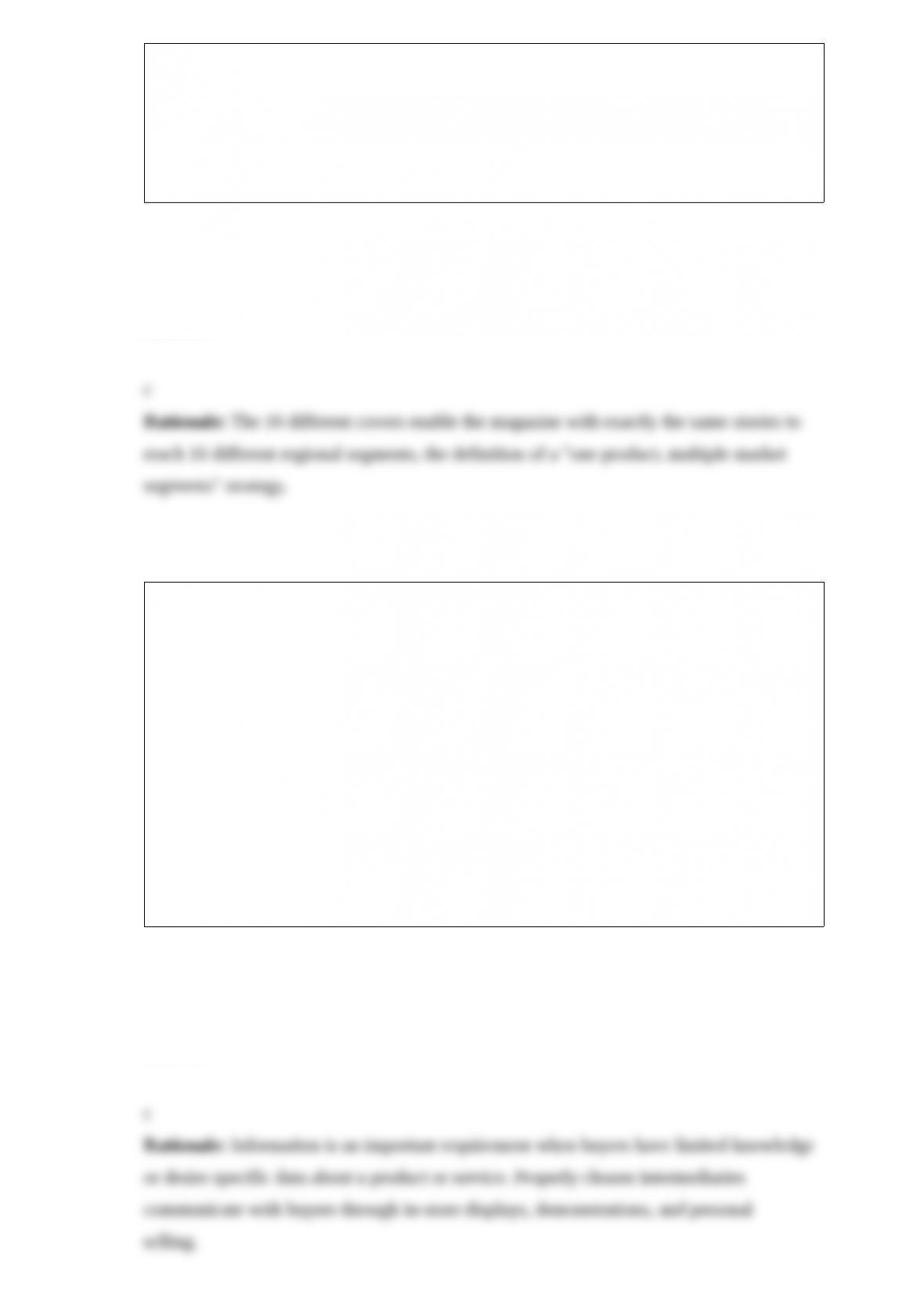
c. one product and multiple market segments.
d. multiple products and multiple market segments.
e. segments of one or mass customization.
Answer:
The most important consideration in choosing a marketing channel when buyers have
limited knowledge or desire specific data about a product or service is to provide
__________.
a. postsale services
b. seller adaptability
c. information
d. convenience
e. presale services
Answer:

Organizational culture refers to
a. the personal moral and ethical codes of ethics of its top management.
b. a written mission statement expressing its goals and objectives.
c. the fundamental, passionate, and enduring principles that guide its conduct over time.
d. the ethos of an organization including the core values of its management.
e. a set of values, ideas, attitudes, and norms of behavior that is learned and shared
among the members of an organization.
Answer:
Which of the following is an example of a product in the maturity stage of the product
life cycle?
a. pocket video cameras
b. hybrid vehicles
c. 3D HDTVs
d. soft drinks
e. tablet devices
Answer:

Synergy analysis refers to
a. identifying a company’s potential strengths, weaknesses, opportunities, and threats.
b. relating the expense of marketing effort to the marketing results obtained.
c. using percentage points of market share as the common basis of comparison to
allocate marketing resources effectively for different product lines within the same firm.
d. using a framework to relate the market segments of potential buyers to products
offered or potential marketing actions by an organization.
e. seeking opportunities by finding the optimum balance between marketing efficiencies
versus R&D-manufacturing efficiencies.
Answer:
The three steps used in choosing a supply chain include: (1) understand the customer;
(2) understand the supply chain; and (3) __________.
a. understand the environment
b. harmonize the supply chain with the marketing strategy
c. understand the marketing strategy
d. understand the logistics
e. understand the company’s goals
Answer:
Which generation (1) feels passionate about the environment and (2) is optimistic about
the future?
a. Generation X
b. baby boomers
c. Generation Y
d. baby busters
e. Generation Z
Answer:
Safeway displays the thousands of items it sells in aisles containing related items or
product groupings. Examples would be the pet food aisle or the soft drink aisle. Why
would Safeway display product groupings in this manner?
a. The groupings increase the number of market-product combinations on the
market-product grid, which makes it a more manageable framework for subsequent
analysis.

b. This form of product groupings makes it easier for customers to get in and out of the
store more quickly, creating time utility.
c. The products are grouped so people can relate to them in a more meaningful way
when they shop.
d. Product groupings can be generated quantitatively to show which adhere to the 80/20
rule.
e. Individual suppliers get preferential treatment based upon the number of different
UPCs they provide in a given store.
Answer:
Advertisements that focus on selling a product or service and take three
formspioneering (or informational), competitive (or persuasive), and reminderare
referred to as
a. product advertisements.
b. service advertisements.
c. persuasive advertisements.
d. institutional advertisements.
e. cooperative advertisements.
Answer:
Which of the following steps in the objective and task approach to promotion budgeting
must be done correctly in order for any of the others to have the proper effect?
a. accurately estimate costs of tasks
b. identify appropriate promotion objectives
c. accurately identify each promotion budget cost item that constitutes each separate
promotion task
d. perform the promotion tasks as intended
e. accurately estimate what tasks will accomplish each promotion objective
Answer: