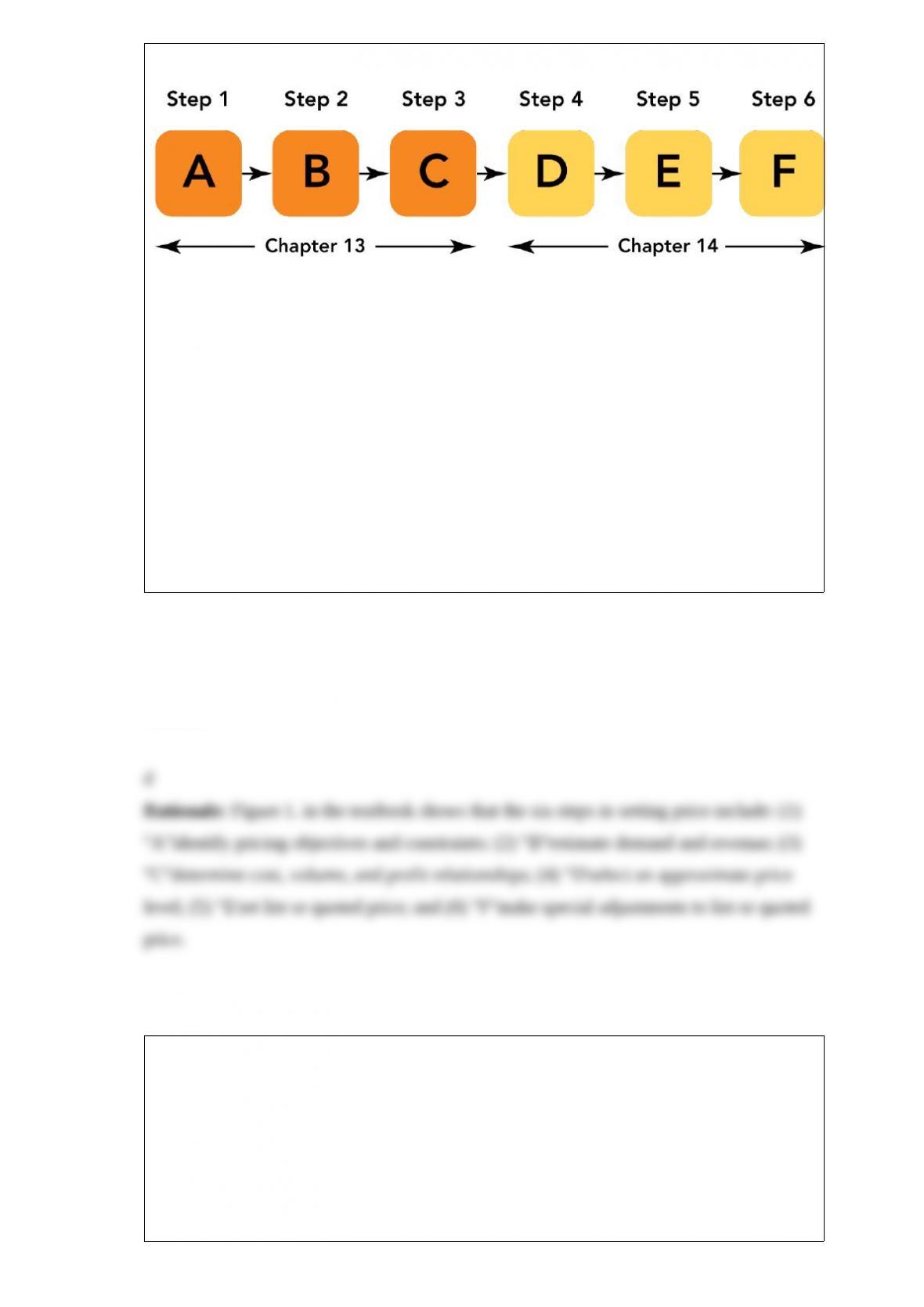
Figure 1.
Figure 1. above represents the six steps in setting price. “C” represents the step at which
a firm would
a. estimate demand and revenue.
b. identify pricing objectives and constraints.
c. scan competitors for prices of similar products or services.
d. determine cost, volume, and profit relationships.
e. establish the price range.
Answer:
The stage of the new-product process that exposes actual products to prospective
consumers under realistic purchase conditions to see if they will buy is referred to as
a. development.
b. market testing.
c. business analysis.
d. commercialization.
e. screening and evaluation.
Answer:
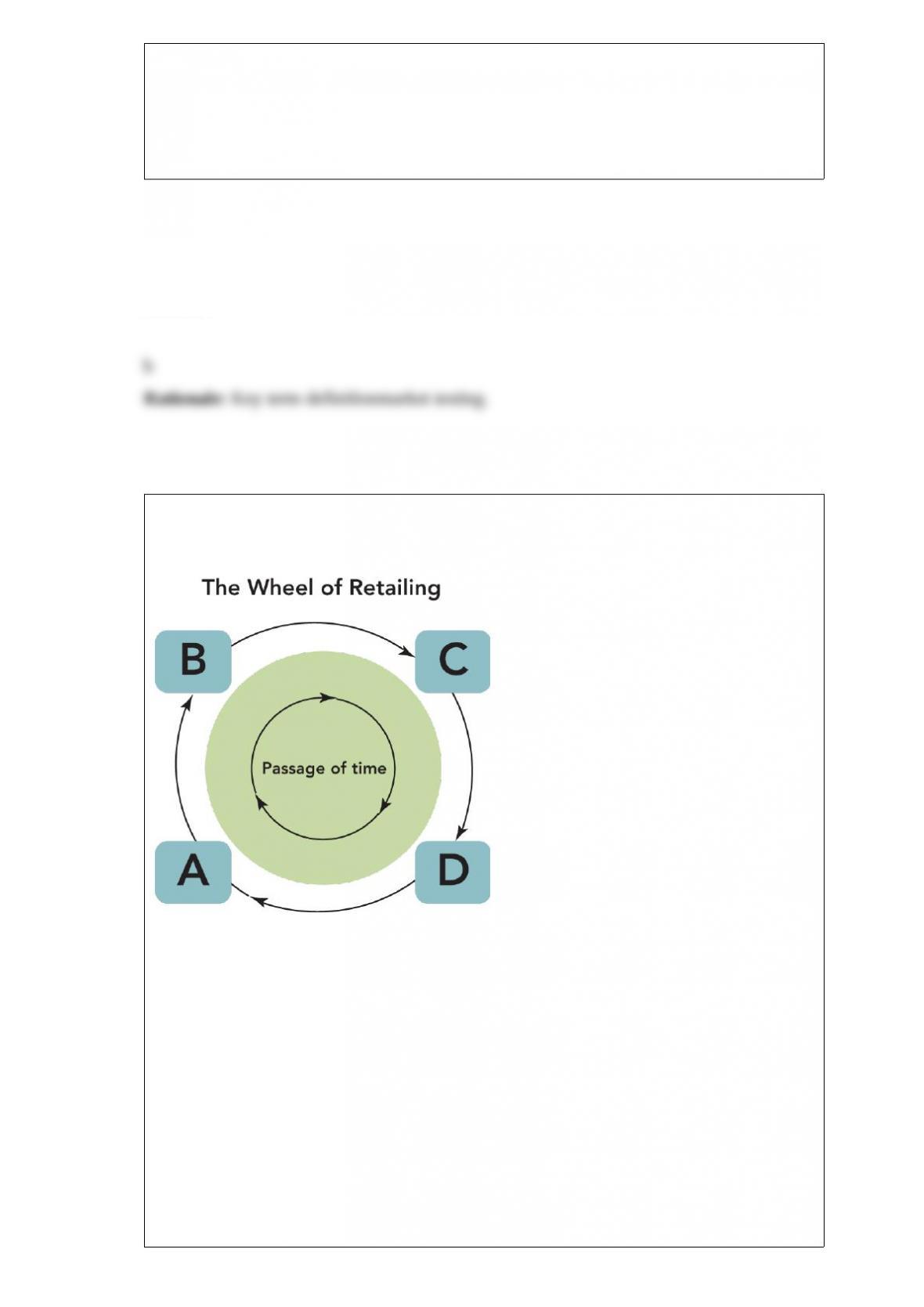
Figure 1.
Figure 1. above shows the wheel of retailing, which indicates that retail outlets typically
go through changes with the passage of time. What stage in the wheel of retailing does
“B” represent?
a. low prices, low margins, low status.
b. higher prices, higher margins, and higher status.
c. low prices, high margins, and high status.
d. mixed prices, mixed margins, and mixed status.

e. moderate prices, high margins, and high status.
Answer:
Consumers have more difficulty evaluating services than they do products; the
difficulty results from the
a. intangibility of services.
b. incongruity of services.
c. inseparability of services.
d. inflexibility of services.
e. interdependence of services.
Answer:
With the rise of electronic music keyboards, the United States is overrun with unwanted
pianos. A craftsman decided that old pianos were the perfect height for computer desks.
The computer keyboard can be placed where the piano keys once were. He sells his

converted pianos for about $1,500. Go to PianoDesk.com if you are interested in this
unusual __________ effort.
a. reapplied engineering
b. post innovation
c. recycling
d. postcycling
e. precycling
Answer:
A message is conveyed by means of a(n) __________ such as a salesperson, advertising
media, or public relations tools.
a. vehicle
b. channel of communication
c. field of experience
d. direct feedback loop
e. information highway
Answer:

In marketing, the philosophical reason for a firm’s existence is referred to as its
organizational __________.
a. strategy
b. direction
c. foundation
d. goal
e. business
Answer:
A sales plan refers to a __________.
a. method of determining a fair and equitable compensation plan
b. method of identifying the target markets that most closely meet the special skills of
the salesforce
c. method for determining the size of a salesforce that integrates the number of
customers served, call frequency, call length, and available selling time to arrive at a
salesforce size figure
d. statement describing what is to be achieved and where and how the selling effort of
salespeople is to be deployed

e. method that specifies times and places for direct communications between
salespeople and their supervisors
Answer:
Jay Bloom’s Pet Assure, a national pet health-care provider network based in Dover,
N.J., recently took advantage of a rival’s navet. When a West Coast provider of
catastrophic pet coverage “preannounced” the addition of a wellness component (Pet
Assure’s specialty) in an interview with a tiny community newsweekly six months prior
to launching it, Bloom was notified immediately through a web-based news monitoring
service. This not only gave him time to add catastrophic benefits to one of his own
wellness products, but also enabled him to get his offering to the market first. Jay
Bloom relied on __________ to keep him abreast of his competitors’ activities.
a. legal environmental scanning
b. economic espionage
c. the use of kickbacks
d. corporate piracy
e. primary market research
Answer:

Sampling and statistical inference are known as special __________, which are vital in
marketing research to solve all or part of a problem.
a. systems
b. styles
c. methods
d. manners
e. modes
Answer:
Customer experience refers to
a. the practice of building ties to customers based on a salesperson’s attention and
commitment to customer needs over time.
b. the links an organization has to its customers for their mutual long-term benefits.
c. the process of identifying prospective buyers, understanding them intimately, and
developing favorable long-term perceptions of the organization and its offerings so that
buyers will choose them in the marketplace.
d. the internal response that customers have to all aspects of an organization and its
offerings.

e. the activities in which a firm will participate in order to create a positive buying
experience for the customer.
Answer:
Small businesses make up the majority of the competitive landscape for most
businesses. There are approximately __________ small businesses in the United States.
a. 17 million
b. 27 million
c. 37 million
d. 50 million
e. 100 million
Answer:
A unique strength relative to competitors that provides superior returns, often based on
quality, time, cost, or innovation, is referred to as a

a. creative advantage.
b. marketing edge.
c. distinctive competency.
d. competitive advantage.
e. core benefit.
Answer:
The information needed for the implementation phase of the strategic marketing process
includes: (1) __________, (2) organizational charts, and (3) marketing research.
a. action memos with deadlines and Gantt charts
b. positioning studies
c. market-product grids with target segments and product groupings
d. detailed plans to execute the marketing program
e. projected future sales, expenses, and profits
Answer:

All of the following are idea evaluation methods EXCEPT:
a. a mail survey
b. an online survey
c. a focus group
d. a telephone survey
e. an e-mail survey
Answer:
Geographical adjustments are made by manufacturers or wholesalers to reflect
a. production costs.
b. administrative costs.
c. selling costs.
d. promotional costs.
e. transportation costs.
Answer:
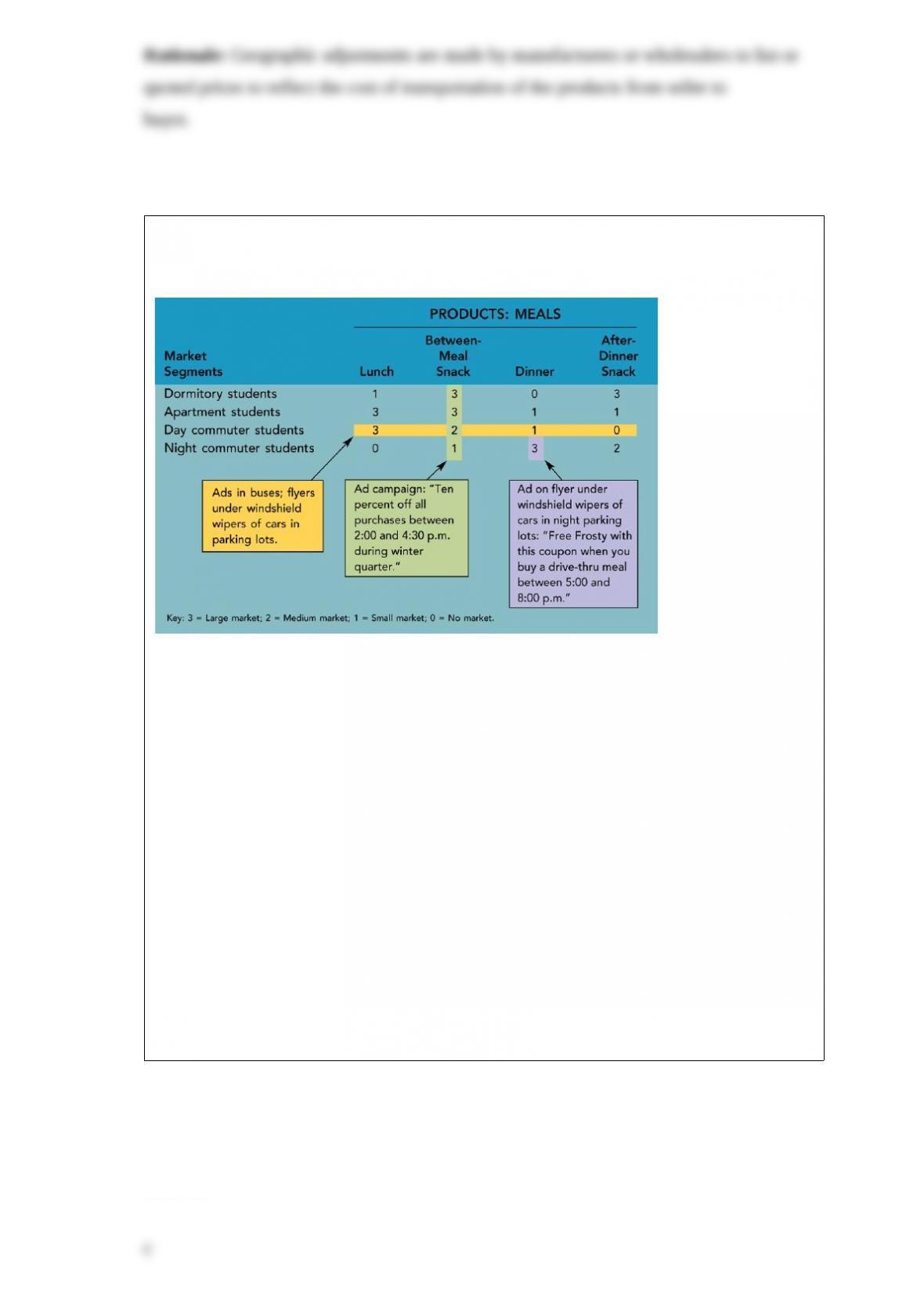
Figure 1.
Figure 1. above shows the market-product grid for a Wendy’s restaurant next to a large
urban university campus after you”ve chosen the market segments to target and the
product groupings to offer based on the market size estimates. The next step is to
develop a simple marketing action to reach a target market. Sending out coupons for
“10 percent off all purchases between 2:00 PM and 4:30 PM” during the winter quarter
would target potential
a. dormitory customers.
b. night commuter customers.
c. between-meal snack customers.
d. after-dinner snack customers.
e. apartment customers.
Answer:

Which of the following statements concerning evaluative criteria is most accurate?
a. If the alternatives in a consideration set don”t really satisfy them, people are not
willing to continue the information search.
b. Consumers often have several criteria for evaluating products.
c. Evaluative criteria represent objective rather than subjective attributes.
d. Evaluative criteria represent subjective rather than objective attributes.
e. Ultimately, the most important evaluative criterion is price.
Answer:
When strolling through the grocery store, a toddler tells her mother, “I don”t like
carrots.” Her mother puts down the carrots and chooses string beans instead. The role of
the little girl in this purchase was that of __________.
a. information gatherer
b. influencer
c. purchaser
d. decision maker

e. user
Answer:
A product
a. consists of the benefits or customer value received by its sellers.
b. is the cluster of benefits that an organization promises customers to satisfy their
needs.
c. is a good, service, or idea consisting of a bundle of tangible and intangible attributes
that satisfies consumers’ needs and is received in exchange for money or something else
of value.
d. consists of items that the consumer purchases frequently, conveniently, and with a
minimum of shopping effort.
e. is the set of intangible activities or benefits that an organization provides to satisfy
consumers’ needs in exchange for money or something else of value.
Answer:

NetJets is a company that offers 1/16 or more ownership in a jet plane for a price
beginning at $325,000. It gives purchasers privacy, convenience, and flexibility as well
as saves them time since the plane is available within four hours unless it’s booked by
one of the other shareholders. This is MOST LIKELY an example of
a. a high-involvement purchase that involves limited problem solving.
b. a high-involvement purchase that involves routine problem solving.
c. a high-involvement purchase that involves extended problem solving.
d. a low-involvement purchase that involves limited problem solving.
e. a low-involvement purchase that involves extended problem solving.
Answer:
Prior to its production, Fisher-Price managers developed a(n) __________ for the
Chatter Telephone that involved adding a noisemaker, wheels, and eyes to the basic
telephone.
a. virtual concept
b. product substitute
c. product hypothesis
d. new-product concept
e. new-feature matrix
Answer:
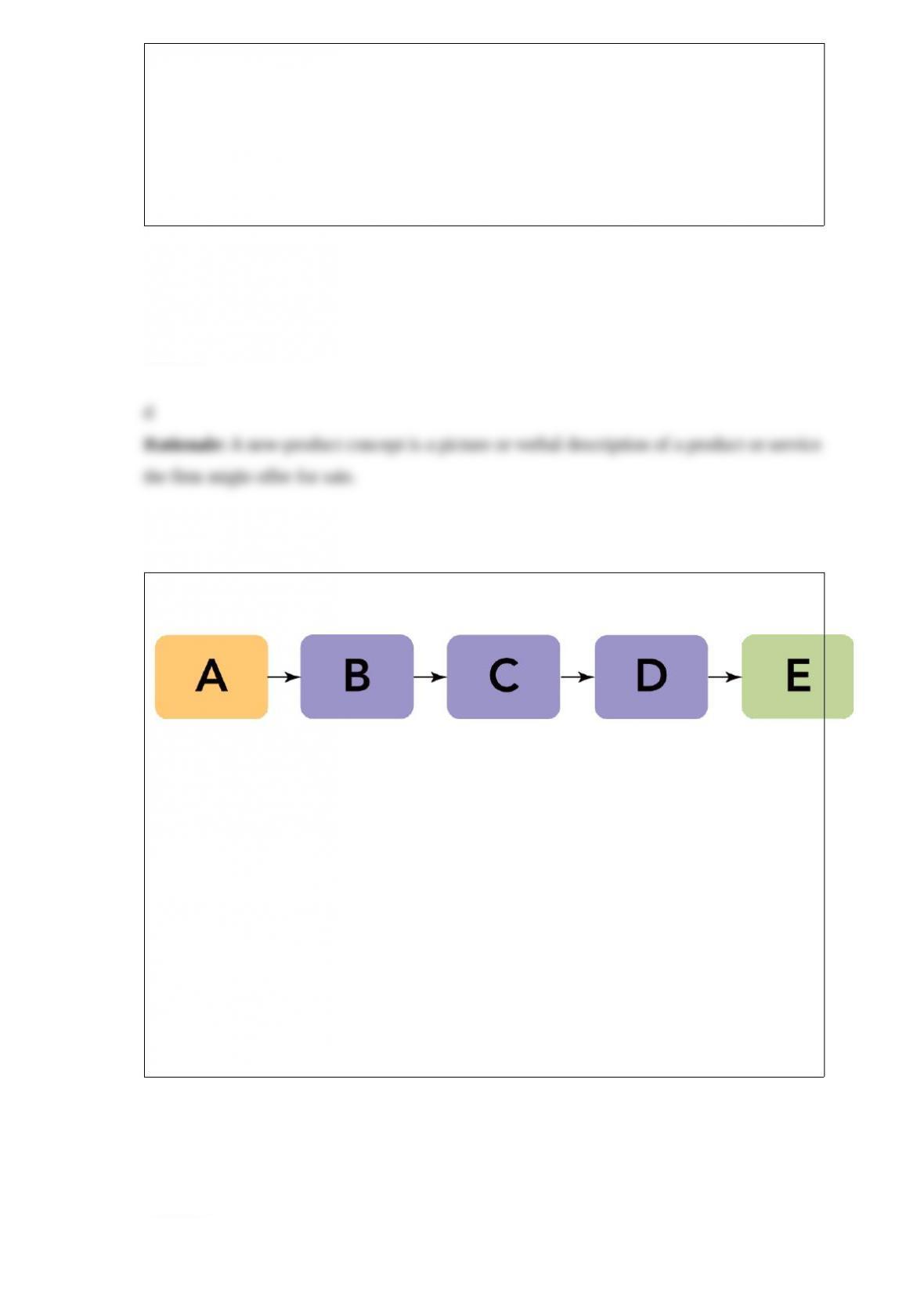
Figure 1.
Figure 1. above outlines the distribution channels through which a product
manufactured in one country must travel to reach its destination in another country. “E”
represents the
a. seller.
b. seller’s international marketing headquarters.
c. channels between nations.
d. channels within foreign nations.
e. final consumer.
Answer:

Doug Ames sells Mercedes Benz automobiles. While making his sales presentation to a
newly qualified prospect, the prospect said, “Doug, I would really like to buy the car,
but you know, the price of the automobile is just too high.” In order to answer the
prospect’s objection, Ames responded, “Sir, you are correct. The price of the Mercedes
Benz automobile is high because of what you are getting for that price.” Ames then
proceeded to describe the quality of the materials used in the car, the high resale value
of the car, the dependability, and the prestige associated with the Mercedes Benz. What
technique did Ames use to handle the prospect’s objection?
a. the postpone technique
b. the agree and neutralize technique
c. the denial technique
d. the accept the objection technique
e. the acknowledge and convert technique
Answer:

In response to Duracell’s introduction of the Duracell Ultra battery, Energizer
introduced an Advanced Formula battery. But unlike Duracell, Energizer priced its
batteries at a low initial price to attract the mass market. Was Energizer’s pricing
strategy to take market share from Duracell a success?
a. No, because consumers are price-insensitive when it comes to batteries.
b. Yes, because of the positive association with the “Energizer Bunny” marketing
campaign.
c. No, because consumers equate quality of batteries with higher prices.
d. Yes, because consumers typically respond positively to cost-plus pricing.
e. Yes, because the demand for batteries has unitary elasticity.
Answer:
In the personal selling process, a telemarketer for a life insurance firm calls and asks the
head of the household, “If you were to die tomorrow, would your family be cared for?”
This telemarketer is engaged in the __________ stage.
a. stimulus-response selling
b. closing the sale
c. prospecting
d. order taking
e. creating a preapproach
Answer:

When customers buy services, they also consider nonmonetary costs, such as the
__________ and __________ efforts required to consume the service.
a. emotional; physical
b. mental; physical
c. psychological; intellectual
d. physical; moral
e. physical; ethical
Answer:
Which of the following is NOT true about a multibranding strategy?
a. With a multibranding strategy, there is no risk that a product failure will affect other
products in the line.
b. Some large firms have found that the complexity and expense of implementing a
multibrand strategy outweigh its benefits.
c. With a multibranding strategy, each brand is unique to each market segment.
d. A multibranding strategy is used when a firm produces products and sells them under
the brand name of a wholesaler or retailer.

e. Some multibrands are introduced to confront competitors’ brands.
Answer:
A large assortment of each item in a store is referred to as
a. product span.
b. breadth of product line.
c. length of product line.
d. width of product line.
e. depth of product line.
Answer:
Although Russia now has a free economy, there are still some problems with its
financial and legal systems as well as with the notion of
a. private property.

b. product promotion.
c. paid advertising.
d. community property.
e. foreign exchange rates.
Answer:
The buying situation where users, influencers, or deciders want to change product
specifications, price, delivery schedule, or supplier is referred to as a
a. new buy.
b. straight rebuy.
c. modified rebuy.
d. buy class.
e. make-buy.
Answer:

A statement describing what is to be achieved and where and how the selling effort of
salespeople is to be deployed is known as a __________.
a. sales plan
b. salesforce framework
c. sales protocol
d. workload plan
e. sales assessment
Answer:
Computer-based networks that trigger actions by sensing changes in the real or digital
world are known as
a. global marketing platforms.
b. convergence systems.
c. intelligence technologies.
d. smart systems.
e. social networking sites.
Answer: