Product modification refers to a marketing strategy that __________.
a. alters a product’s characteristic such as its quality, performance, or appearance to
increase its value to customers and to increase sales
b. manages a product’s life cycle to increase its use among existing customers, create
new use situations, or find new customers
c. tries to find new customers and convince users who abandoned it to purchase again
d. drops the lowest producing market segment and replaces it with an entirely new one
e. combines the lowest producing market segment into others to achieve marketing
economies of scale
Answer:
Figure 1.
A variety of terms are used for marketing intermediaries. According to Figure 1. above,
“A” represents a(n) __________.

a. retailer
b. middleman
c. wholesaler
d. distributor
e. agent or broker
Answer:
The promotional objective of the introduction stage of the product life cycle is to
__________ consumers in order to increase their level of awareness of the product
offering.
a. inform
b. persuade
c. compare
d. remind
e. sway
Answer:
For services, business analysis must consider __________, which finds ways to match
the availability of the service to when it is needed.
a. capacity management
b. customer experience management
c. derived demand
d. internal marketing
e. the seven I’s of services
Answer:
If an individual wants the product, can afford to buy it, and is the decision maker, this
individual is referred to as a(n) __________.
a. activated lead
b. proactive buyer
c. lead
d. hot prospect
e. qualified prospect
Answer:
One of the eight primary MARKETING-RELATED reasons for new-product failure
is __________.
a. skipping steps in the new-product process
b. pushing a product too early into the market
c. no economical access to buyers
d. not learning from past new-product failures
e. not understanding the legal definition of newness.
Answer:
The interaction rate is
a. the total number of people who are fans of the Post divided by the total number of
people in the target demographic.

b. the number of people who “like” a Post.
c. the number of people who read a Post on a Page divided by the total number of
people seeing the Post.
d. the number of people who interact with a Post divided by the total number of people
seeing the Post.
e. the number of people who visit the product website and click on at least one link.
Answer:
A trend likely to influence the strategic marketing process in the future that incorporates
concerns for ethics, integrity, employee health and safety, and environmental safeguards
with more common corporate values such as growth, profitability, customer service,
and quality is referred to as __________.
a. stakeholder value
b. value-based planning
c. marketing ROI
d. value-driven strategies
e. value-added marketing
Answer:

The __________ equation = (Unit price Quantity sold) − Total cost.
a. total revenue
b. variable cost
c. net present value
d. profit
e. break-even point
Answer:
The demand for a business product that results from the demand for a consumer product
is referred to as
a. sequential demand.
b. selective demand.
c. primary demand.
d. secondary demand.
e. derived demand.
Answer:
Swedish company Asko, which prides itself on manufacturing and marketing some of
the best-built and most expensive appliances in the world, would probably use which
competition-oriented pricing approach?
a. customary pricing
b. above-market pricing
c. loss-leader pricing
d. at-market pricing
e. below-market pricing
Answer:
A break-even chart for comparing independent agents and a company salesforce
includes __________ and __________.
a. selling costs; sales revenues in dollars
b. sales profits; percentage of market share
c. salary compensation; commission compensation
d. calls made; sales made
e. number of independent agents; number of company salesforce personnel
Answer:
Culture refers to the set of values, ideas, and attitudes that are learned and shared
among members of a group. Culture also serves as a socializing force that dictates what
is morally right and just. The important thing to remember is that moral standards
a. are relative to particular societies.
b. must be universal in order for cross-cultural marketing to be effective.
c. are fluid and very easy to change.
d. are cyclical so it is important to change with the times.
e. are concrete; something is either right or wrong
Answer:
To encourage buyers to stock inventory earlier than their normal demand would require,
manufacturers often use
a. noncumulative discounts.
b. cumulative discounts.
c. seasonal discounts.
d. trade discounts.
e. functional discounts.
Answer:
Family Dollar Stores Photo
Tendollars.com offers thousands of gifts, all priced at $10. This is an example of two
pricing methods working in tandem. The firm is MOST LIKELY using a(n)
__________ and a(n) __________.
a. customary pricing approach; skimming pricing approach
b. odd-even pricing approach; loss-leader pricing approach
c. below-market pricing approach; one-price policy
d. penetration pricing approach; loss-leader pricing approach
e. everyday low pricing approach; flexible-price policy
Answer:
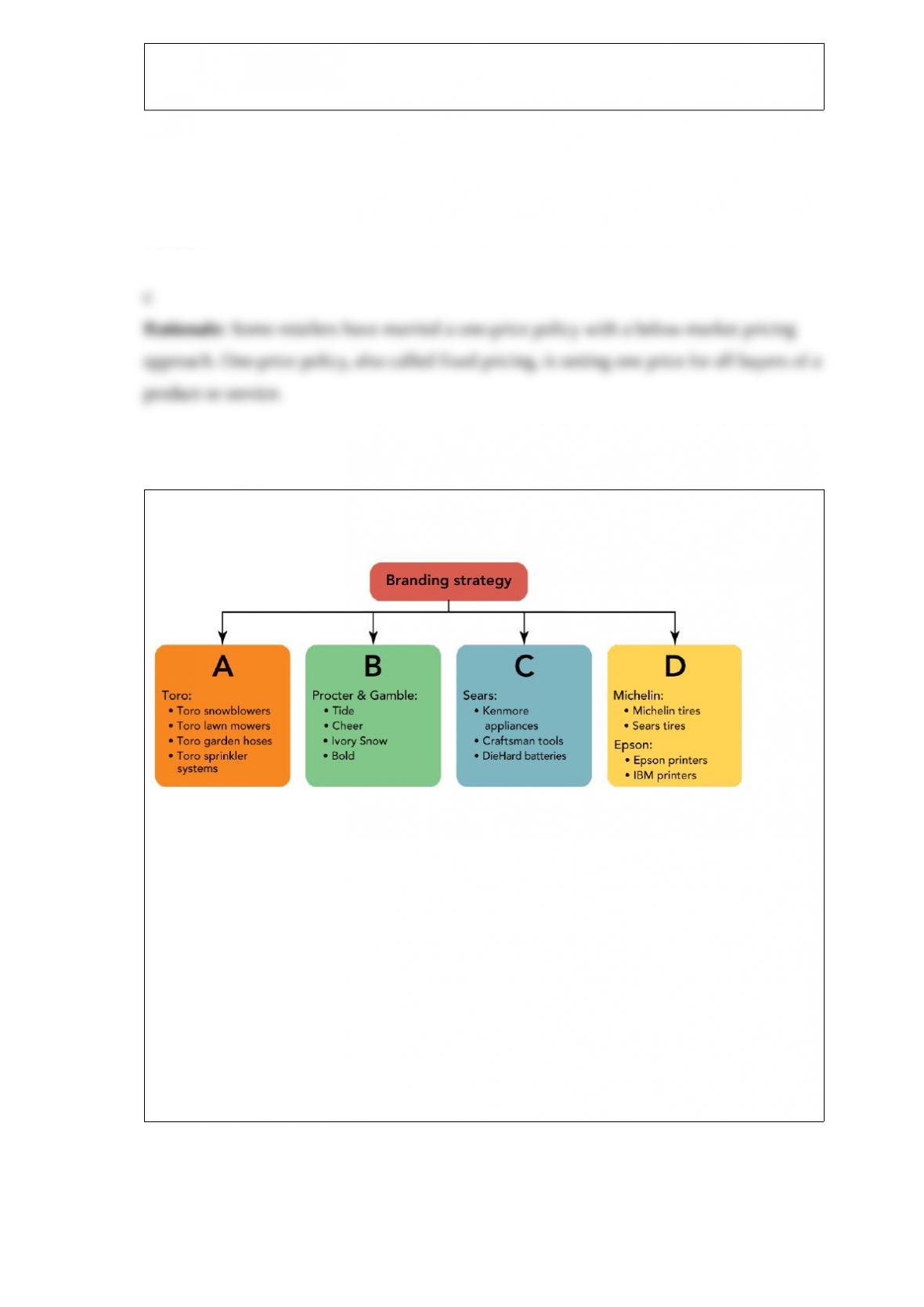
Figure 1.
Companies can employ several different branding strategies. In Figure 1. above, “C”
represents a __________ strategy.
a. retailer branding
b. multiproduct branding
c. multibranding
d. private branding
e. mixed branding
Answer:
A code of ethics is a formal statement of ethical principles and
a. legal restrictions.
b. rules of conduct.
c. cultural values
d. core values.
e. moral laws.
Answer:
A study of four supermarket chains found the average annual cost of changing prices
was $105,887, which represents 0.70 percent of revenues and an astounding
__________ percent of net margins.
a. 10.0
b. 23.6
c. 35.2
d. 38.9
e. 43.0

Answer:
Four basic business and management practices are important, according to researchers
who studied more than 200 management tools and techniques. These are: (1) strategy,
(2) execution, (3) culture, and (4) __________.
a. structure
b. charismatic leadership
c. quality
d. sustainability
e. ethics
Answer:
Thirteen- to nineteen-year-olds in Europe, North America, South America, and the
industrialized nations of Asia
a. are more similar than different regarding their purchase behavior.

b. are becoming more similar, but still differ significantly in terms of fashion and
design.
c. are rebelling against the Americanization of fashion and culture.
d. have some very different appreciation of fashions and music.
e. are more and more influenced by Asian culture than European culture.
Answer:
When Google chose a new model for its advertising, it decided to
a. show advertisements that were the exact opposite of a consumer’s profile to give the
ads a higher awareness rate.
b. randomize the time periods between ads and banners rather than use a steady
schedule in order to keep the ads more noticeable.
c. customize all advertisements to reflect customers’ preferences for color, music, and
fonts based on information obtained from cookies.
d. create a “quality score” to predict how effective an ad would be based on factors such
as click-through rates, advertiser history, and keyword performance.
e. create an “ad-option” page for consumers to create their own consumer profile
blocking out products and services they don”t want and selecting the products and
services they do.
Answer:
Amtrak, the U.S. passenger train service, purchases train cars from Siemens, a German
manufacturing company. This purchase is an example of
a. the product life cycle.
b. global organizational markets.
c. market dynamics.
d. reciprocity.
e. supplier development.
Answer:
Unfortunately, the NAICS system will not allow marketing managers to gather
information about
a. import competition in domestic markets.
b. geographic distribution of industries.
c. market share in a pure competition environment.
d. demand for goods and services.
e. data on industries that are oligopolies.
Answer:
One of the disadvantages associated with radio as an advertising medium is that it
a. has a long exposure time.
b. can target specific audiences.
c. uses humor, sound, and intimacy effectively.
d. has an unlimited amount of advertising time available.
e. is difficult to convey complex messages.
Answer:
To promote their business, some psychics advertise free tarot-card readings and other

insights into their customers’ futures on television. Unfortunately, this “free reading”
has cost some unsuspecting callers as much as $700 in phone charges. This sort of
deceptive pricing practice would be primarily monitored by the
a. Consumer Protection Agency.
b. U.S. Department of Justice.
c. Federal Trade Commission.
d. Federal Communications Commission.
e. Consumer Product Safety Commission.
Answer:
“Hypermarket” refers to
a. category killers that specialize in electronics.
b. a form of intertype competition general merchandise store.
c. shopping malls anchored by four or more department stores such as Sears or
Nordstrom’s.
d. a form of limited-service outlets focusing on general merchandise like that offered in
department stores.
e. a form of scrambled merchandising, which consists of large stores (more than
200,000 square feet) that offer everything in a single outlet, eliminating the need for
consumers to shop at more than one location.

Answer:
Which type of wholesaler carries a broad assortment of merchandise and performs all
channel functions?
a. drop shipper
b. limited-line wholesaler
c. specialty merchandise wholesaler
d. rack jobber
e. general merchandise wholesaler
Answer:
Product packaging such as the Pringles cylindrical package is one example of the
product’s __________.
a. functional benefits
b. convenience
c. communication benefits
d. technology
e. renewable resources

Answer:
Marks & Spencer is a well-known British department store located in the U.K.
Customers from Chicago or Dallas can shop for clothing as easily as a person living in
London. This shows how electronic commerce contributes to customer value through
the creation of
a. service utility.
b. place utility.
c. possession utility.
d. form utility.
e. possession and place utility.
Answer:
Purchases of sodium fluoride by Procter & Gamble for use in the manufacture of Crest
toothpaste would be an example of __________ demand.
a. applied

b. unitized
c. industrial
d. derived
e. consumer
Answer:
In the communication process, noise refers to
a. any unsolicited response from consumers or potential consumers regarding a
company’s message.
b. any communication with consumers who are not in the target audience.
c. extraneous factors that can work against effective communication by distorting a
message or the feedback received during the communication process.
d. the use of colors, words, sounds, or images that make an otherwise simple message
more complex.
e. a unique set of terms, expressions, or jargon that carries a specific meaning within a
specific field (i.e., the medical profession, legal profession, etc.).
Answer:

A pull strategy is when a manufacturer
a. advertises a great deal to its wholesalers, retailers, and ultimate consumers with the
use of nationwide advertising campaigns.
b. forces a retailer to promote its product by placing national brand ads in local
newspapers.
c. directs the promotional mix at ultimate consumers to encourage them to ask retailers
for the product.
d. directs the promotional mix toward channel members to gain their cooperation in
ordering and stocking the product.
e. directs retailers to promote one product over another to help balance fluctuations in
inventory.
Answer:
Which of the following is NOT an environmental force?
a. technological
b. ecological
c. regulatory
d. competitive
e. economic
Answer:

Explain why direct mail is an attractive form of retailing
Answer:
What are the main ways brand managers can use Twitter?
Answer:
List the five store locations or settings. How has the location of stores changed over the
years?
Answer:
How would the following environmental trends influence the success of a manufacturer
of televisions, DVD players, and related equipment: (1) growing number of older
Americans; (2) population shifts to remote suburbs and small towns; (3) increase in per
capita income and standard of living; and (4) increased use of various types of
communication technology.
Answer:
The greatest marketspace opportunity for marketers lies in its potential for creating
form utility. Explain how form utility contributes to customer value through
communication, customization, and choice.
Answer:
What are three special adjustments to list or quoted price?
Answer:
List the elements of an information technology system used to help answer marketing
questions.
Answer:
There are three types of contractual vertical marketing systems (VMS). List the systems
and provide a brief description of each.
Answer:
Explain the difference between personal selling and sales management.
Answer:
Describe a profit objective used by many Japanese firms.
Answer:
What is the difference between multiproduct branding and multibrand strategies? What
advantages are offered by each of these two approaches?
Answer:
Explain the steps in the evaluation phase of the strategic marketing process.
Answer:
Many market-oriented, older manufacturing organizations have experienced four
distinct stages in the life of their firms. Beginning with the 1860s, list and define each
of the four eras of U.S. business history.
Answer:
List the four things that research suggests will produce a motivated salesperson.
Answer:
What is a cross-functional team and how is it used?
Answer:
What are the three properties of goods and services evaluated by consumers when they
are making a purchase decision? Give an example of a product or service for each.
Answer:
A campus service organization annually raises money through the sale of T-shirts. How
could it use market segmentation to increase sales of the shirts? Be sure to include a
definition of market segmentation in your answer.
Answer:
Define derived demand and provide an example NOT included in the text.
Answer:
What are “apps,” and what significance do they have with respect to convergence?
Answer: